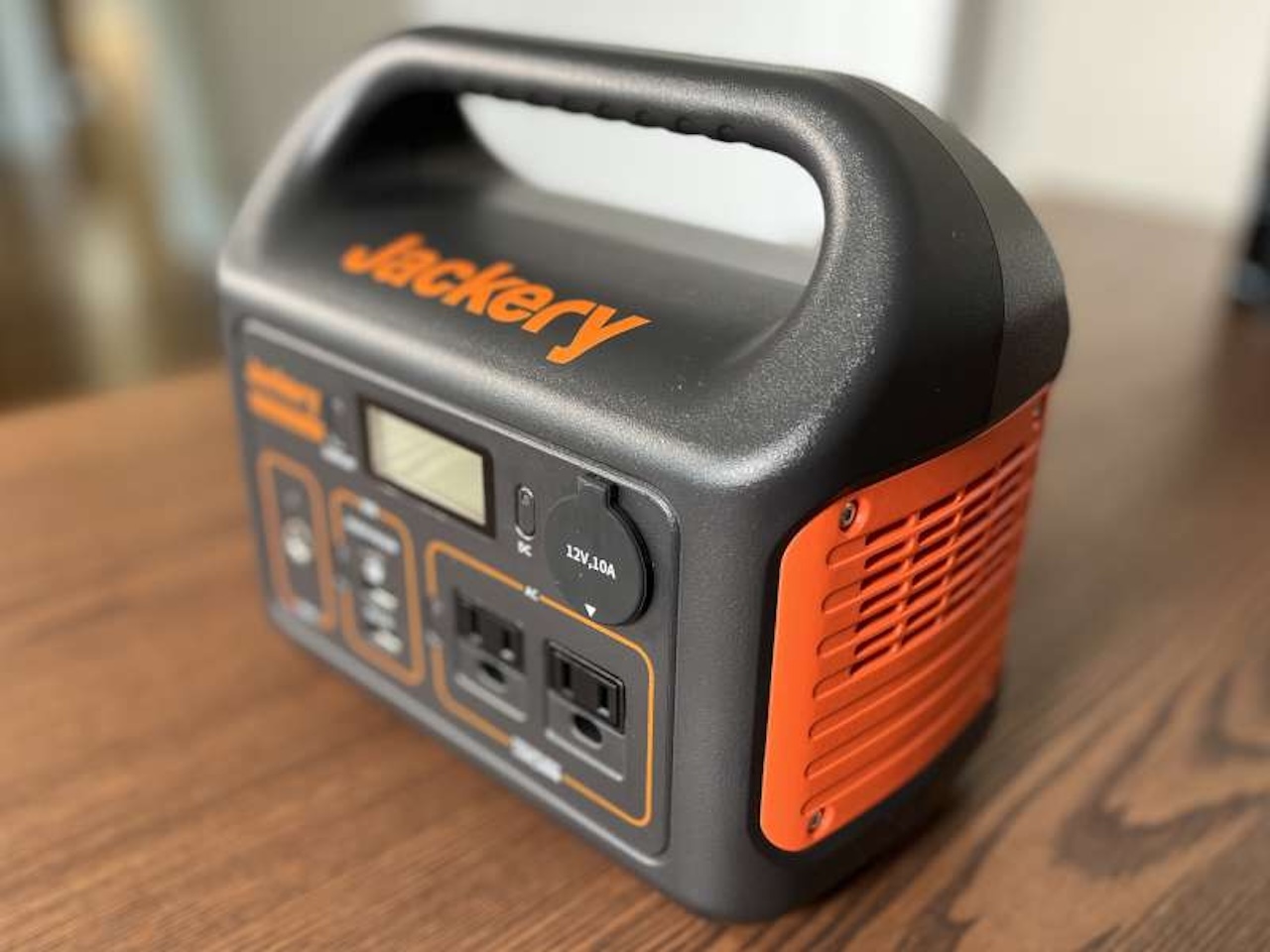
Set the Jackery Explorer 300 next to your sleeping bag, plug in a fan or a CPAP, and you’ll hear nothing all night: no engine, no exhaust, no gas-can smell. That silent, tent-friendly backup is the whole appeal of a LiFePO4 power station, and right now this tried-and-tested one is under $200. It’s genuinely tiny, too, but 292Wh only stretches so far, so here’s what it can and can’t run. We’re always on the hunt for portable power stations that actually work, and this one has been popular for years: we reviewed it back in 2021 and it’s still a clear winner.
Price: $199
Where to Buy: Amazon
The Jackery Explorer 300: silent backup power for under $200, if you size it right
The Jackery Explorer 300 has long been one of the most popular portable power stations on Amazon, and right now it’s down to $199 with an Amazon’s Choice badge and over 11,000 reviews. That’s 23% off the regular $259 price, and for a 292Wh LiFePO4 station weighing just 7.5 pounds, it’s a solid deal for anyone who camps, works remotely, or wants backup power that won’t wake the campsite or choke the garage with exhaust.
The deal isn’t really the question; the size is. Buy too small and you’re recharging every few hours, too big and you’ve overpaid for capacity you’ll never drain on a weekend. Here’s where the Explorer 300 fits, and where it doesn’t. Think of this as the single-product deep dive rather than another ranked list: if you’d rather see it measured against rivals, our sub-$500 power station guide and wider portable power station coverage do the head-to-head work.
What makes the Explorer 300 different
Most stations at this price still use older lithium-ion chemistry. Jackery switched the Explorer 300 to LiFePO4 (lithium iron phosphate), which is rated for more than 4,000 charge cycles before it fades to 70% capacity, roughly 11 years of everyday use. Most lithium-ion rivals in this bracket are spent after 500 to 800 cycles, so the chemistry swap is the difference between one summer and a decade of them.
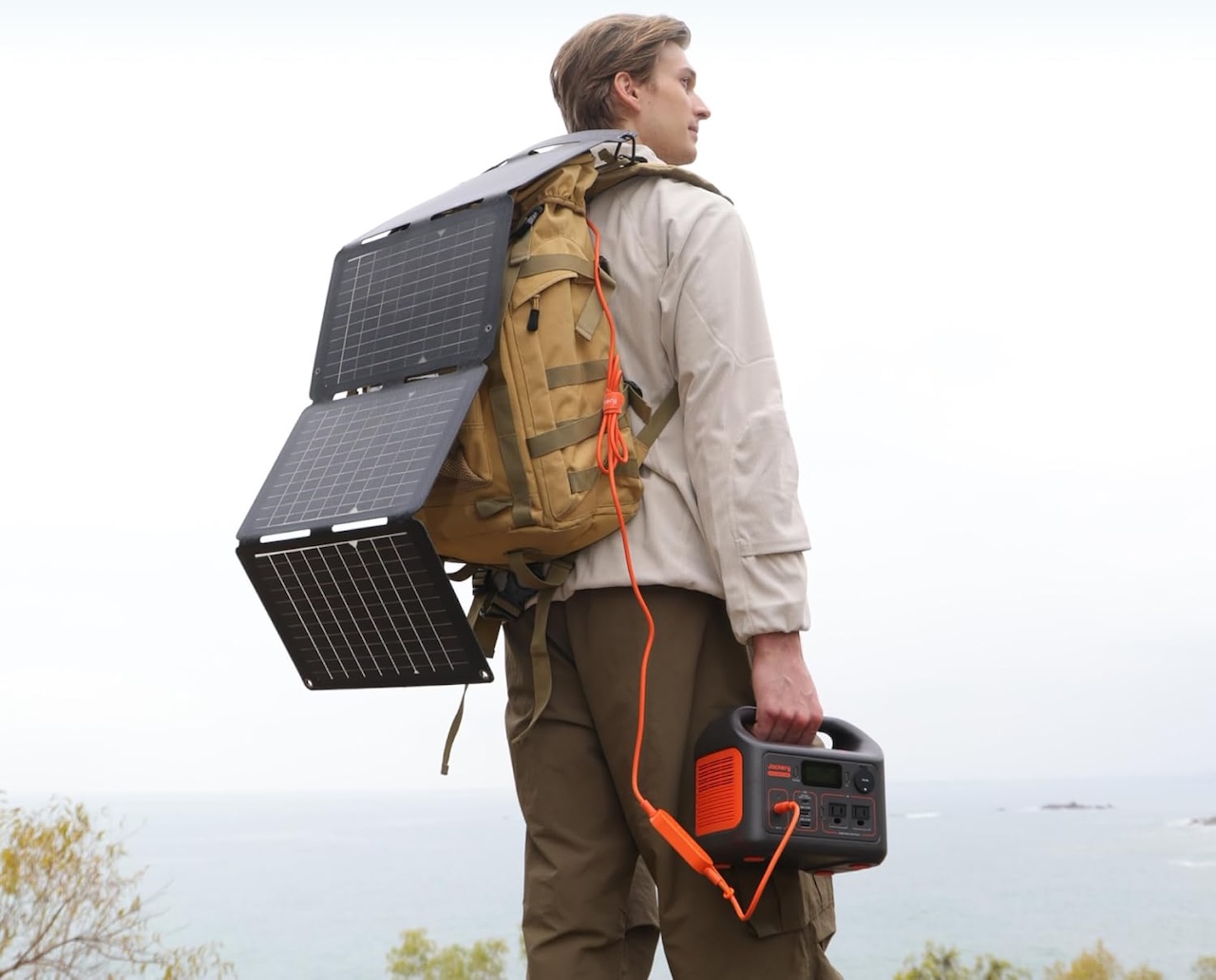
The weight is the other big deal. At 7.5 pounds with a built-in handle, it slips into a daypack, so packing it becomes an afterthought. Many 300Wh-class stations run 10 to 12 pounds, and that difference matters when you’re hiking to a campsite or hauling it from the car to the beach.
There’s also the warranty math. Jackery covers it for 2 years, extendable to 3 once you register, and with that 4,000-cycle pack behind it, the warranty will run out long before the battery does.
What it can actually power
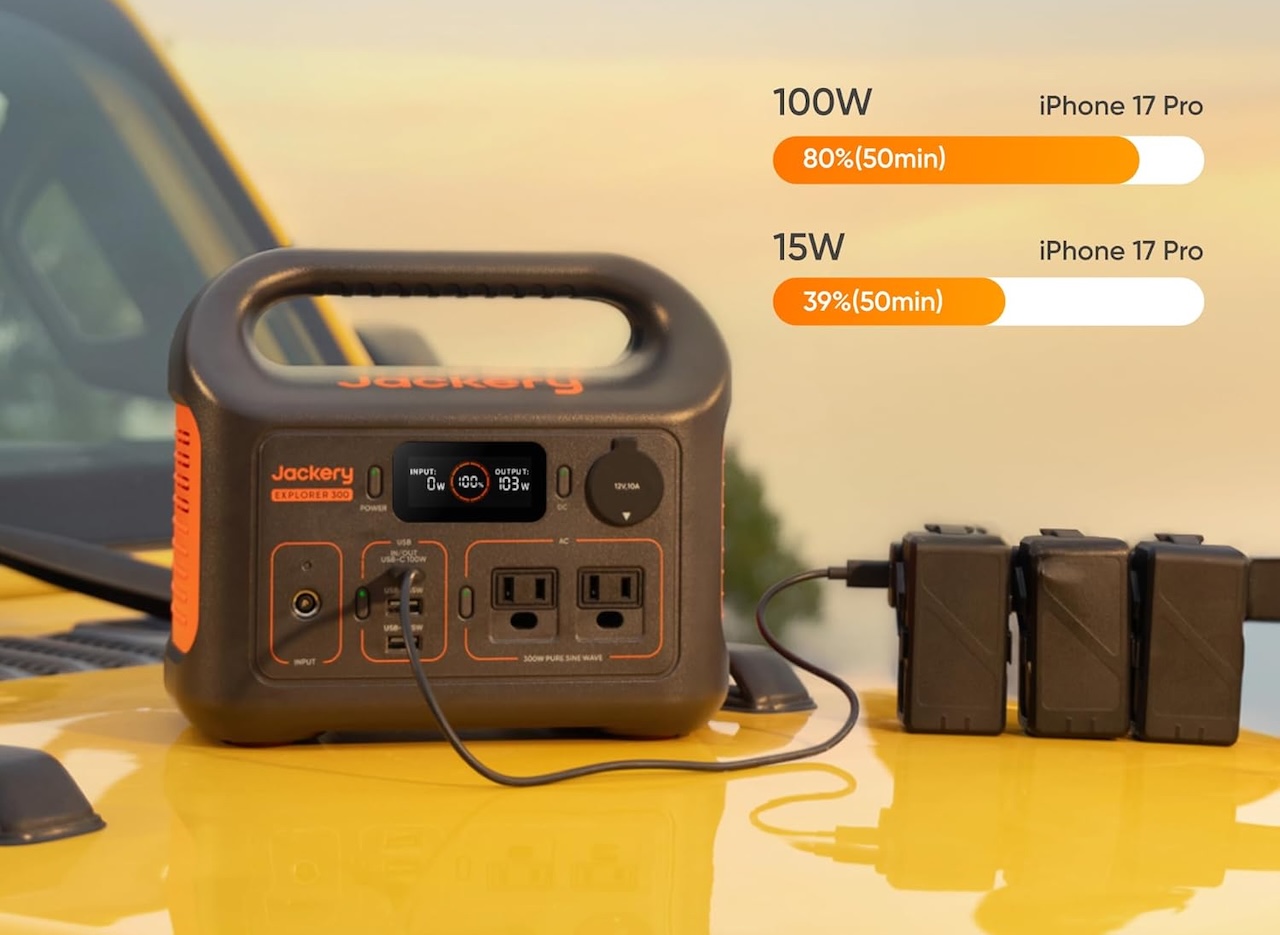
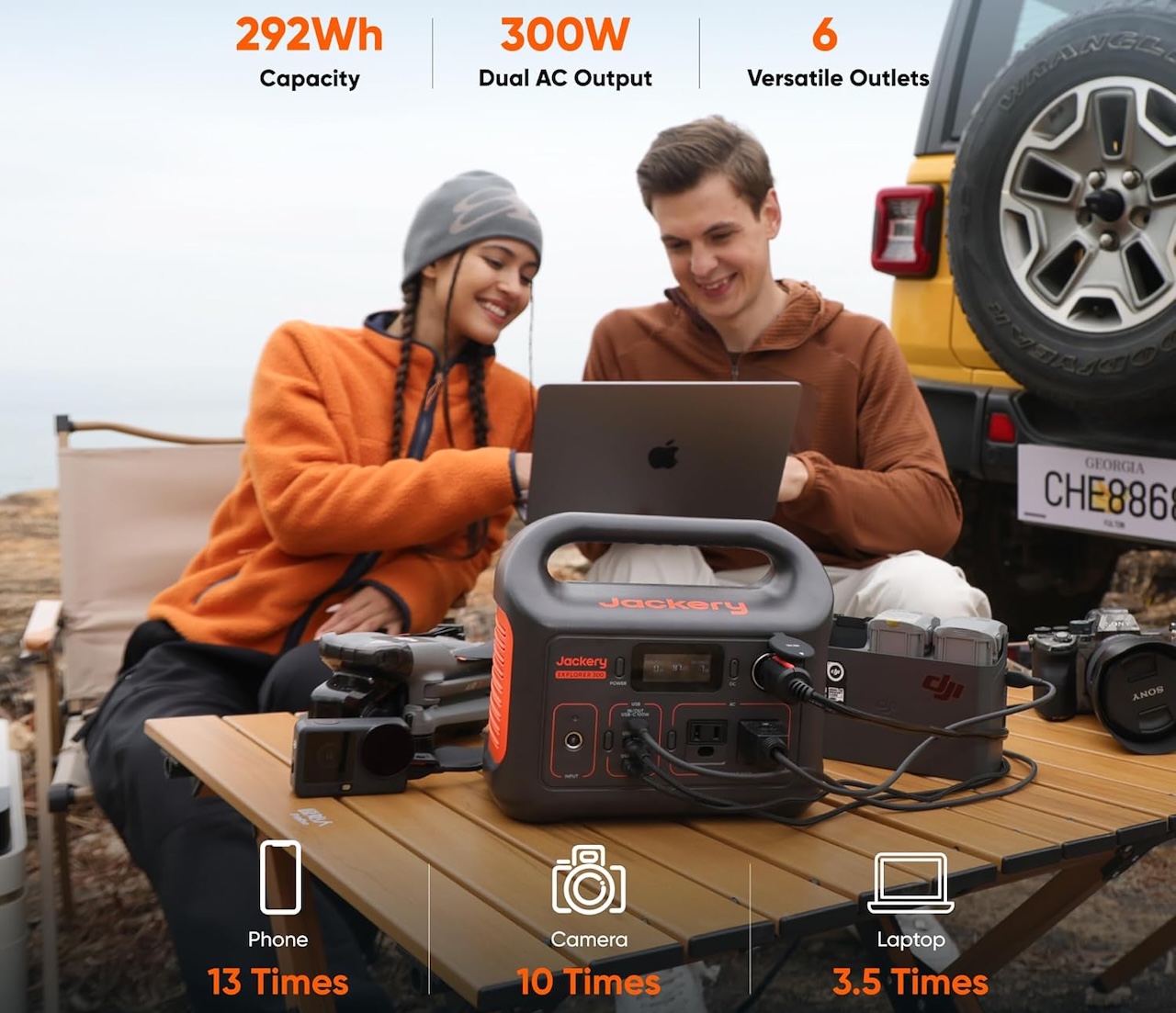
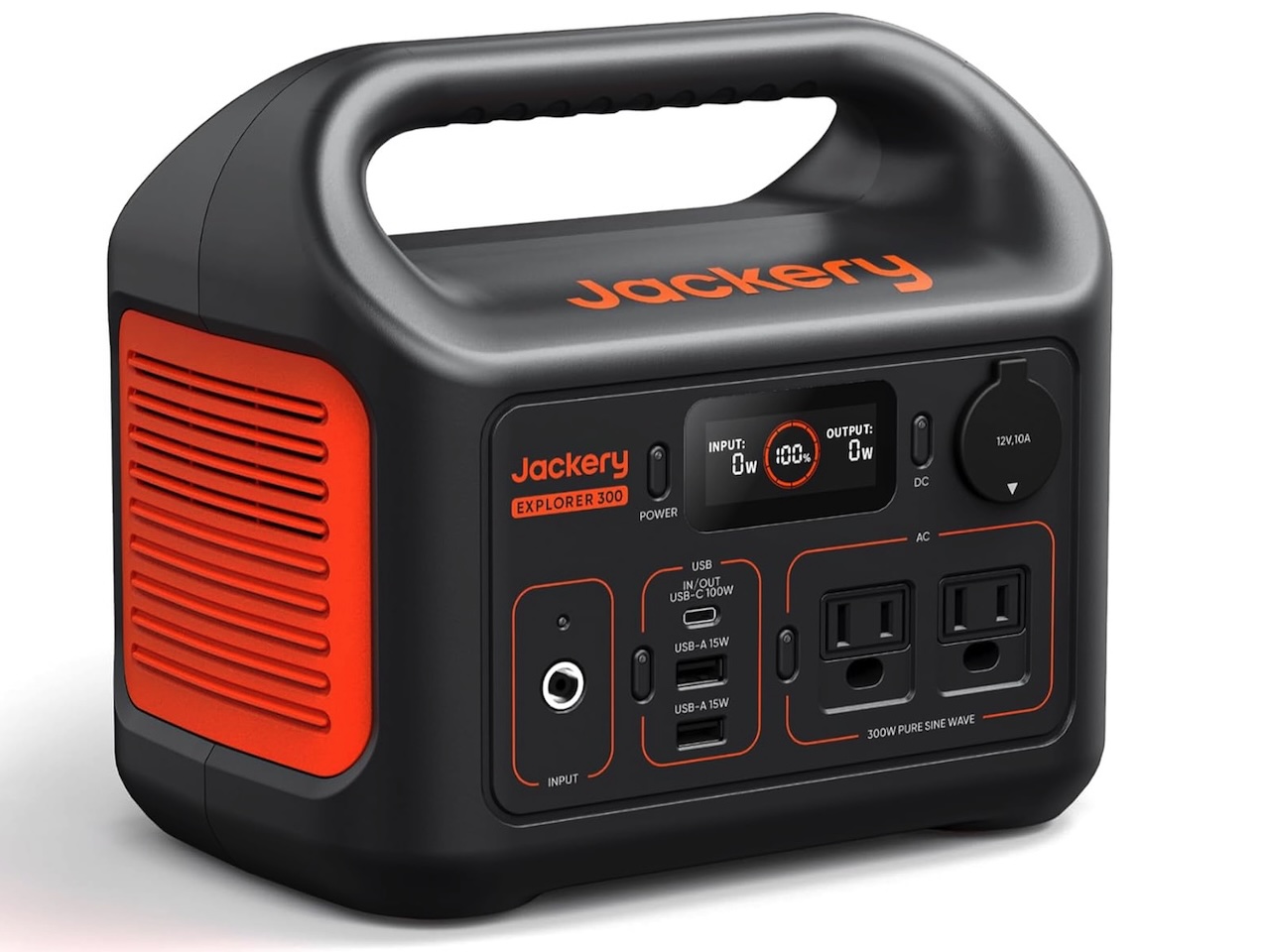
The Explorer 300 puts out 300W continuous (600W peak) through two pure sine wave AC outlets, plus a 100W USB-C PD port and two USB-A ports. That pure sine wave is what lets sensitive electronics like CPAP machines and camera batteries charge safely.
In practice, 292Wh means real numbers: a laptop charges 3 to 4 times, a phone tops up more than 20 times, and a CPAP runs a full 8-hour night with room to spare. Run a small fan or LED lights and you’re counting runtime in days, not hours.
What it won’t do is run high-draw appliances like a full-size refrigerator, coffee maker, or space heater. Those need 1,000W or more, and Jackery’s larger Explorer 1000 v2 is built for that class of load.
Picture it as a rechargeable outlet you can toss in a bag, not a stand-in for a generator. Being honest about that ceiling is what keeps you from buying the wrong size.
Three ways to recharge
The Explorer 300 refills three ways: a wall outlet reaches 80% in about 2 hours via the 100W USB-C input, a 12V car port takes roughly 4 hours, and a 100W solar panel hits 80% in about 2.8 hours. It also supports pass-through charging, and the front LCD shows input, output, battery percentage, and estimated runtime, with simple onboard buttons instead of an app.

What you give up with the Explorer 300
The Explorer 300 isn’t for everyone. If you need to power a full-size refrigerator, run power tools, or carry a home theater through a multi-day outage, its 300W ceiling and 292Wh capacity will frustrate you, since high-draw devices drain it fast.
There are smaller compromises, too. It has no built-in light like some budget rivals, and while the LCD is clear, it’s basic next to app-connected models that log usage history.
So who should skip it? Anyone after whole-home backup or long RV boondocking should size up to a 1,000Wh-class unit like the Explorer 1000 v2. And if you only top off a phone and earbuds, a good power bank is lighter and far cheaper.
Who it’s built for: campers, remote workers, van-lifers, and anyone who wants silent power to run inside a tent, exhaust-free, on trips of a day or two. That’s the sweet spot this capacity was built around.
Price: $199
Where to Buy: Amazon
For what it’s designed to do, it does it well. At $199 with Amazon’s Choice status, 11,000+ reviews averaging 4.6 stars, and a battery you won’t be replacing anytime soon, the Explorer 300 is an easy, low-risk pick, as long as you buy it for its actual size. With 23% off, now’s a good time to grab one.