Huawei just put its own AI glasses on a stage. At an event in China on April 20, the company unveiled the Huawei AI Glasses, the first HarmonyOS eye wearable with an AI-powered camera and a built-in real-time translation tool, pitching them squarely at the category that Meta’s Ray-Ban and Oakley collabs have been dominating in the West.
Price: ¥2,499 (About US$365)
Where to Buy: Huawei
The launch is notable for two reasons. First, it’s Huawei’s clearest move into camera-equipped AI eyewear; earlier Huawei smart glasses in the Eyewear line were audio-first. Second, Huawei is leading with the pair of features most likely to actually get worn every day: a first-person camera for capture and streaming, and on-the-fly translation.
Three designs, a titanium hinge, and 35.5g frames
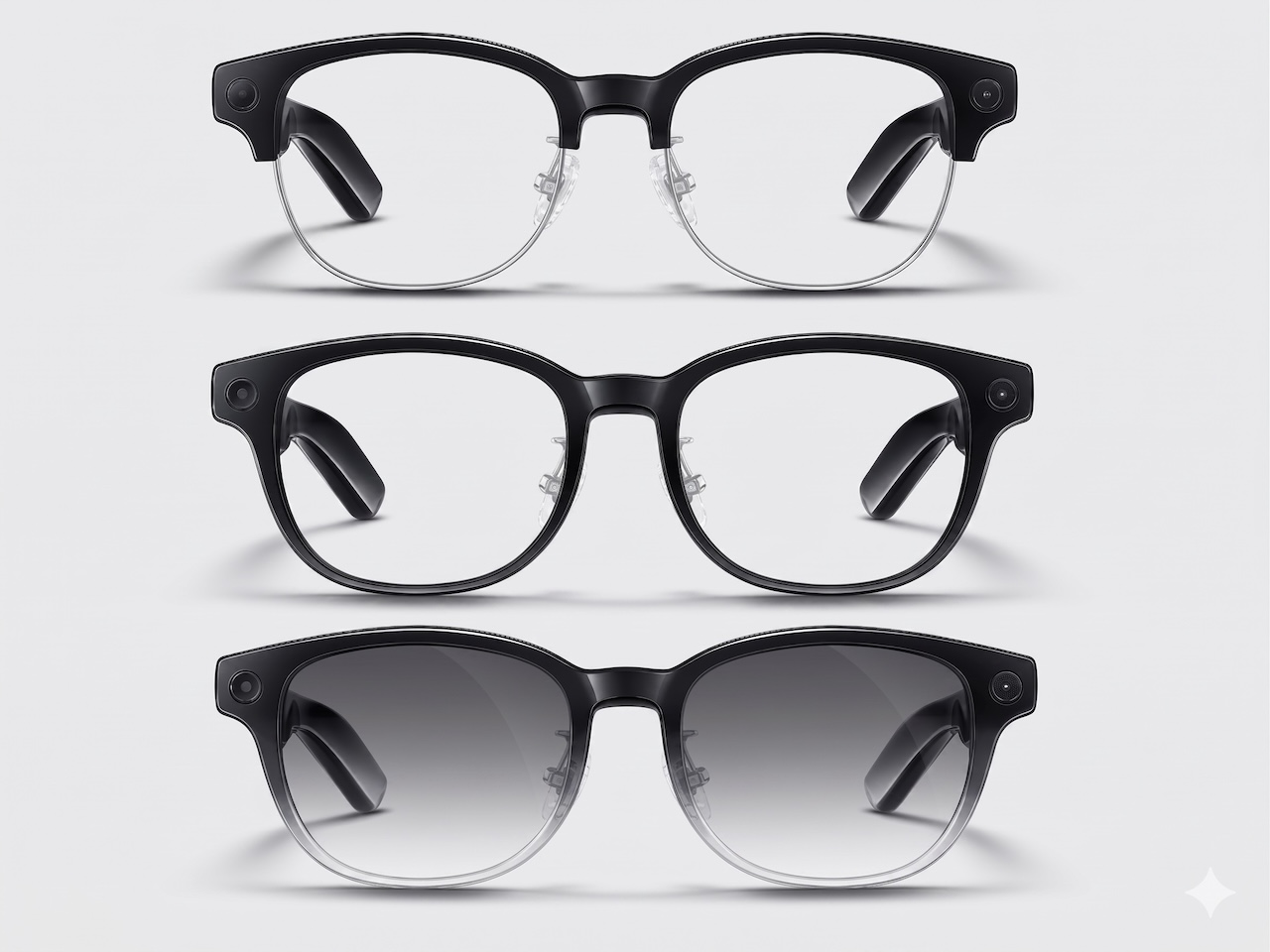
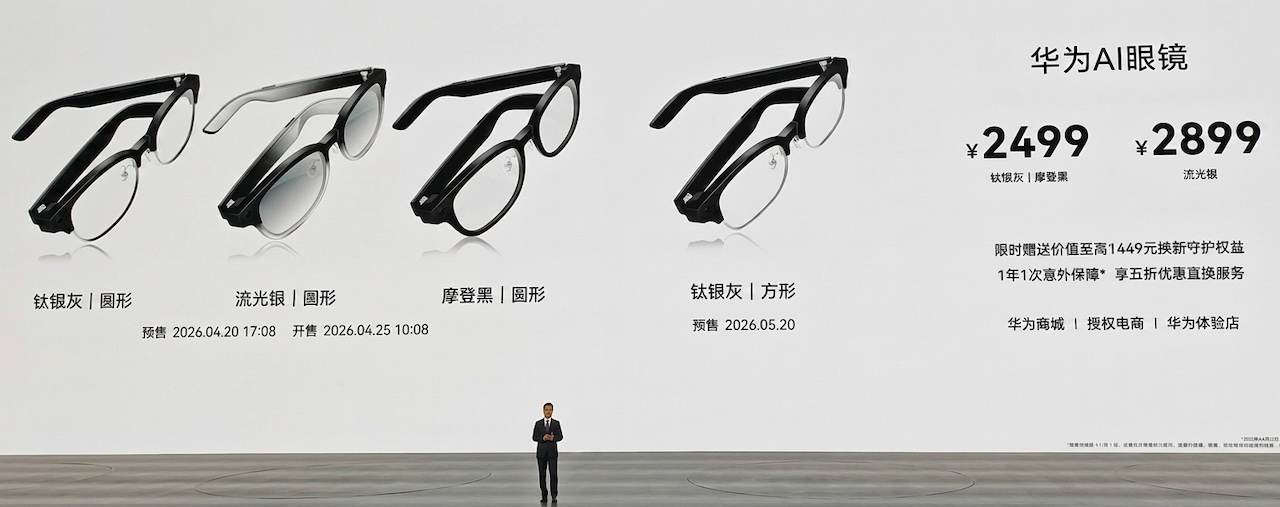
Huawei is launching the AI Glasses in three variants so they read less like a gadget and more like eyewear. The Titanium Silver Gray is a semi-rimless, half-rim optical frame; the Modern Black is a full-rim optical frame; and the Shimmering Silver is a classic full-rim sunglasses style.
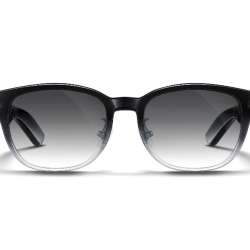
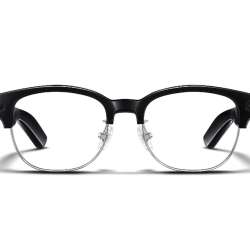
All three come in round and square frame shapes. Huawei says the temples measure 6.25mm thin and the frames weigh 35.5 grams, thanks to what it calls “lightweight parts + precision stacking technology.” The hinge is a titanium-alloy “golden triangle” with constant force, which Huawei claims delivers a 21% improvement over conventional glasses.
He Gang, CEO of Huawei Consumer Business, walked out wearing the glasses at the launch, the company’s way of signaling that these are meant to be worn all day, not just for tech demos.
A real camera on your face, not just a mic array
This is the part that separates the AI Glasses from Huawei’s earlier audio-only eyewear. The glasses carry a 1/2.8-inch image sensor paired with an AI-powered RAW-domain multi-frame fusion algorithm. Huawei says the system handles composition and smart correction while capturing first-person stills, video, and live streams.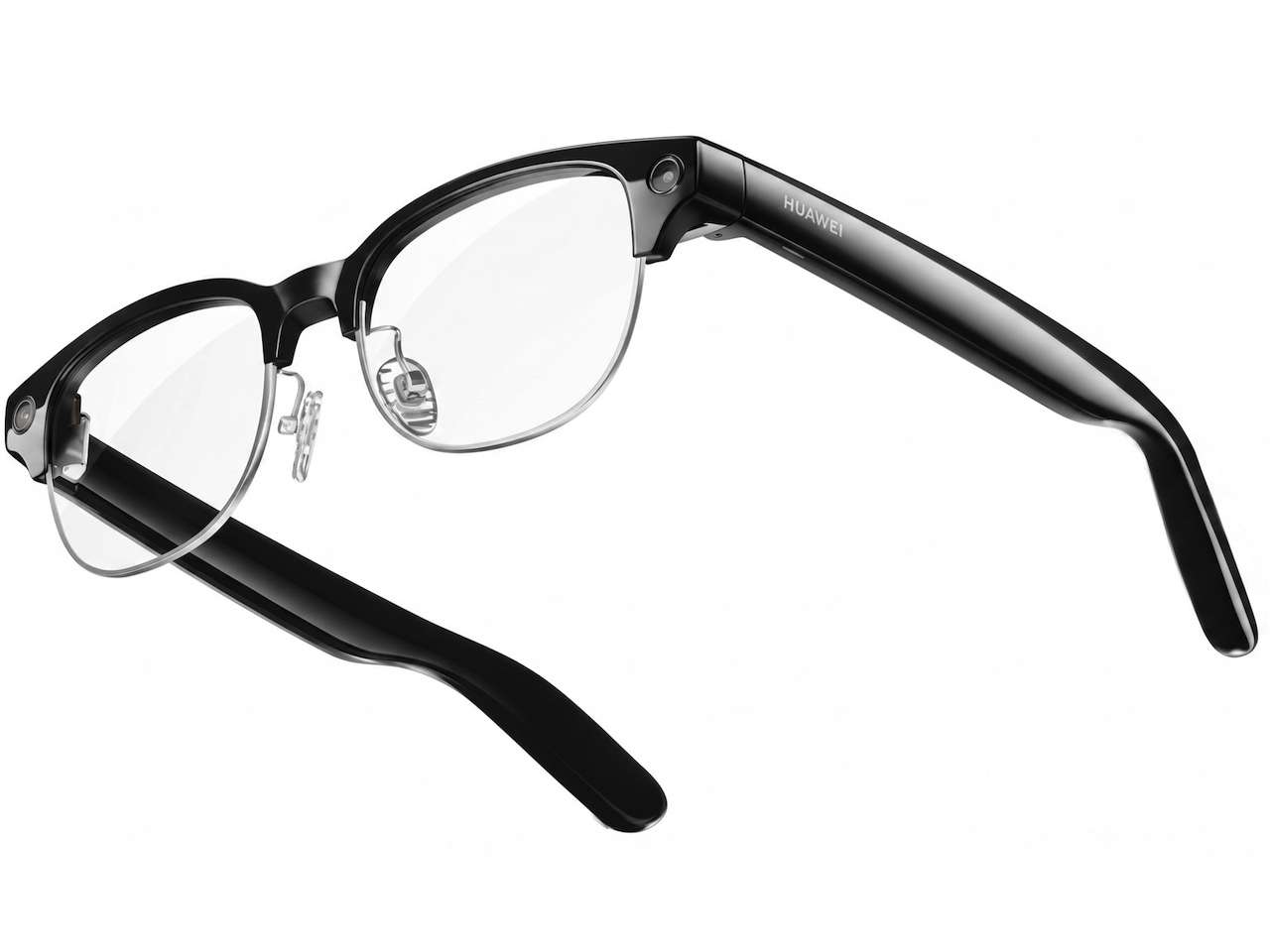
In practice, that means the glasses can shoot POV photos, record video, and push a live first-person feed, the same use case Meta has been leaning on with Ray-Ban Meta and the newer Oakley Meta Vanguard.
HarmonyOS, a self-made chip, and on-device AI
The AI Glasses run HarmonyOS and are powered by a Huawei-designed chip built specifically for eyewear, with what Huawei describes as a dual-engine AI architecture. Huawei says the in-house silicon speeds up response time and enables more instant, on-device answers.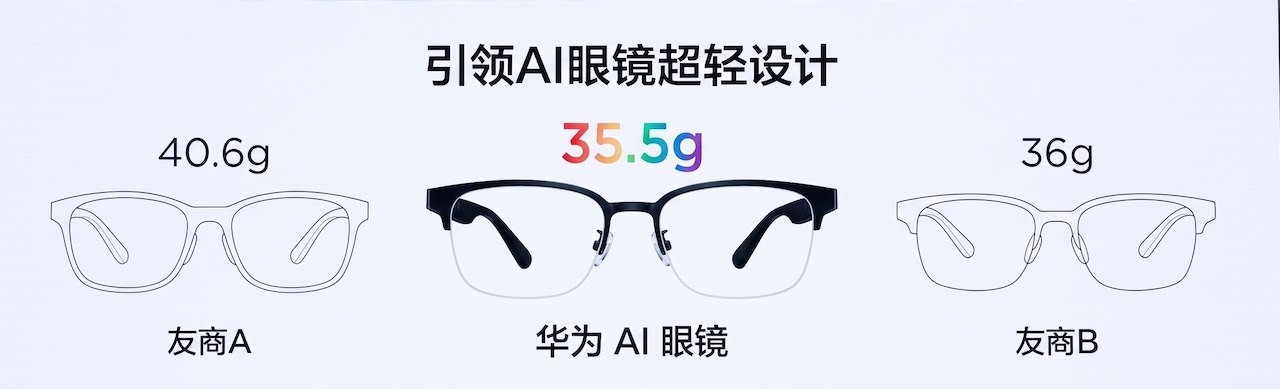
The on-device AI assistant is Celia, and it can be triggered by voice wake-up or a dedicated one-tap shortcut. Huawei says Celia can work in noisy environments and still pick up voice input as low as 47dB, useful if you’re the kind of person who mutters prompts on a crowded train platform.
At launch, the AI Glasses lead with built-in real-time translation across multiple languages and first-person image and video capture with live streaming, backed by a set of multimodal AI functions that covers food calorie estimation and tracking as well as payments via QR scan tied to Huawei’s payment stack. A companion app rounds things out with smartwatch connectivity, automatic import, quick pairing, and smart broadcasting across Huawei’s HarmonyOS ecosystem.
 Battery life Huawei actually wants you to compare
Battery is where Huawei is being unusually specific. The AI Glasses are rated for 12 hours of continuous use, 8 hours of voice calls, and 9 hours of continuous music playback. That’s meaningfully longer than the numbers most camera-equipped smart glasses have been quoting, and it’s clearly the spec Huawei wants picked up in headlines.
Price and availability
The Huawei AI Glasses are already in pre-sale in China through Huawei’s consumer site, and official sale opens April 25 at 10:08 local time. The Titanium Silver Gray and Modern Black variants are priced at ¥2,499 (US $365), while the Shimmering Silver sunglasses run ¥2,899 (US $420). Huawei has not announced global availability, which is consistent with how its HarmonyOS-first products have been rolling out lately.
Price: ¥2,499 (About US$365)
Where to Buy: Huawei
How Huawei AI Glasses stack up
Huawei is walking into a category that is suddenly very crowded. Meta’s Ray-Ban and the more sport-leaning Oakley Meta Vanguard have made camera-equipped smart glasses mainstream in the US and Europe, while the VIZO V1 has been one of the more interesting AR/AI glasses plays we’ve covered recently.
Huawei’s pitch is subtly different: prescription-ready optical frames, a self-made chip, HarmonyOS integration, and translation positioned as a core, day-one feature rather than an afterthought. For anyone tracking where AI glasses go next, the Huawei AI Glasses are the clearest sign yet that 2026 is the year the category stops being a novelty.