For most of computing history, the deal with a personal computer stayed the same. You learned where the buttons lived, you clicked them in the right order, and the machine waited for your next move. Faster chips and brighter screens changed how quickly that dance happened, never the dance itself. The computer sat still until you told it precisely what to do. That arrangement has felt so permanent for so long that most of us stopped seeing it as a choice at all.
AI was supposed to upend this, and for two years it mostly didn’t. The chatbots lived in a browser tab, useful in short bursts, walled off from your files and your apps. They could describe the work in great detail, then hand it right back for you to do yourself.
At its GTC Taipei keynote during COMPUTEX 2026, NVIDIA founder and CEO Jensen Huang argued that the wall is finally coming down. His pitch is a Windows PC that runs capable AI agents directly on the machine, with the access and the muscle to finish tasks instead of narrating them. NVIDIA calls the platform RTX Spark, and it frames the idea in four words: tool to teammate. “The PC is being reinvented,” Huang said on stage. The hardware behind the slogan is real, the partner list is enormous, and the first machines ship this fall. Whether the daily experience earns the slogan is the part worth slowing down for.
Announcements: NVIDIA + Microsoft Windows PCs · Windows Experience Blog · COMPUTEX 2026 roundup · DGX Station for Windows
Events: GTC Taipei keynote · GTC Taipei hub
Why this is happening now
Two forces converged to make this more than a keynote flourish. Open-source agent projects like OpenClaw and Hermes Agent have started posting record numbers on developer hubs such as GitHub and OpenRouter, which means the software side of personal agents finally has momentum behind it. The hardware side, meanwhile, reached a point where a laptop chip can hold a large model in memory and run it at usable speed. Put those together and the case for keeping AI on your own machine, rather than renting it from a data center by the token, stops sounding theoretical.
What RTX Spark actually is
Strip away the teammate language and RTX Spark is a new class of Windows machine built around a single chip NVIDIA calls a superchip. The company bills it as the world’s first Windows PC purpose-built for personal agents, designed to cover three jobs that used to demand separate hardware: local AI, creative work, and gaming. The platform spans slim laptops with all-day battery life and small, power-sipping desktops. NVIDIA says it folds in roughly 30 years of its own technology, from CUDA and RTX to DLSS, FP4, TensorRT, OptiX, Reflex, and G-SYNC. That reads like a greatest-hits compilation, and the reason for stacking it is range. One machine is meant to path-trace a game at night and run an AI workload all day.
Huang put the shift in plain terms. “For forty years, you launched apps. Click. Type,” he said, before adding that with RTX Spark and Windows, “you ask, and the PC does the work.” He closed the thought with a line the company clearly wants repeated: “This is the new PC. The personal AI computer.” Behind the showmanship sits a specific wager, that asking will replace clicking as the main way people drive a computer.
Inside the superchip
The RTX Spark superchip pairs an NVIDIA Blackwell RTX GPU with 6,144 CUDA cores and fifth-generation Tensor Cores that run FP4 precision. That GPU connects to a 20-core NVIDIA Grace CPU over NVLink-C2C, a chip-to-chip link that lets the two halves share data without the usual traffic jam between processor and graphics. NVIDIA built the custom CPU with MediaTek, a leader in Arm-based system-on-a-chip design, and credits that work for the power efficiency. Efficiency is the quiet headline. A chip that sips power is what makes a slim, all-day laptop possible, and it’s the difference between an agent you leave running and one you switch off to save your charge. Battery life and a round-the-clock assistant usually pull against each other, and the whole pitch depends on closing that gap.
Two numbers carry the AI story: up to 1 petaflop of AI compute and up to 128GB of unified memory. The compute figure is the speed, and the memory figure is the ceiling. Running a capable model on-device is mostly a memory problem, because the model and its working context have to fit somewhere fast, and 128GB gives a local agent far more room to think than the 16GB or 32GB most consumer laptops carry today.
NVIDIA put concrete workloads against those numbers, and they’re worth reading with the company’s name attached, since none of this has been independently tested yet. The platform is supposed to run a 120-billion-parameter language model with up to 1 million tokens of context locally, a model size and memory window that belonged to data centers a year ago. On the creative side, NVIDIA cites rendering 90GB 3D scenes with OptiX and DLSS, editing 12K 4:2:2 video through the Blackwell decoder, and generating 4K AI video. For gamers, the claim is AAA play at 1440p and over 100 frames per second with ray tracing, DLSS, and Reflex switched on. If those hold up in review units, the spread is unusual for one thin laptop.
A tradeoff hides inside that 128GB number. Unified memory is shared across the GPU, the CPU, and the agent, so it’s a single budget three workloads draw from at once, and a large model running next to a heavy render can make it tight in a hurry. Generous isn’t the same as infinite.
The real question isn’t speed
Here’s where the story turns. Raw capability has rarely been NVIDIA’s problem, and a fast chip in a gorgeous chassis is the company’s home turf. The harder question is whether an agent living on your laptop becomes something you reach for daily, or a toggle you flip once and forget, the way most people treated voice assistants. Power is the easy part, and trust plus everyday usefulness are where this either becomes a new way to compute or an expensive demo.
Why Microsoft is in the room
An agent that can read your files, move through your apps, and act on your behalf is only as welcome as it is contained. That’s the piece NVIDIA can’t solve alone, so it brought in Microsoft. The two companies are building a native Windows layer for on-device agents, starting with new operating-system security primitives that deliver identity, containment, policy, and end-to-end protection. On top of that sits NVIDIA’s OpenShell runtime, meant to give agents a controlled place to run under full user control. The framing throughout is restraint, not autonomy for its own sake.
OpenShell is where the privacy story gets specific. It lets you define what an agent can and cannot do, routes queries to a local model when your rules call for it, and can disguise personal details in anything sent to a cloud model. Once those guardrails are set, the apps from Hermes Agent and OpenClaw can execute tasks inside Windows applications, reason through cross-app workflows, generate images and video, write plug-ins and apps, and search your local files by meaning rather than filename. NVIDIA and Microsoft say these experiences will eventually live right in the Windows taskbar, which is the detail that signals how mainstream they want this to feel.
The executives sell the ambition in tidy lines. Microsoft CEO Satya Nadella framed the goal as “unmetered intelligence to every home and every desk with Windows” and called RTX Spark “a real breakthrough” toward it, while Nous Research CEO Dillon Rolnick claimed buyers will feel like they bought “a full-fledged assistant, not a typical laptop.” Read past the polish and the strategy is clear, which is to keep the agent era anchored to Windows rather than the browser or the phone. Whether the security model holds outside a controlled demo is the question reviewers will need to push hard on, because a teammate with access to everything is also a liability with access to everything. Microsoft says it’ll detail the developer side at its Build conference on June 2 and 3, so the proof, or the gaps, should surface fast.
The agent ecosystem is the real tell
The reason to take this seriously isn’t the hardware spec sheet, it’s who showed up to build on it. Personal agents have lived mostly in developer circles, and the two projects NVIDIA keeps naming, OpenClaw and Hermes Agent, are the ones posting record traffic on GitHub and OpenRouter right now. Both are shipping Windows apps built on the new security layer. When the loudest open-source projects in a category commit to your platform on day one, that’s a stronger signal than any benchmark.
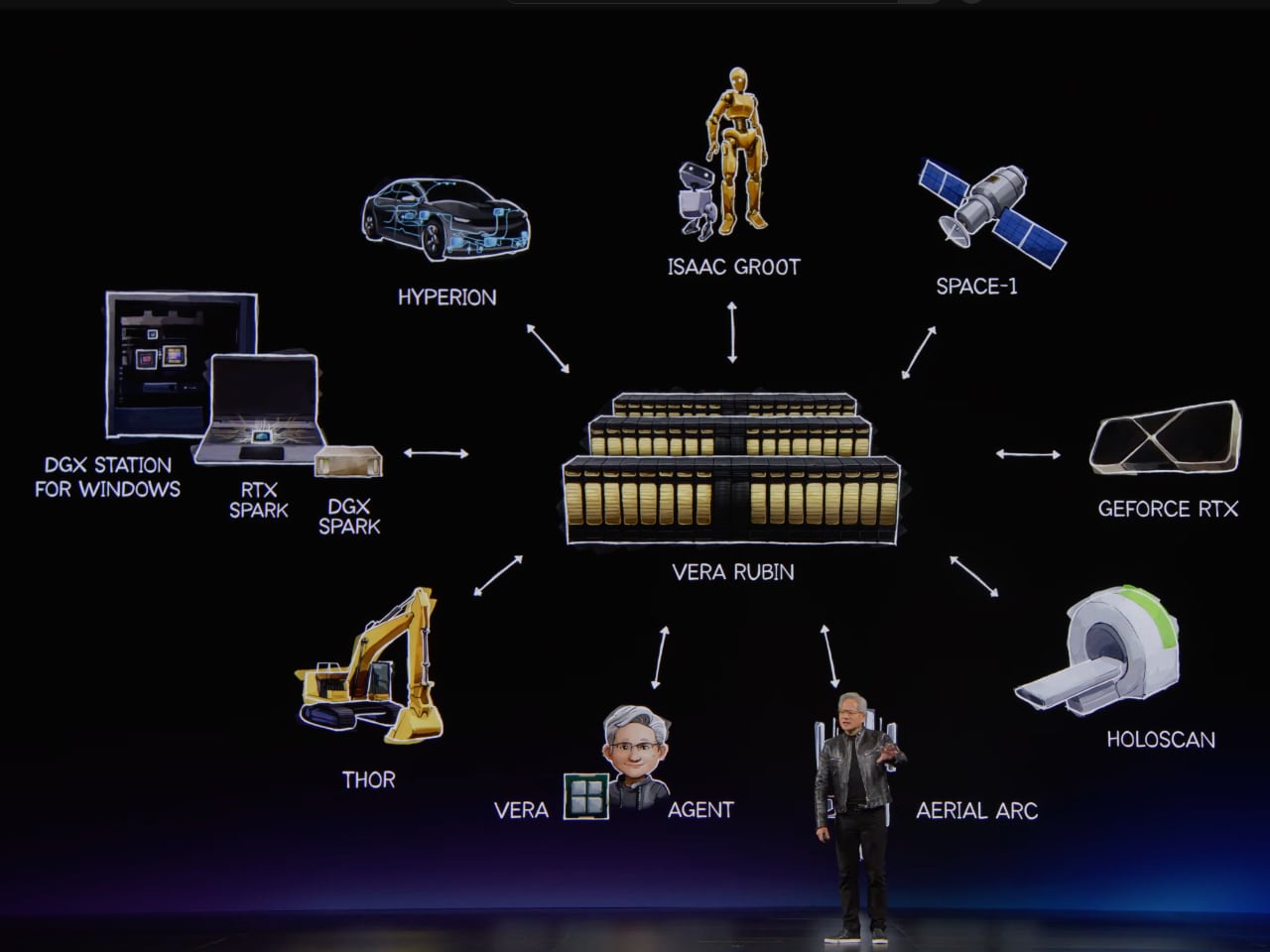
The tooling crowd is louder still. Georgi Gerganov, who created the widely used llama.cpp runtime, said RTX Spark “multiplies the amount of context processing” by putting it in a portable chassis, and his point about context matters more than it sounds, because a bigger context window is what lets a local model remember a whole project instead of a single prompt. OpenClaw Foundation architect Vincent Koc backed the security approach, and Rolnick’s Nous Research is building Hermes around it. None of that proves the agents are good yet. It does show the people who actually write this software think the on-device approach is ready for real users, which is a shift from a year ago.
What it means for creators
The AI headlines will travel furthest, and the creative story might matter more day to day. NVIDIA is rebuilding the parts of the experience creators touch most, starting with Adobe. The company is rearchitecting Photoshop and Premiere from the ground up for RTX Spark, with both firms citing up to 2x faster AI, editing, coloring, and effects. Adobe CEO Shantanu Narayen said the partnership is about “AI-native creative experiences” that respond at the pace people work. The interesting part isn’t the slogan, it’s the plumbing underneath.
Premiere gets a new video pipeline that taps the unified memory, the Blackwell GPU, and TensorRT for real-time editing and color correction on complex timelines. Color work that used to stutter on a thin laptop is supposed to scrub in real time. Photoshop’s next-generation engine moves to GPU-accelerated compositing, with live filters, high dynamic range, and more natural brushing, and Firefly-powered Generative Fill and Generative Extend ride along inside both apps. Substance 3D Painter and Stager will run natively for 3D texturing and scene work. Adobe also plans to let you drive Premiere and Photoshop through Windows agents, so the teammate idea reaches into the timeline and the canvas. These updates are slated to roll out alongside the hardware this fall.
The rest of the creative field showed up as well. Blackmagic Design CEO Grant Petty pointed to lightweight, long-battery laptops helping on-the-go production, OTOY is bringing Octane with Render Network support to the platform, and ComfyUI cofounder Yannik Marek said the mix of compute and large unified memory could make it one of the best laptops for running diffusion models. With more than 100 Windows software makers signed on, including Blender and CapCut, the appeal for someone who shoots, edits, renders, and generates on one machine is breadth rather than any single number. The caution worth keeping is that every speed figure here comes from a vendor, not a reviewer with a stopwatch.
What it means for gamers
For gamers, the headline is that nothing important got left out. Gaming gets the full RTX stack rather than a watered-down mobile version, which is the detail that separates this from a typical thin-and-light. NVIDIA points to AAA play at 1440p and over 100 frames per second with ray tracing, DLSS, and Reflex, plus the new DLSS 4.5 Ray Reconstruction with a second-generation transformer model headed to Blender 5.3 and dozens of games. RTX Video with 4x Frame Generation is coming to ComfyUI, and RTX technology now reaches more than 1,000 games and apps. That last number is the one that makes the platform feel less like a gamble.
The studios showed up to match the hardware. Microsoft is expanding XBOX onto RTX Spark devices, with XBOX’s Jason Ronald framing it as making it easier for players to discover and play on PC. NetEase is bringing titles like NARAKA: BLADEPOINT to ultrathin laptops, and Remedy plans to put its games on the new machines. KRAFTON and Riot Games round out the early list. A flagship-class GPU in a 14-millimeter body has always run into heat and power limits, so the real question is sustained performance, not peak frames. Reviewers will want to see what happens after 30 minutes of load, not 30 seconds.
The machines arriving this fall
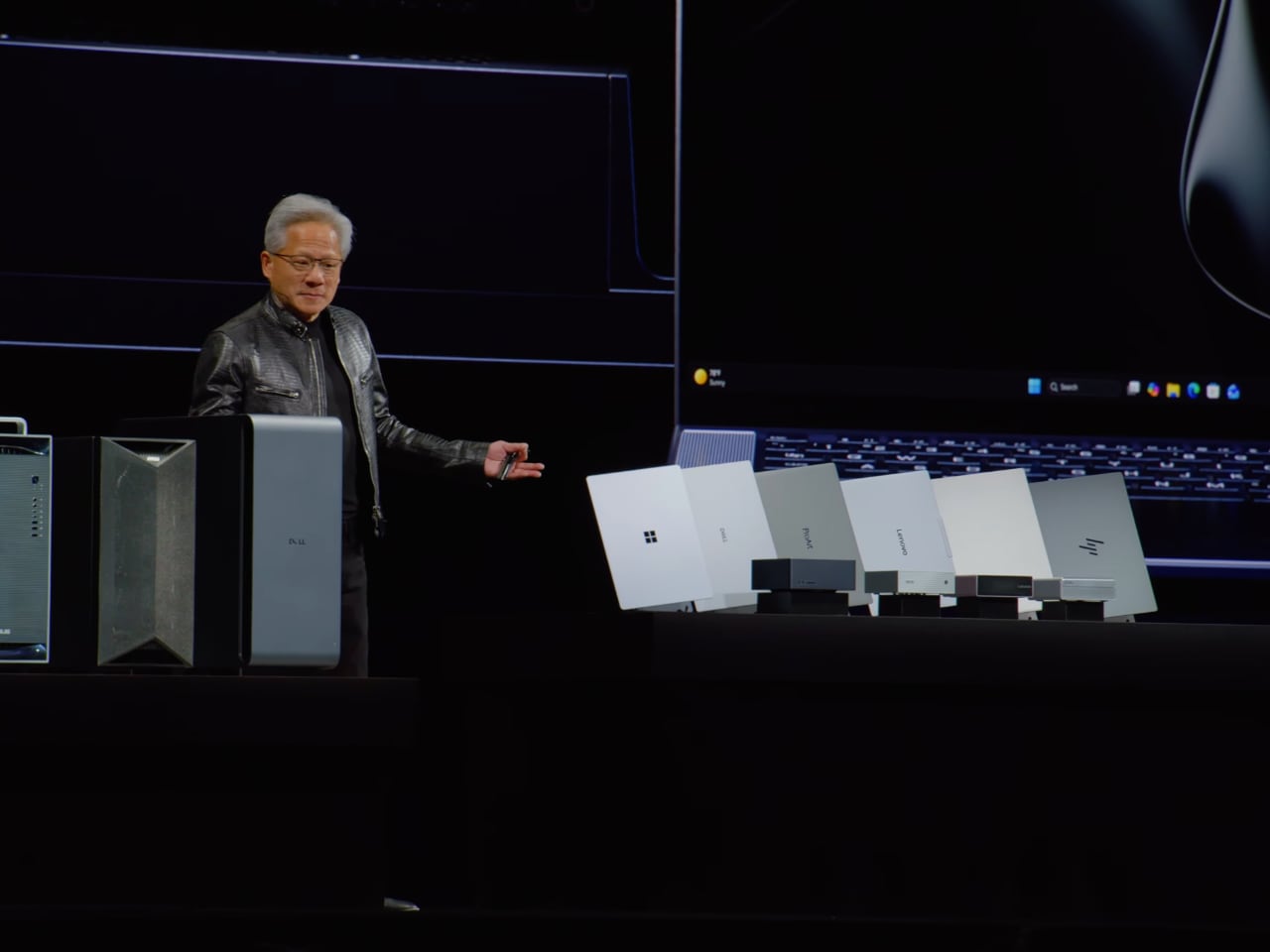
The designs sound like flagships, not science projects. NVIDIA says RTX Spark laptops can get as slim as 14 millimeters and as light as three pounds, in sizes from 14 to 16 inches, wrapped in precision-machined aluminum. The displays are color-accurate tandem OLED panels with G-SYNC, a pairing that should please a colorist chasing accuracy and a gamer chasing smooth frames at once. There’s a desktop side as well, small power-sipping boxes built to run agents around the clock while still handling creative work and games. The chassis is where a spec sheet turns into something you’d actually want to carry.
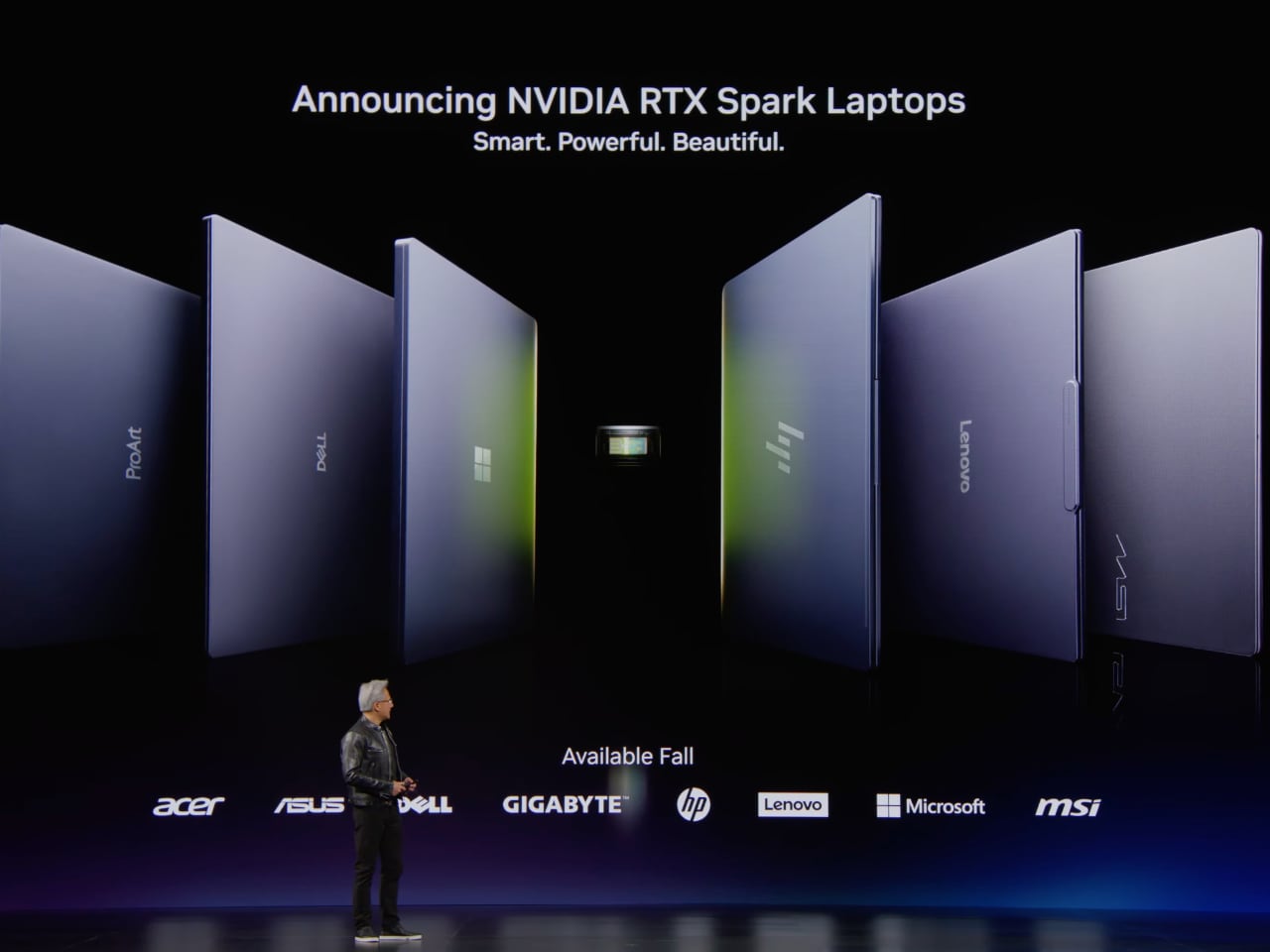
The launch lineup reads like the whole industry showed up. ASUS, Dell, HP, Lenovo, Microsoft Surface, and MSI are first out this fall, with Acer and GIGABYTE to follow. So far the only models partners have named outright are Dell’s XPS 16 Creator Edition, HP’s OmniBooks, and Microsoft’s Surface Laptop Ultra, so treat any other specific model as unconfirmed until launch. When this many rivals build around one platform at the same moment, they see a category forming, not a niche.
The executive quotes blur together, and that sameness is itself the story. ASUS chairman Jonney Shih says the platform defines the future of personal computing, Michael Dell is putting it in an XPS 16 Creator Edition, and HP’s Bruce Broussard claims its OmniBooks will rank among the thinnest RTX Spark laptops. Lenovo’s Yuanqing Yang, MSI CEO Jeans Huang, and Surface’s Brett Ostrum each pledged flagship machines around the same chip, with Ostrum positioning the Surface Laptop Ultra for serious creative and engineering work. You rarely see ASUS, Dell, HP, Lenovo, MSI, and Microsoft agree on anything this fast. That unanimity cuts both ways, since a crowded launch also means every brand is chasing the same buyer with similar silicon. Pricing, build quality, and battery life will end up separating them, and none of those are clear yet.
A supercomputer that fits under a desk
There’s a tier above all of this for the people building the agents. NVIDIA also showed the DGX Station for Windows, a deskside system that scales the Blackwell architecture for enterprise developers, with the company describing it as a trillion-parameter AI supercomputer that fits on a desk. That’s aimed at the builders rather than the buyers, and it shows how far up the stack NVIDIA wants Windows to climb.
What’s still missing
A few gaps in the announcement matter, and they’re the kind that decide whether you buy. NVIDIA didn’t share pricing, and a platform built on tandem OLED, machined aluminum, and 128GB of memory will not be cheap. “This fall” is a wide runway, so exact dates and configurations are still open. Until a model has a number attached, the value question can’t really be answered.
The deeper unknown is the agent itself. A local model with a huge memory window is impressive on paper, and impressive on paper has burned plenty of buyers before. Real usefulness depends on whether these agents handle messy, multi-step work without constant babysitting, and whether the security layer feels invisible instead of nagging. NVIDIA has the silicon locked down, which was always the part it was going to nail. The software experience, the daily rhythm of asking instead of clicking, is the variable that decides everything, and it’s the one a keynote can’t prove.
Who should wait, and who should skip it
This isn’t the machine for everyone, and a couple of readers should sit it out. If your laptop spends its life in a browser, a mail client, and a word processor, RTX Spark is a lot of expensive silicon aimed at problems you don’t have. The agent and the 128GB memory pool are wasted on light work, and a cheaper ultrabook will feel identical for email. You’d be paying for a teammate you never ask to do anything.
Patience is the other filter. First-generation platforms ship with rough edges, and the agent software here is brand new, so anyone who needs a dependable work machine this minute should let early adopters find the bugs. Waiting for fall reviews costs nothing, and it’ll tell you whether the teammate pitch survives contact with real workflows.
What this signals for the rest of us
Step back from the spec sheet and the bigger story is about that long arrangement finally bending. For forty years the PC waited for instructions, patient and inert. RTX Spark is the most serious attempt yet to flip that posture, to build a Windows machine that does work in the background instead of idling until you click. NVIDIA might be early, and the slogan might run louder than the reality on launch day. Plenty of first-generation platforms have promised more than they shipped. The direction, though, is hard to argue with when the entire PC industry moves at once.
For our readers, the move right now is patience with attention. Don’t replace a working laptop on the strength of a keynote, and don’t wave this off as marketing either, because the whole industry rarely lines up behind one idea at the same time. Watch for pricing and fall reviews, and watch whether the agent earns a place in your day or gets switched off by week two, because that answer will tell you more than any number on the box.
Announcements: NVIDIA + Microsoft Windows PCs · Windows Experience Blog · COMPUTEX 2026 roundup · DGX Station for Windows
Events: GTC Taipei keynote · GTC Taipei hub