Screens have spent a decade getting brighter, glossier, and more tiring to stare at all day. Most of us accept the eye strain as the cost of doing real work on glowing glass. That trade feels permanent right up until a screen quietly refuses to glow.
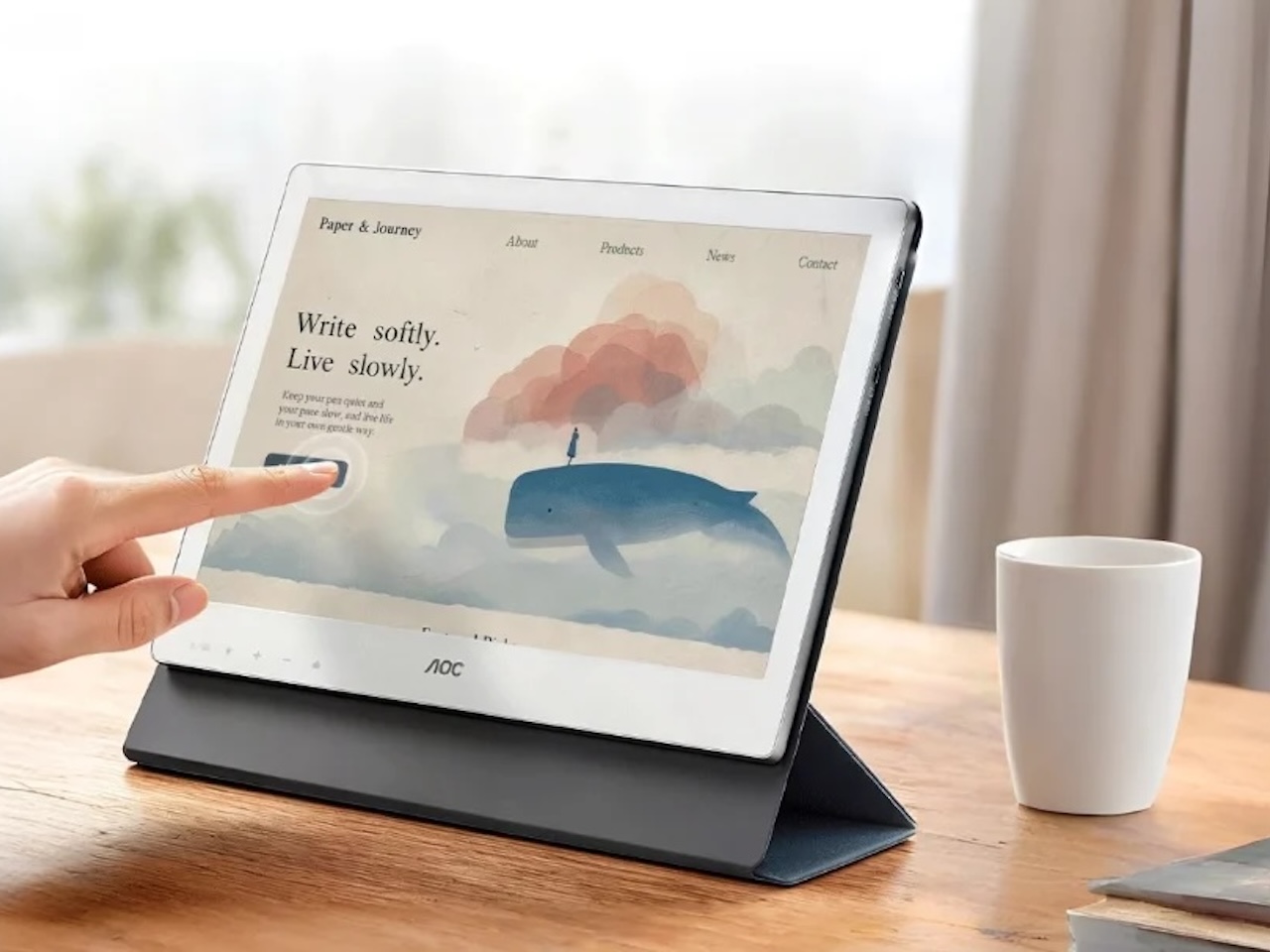
AOC broke that assumption this week. The company announced the 13T5S, a 13.3-inch portable monitor built around a color E Ink screen you read like a printed page rather than the glowing LCD or OLED you’d expect. It arrived first in China at 4,599 yuan, about $679, with no global date attached yet. Putting real color e-paper into a plug-and-play second screen is the actual story, more than any single number.
What Actually Changed
What changed is speed and color arriving together. AOC rates the panel at a 30Hz refresh, which sounds slow next to a normal monitor yet counts as brisk for electronic paper, enough to make scrolling and a moving cursor feel closer to a real display.
Color comes from E Ink’s Kaleido 3 technology, so text stays crisp while photos and charts pick up muted, printed-magazine tones. AOC quotes 300 pixels per inch for black text and 150 for color, the familiar e-paper split between sharp type and softer hues.
Two problems haunt every E Ink screen: ghosting and lag. AOC says a dual T2000 controller works with an AI ghosting system that spots leftover images and refreshes only those patches, so the panel stops flashing black on every page turn. Whether that holds up in daily use is a review question, not a spec-sheet promise.
The Paper Feel Is the Pitch
Numbers only carry an E Ink pitch so far. What sells it is the moment your eyes stop working overtime.
Picture a long afternoon of editing by a bright window, the kind of light that turns a glossy laptop into a mirror. AOC wraps the 13T5S in a matte 0.4mm anti-glare layer meant to scatter that glare into nothing, and a front light it calls ComfortGaze warms or cools the tone instead of firing a backlight at your face. The panel reads by reflecting room light the way paper does, so brighter surroundings make it look better, not worse.
That inversion of everything a normal monitor wants is the real appeal.

What the Hardware Gets Right
Hardware here reads like a premium tablet, not a science project. AOC builds the chassis from anodized aluminum at 8mm thick and around 700 grams, so it slides into a bag beside a laptop as easily as the travel-friendly portable monitors we pack for the road.
Dual full-function USB-C ports carry power, video, and data down a single cable, which keeps a desk uncluttered. A folding cover flips back into a stand that props the screen in portrait or landscape at three angles.
Who Should Wait
Start with who this screen will frustrate. Anyone hoping to watch video or play anything faster than a slideshow should look elsewhere, since 30Hz e-paper is built for text and stillness, not motion.
Mac owners face their own wall, because AOC lists plug-and-play only for Windows and says macOS support waits on a future software update. Color purists should temper expectations, because Kaleido 3 renders gentle tones rather than the punchy hues of an OLED.
Price and the Catch
Pricing is where enthusiasm meets reality. At 4,599 yuan, roughly $679, the 13T5S costs more than plenty of full-size LCD monitors, so this is a comfort and eye-health buy rather than a value play.
AOC has confirmed only a China launch, which leaves shoppers elsewhere watching for a wider rollout and local pricing. No Amazon listing exists yet.
The Bigger Picture
Zoom out and the 13T5S looks like a bet that e-paper is ready to move from e-readers to real work screens. It lands in a suddenly crowded field of 13.3-inch E Ink rivals, from the open-source Modos Paper to Asus’s ZenScreen Color ePaper, all chasing the same eye-friendly niche.
On paper it reads as one of the more polished takes, though every claim here traces back to AOC and its launch materials. We’ll hold judgment until a unit reaches a desk and gets the same eye-strain and speed testing we put every monitor through.