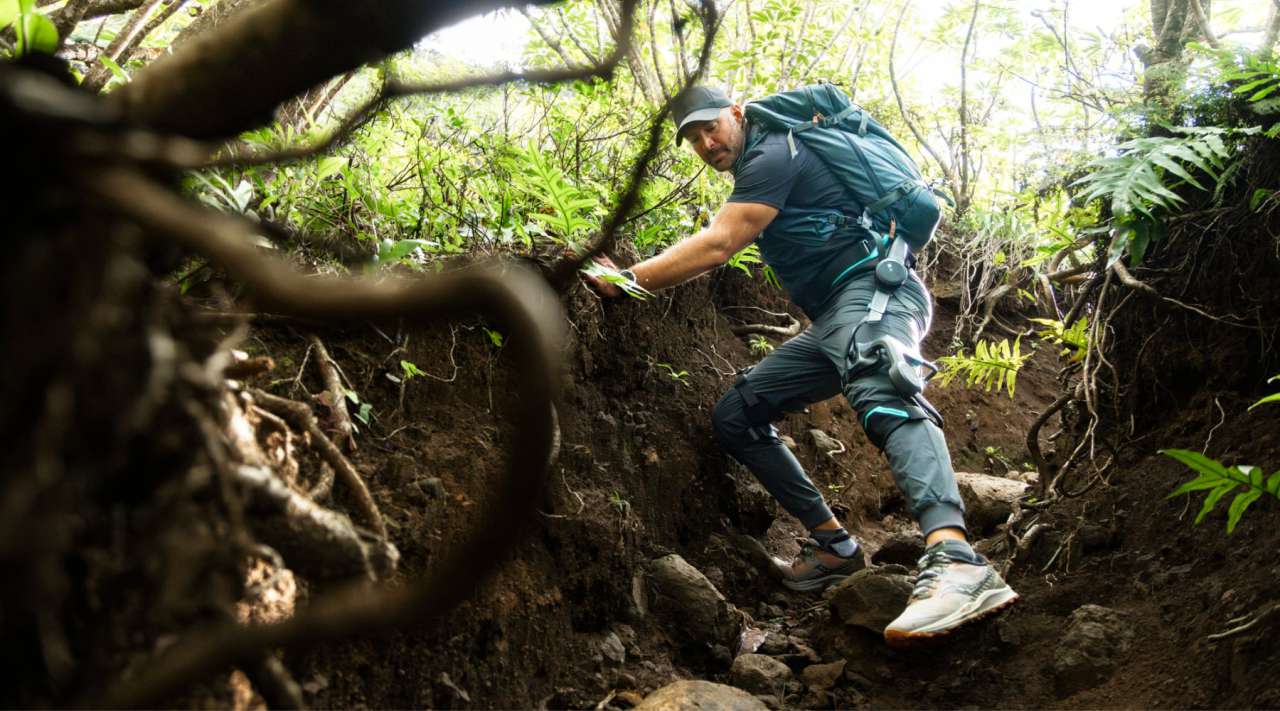
If you’ve spent any time looking at AI hiking exoskeletons, you’ve noticed something quietly weird about the entire category. Every suit on the market wants to talk about going up. The marketing is always uphill switchbacks, summit selfies, climbers arriving fresher than the friend who didn’t strap in. That’s the whole pitch. Climb harder, sweat less, get higher.
Then comes the part nobody films. You turn around, you start descending, and the suit on your hips that gave you 30% extra push on the climb has nothing left to offer the joint that’s now absorbing your bodyweight on every single step. Your knees are doing the work. Your knees were always going to do the work, because the suit was never designed to help them. That’s where most hiking exoskeletons go quiet.
A wearable robotics company called Vastnaut is launching on Kickstarter today 11:00 AM ET (10:00 AM CT), and their entire premise is that half a hike isn’t enough. Their product, the Vastnaut One, is the world’s first AI-powered 4×4 exoskeleton, and it’s the first consumer suit built around the idea that your knees deserve as much help as your hips.
Super Early Bird: $1,299 (Vastnaut One 4×4)
Where to back: Kickstarter · vastnaut.com
Who Vastnaut is, and why “Synergy” is on every product
Before getting into the suit itself, it’s worth understanding who’s making it, because Vastnaut isn’t another lifestyle brand bolting motors onto a hiking belt.
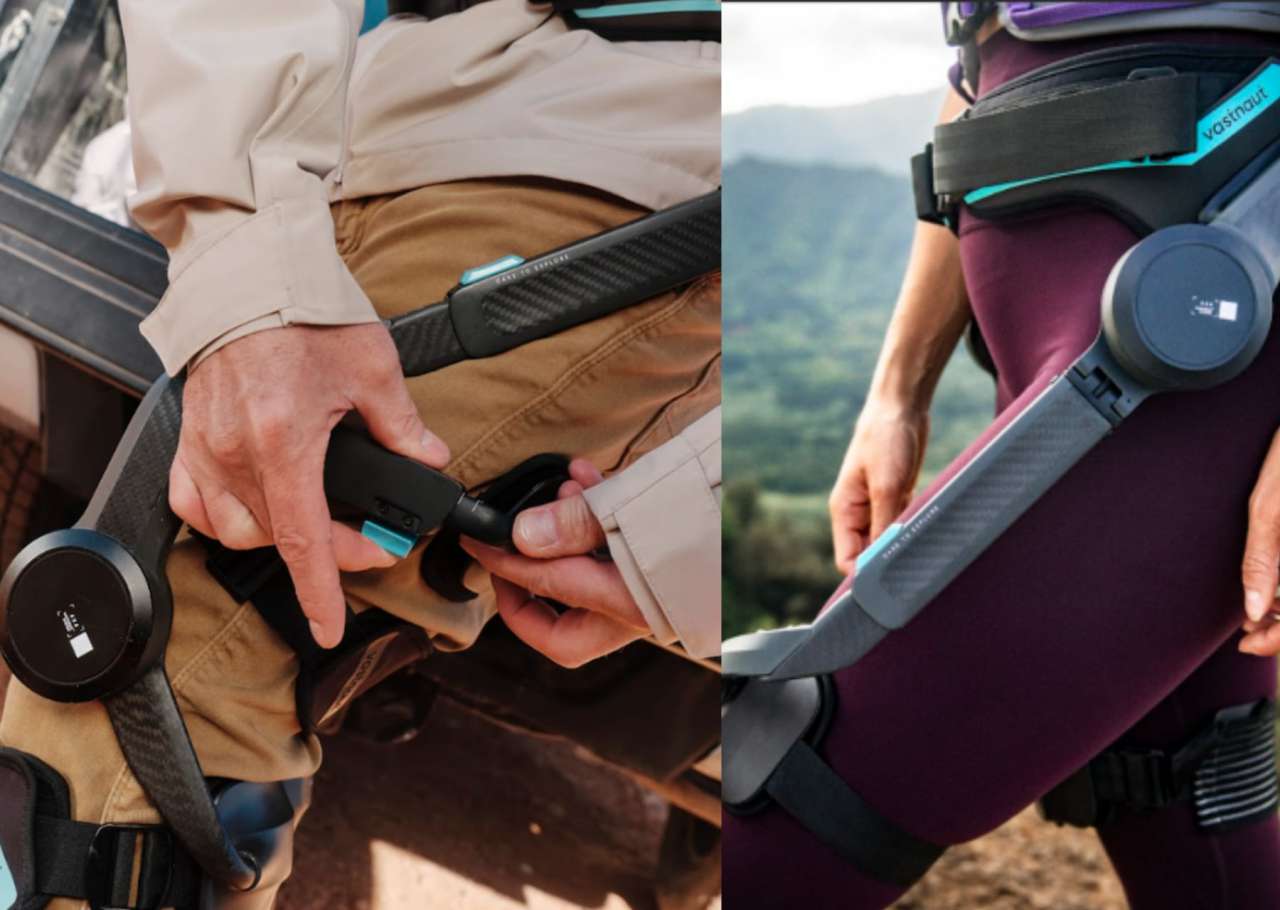
The name is a portmanteau: vast + naut, literally “star sailor,” modeled on astronaut. The founders are engineers rooted in robotics, biomechanics, and control systems, and the company was built on a single conviction: the next era of personal mobility won’t come from bigger motors or louder marketing. It’ll come from systems where every component talks to every other component in real time. Their slogan is “Engineering towards Synergy,” and it’s not a tagline they slap on a website. It’s the thesis behind every piece of hardware and software in the Vastnaut One.
The mission they describe is straightforward: define the new era of wearable robotics. The way they’re attempting it is more interesting. Instead of motorizing one joint and calling it done, they’re coordinating four motors across four joints with one AI brain making the calls. That’s the synergy the slogan refers to, and it’s the reason the Vastnaut One can do things other consumer suits structurally can’t.
What’s actually different about the Vastnaut One
Almost every consumer AI exoskeleton you can buy right now motorizes the same single joint: the hip. Two motors, one pair of hip flexors, that’s the whole suit. A few newer designs add a separate knee unit you can clip on, but it’s a bolt-on accessory with its own controller, its own battery, and its own software. It doesn’t talk to the hip suit on top of it. It’s two products on the same body.
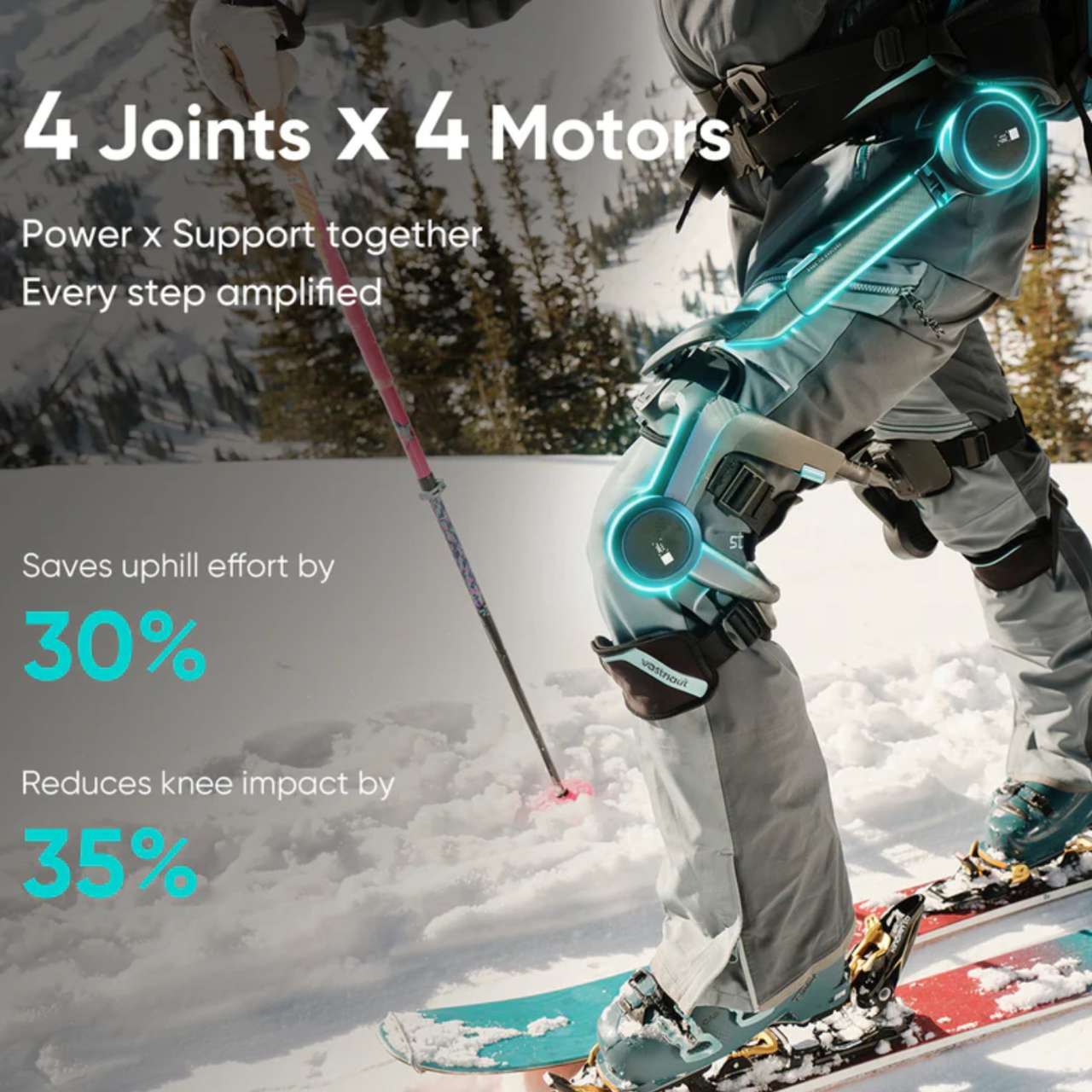
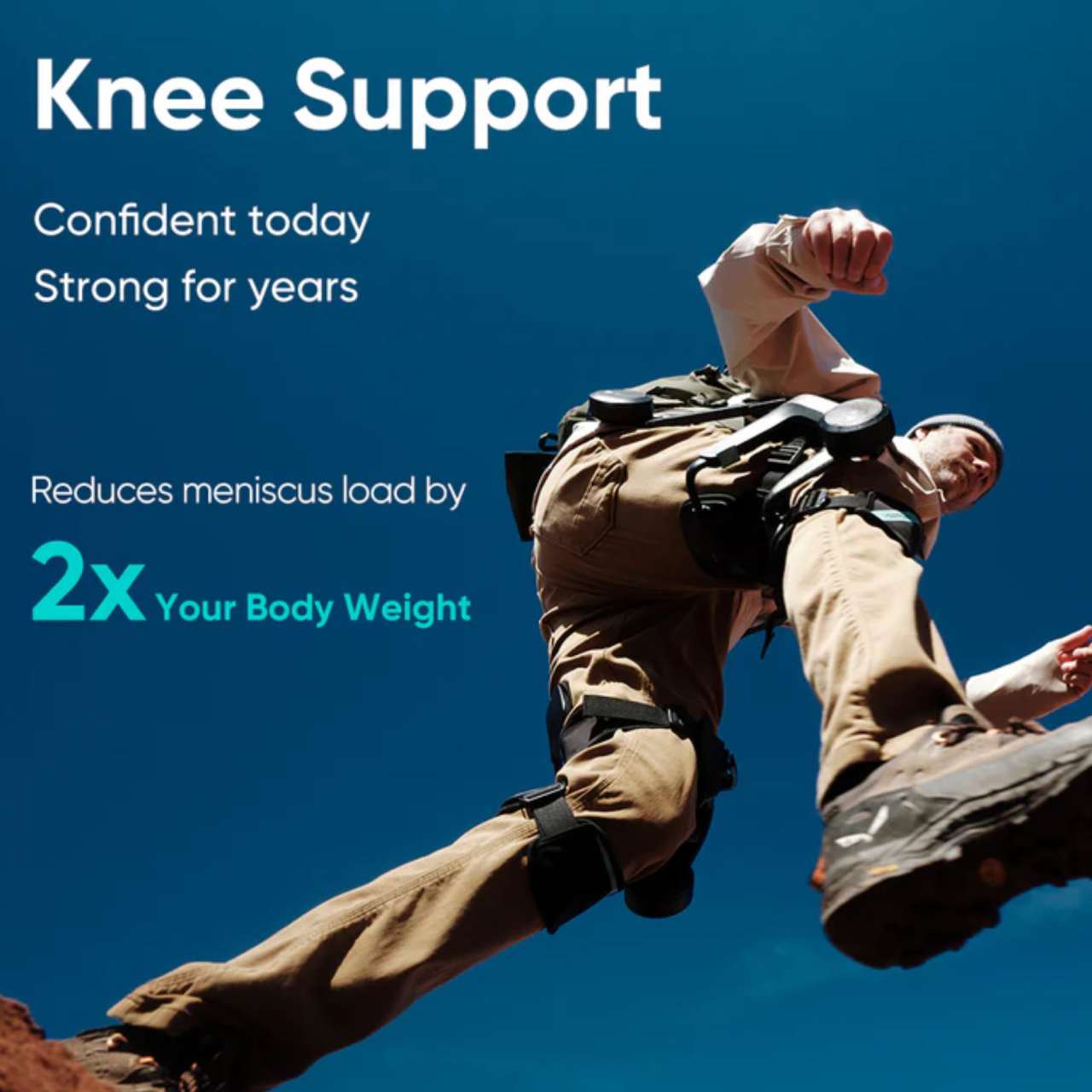
The Vastnaut One is built differently. One frame, one AI engine, four motors, four joints. Both hips and both knees, coordinated in real time by the same software making decisions about which joint needs torque on this exact step. Vastnaut calls this architecture 4×4, and the engineering claim is easy to verify by counting actuators in the product photos. There are four. No other consumer AI exoskeleton on the market has that.
That single architectural choice is the entire reason the descent question changes.
📰 Want to stay current on tech and gadgets?
Follow The Gadgeteer on Google News to get our latest reviews, news, and CES coverage in your feed.
The 4×4 lineup: which one’s right for you
Vastnaut One 4×4 is the headliner. Four motors, four joints, hips and knees working together. Active descent assist. The full ATD™ and VastSynergy™ stack. This is the suit for serious trail hikers, anyone with knee sensitivity on long descents, and anyone carrying real pack weight. Super early bird pricing puts it at $1,299 against a $1,899 MSRP.
Vastnaut One 4×4 Explorer Combo adds a second hot-swappable battery and a carry bag to the 4×4 setup. Same suit, longer range, packed for travel. $1,399 super early bird against a $2,099 MSRP.
Built to wear with a real hiking pack
A detail most early coverage will miss: the Vastnaut One was designed to coexist with the gear you actually hike in. The detachable battery placement and the frame geometry were tuned so the suit doesn’t fight your backpack’s hip belt, lumbar pad, or internal frame. You strap into your pack the way you always have, the suit sits where it always sat, and the two systems share your hips without arguing. For a powered exoskeleton aimed at multi-mile, multi-pound trail use, that’s not a nice-to-have. It’s the whole reason the suit is wearable on the kind of hike it was built for.
What 4×4 actually solves on a real trail
Picture the second half of a 12-mile day. You’ve climbed 2,800 feet. You’ve already eaten the snack you were saving. Your quads are toast. Now you have to get back to the car, and the trail you went up is the same trail you have to come down.
On a hip-only exoskeleton, here’s what happens next. The hip motors that pushed you forward on the climb either shut off (giving you a five-pound brick to carry the rest of the way) or switch into a mild resistance mode that gently pushes back against your stride. Neither one absorbs impact at the knee, which is the joint actually decelerating your bodyweight on every step down. If your knees ache the next day, the suit didn’t help. It wasn’t built to.
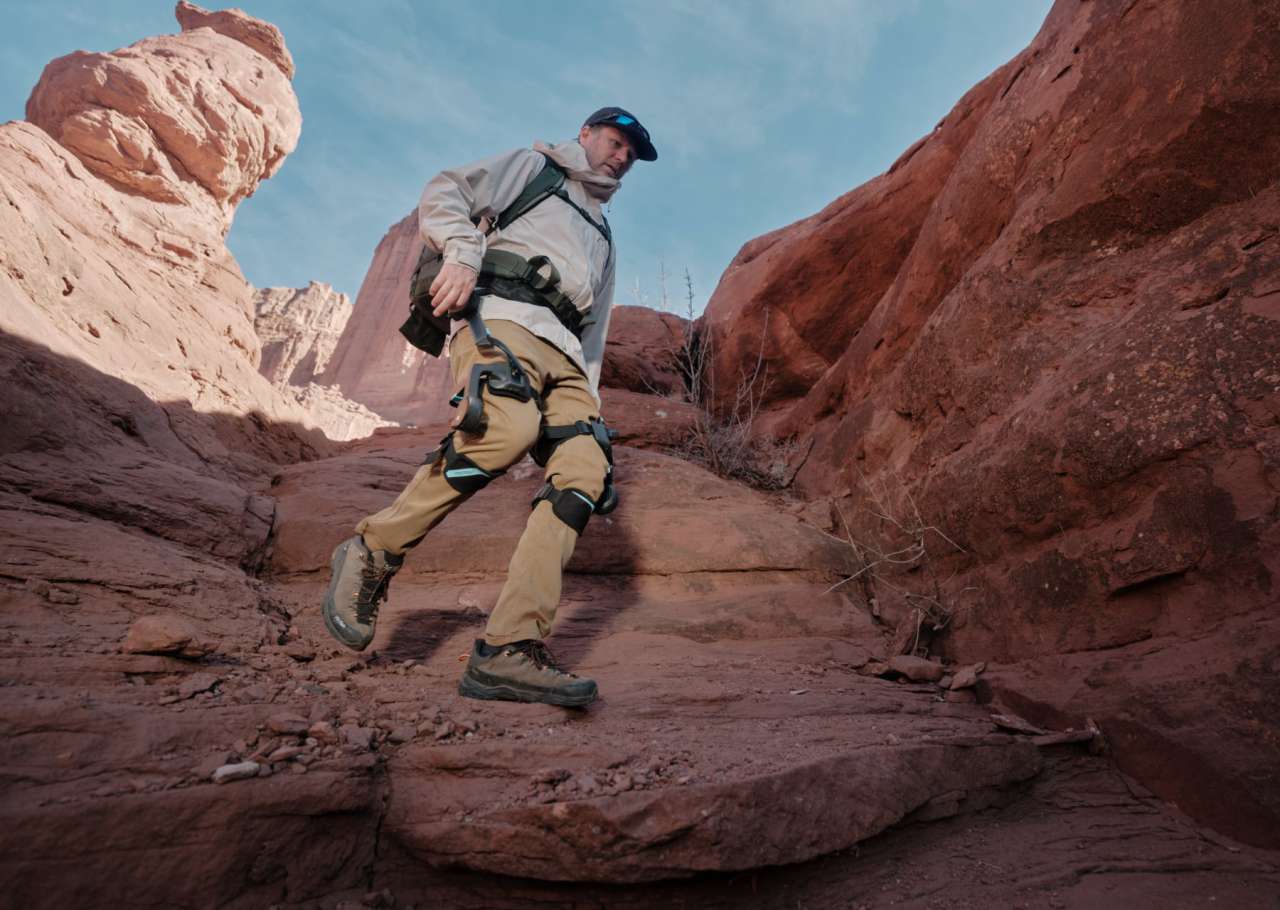
The Vastnaut One’s knee motors stay active on the descent. They engage during what biomechanics people call the eccentric load phase, the moment your quad has to brake your falling bodyweight against gravity. Vastnaut’s measured results: a 35% reduction in knee impact, joint stress relief equivalent to taking 200% of your bodyweight off the joint on a step down, 32% lower physical exertion across a hike, 34% drop in heart rate on climbs, and 30% less uphill effort versus unassisted hiking. Carry a heavy pack and the suit produces the felt equivalent of removing up to 18 kg of load from your shoulders.
Does an exoskeleton actually help with knee pain on hikes
Yes, when the device targets the knee directly. Peer-reviewed research from Stanford’s Steven Collins lab, published in PLOS Computational Biology, frames assistive exoskeletons as a “promising direction of knee OA treatment” because they can produce “larger reductions in knee joint load than existing approaches” like braces, insoles, or gait modifications. More recent work in IEEE Transactions on Neural Systems and Rehabilitation Engineering tested a knee exoskeleton designed specifically to reduce loading during the stance phase, which is the part of the gait cycle when your knee is taking your bodyweight, and the device produced significant reductions in maximum and mean knee joint force during early and middle stance.
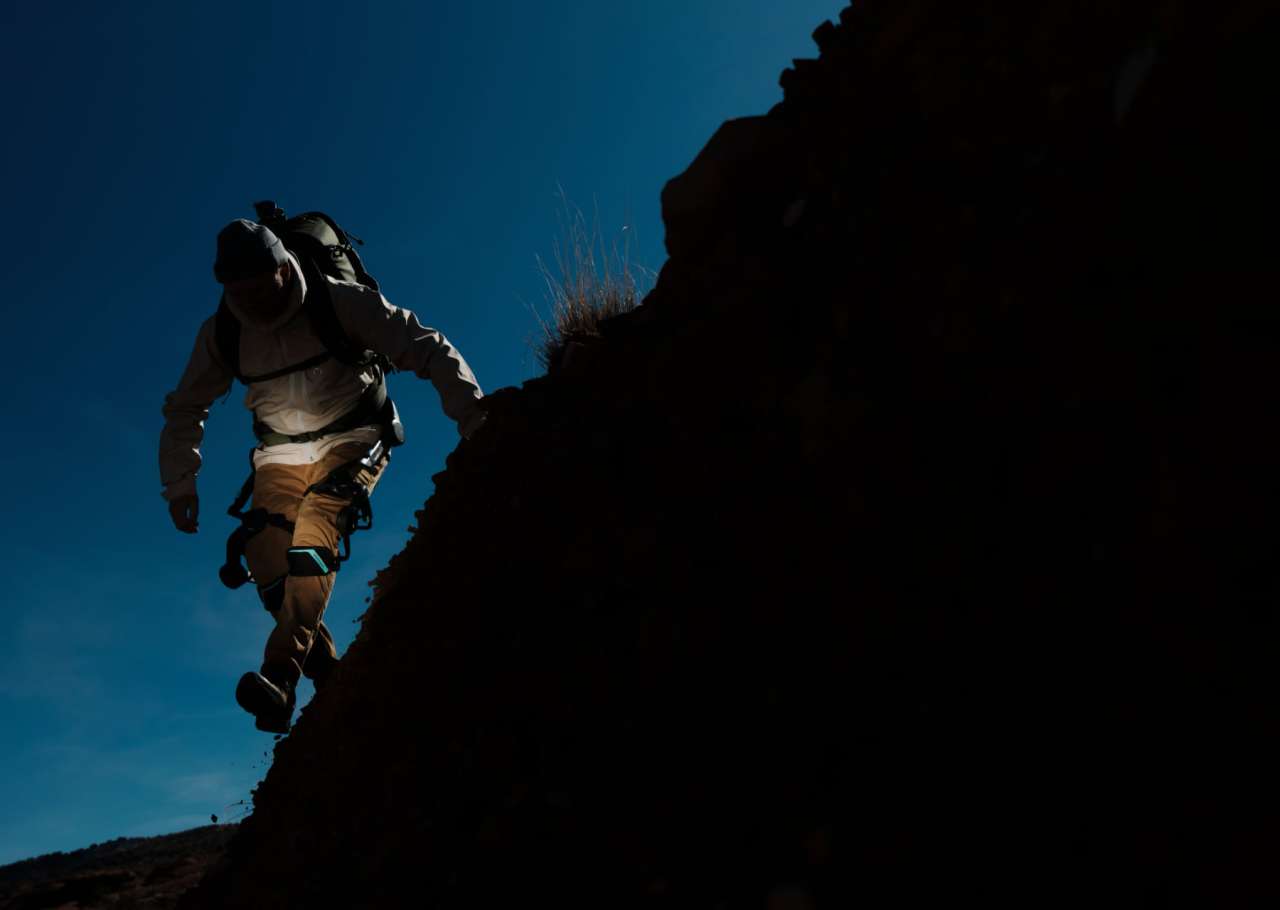
Stance phase is exactly when your knees hurt on a descent. That’s the use case hip-only assist was never going to solve. Your hips weren’t the problem. The Vastnaut One is the first commercial AI suit that takes that fact seriously and puts motors where the load lives.
What real beta testers reported
In early January 2026, Vastnaut put the One into the hands of beta testers across multiple outdoor locations in the United States. The group included outdoor photographers, technology enthusiasts, and experienced users of existing exoskeletons, which is the right cross-section to stress-test a suit like this. Two of those testers carried packs exceeding 15 kg on multi-mile hikes that included serious downhill segments. Both reported a noticeable reduction in perceived load while climbing and, more notably, significantly reduced knee strain on the descents even with the heavy pack. That’s the use case hip-only suits can’t address, validated outside the lab on the kind of hike most people will actually use the suit for.
The four technologies inside the suit
4×4 Structure. Four actuators across both hips and both knees, in a single coordinated frame. Not two products glued together, one system designed top-down to handle every phase of a hike.
ATD™ (Adaptive Torque Distribution). The decision-making layer. ATD™ figures out which of the four motors needs how much power on a given step, and it adjusts in real time as the terrain underneath you changes.
VastSynergy™ AI Engine. The brain. VastSynergy™ reads your gait, the trail surface, your speed, and the pack you’re carrying, then tells ATD™ what each motor should do on the next step. It’s what turns four motors into one suit instead of four independent helpers.
VastDrive™ System. The part most coverage will miss. VastDrive™ is Vastnaut’s self-developed motor, battery, and control package, integrated into a single robotic core. Every component is built from the ground up: power delivery, energy efficiency, durability, thermals. Most consumer exoskeletons assemble off-the-shelf parts behind a custom shell. Vastnaut owns the stack. That’s why the One can be aggressive with peak power, light on weight, and predictable on long days, all at the same time.
Specs, sizing, and comfort
Four actuators, each delivering 400 watts of power. A frame that’s 86% or more carbon fiber, so the whole rig weighs 2.7 kilograms (roughly 5.9 pounds) before batteries. A single battery gets you up to 4.5 hours of assist or roughly 20 km of mixed terrain, and the unit takes hot-swap batteries so you can change one mid-hike without taking the suit off.
Sizing covers a wider human range than most powered exoskeletons attempt out of the gate. The Vastnaut One fits hikers from 5’3″ to 6’3″ with waists up to 51 inches, and Vastnaut has confirmed expansion plans to extend that range further as the platform matures. Translation: if you’ve been told by other AI suits that you’re outside their fit window, there’s a real chance you’re inside this one’s. The straps and contact points use skin-friendly, breathable materials, and the ergonomic layout was tuned for all-day wear. Putting the suit on and taking it off is a quick, no-fuss process, which matters more than spec sheets admit when you’re adjusting layers at a trailhead in the cold.
What it costs and where to get it
| Configuration | Super Early Bird | MSRP | Best For |
|---|---|---|---|
| Vastnaut One 4×4 | $1,299 | $1,899 | Trail hikers, real elevation, knee-sensitive descents, heavy packs |
| Vastnaut One 4×4 Explorer Combo | $1,399 | $2,099 | Travel hikers and longer-range outings (extra hot-swap battery + carry bag) |
You can back the Vastnaut One on Kickstarter or learn more on the official Vastnaut website.
Super Early Bird: $1,299 (Vastnaut One 4×4)
Where to back: Kickstarter · vastnaut.com
Who should back the Vastnaut One
If your hikes have real elevation, real descents, or real pack weight, and especially if your knees have ever felt the cost of a long downhill, the Vastnaut One 4×4 is the only consumer suit being built specifically for you. Not a hip suit with a vague “downhill mode.” A four-motor system with motors at the joint that’s actually taking the hit, coordinated by software making that call on every step.
If you travel for hikes, the Explorer Combo removes the only thing left to worry about, which is range.
Backing the launch puts you in the first group of people to hike with active 4×4 assist, and it puts the suit on your trail at the friendliest pricing the platform will ever see. If the descent half of the hike has been the part you push through rather than enjoy, the Vastnaut One is the suit built to change that, and now is the day to be early.