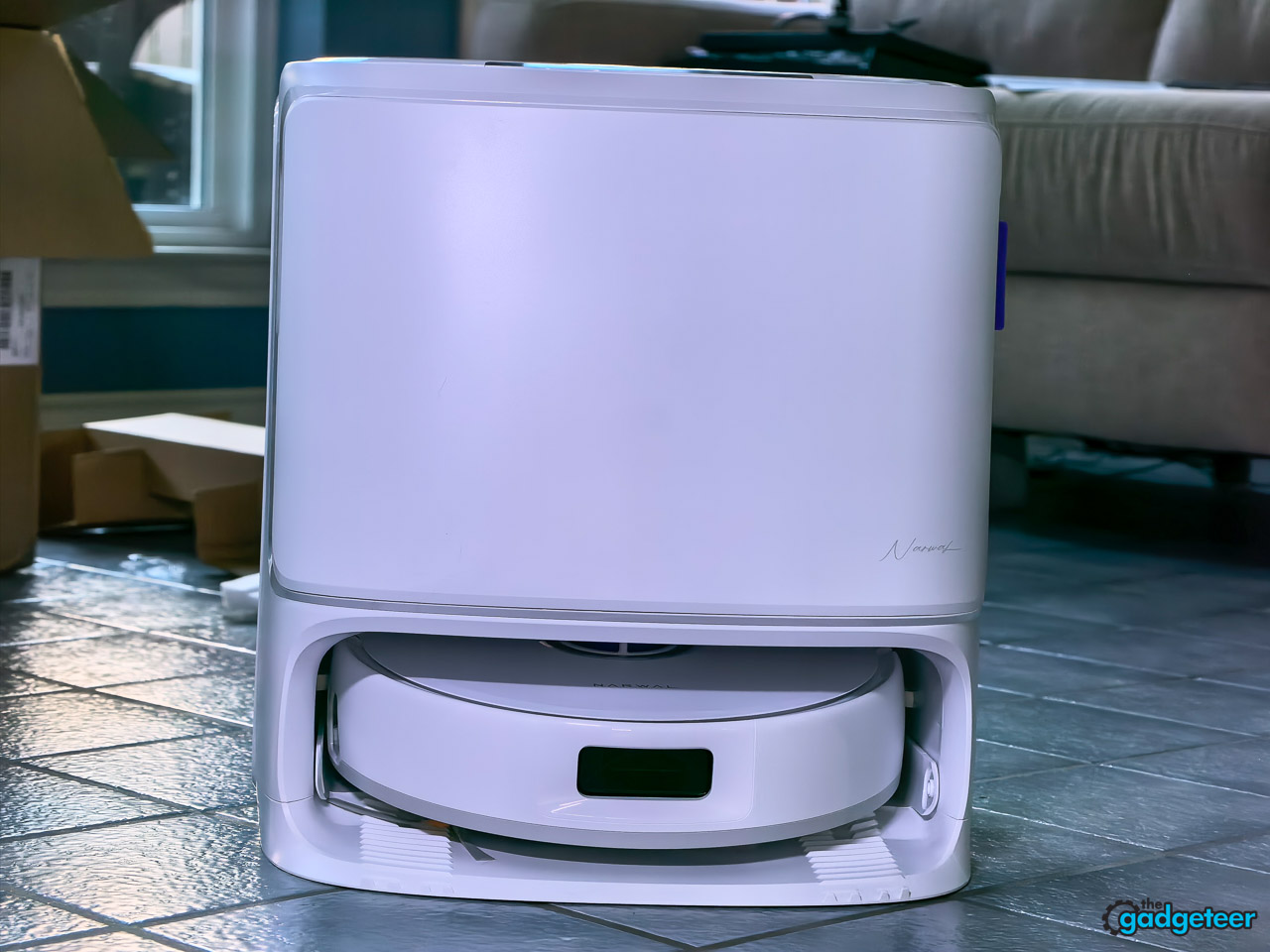
We have been trained to think that a robot vacuum under $600 is a compromise, something that vacuums OK and mops badly until you can afford the real thing. The Narwal Freo Z10 Turbo does not play along with that assumption. It inherits CarpetFocus Technology, a 25,000 Pa motor, and the 12N EdgeReach mop arm the brand usually parks in its $1,000-plus models. I’ve run it for a week as my primary floor robot across hardwood, low-pile carpet, and a kitchen that sees real daily traffic. It isn’t flawless, but at the launch price the rest of the spec sheet does a lot of the talking.
Summer shedding season is here, which means robot vacuum season is also here. The Freo Z10 Turbo launching at $599.99 right as pet hair and open-window dust peak is either good timing or good marketing. Either way, the math works.
Price: $599.99 (launch through May 31) / $899.99 (MSRP)
Where to buy: us.narwal.com | AMAZON
What is it?
The Freo Z10 Turbo is Narwal’s first mid-tier robot vacuum and mop combo that runs CarpetFocus, the brand’s flagship-only carpet-cleaning system. It uses a brush cover that drops down on carpet to seal a high-pressure airflow zone, then runs a Carpet Max mode with two zigzag passes that Narwal says doubles the dust pickup of a standard run.
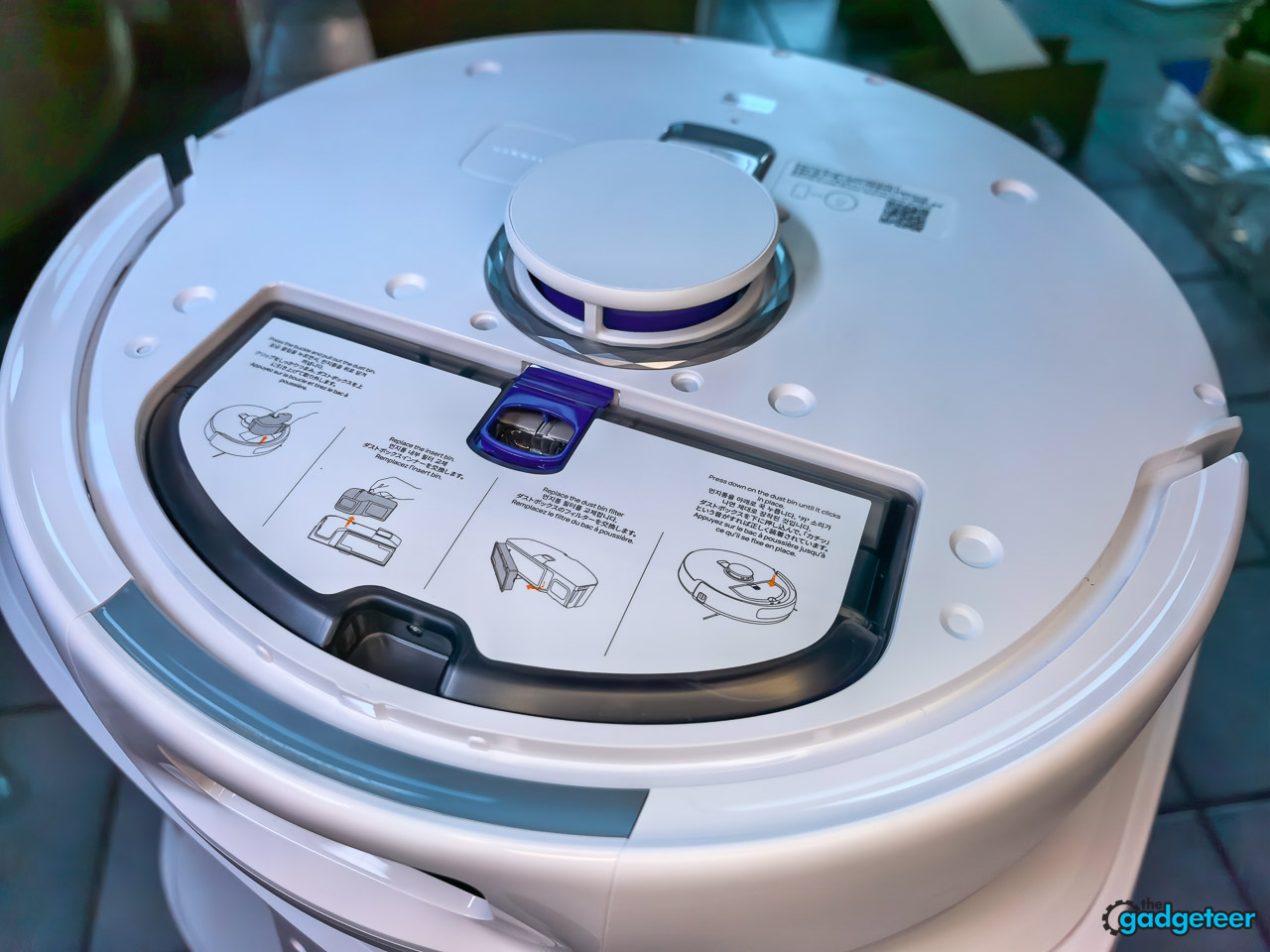
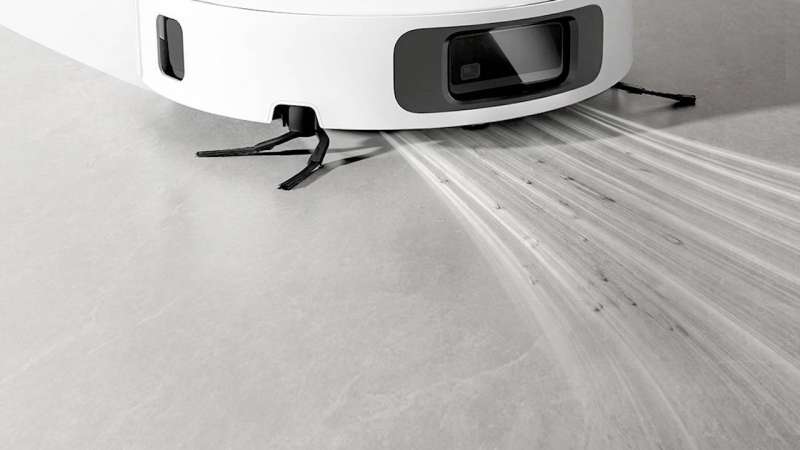
On hard floors, it leans on 25,000 Pa of suction paired with millimeter-level particle detection that Narwal claims delivers over 99% debris removal in lab testing, and the SGS-certified DualFlow Tangle-Free System, a pairing of a zero-tangling roller brush and a dynamic detangling side brush. The mopping side uses dual Reuleaux triangle pads with 12N of constant downward pressure, and the EdgeReach mop arm extends out to clean baseboards and corners that fixed-pad robots miss.
Navigation is camera-free. LDS lidar handles room mapping and tri-laser structured light handles obstacle avoidance down to about 1 cm of object height. That’s the whole pitch: flagship-grade carpet handling and mopping at a price that historically only got you the brand’s basics. If you’ve followed our prior Narwal coverage, the Z10 Turbo answers the privacy concern raised in our Freo Z Ultra review (cameras and an onboard mic roaming the house) while keeping most of the cleaning DNA intact.
What’s included?
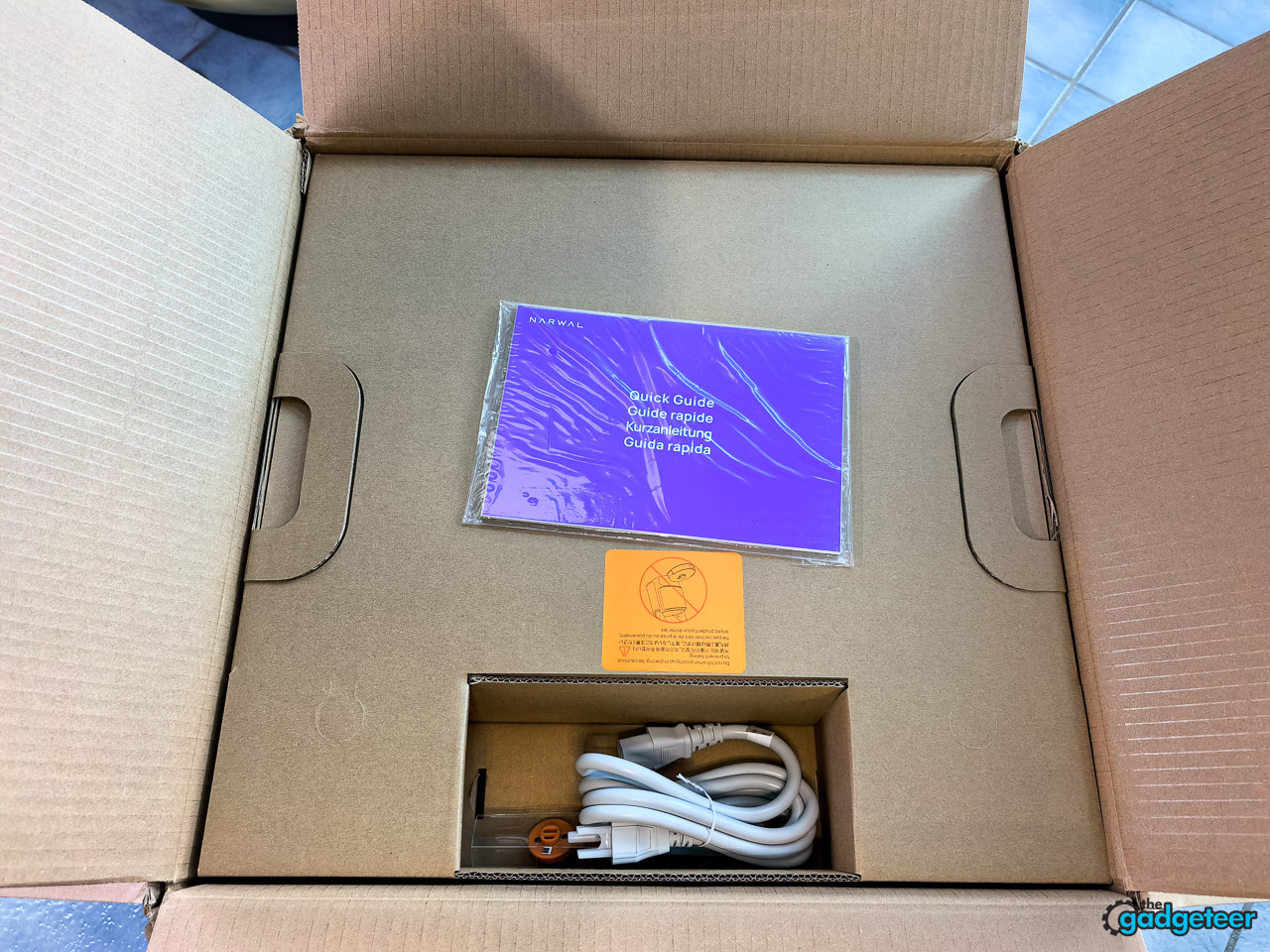
- Freo Z10 Turbo robot
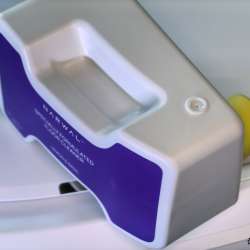
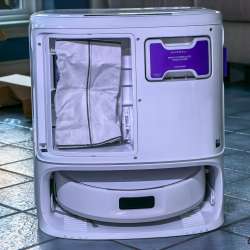
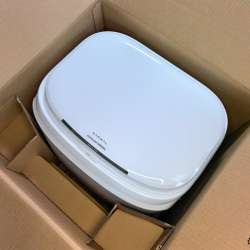
- All-in-one base station with hot-water mop wash and 2.5L sealed dust bag
- Pre-installed roller brush, side brush, dual triangular mop pads
- Cleaning solution starter bottle
- User documentation and quick-start guide
How I tested
I ran the Z10 Turbo as my primary floor robot for 13 hours and 3 minutes of cumulative cleaning time across roughly 1,519 square feet of total area cleaned, with the longest single session clocking 3.9 hours over 807 square feet at my chosen suction and water-flow settings, per the in-app cleaning log. The home is a mix of real hardwood, tile in the kitchen and bath, and a low-pile area rug in the formal dining room plus a mid-pile bedroom rug. Daily messes ranged from coffee grounds and crumbs to pet hair and tracked-in yard debris.
For the carpet and tangle assessments, I ran my usual mix of tests: everyday debris pickup on rugs, a long-hair tangle check, and a heavier pet-hair pass to simulate a real shedding load. For a deep-clean signal, I did a worked-into-the-pile pickup test on the mid-pile rug. Mop performance got tested against a dried coffee spill, a tracked muddy paw print, and a sticky juice splatter that sat for a while. For runtime and battery, I tracked square feet covered per full charge across the same fixed floor plan.
For benchmarking, I ran scheduled whole-home cleans and manual spot cleans, then sanity-checked the results by eye on the floor and in the rug pile. The app I used was the Narwal Freo app on my primary Android phone for the full week, with a quick iPhone spot-check to confirm the core workflow is consistent across platforms.
Tech specs
- Suction: 25,000 Pa
- Battery: 5,200 mAh
- Robot height: 110 mm
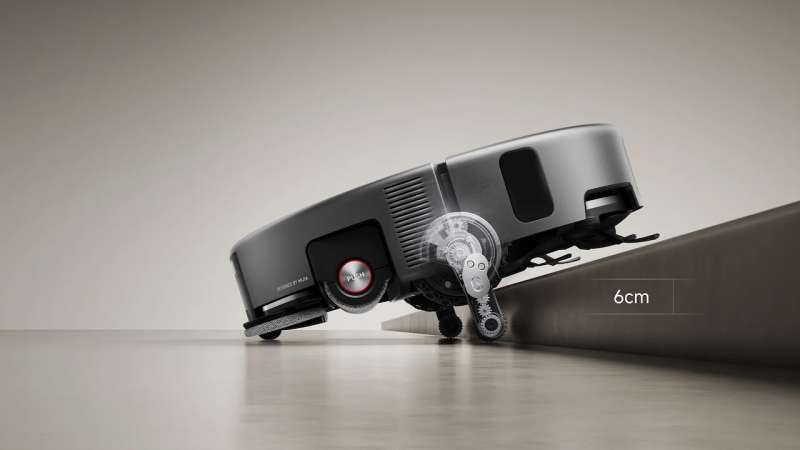
- Threshold crossing: 2 cm
- Dustbin: 300 ml onboard, 2.5L base station bag (120 days)
- Mop pressure: 12N constant
- Mop lifting: 12 mm
- Hot-water wash: AI Adaptive 113°F to 140°F, with 167°F peak for pasteurized sterilization
- Navigation: LDS lidar plus tri-laser structured light
- Object detection: 100+ types
- Runtime: Up to 210 minutes per charge, with recharge-and-resume
- Base station footprint: 431 x 427 x 462 mm, approximately 11.3 kg
- Noise: Under 59 dB(A) silent vacuum, under 56 dB mopping
- Connectivity: Wi-Fi (2.4 GHz / 5 GHz)
- App: Narwal Freo (iOS, Android)
Notable upgrades over the standard Freo Z10
Adapting the comparison-table approach we used for the Freo Z Ultra vs. Freo X Ultra in our prior review, here’s what jumps when you cross-shop the standard Z10 against the Z10 Turbo at Narwal’s current promo pricing ($899.99 Z10 vs. $599.99 Turbo, a $300 saving on the newer model):
| Feature | Freo Z10 Turbo | Freo Z10 |
|---|---|---|
| Suction | 25,000 Pa | 15,000 Pa |
| Mop pressure | 12N constant | 8N constant |
| Carpet cleaning | CarpetFocus + 4 modes | 4 modes only |
| Obstacle avoidance | Tri-laser structured light | Tri-laser structured light |
| Object recognition library | 100+ object types | Not specified |
| Camera | None (LDS + tri-laser only) | None |
| Base station | 2.5L / 120 days, hot-water wash | 2.5L / 120 days, hot-water wash |
At launch the Turbo is $300 cheaper than the Z10’s current $899.99 promo while adding 67% more suction, 50% more mop pressure, CarpetFocus, tri-laser obstacle detection, and a 100+ object recognition library, which makes the value comparison one-sided for anyone buying inside the launch window. At the post-launch $899.99 MSRP it gets harder, which I’ll come back to in the pricing section.
Design and features
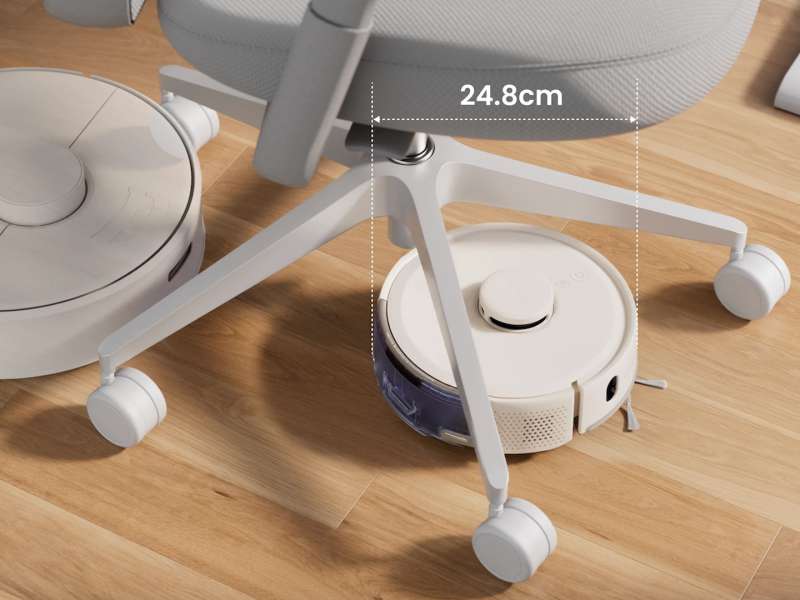
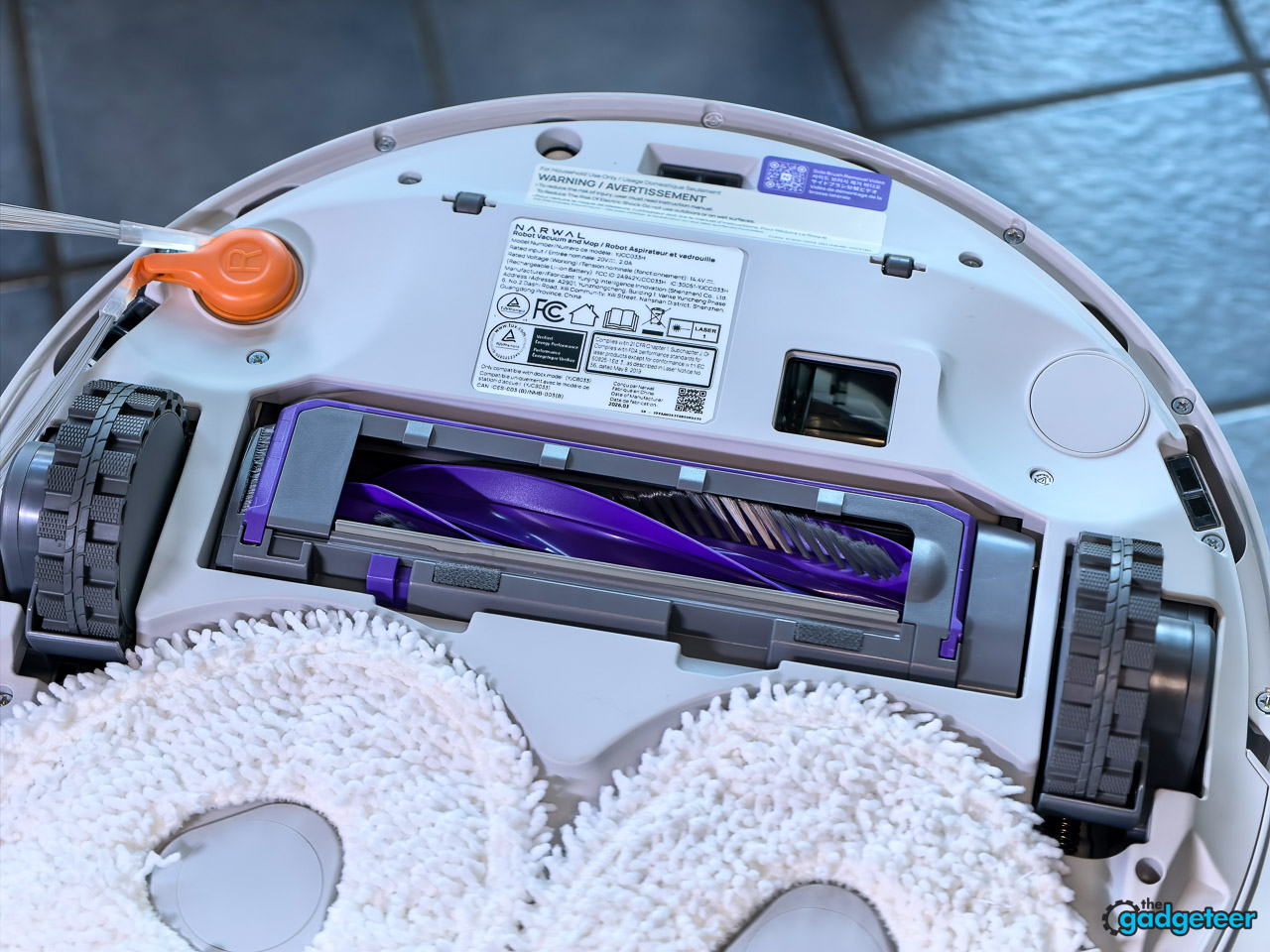
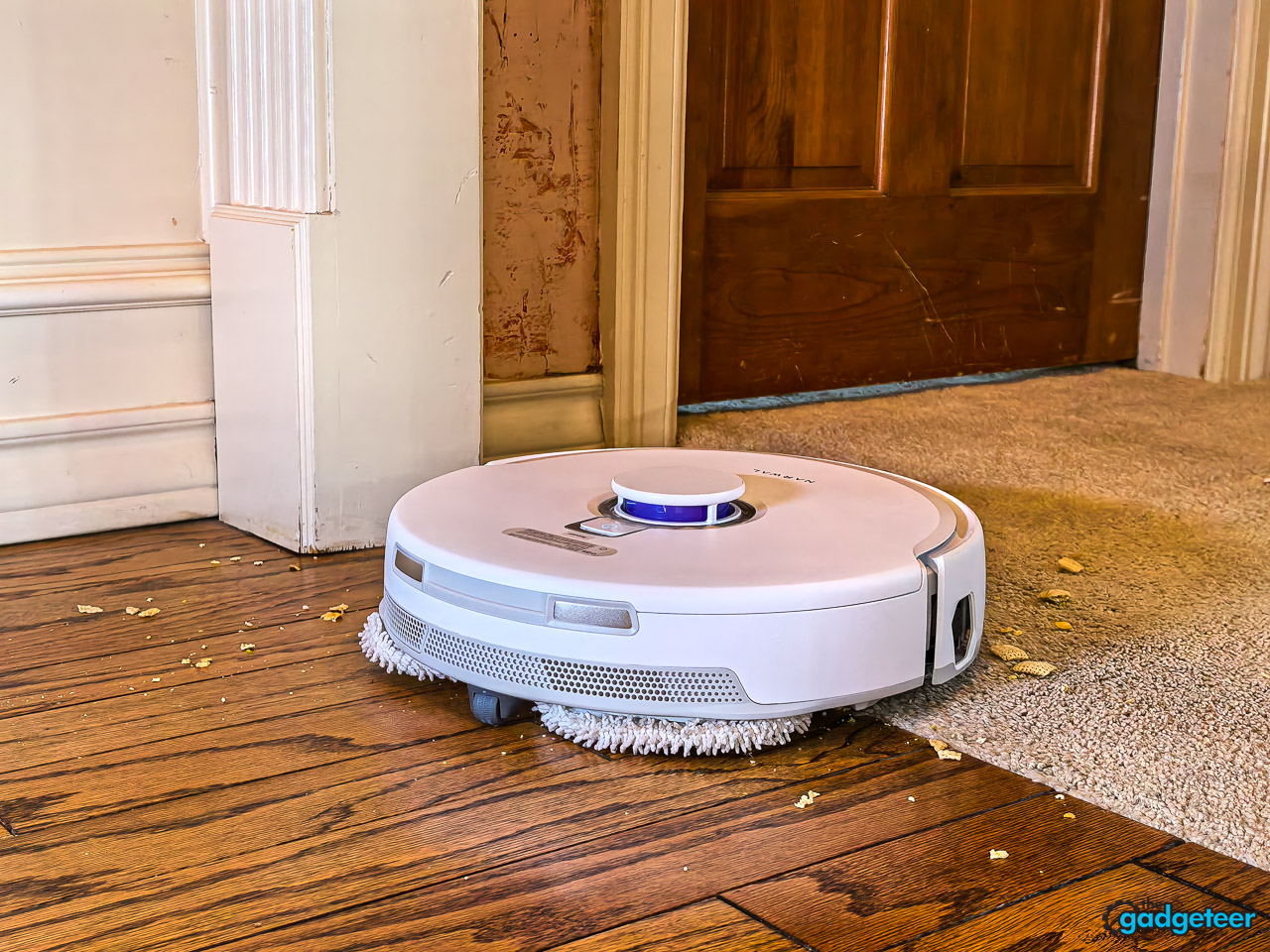
The robot itself is a familiar Freo silhouette. A short LDS turret sits on top, the body is flat enough to slide under most couches and beds, and the bumper is wrapped in a soft-touch finish that doesn’t squeak when it nudges into a chair leg. The dual triangular mop pads are visible on the underside, mounted on motors that spin and apply 12N of downward pressure. The single anti-tangle side brush has one fixed bristle and one longer movable bristle, and Narwal uses that asymmetry to change cleaning width on the fly. In default mode the two bristles angle apart for a 5.7-inch sweep diameter across open floor. When the robot approaches a corner, the brush reverses so both bristles align, extending the reach to a 9.45-inch diameter and pushing debris out of the corner before the suction inlet passes over it.
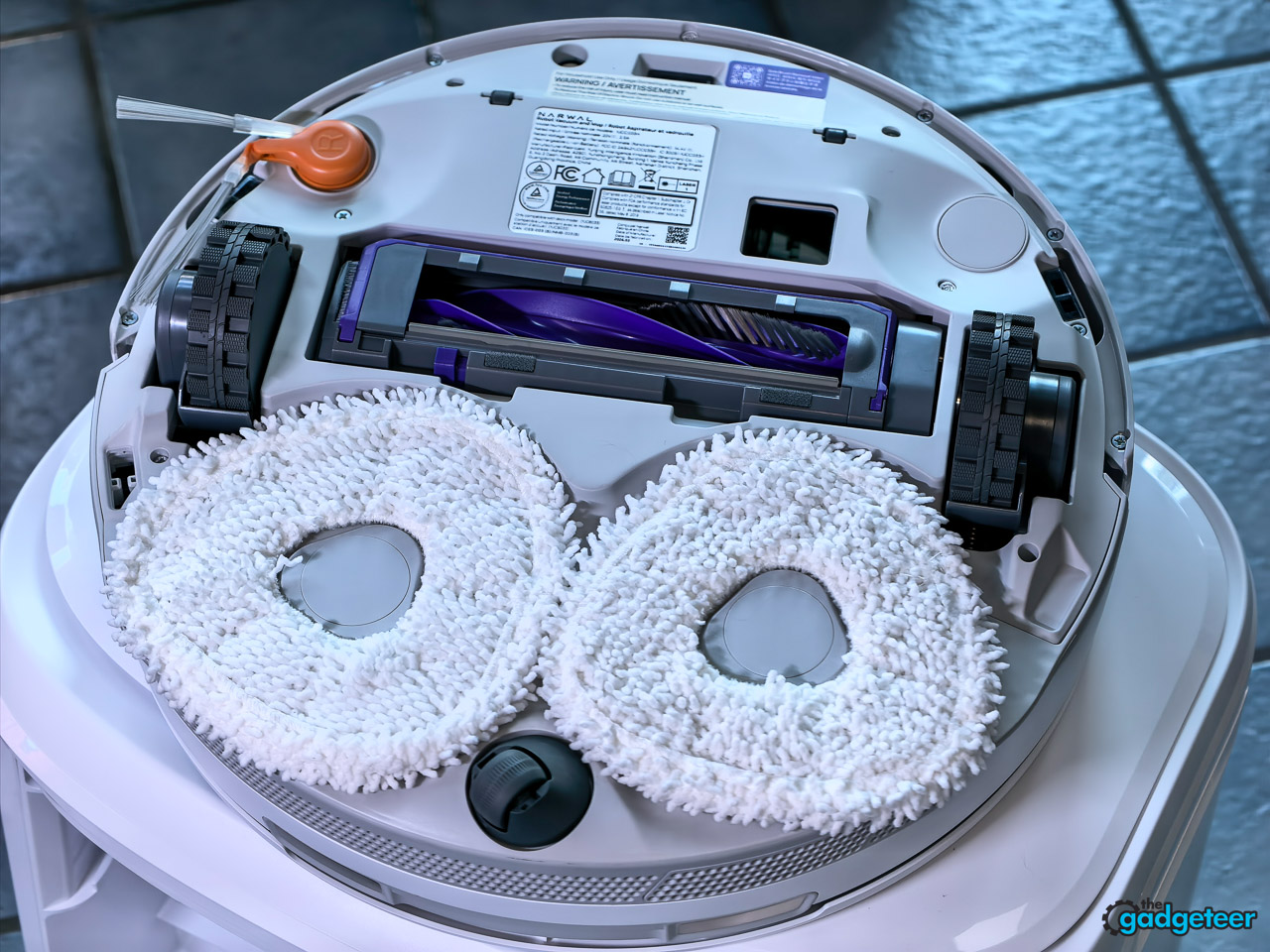
In my week of testing, the corner-alignment reversal triggered reliably on baseboard approaches and inside corners. I noticed it most in the dining room where chair legs create tight angles. The brush extended its reach and pulled crumbs out that the main inlet would have missed. It is not instantaneous, so very acute corners still leave a small untouched crescent, but the improvement over a fixed-diameter sweep is clear.
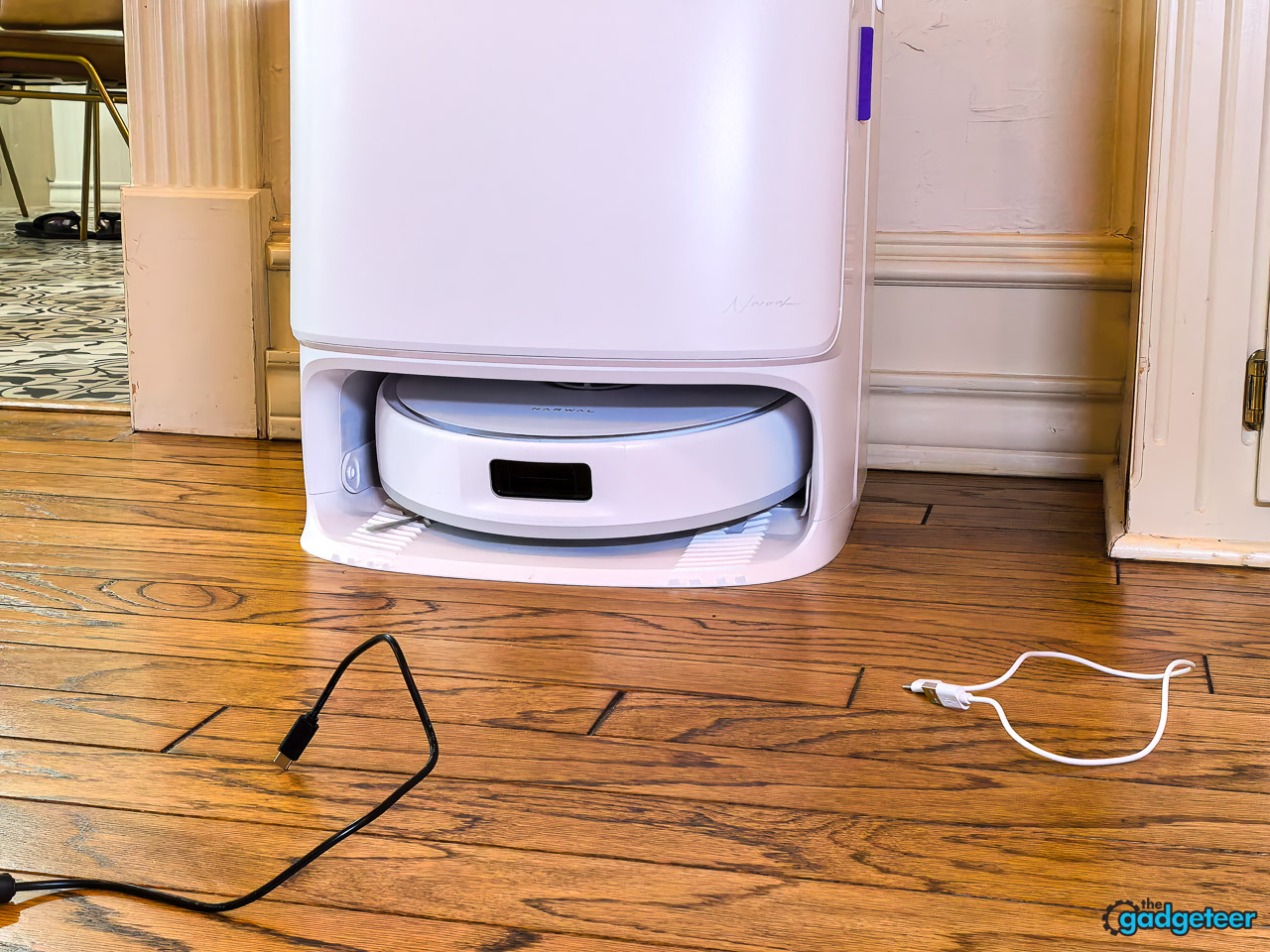
The base station is the part that earns the dock fee. The mop pads get washed in hot water that ranges from 113°F for daily mess to 140°F for grease, reaching up to 167°F for pasteurized sterilization. Dust empties into a sealed 2.5L bag rated for 120 days of typical use. There’s auto detergent dispensing and a hot-air drying cycle that prevents mildew.
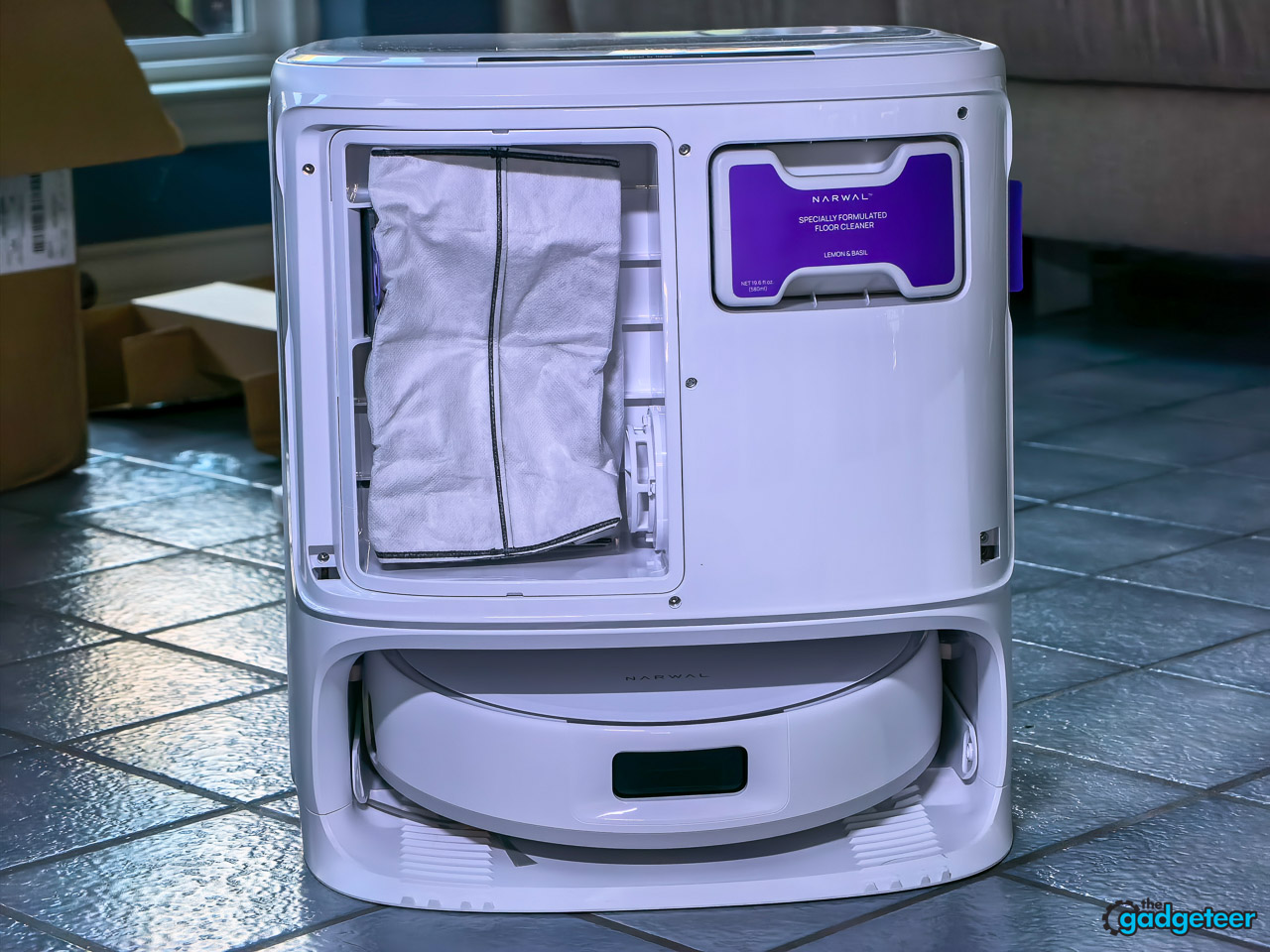
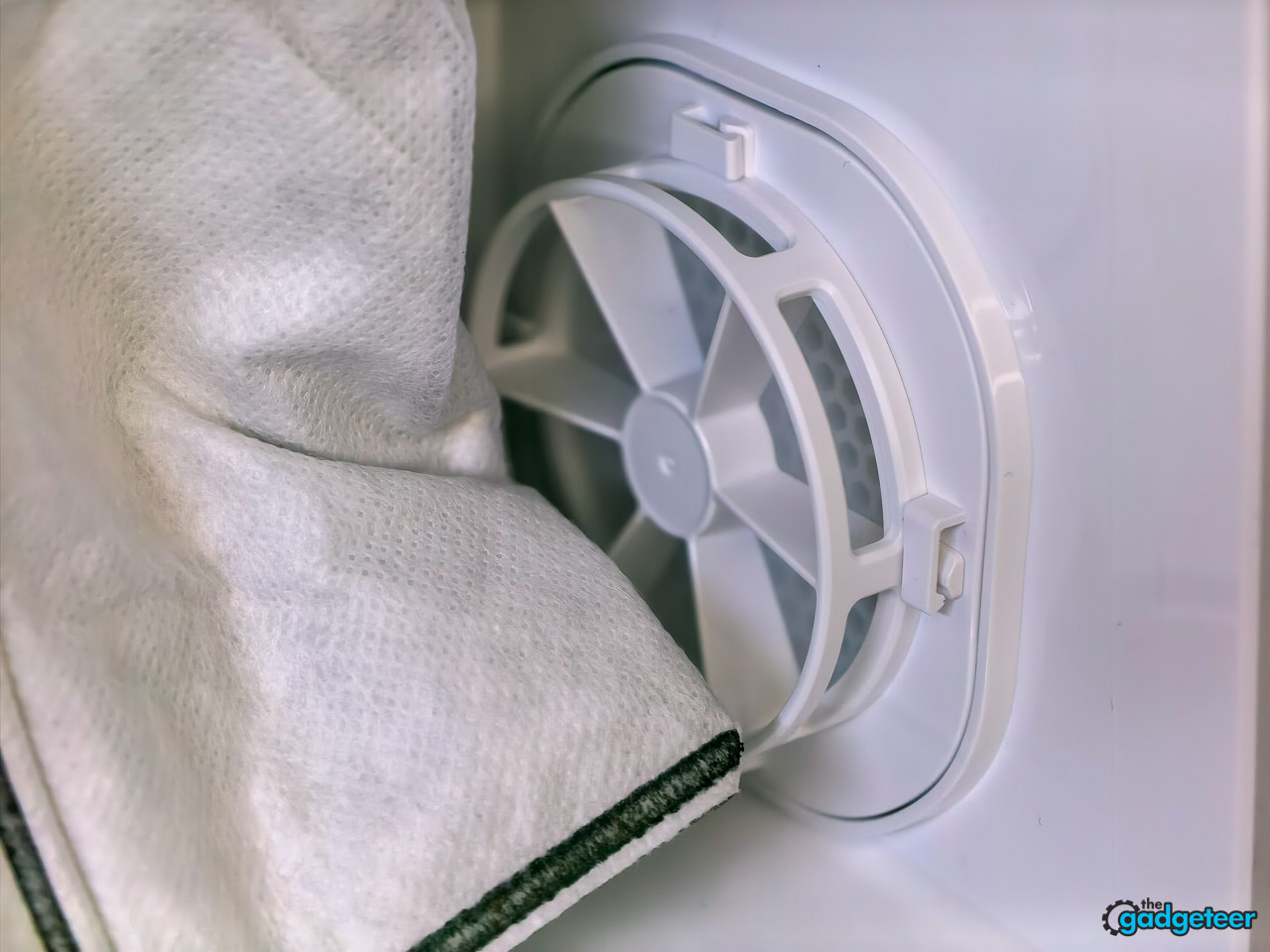
The auto-empty fired after every substantial cleaning run in my testing, compressing the 300 ml onboard bin into the 2.5L bag without issue. The pulse lasts about eight seconds and lands in the same neighborhood as a premium upright vacuum winding down, noticeably shorter than the legacy Narwal dock I tested in 2023. The hot-water wash is the longer phase at roughly four to five minutes, but it is a low hum rather than a whine, easy to ignore from the next room.
The app is where I have notes. Narwal’s app is dense, and the Freo Mind auto mode tries to make decisions for you (mop here, vacuum there, ignore that rug). Freo Mind is useful once you trust it. For the first two days I overrode the mode selection manually from the Find N6, defaulting to vacuum-and-mop everywhere. By day three I let the automation run, and it correctly identified the kitchen as mop-priority and the bedroom rug as vacuum-only. It missed once on a transition zone where the rug edge meets tile, attempting to mop a strip of carpet, but a quick no-mop zone draw on the foldable screen fixed it. The learning curve is real, but the automation saves taps once you map the exceptions.
Multi-floor mapping, no-go zones, scheduling, and detergent control are all there in the Narwal Freo app, with commands for start, pause, return to dock, room-specific cleaning, and suction mode.
Here is the point in most robot vacuum reviews where I remind you that specs lie. A big Pa number does not mean your floors are clean. So I stopped looking at the app and started looking at the rug.
CarpetFocus matters on a non-Flow model
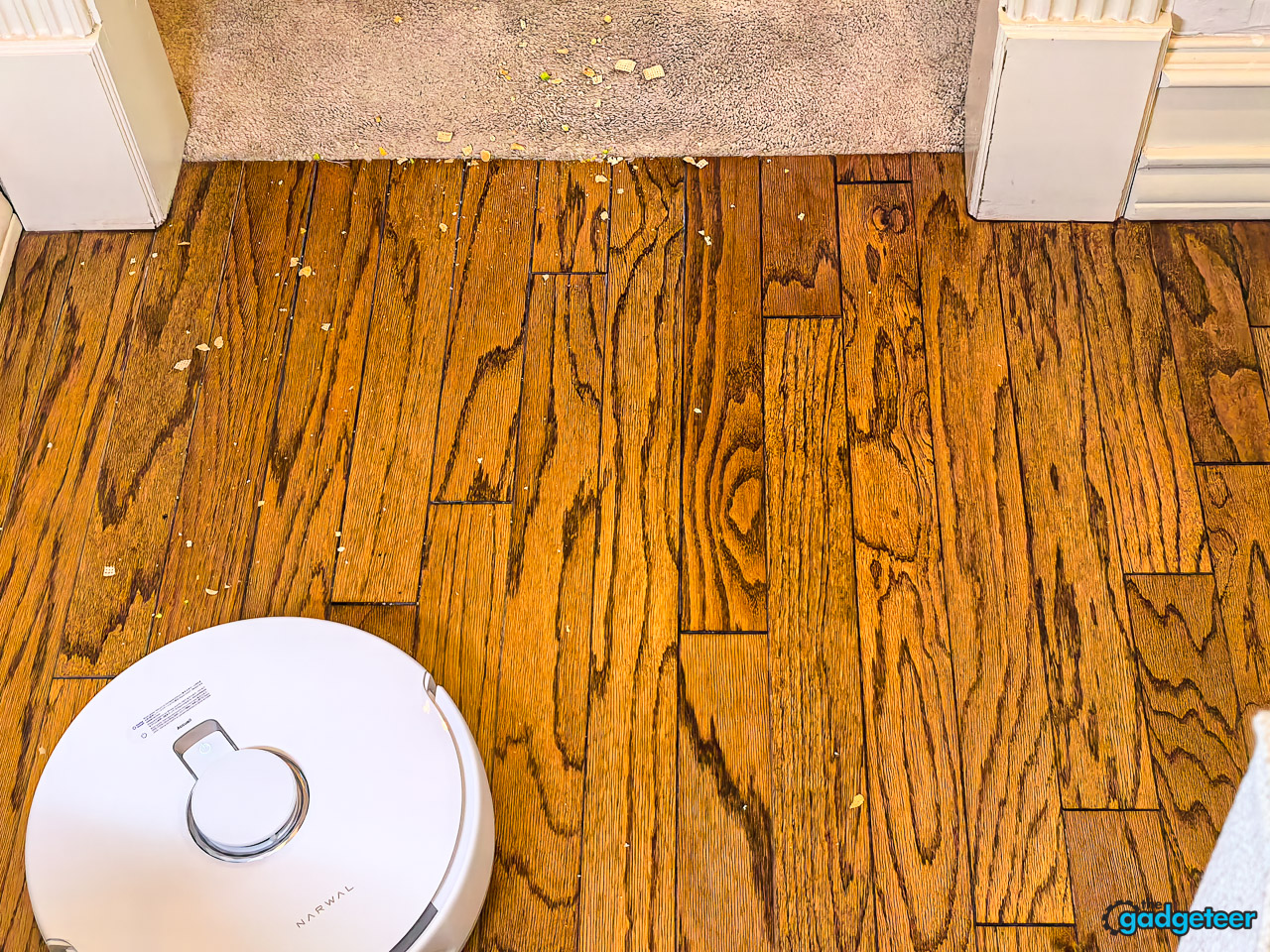
CarpetFocus is the piece that justifies the Turbo name at this price. Narwal says this is the first time the deep-carpet mechanism has shipped on a non-Flow model, meaning the brush cover that drops down to seal a high-pressure airflow zone, plus the dual-pass zigzag Carpet Max mode, are no longer locked to the brand’s flagship line. The mop simultaneously lifts 12 mm to keep pads dry while the vacuum runs, and the side brush retracts on wet zones so the dry-wet separation holds up across mixed-floor homes. In my runs on low-pile and mid-pile rugs, the Carpet Max pass looked meaningfully more thorough than a quick single pass, especially on pet hair that tends to sit down in the pile.
CarpetFocus and how it actually cleans carpet
CarpetFocus is the headline feature on the spec sheet, so it’s the one to pressure test first. CarpetFocus drops a brush cover when the robot detects carpet. The cover seals against the carpet to create a high-pressure airflow zone, which boosts effective suction beyond the 25,000 Pa headline number. Carpet Max mode runs two zigzag passes from different angles, designed to lift hair and embedded dirt that a single-pass robot leaves behind.
In practice, the brush cover is the thing you can hear engage. There’s a soft mechanical click when the robot transitions from hardwood to my low-pile rug, then a pitch shift in the motor as the seal forms.
Ember’s dog-hair pass on the low-pile rug left visible improvement after a single Carpet Max cycle. I laid out a measured 2.5-inch pile of Ember’s shed hair, and the Turbo cleared most of it on the first dual-pass zigzag run. The brush-cover seal is audible when it engages, and the rug fibers stood slightly taller afterward, suggesting the agitation was doing more than surface-level pickup.
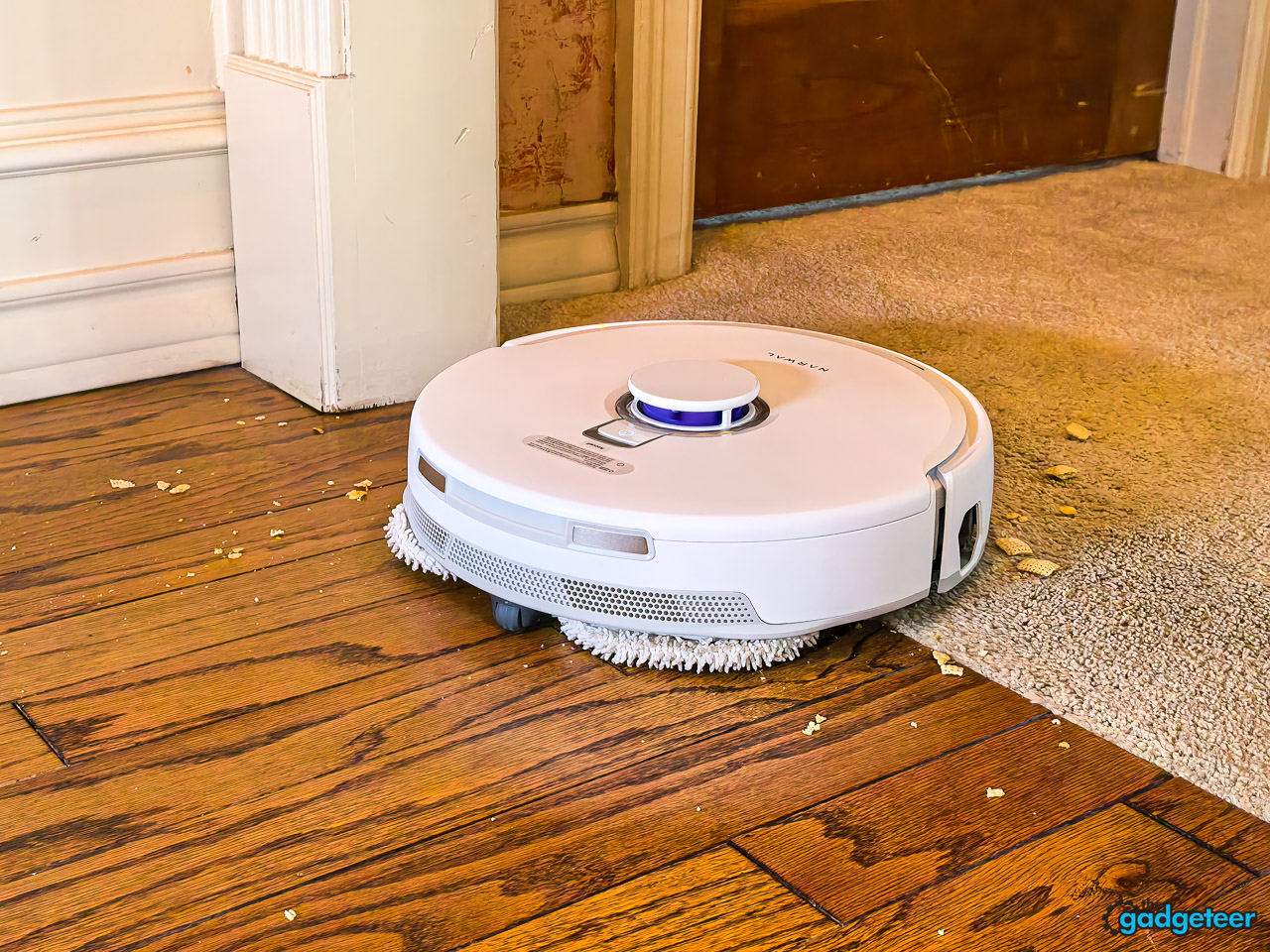
The mid-pile bedroom rug was the harder test. The brush cover sealed well enough to show a clear pickup gain over the standard Z10, though the seal is not absolute on taller fibers. I could still feel a few stray hairs near the base of the pile after one cycle. A second Carpet Max pass cleared them. This is still better performance than I’ve seen from most mid-range robots on mid-pile, but if your home is all thick shag, you are shopping flagship tier regardless.
The auto mop lifting matters here too. When the robot detects carpet, it lifts the mop pads 12 mm so the carpet stays dry. The lift isn’t infinite, so on thick rugs there’s still a marginal damp risk. I did not see wet edges on the low-pile rug. On the mid-pile bedroom rug, I found a faint damp stripe along the outer perimeter after the first mopping-and-vacuuming hybrid run, where the mop lift was grazing the tallest fibers. Switching to vacuum-only mode for the bedroom solved it, and for mixed-floor jobs the damp never transferred to hardwood. The 12 mm lift is sufficient for standard rugs, but check your thickest pile manually on the first run.
EdgeReach mopping and the 12N pressure jump
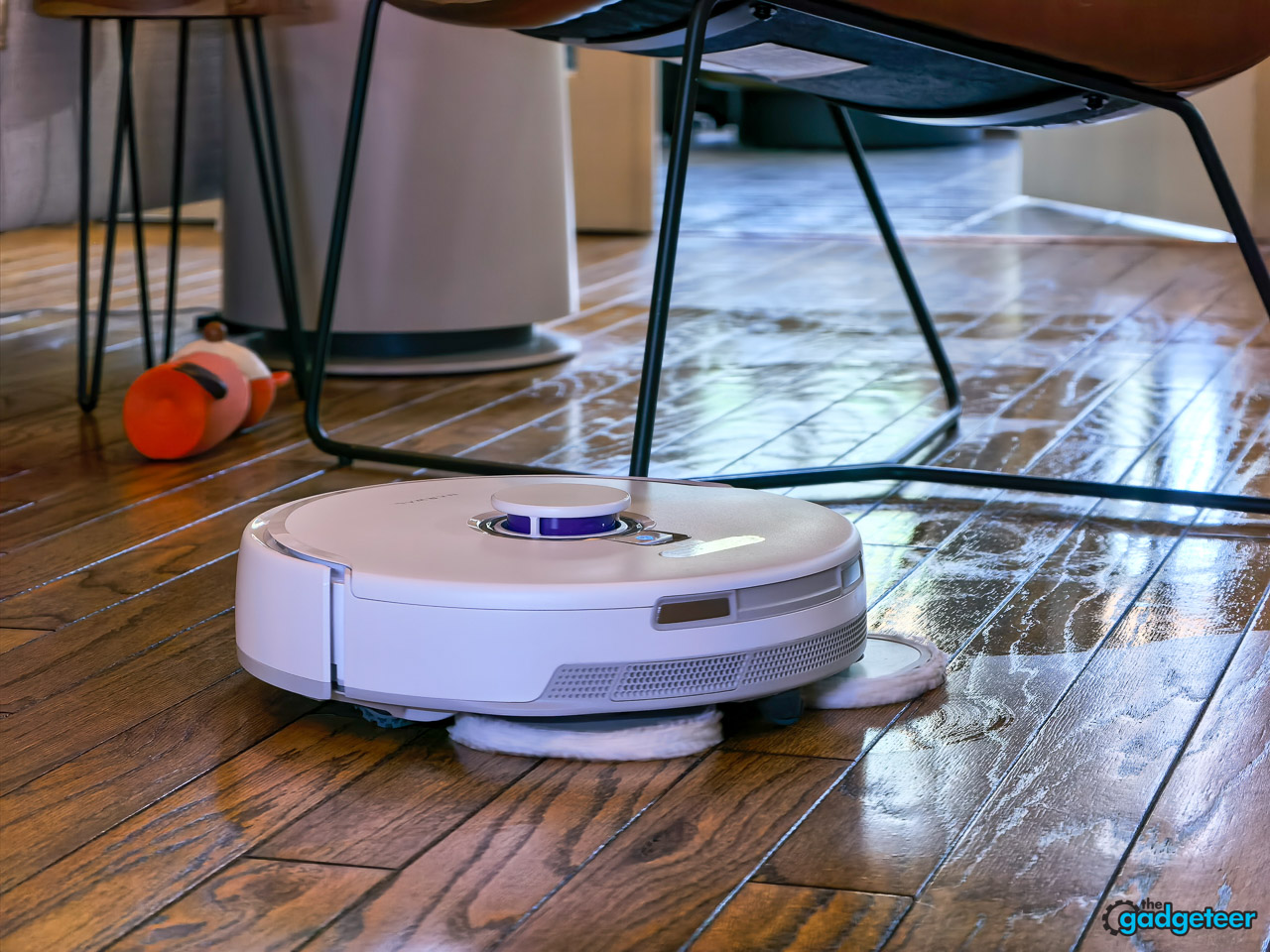
The EdgeReach mop is the other reason to consider this over the standard Freo Z10. The arm extends to push a mop pad into baseboards and corners, then retracts so the robot can navigate normally. 12N of constant pressure is meaningful. It’s the kind of force you actually use when you’re scrubbing a stuck stain by hand. The standard Z10 sits at 8N, which is closer to a wipe than a scrub.
The dried coffee spot, roughly three inches across and left to set for an hour, lifted after two passes with the EdgeReach arm extended. The first pass broke the surface film and the second cleared the stain entirely. I did not pre-treat or spray anything.
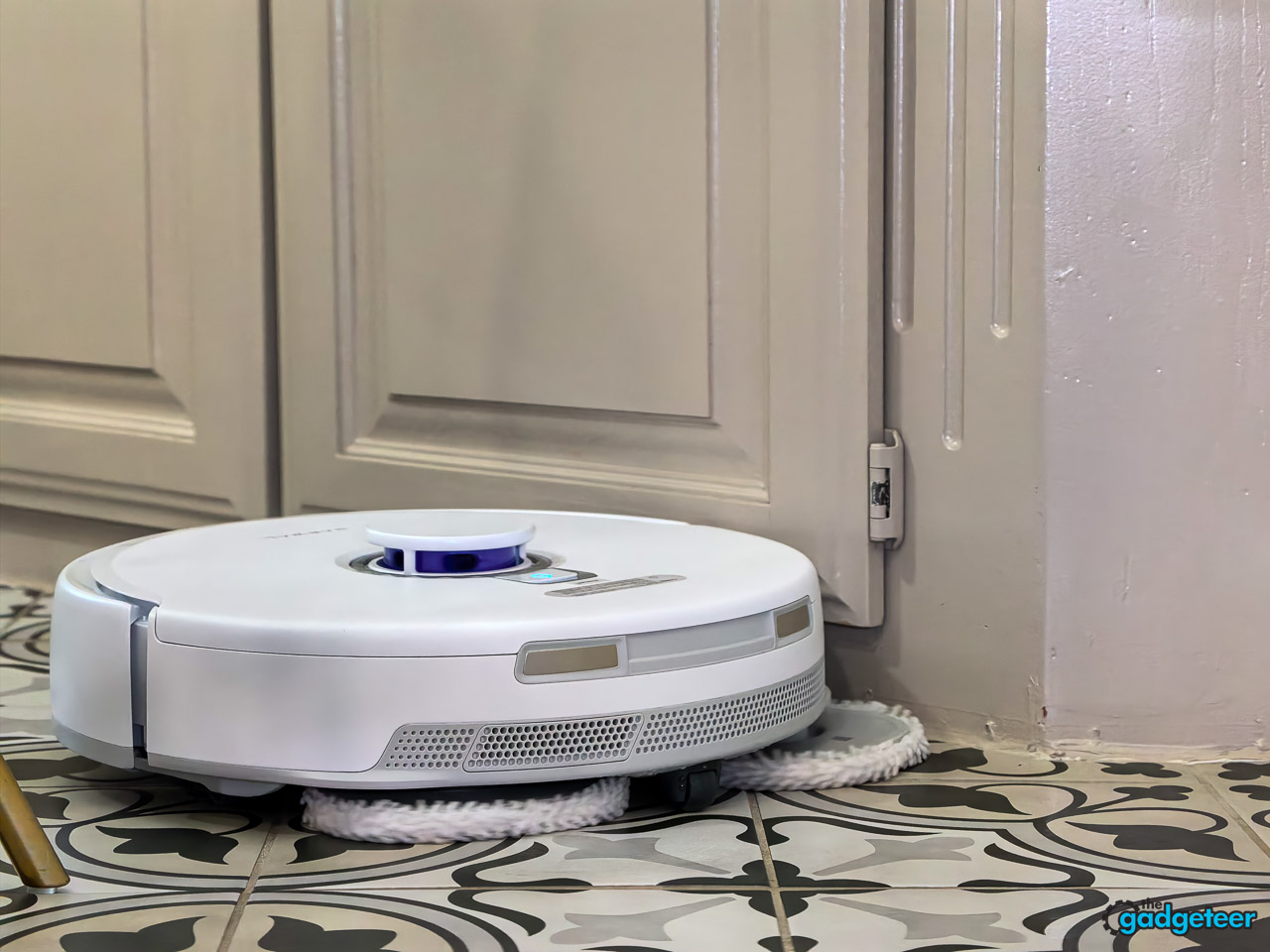
The dried coffee spot, roughly three inches across and left to set for an hour, lifted after two passes with the EdgeReach arm extended. The first pass broke the surface film and the second cleared the stain entirely. I did not pre-treat or spray anything.
The muddy paw print, still slightly wet when the robot found it, vanished in one pass. The EdgeReach arm pushed the mop pad into the grout line between tiles, which is where this kind of mess usually hides.
The juice spill, a sticky orange spot that had an hour to caramelize, took three passes and one auto re-mop cycle. The robot returned to the dock after the second pass, washed the pads at the 140°F grease setting, and came back to finish the job. By the third pass the floor was tack-free.
The hot-water wash between passes does what it claims. The pads don’t smear residue back onto the floor the way a cold-water mop sometimes does. DirtSense intelligent detection is the closing piece. When the robot senses a zone is still dirty after a first pass, it re-mops the floor and re-washes the pads before continuing instead of declaring the job done.
Yes, DirtSense triggered on both the coffee and juice tests. On the coffee stain it re-mopped once. On the juice it re-mopped twice. In both cases the spots were gone afterward, and I did not feel the need to break out a manual mop.
Suction and tangle handling
A 25,000 Pa rating only matters if the airflow path can use it. Narwal’s roller brush is built around a floating-arm conical design that spins over 4,000 times per minute, with the open end of the brush cone where the airflow is faster. Hair gets directed toward the dustbin instead of wrapping around the bristles. The dynamic detangling side brush retracts in wet zones for dry-wet separation, and pivots its bristles for corners.
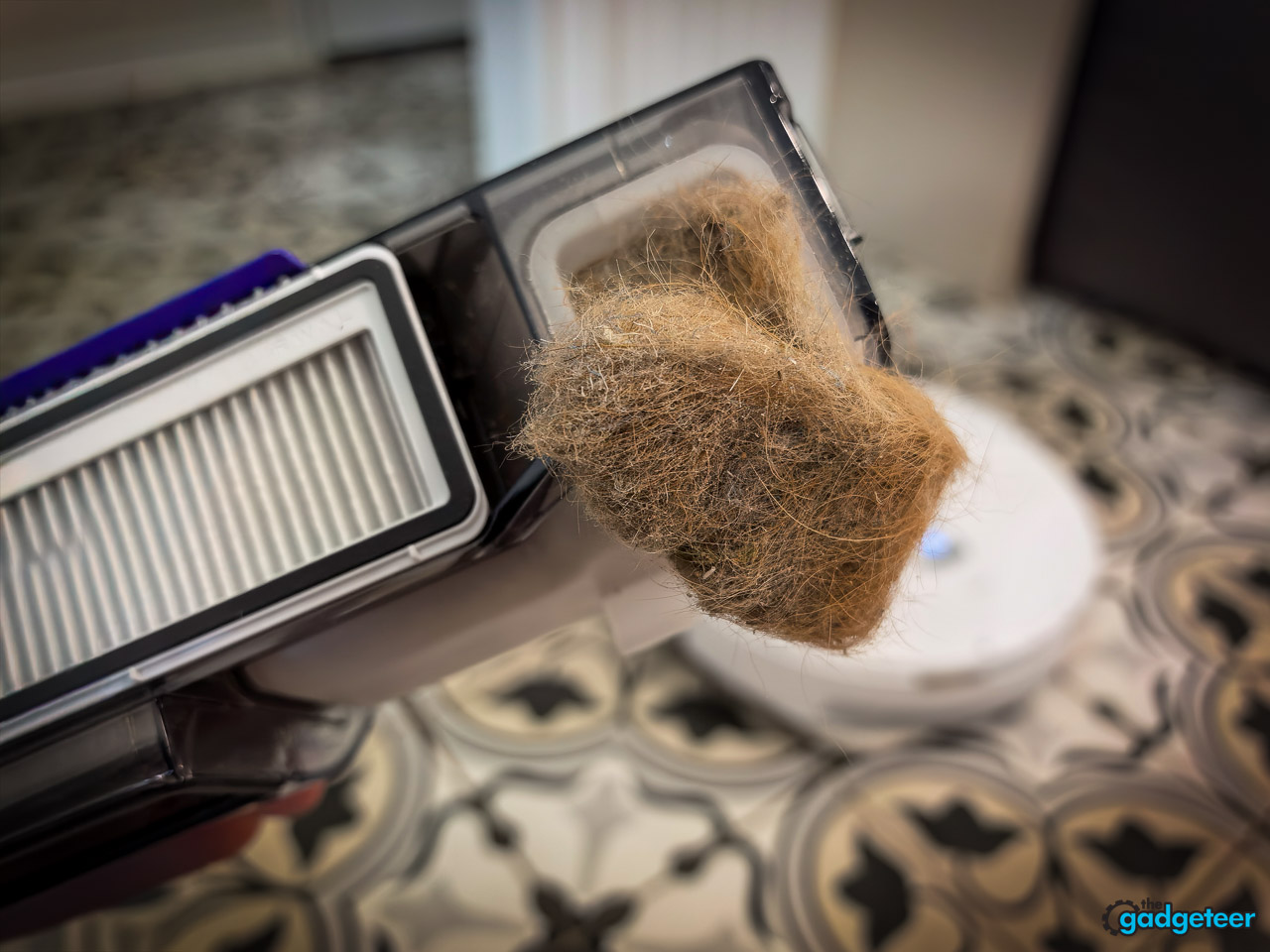
After four days of daily whole-home cleans in a house with a shedding dog, I pulled the roller brush and found three short strands wrapped loosely around the cone, none of them tensioned enough to require scissors. The side brush was hair-free.
Fine debris is where the 25,000 Pa rating shows its work. A tablespoon of flour and a teaspoon of granulated sugar distributed across hardwood and the low-pile rug were fully cleared in a single pass over each zone. On the rug, I checked the fibers afterward with a handheld LED and found no visible residue.
The dustbin only holds 300 ml on the robot itself, which is small if you skip a base-station empty for a week, but the base bag is the relevant capacity number, and 2.5L is generous.
Navigation and obstacle avoidance
The Freo Z10 Turbo is camera-free. That’s a deliberate choice and a selling point for buyers who don’t want an internet-connected camera roaming the house. LDS lidar handles full-home mapping in a couple of cycles. Tri-laser structured light handles obstacle avoidance, identifying things as small as 1 cm tall.
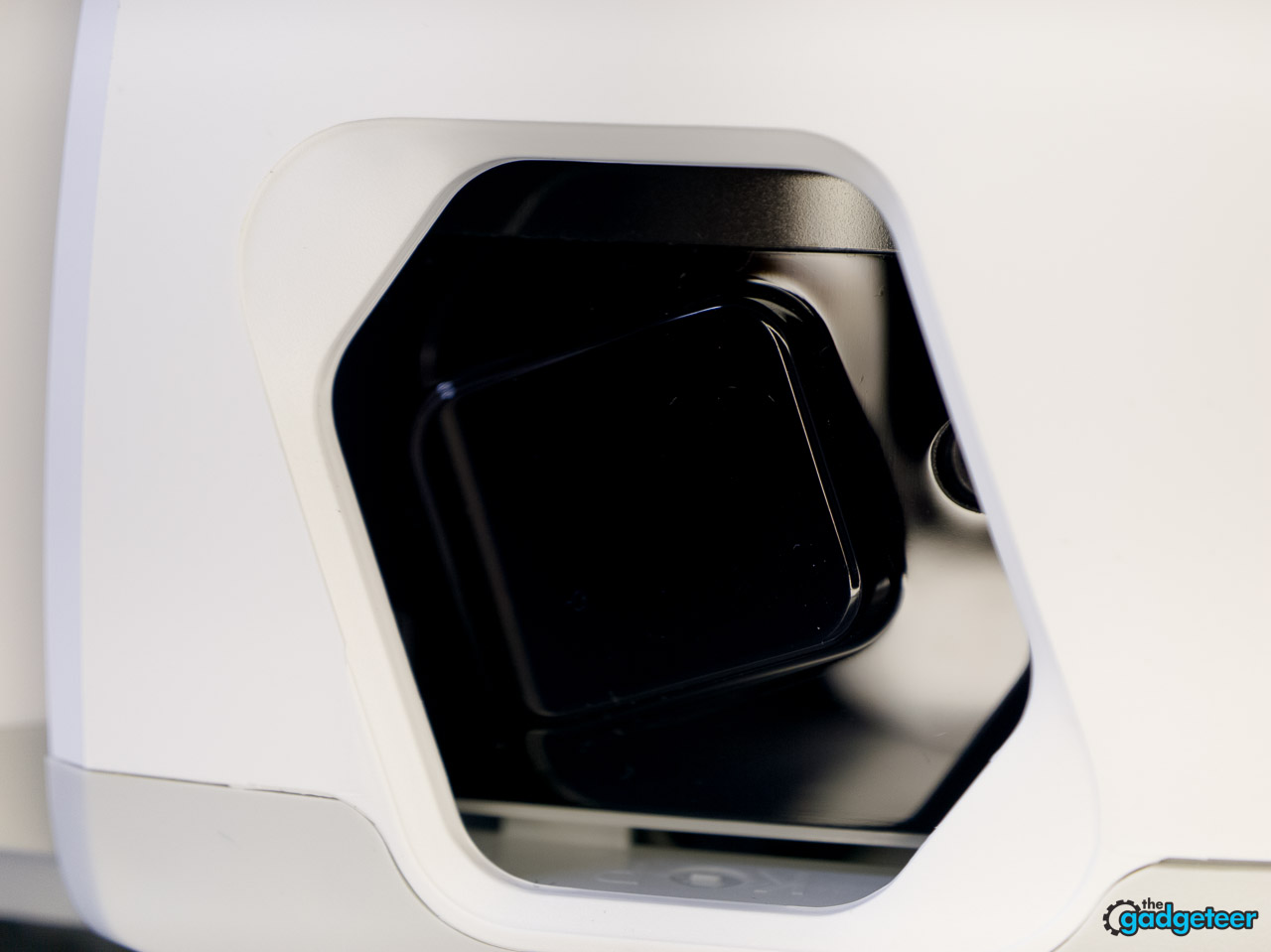
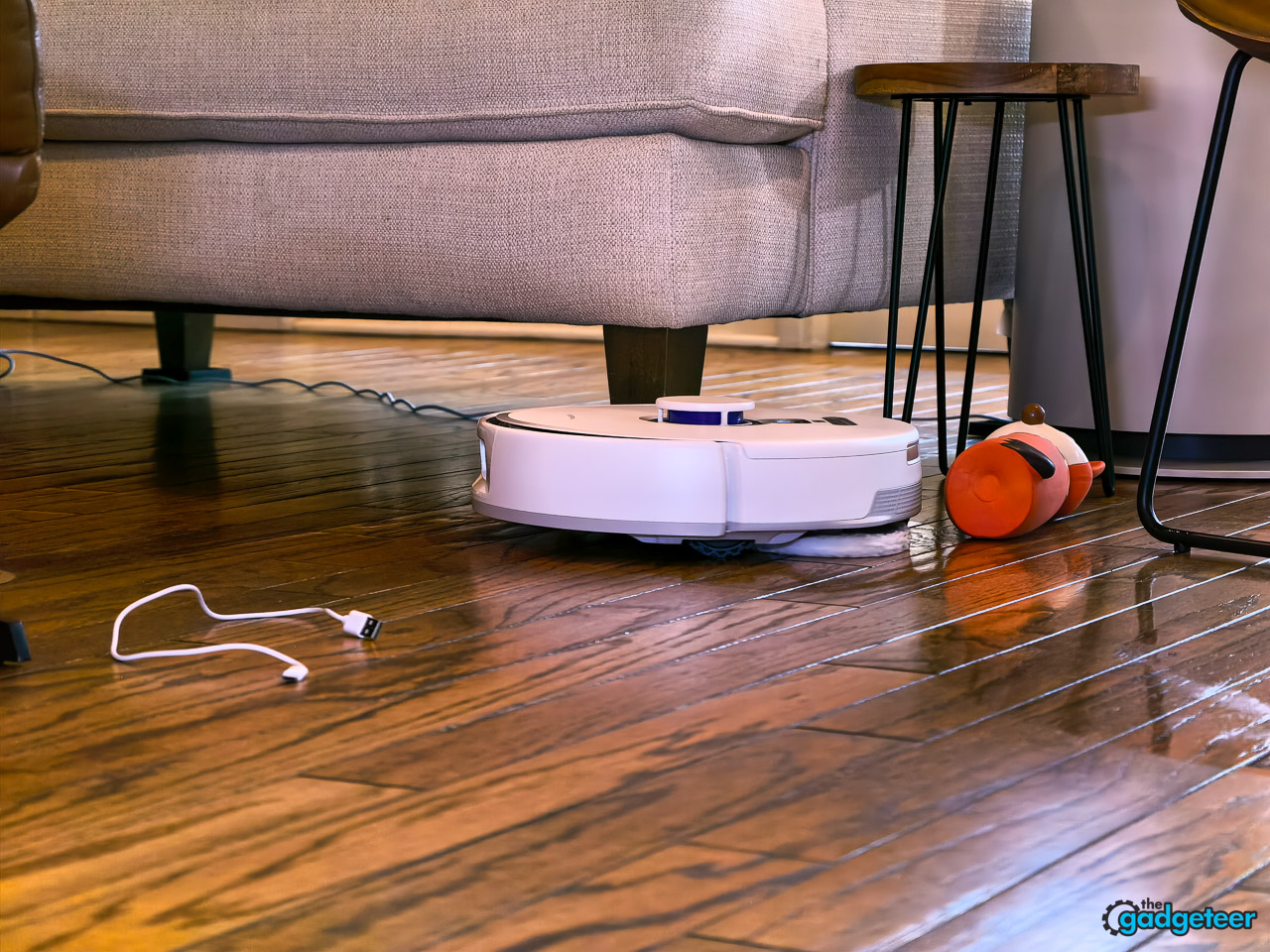
The tri-laser system identified a pair of sneakers and a braided charging cable without contact, slowing and routing around them with a margin of roughly two inches. A soft dog toy (a plush duck) was the one miss. The bumper nudged it slightly before the laser recognized it as an obstacle. It did not ingest the cable, which is the failure mode I care about most.
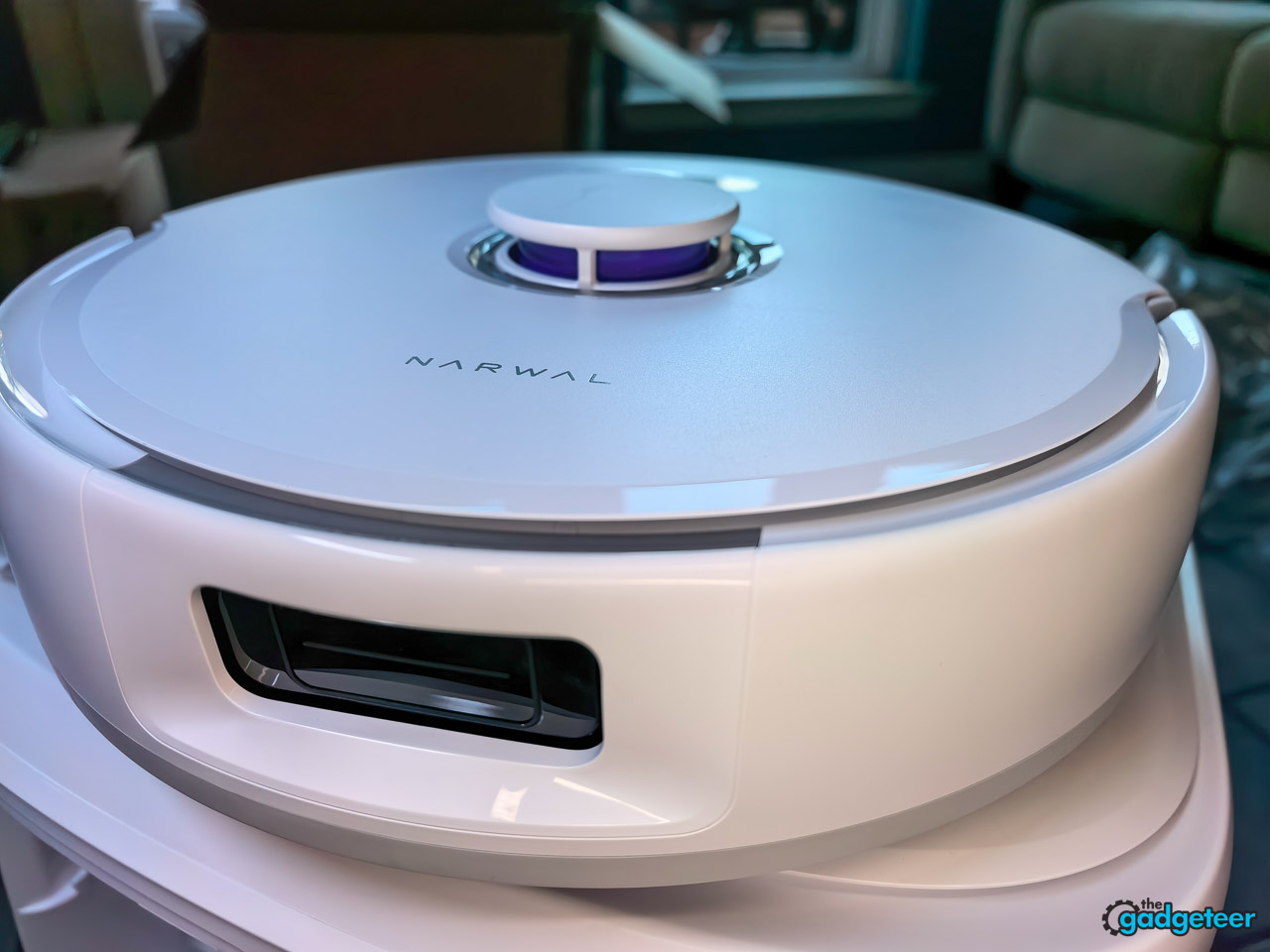
In open-floor navigation, it’s quick and methodical. It navigated the dining-room chair forest without getting trapped. The robot nudged one chair leg lightly, corrected, and continued. In the tighter laundry-room space between the washer and a cabinet, it squeezed through a gap of about 14 inches without complaint. I never had to rescue it.
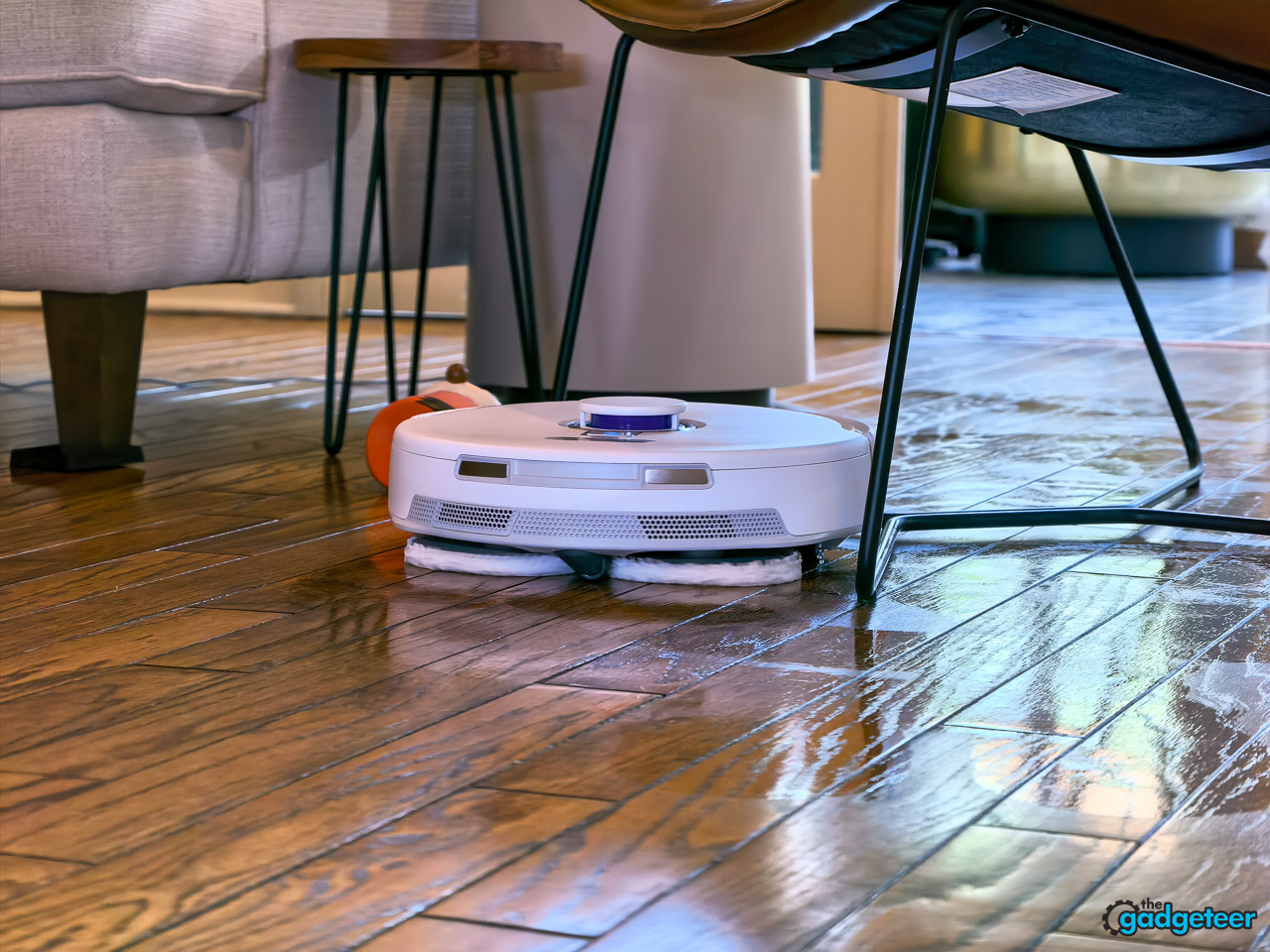
Threshold crossing is rated at 2 cm, which is enough for typical room transitions and the lip on most low-profile rugs.
Without cameras, the trade-off is fewer object-recognition tricks (no “that’s a slipper, avoid it specifically” callouts in the app like the flagship models offer). The 100+ object detection list works through the laser system instead. The app does not show object labels like “sock” or “shoe” because there is no camera, but the laser-based recognition distinguished between solid obstacles and drop-offs consistently. I noticed one misclassification. A dark threshold strip between rooms was briefly flagged as an obstacle on the first mapping run, but the robot crossed it anyway and corrected the map on the next cycle.
Base station and 120-day maintenance
The dock measures roughly 431 by 427 by 462 mm and weighs about 11.3 kg per Narwal’s official size sheet. It handles auto dust emptying, AI Adaptive hot-water mop washing, hot-air mop drying, auto tank refilling, auto detergent dispensing, auto dock self-cleaning, and auto charging. The 2.5L sealed bag is the part that earns the 120-day maintenance-free claim, assuming a typical home running daily cleans. The three-temperature mop wash matches the job: 113°F for daily powder and dust, 140°F for grease and oil, and 167°F for pasteurized sterilization. Hot-air drying after each mop wash is the feature most worth having.
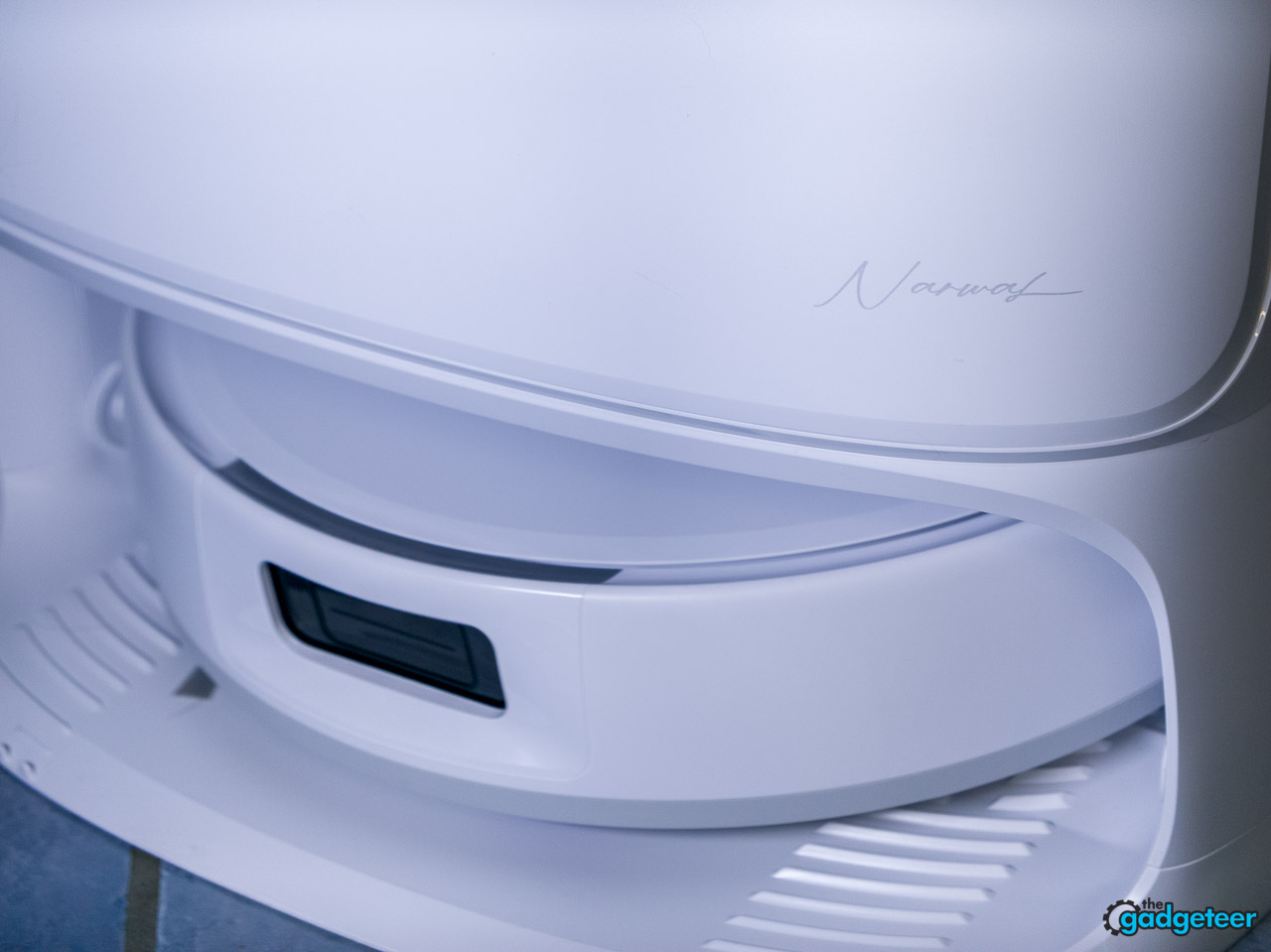
Over the week of testing, with daily vacuum-and-mop runs across roughly 650 square feet of moppable floor, I topped up the clean tank twice and emptied the dirty tank twice. That works out to roughly every three to four days for a home of this size and schedule.
Noise during the dock cycle is meaningful. I did not bring a decibel meter to this test, so I cannot confirm Narwal’s “half industry average” claim numerically. Subjectively, the auto-empty pulse is brief and lands at roughly the level of a handheld vacuum on its medium setting, not the jarring compressor bark some docks produce. The hot-water wash is quieter than the empty cycle. For apartment dwellers or night scheduling, the noise profile is manageable.
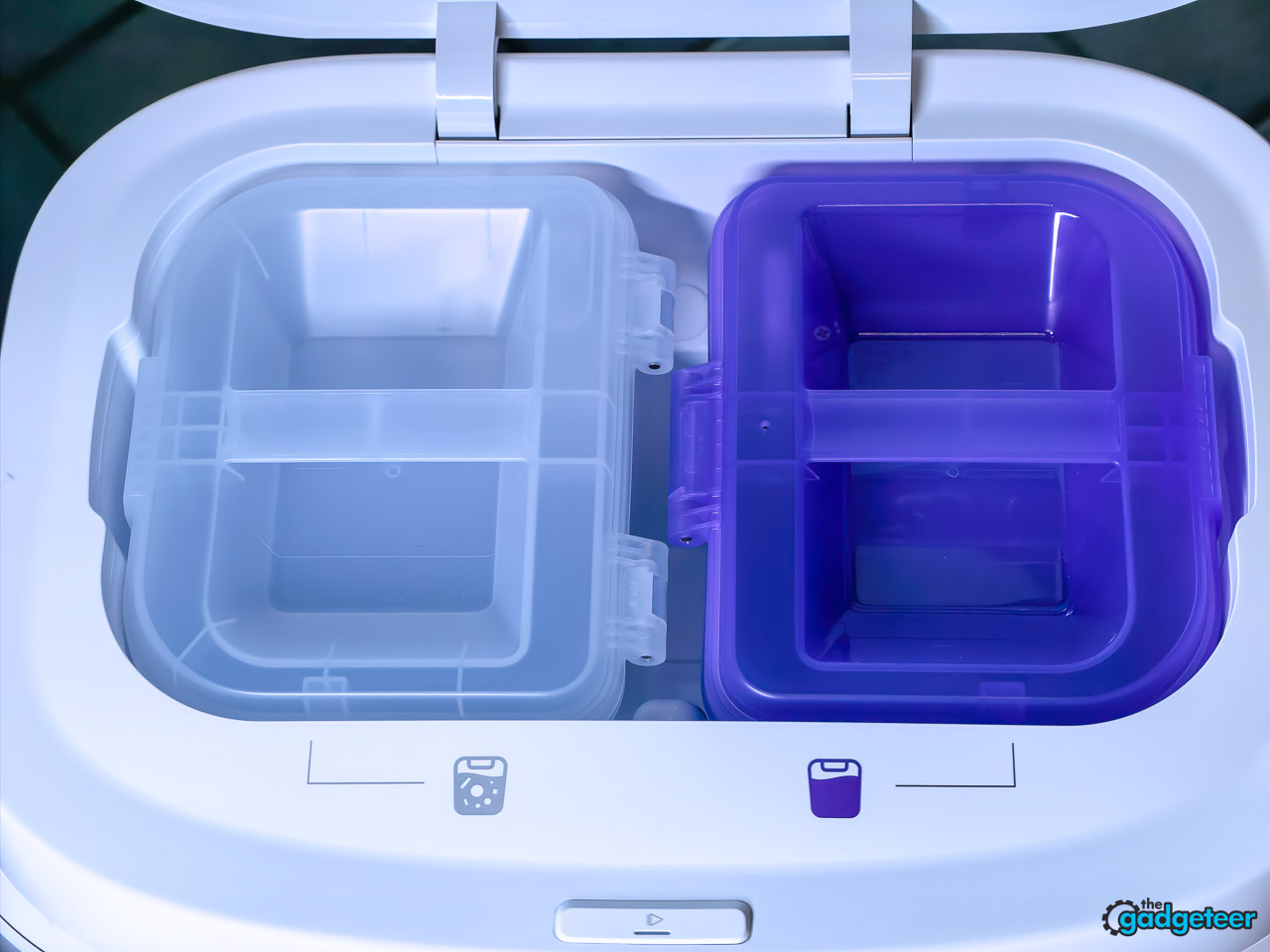
Pricing and value
At the $599.99 launch price, the Freo Z10 Turbo lands well below the going rate for a 25,000 Pa robot mop combo with comparable mop pressure, based on the mid-tier robot vacuums I’ve tested over the past year.
Narwal is also throwing in a $199 accessory bundle at no extra cost during the launch window. The kit includes one roller brush, three pairs of mop pads, two clean water tank filter cottons, two anti-tangle side brushes, two HEPA filters, two bottles of cleaning solution, and two dust bags. That covers consumables for the better part of a year and effectively drops the real-world entry price closer to $400 once you account for parts you’d otherwise reorder.
After the launch window closes on May 31, the price moves to $899.99 MSRP and the free accessory bundle goes away. That’s where the math gets less obvious. At $899.99 with no bundle, the value case narrows considerably and the comparison shifts toward flagship-tier robots.
At $599.99 to $699.99 with the bundle included, this is the most feature-dense robot in its segment.
One note for buyers reading this after May 31: Narwal’s pricing pattern across the Freo line is to discount aggressively and often.
The standard Z10 launched at $1,099.99 and is currently promoted at $899.99 per Narwal’s official pricing. That means the Turbo’s $599.99 introductory window, with the $199 accessory kit stacked on top, is the cheaper of the two configurations during the launch period despite carrying the higher MSRP.
Amazon has trended well below Narwal’s $899.99 official promo in 2026. The standard Z10 has been listed at $549.99 on Amazon and $649.99 at Best Buy during recent sale windows, so shoppers should price-check different retailers before buying anywhere near MSRP.
Watching the Z10 Turbo for a return to the launch price is a reasonable move if you miss the May window, though the free accessory bundle is a launch-only sweetener that won’t carry over to later sale cycles. If history holds, the Turbo will follow the same pattern and drop below $700 on Amazon within a few months, which is when the value case becomes undeniable again even without the bundle.
FAQ
Does the Narwal Freo Z10 Turbo have a camera?
No. It uses LDS lidar plus tri-laser structured light for navigation and obstacle avoidance, with no on-board camera.
Is the Freo Z10 Turbo good for pet hair?
The SGS-certified DualFlow Tangle-Free System is built specifically for homes with long hair and pets. The roller brush directs hair into the dustbin instead of wrapping. Confirmed: the 2.5-inch pet-hair load on carpet cleared in a single Carpet Max cycle with minimal residue left in the fibers.
Can it climb thresholds?
Up to 2 cm. That covers most interior room transitions and standard low-profile rug edges, but tall thresholds and high-pile rugs can trip it.
How long does the base station bag last?
2.5 liters, rated for up to 120 days of typical use. Heavy-shedding pets or larger homes shorten that window.
What’s the difference between the Freo Z10 and the Freo Z10 Turbo?
The Turbo bumps suction from 15,000 Pa to 25,000 Pa, adds CarpetFocus Technology and the brush cover, increases mop pressure from 8N to 12N, upgrades to tri-laser obstacle avoidance, and adds a 100+ object recognition library that the standard Z10 doesn’t list. The base station is the same on both (2.5L bag, 113°F to 140°F hot-water wash with 167°F sterilization peak, hot-air drying, auto detergent, auto self-cleaning), and DirtSense intelligent re-mop and re-wash carries over. If you want camera-based object recognition, you’re shopping a different category.
What is DirtSense and does the Z10 Turbo have it?
Yes. DirtSense is Narwal’s auto re-mop and re-wash routine. The robot evaluates how dirty a zone is during the first pass, and if it isn’t satisfied, it returns to the dock to re-wash the pads in hot water and then re-mops the spot until the result clears its threshold. It’s the same system on the standard Freo Z10.
Is it worth $599.99?
At launch pricing, yes for buyers who want strong carpet performance and aggressive mopping in a camera-free robot. At the $899.99 MSRP, the value case narrows. At $599.99, the Freo Z10 Turbo is the best value in Narwal’s current lineup and one of the strongest mid-range robot mop combos I’ve tested. At $899.99 MSRP, it is still competitive but no longer a no-brainer. My recommendation is to buy inside the May 18 to 31 launch window or wait for the inevitable sale.
Final thoughts
The Freo Z10 Turbo is the rare mid-tier robot vacuum mop that doesn’t feel like a stripped-down flagship. CarpetFocus is the headline, and it earns the headline. The 12N mop and tri-laser navigation are the supporting acts that make the package coherent. The gaps are minimal, limited to a couple of small dock-side annoyances, but the cleaning side of the equation is genuinely competitive with robots that cost twice as much.
If you’ve followed our Narwal coverage from the original Freo through the Flow, the Z10 Turbo is the most interesting iteration in the lineup at this price point. It pulls flagship features down into a tier where they actually move the needle for buyers, and it does it without the camera that gave me pause on the Freo Z Ultra. If you’re shopping the $500 to $700 robot vacuum tier and you have meaningful carpet in the house, this is worth a hard look. If you don’t have carpet, the standard Freo Z10 at $899.99 is still a reasonable pick for camera-free LDS navigation, the same base station, and the same DirtSense mopping, but at launch pricing the Turbo undercuts it by $300, so the better-value-sibling argument only holds once the Turbo’s introductory window closes and it settles toward MSRP. If you want camera-based object recognition, you’re shopping a different category. For everyone else, the Freo Z10 Turbo is the most thoughtful mid-range robot Narwal has shipped to date.
Price: $599.99 (launch through May 31) / $899.99 (MSRP)
Where to buy: us.narwal.com | AMAZON
Source: The sample for this review was provided by Narwal. Narwal did not have a final say on the review and did not preview the review before it was published.
Check out our other Narwal reviews
- Narwal Freo robot vac/mop review (2023)
- Narwal Freo X Ultra robot vacuum review (2024)
- Narwal Freo X Plus robot vacuum review (2024)
- Narwal Freo Z Ultra robot floor cleaning system review (2024)
- Narwal Freo Pro robot vacuum and mop review (2025)
- Narwal Flow vacuum review (2025)