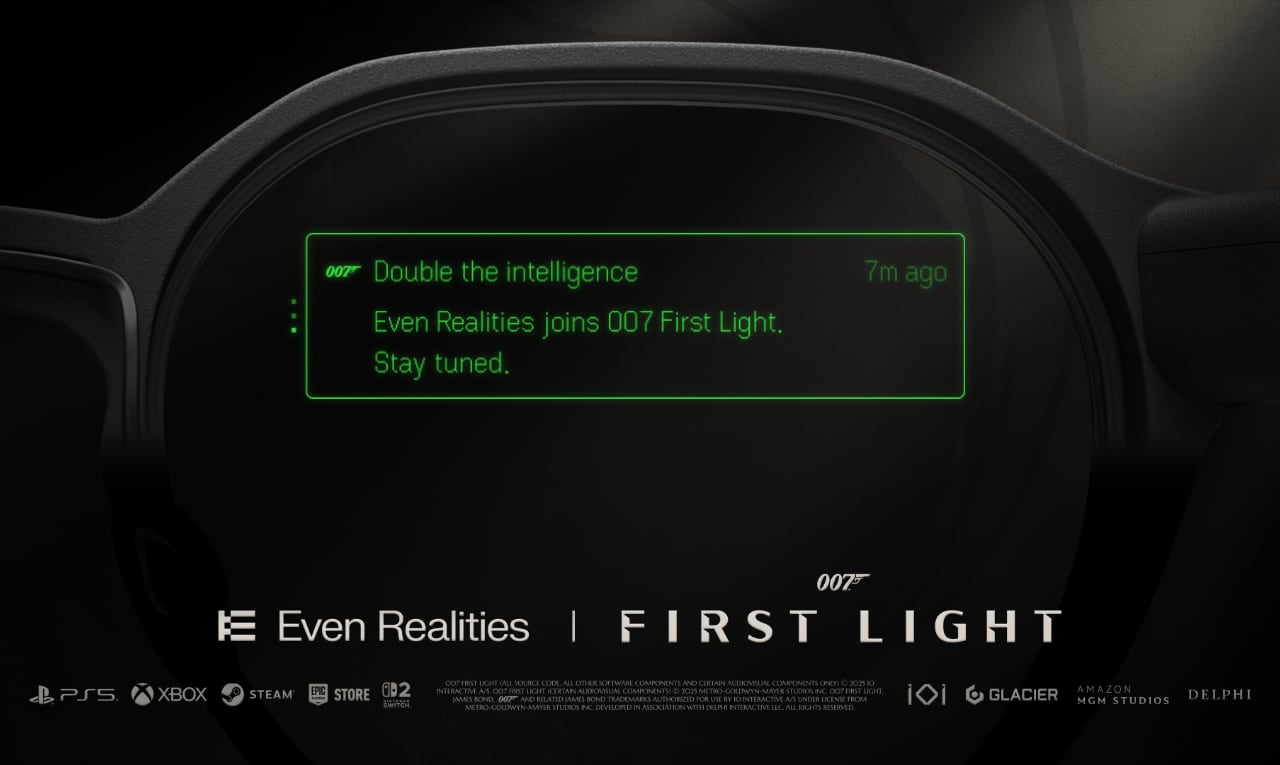
After five months of wearing the Even Realities G2 in the real world, the news that it’s becoming an actual gadget inside 007 First Light doesn’t feel like forced product placement. It feels like the first time a smart-glasses maker understood the assignment: spy gear should be invisible, not a face-mounted camera that screams “I’m recording you.”
I’ve been wearing the Even Realities G2 since January, through the chaos of CES, through security lines at McCarran, through grocery stores where nobody gave me a second glance. That’s the whole pitch: smart glasses that don’t look smart. So when Even announced this morning that the G2 is being woven into IO Interactive’s upcoming 007 First Light as an actual in-game gadget, my first thought wasn’t “nice press release.” It was: finally, a wearable that fits the fiction. No cameras. No chunky frames. Just a clean titanium chassis and an in-lens display that feeds you information without announcing itself to the room. Bond wouldn’t be caught dead in Ray-Ban Meta’s camera bulbs. The G2? I could see it on a young recruit’s face in MI6.
Even G2 smart glasses: from $599
Even R1 ring: $249
Where to buy: G2 Crown Panto · G2 Rectangular · Even R1
The Hook: Five Months on My Face
The first time I wore the Even G2 in public was a CES press day in January. Crowded floor, dozens of journalists, all of them professionally trained to scan faces for new hardware. Nobody clocked them. Not a single “are those?” Not a single glance held longer than a second. Full chronicle: I Wore the Even G2 Through All of CES and Nobody Knew They Were Smart Glasses.
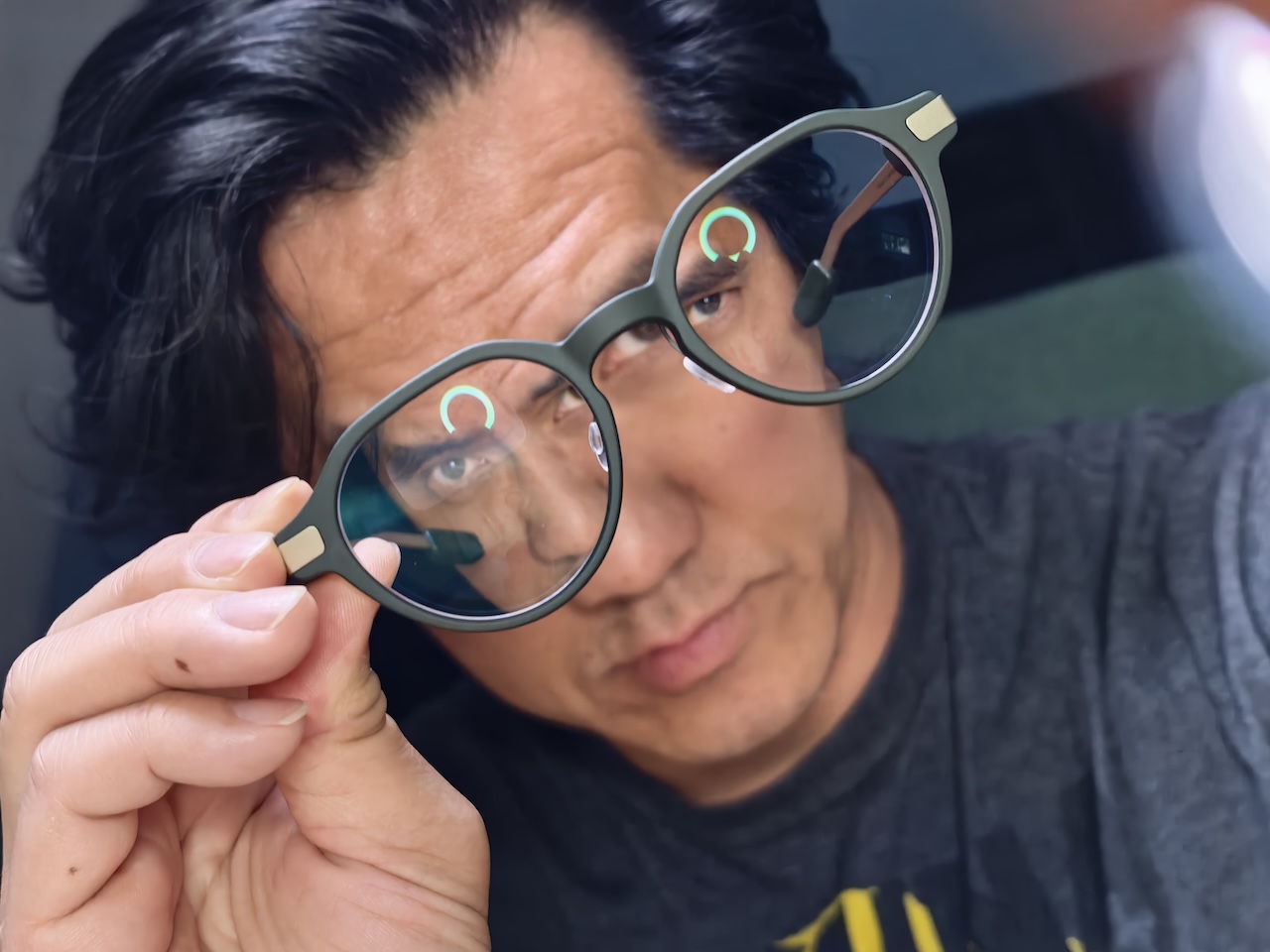
That set the pattern for five months. Airport security, restaurants, rideshares, my own home. The G2 reads as eyewear, not gadgetry, which means I’ve lived with these the way a real person lives with glasses. Not unboxed, not bench-tested, not worn for a single review week. Lived with. That’s the credibility I’m bringing to this story, and it’s the reason a Bond integration on these specific glasses lands differently than it would on any other pair in the market.
What Was Announced
This morning Even Realities, IO Interactive, and Amazon MGM Studios confirmed a three-way partnership: the G2 will appear inside 007 First Light as an actual in-game gadget, delivered through a post-launch update after the game ships on May 27, 2026.
The companies framed the integration as something designed to “reward sharp eyes and deeper engagement.” Translation: it won’t be plastered on box art or trailers, and it won’t be unlocked in the first hour. Players who pay attention will find it. Players who don’t, won’t. Which, frankly, is the most Bond way to release a Bond gadget.
Even Realities founder and CEO Will Wang framed the partnership as “the glasses’ invisible power working alongside Bond’s legendary instincts.” Marketing language, but accurate. The whole product thesis is that smart glasses shouldn’t telegraph that they’re smart, and after five months I can confirm: they don’t.
Why This Isn’t Just Product Placement
Most “as seen in” tie-ins are a flat 3D model swap with a logo glued on. This one is different for a reason that should be obvious to anyone who has watched a Bond film: Bond’s gadgets are defined by discretion. Q doesn’t hand 007 a pair of Meta Ray-Bans with two camera bulbs glaring out of the temples. That’s surveillance gear, not spy gear. The point of a Bond gadget is that it vanishes into a tuxedo.
The G2’s design philosophy maps almost embarrassingly well to spy fiction: no outward-facing camera, no recording light, no obvious sensor cluster. Just a titanium frame and a display that lives inside the lens, visible only to the wearer. The fiction and the hardware finally line up. I made the full case in 7 Reasons These Camera-Free Smart Glasses Keep Winning, and the no-camera angle is the through-line.
Wang’s “invisible power” line is marketing-speak, but the hardware actually backs it up. IO Interactive Gameplay Director Andreas Krogh framed it the same way in the announcement: “James Bond has always been defined by his instincts as much as his tools. With Even Realities, we’ve found a partner who shares our obsession with sophistication and precision.” That’s not standard product-placement boilerplate. That’s a game studio saying the hardware fit a creative bar.
The Game Context
007 First Light is IO Interactive’s origin story for a young James Bond inside the MI6 training program, launching May 27, 2026 on PS5, Xbox Series X/S, and PC. Search interest for the title is at its apex: roughly 74,000 U.S. searches per month, climbing daily as the launch window closes in.
What’s still unknown is exactly how the G2 will function in-game. The post-launch update could go several directions, all of them grounded in features the real product already ships with:
- HUD-style overlays for objectives, dossiers, and intel readouts
- Environmental clues surfaced inside the lens during exploration
- Real-time translation during stealth or social-engineering segments
- Discreet notifications during dialogue, the way the G2 already handles texts and calendar nudges in the real world
If IO Interactive treats the integration like a genuine tool rather than wallpaper, 007 First Light will be the rare product placement that actually teaches the audience what the product is for.
Hands-On Perspective: What the G2 Actually Does

Here’s where five months of daily wear matters more than any press release. The G2 runs on Even Realities’ Even HAO (Holistic Adaptive Optics) platform: miniature projectors fire light into a clear waveguide and form an in-lens display only the wearer can see, sitting in your peripheral view until you summon it. The features that feel most Bond-adjacent:
- Audio-to-visual-text captioning. Spoken audio around me converts to readable text inside the lens. Flawless on a clean signal, less reliable in a loud restaurant or on a crosstalk-heavy show floor.
- Turn-by-turn navigation. This is the killer app. Walking through a new city with arrows floating in your eye line is the closest thing to “augmented reality that actually feels useful” I’ve worn.
- Teleprompter mode. Quietly excellent for podcasts, panels, and live presentations.
- Notifications. Discreet, glanceable, and never the LED bonfire your phone is.
Receipt from the road: I spent about 10 days in China recently, wearing the G2 with progressive prescription lenses (poor eyesight is its own kind of always-on accessory). The audio-to-visual-text captioning caught 70 to 80% of what was being said in Didi rides and casual conversations, converting the spoken audio into readable text inside the lens. I obviously couldn’t respond, but being able to read along with what my driver was saying, what someone was explaining, what was being talked about in the chatter next to me, completely changed how a non-Mandarin speaker moves through a country. And nobody knew I was doing it. The whole exchange looked like me wearing my normal glasses. That’s the gap between this and any pair of smart glasses with a camera bulb on the front: I can pull useful signal out of a foreign-language room without making anyone in that room feel surveilled.
What still feels like early-adopter compromise: battery life under heavy AI use is mediocre, and the on-device AI assistant is inconsistent. It’s good enough to be useful, not yet good enough to be invisible the way the hardware is. If Even can land a meaningful AI update before the holiday season, the G2 becomes a much harder product to argue against.
The Bigger Picture: Smart Glasses Going Mainstream Through Culture
Spec sheets don’t sell wearables. Culture does. Stranger Things revived walkie-talkies. Top Gun: Maverick moved a fresh wave of aviators. The Queen’s Gambit sold a generation of chess sets. A James Bond tie-in is exactly the kind of cultural moment that pulls a product out of the early-adopter bucket and into normal people’s mental shopping list.
That matters right now because the smart glasses category is suddenly crowded. Google’s Android XR push is real, Apple’s rumored entry keeps creeping closer, and Gucci is partnering with Google on a fashion-forward play. Even Realities was already differentiated on hardware philosophy; this partnership gives them a cultural moat the rest of the category cannot buy back overnight. I tracked the full landscape in 7 Smart Glasses Stories That Defined 2026 So Far and 6 Smart Glasses Worth Watching as Apple Joins the Race. The G2 keeps surfacing for the same reason: it’s the one pair that doesn’t look like a wearable.
It’s also the one pair that keeps winning in my AI wearables comparisons, almost entirely on the strength of the form factor.
Pricing & Availability
The Even Realities G2 starts at $599 directly from Even Realities, with prescription lens add-ons configurable at checkout (single vision from $159). The optional R1, a $249 zirconia ceramic and stainless steel ring that pairs with the G2 over Even Realities’ TriSync connectivity, lets you keep your hands off the temple, which is the most Bond-coded peripheral I’ve ever owned.
Bottom Line
Most product placements are wallpaper. This one has a chance to be a demonstration. If IO Interactive lets the G2 function in-game the way it functions in real life, 007 First Light won’t just feature smart glasses; it will explain why a specific kind of smart glasses, the ones without cameras, are the only ones that make sense on a spy’s face.
That’s a better commercial than anything Even could have shot themselves. And it lands at exactly the moment the category needs to convince mainstream buyers that smart glasses are not a Glass-era novelty anymore.
Bond gets a new gadget. Even Realities gets a cultural anchor. The rest of the smart glasses industry gets a reminder that hardware philosophy still beats spec-sheet maximalism.
Even G2 smart glasses: from $599
Even R1 ring: $249
Where to buy: G2 Crown Panto · G2 Rectangular · Even R1
The real test is whether the in-game integration is deeper than a 3D model swap. I’ll be watching the post-launch update closely. Until then, I’ll keep wearing mine, and nobody will keep noticing.