
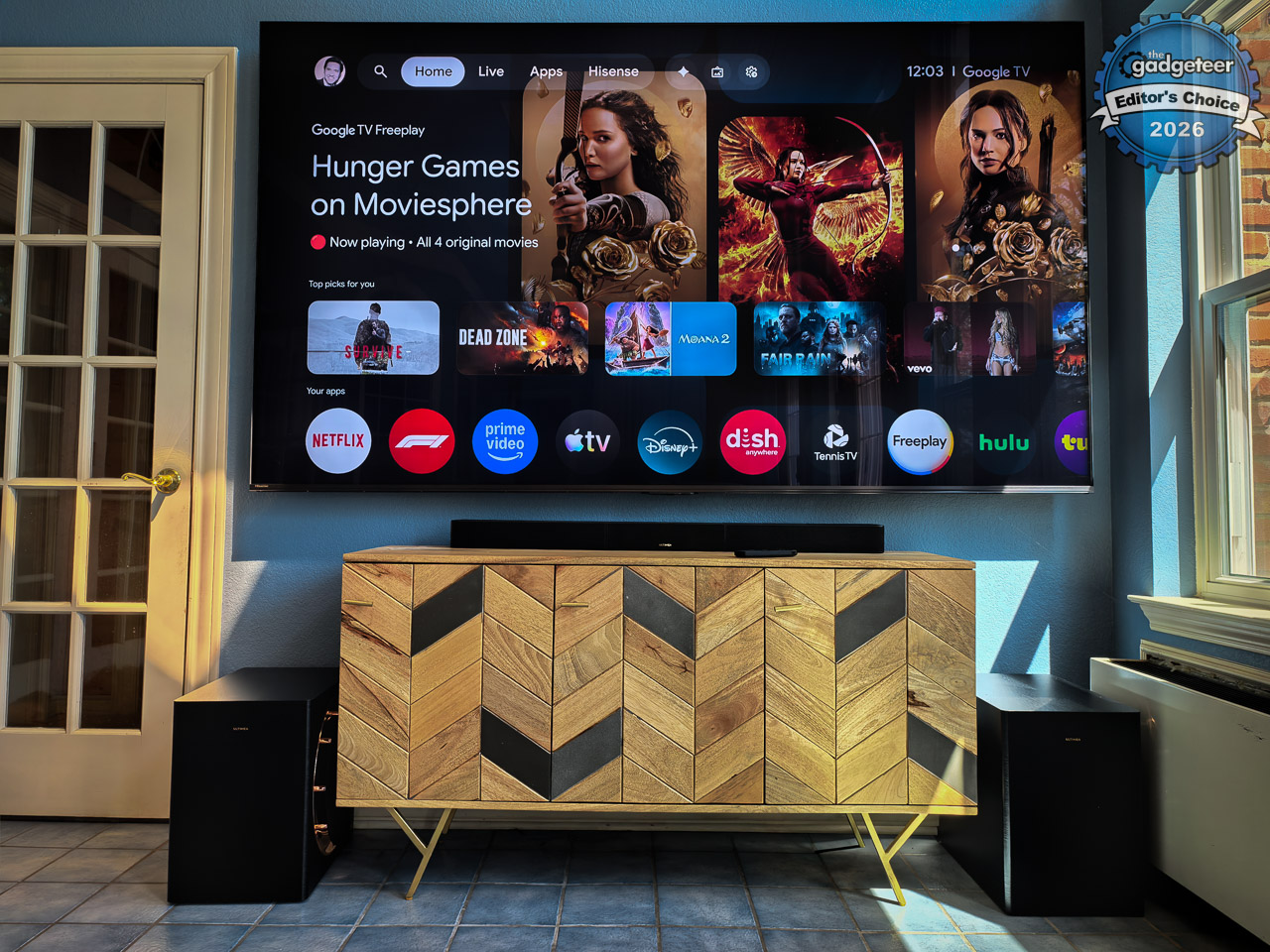
The Skywave X100 Dual is Ultimea’s flagship wireless surround system: a 9.2.6 channel package with a 43.3-inch soundbar, four wireless surround speakers, two 10-inch wireless subwoofers, and six up-firing drivers for overhead audio. The system carries a Tuned by THX designation, decodes Dolby Atmos and DTS:X natively, and connects every component wirelessly through CineMesh dual 5GHz with under 20ms latency. It launched on Kickstarter at $999 (Super Early Bird), with an MSRP of $2,299.
Super Early Bird: $999 (only 29 left of 1,115)
Save $1,300 (57% Off) · Free Shipping to US, EU & UK
Where to buy: Kickstarter | Ultimea.com
The core question this review answers: can a $999 crowdfunded wireless system with 9.2.6 channels and dual subwoofers actually deliver convincing home theater sound? I spent multiple weeks testing the X100 Dual across movies, music, gaming, and daily use. Here is what I found.
How This Review Was Tested
I ran the X100 Dual through multiple weeks of varied content across movies, music, gaming, and everyday TV watching. Source devices included a 4K streaming device connected via HDMI eARC and a gaming console through the HDMI passthrough input. Volume levels ranged from late-night whisper mode to full reference level during weekend sessions.
Content covered Dolby Atmos native films (F1, Dune: Part Two, Blade Runner 2049, The Dark Knight Rises), DTS:X tracks, stereo music through Xupmix spanning EDM, Eurodance, synthwave, hip-hop, jazz, and pop, Bluetooth streaming, competitive and cinematic gaming, and standard broadcast television. My testing focused on three questions: does the surround imaging create a convincing soundfield in a real room? Does the bass extend as deep as the spec sheet promises? And does THX tuning produce an audible difference compared to generic processing?
What’s in the Box
The packaging makes the ambition clear before you power anything on. You’re unpacking a 43-inch soundbar, four satellite surround speakers, two 10-inch subwoofer units, all necessary power cables, an HDMI cable, a remote, and mounting hardware for the soundbar. Total package weight is 99.2 pounds, so grab a friend or clear a path. This is a serious system, and it arrives feeling like one.
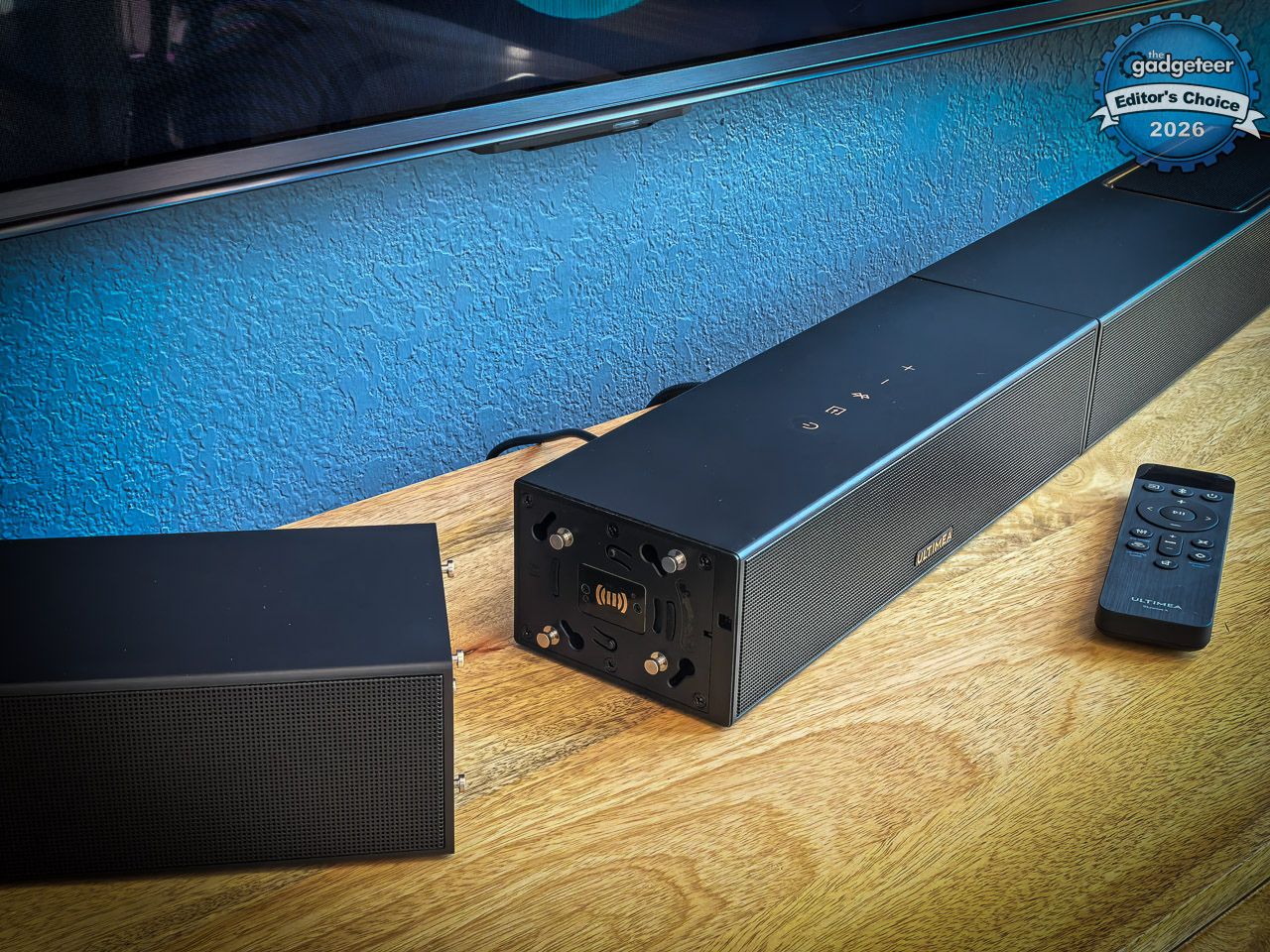
Every wireless component pairs automatically through CineMesh, Ultimea’s proprietary dual 5GHz wireless protocol. No AV receiver in the chain. No speaker wire to run anywhere. The entire system communicates wirelessly from the moment you plug everything in. That’s the core pitch: a real discrete channel home theater without the infrastructure nightmare that’s kept most people locked into basic soundbar compromises.
Design and Build Quality
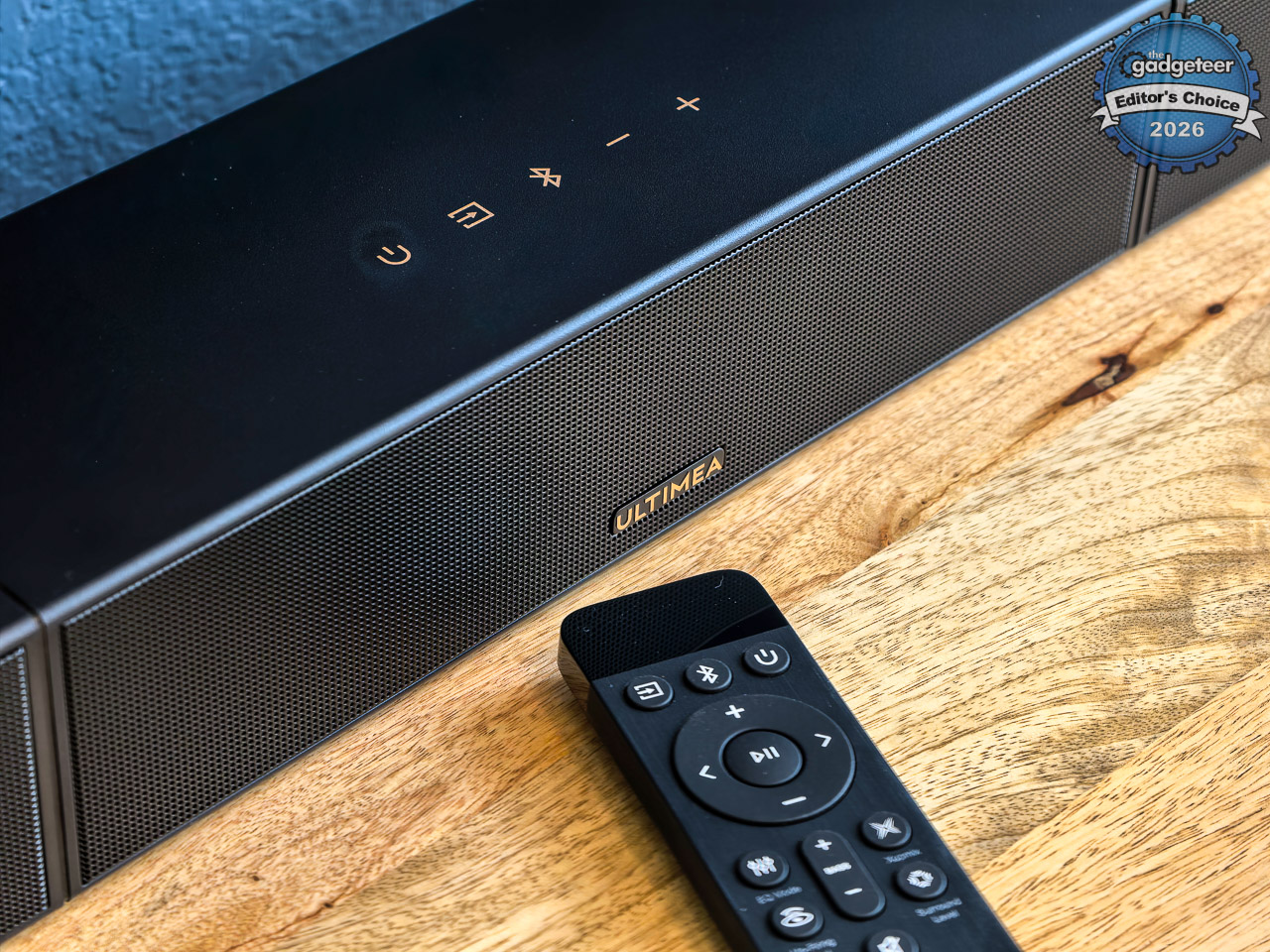
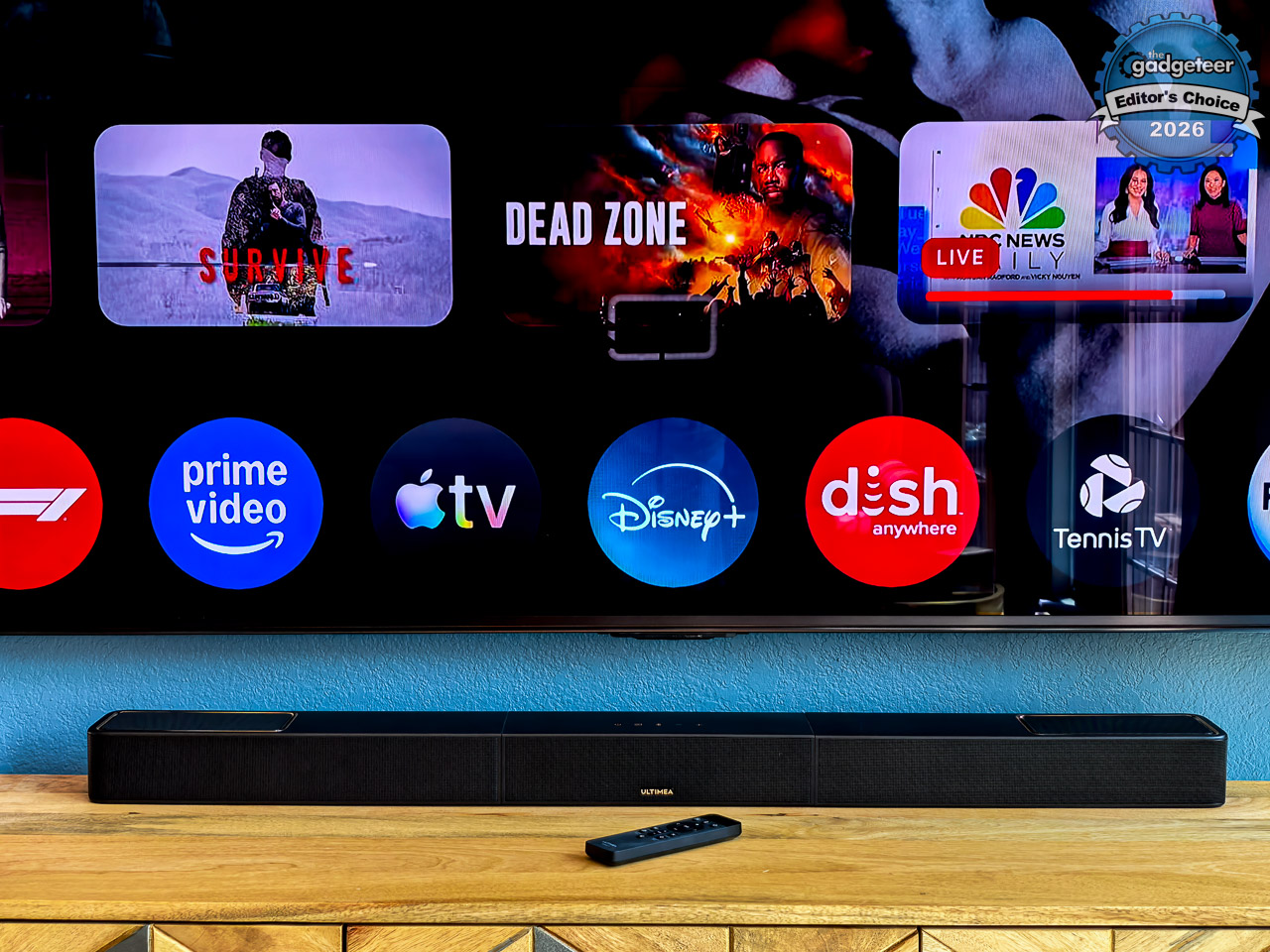
The first thing you notice is weight. The soundbar has genuine heft, the kind of density that tells you there’s real hardware inside rather than hollow plastic. The metal grille and matte finish give it a clean, low-profile look that tucks under most 55-inch or larger TVs without blocking the IR sensor. At 43.3 inches wide, 2.76 inches high, and 3.94 inches deep, it doesn’t dominate the TV stand. It sits there looking like it belongs.
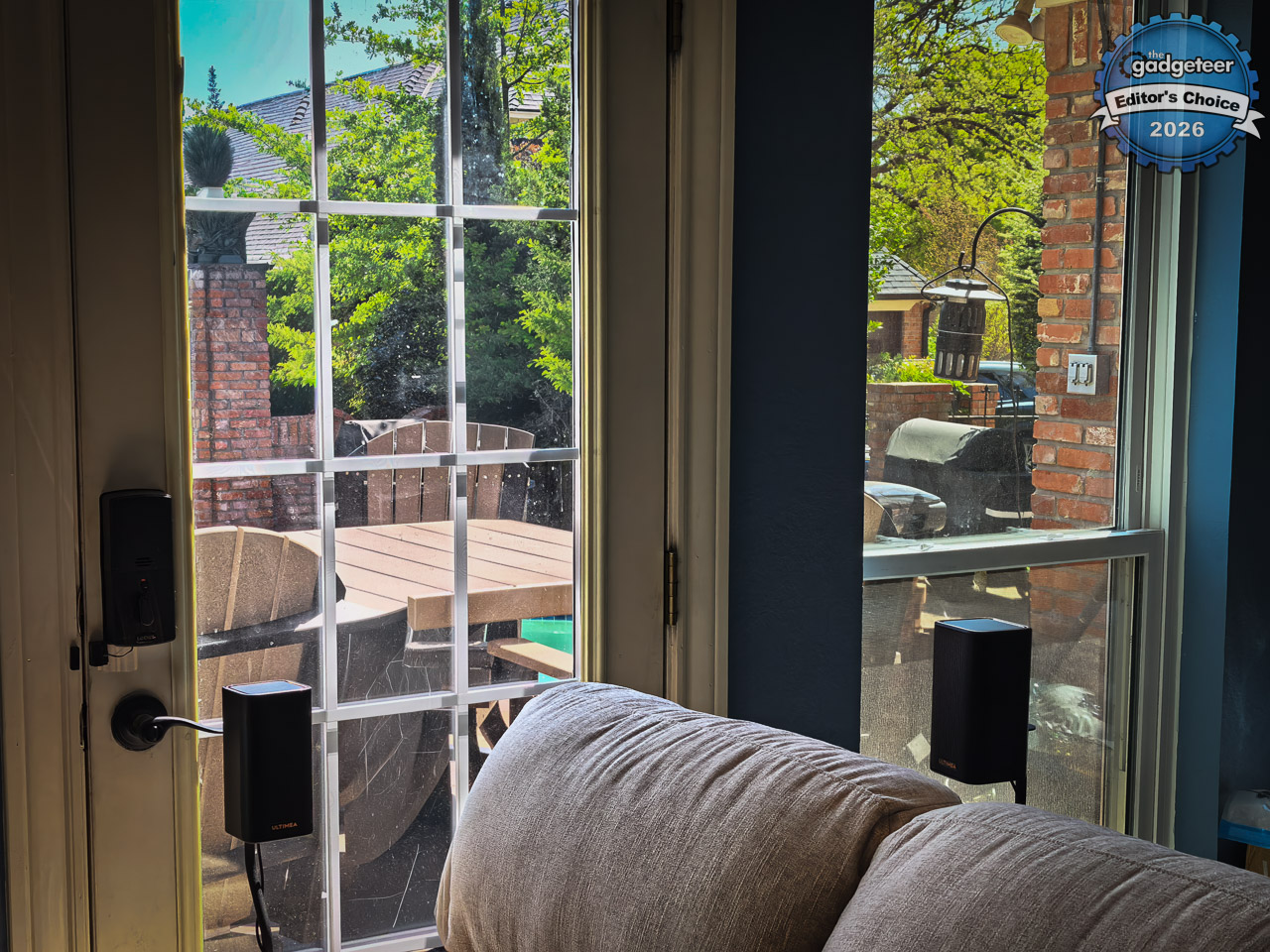
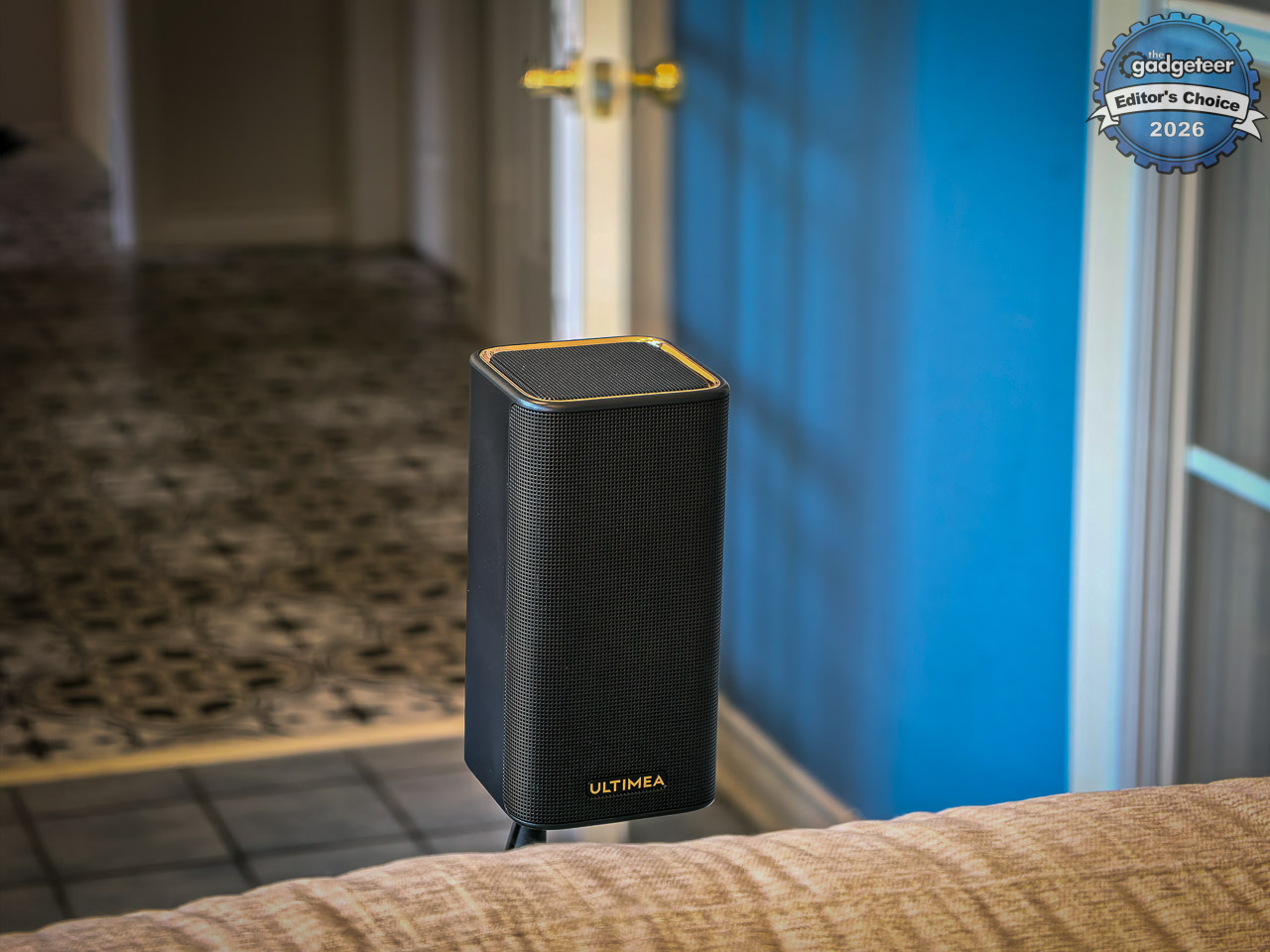
The surround speakers are surprisingly compact. Each one is small enough to perch on a bookshelf or mount to a wall without turning your living room into an audio showroom, and they house their own amplification and wireless receivers. Build quality on the satellites feels solid for the price: clean lines, a consistent finish, and enough weight to suggest durability without being cumbersome. You could place these on end tables flanking a couch and most guests wouldn’t even register them as part of the system.
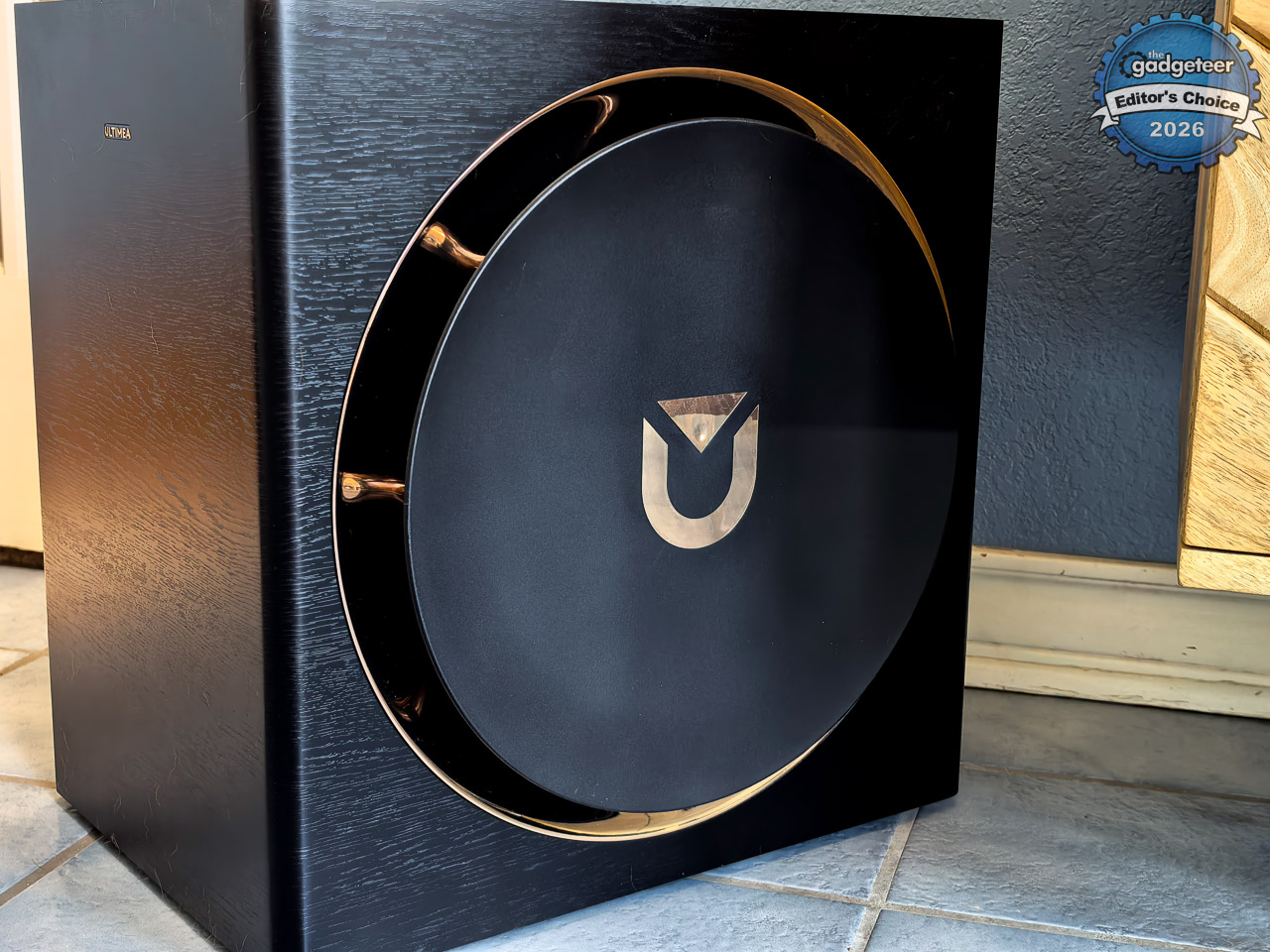
Then there are the subwoofers. Two of them. Each packing a 10-inch driver in a ported enclosure with a black wood grain finish and gold accents that give the whole system a premium visual identity. They’re not small, and you’ll need floor space on both sides of your seating area to get the best stereo bass imaging. But the visual design is genuinely attractive. These don’t look like afterthought boxes shoved into corners. They look intentional, like furniture that happens to produce bass you can feel in your ribcage.
The gold accent detail carries across the entire system, from the up-firing driver rings on the soundbar to the satellite speaker trim. It’s a design language that Ultimea clearly thought through, and it gives the X100 Dual a cohesive visual presence that most multi-component systems lack at any price. The remote feels upgraded too, with a modern button layout and dedicated controls for individual channel groups, EQ presets, and the Xupmix upmixer.
Every piece of this system communicates “we’re serious about this.” From the packaging to the materials to the way components feel in hand during setup, the X100 Dual presents itself as a flagship product. Whether it performs like one is the more important question. Spoiler: it does.
Setup and Installation
Here’s where the X100 Dual earned its first genuine surprise. I plugged in every component, powered on the soundbar, and every single satellite and subwoofer paired automatically within about 30 seconds. No manual pairing codes. No app-guided discovery process. No firmware dance. CineMesh found everything on its own, and the system was producing sound within minutes of opening the box. The pairing process is almost brilliantly simple, and I say that as someone who’s wrestled with Bluetooth speaker pairing screens more times than I care to admit.
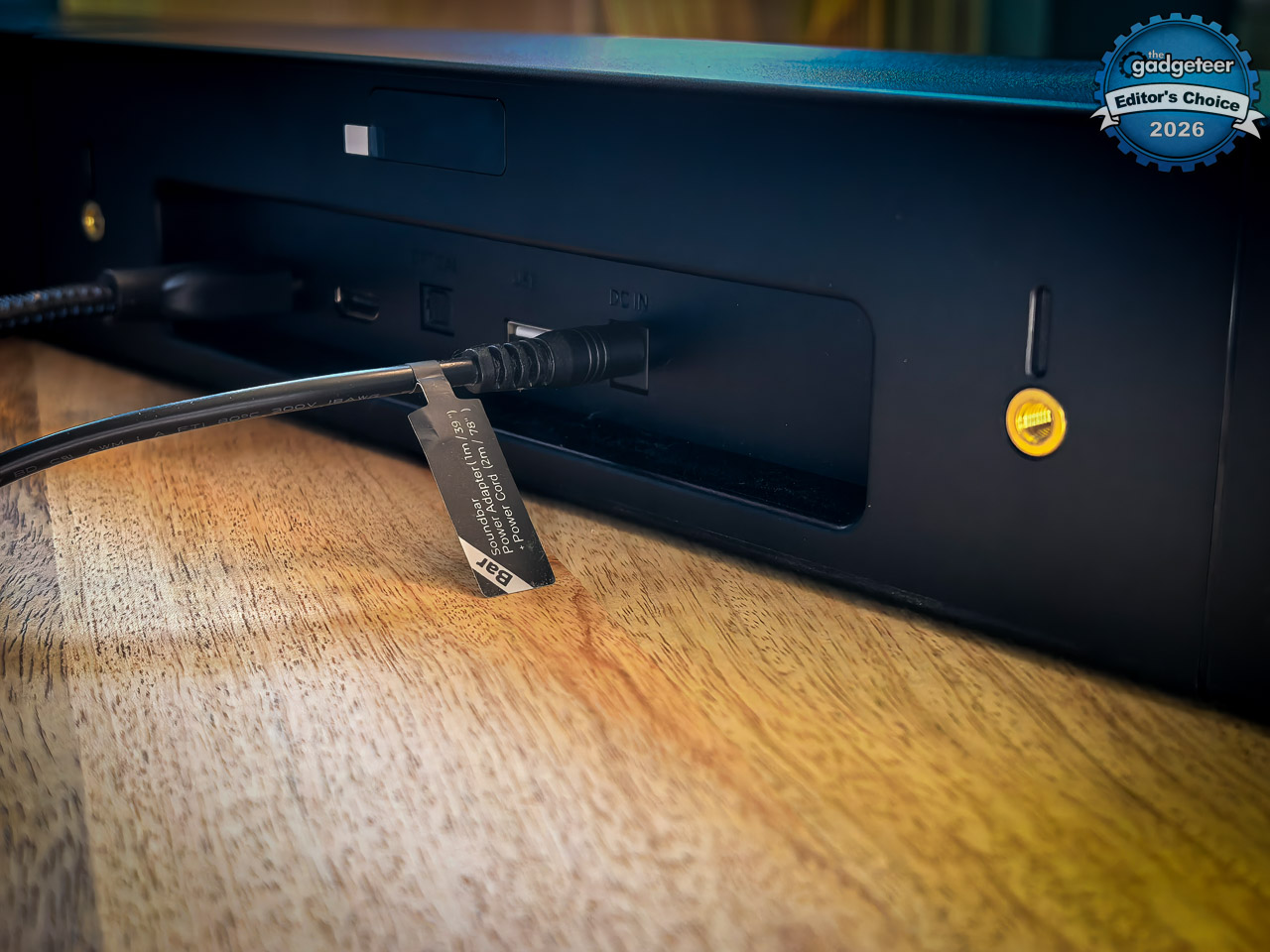
For the main connection, HDMI eARC handles the heavy lifting. One cable from the soundbar to the TV’s eARC port, and you’re getting full Dolby Atmos and DTS:X passthrough with zero compromise. The HDMI 2.1 implementation supports 8K at 60Hz and 4K at 120Hz, so routing through the soundbar doesn’t sacrifice picture quality. CEC handshake worked cleanly on the first try, and source switching between a streaming device and console happened without audio dropping out or requiring manual input selection. If you’ve ever fought with eARC handshake issues on other systems, you’ll appreciate how seamlessly this worked.
The independent channel volume control is the feature I didn’t expect to matter as much as it does. Most systems give you master volume and maybe a subwoofer knob. The X100 Dual lets you adjust every channel group independently: push the height channels harder for music, pull back the surrounds for late-night viewing, boost the center for dialogue-heavy content. That level of customization usually lives behind an AV receiver’s menu system, not a soundbar remote. Having it accessible through both the remote and the app changes how you interact with the system daily.
Sound Quality: Movies
This is where the X100 Dual either justifies its existence or falls apart. And I’ll say upfront: it justifies it with room to spare.
I paired the system with my setup and immediately reached for content that would stress every channel simultaneously. “F1” was the obvious first choice. Brad Pitt’s racing epic is a surround sound torture test disguised as a movie. The opening sequence drops you onto the grid at Silverstone with engines screaming from every direction, and the X100 Dual placed each car’s engine note in a distinct spatial position that tracked with the on-screen action. When the pack roared past the camera, the sound swept from the front channels through the surrounds with a Doppler shift that felt physically real. Pit radio communication stayed locked to the center channel with crisp intelligibility even as tire squeal and crowd roar filled the rest of the soundstage. The dual 10-inch subs turned engine vibration into something you didn’t just hear but felt resonating through the couch. I caught myself gripping the armrest during a late-race overtake sequence, and that’s the kind of involuntary physical response that separates real surround sound from marketing surround sound.
If you’ve read my Hisense 100U8QG review, you know I’m a firm believer that screen size transforms the viewing experience. Pair that 100-inch display with its 5,000-nit HDR brightness alongside the X100 Dual’s 9.2.6 channel system, and you’ve built something that honestly rivals commercial screening rooms. The visual scale of a 100-inch panel combined with bass that reaches 18Hz and six overhead channels creates an immersion level that no 65-inch TV with a basic soundbar can approximate. It’s the combination that finally delivers on the “theater in your living room” promise that the industry has been making for a decade.
“The Dark Knight Rises” became my dialogue clarity benchmark. Bane’s masked voice is a brutal test because the processed vocal sits on top of Hans Zimmer’s relentless score and dense ambient noise. With the center channel handling dialogue duties, every word cut through without effort. I didn’t reach for the remote once. The voice mode processing keeps intelligibility locked even when the mix gets chaotic, and Bane’s distorted delivery came through with texture and detail rather than muffled compression. This is the scene I use to separate good dialogue handling from great dialogue handling, and the X100 Dual landed firmly in the great category.
“Dune: Part Two” brought the real test for height channels and dual subwoofers working in concert. The sandworm emergence sequences demand bass that starts in your floor and climbs through the room, and those two 10-inch drivers delivered exactly that kind of physical response. I felt the low-frequency energy in my chest before I consciously heard it. The up-firing channels placed atmospheric desert wind and ornithopter engine noise convincingly above the listening position, creating a dome of sound that a standard soundbar simply cannot replicate. Height effects landed above average for any system I’ve tested in this category, and while they’re still ceiling reflections rather than dedicated overhead speakers, the effect is genuinely immersive rather than gimmicky.
“Blade Runner 2049” pushed the system’s ability to handle sustained atmospheric tension. The entire film operates in a brooding, layered sonic space where synth drones blend with environmental sound design across every channel. The X100 Dual kept all those layers separated rather than collapsing them into a wall of noise. Rain fell from above through the height channels. Spinner engines panned across the rear surrounds. Vangelis-inspired bass notes anchored at floor level through the dual subs. During Wallace’s confrontation scenes, whispered dialogue stayed intimate and centered while cavernous room ambience expanded into the surrounds with eerie precision.
For late-night viewing, the system offers genuinely different listening modes that aren’t just EQ presets with fancy names. Movie mode pushes a hyper-real, immersive staging that’s exciting for blockbusters and gets loud enough to fill large rooms at surprisingly low volume settings. THX mode dials everything back to something closer to actual movie theater calibration: more consistent, more controlled, better for long sessions. Night mode pulls the dynamics down without killing the spatial imaging, so you can watch “Mad Max: Fury Road” at 11 PM without the dual subs announcing every explosion to the rest of the house. I found myself defaulting to THX for most movie nights and switching to Movie mode for big spectacle films where I wanted the system to show off.
Sound Quality: Music
I’ll be honest: I didn’t expect a home theater system to handle music this well. Most surround setups treat music as an afterthought, slathering stereo tracks with artificial reverb and calling it “immersive.” The X100 Dual takes a different approach with its Xupmix processing, and the results caught me off guard from the first track.

Avicii’s “Levels” was my opening salvo because EDM exposes every weakness in a system’s bass response and transient handling simultaneously. The iconic synth buildup climbed through the front channels with sparkling clarity, and when the drop hit, the dual 10-inch subs turned it into a full-body event. I felt the bass in my chest, not just my ears. The sub-bass extension reached deep enough to reproduce the physical chest-thump that separates feeling music from merely hearing it, and the GaN amplifier kept the transients snappy even at volumes where lesser systems would compress into mush. Switching to Modern Talking’s “You’re My Heart, You’re My Soul” was a deliberate contrast. The Eurodance synths and Thomas Anders’ vocals need midrange clarity and high-frequency sparkle to land properly, and the X100 Dual delivered both without the slightly forward treble overwhelming the mix. The retro production sounded warm and spacious rather than thin and dated.
The Weeknd’s “Blinding Lights” confirmed what the EDM tracks suggested: this system loves synthwave. The analog-inspired synths expanded with warmth and dimension through the height channels, while the driving bassline propelled the track forward without smearing the crisp percussion. Dua Lipa’s “Physical” pushed the disco-pop layering further, with stacked harmonies maintaining their separation rather than collapsing into mud. Travis Scott’s “SICKO MODE” stressed the system’s ability to handle abrupt beat switches and dense trap production. Each section transition arrived clean, with 808s occupying their own bass space in the dual subs and hi-hats staying razor-sharp in the tweeters.
Then I switched gears completely. Miles Davis’ “Kind of Blue” is the opposite of everything else on this list: intimate, delicate, and ruthlessly revealing of any system that can’t handle subtlety. The upright bass anchored warmly in the lower register with genuine body. Trumpet positioned centrally with natural breath and bite. Cymbal shimmer floated above the main soundstage through the height channels with a lightness that proved the system could scale from chest-thumping EDM drops to acoustic jazz detail without touching the EQ. Billie Eilish’s “bad guy” confirmed the dynamic range handling at both extremes. Those signature bass drops packed real physical punch from the dual subs, while the whispered vocal passages stayed crystal clear at the opposite end of the volume spectrum.
The tracks that surprised me most were the ones I grew up with. Survivor’s “Eye of the Tiger” hit different through the X100 Dual. That opening guitar riff, the one you’ve heard a thousand times, suddenly had spatial width and punch I’d never noticed in the recording before. The dual subs gave the kick drum a physical presence that made the track feel alive again instead of nostalgic background music. Michael Jackson’s “Beat It” was even more revealing. Eddie Van Halen’s guitar solo, which I’ve listened to since childhood, gained new texture through the height channels as the production’s layered reverb expanded into the room with dimension that flat speakers simply eat. Then “Thriller” sealed it. Vincent Price’s spoken-word breakdown surrounded the listening position with genuine creepiness as the vocal echoed through the rear channels, and when that bassline drops back in, the dual 10-inch subs reminded me why I fell in love with this song in the first place. There’s something special about a system that makes you rediscover music you thought you knew by heart. The X100 Dual kept doing that, track after track, decade after decade.
Music mode delivers the cleanest stereo presentation, but the real discovery was Xupmix’s ability to expand stereo content into the full 9.2.6 soundstage without sounding artificial. The upmixing algorithm adds spatial width and height cues that feel like natural room reflections rather than processing artifacts. Streaming Dolby Atmos tracks from Apple Music let the system fully stretch its legs, placing instruments in distinct spatial positions around the room. It won’t replace a dedicated two-channel audiophile setup for critical listening, but for filling a living room with rich, spatially engaging music while cooking, hosting friends, or just vibing on a Saturday afternoon? This system handles that brief with more authority than anything else I’ve tested at this price.
Avicii’s “Wake Me Up” became my go-to demo track for visitors because it hits every strength at once: the folk-guitar intro tests midrange detail, the EDM drop tests bass impact and transient speed, and the vocal melody tests clarity across the frequency spectrum. Every person who heard it reached for their phone to look up the system’s price. That reaction tells you more than any measurement could.
What Tuned by THX Actually Means
A “Tuned by THX” designation on a wireless soundbar system at this price is unusual enough to warrant explanation. THX isn’t an audio format like Dolby Atmos. It’s a quality benchmark. “Tuned by THX” means THX engineers collaborated directly with Ultimea on acoustic tuning, optimizing the system’s soundstage width, depth, clarity, and frequency response to meet THX performance standards. This is distinct from full THX Certification (a separate, more rigorous program), but it’s still a meaningful third-party collaboration. The brand didn’t tune this in a vacuum.

For the X100 Dual, THX tuning specifically addresses the biggest complaint about all-in-one systems: sound that collapses into a narrow beam from one source. The THX tuning process targets measurable dispersion and imaging standards that ensure audio spreads naturally across the listening area rather than projecting at you from a single point. The practical difference is a soundstage that wraps around your seating position with convincing width, and it’s audible from the first scene you play. As of this review’s publication, I have not found another wireless surround system in this price range carrying a THX Tuned designation. The difference was audible in my room: I could hear it immediately in how naturally the sound distributed compared to non-THX-tuned systems I have tested.
App Experience
The Ultimea app handles EQ customization, independent channel-level control, room calibration, and firmware updates. The interface is clean and responsive without the bloated design that plagues many audio companion apps. Seven listening modes (Movie, Music, Voice, Sport, Game, Night, plus a dedicated THX mode) cover the basics, and a 10-band EQ with 121 preset sound profiles provides deep customization beyond those defaults for anyone who wants to fine-tune their specific room.
The independent channel control accessible through the app is where most users will spend their real time. Push the rear surrounds up for gaming. Pull the subs back for apartment-friendly listening. Boost the center for dialogue-heavy content. This granularity typically lives behind an AV receiver’s menu system. Having it in a mobile app with instant responsiveness and no perceptible latency makes the X100 Dual feel like a system that adapts to your life rather than demanding you adapt to it.
The LED display on the soundbar’s front panel shows volume, input, EQ settings, and channel levels at a glance, and you can dim or disable it completely for lights-out sessions. One note worth mentioning: there’s no WiFi, no AirPlay, and no built-in streaming. Audio comes in through HDMI, optical, USB, or Bluetooth (with Auracast support). For most users routing everything through a TV or streaming device, that’s a non-issue. But if standalone streaming from the soundbar itself matters to you, it’s not here.
Gaming Performance
The 8K & 4K at 120Hz passthrough with sub-20ms wireless latency makes this system genuinely viable for competitive gaming, which is a sentence I rarely get to write about wireless surround setups. Most competing systems see latency climb past 40 or 50 milliseconds once you add wireless rear channels, creating that subtle audio lag that serious players notice immediately in fast-paced shooters and racing titles.
Racing games delivered environmental immersion I hadn’t experienced from a soundbar system before. Engine roar swelled as you approach a tunnel, the acoustics shifted as you passed through, and the Doppler effect of competing cars panned accurately from rear surrounds to front channels. Combined with the dual subs providing tactile bass feedback during collisions and heavy acceleration, the gaming experience felt physically connected in a way that headphones can approximate but speakers deliver differently. First-person shooters benefited from the overhead channels placing vertical audio cues that flat systems miss entirely: footsteps on the floor above, helicopter approach from behind and above, grenade arcs tracing overhead paths.
The Game EQ preset pushes directional cues forward in the mix and tightens bass response for cleaner positional accuracy. For competitive multiplayer, this tuning provided a genuine informational advantage through audio alone. For cinematic single-player titles, switching back to Movie mode let the soundstage bloom into full surround immersion. The ability to toggle between these profiles without menu diving (a dedicated EQ button sits on the remote) keeps transitions fast. Console gamers running a PS5 or Xbox Series X get full 4K/120Hz and VRR passthrough, so you’re not making any visual compromise to route audio through the system. Sub-20ms latency means audio-video sync stayed locked even during frenetic gameplay with zero lip-sync drift.
Specifications
| Specification | Ultimea Skywave X100 Dual |
|---|---|
| Channels | 9.2.6 |
| Audio Formats | Dolby Atmos, DTS:X |
| Peak Power | 2,000W |
| Frequency Range | 18Hz to 20kHz |
| Max SPL | >102dB |
| THD | <1% |
| Subwoofers | 2 × 10-inch wireless |
| Surround Speakers | 4 × wireless satellites |
| Up-firing Channels | 6 |
| Amplifier | GaN (Gallium Nitride) |
| DSP | NeuraCore (24-bit/192kHz, 2,000 MIPS) |
| Wireless Protocol | CineMesh dual 5GHz (<20ms latency) |
| Video Pass-through | 8K@60Hz, 4K@120Hz (HDMI 2.1) |
| Connections | HDMI eARC, HDMI In, Optical, USB, Bluetooth, Auracast |
| Soundbar Dimensions | 43.3 × 3.94 × 2.76 inches (W × D × H) |
| Certification | THX Tuned |
| Upmixing | Xupmix upmixing |
Who Is This For
Best for: Anyone who’s been running a basic soundbar and secretly wondering what real surround sound actually feels like. If you’ve watched a Dolby Atmos trailer in a demo room and thought “I want that, but I’m not running cables through my walls,” the X100 Dual is the answer to a question you’ve been asking for years. The fully wireless design makes it perfect for renters, for rooms where construction isn’t an option, or for anyone who values clean aesthetics as much as clean audio. Pair it with a large-format display (65 inches or larger) and you’re building a genuine home cinema, not just upgrading your TV sound.
Also good for: Gamers who refuse to compromise. The 4K/120Hz passthrough with sub-20ms latency makes this a real spatial audio gaming rig, not just a movie system with a game mode bolted on. Music lovers who want a room-filling listening system that doubles as their movie setup. Couples who disagree about speaker placement (the wireless form factor ends that argument permanently). And anyone running a big-screen setup like a 100-inch display who needs audio that can match the visual scale without requiring a contractor.
Skip it if: You’re a dedicated separates audiophile who upgrades individual components over time. The X100 Dual is a closed ecosystem: you can’t swap the subs for aftermarket units or replace the center channel with a dedicated speaker. If modularity matters more than convenience, a traditional receiver-based setup is still the right call. Also skip it if having every component need its own power outlet is a dealbreaker for your room layout, because each wireless unit still requires access to an electrical outlet.
Pricing, Availability, and Value
The X100 Dual launched on Kickstarter at $999 Super Early Bird, with tiers stepping up to $1,299 (Early Bird), $1,699 (Late Pledge), and a $2,299 MSRP. Insider pre-orders begin shipping in late May 2026, with Kickstarter backers expected to receive units approximately one month later (the campaign itself runs through May 11).
That $999 entry point is the number that makes this review interesting. At that price, you’re getting a THX Tuned 9.2.6 system with dual subwoofers at a price point well below many competing wireless surround packages I have reviewed. Based on my experience pricing discrete channel setups, a comparable 9.2.6 system with separates would cost significantly more before installation labor.
At the $999 and $1,299 tiers, the X100 Dual is an exceptional value that I’d recommend without hesitation. You’re getting more channels, more power, and third-party THX tuning collaboration at a price that competes with or undercuts many established 7.1.4 systems. At the $1,699 Late Pledge, it’s still competitive with established wireless options. At the full $2,299 MSRP, the conversation shifts because you enter territory where established brands offer strong 7.1.4 options with mature app ecosystems, WiFi streaming, and AirPlay support that the X100 Dual doesn’t match. The sweet spot is clearly the Kickstarter pricing, where the performance-to-dollar ratio is the strongest I have encountered in wireless home audio.
Ultimea is an established audio brand with products sold through and its own retail channels, and it operates a registered subsidiary in Germany (Ultimea GmbH, Hamburg). The company has run one previous Kickstarter campaign (Thor T60 Triple Laser TV). Warranty coverage follows regional standards: one year in the US, two years in the EU. That said, this is a Kickstarter campaign, not a retail purchase. Delivery timelines frequently shift in crowdfunding, even for experienced creators. Backers should treat the estimated ship dates as targets, not guarantees, and understand that standard Kickstarter protections differ from retail return policies.
Final Verdict
The Ultimea Skywave X100 Dual does something I genuinely didn’t think was possible at this price: it delivers a real, convincing home theater experience without a single speaker cable crossing the room. The dual subwoofers produce bass you feel in your furniture. The height channels create an overhead dimension that basic soundbars can’t touch. The surround imaging holds up across movies, music, and gaming with spatial precision that rewards careful speaker placement. And the music performance surprised me more than anything else, turning Avicii drops into full-body events and giving Miles Davis’ trumpet the breath and space it deserves.
It’s not perfect. There’s no WiFi or AirPlay for standalone streaming. The treble leans slightly forward out of the box, which benefits dialogue clarity but means bright recordings can feel a touch aggressive until you dial in the EQ. Each wireless component needs its own power outlet, which limits placement depending on your room’s wiring. And the height channels, while above average for any soundbar system I’ve tested, are still ceiling reflections rather than dedicated overhead speakers. Physics hasn’t been fully rewritten yet.
But here’s what matters: at $999, this is the most fully featured wireless surround system I have tested. THX Tuned designation, 9.2.6 channels, dual 10-inch subs, Dolby Atmos and DTS:X, sub-20ms latency, and a setup process that takes minutes instead of hours. Pair it with a large-format display and you’ve built a home cinema that would have required a much larger investment and professional installation just a few years ago. For anyone who’s been waiting for real home theater to become accessible without rewiring your house, the wait is over. Score: 9/10.
Frequently Asked Questions
Is the Ultimea Skywave X100 Dual truly wireless?
Yes. Every component (soundbar, four surround speakers, two subwoofers) communicates via CineMesh dual 5GHz wireless. The only cables are power cords for each unit. No speaker wire crosses the room.
Does it support Dolby Atmos and DTS:X?
Both formats are decoded natively. Six up-firing channels deliver true height audio, and the NeuraCore DSP engine handles spatial object placement across all channels simultaneously.
What’s the difference between the X100 and X100 Dual?
The X100 is a 9.1.6 system with one subwoofer and 1,500W peak power. The X100 Dual adds a second 10-inch subwoofer, extends bass response to 18Hz, and bumps peak power to 2,000W. The Dual is built for larger rooms and deeper bass impact.
Can I use it for gaming?
Yes. HDMI 2.1 passthrough supports 4K at 120Hz with VRR and no visual compromise. Wireless latency stays under 20 milliseconds, which is fast enough for competitive gaming without perceptible audio delay.
What does Tuned by THX mean for this product?
Tuned by THX means THX engineers collaborated with Ultimea to optimize the system’s soundstage width, depth, and clarity against THX performance standards. It’s not a self-awarded badge. As of this review’s publication, I have not found another wireless surround system at this price with a THX Tuned designation. Note: this is the “Tuned by THX” program, which is a co-engineering collaboration, distinct from full THX Certification (a separate, more rigorous independent testing program).
How does it sound with music?
Surprisingly good. Stereo music through Xupmix upmixing sounds natural and expansive rather than artificially processed. Dolby Atmos music tracks take full advantage of the 9.2.6 channel layout. The dual subwoofers give EDM, hip-hop, and bass-heavy genres real physical impact, while the tweeters maintain clarity for acoustic, jazz, and vocal-forward content.
What are the disadvantages of a wireless surround sound system?
The main trade-offs are modularity (you can’t swap individual components for aftermarket upgrades) and power cord requirements (each wireless unit needs an electrical outlet). There’s also no WiFi or AirPlay for standalone streaming. Audio purists may prefer wired signal integrity, though CineMesh’s sub-20ms latency makes the wireless penalty negligible for most listeners.
How does the X100 Dual compare to premium soundbar systems?
Most premium soundbar brands charge $1,000 to $1,900 for their flagship systems. Samsung’s HW-Q990F (11.1.4, ~$1,500) and JBL’s Bar 1300X (11.1.4, ~$1,700) claim higher total channel counts, but the X100 Dual counters with dual 10-inch subwoofers, six dedicated up-firing drivers, and a THX Tuned designation that neither competitor offers. The X100 Dual delivers more channels, more power, dual subwoofers, and third-party validation at a lower entry price.
What should I know before backing on Kickstarter?
Ultimea is an established audio brand with retail presence on Amazon and its own direct channels, plus a registered subsidiary in Germany. The company has run one previous Kickstarter campaign. Insider pre-orders are expected to ship late May 2026, with Kickstarter backers receiving units approximately one month later. However, crowdfunding delivery timelines frequently shift, even for experienced creators. Backers should treat ship dates as estimates, not guarantees, and understand that Kickstarter purchases carry different protections than retail orders.
Super Early Bird: $999 (only 29 left of 1,115)
1,086 backers · Estimated delivery June 2026
Where to buy: Kickstarter | Ultimea.com
Source: The sample of this product was provided for free by Ultimea. Ultimea did not have a final say on the review and did not preview the review before it was published.




Gadgeteer Comment Policy - Please read before commenting
A 9.2.6 setup at this price point with THX tuning is pretty wild. I’ve been looking at wireless systems to avoid tearing up my drywall for cable runs, but I’m always a bit skeptical about the latency with dual subs. Good to hear the ‘sound bubble’ actually holds up—that’s usually where these systems struggle. How’s the mid-range clarity when the bass really starts kicking in?