
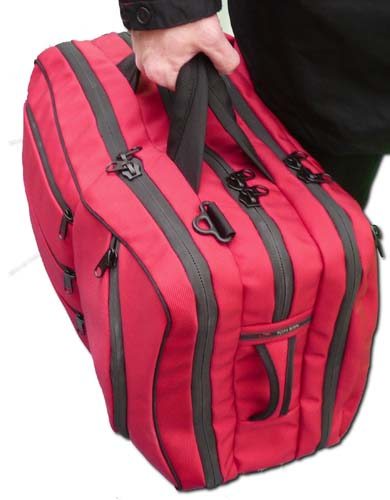
 Before I kick off, full disclosure; I’m a fan! A fan of Tom Bihn and nearly everything that comes out of their Seattle factory. I bought my first Tom Bihn bag in 2002, an Empire Builder, and shortly after bought the Brain Bag. These were painfully expensive at the time, but when I eventually sold them I got a re-sale price that I’d never get from lesser bags. So the total cost was not so bad. Also, the functionality; the features and benefits; and the incredible build-quality loaded into every case made the expense worthwhile.
Introduction
Over the years since I’ve had a succession of Tom Bihn cases and accessories. Not because the old ones wear out, but I’m intrigued by the company’s approach to design, and am keen to sample what they make. Tom Bihn’s cases are quirky and uncompromising. Quirky in that they tend not to follow fashion, often bucking fashion completely. Uncompromising in that they seem to rarely design and build to a price. They offer a lot in terms of user benefits, but you have to pay for it. So I’m a fan, but not because of some arbitrary devotion to a brand or style, but because I’m interested in good luggage design, and these guys always deliver this.
To write a decent review takes quite a lot of testing, and time and effort in the writing. There is a reward though, and that is the sense that one’s comments inform the design of new products. I’m not sure if that actually was the case here, but Tom Bihn’s new Tri-Star seemed to be pretty much what I’d been asking for in a travel bag. I’ve gone through loads of carry-on travel bags over the years: Tom Bihn’s Aeronaut and Brain Bag, the Red Oxx Air Boss, several generations of Spire’s Meta, North Face duffles of various sizes … and so on. All were good, but none completely addressed the evolving specification I was building for the ideal travel bag. The Tri-Star takes a huge leap in the right direction. By way of a preview of how impressed I am with the Tri-Star, I should say that I have already sold most of my existing travel bags on eBay. The Tri-Star is not perfect for me, but comes very close.
Testing environment
I like to test luggage properly, so that means travelling with it, and stress-testing it. As a lecturer in higher education, the best time for me to do this is the summer of academic conferences. The Tri-Star, arrived late August and so I had just a couple of trips left on which I could test out the new case in anger. I’ve just returned from the second of these. Both trips were for three nights and four days away and involved short-haul air travel.
Unpacking
Ordinarily I would begin a review by describing the technical and aesthetic aspects of a case before getting into some comment on its use. However, having recently returned from a trip I thought I would unpack and photograph the process, commenting as I go.
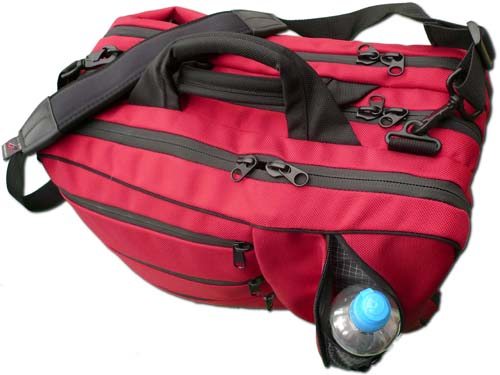
So first up you see the Tri-Star all zipped up with about 13 kg of gear. My trips required that I have a suit, and business clothing for each day. I would also need more casual gear for the evenings. Also in there is my MacBook Pro and associated teaching/presentation gear, gadgets, paperwork etc.
In the flat rear compartment we have a large, shallow area that is designed for stowing clothing.
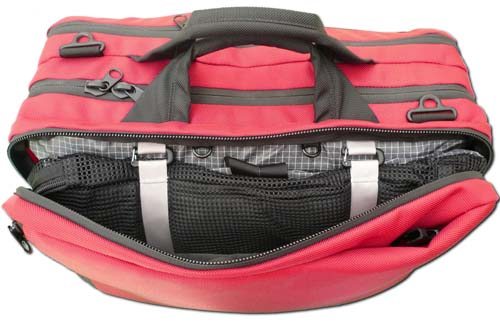
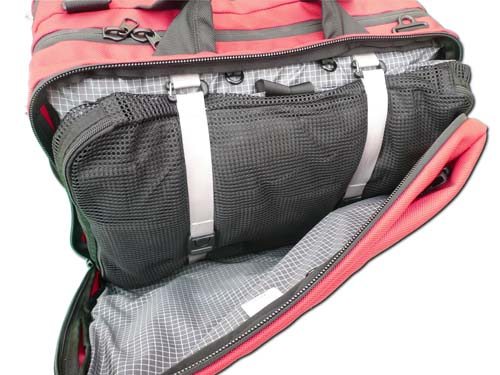
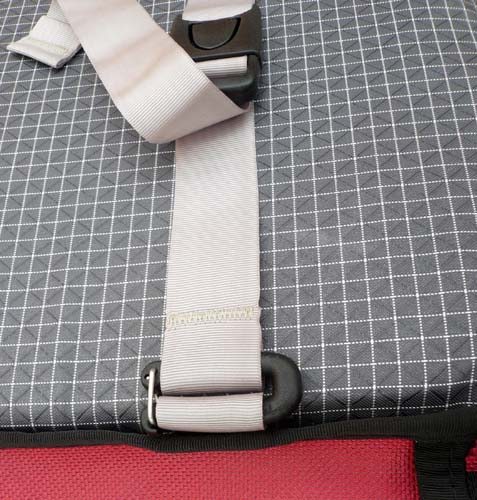
There are a pair of tie down straps in there, but little else intrudes into this space. The tie-down straps are removable.
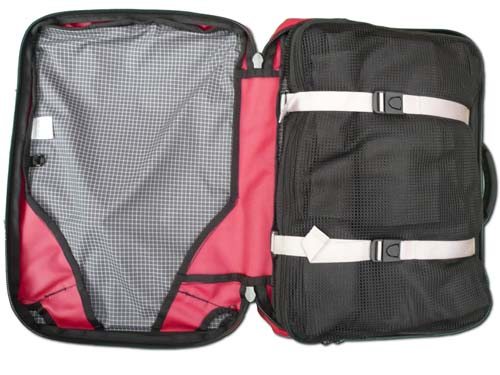
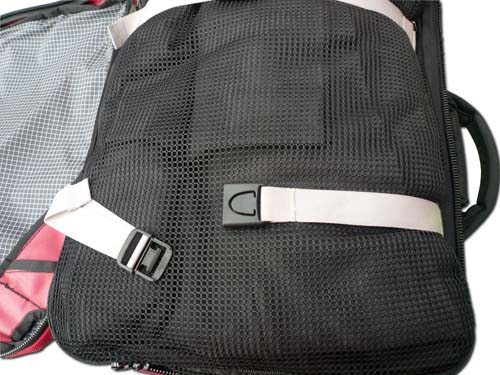
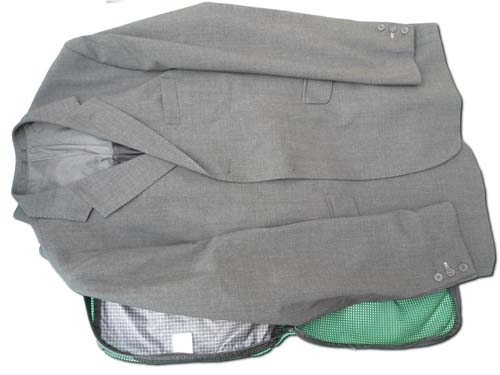
I put my suit in this space, and in turn this was constrained in the large Tri-Star parking cube. The packing cubes are not included in the cost of the TriStar, but as these are all designed as a kind of system, it makes sense to get them. Further, they are not too expensive; this one is $18. I should say that the suit is a dedicated travel suit made by Rohan. An ordinary suit might suffer in this area as it would become compressed by the weight of the pack pushing against one’s back. Hang up the Rohan suit overnight however, and the creases drop out fairly easily.
In the front we have two packing cubes. Again, these are extra cost; $16 and $15 for the medium and small respectively, but are custom made to fit perfectly in the front compartment. They make the Tri-Star so much easier to pack and use, that I think their purchase is a no-brainer.
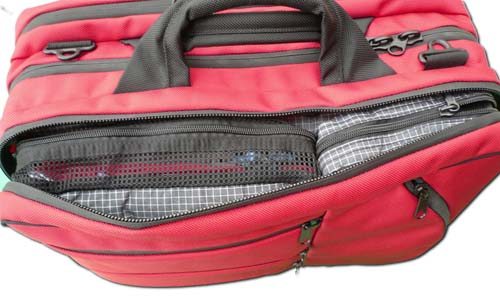
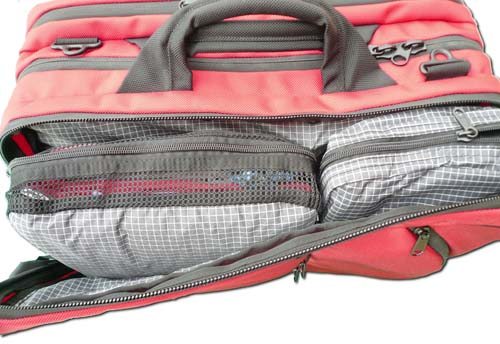
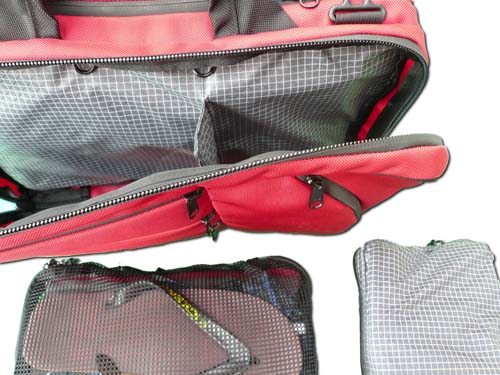
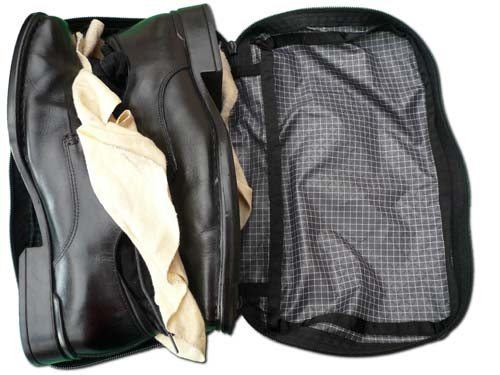
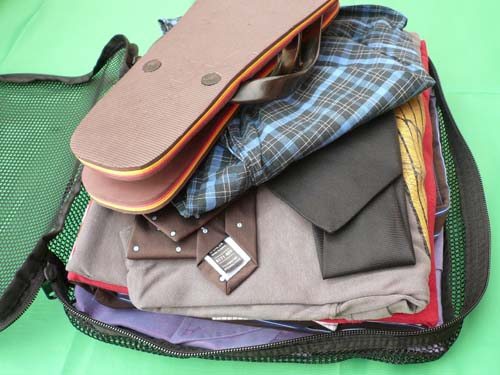
In the pictures above. the smaller of the two cubes contains a pair of size 10 1/2 shoes, with socks and underwear tucked into these. The medium-sized parking cube contains three shirts, three T-shirts, flipflops, a pair of shorts and a couple of ties. (There are more pictures of these further on in the review.) Clearly, you cannot jam your clothing into these packing cubes willy-nilly. Even on a return trip, everything has to be packed just so.
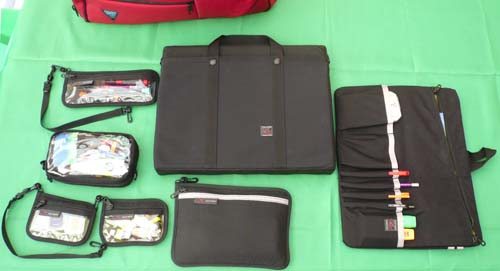
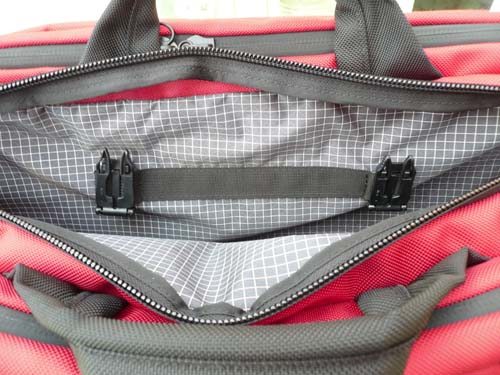
Opening up the central gear compartment we have Tom Bihn’s Brain Cell laptop cell which contains my 15″ MacBook Pro, a horizontal Freudian Slip and several small gear cubes and organizer pockets. Some of these gear cubes as you can see are secured to the case by little nylon Key Straps.
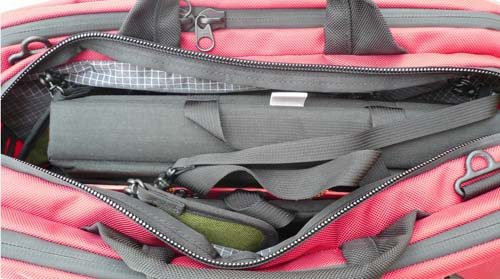
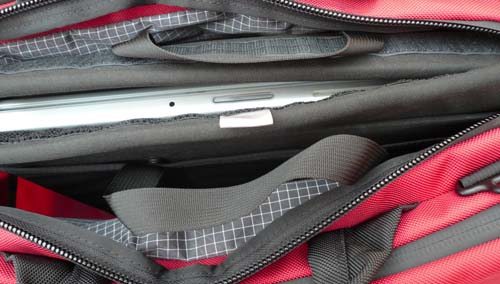
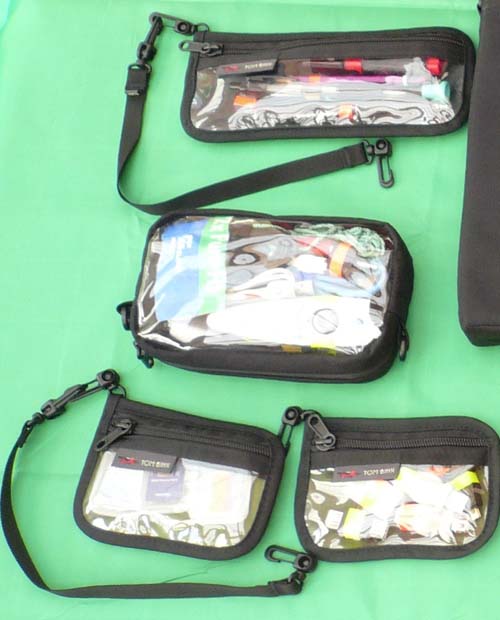
Here are the contents of the gear compartment laid out on the table. The Organizer Pockets at the bottom left have the long Key Straps still attached. These things are really handy for rescuing stuff from the depths of the Tristar:
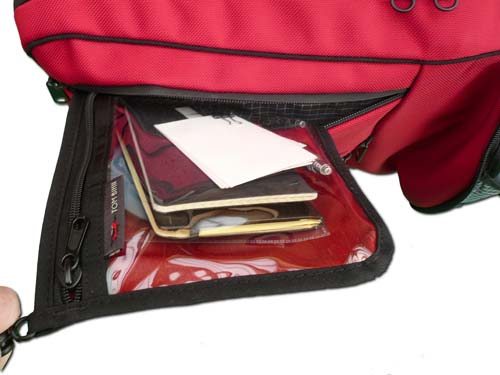
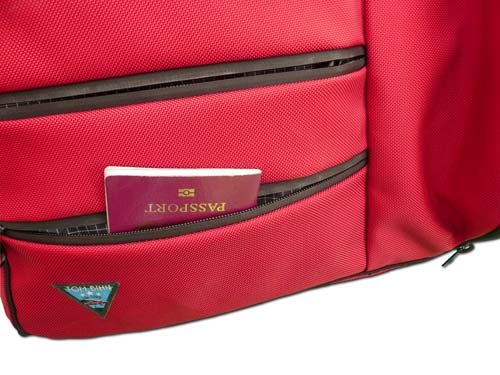
In the slip pockets on the front of the case are some more organizer pockets, travel paperwork, a paperback etc.
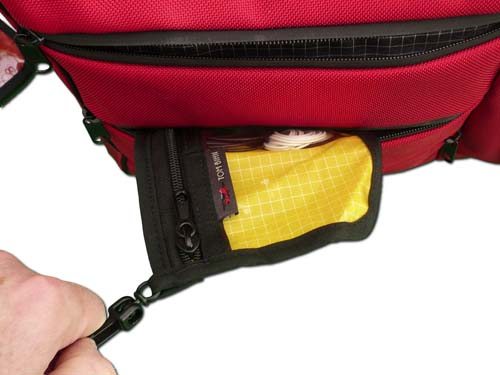
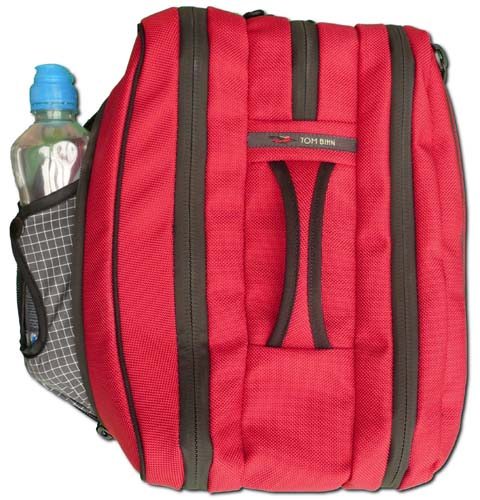
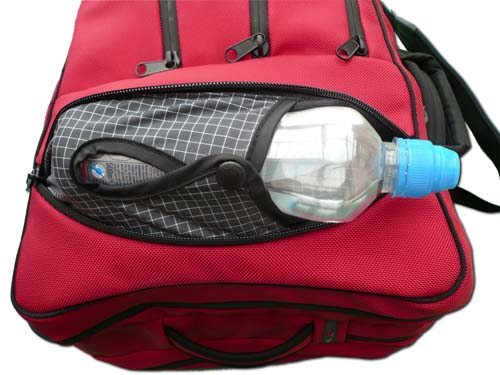
At the front of the bag is also a neat holder for a water bottle, you can also see one of the grab handles in this pic.
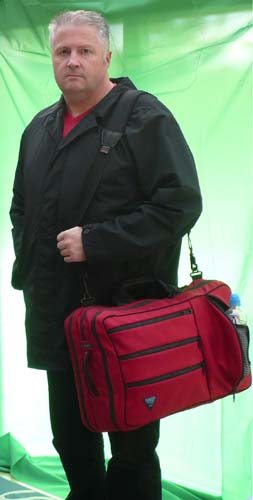
So this is what I lived with for three days and four nights away at two conferences. In addition there was obviously the clothing I was wearing; running shoes, jeans, belt, T-shirt and a overcoat.
In use – carrying the Tri-Star
Carrying this lot in the Tri-Star was easy. Mostly, I used the carrying handles or the shoulder strap, the latter being Tom Bihn’s “absolute shoulder strap.” I’ve reviewed the Absolute Shoulder Strap several times previously for the Gadgeteer, so I won’t re-d0 that, suffice to say its staggeringly comfortable even with heavy loads.
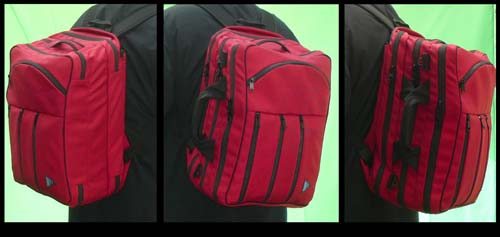
Now and then I carried the TriStar on my back using the built-in harness. This was pretty comfortable, though clearly this comfort is dependent upon the nature of the items in the rear compartment. There is also a fair chance that such items will be creased if you carry the Tri-Star on the back.
I gather that Tom Bihn designed this case to address the more restrictive carry on luggage rules that we have in Europe. So it is a quite a bit smaller (33 l.) than the aeronaut (45l.) I reviewed previously. Fully loaded like it appears in the picture it fits perfectly into the luggage size testers at check-in desks. Being about 3″ shorter than the aeronaut it was a lot easier to fit into overhead baggage compartments, especially those on small commuter jets.
Another aspect of the Tri-Star is that it actually looks like a large pilot’s briefcase, and so does not appear out of place if you take the whole thing to a business meeting. Actually, the black or grey version of the case would look a lot better in such contexts, but more on that later.
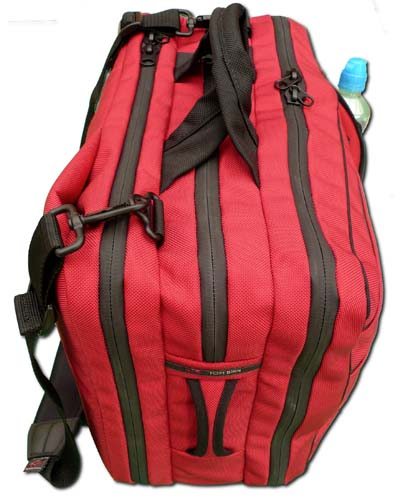
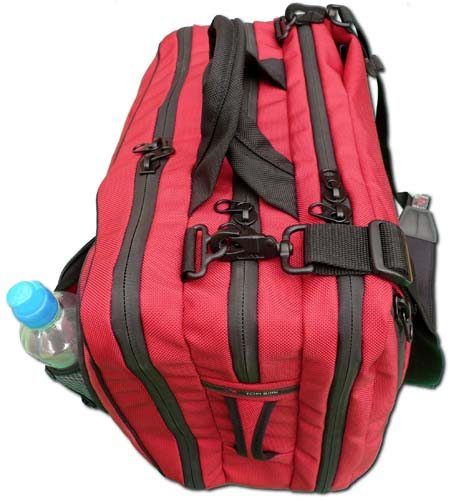
For the conference presentations this is exactly what I ended up doing – taking the whole TriStar sans clothing and packing cubes. In place of the packing cubes I would lug around handouts etc.
Features
My TriStar is in a bright scarlet ballistic nylon that is used on many of Tom Bihn’s other bags. It also comes in steel-grey, black and indigo. With hindsight I wish I’d got the grey or black version on the case. The scarlet fabric looks fabulous when new, but already its picking up the grime. The dirt does not show up in these pictures, but its there. My red Aeronaut was a dirt magnet too, and while it would clean up nicely in the washing machine, I’d rather not have to wash it so often.
Build quality is superb, no pulled seams, no frayed edges where fabric is cut but not sealed. The zip fasteners are big, beefy and waterproof. The lining, is Tom Bihn’s signature grey chequered Dynema fabric. Most of the webbing straps are black, with the exception of the tiedown straps in the rear compartment which are grey. The steel-grey and indigo versions come with an extremely loud yellow version of this liner material called “solar.” Check out the Tom Bihn website for pics of these different colour variations.
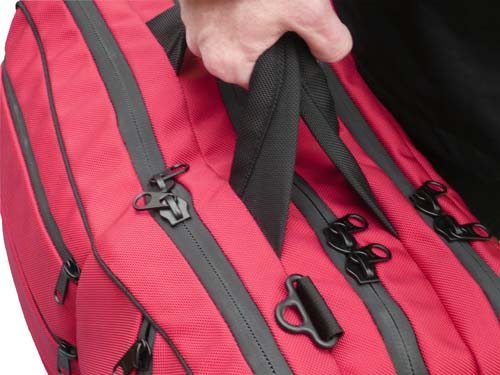
The main carry handle is a padded item in two parts. It works pretty well, though if you have small hands it can be a little tiring to carry as you cannot lock your hands around it.
No Bulging!
In the front compartment, is a zipped divider.
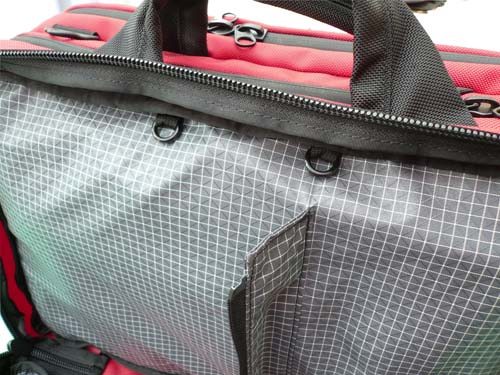
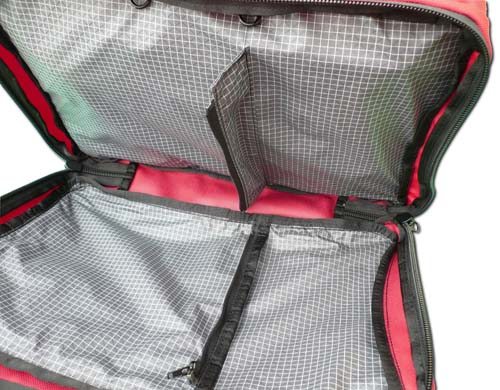
The divider serves to provide compartments for the small and medium packing cubes, or if unzipped allows one to use a large parking cube. The main benefit of this divider however, is to prevent the side wall of the case from ballooning out when the bag is full. I used to have the much-hyped Red Oxx Air Boss travel bag, and its a real pain in this regard; a neat cuboid turns into a soggy balloon after a couple of hours use. So, this is a really nice feature of the Tri-Star design and it works very, very well. I think its in the wrong place though. Where it is currently located it means that one locates shoes directly under the water-bottle. If the divider were located such that the small cube was on the left, and the medium cube on the right, then beneath the water bottle would be something that was more likely to “give” than a pair of shoes, and the water bottle would not jut out so much. Better still, Tom Bihn could add an additional divider so that one could locate the cubes either side.
Also in these last two pics you can see the small D rings designed for securing key straps, organizer pouches etc. There are lots of these d-rings dotted around the interior of the TriStar.
The flat zipped pockets on the front of the case provide access to different height pockets; the rear being the deepest obviously.
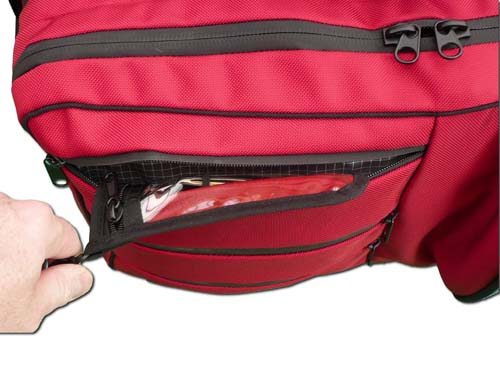
The curved zipper hides the pocket for a water bottle, and inside this is a clipped pocket made of Dynema to hold the bottle itself. By the way, the pic below shows a cord zipper pull attached. I had a pack of these from Tom Bihn, but eventually took them off as they made the bag look a bit fussy.
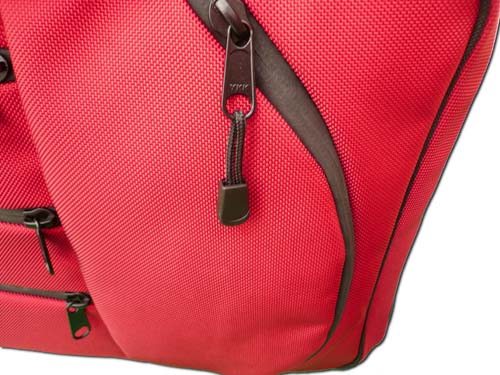
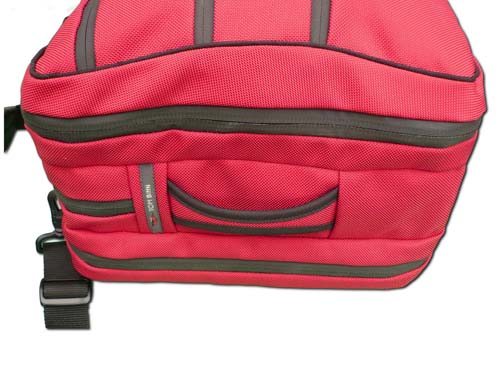
At either end of the case we have grab handles which are ideal for pulling the case from overhead lockers.
Tucked between the back and the liner is the svelte but very comfortable harness. This has more than enough padding for the weight that you would carry in the Tri-Star. It also comes with a neat chest strap which can slide to different heights / chest positions.
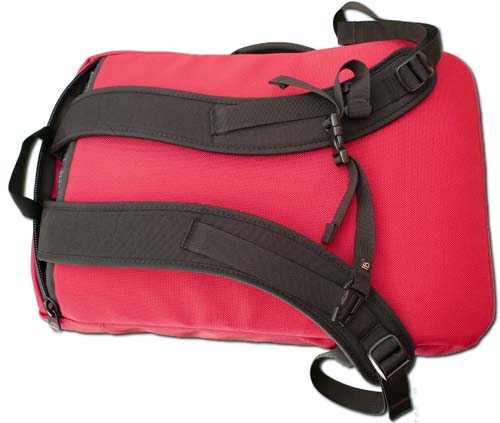
In the pic below the harness is partially hidden, waiting to be zipped away. Just down at the bottom left is a small handle which I found handy for hanging the Tri-Star, though it does rub on your neck a bit when carrying on the back.
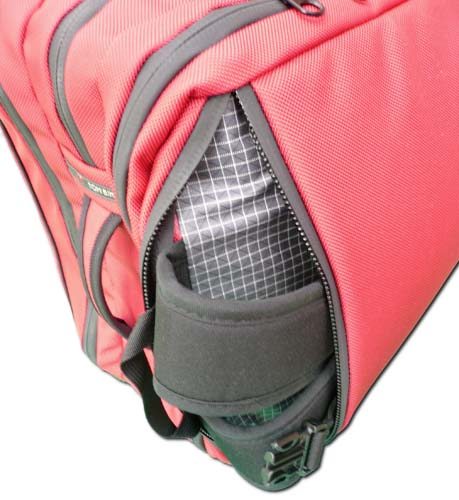
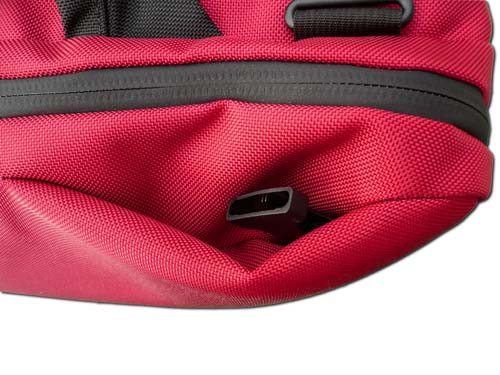
The harness is anchored to the lower corners of the case via some clips. These hide away when not in use:
The Brain Cell is attached to the gear compartment with a couple of bayonet clips:
Tri-Star Physical Specifications:
External dimensions: 19″ x 13″ x 8″ / 480 x 330 x 205mm
Weight: 3.4 lbs / 1.55 kg
Volume: 33 l. (2000 cu. in.)
Accessories – Packing Cubes
We have an insane number of packing cubes in our house. These things make packing so much easier. To fully exploit the Tri-Star, they are essential I think. Tom Bihn make a range ofsizes to suit their different bags. These UK size 10.5 shoes “just” fit inside the small Tri-Star cube.
The medium size Tri-Star cube is ideal for shirts and t-shirts:
Finally, the large size is great for suits and trousers. I think Tom Bihn now have a version of this large cube which converts into a daypack. Nice.
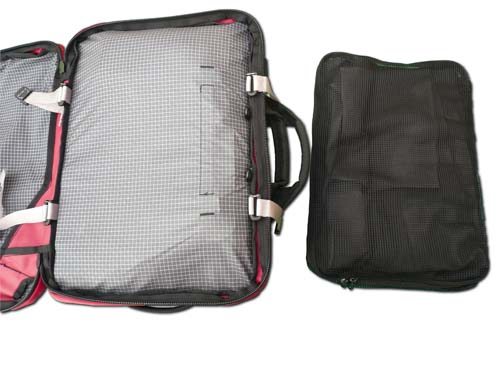
The packing cubes are very light in weight, even the large size. They come in mesh or opaque fabric.
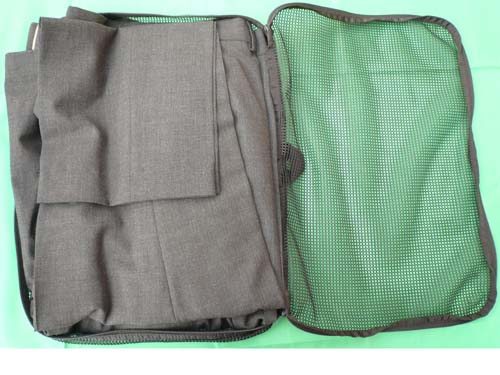
The Tri-Star packing cube dimensions are:
Small: 12.8 x 7.4 x 2.3″ (325 x 188 x 60mm)
Medium: 12.8 x 11.3 x 2.3″ (325 x 288 x 60mm)
Large: 18.7 x 12.8 x 2.3″ (475 x 325 x 60mm)
Accessories – Horizontal Brain Cell
The Brain Cell is essential if you are going to carry a laptop in the Tri-Star. The Brain Cell is probably the best laptop cell out there, its tough and lightweight. I’ve reviewed the Brain Cell a couple of times for the Gadgeteer so will not repeat these. Please go here if you are interested in the detail.
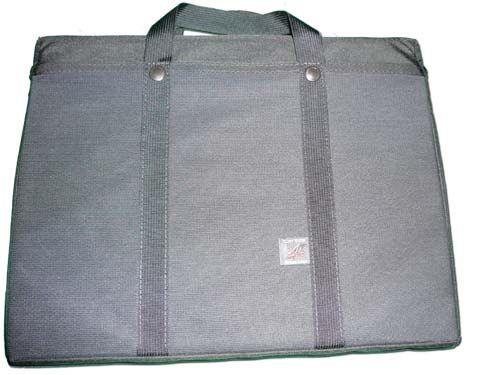
Accessories – Horizontal Freudian Slip
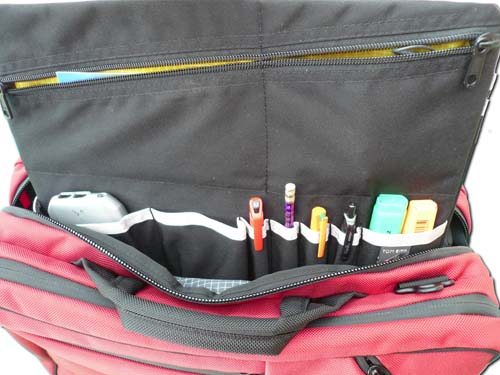
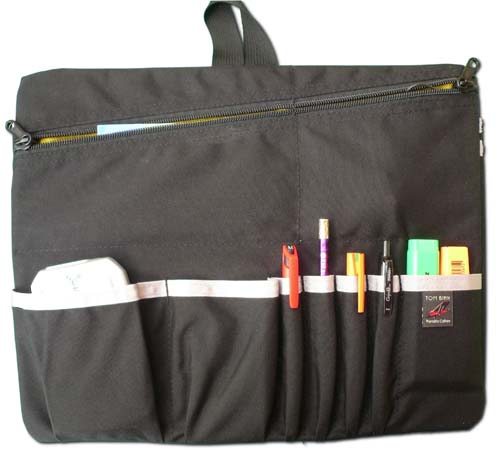
The Horizontal Freudian Slip is a panel of organiser pockets that fits into the Tri-Star. On one side are some pen holders, slip-pockets and lined zippered pockets:
On the reverse are some large slip-pockets for documents and writing pads:
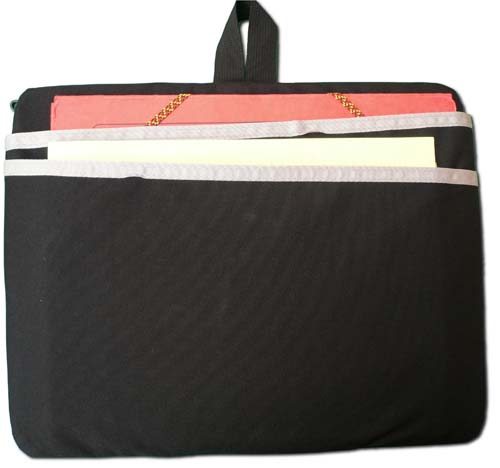
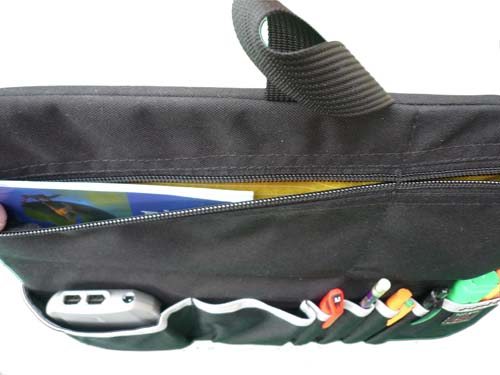
The zippered pockets are lined with that very loud yellow “solar” fabric I mentioned earlier. Nothing’s going to get lost in there! The Freudian Slip is one of those items that you didn’t know you had a need for until you get out and play with it. Its really handy of you tend to work when flying – a lot of your otherwise, hard-to-find stuff, comes easy to hand. You can hang the Freudian Slip on the seat-back in front of you.
Accessories – Organizer Pouches and Wallets
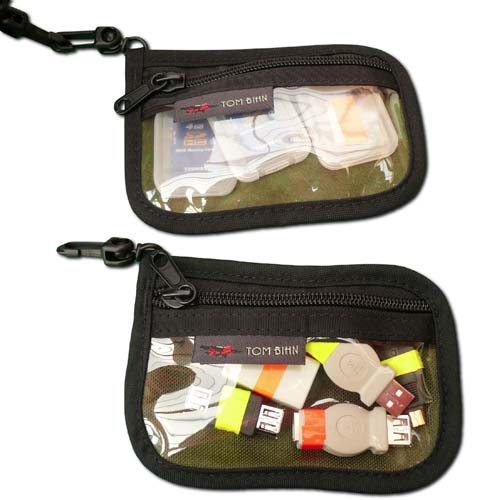
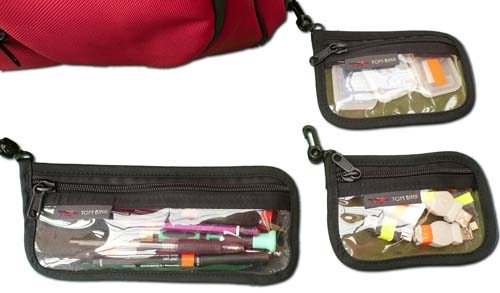
I’ve got a load of Tom Bihn’s organizer pouches and wallets already, but I love these things, and one can never have too many I think. The design of the clear Organizer Pouches has been refined a little since I last reviewed them for the gadgeteer. The range of colours and sizes has increased, and the clear part now seems to be of a softer, more pliable material (it says .020″ clear urethane on Tom Bihn’s site).
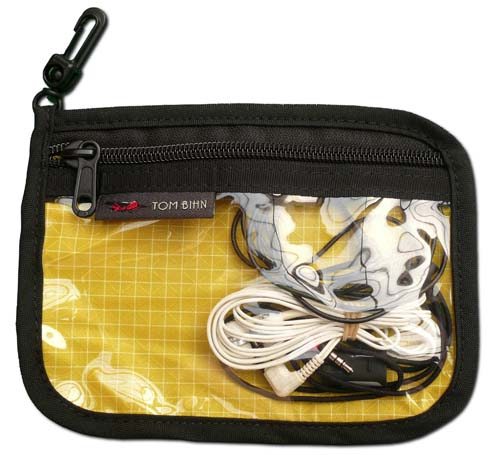
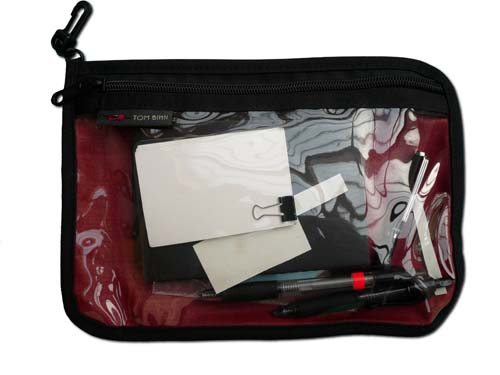
Tom Bihn also now do a mini version with ultra-suede dividers. I used this for SD cards, but I might buy another soon – to take my work ID card, some credit cards, cash etc, and fix this permanently to my car keys. Just below this is a mini standard pocket which was ideal for USB adapters. In case anyone is wondering at all this dayglo, I find it helps prevent me leaving stuff in hotels. If something small but important falls under the bed, I can spot it easily.
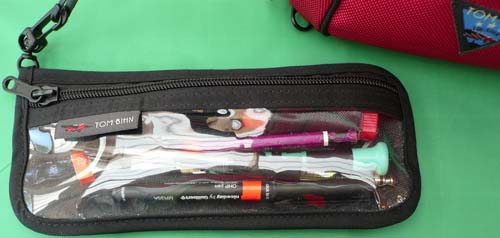
Here is the pen / pencil wallet:
Accessories – Key Straps
Here you can see a couple of the long key straps attached to pouches. These are great for retrieving stuff from the depths of a large case, but also prevent you from loosing items under aircraft seats etc.
Accessories – Absolute Shoulder Strap
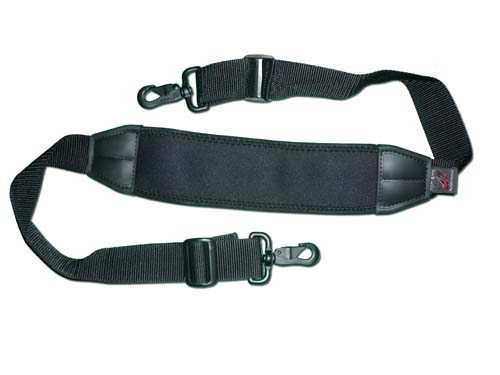
I’ve had a couple of these, and they are awesome. The most comfortable strap ever. The wide section is made of neoprene, and besides being non-slip, it acts as a suspension device for your bag. It really does create an illusion that the bag weighs less. If you want a bit more comment on the Absolute Shoulder Strap please have a look at my Empire Builder review.
Accessories – 3D Clear Organizer Cube
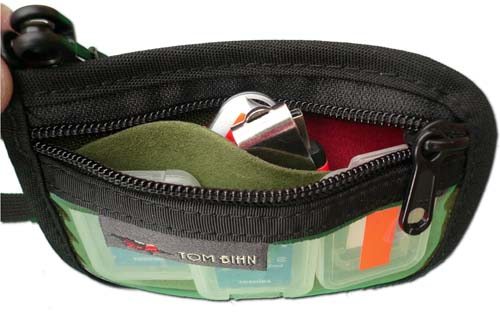
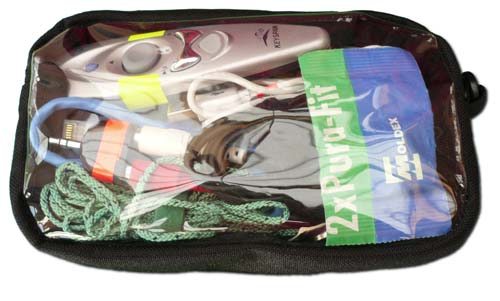
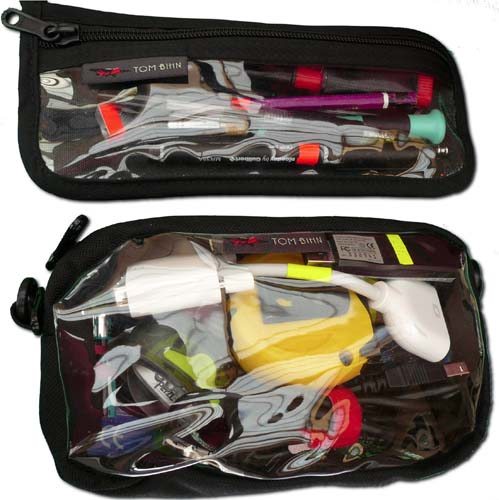
The 3D Clear Organizer Cube was a new item that I had not tried before, and its very effectuve. An obvious use would be for toiletries. I use it mainly for presenting gear – bits of cabling and connectors, Keyspan Remote … that kind of thing. With the two sides being clear its really easy to find stuff. Even with the clear urethane its also pretty tough.
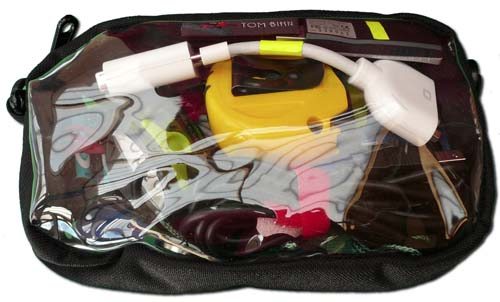
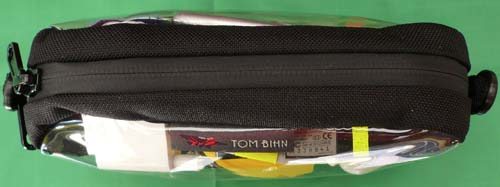
This pic below shows the 3D cube up alongside the pen/ pencil organiser pocket.
Conclusion
The Tri-Star is not marketed as part of a system, but its clearly just that. At the very least I think its worth adding the three packing cubes, the Brain Cell and an Absolute Shoulder Strap. With that lot and shipping you are not going to get much change from $400. So is it worth it? For me, the answer is overwhelmingly yes. I think good design … disappears. By that I mean, travelling with the Tri-Star does not give me super hero powers, or street cred’, or style. Rather, it means no headaches or problems in the luggage department. It just works. Lesser bags always have one feature or another that gets in the way. The only minor problem with the Tri-Star was that “sticky-out” water bottle holder (which Tom Bihn could easily fix I think) and the “dirt-magnet” red fabric. The latter could have been fixed by me choosing black or grey. The Tri-Star is so close to my perfect travel bag that it hurts every time I think I could have ordered a grey or black one.
If you are feeling really flush, you could also add in a pile of 3D Cubes, Organizer pockets and the Freudian Slip. These are not essential, and the selection reviewed here pushes the total price up to about $500, but they really do make the whole system work well. If you can’t stretch to the $240 Tri-Star, then try a few of the Organizer Pockets – they are staggeringly useful. Everyone should get one as a Holiday present!
So, the Tri-Star and its associated accessories are not cheap. However, they do the job beautifully. Nice work Tom Bihn.
Product Information – Tri-Star
| Price: | $240.00 |
| Manufacturer: | Tom Bihn |
| Retailer: | Tom Bihn |
| Pros: |
|
| Cons: |
|
Product Information – Packing Cubes
| Price: | $15 – $18 |
| Manufacturer: | Tom Bihn |
| Retailer: | Tom Bihn |
| Pros: |
|
| Cons: |
|
Product Information – Organizer Pockets and Cubes
| Price: | $6 – $18 |
| Manufacturer: | Tom Bihn |
| Retailer: | Tom Bihn |
| Pros: |
|
| Cons: |
|
Product Information – Horizontal Freudian Slip
| Price: | $35 |
| Manufacturer: | Tom Bihn |
| Retailer: | Tom Bihn |
| Pros: |
|
| Cons: |
|
Product Information
| Price: | |
| Manufacturer: | Tom Bihn |

Gadgeteer Comment Policy - Please read before commenting
Very nicely reviewed, Michael. Your finding and conclusions are spot on, certainly in reference to the added functionality when used with Packing Cubes and Organizer Pouches. I also enjoy several Tom Bihn products, including the Aeronaut, Brain Bag and Tri-Star, as well as several accessories. The quality and workmanship is universal and consistent across them all. I use the water bottle holder infrequently, and the backpacks straps have never been used to date. Instead, I use the Absolute Strap for very comfortable shoulder carry, or hand carry if the load allows as it often does, just carry it by the top handles.
But I do confess to a little buyer’s remorse in that I ordered my Tri-Star in Indigo… don’t know why, but I did. I should have gone for Steel or Black. But, I’m loving it… for all the reasons you’ve laid out.
Great review, thorough and the pictures are very helpful. Thank you. I have a couple of questions. First, how much of a problem did you feel the “sticky-out” water bottle design was? If there were softer things packed behind it would it make a difference?
Second, you mention using the Aeronaut, and since I’m trying to decide between the two bags could you say why you felt your experience with the Tri-star was better? I like the format of the Tri-star better, but it seems like the open compartment of the Aeronaut would lend itself better to a wider range of packing tasks.
Finally, I’d love to hear more about your experience with your Rohan suit. I visited their website, but it looks like they have only one option (sold as separate jacket and pants).
Thanks again for your great review, and for the indirect validation. I just bought the Western Flyer and after much deliberation decided to go with black.
Thanks for the feedback Karl and Chris,
So it looks like we are agreed on colour choice :-(. I think I had better bite the bullet – sell this one and order another in black.
As to your questions Chris:
Don’t worry about the water bottle thing – its not a huge issue. My review comments were more a critique on the (assumed) design logic rather than a reflection of any great problems in use. I suppose it would be an issue if you carried big and bulky shoes in that area, in which case BTW you would not fit them into the packing cube. They would have to be loose in the front compartment.
As to Aeronaut v. Tristar. Sure – greater flexibility in packing is plus point for the Aeronaut, but in all other respects the Tri-Star wins it I think. As long as you are reasonably disciplined in packing, go for the Tri-Star.
Rohan are a really good, but annoying company. They make some fantastic products, but they run out of the good stuff way to early in the season. You have to be quick. I’ll maybe do a review of the suit one day, but it might not be much use to readers unless they bring the line back into stock. Suffice to say, that you can trust what Rohan say in their brochure about easy wash, creases dropping out, very light weight. The cut of Rohan gear tends to suit a slimmer shape, which is a problem for me as I’ve just gained a bit of weight. The shirts they make are awesome – especially the “expedition.”
Best,
Mike
As to the question of Aeronaut vs. Tri-Star – I am intrigued by the Tri-Star, but since I live on a limited suitcase budget (!), I own and use the Aeronaut for all travel. I recently traveled to the mainland US and Europe for three weeks with my Aeronaut, and it worked incredibly well for all flights. I took a strap to cinch in the bag for European flights, but actually did not need to use it, because of the bag’s soft-sided open format. Still, someday it would be lovely to have a Tri-Star, too . . .
Hi Louise. I agree, there is not much wrong with the Aeronaut, its just that the TriStar worked out a lot better for me for short business trips. It has more than enough space for me. These days, when I need a bigger bag, I need a really big bag – like on ski trips for instance, when I would probably take a big duffel.
Hi Michael,
I was wondering on your thoughts comparing the tri-star, aeronaut and the air boss. I fly frequently to europe and need to be able to pack two suits in the bag, I am currently using an old version of the victorinox weekender which I like for the garment section and expandability, but hate the bulging side pouch (also have been forced to check it a few times). Any thought on which of the three bags would be best for me?
Thanks
Drew
Hi Drew,
If you don’t like bulging pockets etc., then I’d forget about the Air Boss. The Air Boss is unstructured. As you asked the question, I just now went upstairs and tried packing two suits into the TriStar. I used the biggest of the packing cubes (the TriStar large). I inverted one of the sleeves on each jacket and folded one half of the jacket into the other. I then folded the result in half. The trousers had two folds and were laid on top. It all fit into the Tristar no problem. It was snug, and there would likely be some creases after a trip across the pond, but it works. These suits were modern and lightweight (Rohan and Digel) and so they tend to resist creasing. A wool suit might not fare so well.
The Aeronaut will take two suits easily. My recommendation here would be to buy a couple of cheap, thin suit covers (Ikea for example). Put the suit jackets in the covers with the buttons done up, then do two horizontal folds. The result just about fits into the main compartment of the Aeronaut (as long as you don’t have too much in the end pockets). Make sure the two suits go in so that their necks are “opposed” – evens out the bulk. The slipperiness of the suit covers tends to prevent creasing. The Aeronaut is less structured than the TriStar, but nowhere near as floppy as the AirBoss.
I seem to remember Tom Bihn saying a while back that he was going to make some suit packing “thing” – just looked on their website and there is nothing there yet.
I’m talking about large mens suits here, so for women’s suits its going to be way easier.
If you want compactness and structure, go with the TriStar. Make sure you get the packing cubes though – these things make a big difference. If it was not for the horrendous import taxes, weakness of the pound and the sky high shipping, I would order two each of every packing cube and accessory pouch that Tom Bihn makes – these things are amazingly useful. Also get a Freudian slip – sooo useful, if a bit geeky on long flights! Just hang it on the seat-back. The Freudian also slip keeps things from slipping to the bottom of the bag and so prevents bulging. I’m going to order a vertical one for my backpack – I’m using my old Spire Volt for work at the moment, but it needs some internal organisation.
Anyway, sorry – going down a rathole here. Hope this helps, if not post another question. Best, Mike
“Even on a return trip, everything has to be packed just so.”
This is the bit that bugs me. At the end of a vacation, I’m sometimes lazy enough to just stuff the dirty clothes into my suitcase willy nilly. Just be done and go home. This rigid organization prevents my normal stuffing.
Well now Bill, as you will probably guess, anyone who is willing to write a gazillion word review, with lots of photos … is probably a bit OCD anyway. That’s me 😉 I love organising and ordering.
The clincher though, is that “Her indoors” will beat me up if I come home with things all messy and creased!
Best,
M
Tristar is my next purchase. I am traveling more and have learned the limitations of a wheeled bag. I love Eagle Creek packing folders to keep my clothes wrinkle free, do you think they will work in the Tristar? I have a few cubes but clothes seem to fit so sloppy in them.
Hi Michael,
The thing about the Tom Bihn Tristar cubes is that they fit PERFECTLY into the Tristar. Also, they are very inexpensive. I would say get them. I have some Eagle Creek packing gear, and its very good, but its not going to fit so well. Also, remember that the TriStar has tie downs to keep whatever is in the main compartment flat.
Very spooky this you know. Last night I was looking at my gadget bags and I decided to replace my old and tatty, but very functional Spire Volt XL with a new Brain Bag from Tom Bihn. I ordered the black one, and its coming at the end of the month. I think I will be able to fit my TriStar packing cubes into the Brain Bag and so it might make a good bag for overnights / long weekends. I also ordered the Tom Bihn Ristretto for iPad a couple of weeks back (ordered wrong colour, but that’s another story) and the Ristretto carries quite a lot of gear, so my backpack / travelbag does not need to be so big.
If it all works out, and I can get my gear in there I will probably sell my Tri Star. Need to have a clearout anyway, as missus is starting to kick up about so many bags around the house.
Anyway, the Tri Star is fab, just make sure you get a darker coloured one as the loud ones are dirt magnets.
Best,
Mike
Hi,
You mentioned that you used to have the Brain Bag by Tom Bihn. Do you like the Spire Volt more or did you get rid of the Brain Bag for some other reason?
Also, did you notice a big difference in what you could carry between the Aeronaut and Tristar? I’m taking a 7 day trip to the beach and was unsure which of the two to get (a few bathing suits, about 5 pairs of shorts/polo shirts).
Thanks for your incredibly helpful reviews. They are gold!
Hi Jim,
I bought one of the light blue Brain Bags way back. I loved the bag, but hated the colour. I don’t think they do that colour anymore. It looked great on the website, but was cheesy in the flesh. I swapped the bag for two concert tickets (Simply Red I think it was – sad I know).
I use my old Spire Volt XL as my main bag for work. I don’t think Spire do that one anymore, the latest incarnation is the Torque – about the same size as the Volt XL, but with two compartments. My Volt XL is a bit tatty now, but perfectly functional. I have a vertical Tom Bihn Brain Cell inside the Volt as the Spire sleeve (the Boot) does not offer much protection. I also have a Tom Bihn Freudian Slip to organise things and keep the contents from flopping at the bottom of the Volt.
This said, its all change at the moment. “Her indoors” was complaining that my Volt looked too scruffy and also that I carried too much stuff in my pockets. So, after resisting for many years, I have finally got a “man bag.” I have just taken delivery of a Tom Bihn Ristretto for iPad in black and wasabi. Its Fab, and stops my gadgets from pulling my trousers down. I also ordered one of the new brain bags in black, but it has not arrived yet. Not sure what’s going on at TB, but its been a while now. Will have to chase.
Anyway, I decided on this combination because I work in two places, at home, and at my office in my university. I have to lug 15″ macbook pro, podcasting kit, sports kit etc back and forth. So I needed a big backpack. However, when at either place I might have to go to meeting, or give a lecture with just ipad, wallet, phone etc. Did not want to carry the whole setup around; hence the Ristretto. The idea is that the Ristretto and gym kit goes in the front of the Brain Bag, with the brain cell and other bits in the back.
I have a Spire Meta, but its too big and floppy / unstructured. I considered buying the Spire Torque, but it looked a bit too small. The Tom Bihn Brain bag looks just about right – gives me just the few litres of extra space that I need. We will see. I hope to take delivery of the Brain Bag soon.
As to your questions on the Aeronaut v Tristar for a beach trip – either will do, but I would think beyond the one trip unless you are loaded. Get the back that serves most of your travel needs – the Tristar is a bit more structured, and better for shorter business trips when you have laptop plus gadgets. The Aeronaut is better for more casual things (beach trips for example) where you can just squash stuff in there. For me, the Tristar has the edge, but when I travel its mostly business-related.
Hope this helps.
Best,
Mike
Mike, I need help: In two weeks I start a new job where I’ll be traveling the Western US (exclusively), gone 3-5 days per week, every week. Airports, rental cars and hotels will become my life. I’m just now learning that some people actually prefer bags without wheels. But is non-wheeled luggage the best in all occasions? If a piece of Tumi or Kirkland luggage I pick up from Costco fits all my belongings, isn’t that enough? Of course, there is the added weight of the wheeled luggage. But am I really going to notice an extra 5 lbs if it’s rolling smoothly through the terminal atop a high-quality set of wheels? Isn’t that actually traveling “lighter?” It seems that lugging around a bag, even if it is 5 lbs trimmer, would be more work.
In 2001 I traveled around Europe for two months with a proper travel backpack. I couldn’t imagine trying to roll around a piece of luggage all over Europe. These bags certainly do have their limits. But in my current situation, where my luggage travel is limited to: from car to plane to car to hotel, and the most I’ll have to bear the brunt of its additional heft is when lifting the bag five feet into the overhead bin, is the rolling bag really such a bad a choice?
Let me also fill in a few more blanks: I’m based out of Los Angeles, and since I’m only doing short hauls, I’ll rarely, if ever, have a stop over. I’ll also be traveling primarily on JetBlue and Southwest Airlines, both of which have lenient carry-on policies.
Although I used Costco as a hypothetical, I will buy my luggage there. And since they have an absurdly lenient return policy, I’m not too worried about the longevity of such a bag — if a wheel breaks in 5 years, I can just bring it back and they’ll give me something brand new.
Is my logic off target? What am I missing? Thanks!
Hi Eric,
What you choose depends on you, and your circumstances. With a situation as you describe it, maybe a roller does make sense. However, consider also that because you can put extras into the roller, you probably will. There is also the speed issue, you can move much more quickly with a lighter backpack. This is an important consideration for me, because I want to be first in the rental car line (some provincial airports over hear are not well stocked with hire cars) Finally, while the airline may be tolerant about big carry-ons, you still have to find a space for yours in the overhead.
Mike
Michael, great review!
How are you liking the Brain Bag compared to your old Spire? I just concluded an intensive search for a new laptop backpack. Tried a bunch of different models, final choice was the Brain Bag and I love it. I wish it had just a bit more organizational features, but this is a great bag.
Still debating about Tri-Star vs Aeronaut. I’m thinking for 5-7 days trips, the Brain Bag along with the Tri-Star could be perfect. Put the Tri-Star in the overhead compartment, Brain Bag under the seat in front. Do you ever travel with both?
Hi Rick,
**Michael, great review!
Thank you
**How are you liking the Brain Bag compared to your old Spire?
The Brain Bag is now my daily bag. It sticks out from the back a bit more than the spire, and, as you say could do with a bit more internal organisation, but otherwise is a better bag for me. I understand why its not full of internal pockets etc, I think Tom Bihn intended it to be versatile. It is. Here is how I use it:
As daily work bag: Brain cell in laptop compartment nearest back, with 15″ MB Pro. Vertical freudian slip after that (in same compartment). In outer compartment I put my ristretto (iPad size) which contains iPad2 and small metrosexual stuff. (Its my first ever man-bag and I am struggling to come to terms with it.) Outer compartment also has lunch in tupperware-type box.
So, I get into work, connect up laptop to office peripherals, remove Ristretto and hang on coat rack for later use at lunch, meetings etc.
Some days I want to take my podcasting kit home. If students are driving me nuts and I need peace and quiet I go work on kitchen table. So, I have some Eagle Creek Pack-It Protect-It Cubes. I can fit two Medium cubes vertically in the outer pocket of my brain bag, and then two small Protect-It Cubes horizontally above these. The fit is perfect. I’ve been waiting for Tom Bihn to make his damn photo insert for the brain bag, but the heat death of the universe will come first I think. Anyway, my mobile studio in the form of Heil PR40, M-Audio interface box, Two LED light panels, loads of Joby Gorillapods to hold things, XLR cables … etc all fits neatly and safely in the outer compartment of the brain bag. I have a ‘tube’ bag to hold my mic stand and green screen and this is strapped to the water bottle holder straps on the outside of the brain bag. Obviously the Ristretto has to come out and go on my shoulder in this mode.
Finally, if I am doing a couple or three overnight stays (sans podcast studio) I use my Tom Bihn packing cube backpack which fits neatly into the outer compartment, and carry the Ristretto on my shoulder. The packing cube will take two or three shirts, one trousers, underwear etc.
Any trip for longer I would probably, as you say, take a big bag alongside the brain bag. It would not be the Aeronaut or Tri Star though. In Europe I would have to check the extra bag, and both are too nice for checked baggage. I would probably just put a load of clothes in a cheap duffle, then check that.
In USA or Canada, as you suggest, you could probably get away with both Brain Bag and Aeronaut as carry ons. I would not put the brain bag under the seat in front of me though. I’m a tall guy, and I need wiggle room for my feet.
Other thoughts:
I should probably to a comprehensive review of the new Brain Bag, it really is a gem. Not perfect, but as is usual with Tom Bihn, the design trade-offs are managed with care and attention to detail. My Brain Bag is black though, and I probably could not get good enough pics for a review. Will experiment over the w/e. If I can get the details to show up in pics then I will do the review.
The vertical freudian slip was designed for a time when we used to carry paper around. I think TB needs to re-design this thing for modern accessories. It could do with some portable hard drive pockets high up for example. I’ve bought all the materials, and if I can get the time am going to have a go at making a 2012 freudian slip just for me!
That’s it.
Thanks for the comments and questions Rick.
Best,
Mike
Mike, wow, what a great response. I appreciate you taking the time to do that.
You need all of that expensive equipment to do a podcast? I thought quality podcasts could be done relatively inexpensively? That’s some impressive gear.
Re the luggage, a few thoughts.
I agree about putting stuff under the seat in front. I’m 6′. I like having that space, but can live without it. What I’m probably going to do on my next flight is put both bags in the overhead, then put the basics I’d need on a relatively short (3 hour give or take) flight in the Tom Bihn Side Effect (food bar, iPhone, Etymotic ear buds, etc…), grab a book out of one of the pockets and then put it all up.
Re the Brain Bag, the one complaint I have is that they could’ve built in much more organizational structure into the bag without compromisng the bag’s vision. I understand he wants it, without any of the accessories in it, to be a big old somewhat plain pack. But he could’ve easily sewn some slim pockets into the liner that separates the two compartments, for example. And the small accessory detail in the two side pockets? Close to worthless. How many pens does one need to take? Give me 2-3 pen pockets on one side, and then make the other side useful. Am thinking about taking the bag to a seamstress to see if they can rip out the seams on some of these pen loops to make one bigger pocket. Also, the water bottle pocket on the side isn’t particularly useful if one has that side pocket fairly full.
But all that said, those are minor quibbles with what is otherwise a great piece of gear. The materials and construction are just a step above everything else I demoed, save for the Briggs & Riley, and that was just an entirely different kind of bag. I bought (and subsequently returned) the Verb Live. There was much to like about it, and MUCH better organizational detail than the Brain Bag, but it’s the kind of bag you’d want to be careful with, it’s a ‘pretty’ bag. Also doesn’t have the sheer volume the Brain Bag has.
Interesting comment re the Vertical Freudian Slip. I don’t haul many pieces of paper around, but it happens enough that I do need that kind of organizational structure. Seems like the two large elastic pockets on the back side would work well for portable hard drives, etc… One thing I really like about its basic design is how well it uses vertical space and preserves horizontal space, something most bags do a poor job of. I use David Allen’s “Getting Things Done” methodology, so I ALWAYS have certain files with me: Inbox, Action Support, To Home, To Office, and To Read. I love that with the Slip I can open up the compartment and see all the files at a glance, I don’t have to rummage for them. But I could absolutely see the value in Tom offering a ‘digitized’ version of the Slip. Less file structure, more ‘stuff’ structure.
Thanks again for the response, it’s much appreciated. The Tri Star is just a beautiful bag. Not sure I can justify the expense (close to $400 with all the packing cubes and shoulder strap) at this point, but someday.
Hi RIck,
** You need all of that expensive equipment to do a podcast? I thought quality podcasts could be done relatively inexpensively? That’s some impressive gear.
Mmmm? Well, if push came to shove I could do a podcast, or screencast with just my iPhone. Would I want to though?
** Re the Brain Bag, … and the small accessory detail in the two side pockets? Close to worthless. How many pens does one need to take?
Agreed. Bag makers generally seem to be obsessed with pen pockets. I teach course in innovation and design. Last year I got my students to design a better student bag. The students did some pretty good market research. One finding was overwhelming, that most bags have too many pen pockets!
** Also, the water bottle pocket on the side isn’t particularly useful if one has that side pocket fairly full.
If you mean the mesh pocket, I guess you are right. I never think of that one as a water bottle pocket. I have a small umbrella in there. I clip my water bottle to the carabiner and cinch it up with the two straps below it.
** Interesting comment re the Vertical Freudian Slip. I don’t haul many pieces of paper around, but it happens enough that I do need that kind of organizational structure. … Seems like the two large elastic pockets on the back side would work well for portable hard drives, etc…
Kind of, but they are in the wrong part of the Freudian Slip. The bottom of the bag is going to ‘bell out’ anyway, and having storage pockets up high would help to counter that. Also, I really don’t want delicate hardware at the very bottom of the bag. One thing I really like about the brain cell is that it ‘hangs’ the laptop, and keeps it from banging on the deck.
**I use David Allen’s “Getting Things Done” methodology, so I ALWAYS have certain files with me: Inbox, Action Support, To Home, To Office, and To Read. I love that with the Slip I can open up the compartment and see all the files at a glance, I don’t have to rummage for them.
Understood, I am GTD-type too, but omnifocus does it for me. I try to avoid paper, and most of my work colleagues have got the message now. If someone insists on giving me paper I photograph or scan it and discretely bin the original.
Best,
Mike
Another OmniFocus user!
Yes, I use it on my mac and iPhone. Just terrific. And while I’ve managed to significantly reduce paper, I can’t eliminate it. For example, I’ve got to send in my auto registration renewal and this time I can’t just do it online, gotta include a copy of my insurance card. So that’s in my action support folder. Paper receipts from travel just get filed. Faster than scanning them, etc…
I don’t use much paper, but enough to make the Freudian slip a nice accessory for me.
And I just bought one of the glass bottles that Tom Bihn sells. Planning on attaching the water bottle the way you describe to see how that works. Only thing I can see is not enjoying messing with the carabiner and the straps every time I want to take a sip. Would be easier just to pull it out of the exterior pocket and slide it back. Oh well.
Hey Michael, I’m going back and taking a hard look at the Tri-Star and I realized I’m missing something from your review: where did you put your toiletries? Sorry if you laid that out and I missed it.
Do you think there would be room in the center compartment for a brain cell, a freudian slip, and then one of Tom Bihn’s Clear Quarter Packing Cubes?
Ahhhh! Good point, I forgot to put that in the review. Well, my wash bag is tiny, its an old LifeVenture bag that is just a bit smaller than the 3d Clear Organizer Cube at about 16x11x5 cm. They don’t make this small size anymore, the smallest they do now is about 25cm long. I tend to use small, travel size toiletries, or decant from big shampoo bottles etc into GoToob (from humangear.com).
Anyway, if you look in the review for the series of pics showing the gear compartment, the first of these shows the brain cell shut, and just to the left of it is a small gap. This occurs because the laptop compartment is designed to take some big laptops. For example, the size one brian cell for the 17″ macbook pro will fit in there. My laptop is a 15″ mbpro in the appropriate brain cell, so there is a gap. The bayonet clips in the centre compartment are placed so that when fastened in place, the brain cell is itself centred in the compartment. If you don’t attach the brain cell to the clips, then you can push it to one side and create a nice space just right for a 3d organiser cube, and a small wash bag. I suppose there is small risk of the braincell falling out should you forget its not attached, but its not really anything to worry about.
Thanks for pointing out the omission – good spot. I do wash, honest!
Lol, thanks Michael!
So, you put your small toiletry bag just to the side of the Brain Cell in that space? Cool. Was that bag also your 3/1/1 bag? I’m assuming you had liquids of some kind like shampoo and toothpaste, unless you just got those at your destination.
One question I have is where I’d put a 3/1/1 bag for easy access during the security process, and then where I’d put the rest of my toiletries (and in what). Since getting my Brain Bag and becoming Bihn-fected, I’m now re-evaluating my entire travel strategy. In the post-9/11 era with the new carry on rules, I just said “screw it, I’ll check a bag” and then since I had so much space, I just threw a ton of stuff in there. Now I’m trying to lean things up.
And I do have one other question if I may: what did you do once you took your seat on a plane? Did you keep some kind of bag within the Tri-Star that you could easily pull out with the things you’d want to access in-flight? One of my concerns migrating to a 1-bag travel style is exactly this. Once I get to my seat while boarding I want to stow my gear and get out of the way as quickly as possible so I don’t delay other boarders. I don’t want to have to get to my seat, open my bag, pull out the 4 things I want in flight and then close it up and stow it. Just curious how you manage that process.
I’ve read a number of luggage reviews in the last few weeks, this one on the Tri-Star is one of the best, you did just a great job on this.
Hi Rick,
As to the 3/1/1 thing … I just had a look at my wash bag, which is usually hanging behind the bathroom door. First thing I’ve noticed is that my partner (who is off on a girls photography trip to Paris this weekend) has nicked my toothpaste. In the bag my liquid toiletries are:
(usually) 20ml tube of Sensodyne toothpaste
55ml GoToob of Shower gel
55ml GoToob of hair gel
15ml King of Shaves shave oil
These fit neatly into a small, cheap clear plastic bag, which in turn nests in the main pocket of the LifeVenture wash bag. When I go through security, this 3/1/1 bag is in my coat pocket, or somewhere in my travel bag where I can grab it quickly. I go through security, then, put it back into the wash bag, and in turn put that away in the travel bag.
To be honest, I could probably get away without these. If you fly business you usually get a nice pack of toiletries that last for w/e. Hotels have all the soap and shampoo etc. However, I have often been stuck on a stopover, weather diversion etc, and I’m glad the I can freshen up. Also, having standard patterns of behaviour is helpful. It means you don’t forget things in a rush. My partner takes a week to pack for even a short trip, but because I take the same standard items I can pack in an hour or so.
As to the stuff to access in flight issue, NOW, I use the Ristretto for most flights. I can put enough toys in there to keep me sane, do a bit of work on the iPad etc. On short haul I tuck the ristretto inside my Brain back for check in, and pull it out before stowing Brain Bag in overhear. THEN (when I wrote the review) I would pull out the brain cell and sometimes the fruedian slip (hang it on the seat back – looks geeky, but works).
The answer to this one also depends on class of travel. For example, every now and then I do a bit of training for an investment bank in New York. They fly me out from UK business class, and from Birmingham which is a smaller airport in the Midlands. I practically have the front of the jet to myself, so I can do what I like. By contrast, if I fly to a conference in s. France or maybe Italy, I generally use RyanAir, BMI etc, and I just have my iPad in my hand for entertainment, plus maybe a bottle of water.
Best,
Mike
Michael,
Late to the conversation. Great review. I too am looking for a replacement for an old Spire bag (I think a Volt). Main zipper is failing.
I’m thinking hard about a Brain Bag – can’t find anything else that feels/looks right – but am concerned about size and in particular depth. You noted that it “sticks out in the back more than the Spire”. I travel a lot, and despite being over 6′ prefer a bag under my feet. I am constantly pulling something out – ear buds, snacks, shifting from my computer during the flight to a book for landing, tylenol…
Two questions if you are still following this thread:
1. Does the depth make sliding it under a seat a problem? Does it fit?
2. Is it possible to get at stuff with it under the seat? I use the Spire organizer compartment (very useful for me – main space is big and holds my charger, spare battery, snacks, can throw lunch or a small book in on top)
I’m really struggling with a replacement that feels right.
John
Hi John,
As usual, the answer has to be prefaced with … it depends; on how much you put in it. I nearly always have my Brain Bag packed up to the max. I took delivery of my Tom Bihn camera insert outsert a few weeks back, and I use this to carry some audio gear safely in the outer compartment of the brain bag. There is a macbook pro in brain cell in the inner compartment, as well as vertical freudian slip. I think I could fit this into the undersea, but I would never do so in reality. It would be painful to have no foot room.
If there was nothing in the outer compartment, and the pack was cinched up tight it would be fine for the under seat space.
As to getting stuff in and out, again, depends. Small stuff would be in the outer pockets maybe, and that would be OK. If you wanted to access your laptop you would probably have to pull the whole bag out of the under seat space a bit.
Best,
Mike
Great review!
I also live in the UK. Do you tend to buy this gear on visits to America? Or do you pay the customs charges and order online?
Thanks again for a great review!
Thanks James. I have bought some gear while in the US. You can usually get things sent to your hotel, though some cheesier hotels charge a $10 “admin” fee for handing you the parcel! It’s not just “rip off Britain”.
Email the seller in advance of making the purchase so that they know the order is coming, and also the credit card issuer too. Sellers and credit card companies are sometimes unwilling to send to an address other than the cardholder address.
That Tristar was a review sample though. I wrote a couple of online reviews and for about a year after the bag makers were sending me quite a lot of stuff. At first it sounds great (free bags) however, it takes an age to write a decent review. When I think of the charge out rate my employer uses for my time … well, its way cheaper to buy the bags. I was threatening to sell the Tristar, but I held onto it. I took it down to Saundersfoot for the bank holiday. Just got back home and unpacked it. It looks like new. I have the Brain Bag, Smart Alec and Synapse in black too. I need therapy.
I have the rest of the week off, and really should sell some bags. Might have an Ebay fest!
Best,
Mike
yeah, I bought the TriStar and it’s a terrific bag. But for my needs, I don’t really use it much. I’m never going to be the super-lite traveler. I bring stuff on the nutritional front along with what I need to make something called Bulletproof Coffee, and it renders “minimalist” bags too small for more than an overnight trip.
What I’ve found is that if I’m just doing a one night thing I’ll use my Brain Bag. If I’m going on a 2-4 night trip, I’ll use my rolling Tumi carry on and my Brain Bag.
I will almost certainly be selling my Tri Star. That’s not a reflection of the bag, just the way I travel.
Thanks for the reply. I will try the hotel angle next time I’m over there. I almost did that with a Martin guitar last month. It would have been about half the IK price. Cheers, James
Best TriStar review I’ve come across.. doesn’t look like the Brain Cell is no longer made.
Will the TriStar for a 15″ Dell Laptop?