Most “new” dive watches are the same watch wearing a different strap. A brand rolls out fresh colors, calls it a launch, and counts on nobody looking past the marketing shots to the movement inside, which often hasn’t changed in years.
That sets up the only test that matters for a color-drop diver: whether anything under the dial actually changed, or whether you’re paying launch-day money for a paint job.
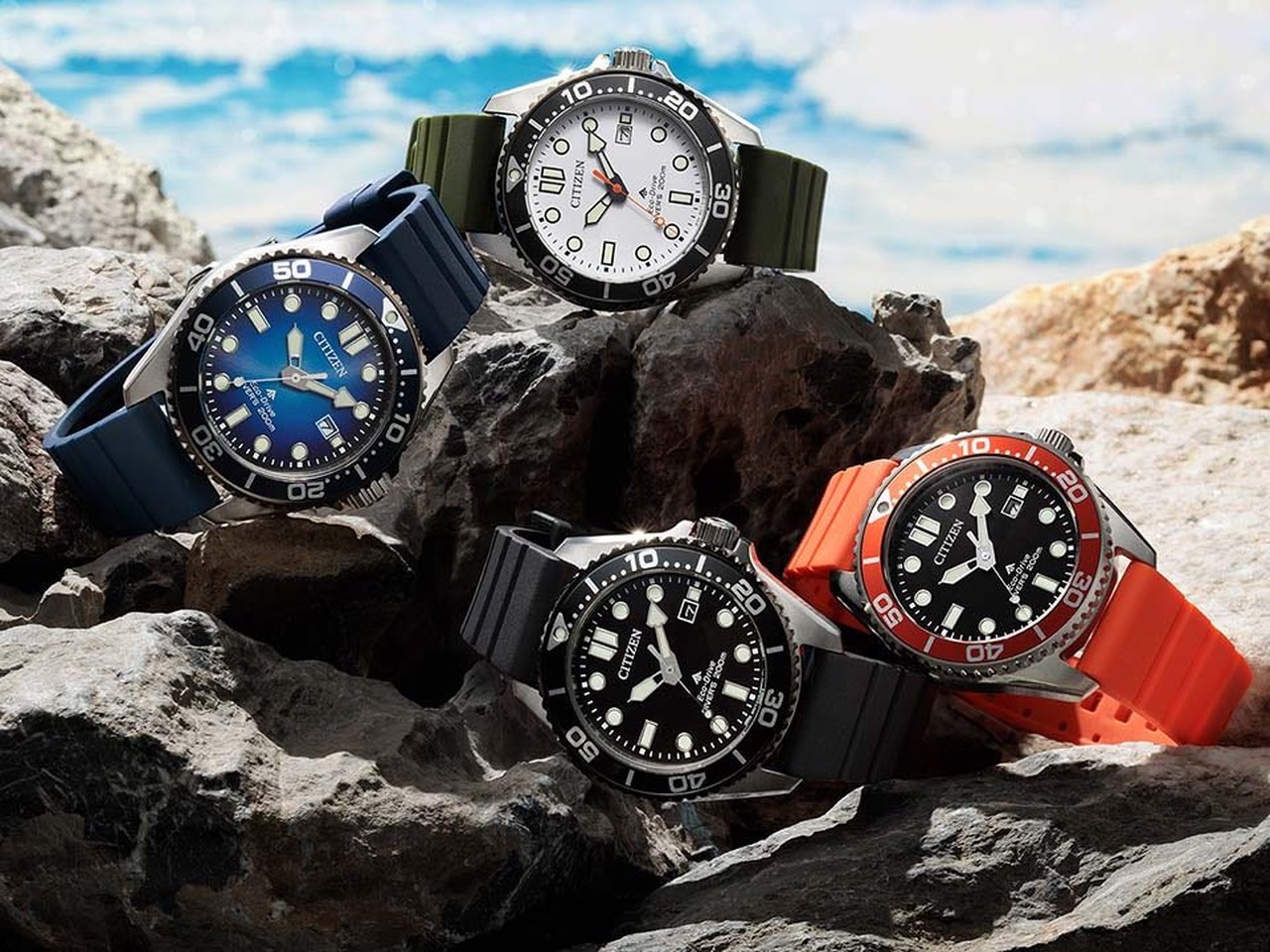
This time the answer sits somewhere unusual. The four bright Promaster Marine divers Citizen ships to Japan on July 16 lead with color, but the upgrade that counts is the one you can’t see. A new Eco-Drive Caliber E118 runs about a year on a full charge and holds ±15 seconds a month. The colors sell the scroll. The movement sells the watch.
Citizen also picked a telling moment. It kept the affordable Promaster diver formula mostly frozen for years, leaning on the same solar calibers while rivals chipped away on price. Dropping a fresher movement into a compact 40.6mm case, at ¥69,300 (about $426), is the first real change this line’s made in a while.
What actually changed
This is an update to a familiar idea: a practical Citizen dive watch that you can wear hard and mostly forget about. The new models keep the real tool-watch essentials: 200m diving water resistance, a unidirectional timing bezel, a screw-lock crown, lume on the hands and indices, and a date window.
- The case lands at 40.6mm wide and 11.7mm thick, which is friendly for daily wear.
- The new Caliber E118 stretches full-charge running time to about one year.
- Citizen credits the caliber’s lower power draw for letting it run bolder dial colors than the old movement could.
- The strap uses BENEBiOL, a plant-derived biomass urethane material.
- Citizen’s official pages list sapphire glass with anti-reflective coating.
That last point matters because some early coverage listed mineral glass. Citizen’s own Japan pages list sapphire glass with anti-reflective coating for the new BN0265, BN0266, BN0267, and BN0268 models.
Why Eco-Drive matters on a dive watch
Eco-Drive is Citizen’s light-powered watch technology. The simple version is that the watch converts light into electrical energy and stores it in a rechargeable cell, so you don’t need routine battery changes. Citizen says Eco-Drive can use natural light or indoor light, and the company recommends regular light exposure rather than treating it like a sealed-away mechanical watch.
For a diver, that’s more than convenience. Traditional quartz watches eventually need a battery swap, and opening a dive-watch case can compromise water resistance if it isn’t resealed and pressure-tested correctly. Eco-Drive avoids that normal battery-change cycle.
The Caliber E118 upgrade also connects directly to the new colors. Eco-Drive dials have to let light reach the solar cell without looking transparent. Citizen says the more efficient drive system helps it use brighter dials than before. That makes the orange, blue, white, and black versions feel like more than a paint job.
The four versions, and who they fit
| Model | Look | Best for |
|---|---|---|
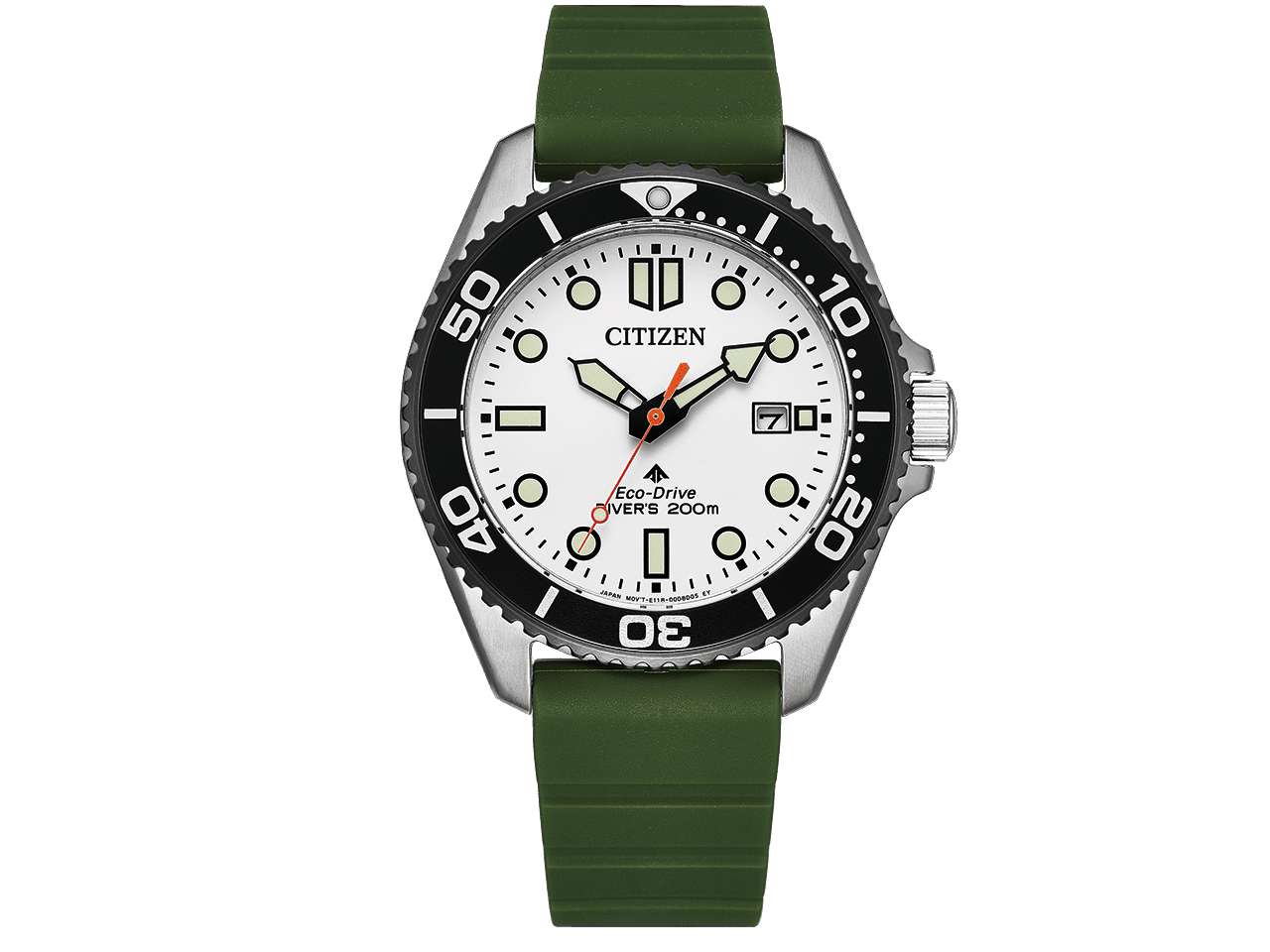
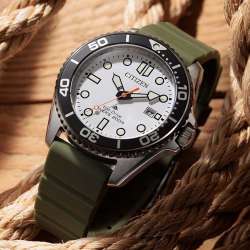
| BN0265-00A | White dial, black bezel, olive strap | Someone who wants field-watch contrast with dive-watch specs |
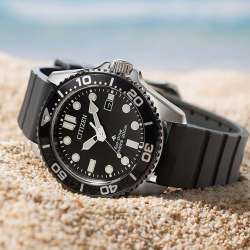
| BN0266-07E | Black dial, black bezel, black strap | The safest everyday pick |
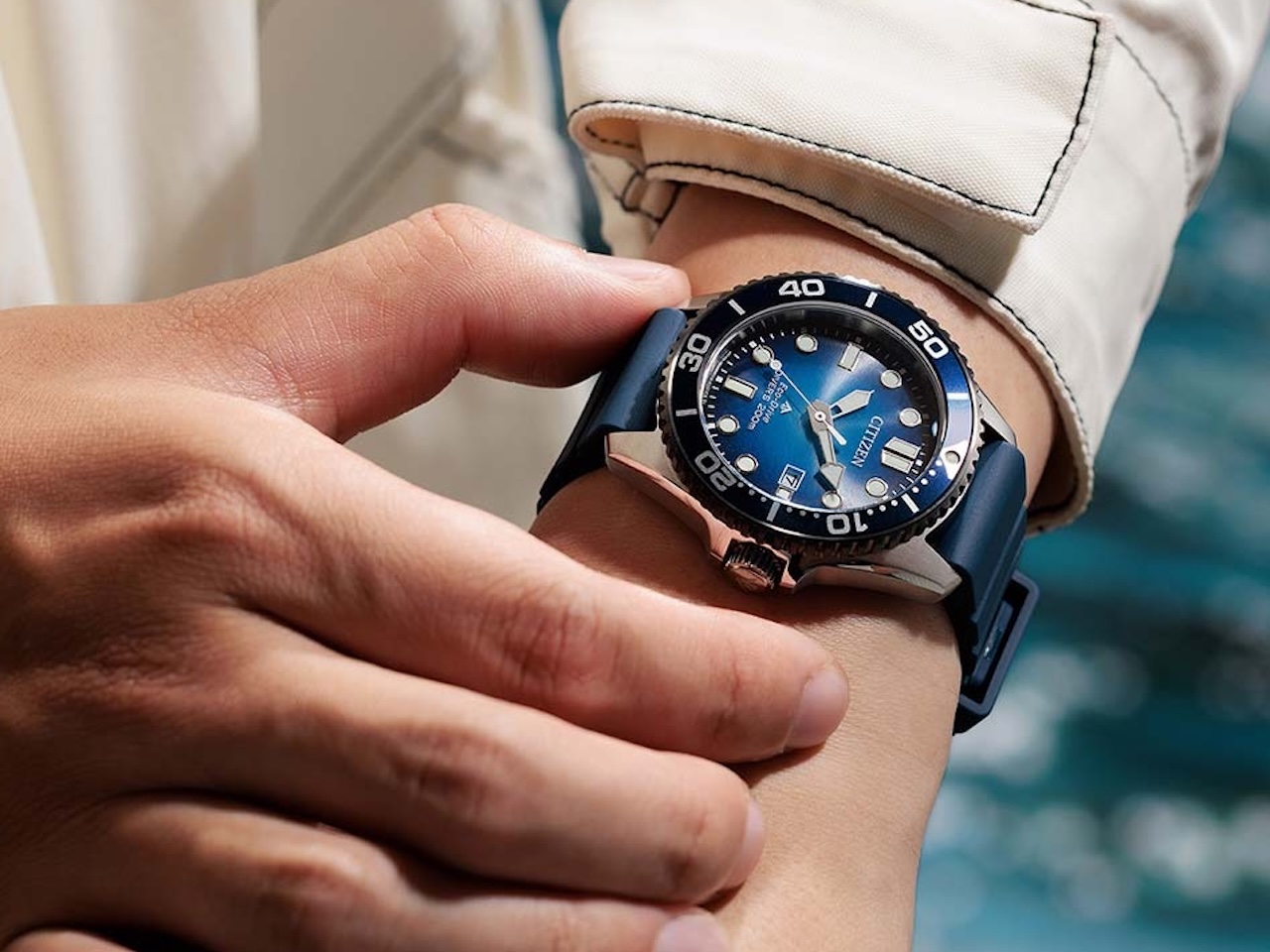
| BN0267-04L | Blue gradient dial, blue bezel, blue strap | Beach, travel, and water-sport use |
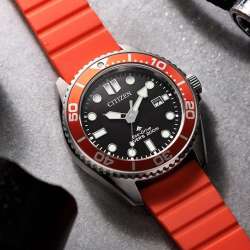
| BN0268-01E | Black dial, orange bezel, orange strap | The boldest, most visible option |
The orange BN0268-01E is the Discover bait. It photographs well, looks fun, and makes the lineup feel new even if the case architecture is familiar. The black BN0266-07E is probably the easiest one to wear every day. The white BN0265-00A may be the sleeper because the black bezel and olive strap make it feel closer to a field diver than a pure beach watch.
Specs that matter
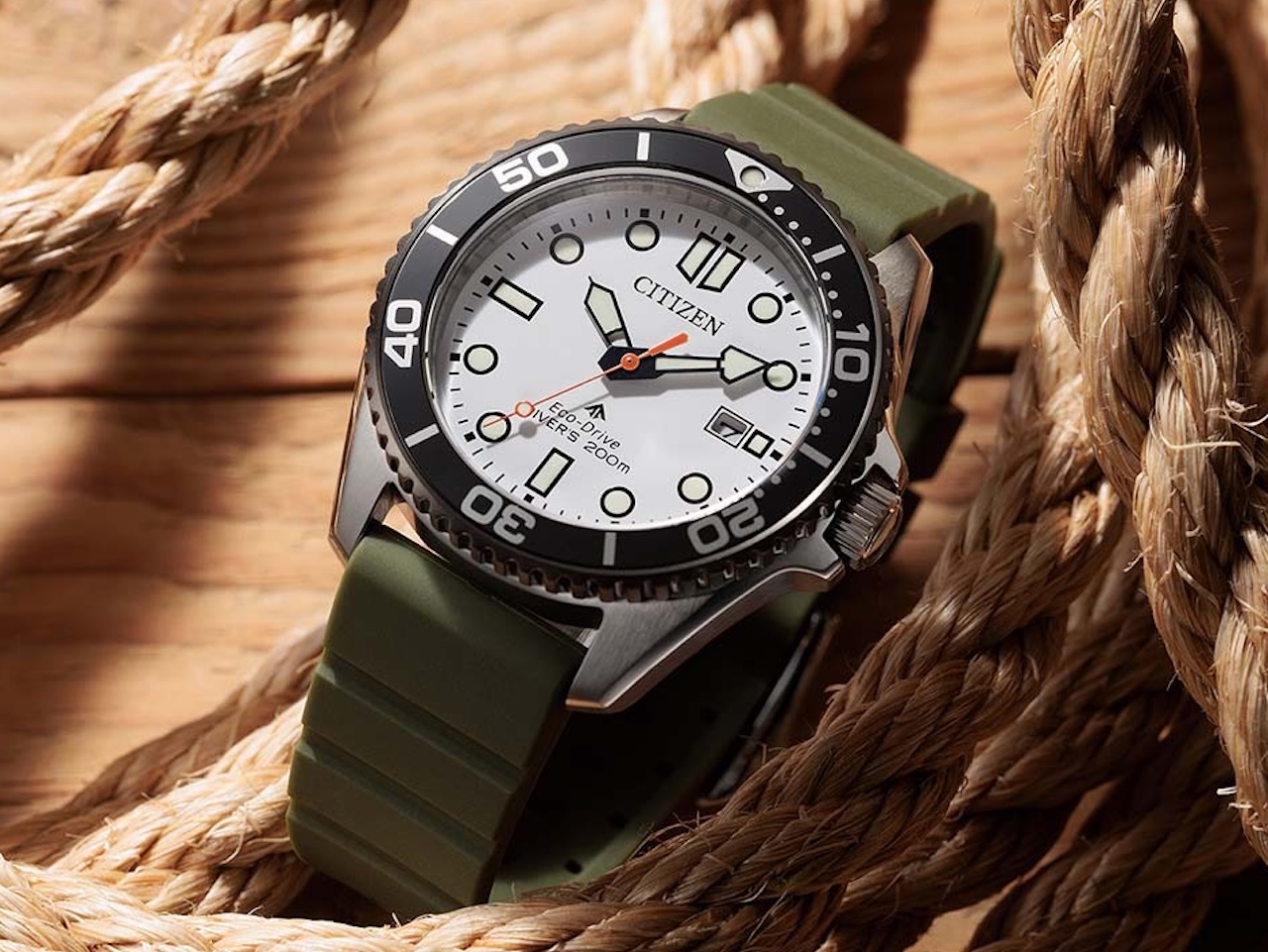
All four share the same core hardware. At the center is Citizen’s new Eco-Drive Caliber E118, a light-powered movement rated to ±15 seconds per month that runs for about a year on a full charge. The stainless steel case measures 40.6mm wide and 11.7mm thick and weighs 86g, capped with a sapphire crystal with anti-reflective coating and wrapped by a unidirectional timing bezel.
Water resistance is a full 200m diver rating. The strap is BENEBiOL biomass urethane in a 20mm width, sized to fit wrists from 140 to 210mm. In Japan, every model launches at ¥69,300, about $426 converted.
Why this could be a great everyday EDC watch
The best dive watches for daily life are boring in the right ways. They survive water, sweat, travel, yard work, beach days, and desk duty without asking for much. These new Promaster Marine models hit that formula well.
The 40.6mm width keeps them away from the dinner-plate territory that can make some dive watches annoying on smaller wrists. The 11.7mm thickness should help them slide under sleeves better than thicker mechanical divers. The 86g weight is also reasonable for a strap-based stainless steel diver.
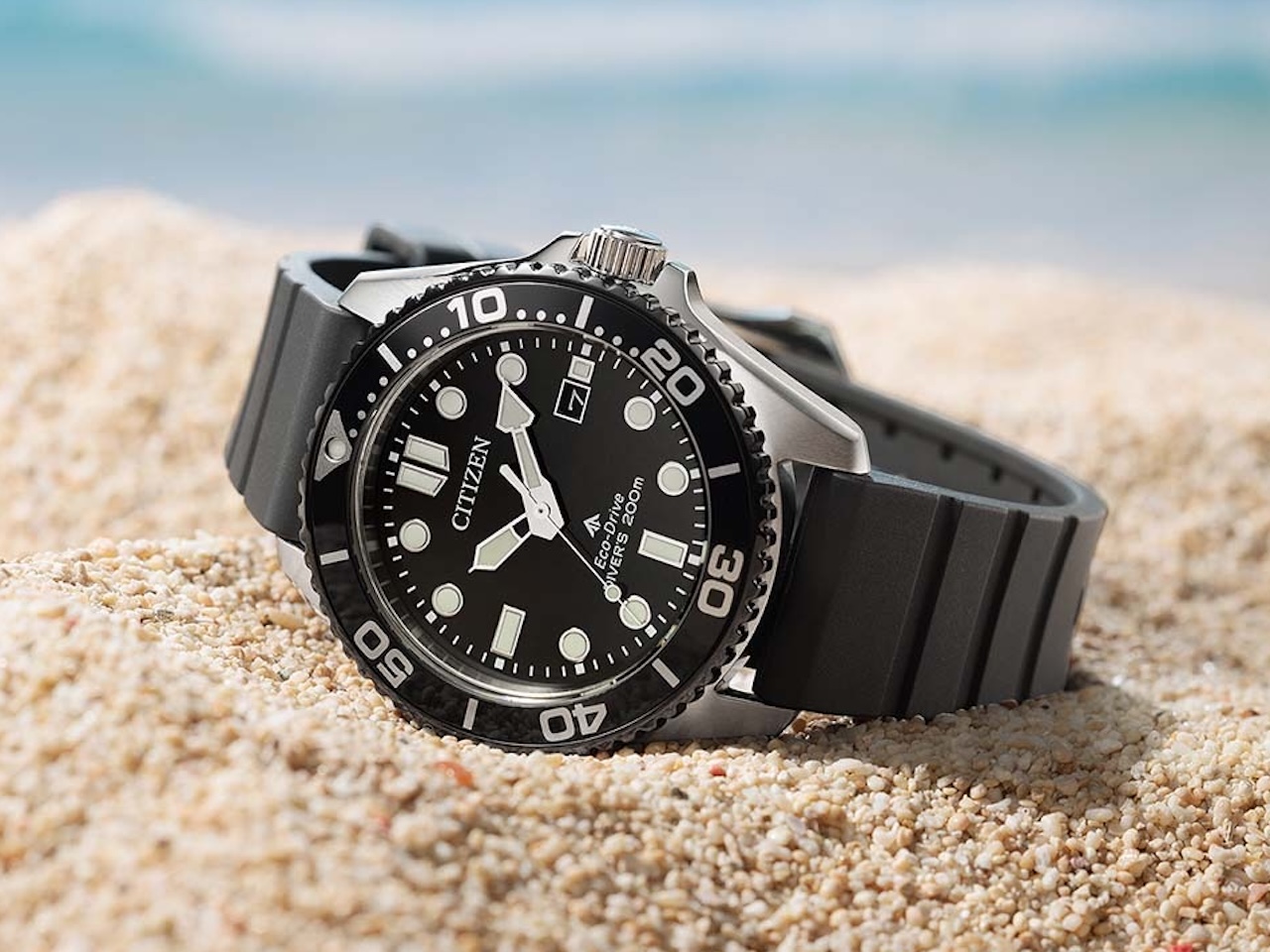
The 20mm strap width is another practical win. If you don’t love the stock urethane strap, replacement options should be easy to find.
The trade-offs
These are still quartz solar divers, and that’s either the point or the problem depending on what kind of watch person you are. If you want a sweeping seconds hand, an automatic movement, exhibition caseback theater, or mechanical charm, this isn’t that watch.
The launch is also Japan-first. Citizen hasn’t announced US availability or US pricing yet. The converted price is about $426, but that doesn’t guarantee the final US price. A live shopping-carousel check puts existing Citizen Promaster Eco-Drive divers between roughly $237 and $500 in the US right now, with the closest comparable models sitting well under that converted launch figure, so value will depend heavily on where these land once they leave Japan.
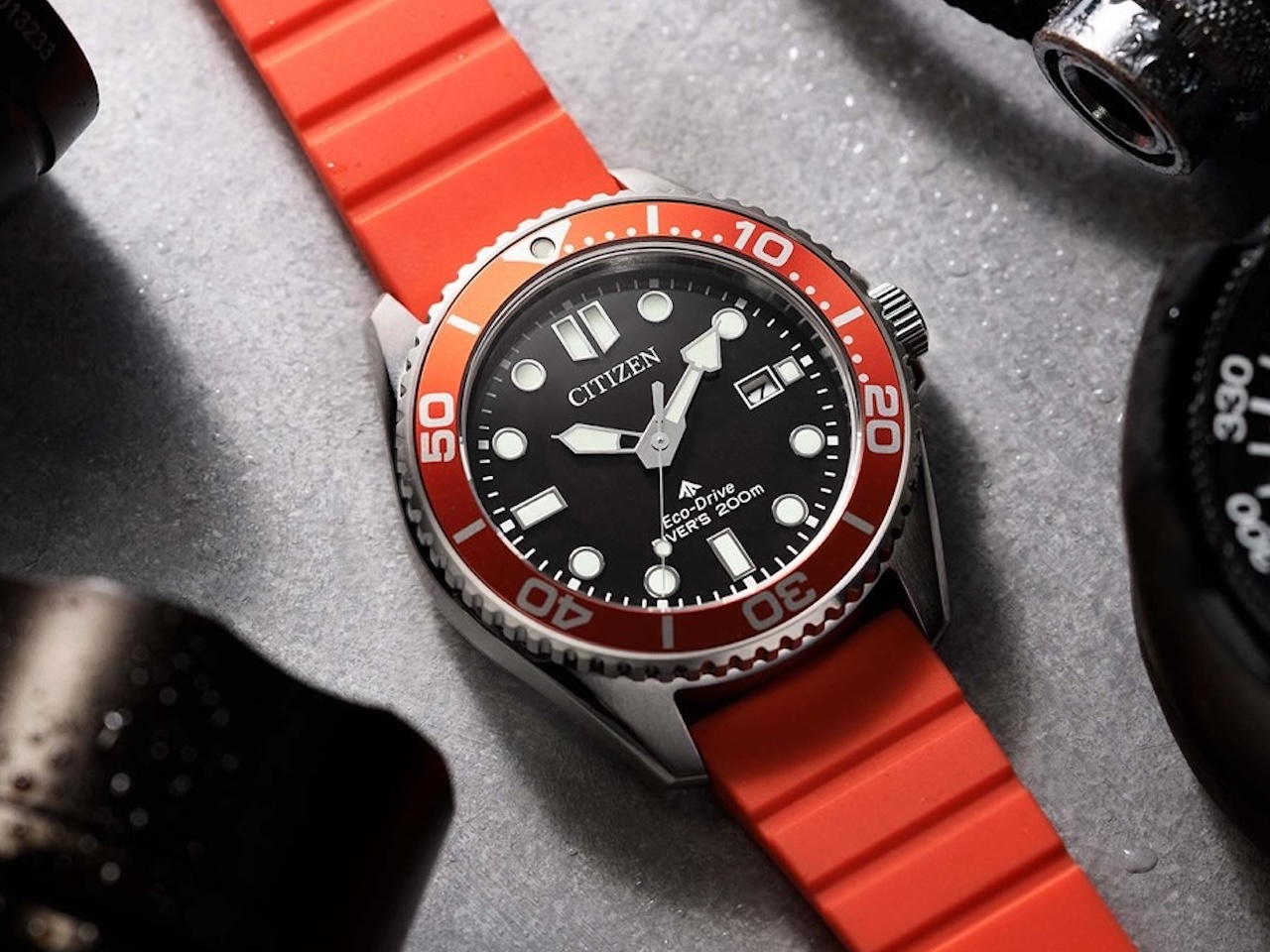
The bright orange model is fun, but it isn’t subtle. The blue model is pretty, but less neutral. The black model is safe, and safe can also be boring.
Alternatives to consider
If you want the cheapest proven Citizen Eco-Drive diver, look at existing Promaster Dive models in the BN015x family. They’re widely available in the US and often discounted.
If you want an automatic diver with a similar affordable Japanese-watch spirit, the Orient Kamasu and Seiko 5 Sports dive-style models are obvious cross-shops. You give up Eco-Drive convenience, but you get a mechanical movement.
If you want a more premium Citizen diver, look at titanium Promaster models or Citizen’s more feature-heavy Aqualand-style watches. They cost more, but they give you a stronger spec story.
Who should buy it
Buy one of these if you want a practical, solar-powered dive watch that’s compact enough for everyday use and colorful enough to feel like a summer watch. The strongest buyers are people who want low maintenance more than mechanical romance.
The BN0266-07E is the safe daily driver. The BN0265-00A is the best crossover pick. The BN0267-04L is the vacation watch. The BN0268-01E is the one you buy because you actually like orange, not because a headline told you to.
Who should skip it
Skip it if you already own a Citizen Promaster Eco-Drive diver and don’t care about the new colors, sapphire, or one-year E118 reserve. Also skip it if you want an automatic watch or if you’d rather wait for US availability and discounting.
🛒 Citizen Promaster Marine Eco-Drive Caliber E118 – official Japan launch
All four models: ¥69,300 tax included, about $426 converted
Launch: July 16, 2026 in Japan
Where to Buy: BN0265-00A | BN0266-07E | BN0267-04L | BN0268-01E
Where this leaves you
Citizen did not reinvent the affordable dive watch here. It did something more useful. It made a compact solar Promaster Marine a little more practical, a little more colorful, and potentially more compelling as an everyday EDC watch.
The Caliber E118 is the key. A one-year full-charge reserve and better dial-color flexibility are exactly the kind of invisible upgrades that make a simple watch easier to recommend. If these arrive globally at a sane price, the black and white versions could become easy everyday picks, while the orange model will probably keep doing the thing it was clearly born to do: stop people mid-scroll.