
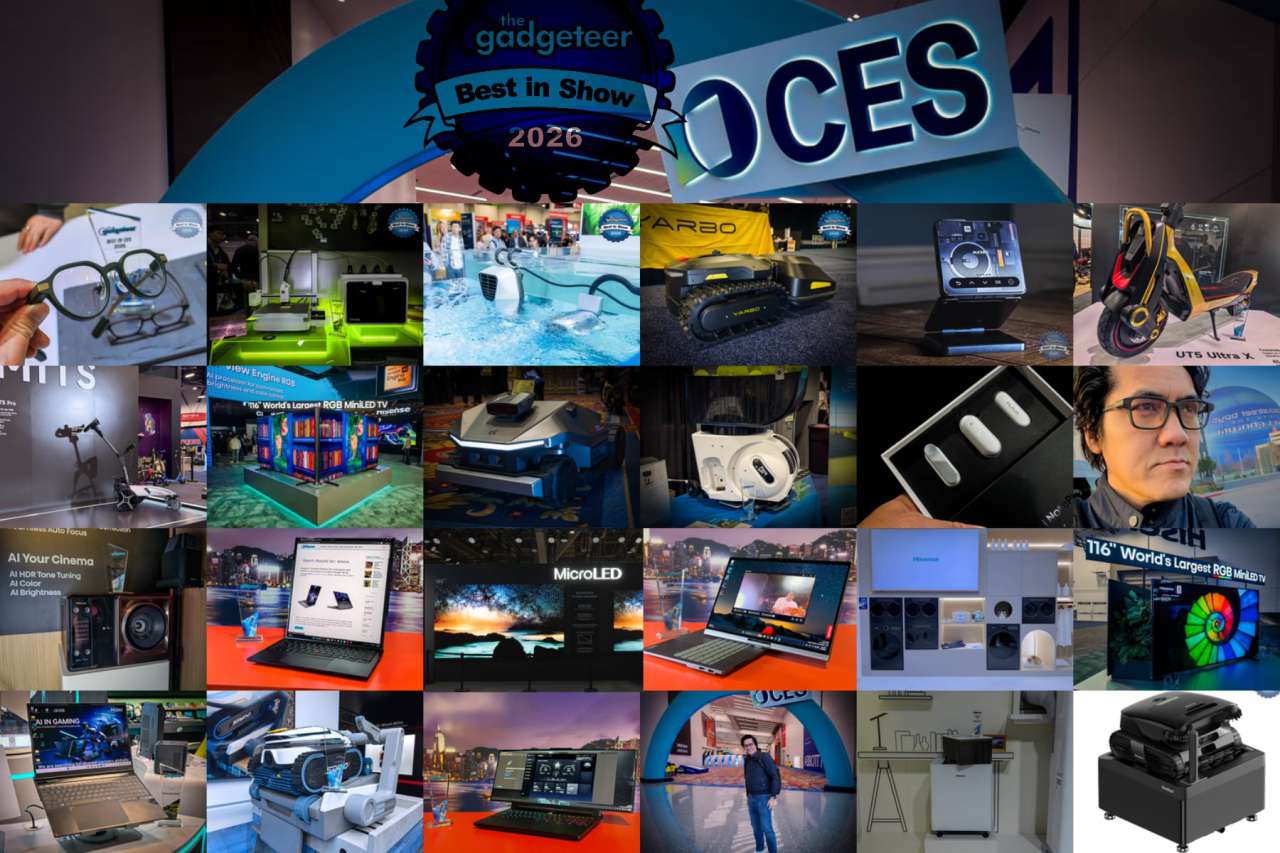
CES 2026 NEWS – After 15 years of covering CES, I thought I knew what to expect. This was my first year as owner and editor-in-chief of The Gadgeteer, though, and that shift in responsibility brought a different kind of learning curve.
Here’s what nobody tells you about CES: the show floor isn’t where the work happens. Three press events run back to back across three nights (CES Unveiled, Pepcom Digital Experience, and ShowStoppers), and they’re where brands gather to show journalists everything at once. You get face time with brands, conversations with other journalists covering the same products, and embargoes that lift the same night. For a small team trying to cover as much ground as possible, these events are essential.
Add The Gadgeteer as a preferred source to see more of our coverage on Google.
The tradeoff is time. Between briefings, writing, filming, and meetings, there’s almost nothing left for wandering the convention halls hoping to stumble onto something unexpected. Larger brands like Lenovo hosted their own separate events this year. Smaller brands without agency representation often don’t make it onto our radar at all.

So this best-in-show list reflects something honest: it’s built from relationships I’ve developed over the years, brands I’ve covered before, and agencies that reached out. There wasn’t much room for discovery beyond those channels. That’s the reality of covering a show this size with a team this lean.
What you’ll find here are the 25 products that earned our attention. Not a press release compilation. These are the innovations that made us stop, lean in, and take notice, from a TV that added a color we didn’t know we were missing to a pool robot that empties its own gunk into a bag so you don’t have to.
Here are the winners, and why each one deserves the spotlight.
Display Technology
Televisions crossed a quiet threshold at CES 2026. The biggest leaps were not just about going bigger or brighter. They were about fixing long standing compromises in color, scale, and flexibility that have shaped living room screens for years. These sets did more than look impressive on a show floor. They made it obvious what modern TVs have been missing all along.
Hisense 116UXS RGB Mini LED Evo
Every TV you’ve ever owned has been lying about the color blue. Standard RGB backlighting can’t reproduce the cyans and teals that exist in the real world. Ocean footage looks flat. Forest canopies lose depth. You’ve never noticed because you’ve never seen the alternative.
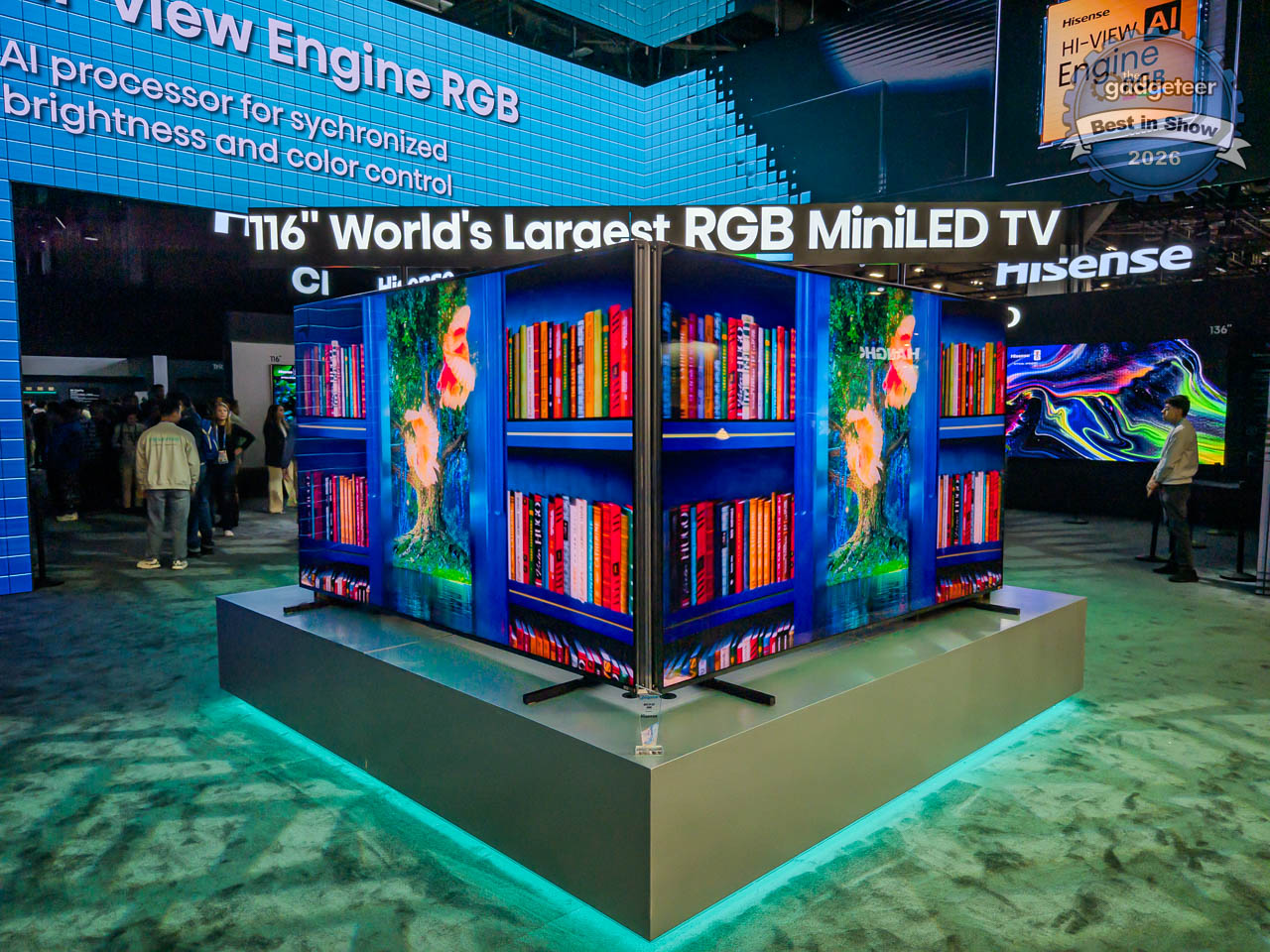
The 116UXS is the alternative. RGBC (Red, Green, Blue, Cyan) Mini LED Evo backlighting adds a dedicated cyan LED as a fourth primary, filling the color gap that’s existed since displays began. This is backlight architecture, not per-pixel self-emission like OLED or Micro-LED: the cyan primary lives in the backlight zones behind the LCD panel, not in each individual pixel. Hisense claims up to 110% of BT.2020 color coverage, and the difference is immediately visible in scenes with cyan-green tones: ocean footage, forest canopies, and northern lights sequences that previously looked flat now carry the depth you’d see in person. At 116 inches, this is the first consumer TV to show you colors your previous displays physically couldn’t produce. Samsung, LG, and TCL all pushed next-gen color technology at CES 2026, but we did not see another company unveil a consumer TV using a dedicated fourth primary cyan emitter in its backlight system at this scale. That’s why the 116UXS earned a trophy: it doesn’t iterate on color accuracy. It expands what color accuracy can mean.
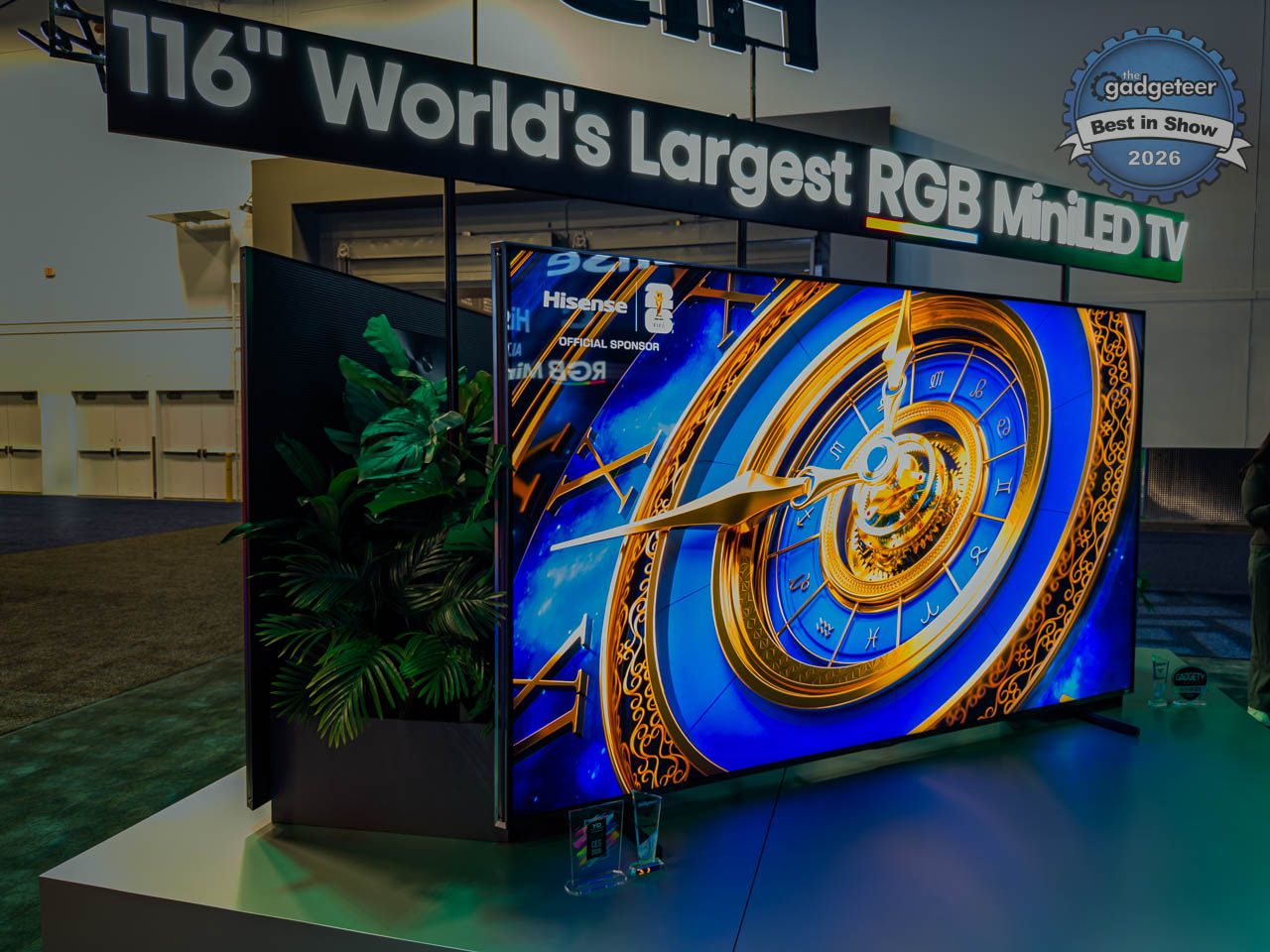
Hisense XR10 Laser TV
Fixed size displays force a permanent commitment. You design the room around the screen and hope you never move, remodel, or change how you use the space. The XR10 breaks that assumption by treating screen size as a variable instead of a decision you lock in on day one.
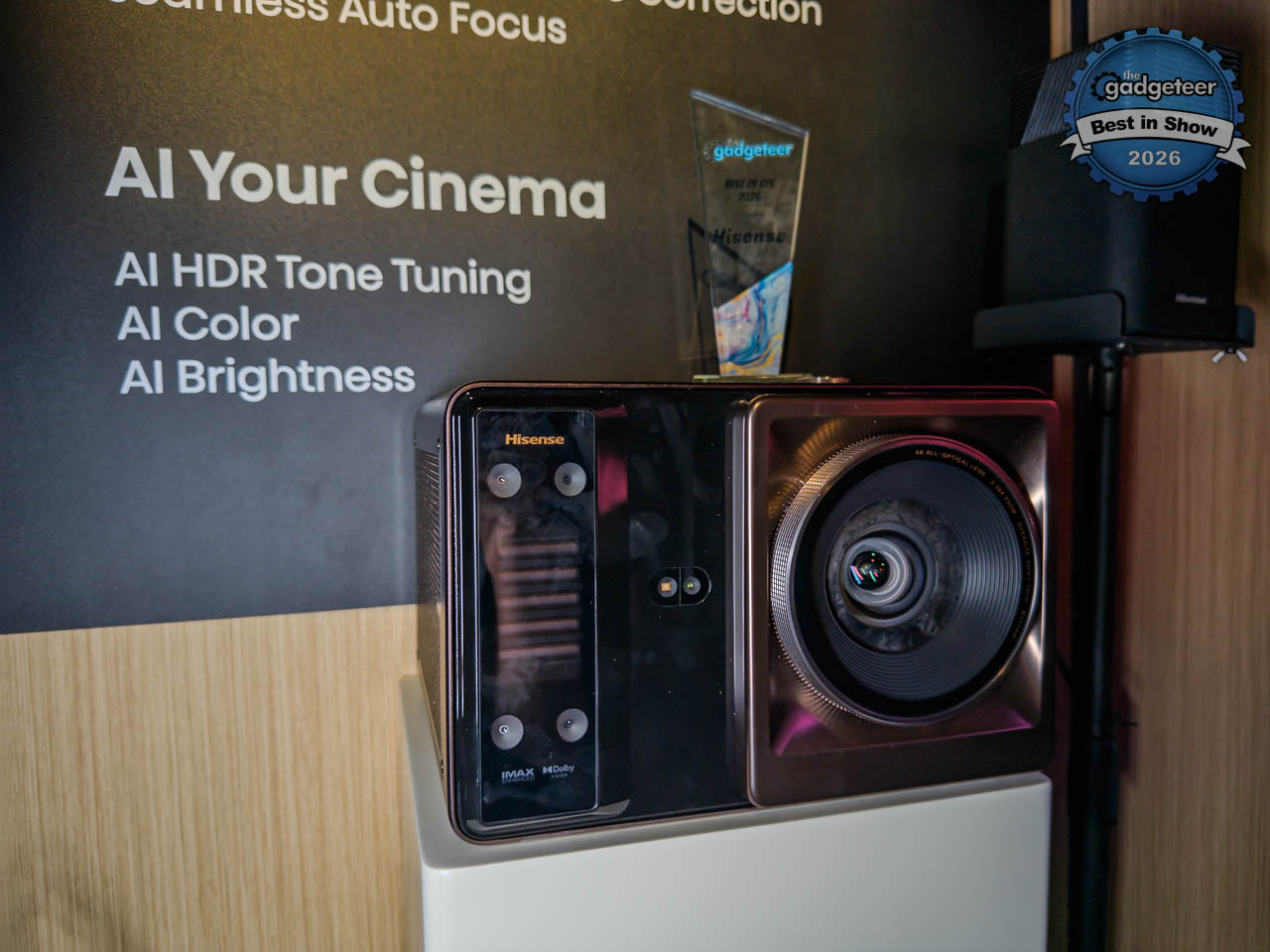
The XR10 uses Hisense’s TriChroma triple laser light engine, projecting separate red, green, and blue lasers rather than relying on a single lamp or hybrid LED system. That matters because pure laser primaries deliver higher color purity and brightness consistency at scale. Instead of locking you into a single diagonal measurement, the XR10 can scale across a wide range of screen sizes, from typical living room setups to extreme large format projections that fixed panels simply can’t approach. In person, that flexibility feels almost unfair compared to traditional TVs. You’re no longer choosing a display for one room. You’re choosing a display system that can move with you.
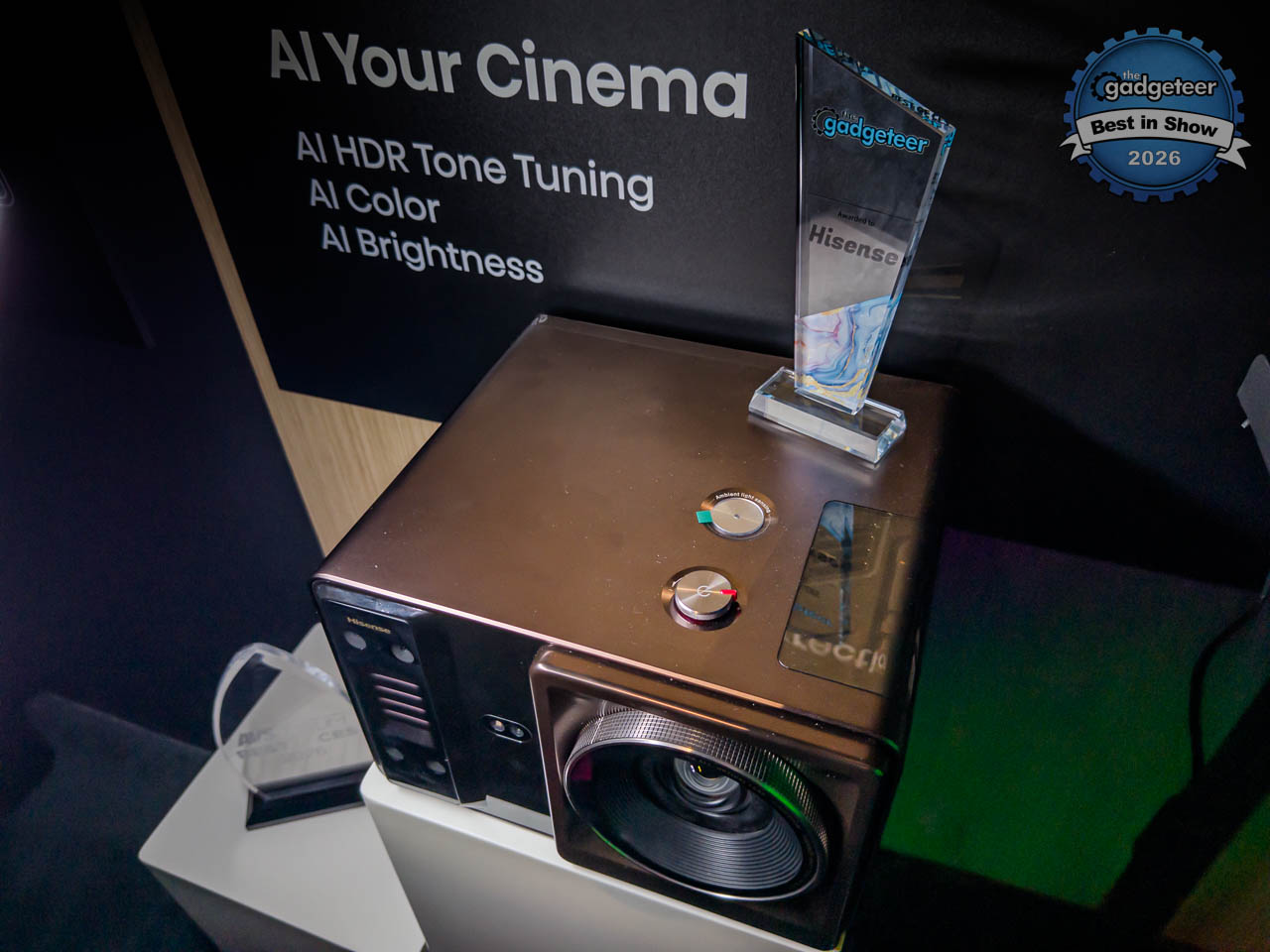
The surprise is how little compromise you feel as the image grows. Hisense positions the XR10 among its brightest Laser TV systems shown at CES, producing images that remain punchy and legible even before you fully control ambient light. HDR10 and HLG support preserve highlight detail and contrast in real world viewing, not just dark room demos. When seen at scale, the image doesn’t feel like a stretched television. It feels cinematic in a way that even very large TVs struggle to replicate because they can’t physically reach this size without enormous cost and installation complexity.
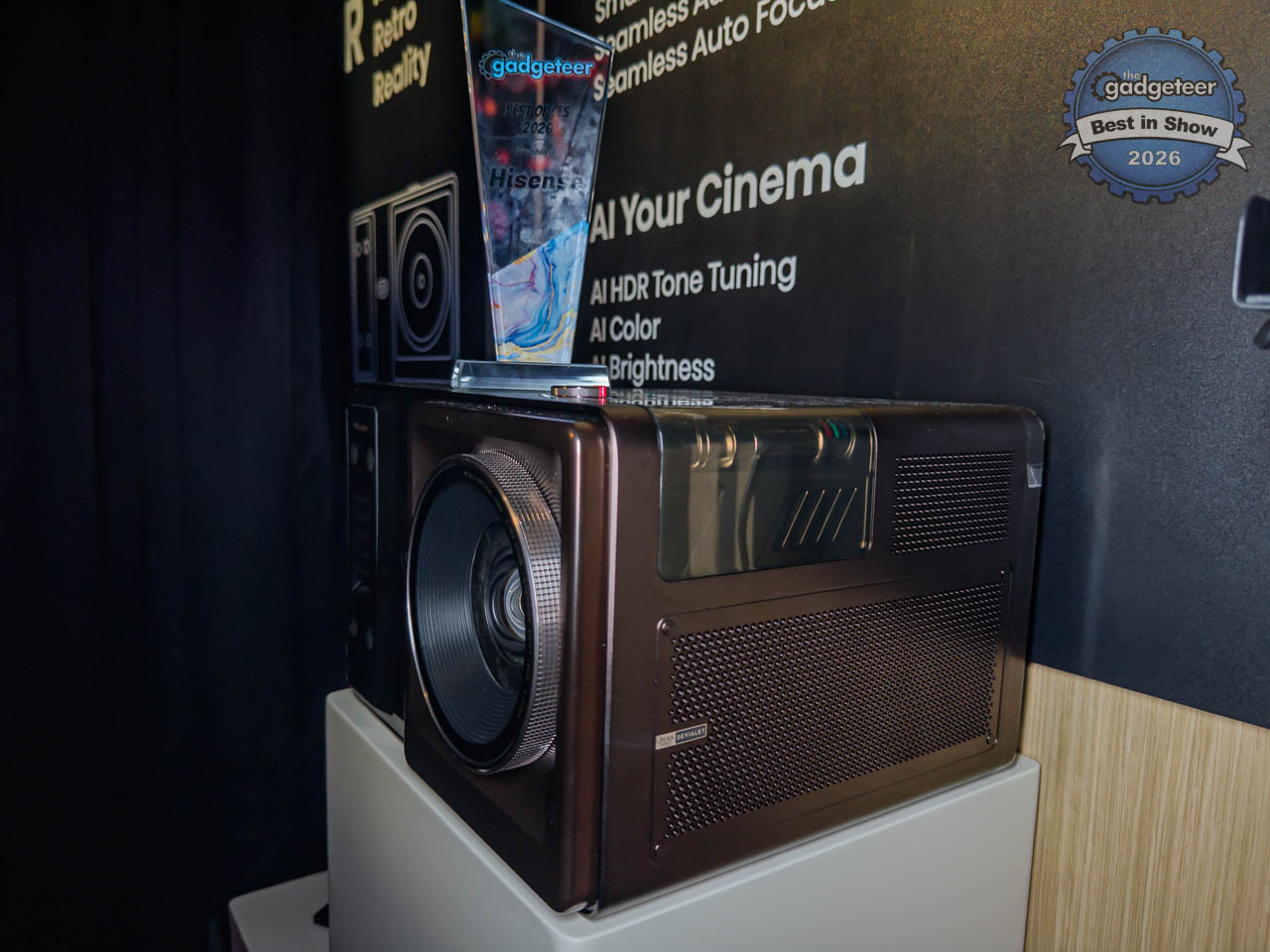
At CES 2026, we did not see another large format projection system combine this degree of adjustable sizing, consumer focused laser architecture, and premium HDR performance in a single product. Flat panels top out quickly and Micro LED remains inaccessible for most buyers. Traditional projectors demand tradeoffs in brightness, color, or ease of use. The XR10 sits in a rare middle ground where flexibility doesn’t come at the expense of image quality. That balance, especially when experienced firsthand, is what earned it a spot on our winners list.
Hisense 163MX Micro-LED
The pinnacle of display technology has a name: Hisense 163MX.
At 163 inches, this Micro-LED display exists in a category most consumers have only ever seen in commercial installations or six-figure custom homes. Hisense states its RGBY (Red, Green, Blue, Yellow) four-color Micro-LED architecture targets full BT.2020 color coverage, expanding color volume beyond traditional RGB systems. The addition of a yellow emitter is especially meaningful at this scale, where brightness, color purity, and saturation all become harder to maintain simultaneously.
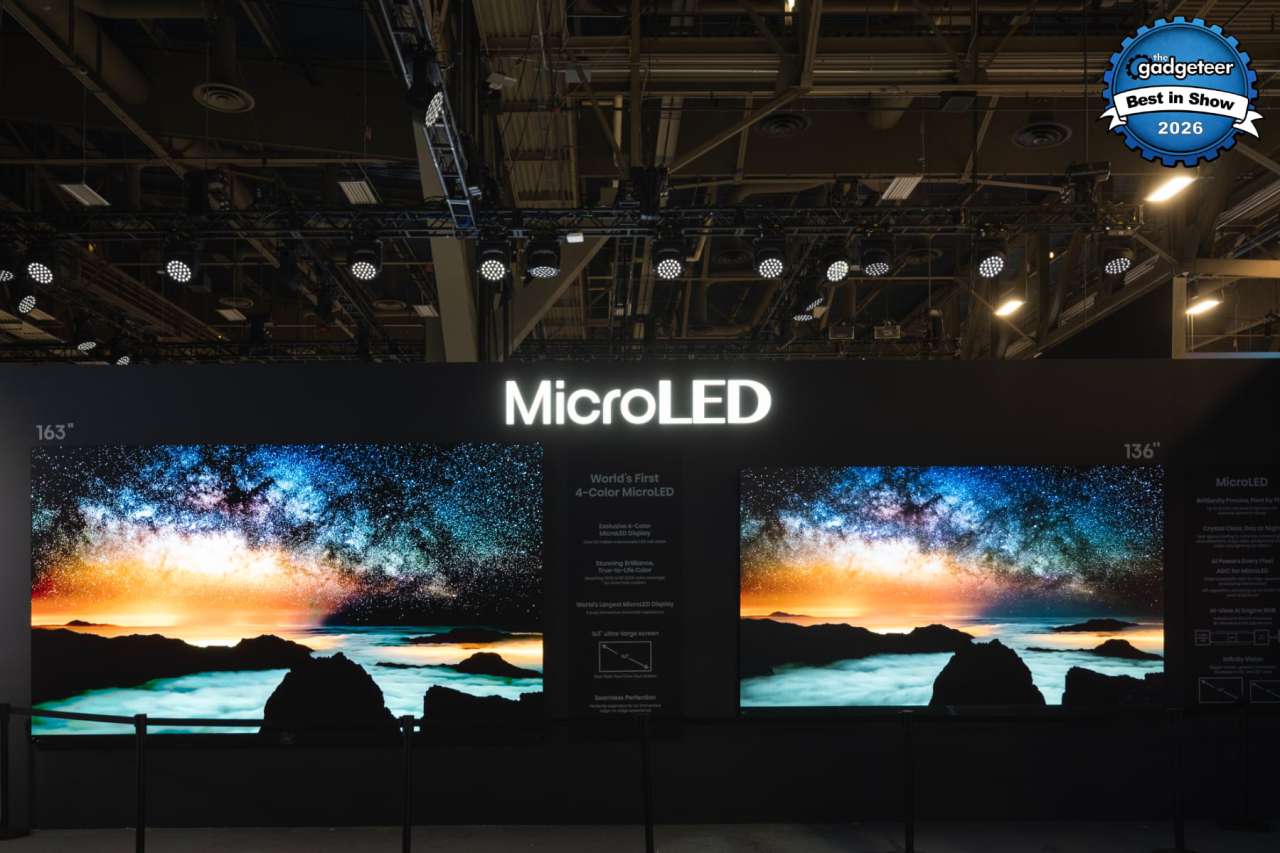
Micro-LED has always promised the best of everything. Self-emissive pixels, perfect blacks, extreme brightness, and no burn-in concerns. The problem has never been image quality. It has been accessibility. Systems were modular, complex, and designed for commercial walls rather than living rooms. The 163MX reframes Micro-LED as a defined, residential display instead of a construction project.
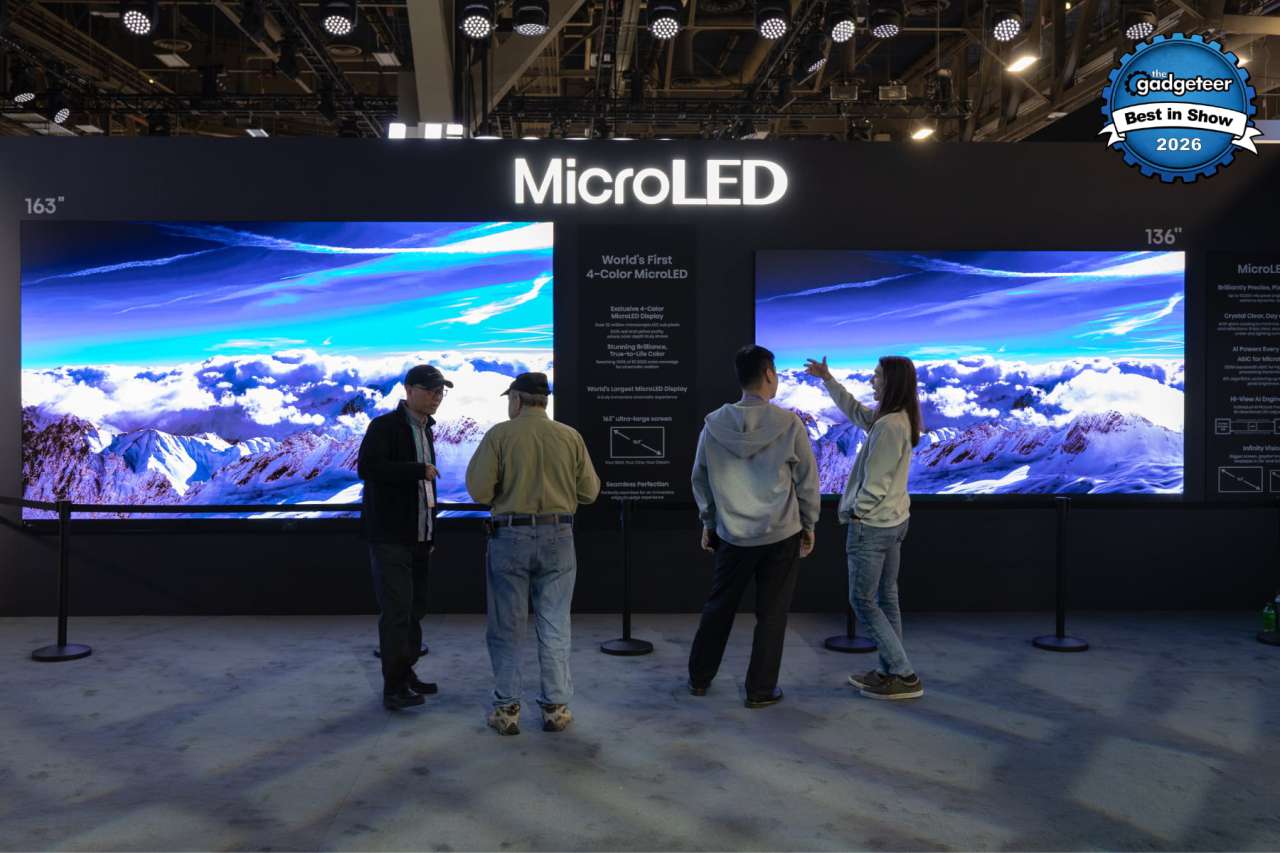
Unlike projectors at this size, the 163MX doesn’t demand blackout conditions, specialized screens, or constant calibration. Every pixel emits its own light. Dark scenes stay dark even in rooms with ambient light. Bright scenes retain punch without washing out. For dedicated home theaters, this delivers true TV behavior at a scale that previously required commercial budgets and professional installation teams.
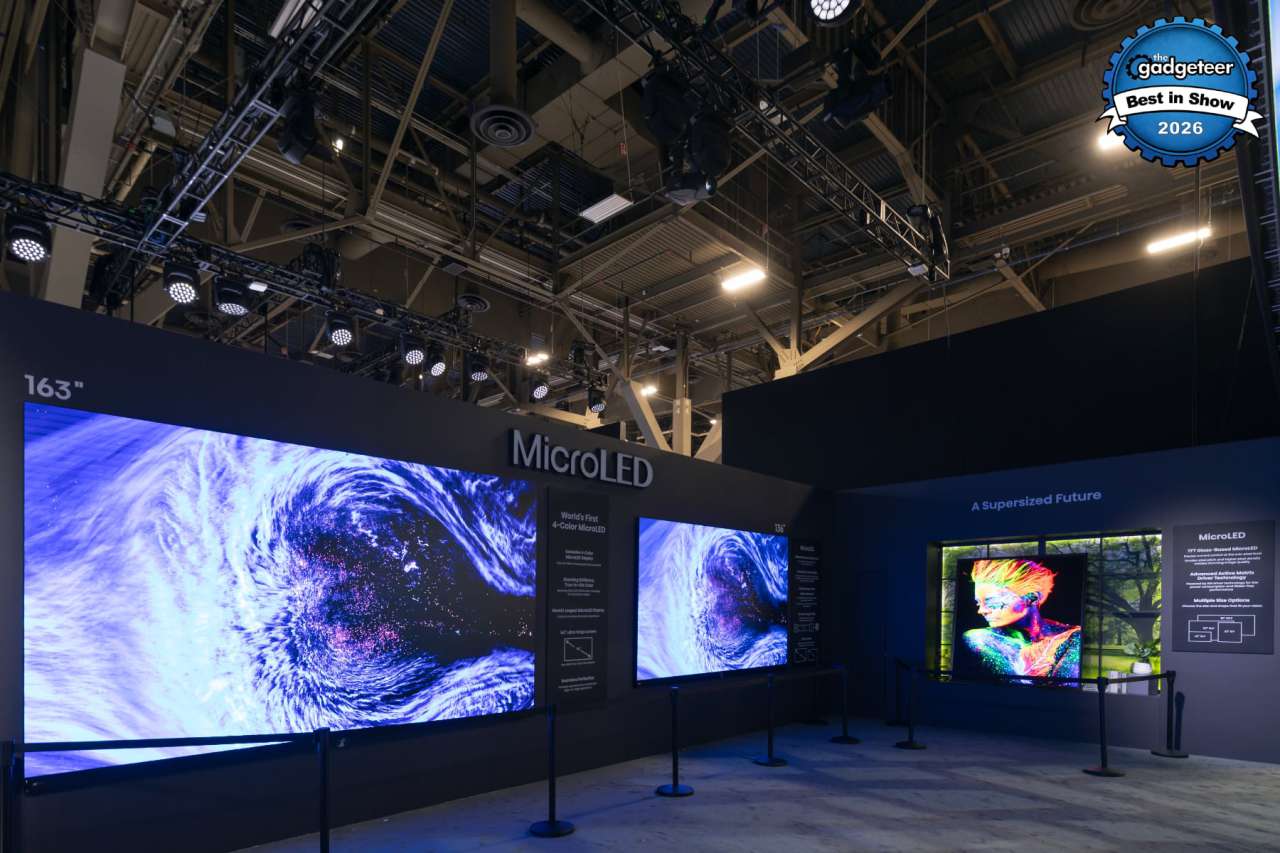
While other Micro-LED displays appeared at CES 2026, we did not see another positioned as a home-ready, self-emissive display system designed specifically for private theaters at this size. That combination of Micro-LED performance, expanded color architecture, and residential intent is why the Hisense 163MX made our list.
Samsung 130-inch Micro RGB TV
Samsung has shown massive TVs before. What made this one different at CES 2026 was not the size alone. It was the intent behind it.
The 130-inch Micro RGB TV abandons conventional backlighting entirely, using a dense Micro RGB architecture where red, green, and blue light sources are controlled independently across the panel. Samsung states this allows for full BT.2020 color coverage with certified color accuracy, eliminating the color filtering and conversion steps that traditionally compromise large-format displays. The result is not just brightness or scale, but color that holds together across an image this large without washing out or fragmenting.
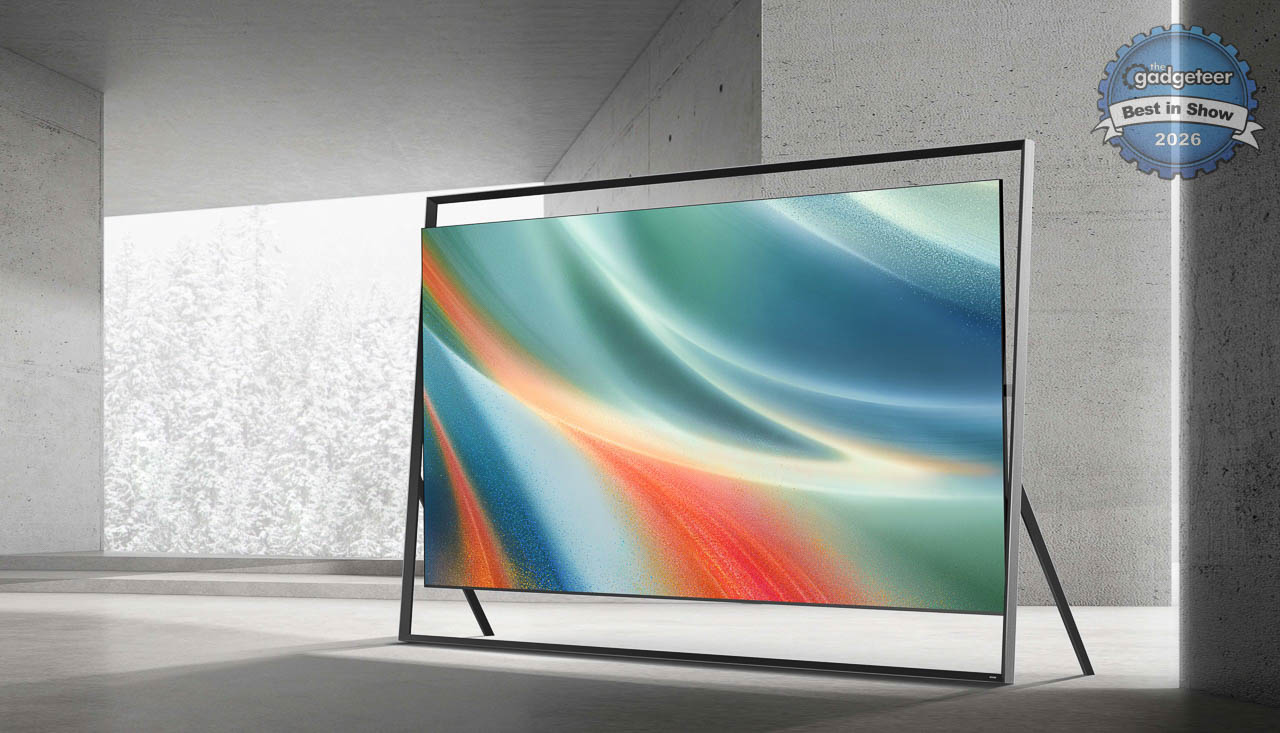
At this size, most displays stop behaving like televisions and start behaving like installations. Samsung leaned into that reality rather than fighting it. The panel is designed to function as a wall-scale visual surface, closer to a digital window than a screen you orient furniture around. Anti-glare treatment and AI-driven picture processing are tuned for real living spaces rather than controlled demo rooms, which matters when a display dominates the field of view instead of sitting politely across the room.
What made the Micro RGB TV one of the most talked-about displays at CES was how composed it felt. There was no sense of spectacle trying to distract from technical limitations. Motion stayed coherent. Color gradients remained intact. Blacks held without crushing detail. Samsung was not chasing novelty here. They were testing how far the television form factor can stretch before it becomes something else entirely.
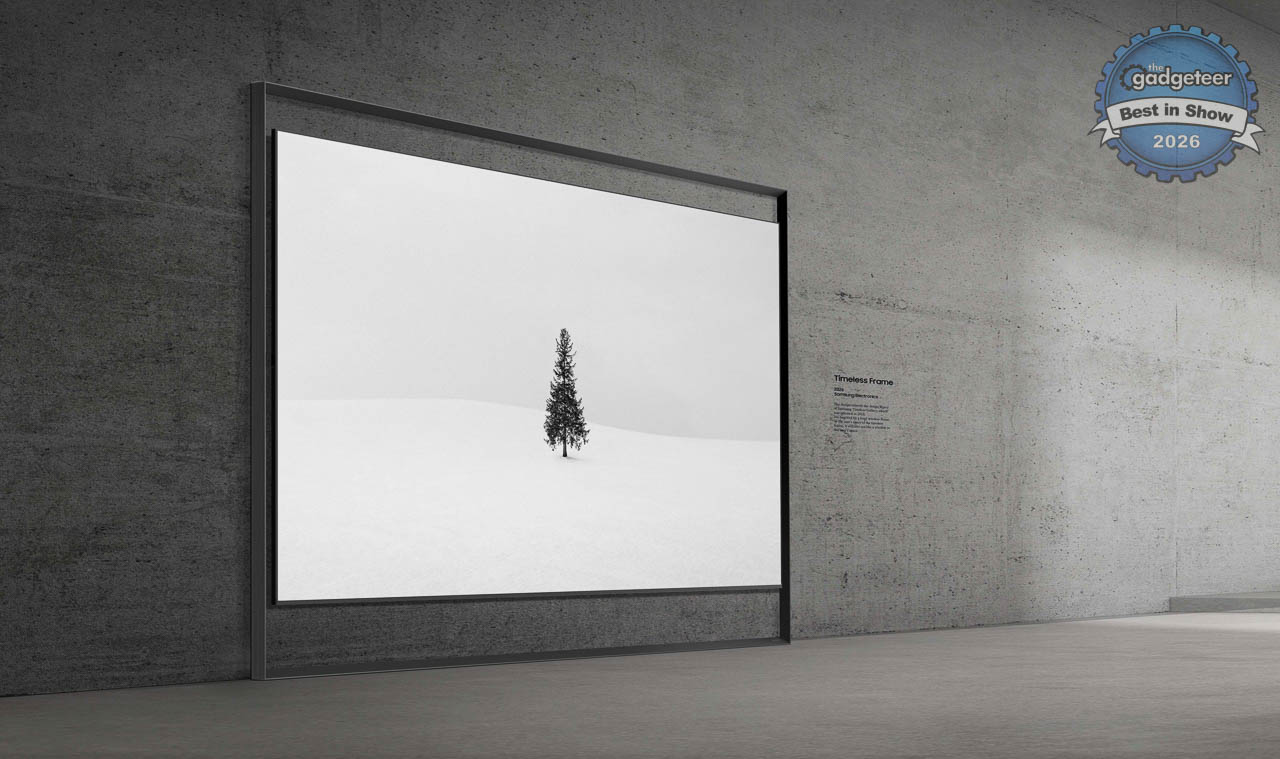
This is not a consumer-ready product in the traditional sense, and Samsung is not pretending otherwise. But as a statement of direction, the 130-inch Micro RGB TV clarifies where ultra-large displays are headed: away from brute-force brightness and toward architectural-scale color accuracy. That direction-setting clarity earns it a place among this year’s winners.
Computing & Concepts
Lenovo dominated this category with a simple thesis: the next laptop upgrade won’t come from a faster chip. It will come from hardware that physically adapts to how you work. Motorized hinges that anticipate your posture. Screens that grow when the task demands it. Displays that stay useful even when the lid is closed. These aren’t spec bumps. They’re design philosophies that treat the laptop as a responsive system rather than a static tool.
Lenovo ThinkBook Plus Gen 7 Auto Twist
Laptop hinges have been frozen in time for decades. You adjust them manually, they stay where you put them, and the computer assumes your posture and use case never change. The Auto Twist treats that assumption as a design failure.
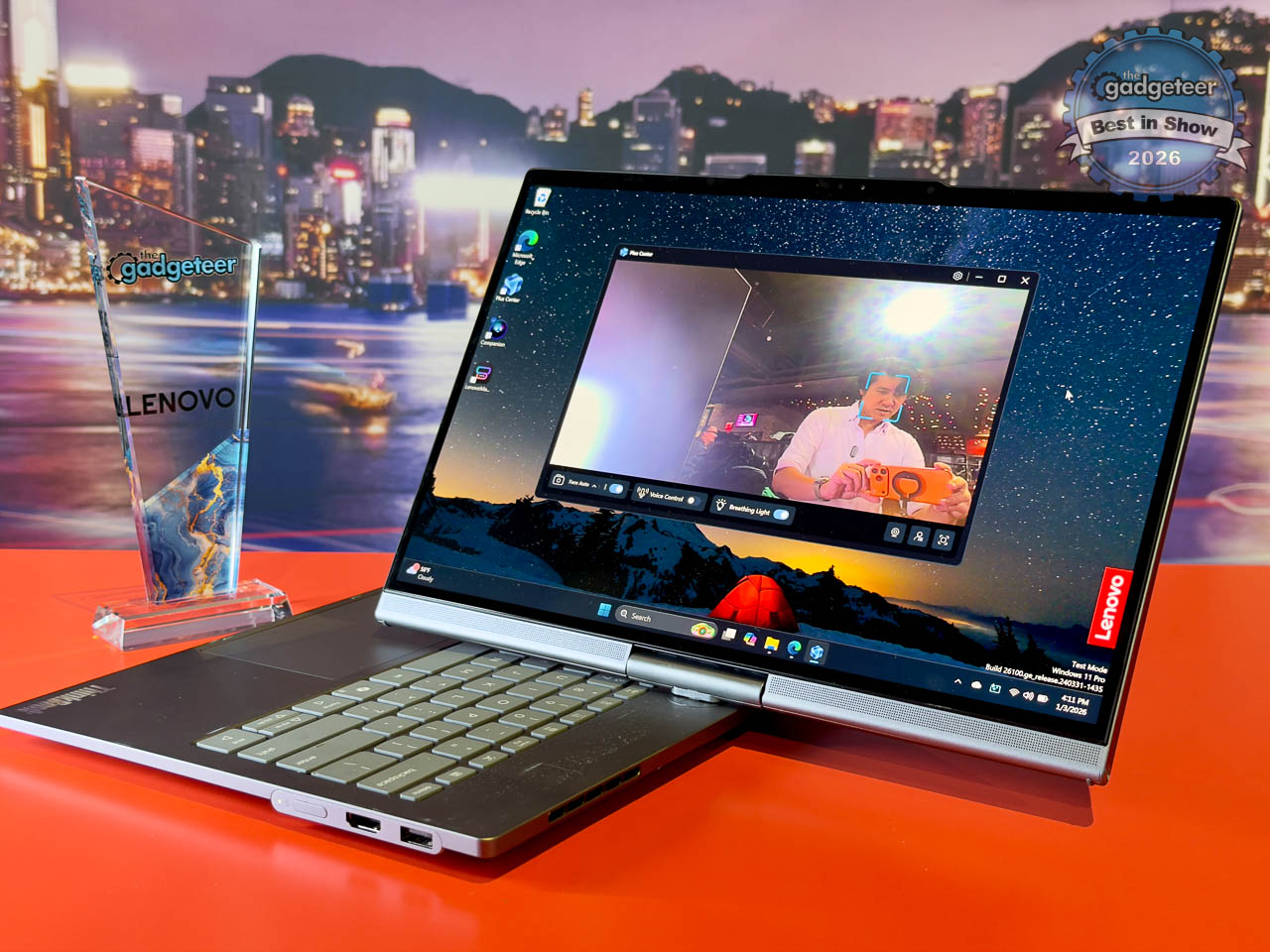
The ThinkBook Plus Gen 7 introduces a motorized hinge that responds to context instead of waiting for user input. Reach for the touchscreen and the display automatically folds into tablet orientation. Start a video call and the screen adjusts to improve camera framing. Begin a presentation and the display elevates and reorients for sharing. In Lenovo’s CES demo, these transitions happened fluidly, without prompts or mode switching. The hardware reacts the way modern software already does: by anticipating intent.
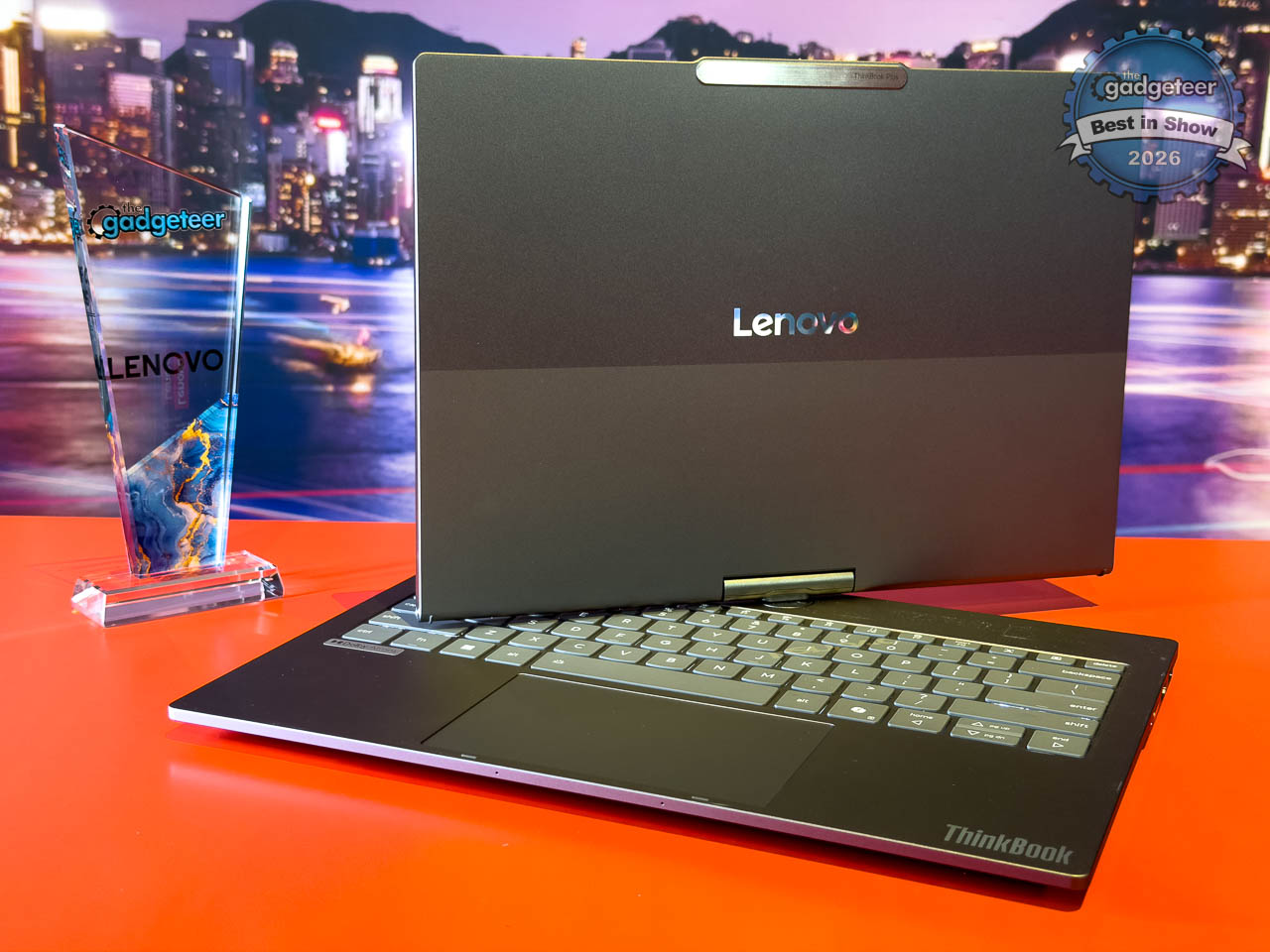
What makes this significant is not the motion itself, but the shift in responsibility. The user no longer manages the hinge. The system does. Other manufacturers showed flexible and convertible designs at CES 2026, but we did not see another ship a production ready laptop with a motorized hinge that physically adapts in real time based on how the device is being used. Lenovo did.
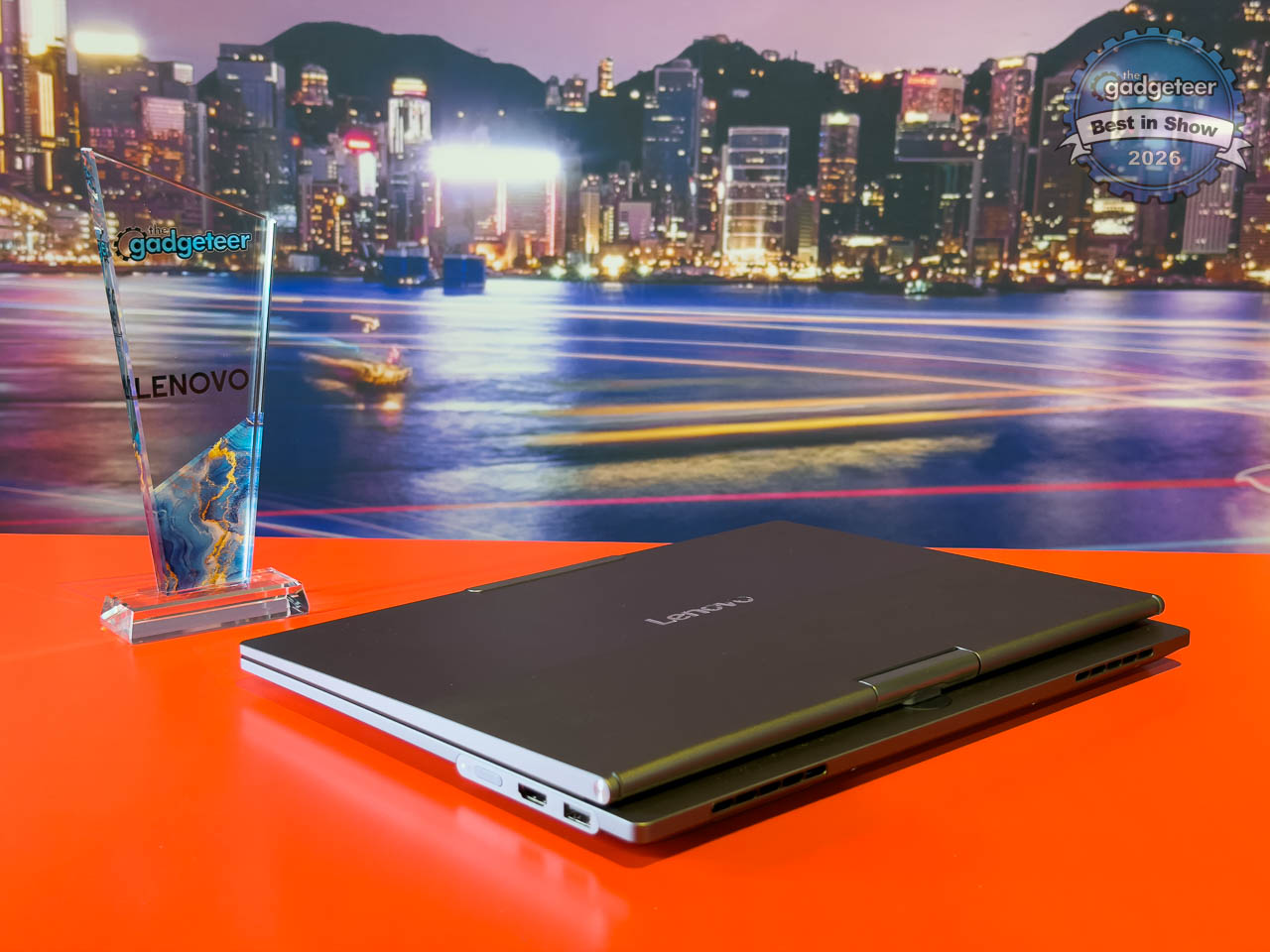
That matters because it reframes laptop hardware as responsive rather than static. The ThinkBook Plus Gen 7 Auto Twist is not a concept experiment. It is a $1,649 system arriving in June 2026. Lenovo did not just imagine a smarter hinge. They shipped one. That’s what earned it a trophy.
Lenovo Legion Pro Rollable Concept
Gaming laptops have always forced a compromise. You either buy a portable machine with a 16-inch screen that travels well, or you anchor yourself to a desk with an external monitor for real immersion. The Legion Pro Rollable challenges that assumption by refusing to treat screen size as a fixed decision.
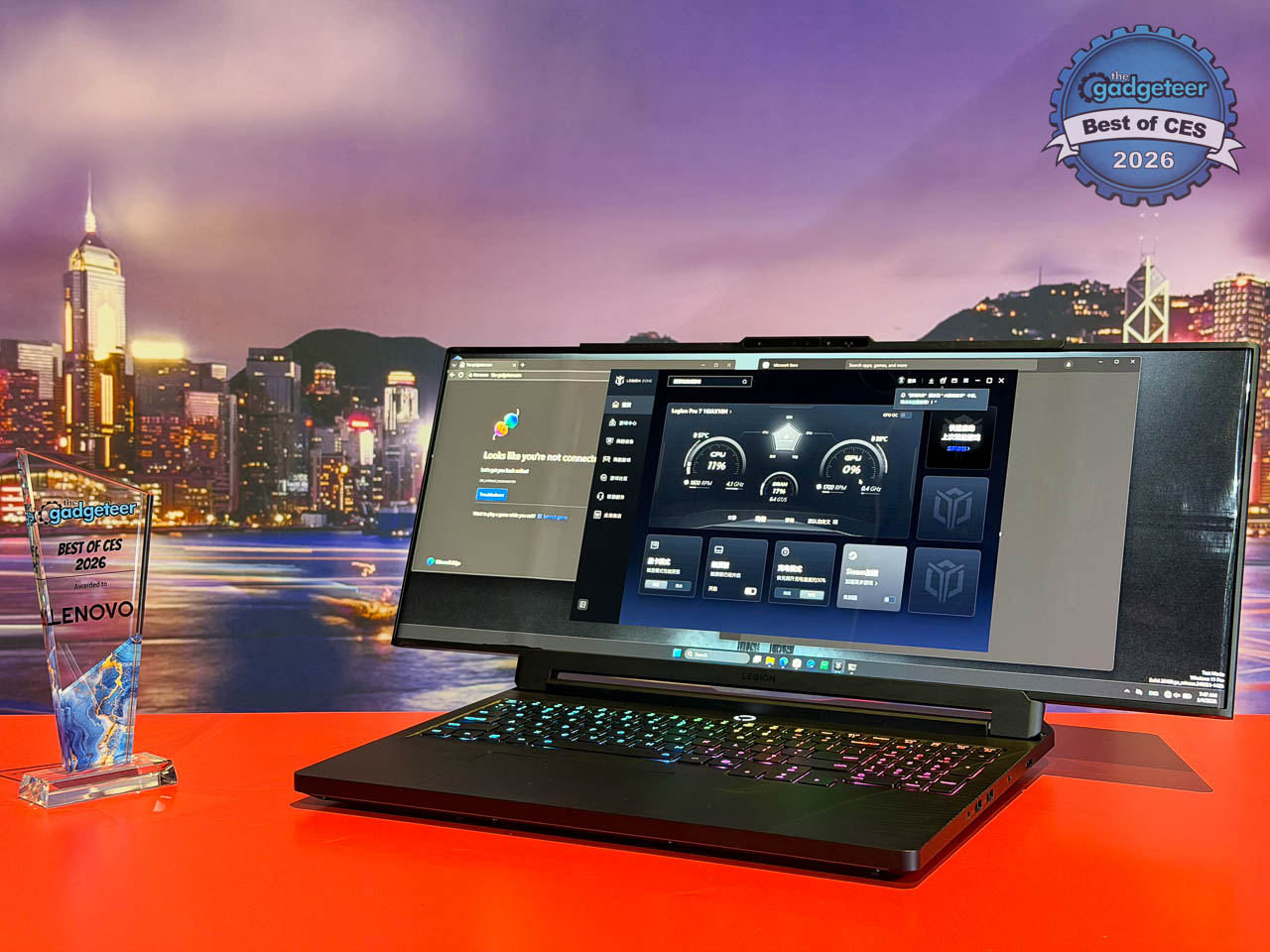
In its closed state, the Legion Pro Rollable behaves like a traditional high-end gaming laptop, starting at a 16-inch display footprint that fits easily into backpacks and coffee shop tables. With a single action, the OLED panel physically expands horizontally, unfurling into a dramatically wider 24-inch PureSight OLED display. Lenovo demonstrated multiple working aspect ratios during CES, including 16:10 for productivity, 21:9 ultrawide for cinematic gaming, and an extreme 24:9 configuration that pushes field of view into territory normally reserved for multi-monitor desktop setups. This is not digital scaling or software trickery. The panel itself is mechanically extending in real time.
The display innovation is not paired with compromised internals. Lenovo paired the rollable OLED system with full RTX-class graphics and flagship-level gaming hardware, maintaining performance consistency regardless of screen size. Frame rates, thermal behavior, and power delivery were demonstrated without downclocking or feature disablement. In other words, the screen expands, but the system does not flinch. That matters because most concept devices quietly trade performance for spectacle. This one does not.
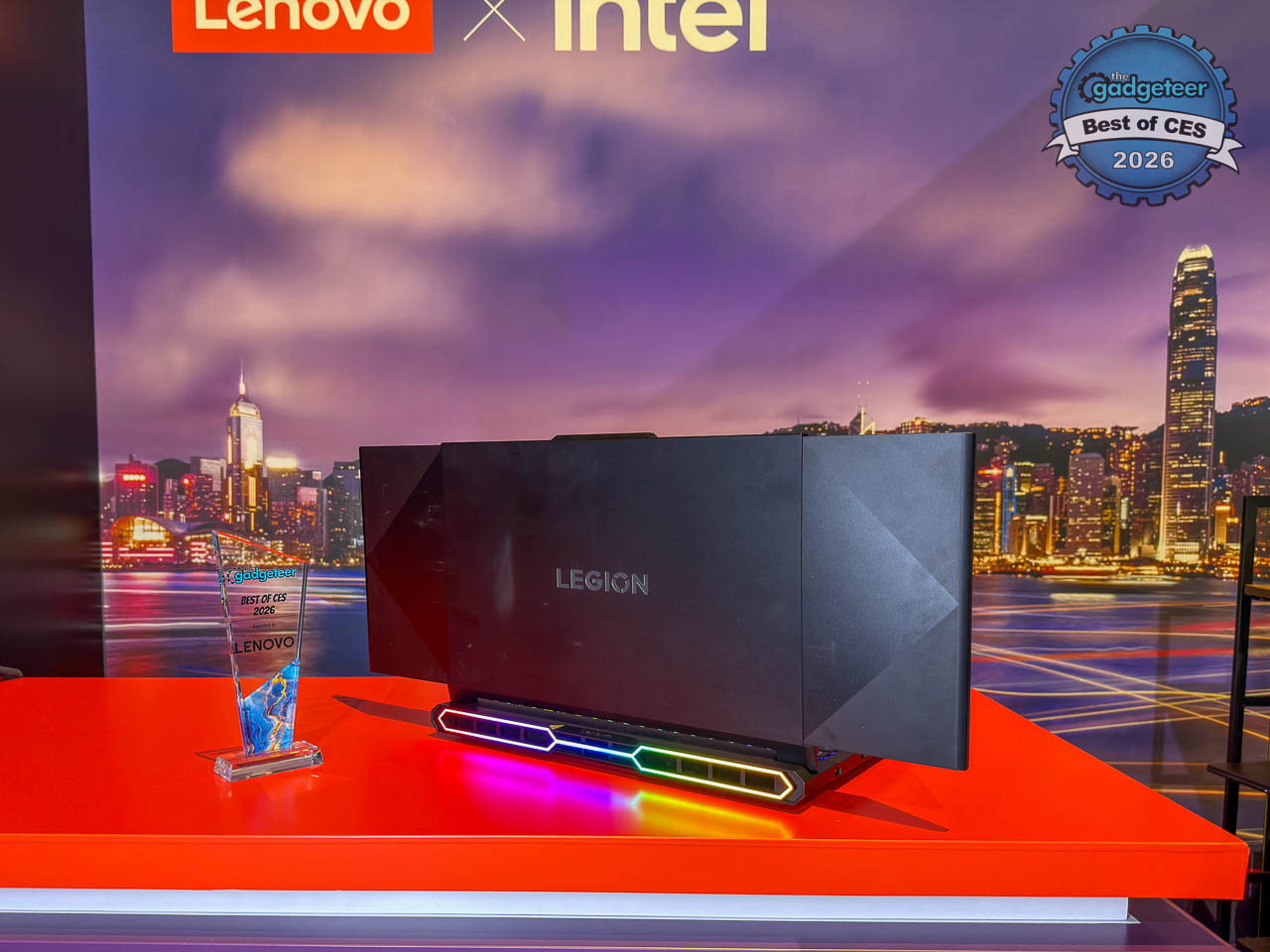
The use cases become obvious the moment you imagine real workflows. On the road, it functions as a conventional premium gaming laptop. At a hotel desk or temporary setup, it becomes a full ultrawide battlestation without carrying an external monitor. Competitive titles benefit from wider peripheral vision. Strategy games gain expanded interface real estate. Creative users get timeline and canvas space normally impossible on a laptop. One machine adapts to radically different environments without accessories or compromises.
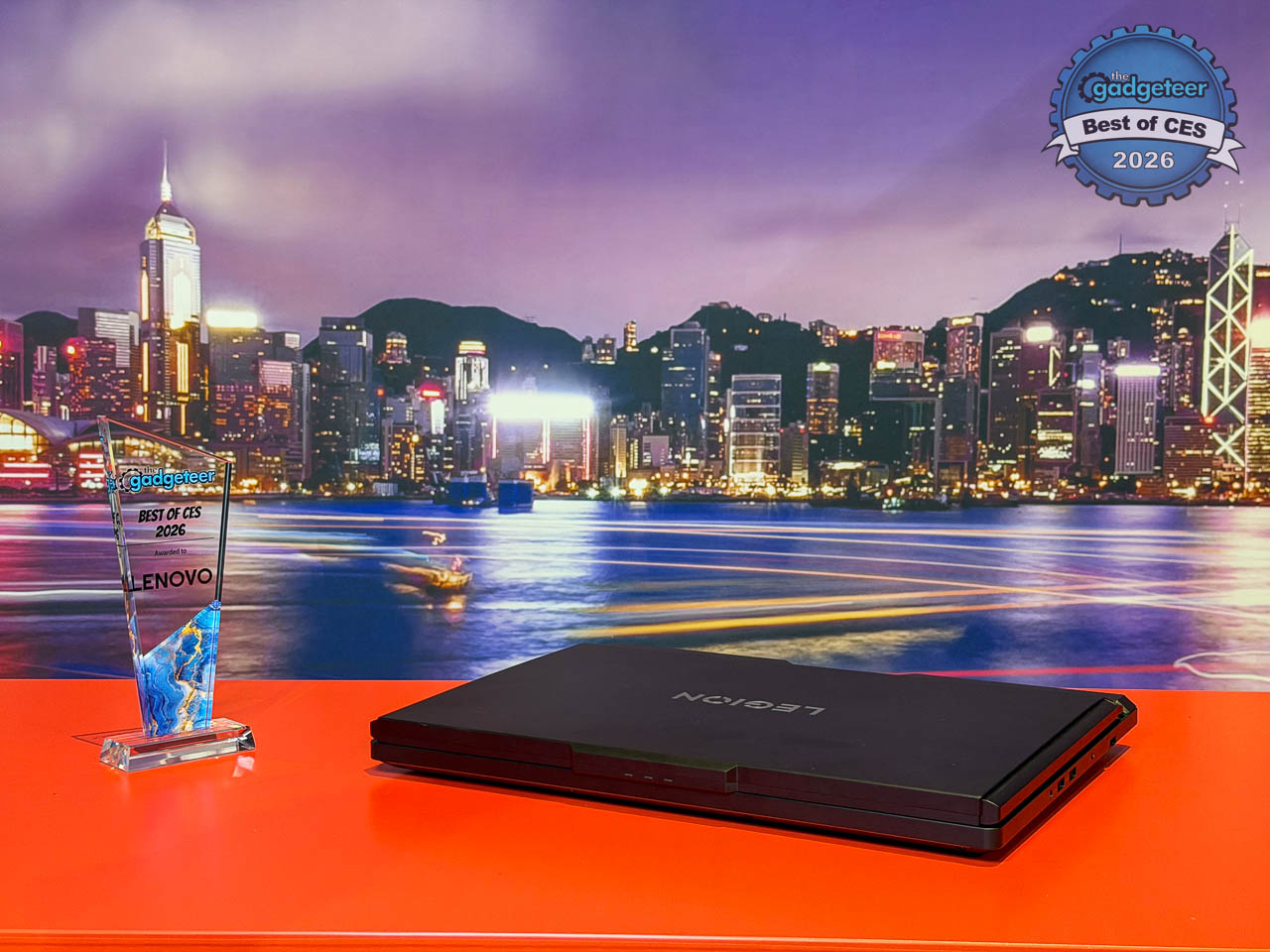
Just as important, this was not a static mockup or a vision video. Lenovo demonstrated a fully functioning rollable OLED mechanism at CES 2026, repeatedly expanding and retracting the panel while driving the display with full RTX-class graphics. We did not see another gaming laptop concept at the show demonstrate horizontal screen expansion at this scale while preserving flagship performance. The Legion Pro Rollable does not hint at a future where laptops get bigger. It shows a future where laptops get smarter about when they need to be.
That combination of mechanical innovation, real performance, and flexible use cases is why the Legion Pro Rollable made the cut.
Lenovo Yoga Pro 27UD-10 Monitor
Color-critical work has always required rituals. Switching profiles. Adjusting brightness for ambient light. Double-checking against reference monitors before every session. The Yoga Pro 27UD-10 eliminates that entire routine.
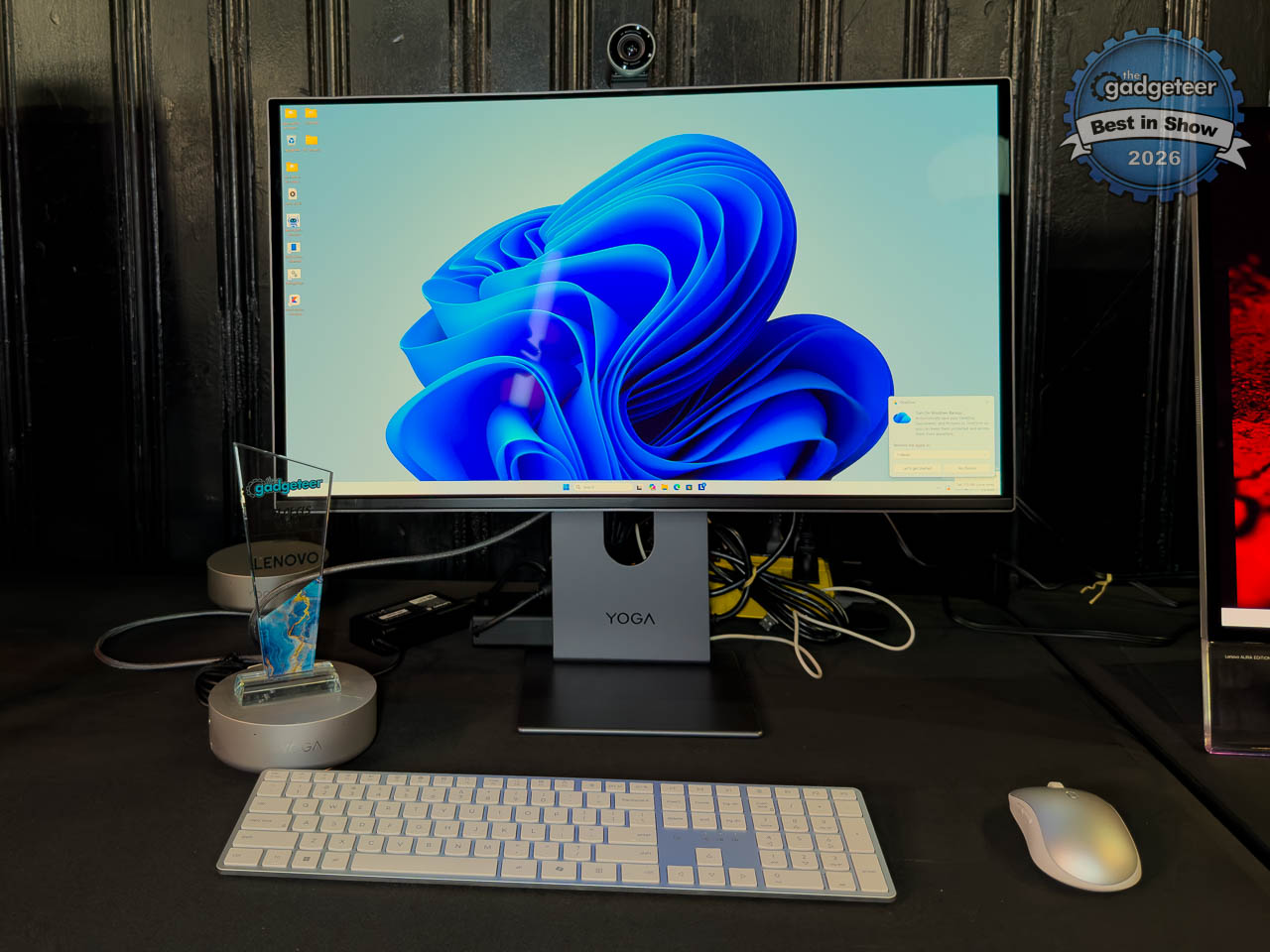
Lenovo’s Aura Edition AI integration creates context-aware adjustments automatically, adapting to your workflow without manual intervention. The 4K QD-OLED panel delivers reference-grade color accuracy, while Dolby Atmos speakers and a detachable webcam complete the creative workstation setup. The inclusion of QD-OLED matters here. It delivers the contrast and color volume creators expect from reference-class displays, not general-purpose monitors. Lenovo positions the panel for color-critical creative work, and the intelligence layer means you spend less time managing the tool and more time using it. We did not see another creative monitor at CES 2026 combine 4K QD-OLED with AI-driven context-aware calibration that adapts to your workflow in real time. That’s why the Yoga Pro 27UD-10 earned a trophy: it’s what creative monitors should have been all along.
Lenovo ThinkPad Rollable XD Concept
Most laptop upgrades feel the same: a slightly faster chip, a slightly brighter panel, and a new sticker on the palm rest. The ThinkPad Rollable XD Concept is one of the rare designs that actually changes what a laptop is.
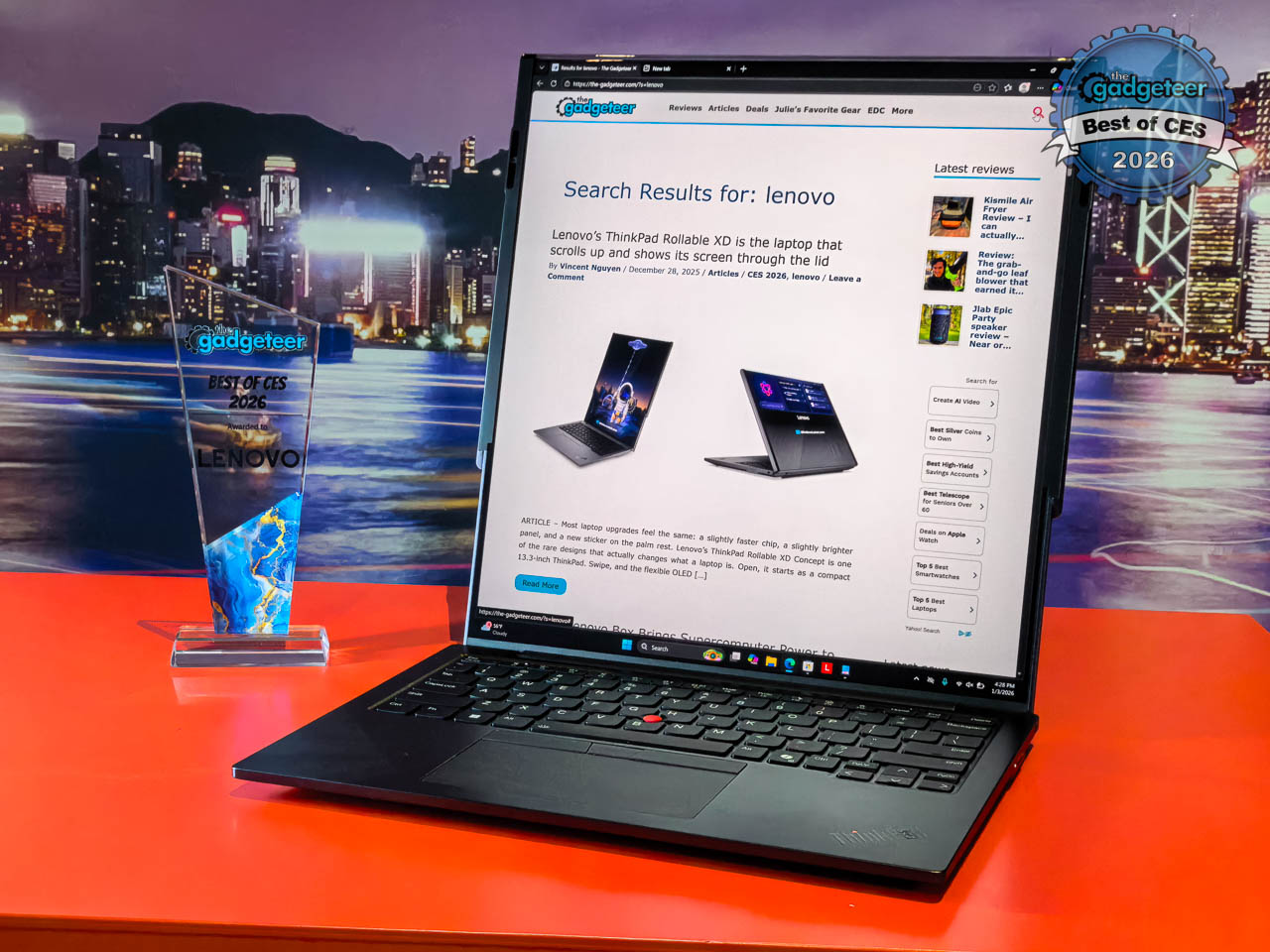
Open it and you start with a compact 13.3-inch ThinkPad. Swipe, and the flexible OLED scrolls upward into a 16-inch vertical canvas, giving you over 50 percent more screen real estate without hauling a bigger machine. That extra height lands exactly where spreadsheet users, document workers, and dashboard watchers have always wanted it: more visible rows, more reference windows, more timeline without scrolling.
Close the lid and it still refuses to act like a normal laptop. Instead of a dead slab of aluminum, you get a transparent Gorilla Glass Victus 2 cover with a strip of the 16-inch OLED still visible underneath. Lenovo calls this the world-facing display: a glanceable surface for notifications, calendar events, and AI interactions that stays useful even when the machine is shut. The idea is to make your laptop context-aware whether it’s open on a desk or closed in a meeting.
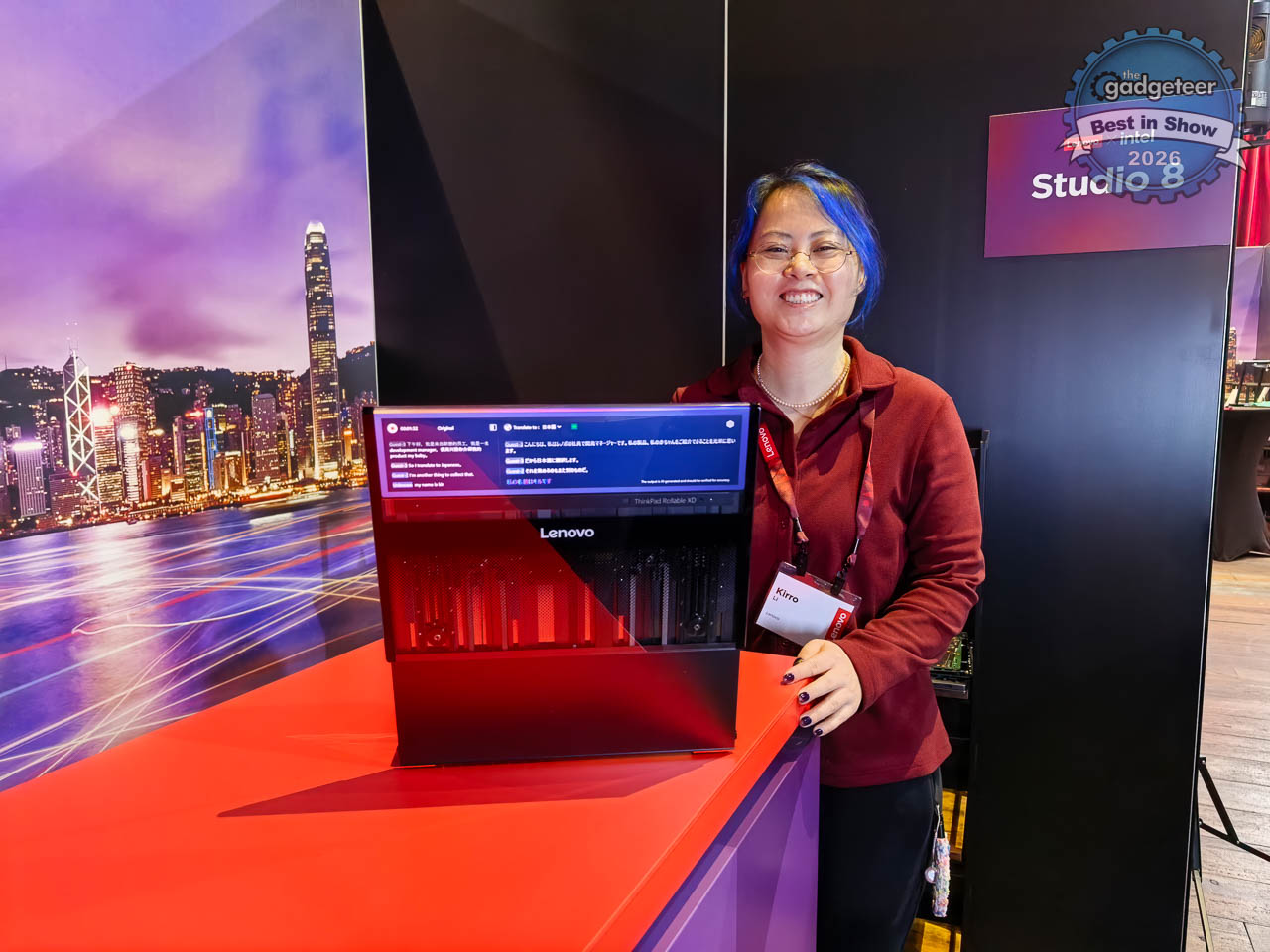
The ThinkPad Rollable XD isn’t a foldable in the usual sense. There’s no crease down the middle and no dual-panel hinge. The flexible OLED is rolled inside the chassis and scrolls upward behind the top bezel when you extend it. In its default 13.3-inch mode, it looks like a normal ThinkPad. Trigger the mechanism and the screen rises vertically until you hit the full 16-inch height.
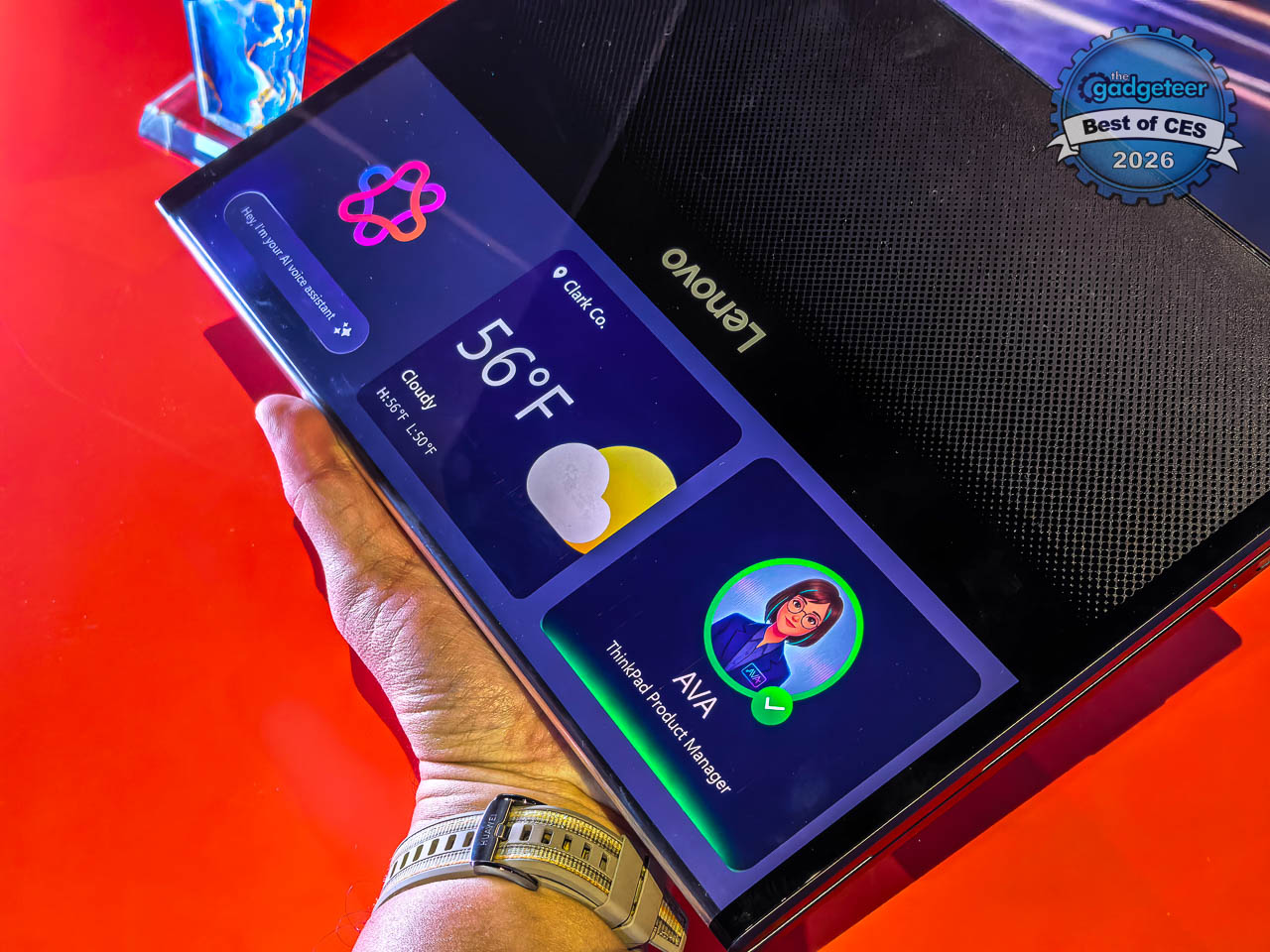
Durability questions remain. A rollable OLED panel and a 180-degree glass lid will have to survive backpacks, airport security bins, and years of opening and closing. This is still a concept, not a shipping product, and Lenovo hasn’t announced pricing or availability. But the ThinkPad Rollable XD signals something important: the next meaningful laptop upgrade might not be a faster processor. It might be a screen that grows when your work needs more room and stays alive when you close the lid. That shift in thinking is why it made our list.
Pool & Outdoor Robotics
Pool automation has always been a half-truth. Robots cleaned the water, then handed the mess back to you: lift it out, rinse the filter, empty the debris, find somewhere to store it. This year, the category finally closed that gap. Self-emptying docks, self-docking robots, and portable swim training systems arrived with the same thesis: if you still have to touch the machine afterward, it was never really automatic.
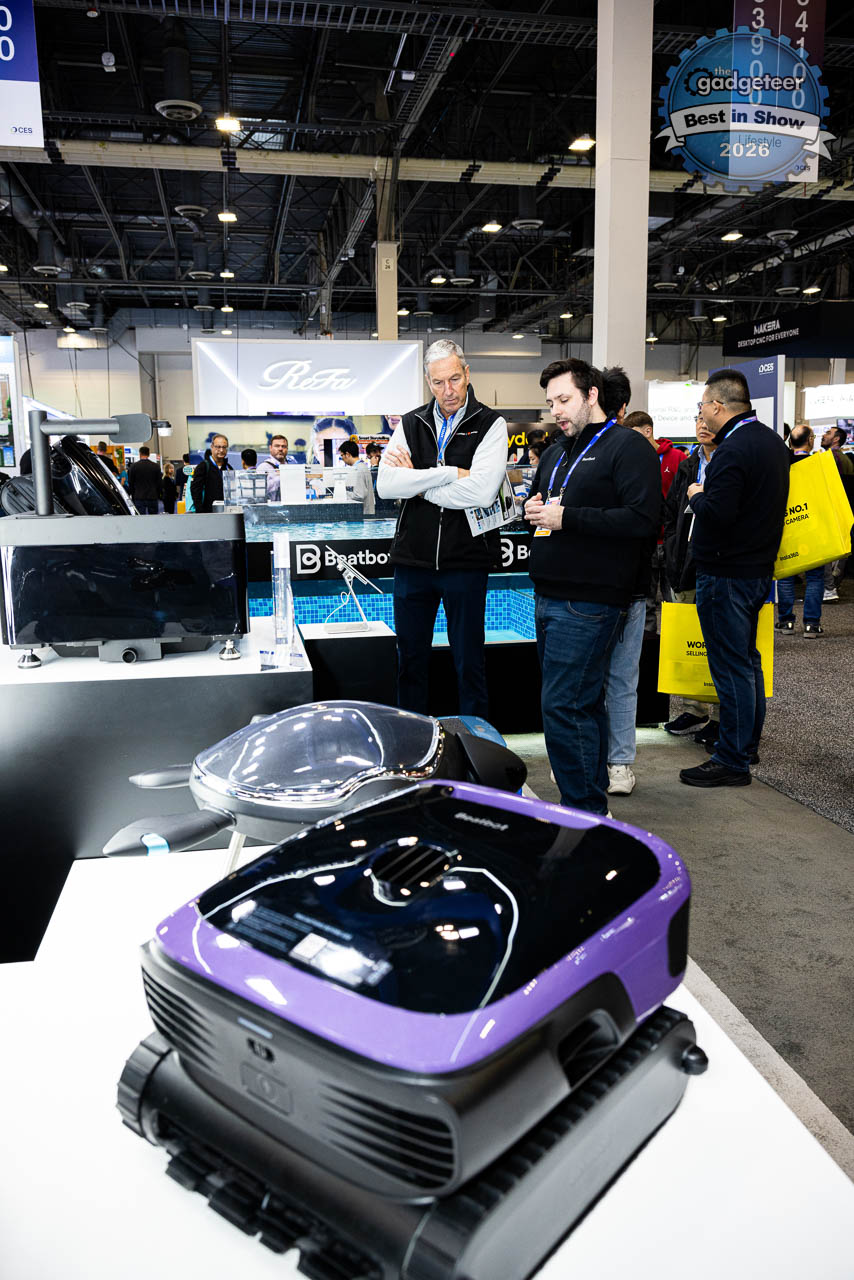
Beatbot AquaSense X Ecosystem
Pool robots have always stopped one step short of being truly automatic. They clean the water, then hand the mess back to you. You still lift them out, rinse filters, empty debris, dry components, and find storage space. “Automatic” has always meant automated movement, not automated ownership. The AquaSense X closes that gap.
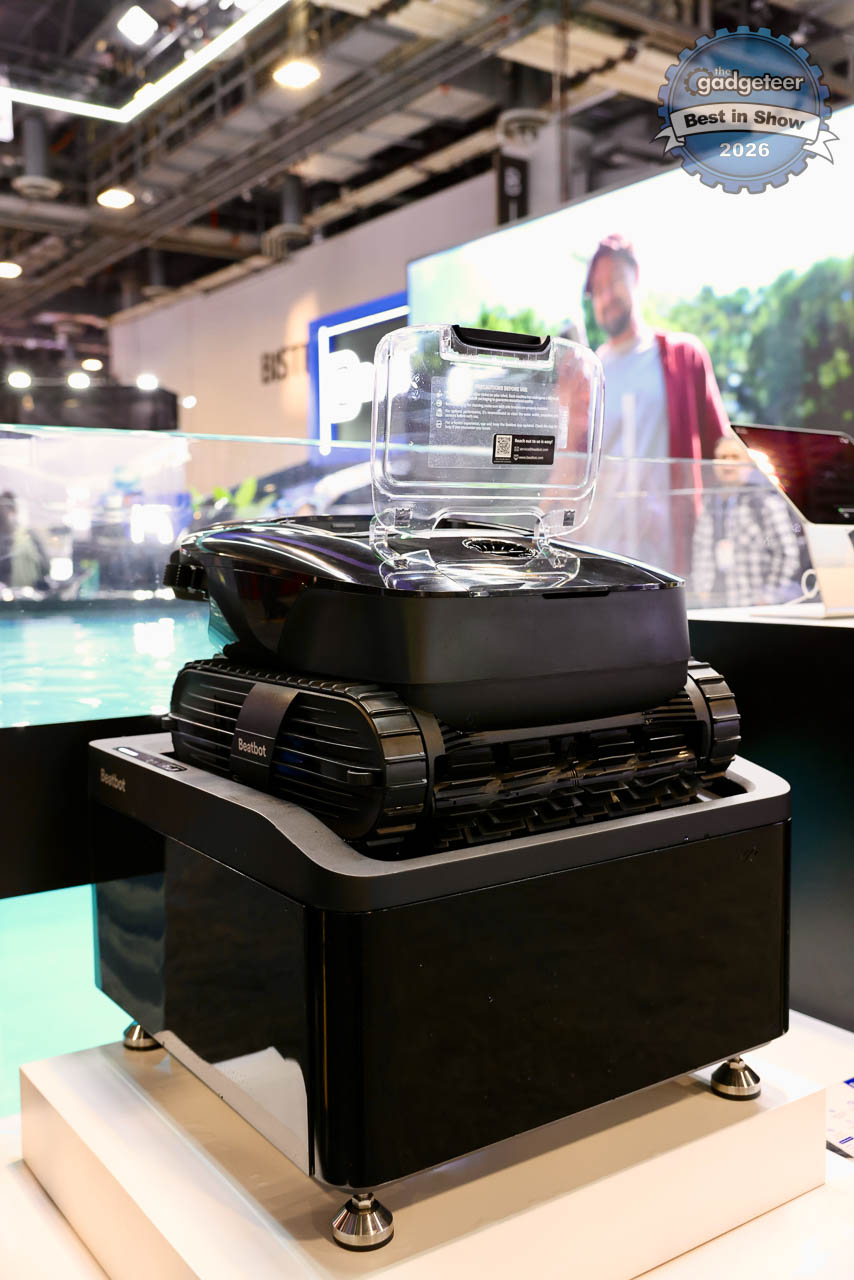
Beatbot positions the AquaSense X as the first pool cleaning system built around a fully autonomous post cleaning workflow. After completing a cycle, you dock the robot at the AstroRinse Cleaning Station, where a high pressure rotating backflush rinses the internal filter and evacuates debris into a sealed waste bin in roughly three minutes. Charging begins automatically once docked. The debris container holds about 22 liters, supporting extended operation measured in weeks rather than days. For the first time, routine pool cleaning does not end with a chore.
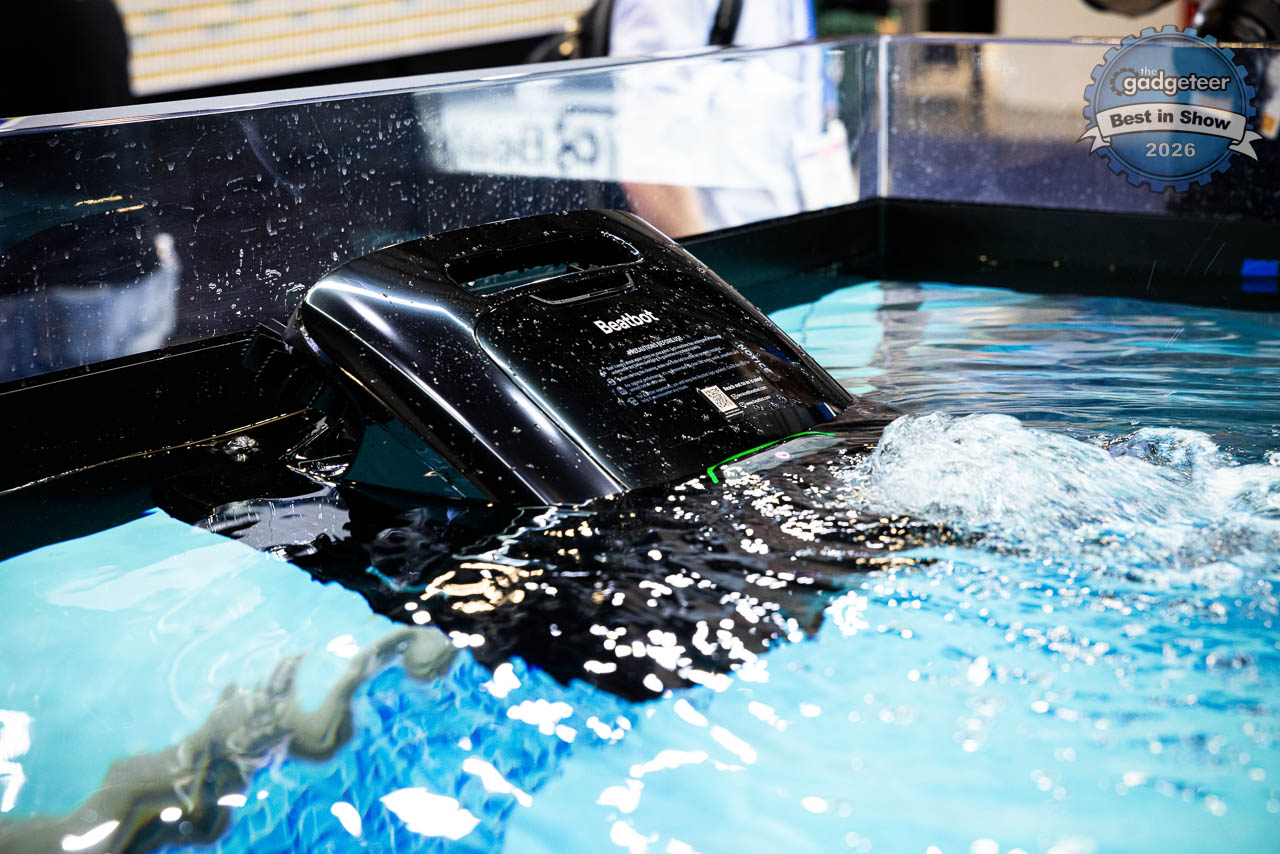
The robot itself is equally overbuilt. Beatbot AI 2.0 powers HybridSense AI Vision, combining camera imaging, infrared sensing, and ultrasonic detection to identify and classify 40 types of debris, double what Beatbot supported in previous generations. Eleven independent motors drive a submarine style propulsion system capable of cleaning the pool floor, walls, waterline, and surface. Dual bottom mounted ultrasonic sensors detect steps, ledges, and shallow platforms down to 13.7 inches, allowing the system to clean complex pool geometries without manual intervention or exclusion zones.
What separates the AquaSense X from every pool robot before it is that the dock is not an accessory. It is part of the product. Most competitors still treat cleaning, charging, and maintenance as separate steps. Beatbot designed a closed loop system where the robot cleans, empties itself, rinses itself, and prepares for the next cycle without human involvement. That changes how often owners actually use their pool because it removes the friction that quietly discourages daily or weekly cleaning.
At $4,250 with a three year full replacement warranty, the AquaSense X is not positioned as a budget option. It is positioned as a labor replacement. If you value time, consistency, and the idea that pool care should behave like modern automation instead of a recurring task list, this is the first system that delivers on that promise. That is what earned it a trophy.
Beatbot Sora 70
Most pool robots ignore the surface. Leaves float, pollen accumulates, debris drifts until it eventually sinks to the bottom where the robot finally notices it. The Sora 70 doesn’t wait.
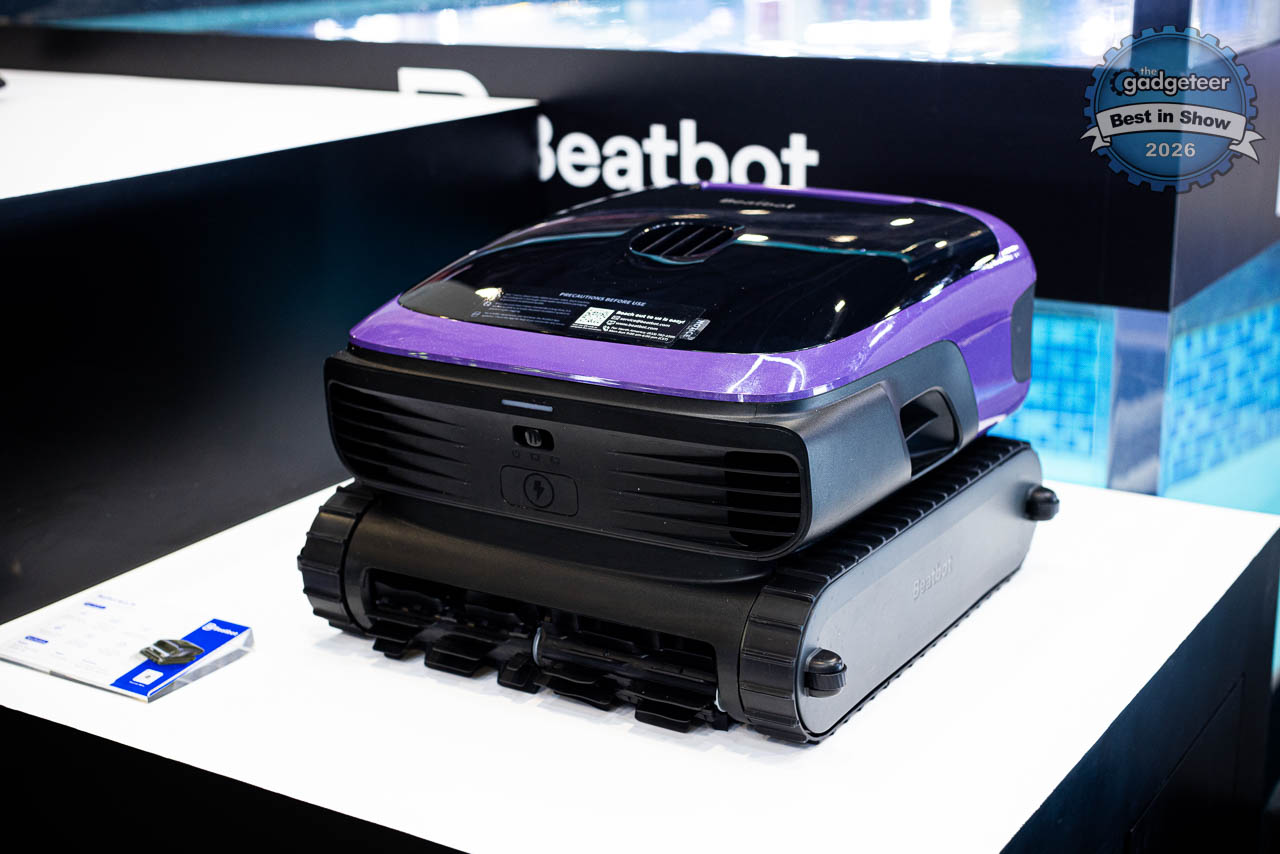
Beatbot’s JetPulse dual-flow jet system actively collects floating debris before it sinks. Full 360-degree coverage handles floor, walls, waterline, and surface in a single cycle. The system reaches shallow zones down to 20cm depth (7.9 inches), allowing operation in very shallow water. Same AI mapping and optimized cleaning patterns as Beatbot’s flagship, without the full ecosystem price tag. For pool owners who want intelligent cleaning without the self-cleaning dock investment, the Sora 70 hits the sweet spot.
MAMMOTION SPINO S1 Pro
Every pool robot requires the same ritual: wait for it to finish, walk outside, reach into the water, pull it out, carry it to the charger. MAMMOTION decided that was stupid.
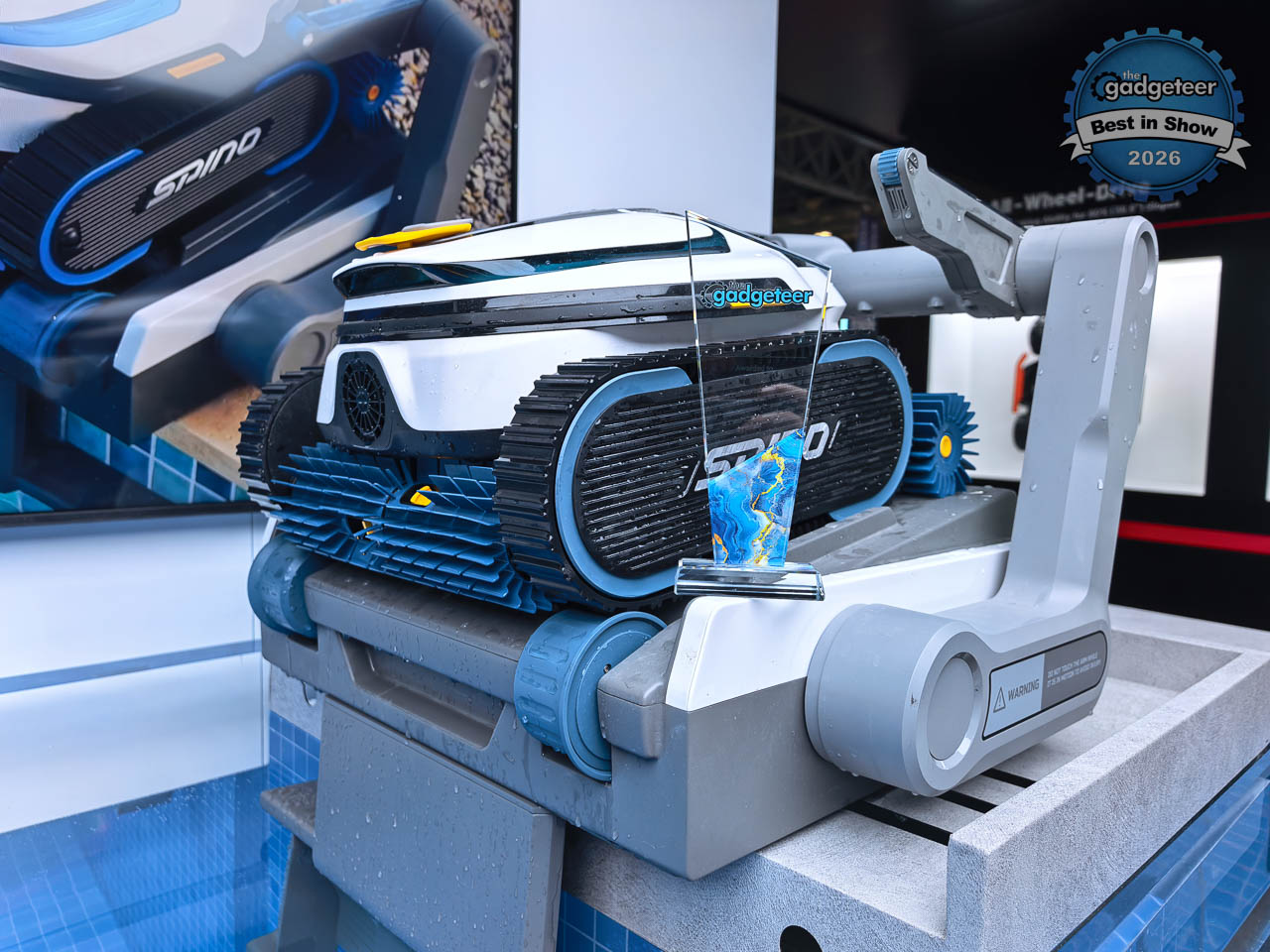
The SPINO S1 Pro climbs out of the water, docks itself, and starts charging. AutoShoreCharge technology uses a robotic arm system that physically lifts the cleaner from the water and returns it to the charging station, no human intervention required. ZonePilot AI maps your pool’s geometry and optimizes cleaning paths. Edge-hugging suction tackles corners where debris hides. MAMMOTION earned their second consecutive CES Innovation Award for this, and the reason is obvious: they eliminated the one step that made “automatic” pool cleaning a lie. That’s why the SPINO S1 Pro made the cut.
iGarden Swim Jet X Series
Endless pools cost a fortune and require permanent installation. Tethered swim trainers feel like swimming against a leash. The Swim Jet X Series offers a third option: drop a suitcase-sized unit into your existing pool and swim against a current strong enough to challenge competitive swimmers.
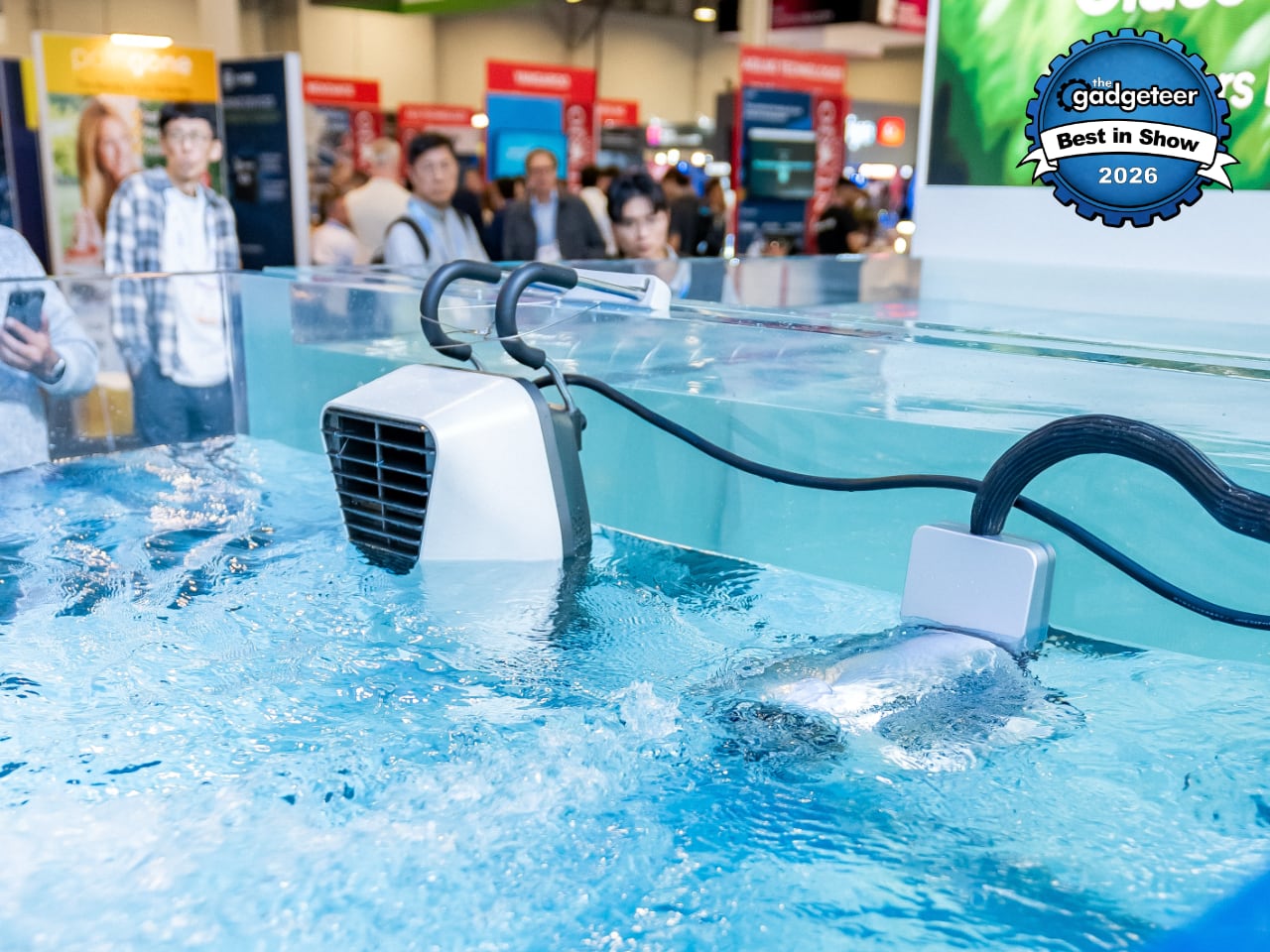
The X34 models push water at up to 230 m³/h with peak flow speeds of 3.4 m/s. The X24 models deliver 170 m³/h at 2.4 m/s for lighter resistance training or casual fitness swimming. Both produce smooth, stable currents rather than the choppy turbulence cheaper alternatives create. You adjust intensity from the app, scaling from gentle resistance to serious workout without leaving the water.
The portability is what makes the Swim Jet X work. Wheels and handles turn it into rolling luggage. No permanent plumbing. No construction. No commitment to a single pool. You can move it between your main pool and a vacation rental, store it in the garage during off-season, or lend it to a neighbor training for a triathlon.
The X34 P60 runs 1.5 hours at full output on a single charge. The smaller X24 P30 stretches to 1.5 hours at its lower power draw. All models carry IP68 waterproof ratings and operate in water temperatures from 5°C to 40°C.
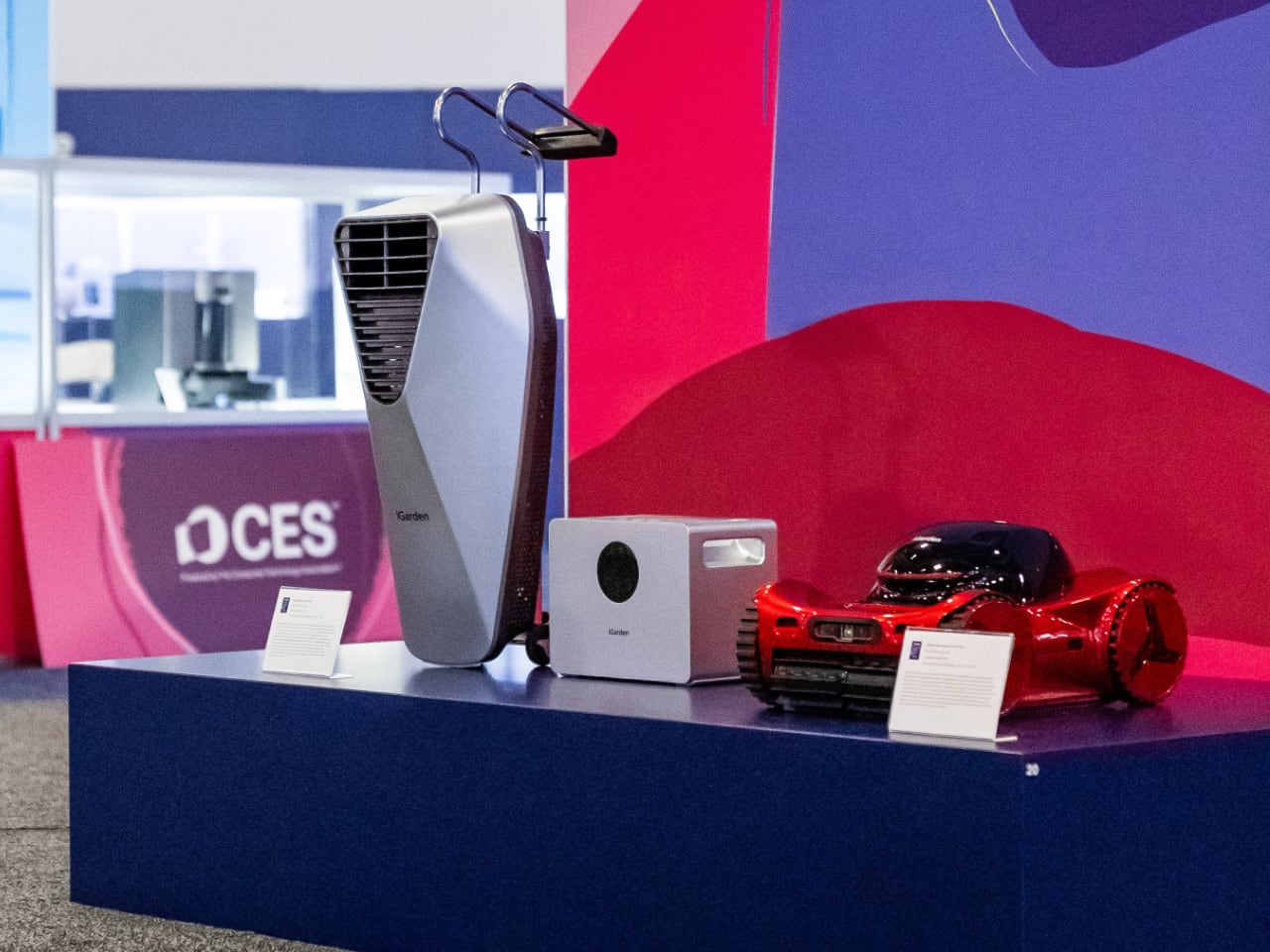
iGarden, a subsidiary of Fairland Group, built the Swim Jet X as part of a broader trust-centered AI Ecosystem that connects pool cleaners, heat pumps, and lawn equipment through a unified control layer. The Swim Jet X earned a CES Innovation Awards 2026 Honoree recognition, and the thinking behind it is clear: serious swim training shouldn’t require a serious renovation. That clarity is what earned the Swim Jet X a spot on our list.
Yard Robotics & Outdoor
The garage has quietly become a museum of single-purpose machines. Mowers, blowers, snow throwers, trimmers: each one earns its keep for a few weeks, then collects dust until the next season rolls around. This year’s outdoor robotics winners share a different vision. Modular platforms that swap attachments instead of duplicating motors. Wire-free navigation that actually works. Mobility systems that make walking eighteen holes or commuting ten miles feel sustainable instead of exhausting. The thesis is consolidation without compromise.
Yarbo M Series
Most garages quietly accumulate redundancy. A mower for summer. A leaf blower for fall. A snow blower for winter. Each machine solves one seasonal problem, then sits idle for months, demanding storage space, maintenance, and a fresh learning curve every time the weather changes. Yarbo questioned why outdoor work still works this way.
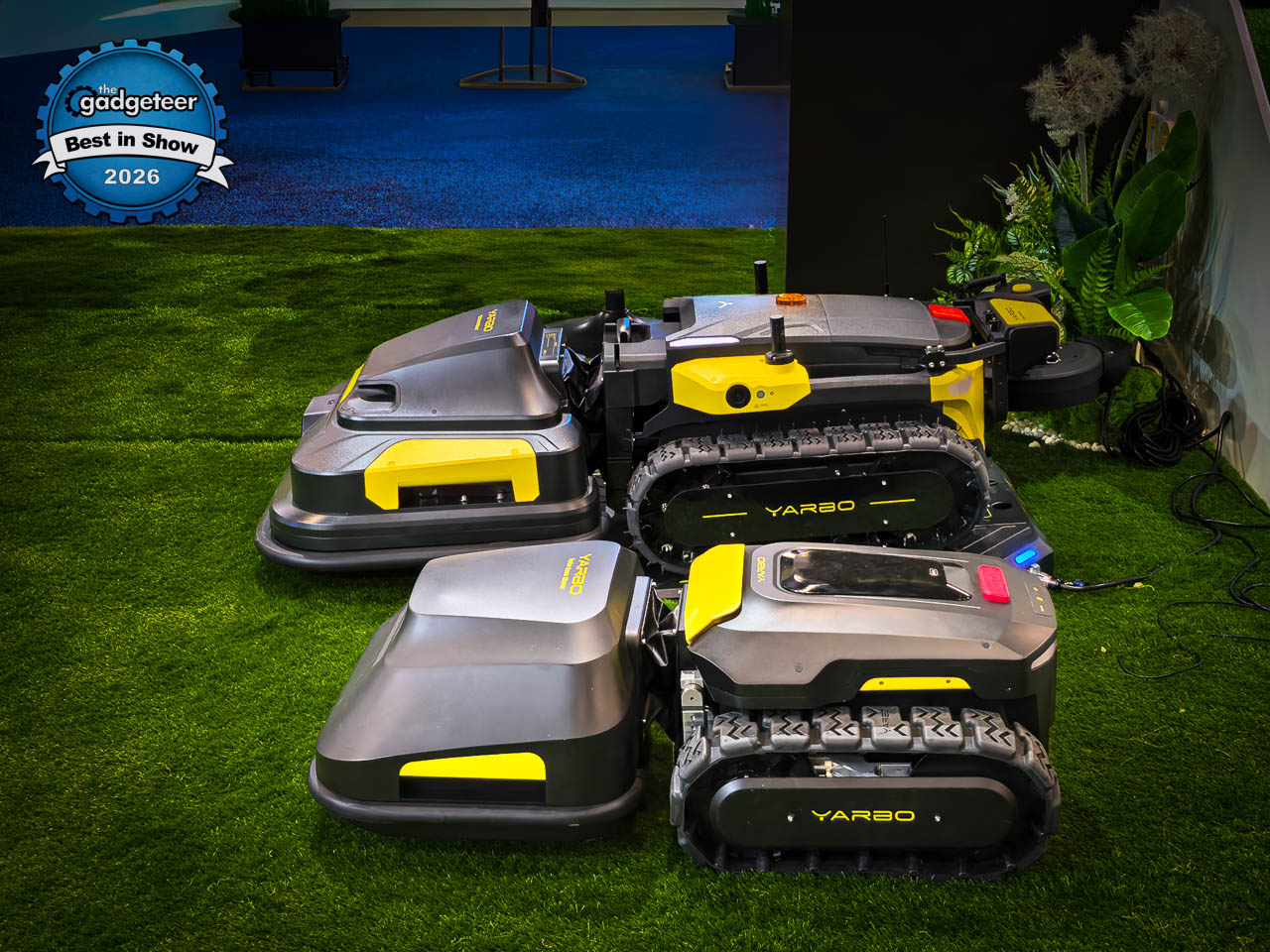
The Yarbo M Series is a 36V modular robot core with swap-on modules for mowing, snow clearing, leaf collection, and trimming, designed specifically for typical North American and European yards rather than sprawling estates. Instead of owning four seasonal machines, you own one intelligent platform that adapts as conditions change. The core unit provides drive, power management, navigation, and computing. Attachments add task-specific hardware without duplicating brains, batteries, or motors. Pre-orders opened via Kickstarter soon after CES 2026, and the positioning feels deliberate: consolidation for homeowners who don’t want a garage full of single-purpose equipment.
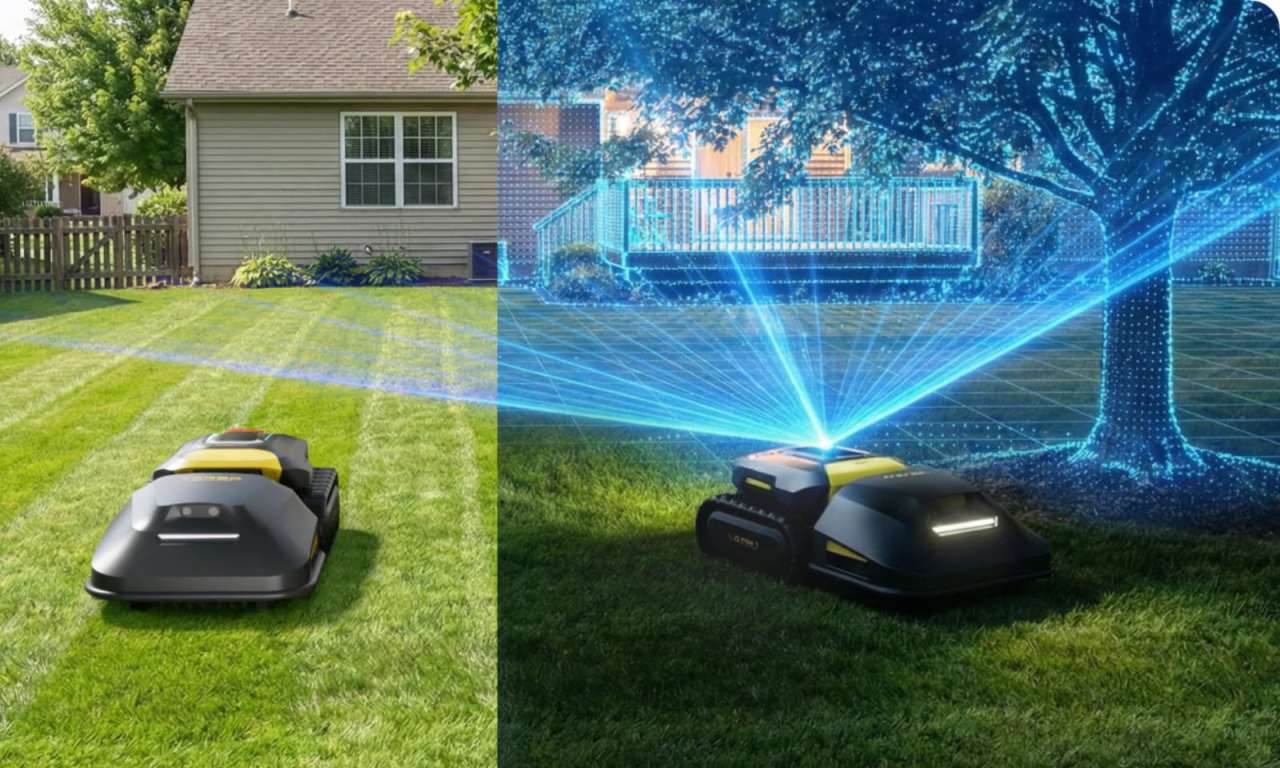
Navigation is where the M Series separates itself from cheaper robotic mowers. Yarbo combines LiDAR, cameras, and bumper sensors, powered by a 6 TOPS AI chip, to build its own map wire-free without perimeter wires. Yarbo claims the LiDAR system works under tree cover and even after dark. Rubber tracks handle slopes up to 70 percent (35 degrees), top speed sits around 3.9 feet per second for balanced coverage and precision, and the operating temperature range spans minus 13°F to 113°F with IPX6 weather resistance. Wireless fast charging brings the 10Ah battery from 10 percent to 90 percent in roughly 30 minutes. This isn’t a fair-weather toy. It’s built to stay outside and work year-round.

The mower module cuts a 15.7-inch swath with adjustable height from 1.2 to 4 inches. Two battery options (10Ah and 20Ah) change motor power and coverage per charge: up to 1 acre per day on the smaller pack, 1.5 acres per day on the larger one, with runtime stretching to 110 minutes. Noise sits around 58 dB, quiet enough for early morning or late evening runs without angering the neighbors. The collector module handles leaves and debris with a 25-liter capacity and roughly 11.8-inch sweep width, AI-assisted planning with 50+ preset dumping spots, and automatic resume after each dump cycle. The snow plow module features a 25.6-inch blade with adjustable angle (plus or minus 25 degrees) and clears 2,000 to 4,000 square feet per charge depending on battery choice. The trimmer module uses a dual-line system with 23 feet of line capacity and automatic feed, handling autonomous edge work around tight garden beds and walls.
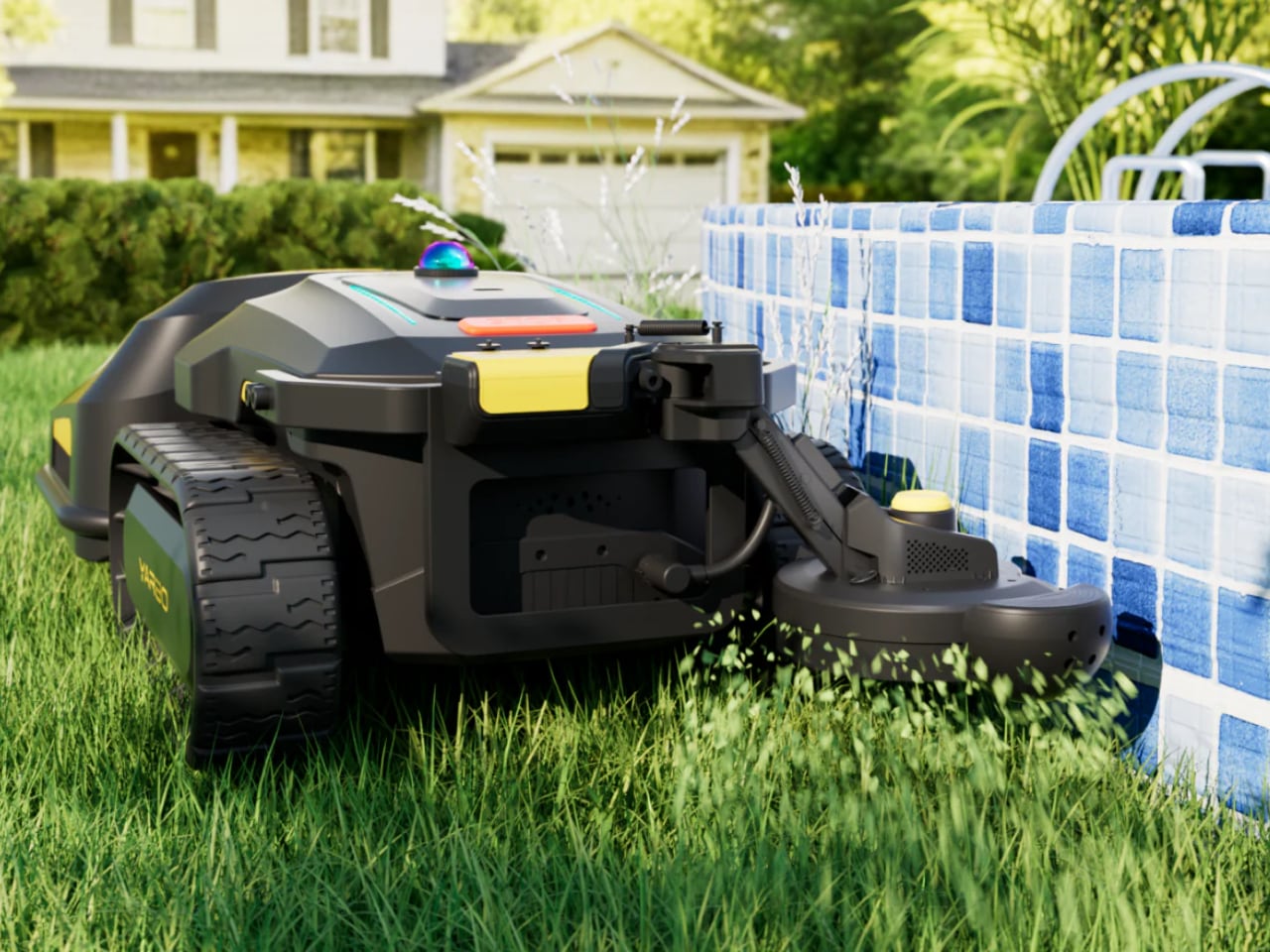
What elevates the M Series beyond convenience is consolidation backed by real engineering. This isn’t about replacing a mower with a robot. It’s about replacing an entire category of seasonal equipment with a single intelligent system that actually delivers the specs to handle each job properly. Fewer machines mean less maintenance, less storage, and fewer points of failure. Over time, that simplicity changes how often outdoor work actually gets done because the friction that delays routine maintenance disappears.
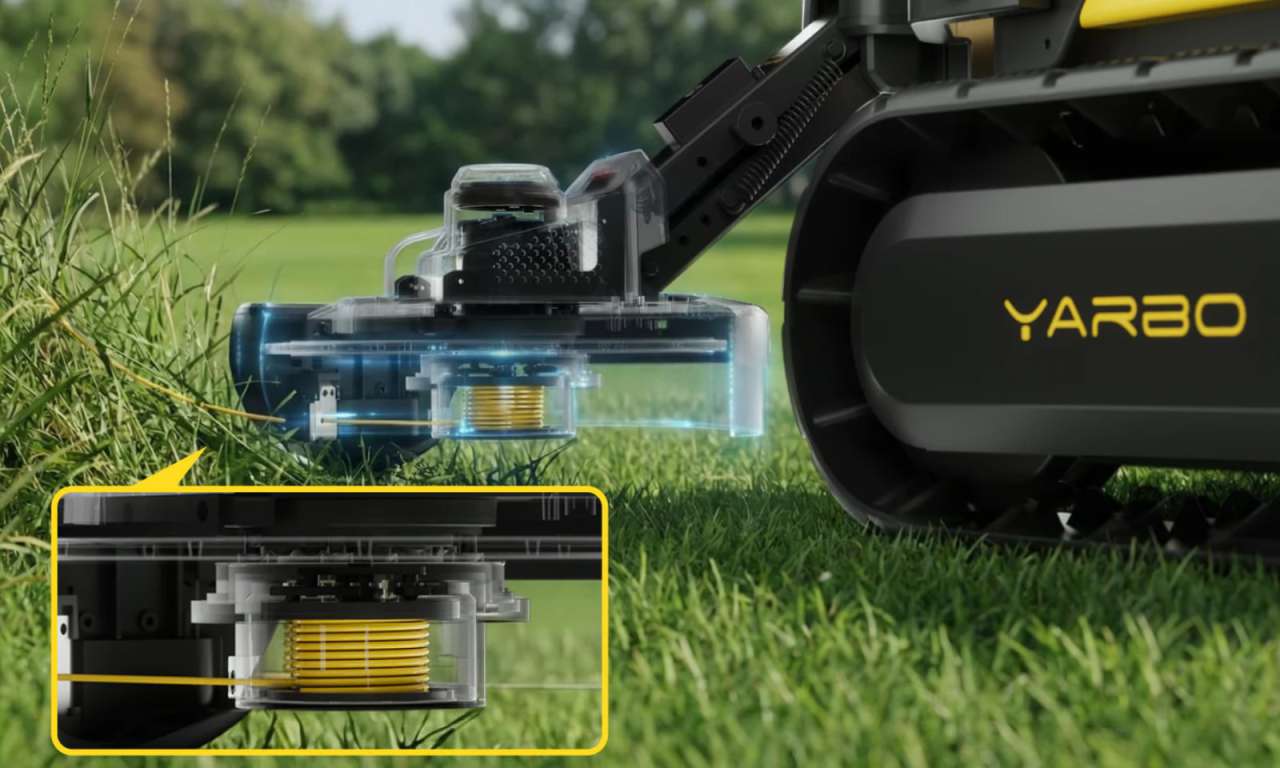
Yarbo didn’t build a gadget. They built infrastructure for residential outdoor automation. The M Series represents a shift from owning tools to owning a platform, and that shift is why it earned a trophy.
NAVEE UT5 Ultra X
High-power electric scooters have a fatigue problem. The thrill fades fast when your arms are fighting instability at 30 mph, which is why most powerful scooters stay recreation toys instead of becoming real transportation.

The NAVEE UT5 Ultra X attacks that problem directly. Dual motors deliver 43 mph top speed and up to 87-mile claimed range under controlled conditions, but NavScooterAssist is the real story: software-based stability enhancement, traction control, and adaptive response that keep long rides comfortable instead of exhausting. Commuters covering real distances notice the difference in their wrists and shoulders by mile ten.
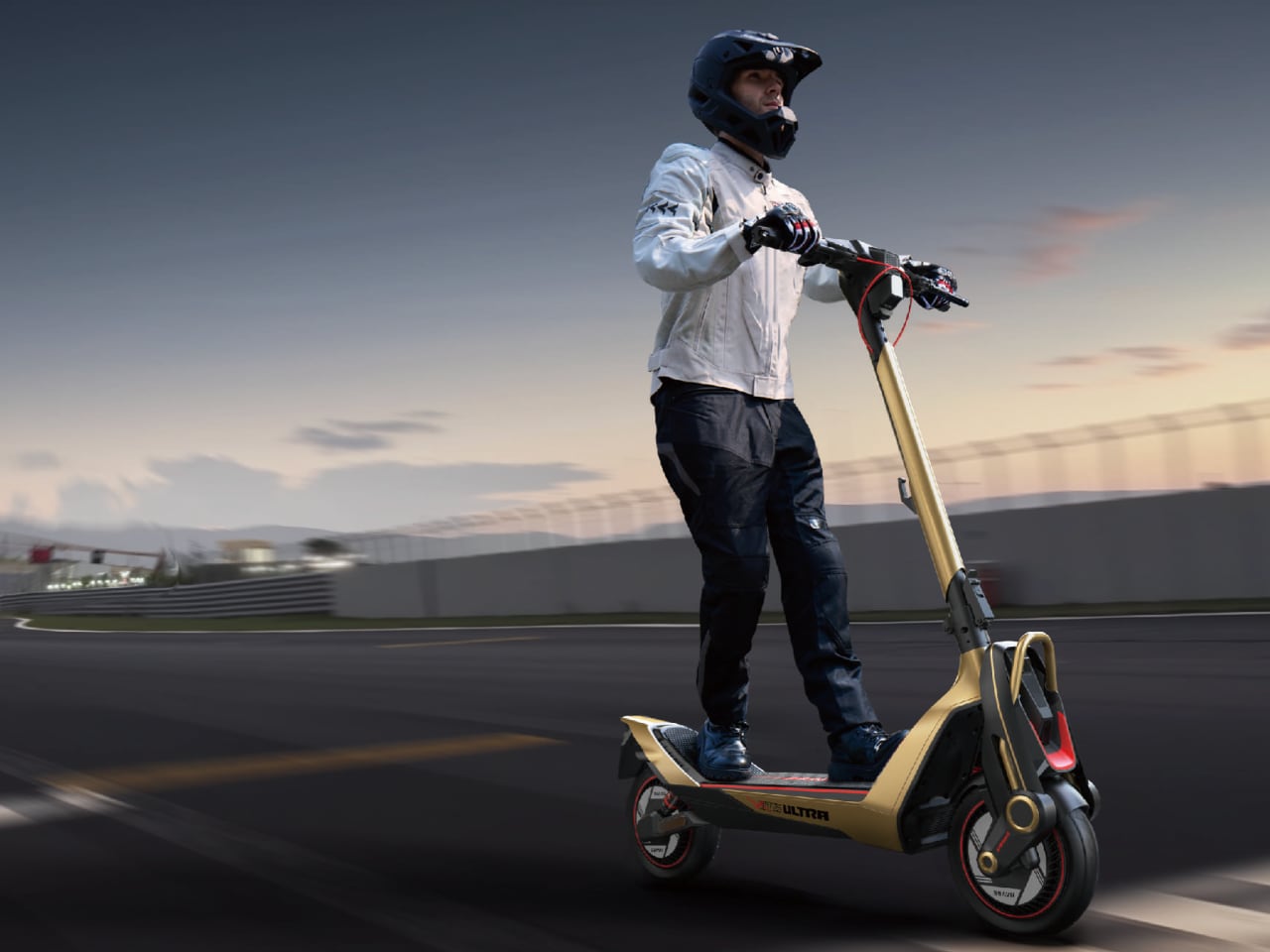
The lighting and braking systems address safety with engineering rather than compromise. For riders ready to graduate beyond weekend toys, NAVEE has built a scooter that actually works for daily transportation.
NAVEE Eagle F1 X Electric Golf Push Cart
Push carts do not fail because golfers dislike walking. They fail because steering a loaded cart uphill, across uneven fairways, and through long rounds becomes work by the back nine. The Eagle F1 X solves that problem by removing steering from the equation entirely.
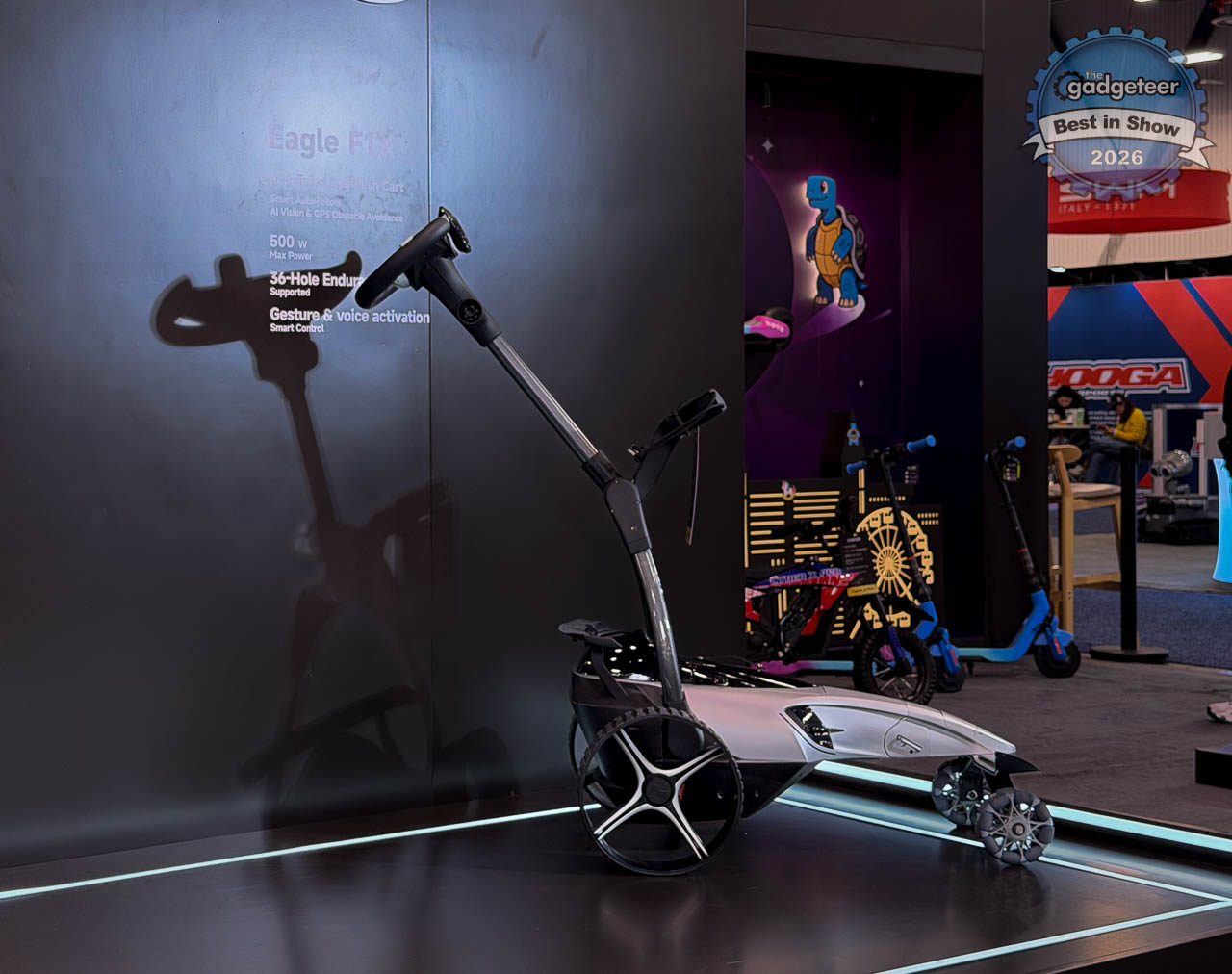
The second-generation Eagle F1 X uses a dual tracking system that combines AI vision with Ultra Wideband positioning to follow the golfer naturally and predict movement in real time. Instead of reacting late or drifting off line, the cart maintains a consistent following distance and adjusts smoothly as pace and direction change. The result feels less like remote control and more like a silent caddie that understands where you are going before you think about it. NAVEE pairs that tracking system with GPS-based obstacle avoidance to navigate course features such as bunkers, slopes, and cart paths without constant supervision.
What makes the F1 X especially compelling is how deliberately it targets endurance rather than novelty. NAVEE states the system is designed to support a full round of walking golf, which reframes the product as a health and consistency tool rather than a convenience toy. You walk more. You carry less strain in your arms and shoulders. By the final holes, the cart is still doing its job quietly in the background instead of demanding attention.
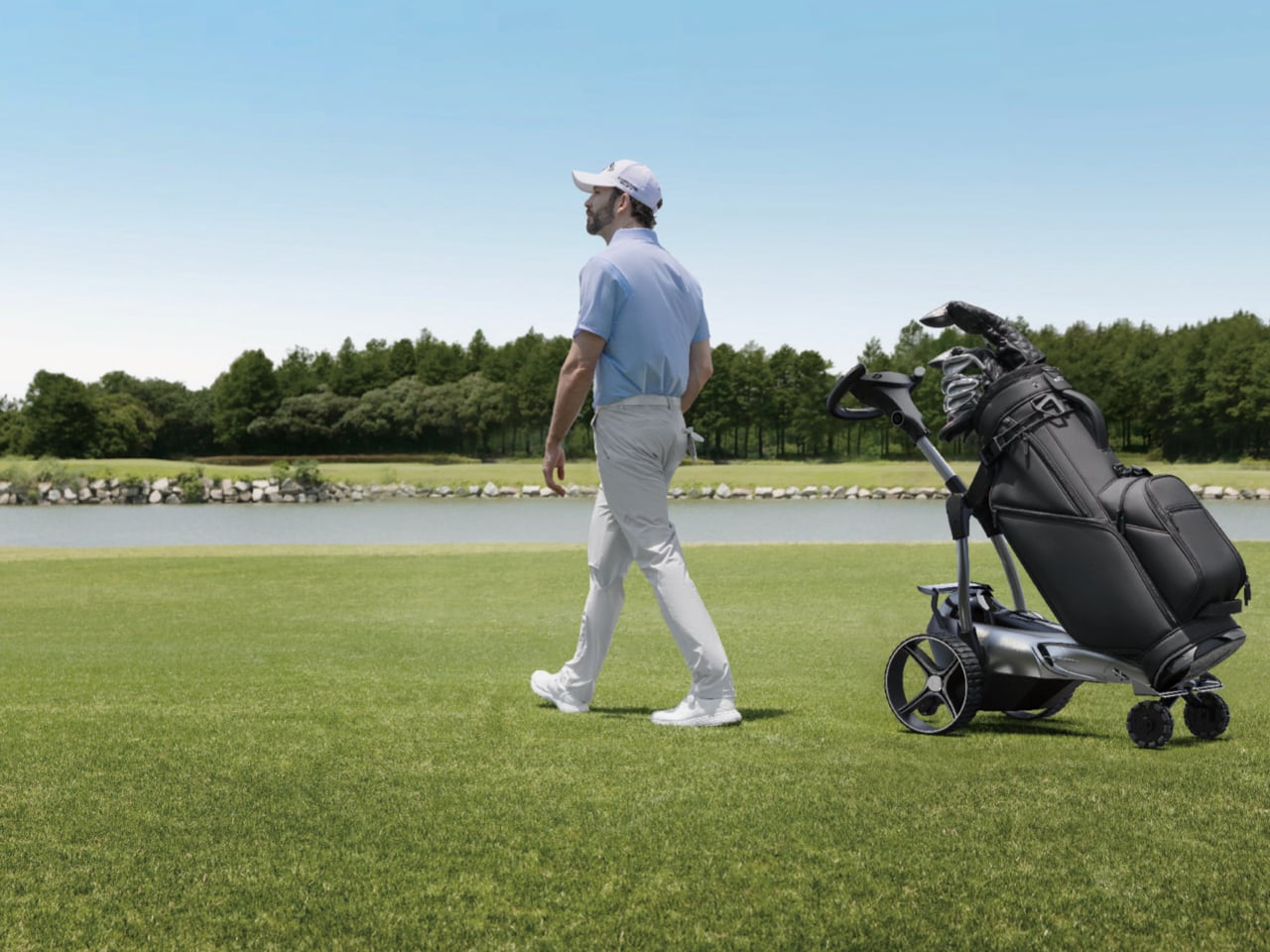
The F1-inspired design language is not cosmetic bravado. The low, wide stance communicates stability, while the aggressive form hints at the engineering underneath that keeps the cart planted on slopes and responsive on uneven terrain. Compared to earlier generations and traditional motorized push carts, the Eagle F1 X feels purpose-built for modern walking golfers who want the benefits of walking without turning the round into a workout of its own.
This is not about automating golf. It is about making walking sustainable across eighteen holes, week after week. As a second-generation product that refines tracking accuracy, autonomy, and endurance into a cohesive system, the NAVEE Eagle F1 X made our winners list.
Goko M6 Robotic Mower
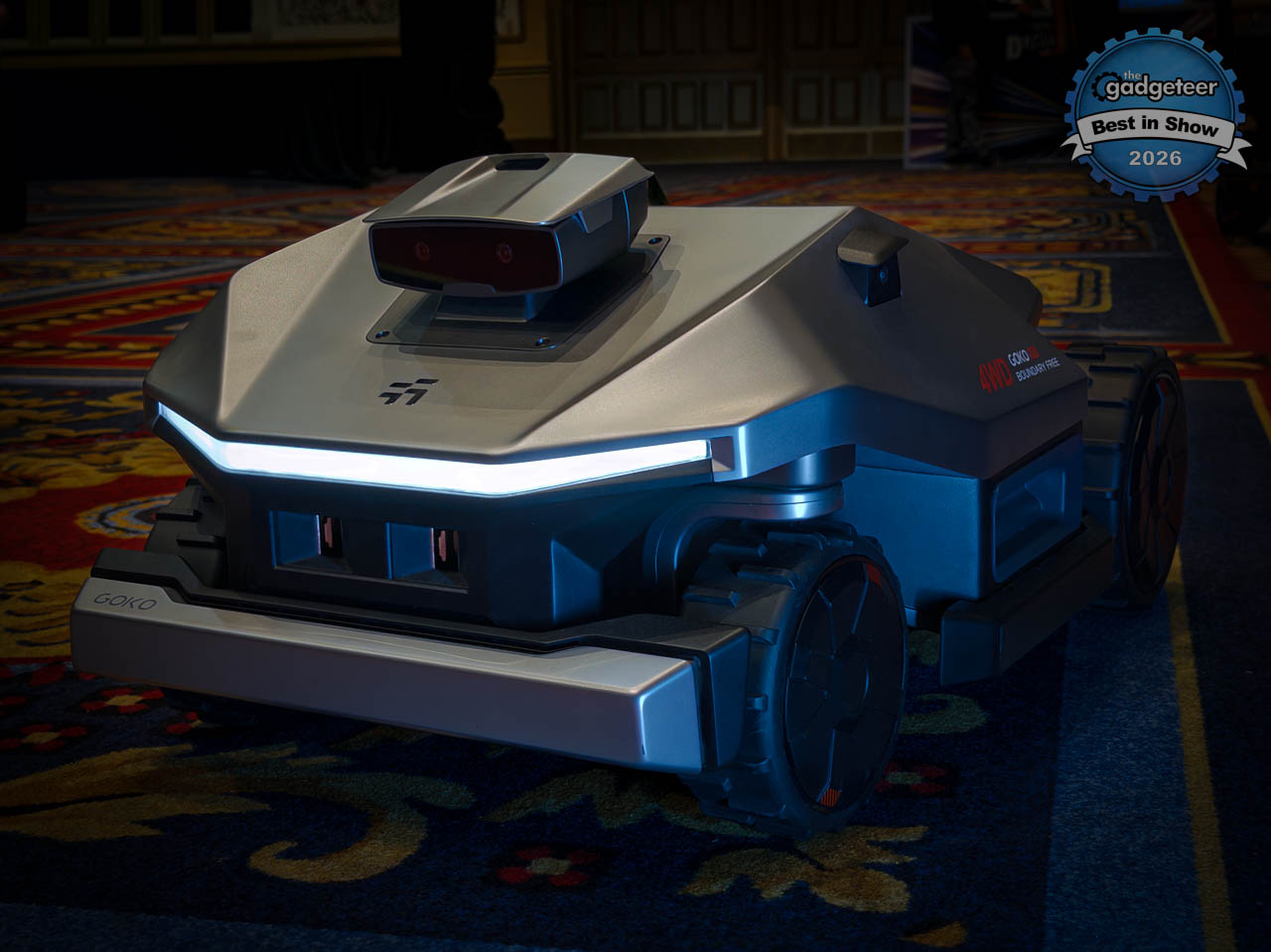
Wire-free navigation isn’t a convenience feature. It’s the difference between a robotic mower that gets installed and one that stays in the garage. Goko built the M6 around that adoption reality, then engineered the rest of the machine to match it.
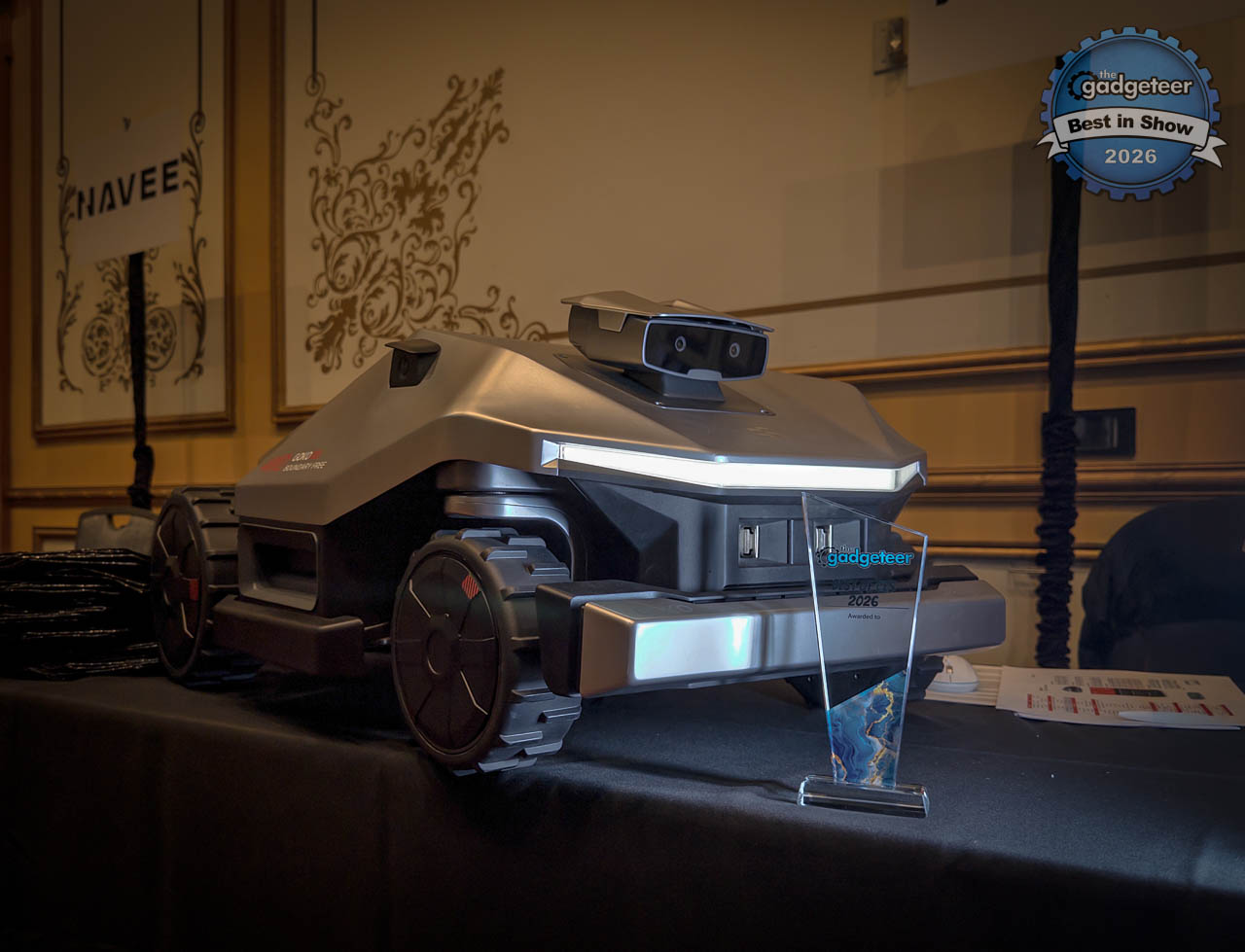
Goko is backed by RobotPlusPlus, an industrial robotics company whose work has included autonomous systems and robotic solutions used in oil and gas environments. That pedigree matters because residential mowers fail in the same way industrial systems fail: they lose traction, they get confused, and they quit when conditions stop being perfect. The M6 leans into ruggedness with 4WD mobility, and it pairs that with a named navigation stack called CyberNav Fusion Navigation, described in CES coverage as blending visual SLAM with RTK, IMU sensors, and wheel odometry. The sharp, Cybertruck-inspired shell reads like design theater at first glance, but it’s also a visual cue for what this product is trying to be: a yard machine, not a delicate gadget.
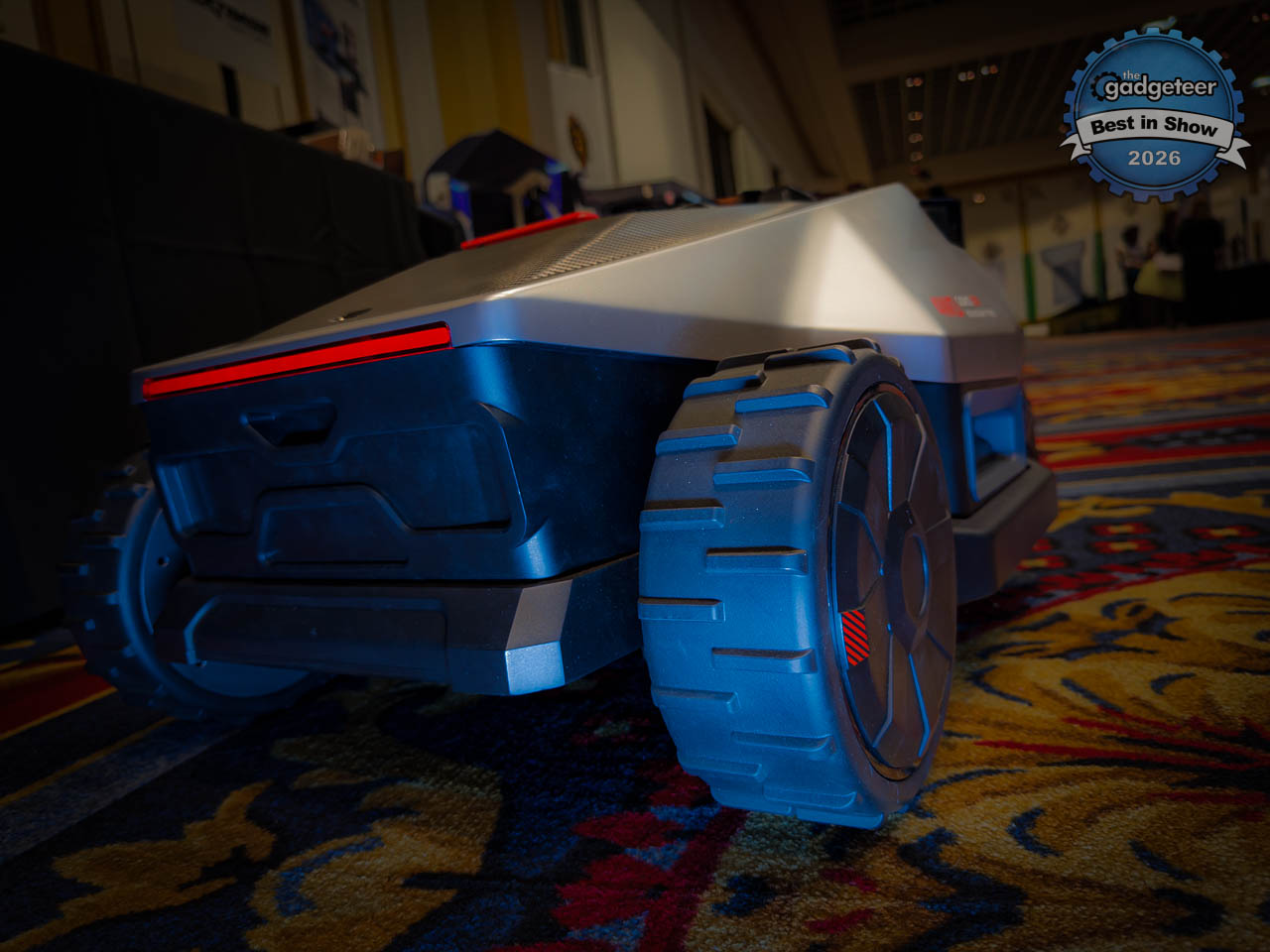
Where the M6 earns its place in the value conversation is that the fundamentals scale up. CES reporting positions it for lawns roughly 0.25 to 2.5 acres, and it uses a 42 cm floating cutting deck with cutting height adjustment listed in the 25 to 100 mm range. Goko claims the M6 can traverse slopes up to 90 percent and clear obstacles up to 75 mm, which is exactly the territory where budget robot mowers usually fall apart. If the company hits its promised reliability, the payoff is simple: you skip wire installs, you reduce setup friction, and you get a mower designed to keep moving when the yard stops being flat and friendly.
Sports & Fitness
Sports and fitness tech usually promises motivation. This year, the best gear did something harder. It enforced better habits by design. That is why our favorite winner in this category feels less like a gadget and more like a coach you can actually live with.
Pongbot Pace S Pro
Traditional tennis ball machines are excellent at one thing. Repetition. They fire balls at fixed intervals, predictable locations, and consistent speeds, which makes them useful for grooving strokes but terrible at simulating real match conditions. The longer you train with them, the more they teach habits that collapse the moment an opponent disrupts your rhythm. The problem is not accuracy. The problem is that consistency itself trains the wrong instincts.
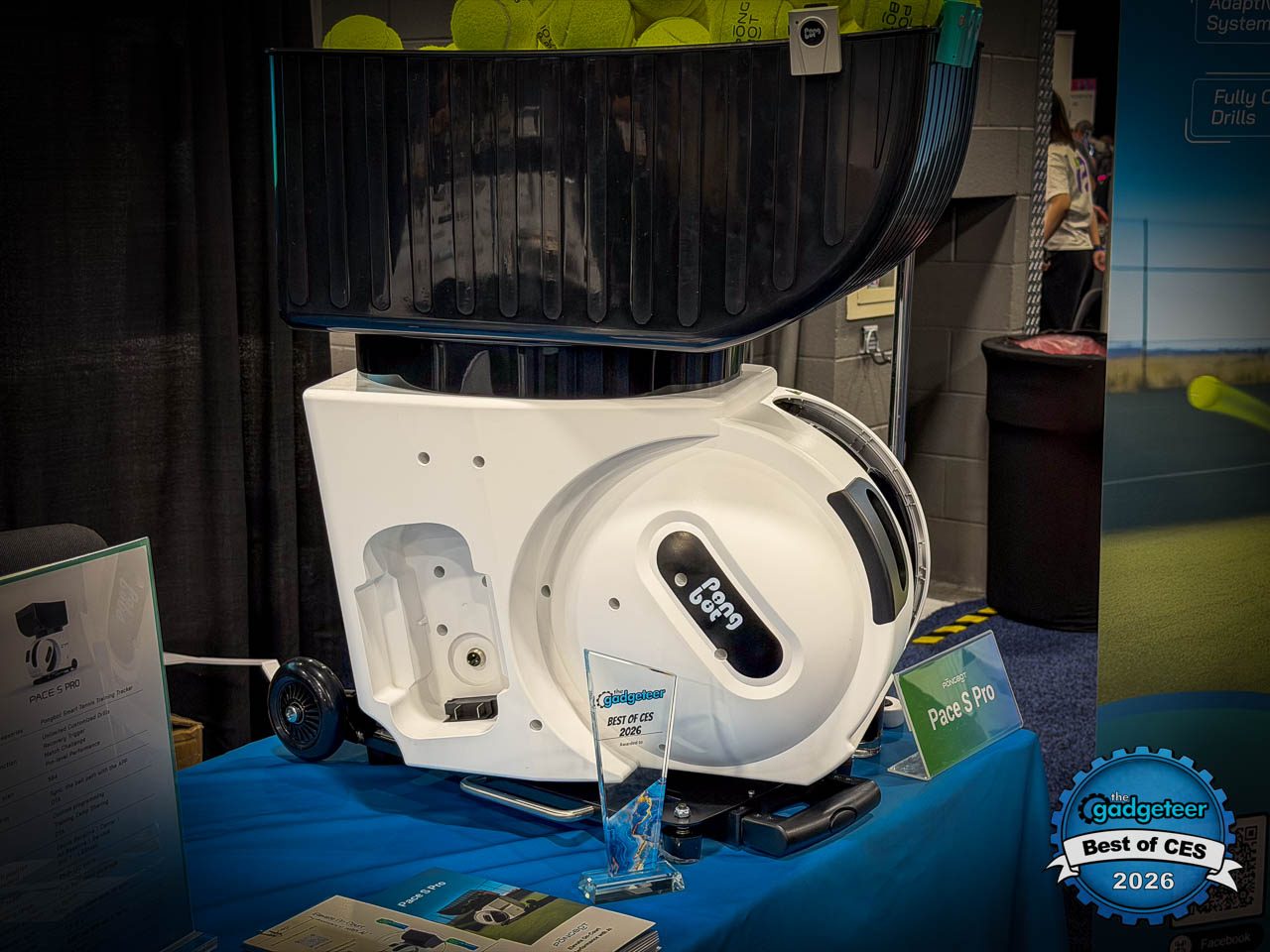
The Pace S Pro attacks that flaw at the systems level. It is the first tennis ball machine to integrate Ultra Wideband technology for player tracking, allowing it to understand where you are on the court with accuracy within 10 centimeters and a sampling rate of 100 Hz. That speed matters. It is more than three times faster than camera-based tracking, which means the machine reacts in real time instead of after the moment has passed. Recovery Trigger technology uses that positional data to detect when you have returned to a ready stance before releasing the next ball. If your footwork is late or sloppy, the drill pauses. The machine does not reward bad habits.
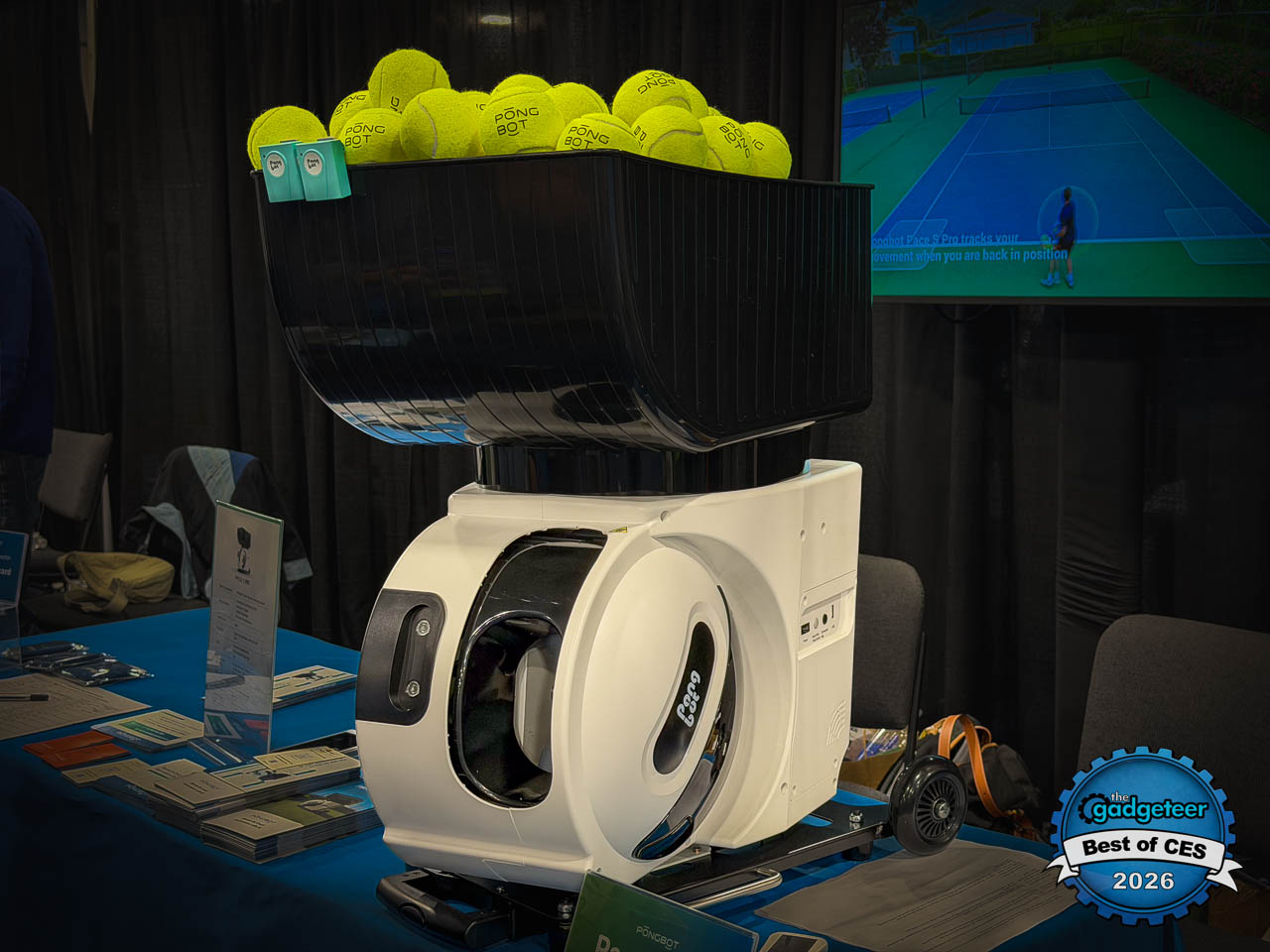
That single change alters how solo training feels. Instead of chasing balls, you are forced to recover properly between shots, just as you would in a real rally. The Pace S Pro does not dictate tempo. You do. The machine watches, waits, and responds, which makes every drill conditional rather than automatic. Over time, that conditional response trains spacing, balance, and recovery rather than just stroke mechanics.
The hardware supports that philosophy. Ball speeds reach up to 80 mph with spin rates topping out at 60 rotations per second, covering everything from beginner feeds to advanced pace. The drill library includes 564 pre-programmed patterns spanning NTRP levels 1.0 through 7.0, allowing players to scale difficulty without outgrowing the system. AI Match Training mode adds another layer by randomizing serves and ball placement using logic trained on more than 100,000 real matches. Patterns feel less like drills and more like rallies that refuse to repeat themselves.

Pongbot raised $2.7 million on Kickstarter to bring the Pace S Pro to market, and the reason is clear once you understand what it enforces. This is not a ball launcher designed to save time. It is a training partner designed to punish shortcuts. For players who train alone and want that time to translate into match performance, the Pace S Pro replaces repetition with accountability. That’s what earned it a trophy.
Maker Technology
Creality SPARKX i7
3D printing has spent years promising desktop fabrication and then burying that promise under calibration headaches, failed first layers, and forum threads written for people who already know what they’re doing. The SparkX i7 takes a different bet: that the barrier to entry matters more than the spec sheet, and that the best feature a beginner printer can offer is the freedom to actually use it.

The numbers still impress. 500mm/s print speeds (600mm/s max), Creality-stated 20,000mm/s² acceleration, and a 260×260×255mm build volume that handles phone stands, desk organizers, and small props without running out of real estate. The hardened steel nozzle rated to 300°C hints at material flexibility beyond basic PLA, supporting PLA Silk, PETG, TPU, and PLA-CF for users ready to experiment. But specs don’t explain why this printer earned a trophy. The experience does.
Setup takes under ten minutes from sealed box to active motion. The SparkX i7 ships nearly fully assembled, with only the spool holder and a handful of screws standing between unboxing and your first print. Powering on triggers automatic calibration: AI Flow Calibration and AI Build Plate Detection handle bed leveling without intervention, adjusting extrusion and adhesion settings before you even select a file. The touchscreen walks through each step with clear prompts, and you never need to understand what the machine is doing to benefit from it working correctly.
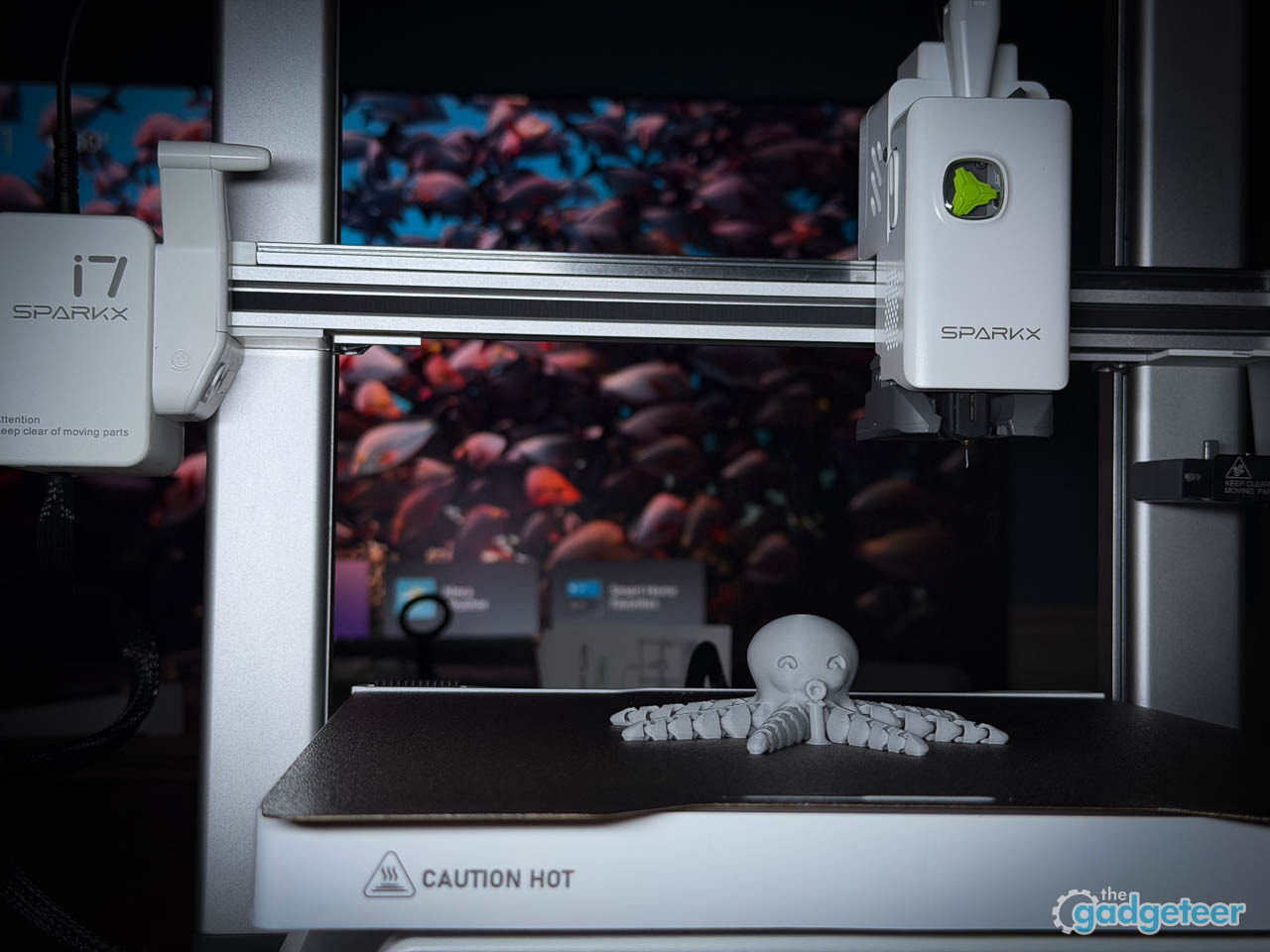
The Creality Cloud app consolidates what used to be three separate steps (browsing models, slicing files, and launching prints) into a single workflow that beginners can run from a phone without ever touching a traditional slicer. Default material profiles handle parameters like flow rate, retraction, and nozzle temperature automatically. The 720p camera enables remote monitoring through the app, while AI spaghetti detection and filament tangle detection reduce the anxiety around leaving prints running overnight. You start a job, walk away, and trust that if something goes wrong, the system will catch it before wasting hours of filament.
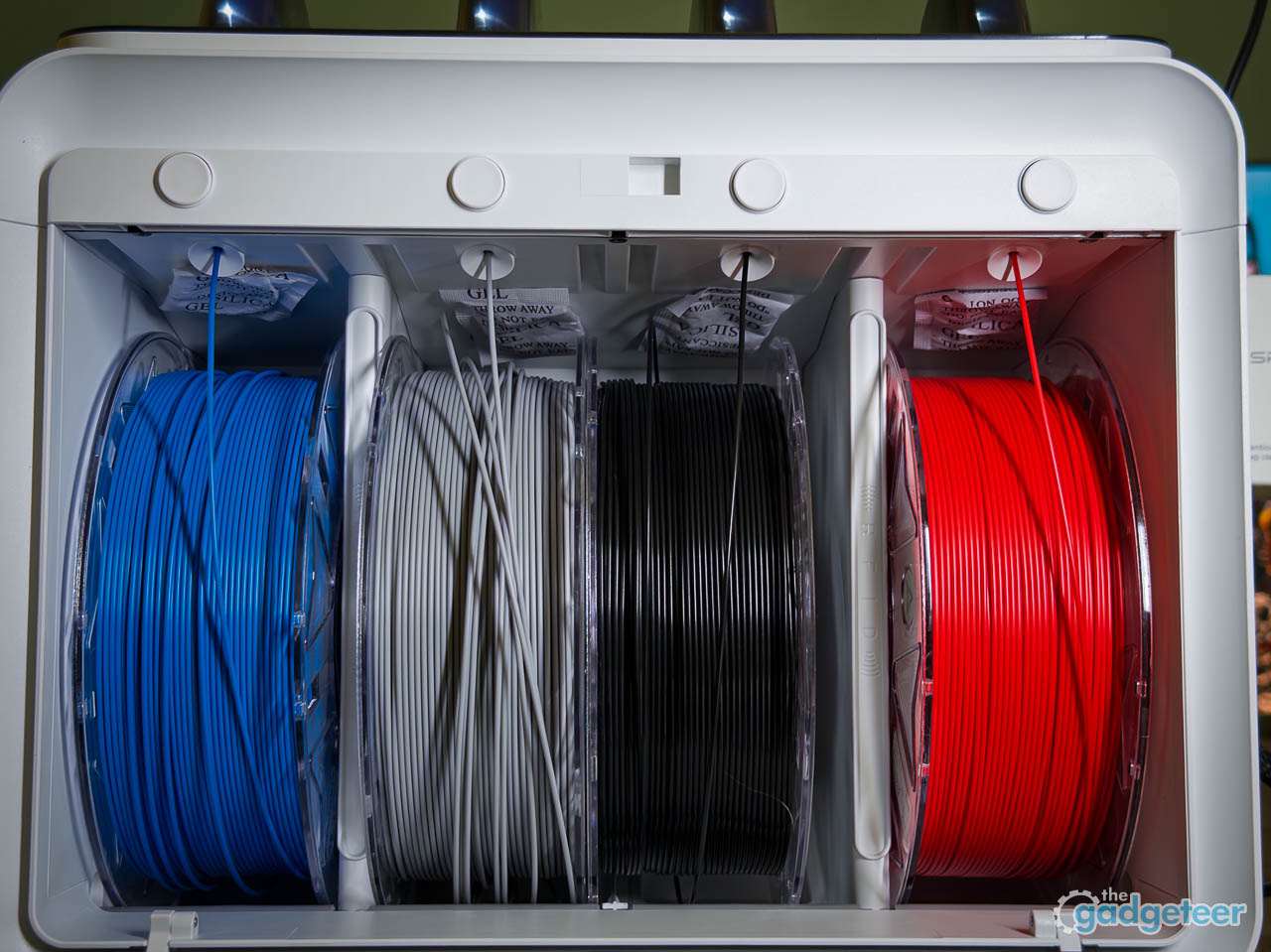
In daily use, the SparkX i7 performs less like a project machine and more like an appliance. Prints start reliably, finish cleanly, and don’t demand constant supervision. The dual-sided textured golden PEI build plate delivers consistent first-layer adhesion. The quick-swap nozzle requires no tools. Noise levels during fast moves stay lower than expected, sitting somewhere between a quiet dishwasher and a laser printer. Successful early prints feel routine rather than surprising, which keeps beginners printing instead of troubleshooting.
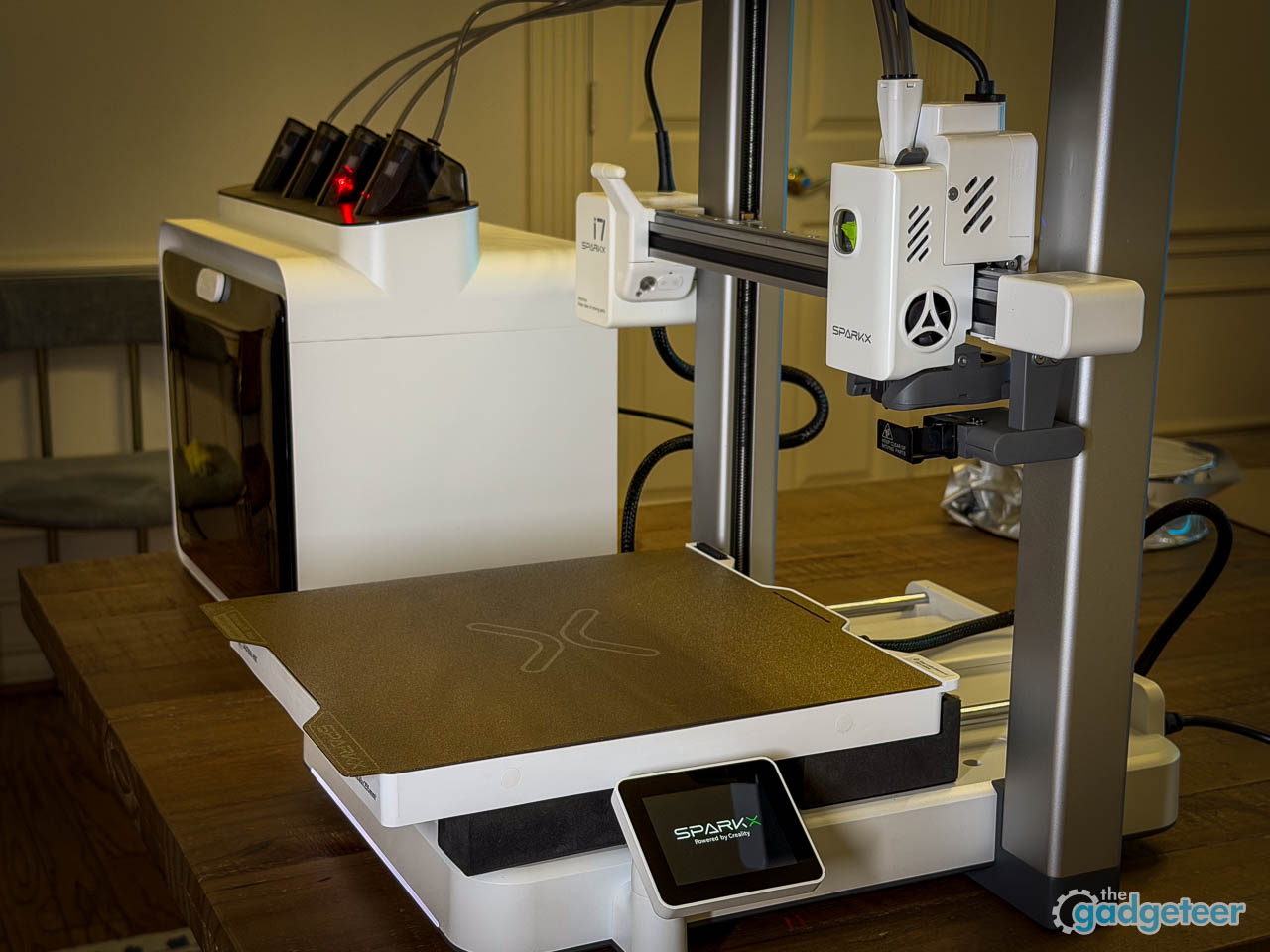
At $339 early bird ($399 launch), Creality brought prosumer speeds and automation to an entry-level price. The i7 Color Combo pairs the printer with the CFS Lite multi-color system for $339 (saving $60), while the i7 Combo with Hyper RFID filament runs $374.98 with four spools included. For anyone who has wanted to try 3D printing but never followed through because the learning curve felt too steep, the SparkX i7 removes enough friction that printing becomes a casual activity rather than a technical project. That shift, from intimidating hobby to accessible tool, is why the SparkX i7 made the cut.
Wearables & Audio
Some products are impressive at CES. A few become tools you actually build your life around. In 2026, these are the two I expect to use the most, not because they chase novelty, but because they solve problems that quietly shape how days unfold.
Both products address memory, organization, and efficiency, but they approach those goals from opposite directions. One captures the world as it happens so nothing important is lost. The other delivers information at the exact moment it is needed, without demanding attention or breaking focus. Together, they form a system for living more deliberately, one that documents life without friction and augments it without distraction.
Plaud NotePin S and Even Realities G2 are not competing products in the traditional sense. They serve different purposes, operate in different moments, and succeed by staying out of the way. One is about capture and recall. The other is about presence and guidance. Used together, they outline a future where personal technology supports memory and decision-making without asking you to stop living in the moment.
These are the tools I expect to lean on daily in 2026. Not to do more, but to remember better, stay organized, and move through the world with less cognitive overhead.
Plaud NotePin S
Your phone can record anything. Good luck unlocking it, finding the app, and tapping record before the best part of the conversation is already over. The NotePin S clips to your shirt and starts capturing with one button press. No fumbling. No guessing whether it worked.
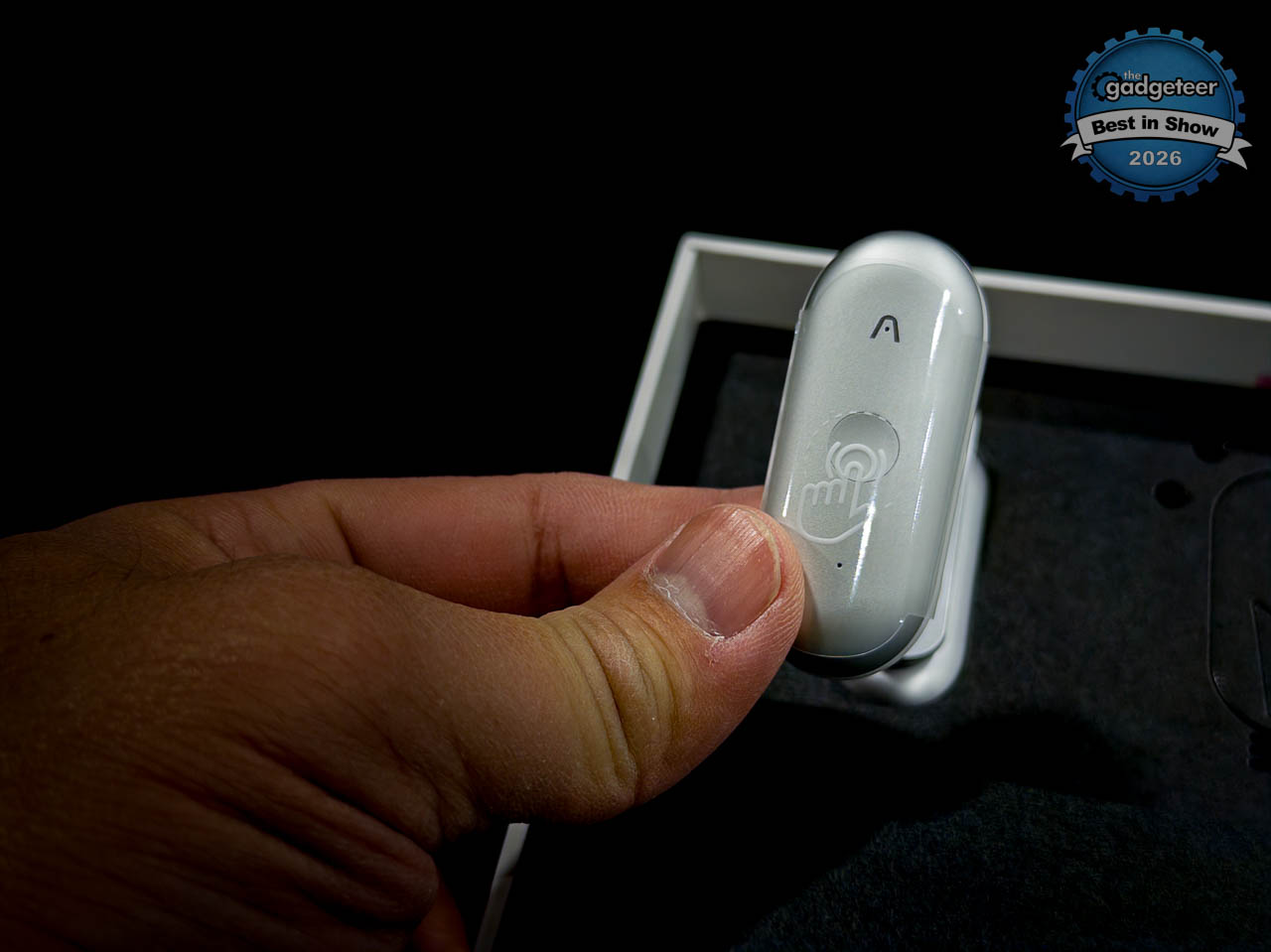
At 0.6 ounces (17g), this is the kind of device you forget you are wearing until you need it. The form factor sits somewhere between a lapel pin and a small brooch, thin enough that it disappears under a jacket without creating a visible bump. Dual microphones pick up audio from nearly 10 feet away, so you are not leaning awkwardly toward whoever is talking. Four wearing modes (pin, wristband, lanyard, clip) mean it fits whatever context you are in: boardroom meetings, medical consultations, field interviews, or casual conversations where you want a record without making it weird.
Press to Highlight lets you tap the device during recording to flag the moments that matter, and the AI emphasizes those sections when it generates your summary. That small interaction shifts how you listen. Instead of mentally cataloging every important point, you mark it in real time and trust the system to surface it later. The cognitive load drops noticeably.
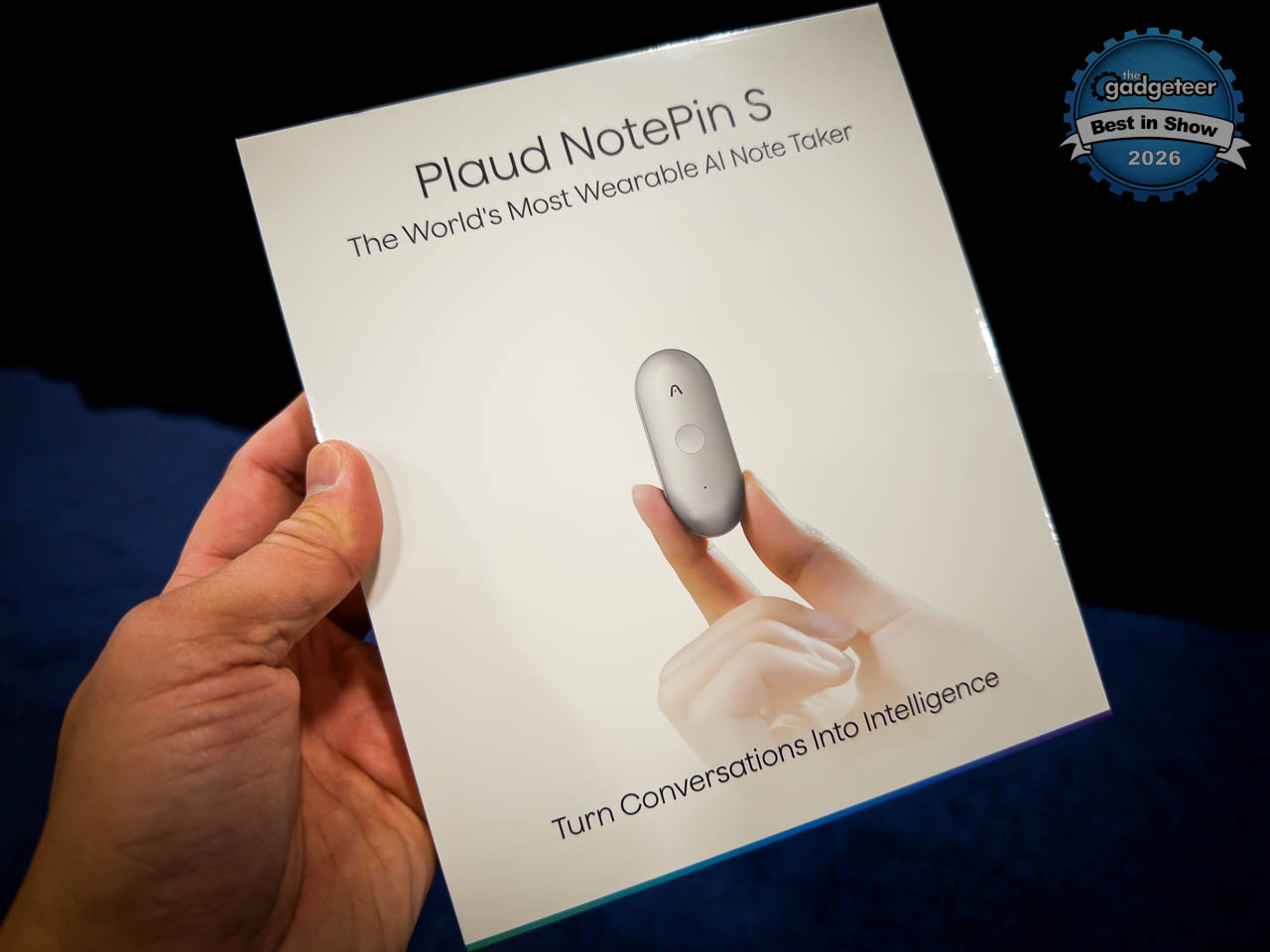
Plaud Intelligence handles transcription across 112 languages, recognizes industry jargon so your medical terms and sales acronyms actually appear correctly, and lets you search across months of recordings to find exactly what someone said and when they said it. The desktop app brings that entire archive to your computer, where you can review transcripts, export to other tools, and manage recordings without touching your phone. For anyone who spends time at a desk processing what they captured in the field, that convenience matters more than it sounds. You record on the go, then sit down and work through everything in a proper environment with a full keyboard and larger screen.
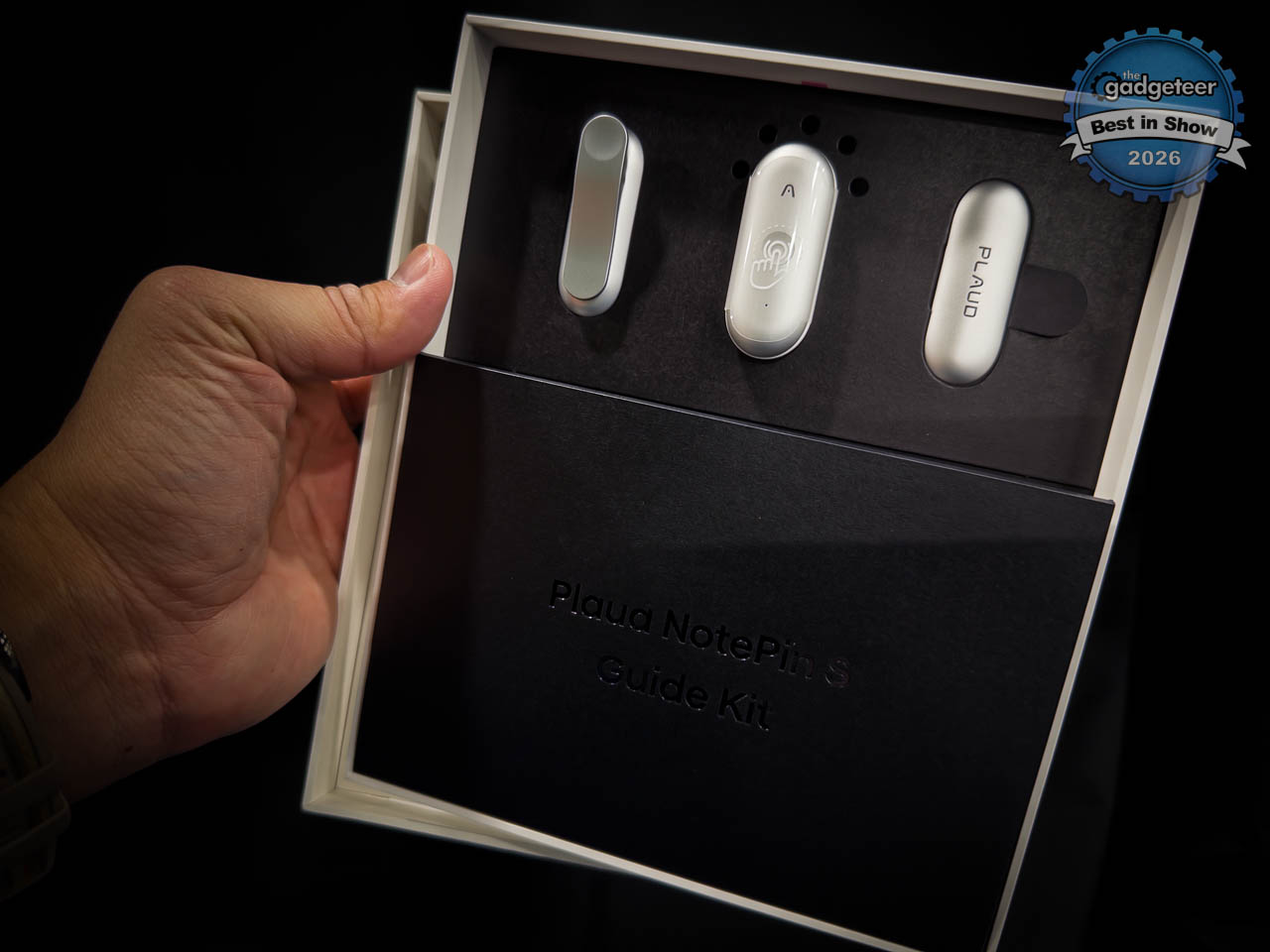
At $179 with subscription tiers for AI processing, this is for anyone who attends meetings, consultations, or conversations where the stakes are too high to rely on memory alone. The NotePin S does not try to replace your phone. It simply removes the friction that keeps most people from recording in the first place. Available now.
Even Realities G2
At just 36 grams with a magnesium alloy frame and titanium temples, the Even Realities G2 looks like beautiful, stylish glasses first: smart glasses you will actually want to wear in public. That weight matters more than it sounds. Most smart glasses feel like equipment strapped to your face, announcing themselves through bulk or balance problems within the first hour. The G2 disappears. You forget you’re wearing anything unusual because the glasses behave like glasses.
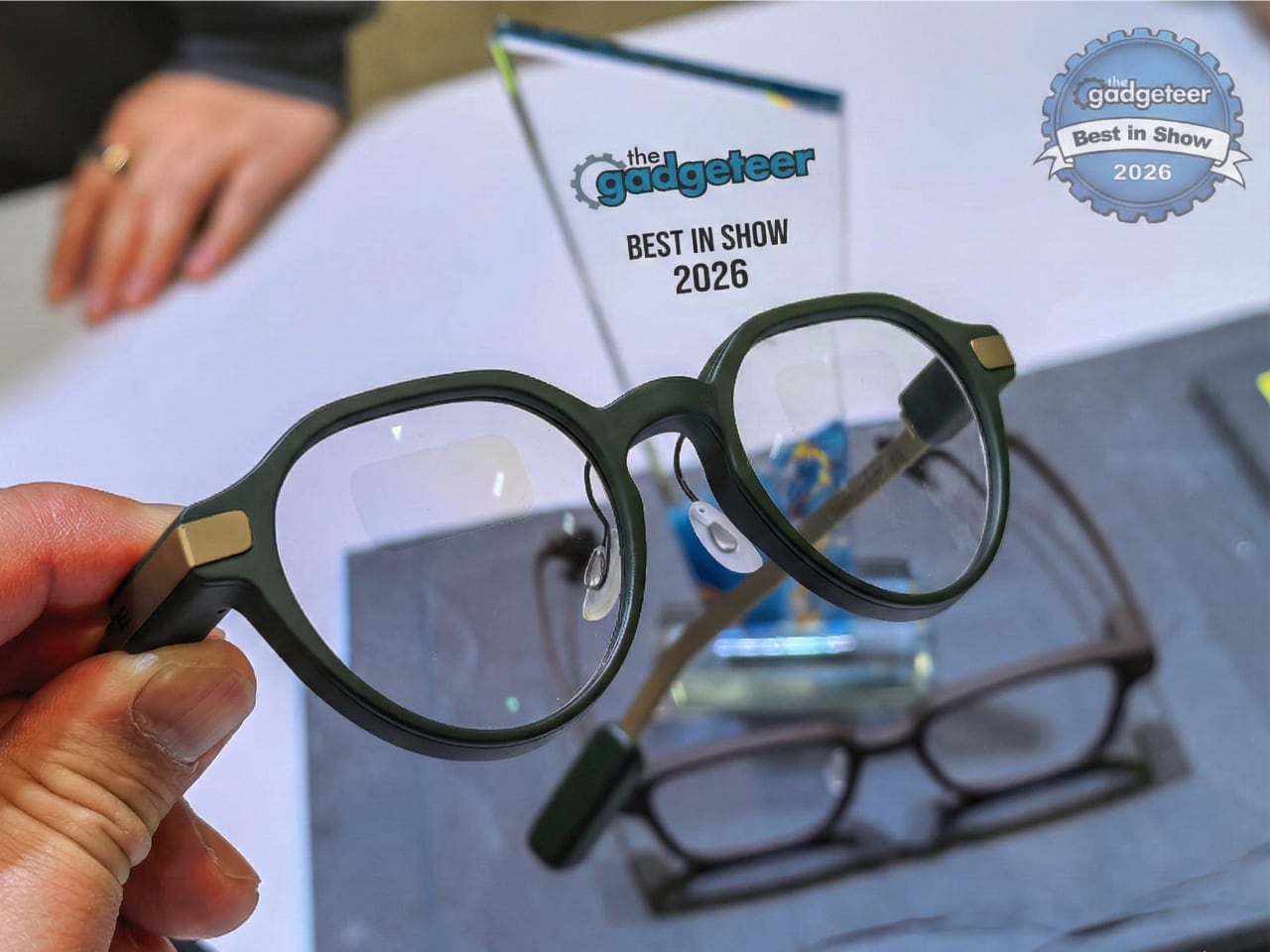
The technical foundation is something Even Realities calls Even HAO, which stands for Holistic Adaptive Optics. Most smart glasses have three separate systems that coexist without coordinating: the projector creates the image, the waveguide carries it to your eye, and the lenses handle your prescription. Even HAO makes all three work together as a single tuned platform. The practical result is that the floating display and the real world both look good at the same time. Your eyes don’t get tired jumping between the screen and whatever’s in front of you because the system treats both as equally important.
The Even HAO 2.0 display engine uses micro-LED projectors with gradient waveguides to deliver a 75% larger viewing area than the G1. The projector itself is 40% smaller than previous designs while delivering brighter, sharper output. That size reduction translates directly to comfort because less bulk means better weight distribution across the frame. The lenses are about as thin as a credit card, built in multiple ultra-thin layers that keep your peripheral vision wide open instead of tunneling your view.

IP65 water resistance and two-day battery life make this something you can wear every day. Even Realities tested the screwless hinges to 40,000 open-close cycles and drop-tested from 2 meters. These aren’t delicate prototypes. They’re built to survive actual life.
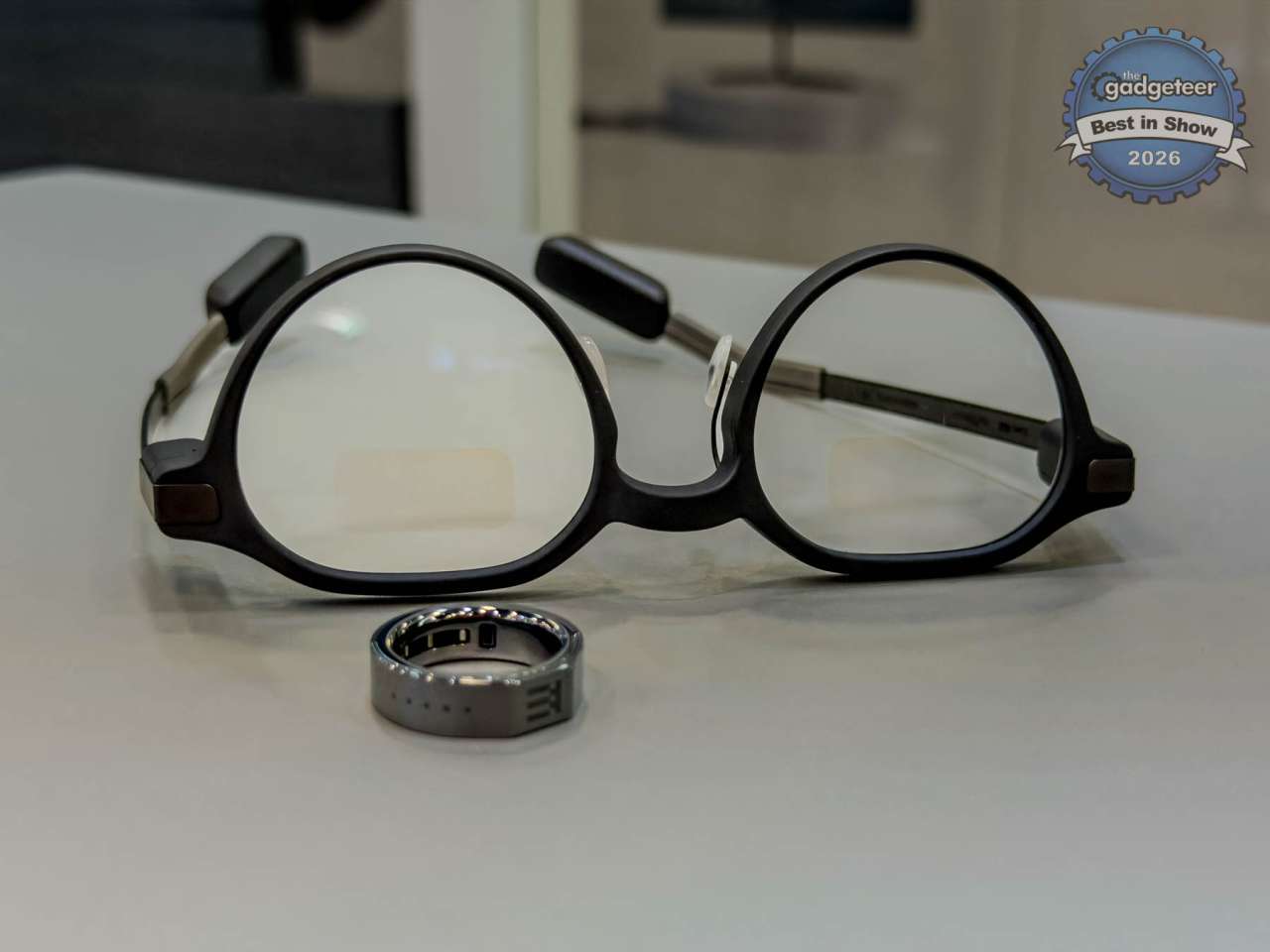
The G2 works as part of a three-device system called TriSync: the glasses connect to your smartphone and the Even R1 smart ring, spreading controls across devices that already handle those jobs well. The ring handles gestures. Your phone handles the complicated stuff. The glasses just show you information when you need it, then get out of the way.
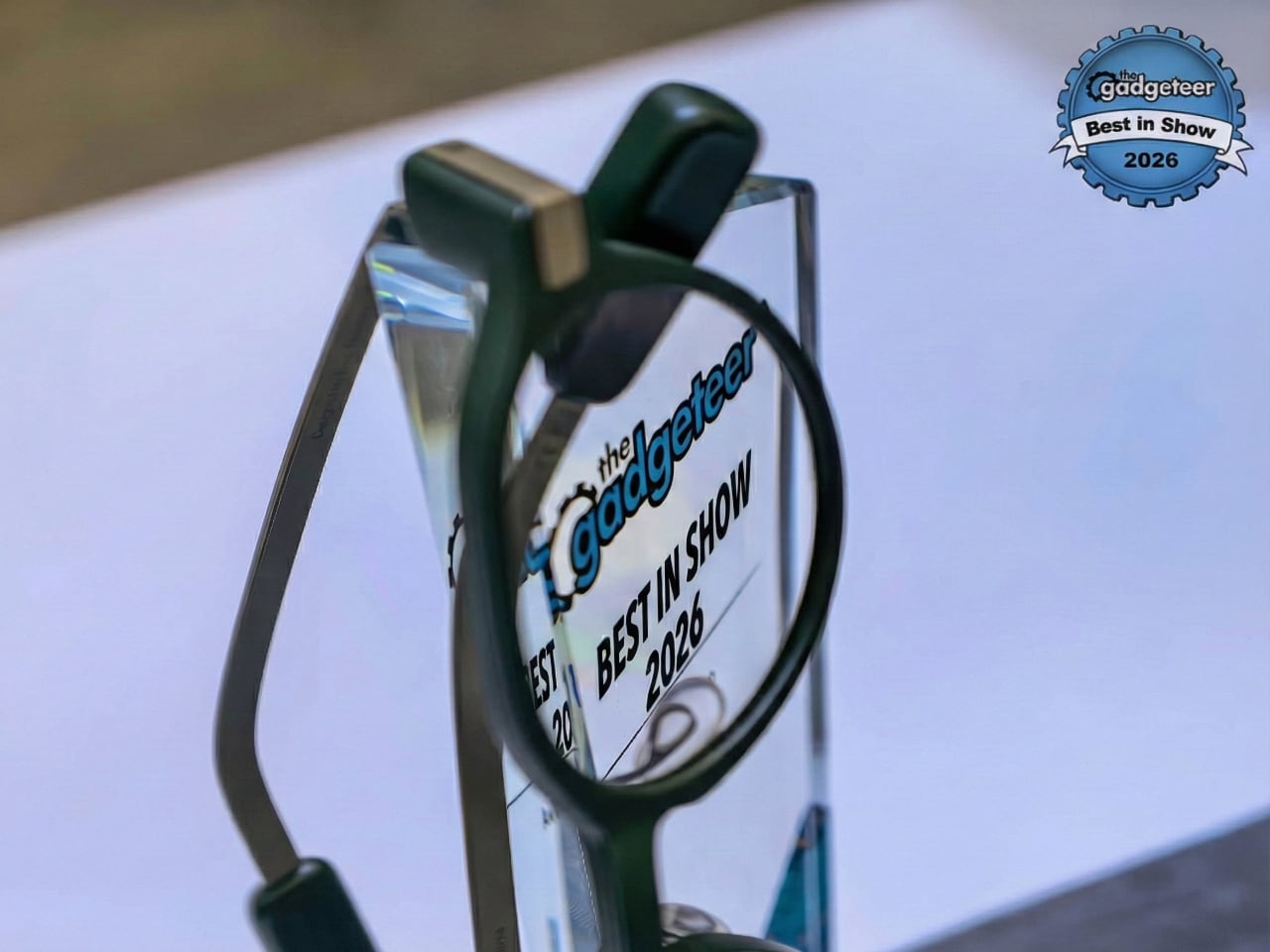
At $599, the G2 solved the problem that killed Google Glass: social acceptance. No cameras, no speakers, just seamless notifications, navigation prompts, and real-time translation that arrive without announcing to the world that you’re wearing a computer on your face. Google Glass died because wearing it felt like a statement. The G2 survives because it doesn’t. Available now.
Gaming & Computing
Thunderobot Zero Air
Benchmark scores lie about gaming laptops. A machine that hits 144 fps for ten minutes then throttles to 90 fps for the next three hours isn’t actually a 144 fps machine. Every review site runs the same synthetic tests, publishes the same peak numbers, and moves on before the thermal throttling kicks in. Thunderobot built the Zero Air to expose that gap between marketing specs and lived reality.
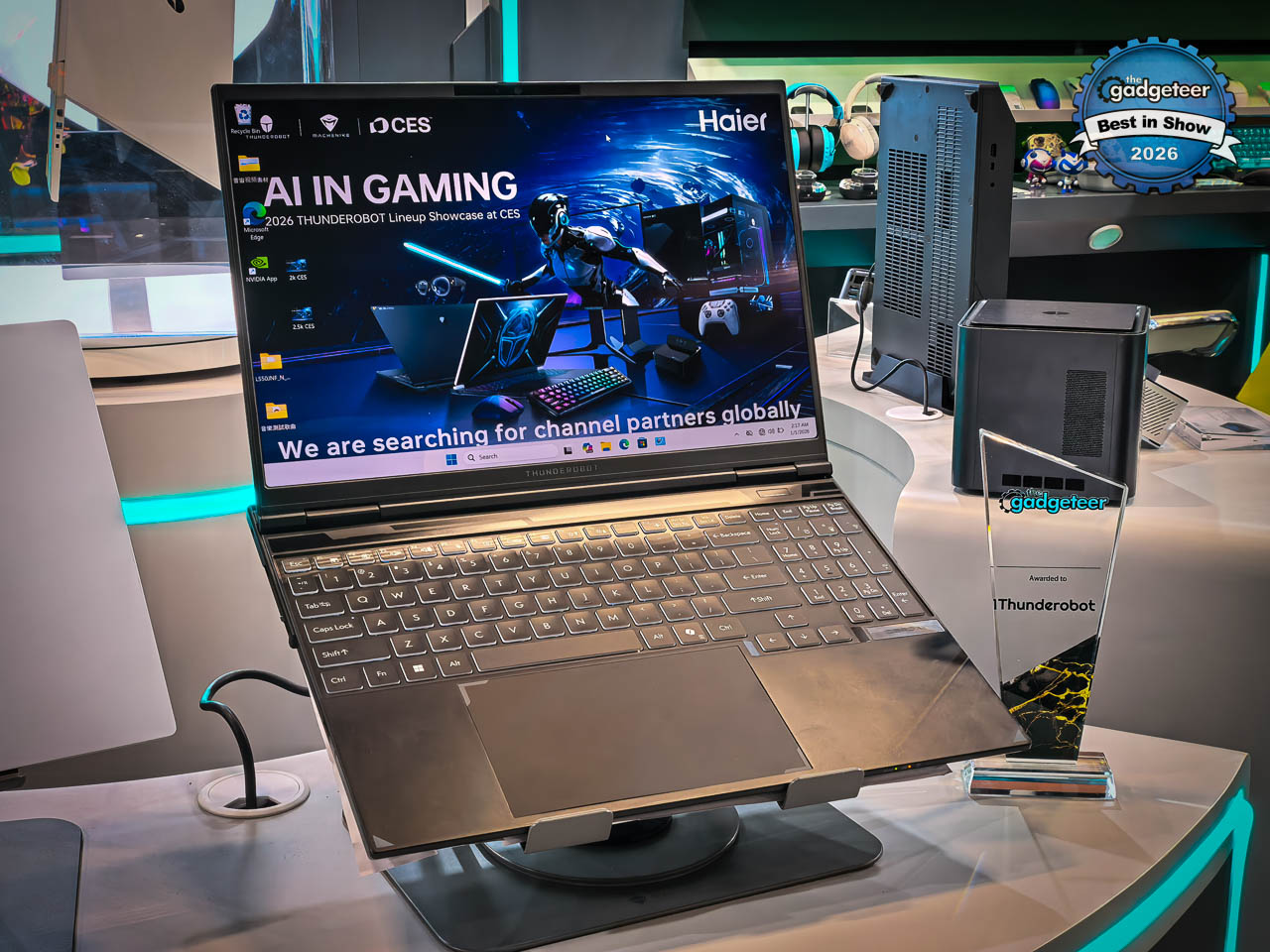
You’ve felt the problem even if you didn’t know what to call it. Hour one, everything runs smooth. Hour two, the fans spin louder. Hour three, frame rates start dipping during intense fights, input lag creeps in, and you’re dying in situations that should have been clean wins. That’s thermal throttling. The laptop is protecting itself from overheating by quietly cutting performance. Most gamers blame their connection or their skills. The real culprit is sitting in their lap.
The Zero Air attacks this at the hardware level. At just 1.6kg, it pairs a 16-inch display with Intel’s Panther Lake (Core Ultra Series 3) processors and NVIDIA RTX 50 series graphics. That weight matters because cooling usually demands mass: more metal means more heat dissipation. Stripping the bulk without losing thermal capacity is the engineering flex here. You’re not carrying a textbook in your backpack anymore, but the machine doesn’t punish you for it during long sessions.
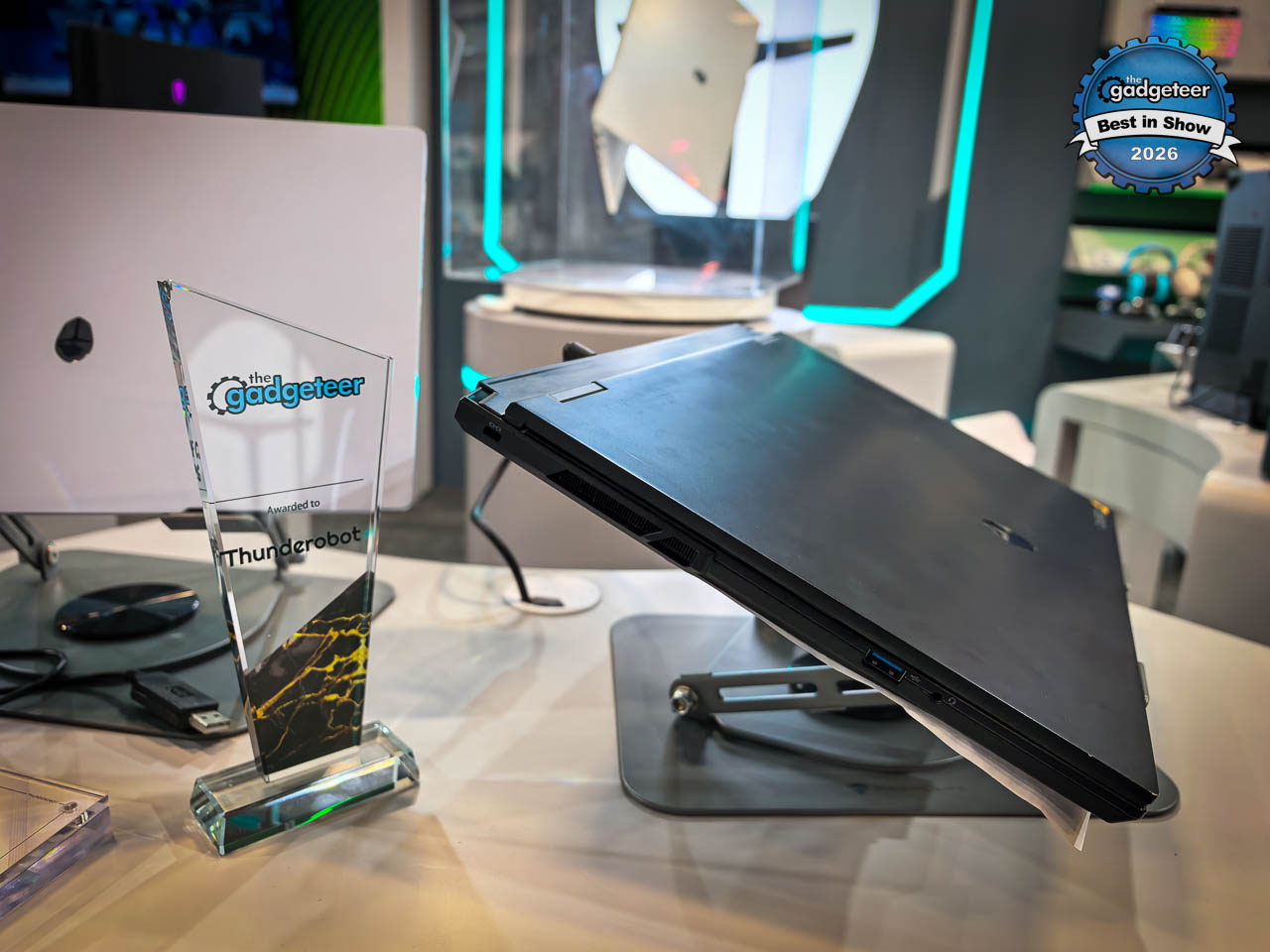
Thunderobot’s vapor chamber cooling and optimized airflow paths are designed for exactly what most manufacturers ignore: sustained loads over extended sessions. The kind of gaming that actually happens when you sit down to grind ranked matches for an evening or finish a campaign in one sitting. When competitors quietly step down clock speeds to manage heat, the Zero Air holds steady. Same frame rates at midnight as you had at 9 PM.
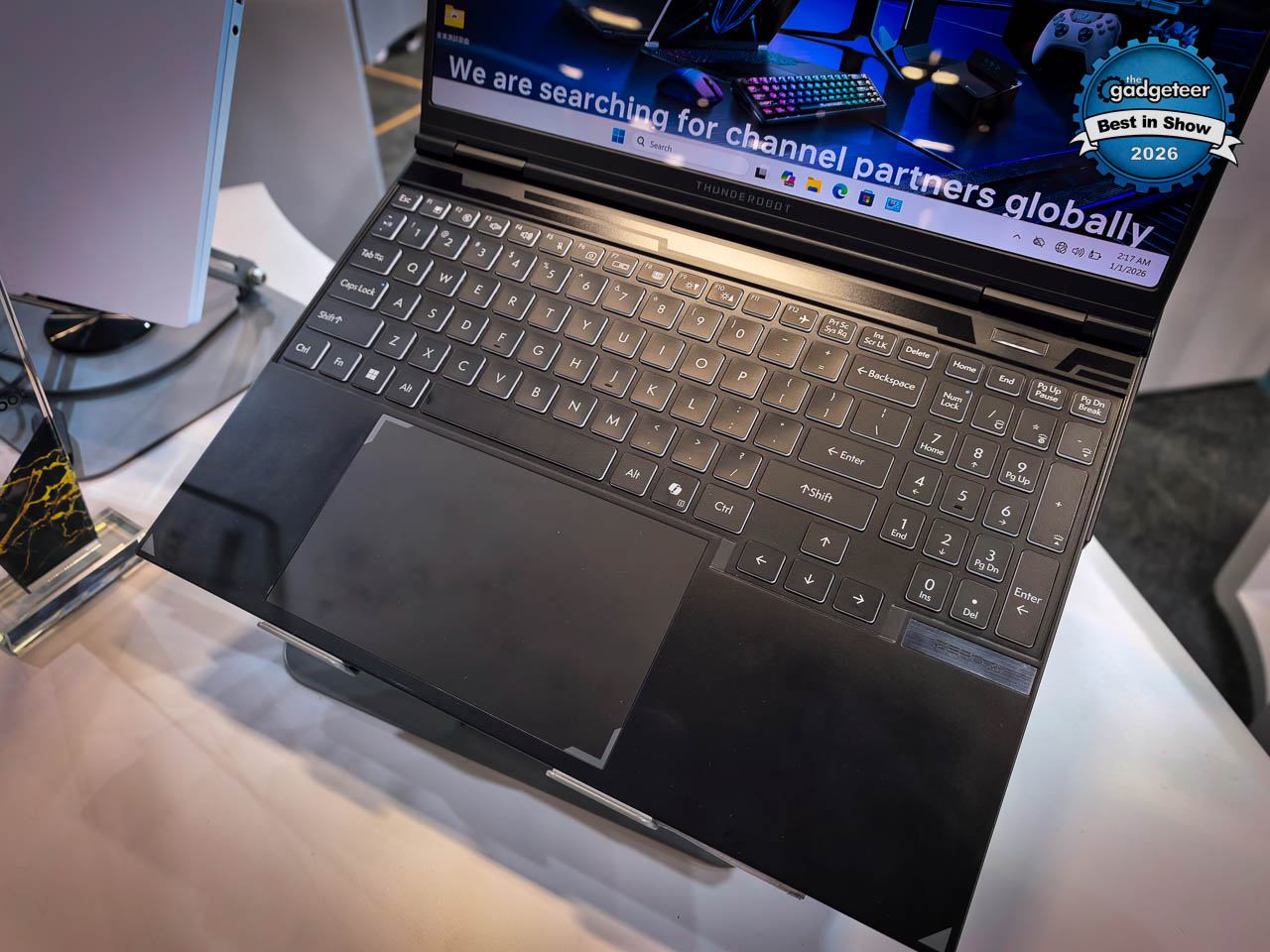
This matters because gaming laptops have trained us to accept performance decay as normal. It’s not. It’s a design choice. Thunderobot made a different choice: honesty about sustained performance. The Zero Air isn’t just fast at launch. It stays fast when it counts. That consistency, invisible in benchmark charts but obvious every time you’re still hitting your shots at 2 AM, is why the Zero Air earned a spot on our list.
Smart Home & Projectors
Aurzen ZIP Cyber Edition Projector
Projectors carry a stigma they’ve never escaped. They look temporary. They demand mounts, cables, and compromises. Even when the image is good, the object itself feels like equipment intruding into a space that’s supposed to feel like home. The Aurzen ZIP Cyber Edition exists to dismantle that entire assumption.
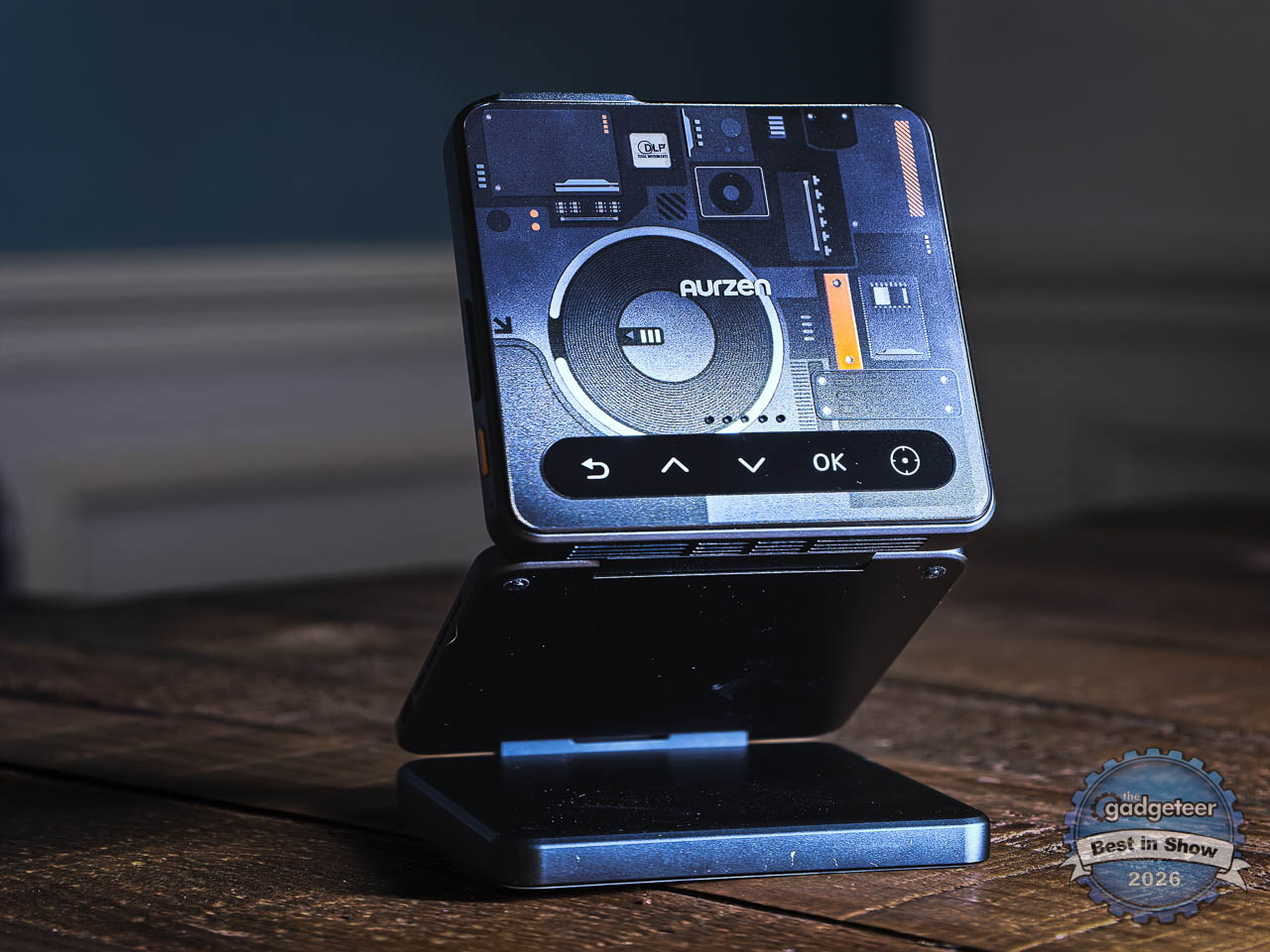
The defining feature isn’t resolution. It’s form. The tri-fold design collapses into a pocket-sized slab, then unfolds into a rigid, self-standing projection system with its own integrated angle and posture. There’s no tripod. No ceiling mount. No stack of books to get the height right. You place it on a table, unfold it, and it’s ready. That physical confidence changes how often it actually gets used, because setup friction is what quietly kills most casual projection.
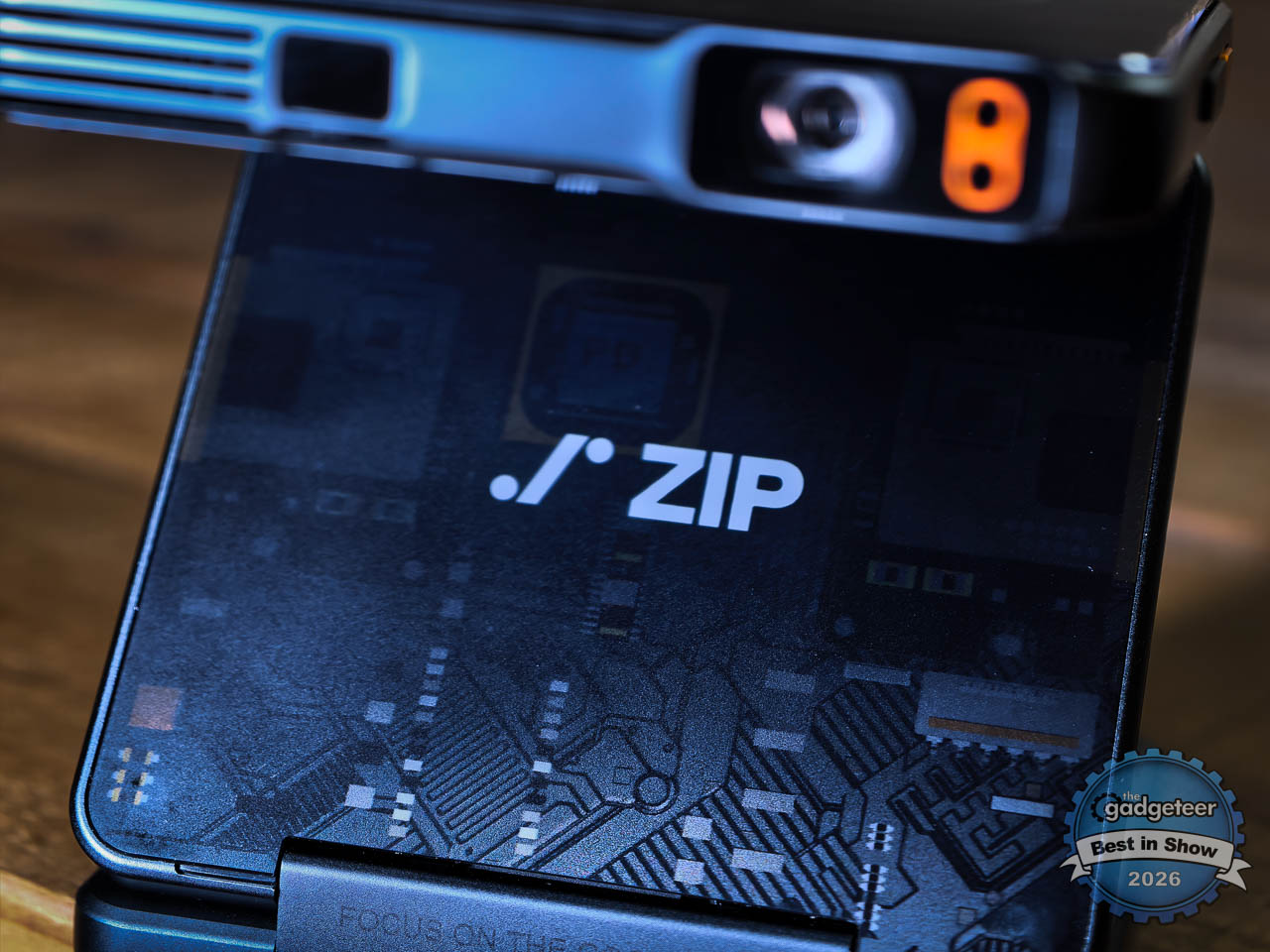
On paper, the specs are modest and intentionally so. A 720p image scales from roughly 20 to 80 inches, powered by a 5,000mAh battery that delivers about 1.5 hours of untethered viewing. That’s enough for a movie, a presentation, or a shared experience without turning the device into something bulky or heavy. Aurzen didn’t chase numbers that would bloat the product. They optimized for spontaneity. The kind where you decide to project something because it’s easy, not because you planned for it.
The Cyber Edition aesthetic is where the product quietly wins. The industrial, almost sci-fi exterior isn’t trying to disappear. It’s trying to belong. This is a projector you leave on a shelf like a camera or a speaker, not something you hide in a drawer until you need it. That matters deeply for apartment dwellers and renters, where permanent installation isn’t an option and visual clutter is a real constraint. When a device looks intentional, it earns a place in daily life instead of feeling like a workaround.
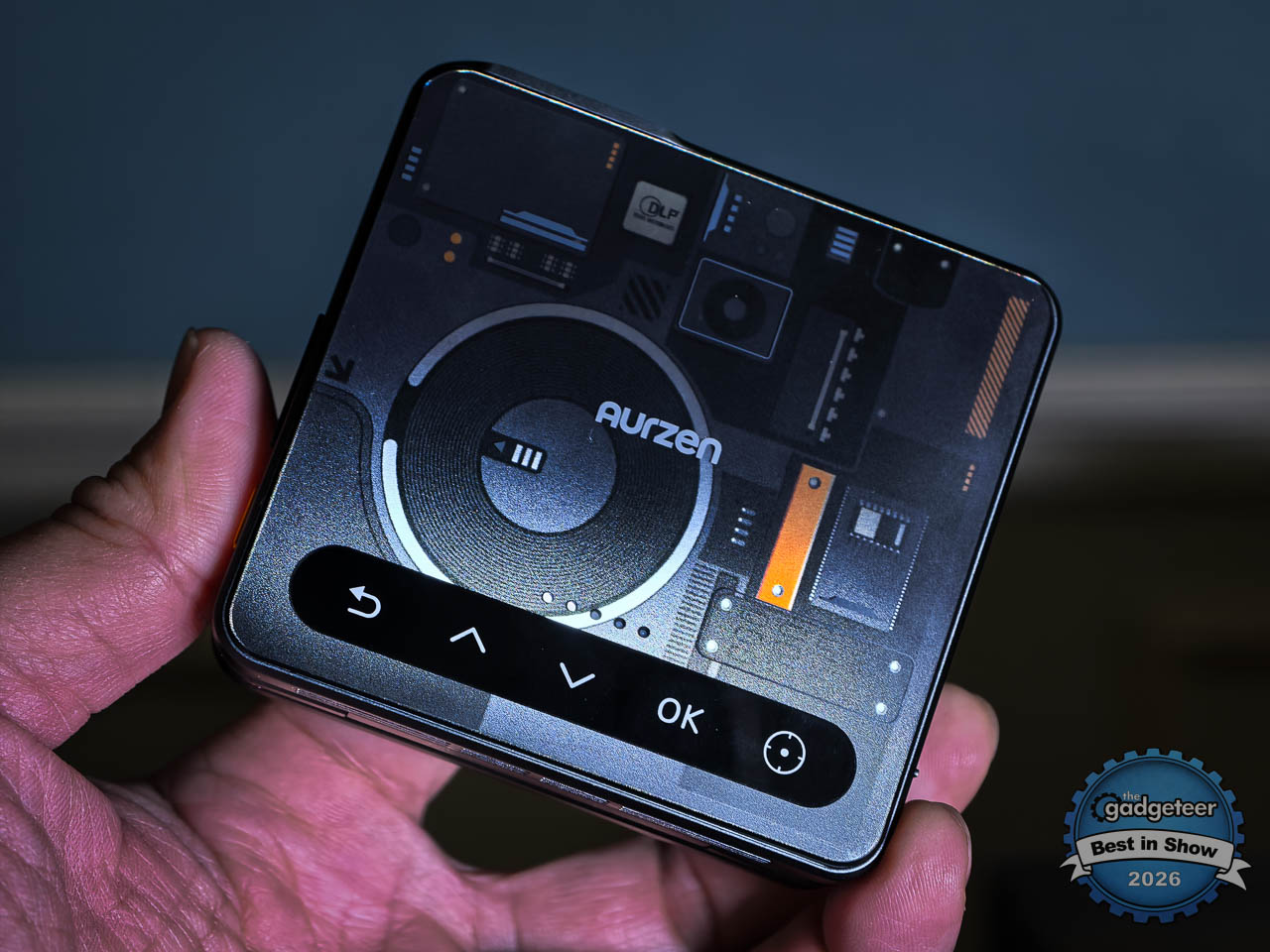
The Aurzen ZIP Cyber Edition isn’t competing with home theater projectors. It’s competing with friction. It makes projection casual, mobile, and socially acceptable in spaces where it previously felt awkward. That shift, from equipment to object, is why the ZIP Cyber Edition made the cut.
Home Appliances
Appliances rarely earn CES trophies because the category rarely earns them. Most “smart” washers and refrigerators are just old machines with touchscreens bolted on. But when a company rethinks the fundamental architecture of a product category, the results are impossible to ignore. Hisense brought that thinking to two appliances this year, proving that genuine innovation doesn’t require screens, apps, or AI branding. Sometimes it just requires asking why we’ve accepted decades of obvious friction.
Hisense Excel Master Modular Laundry System
Every household eventually faces the same laundry compromise. You either wash everything together and accept cross-contamination, or you run endless sequential loads and lose half your weekend. Baby clothes mixed with gym gear. Pet bedding tumbling with dress shirts. Delicates waiting their turn behind work pants. The single-drum washer has forced this tradeoff since it was invented. Hisense decided that was stupid.
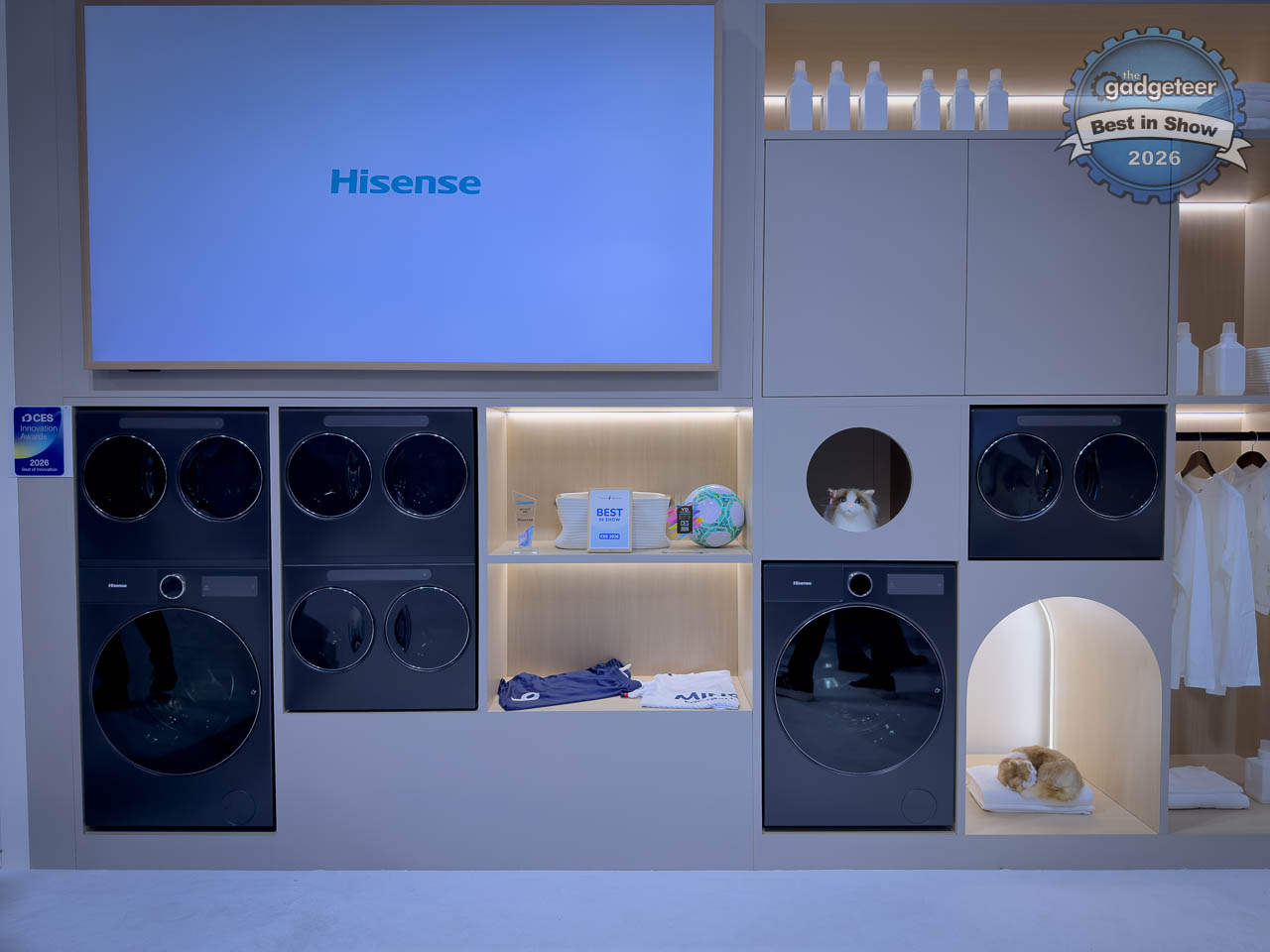
The Excel Master is the world’s first infinitely scalable modular washer dryer system. Start with a full-size main unit using heat pump technology for maximum efficiency on larger loads. Add mini modules as your household demands: each module contains two drums (a washer and a dryer combo) using fresh air condensation drying optimized for smaller, delicate loads. Scale as needed. Run everything simultaneously.
The use cases become obvious once you imagine dedicated zones. A baby clothes module prevents cross-contamination with adult laundry. A pet bedding module keeps animal items isolated. An athletic wear module handles technical fabrics with specialized cycles. Delicates get gentle treatment without waiting for everything else to finish. Growing families add modules instead of upgrading machines.
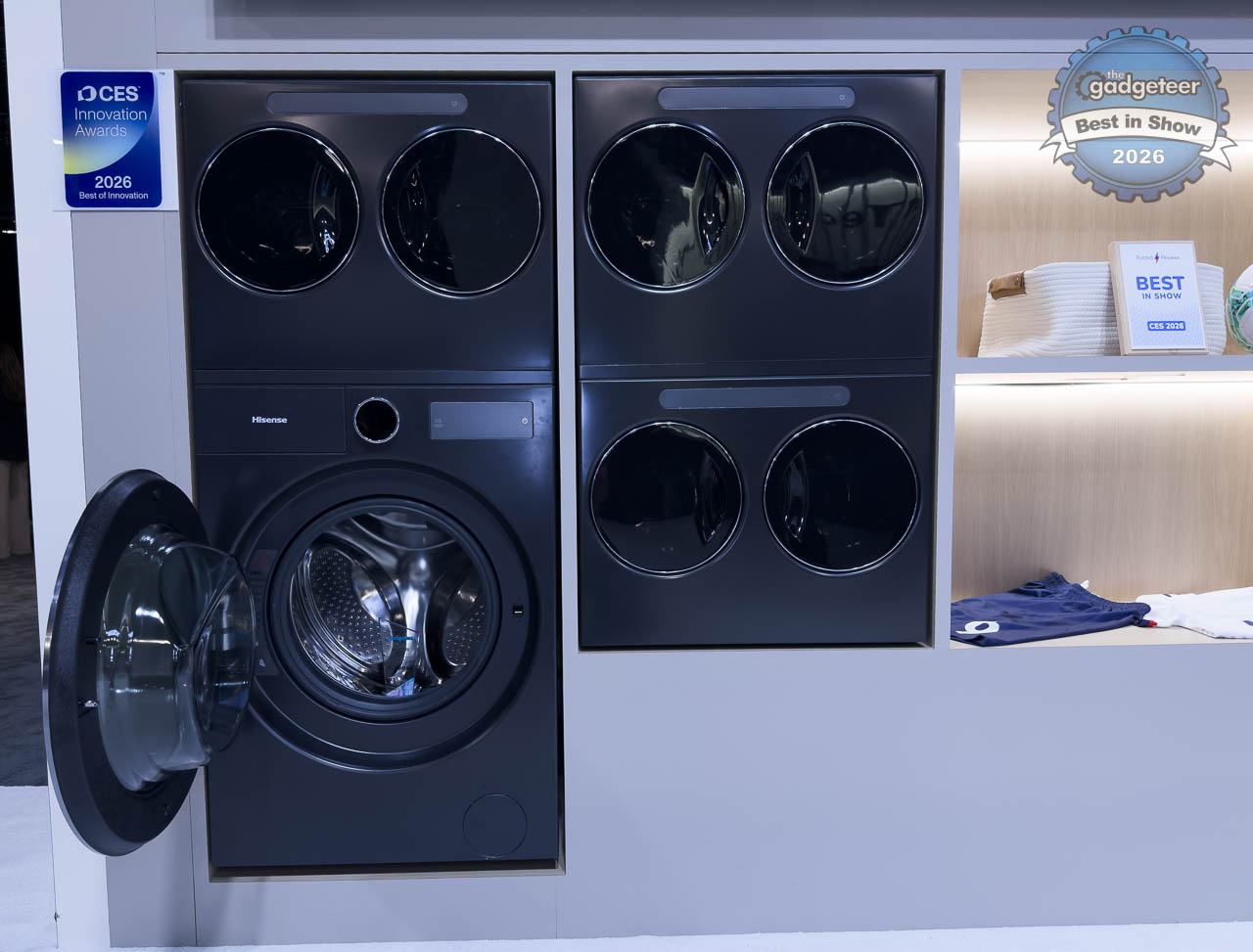
Despite potentially running four or more drums at once, the system operates at under 46 decibels. That’s quieter than a typical conversation. The modules stack vertically or arrange horizontally depending on your space, and they’re aesthetically matched so the configuration looks intentional rather than improvised.
No competitor offers anything like this. Traditional laundry means one drum doing everything sequentially, or expensive stacked pairs that still can’t run specialized cycles simultaneously. The Excel Master reframes laundry infrastructure the same way modular storage systems reframed closets: start with what you need, expand as life changes, and stop accepting compromises that existed only because nobody questioned them. That rethinking earned it a trophy.
Hisense Top Lift Dehumidifier
Dehumidifiers haven’t changed in decades. You set one in a basement, forget about it, then eventually wrestle with a heavy, awkward water collection tray that splashes on the floor no matter how carefully you carry it. Bending, spilling, and clunky design have been accepted as normal because nobody expected better from the category.
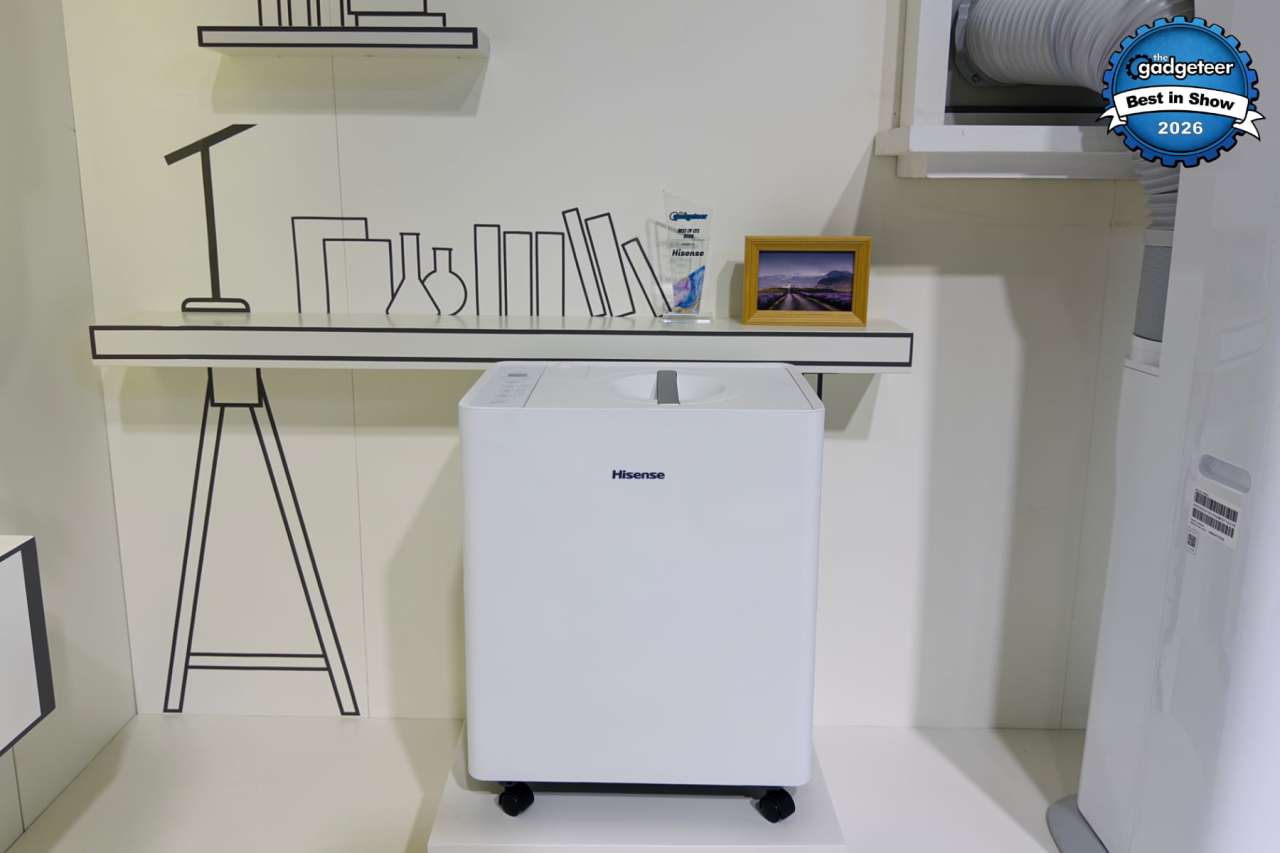
The Top Lift Dehumidifier is the world’s first with a top-lift water collection system. Instead of crouching to pull a tray from the bottom of the unit, you lift an enclosed cartridge from the top. No bending. No spillage during transport. The cartridge holds 38% more water than traditional models, so you empty it less often. When you do, the ergonomic position and enclosed design make the task effortless instead of annoying.
This matters especially for accessibility. Users with back problems, mobility limitations, or anyone who’s ever dreaded the basement dehumidifier ritual now have an alternative designed around how people actually move. The thoughtfulness extends to smart home integration: Connect Life, Google Home, Apple Home, and Amazon Alexa compatibility means you can monitor humidity levels and receive alerts without climbing downstairs to check.
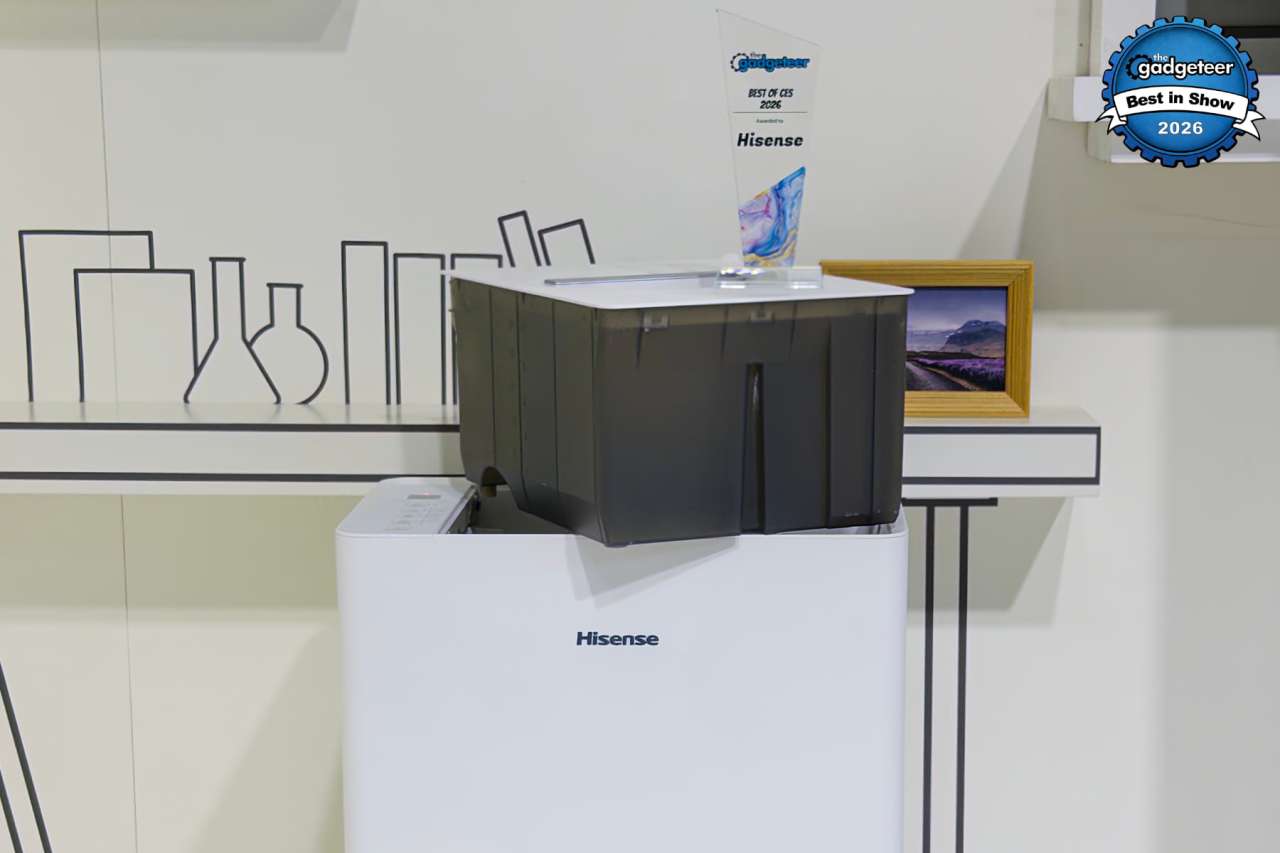
The Top Lift Dehumidifier earned a trophy because it represents innovation where you least expect it. Hisense looked at a product category everyone else ignored, identified friction points that had persisted for generations, and engineered solutions that feel obvious in hindsight. That’s what good design does. It makes you wonder why nobody did it sooner.
Power & Energy
EcoFlow DELTA Pro Ultra X
Backup batteries feel like insurance: necessary but annoying to pay for, sitting idle until disaster strikes. The DELTA Pro Ultra X reframes that relationship by staying active every day.
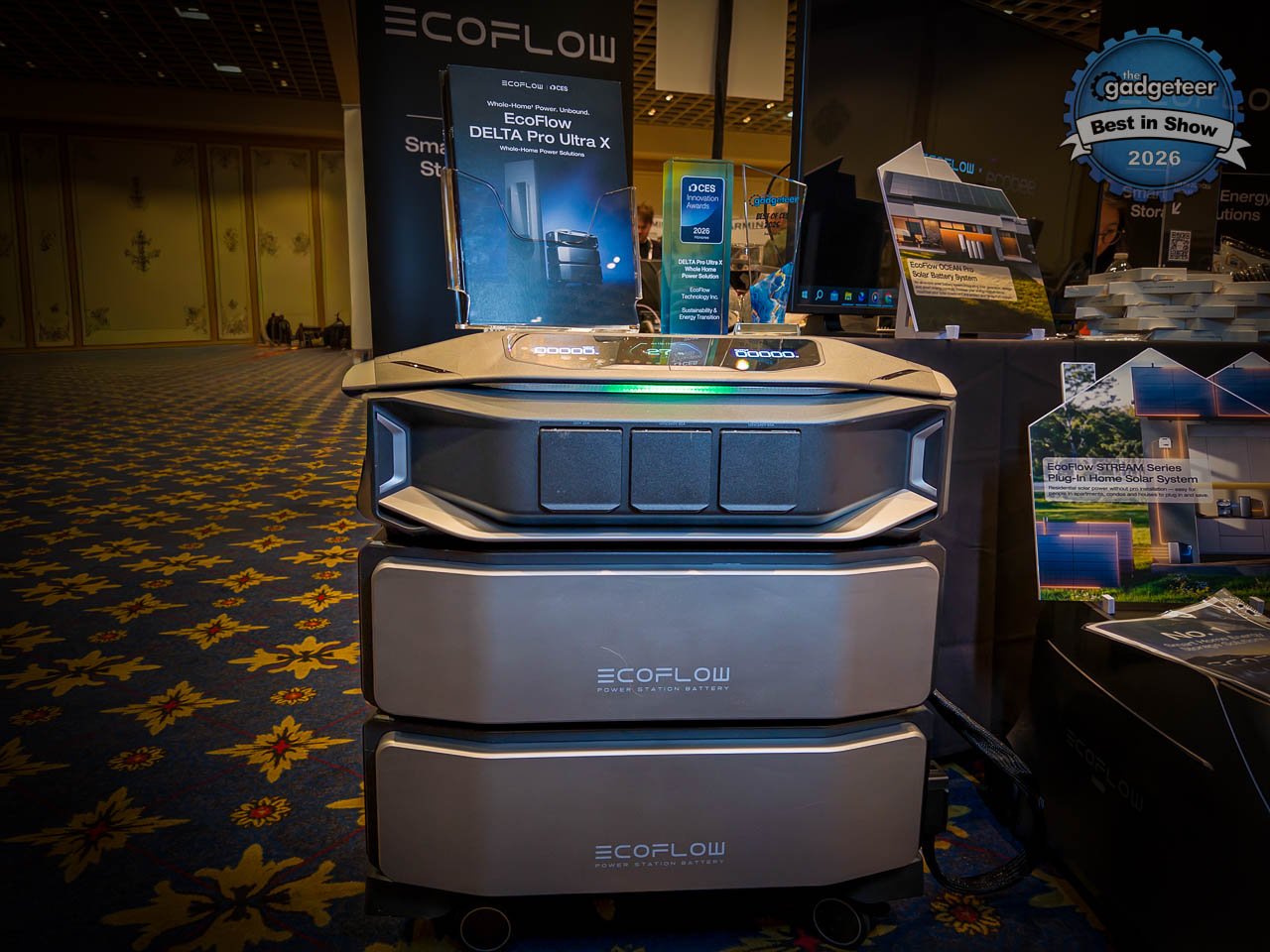
As flagship of EcoFlow’s Ecosystem Alliance, EcoFlow says its ecosystem integrates with more than 15 partner brands (Homey by LG, Bosch) into a single intelligent platform. It manages peak electricity costs daily. Coordinates solar input automatically. Prioritizes circuits based on your actual usage patterns. Storm-prep alerts charge proactively when weather’s coming. And when the power does go out, there’s no scramble because the system was already running the house.
This is what whole-home energy management should look like: infrastructure that earns its keep before the emergency, not equipment that waits in a closet hoping to be useful someday.
The Bottom Line
CES 2026 proved that meaningful progress still happens when companies stop chasing spec sheets and start solving friction.
The best displays this year expanded what color accuracy can mean. The best laptops physically adapted to how people actually work. Pool robots finally eliminated the cleanup after the cleanup. Yard equipment consolidated into platforms instead of duplicating motors. And wearables stayed out of the way long enough to be useful.
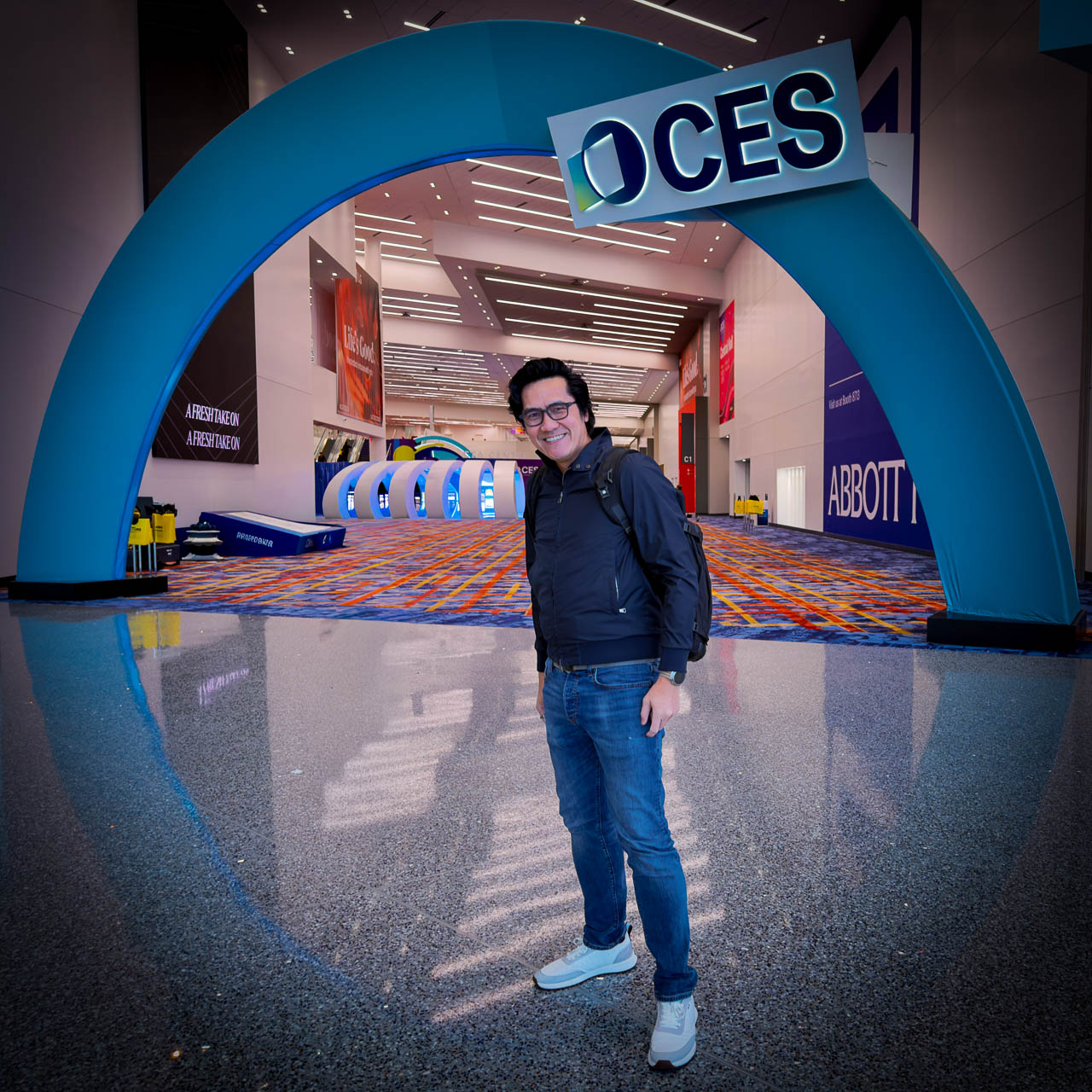
Every winner here earned a trophy by doing something competitors had not figured out yet. Hisense added a fourth primary to its backlight. Lenovo shipped a motorized hinge that responds to context. Beatbot built a dock that handles post-clean maintenance. Yarbo replaced four seasonal machines with one modular core. Even Realities made smart glasses that disappear on your face.
These 25 products represent the show at its best: engineering that improves daily life without demanding attention.
📡 CES 2026 Coverage
Want more from the show floor?
We’re covering the biggest announcements, wildest concepts, and gear that actually matters from CES 2026.

Lenovo 2026 New V15 Laptop for Student & Business | Intel Pentium 4-Core Processor | 15.6 FHD Screen (1920 x 1080) | 12GB RAM | 256GB SSD | Ethernet RJ-45 | Windows 11 with Office 365 for The Web
(as of February 26, 2026 17:40 GMT -06:00 - More infoProduct prices and availability are accurate as of the date/time indicated and are subject to change. Any price and availability information displayed on [relevant Amazon Site(s), as applicable] at the time of purchase will apply to the purchase of this product.)