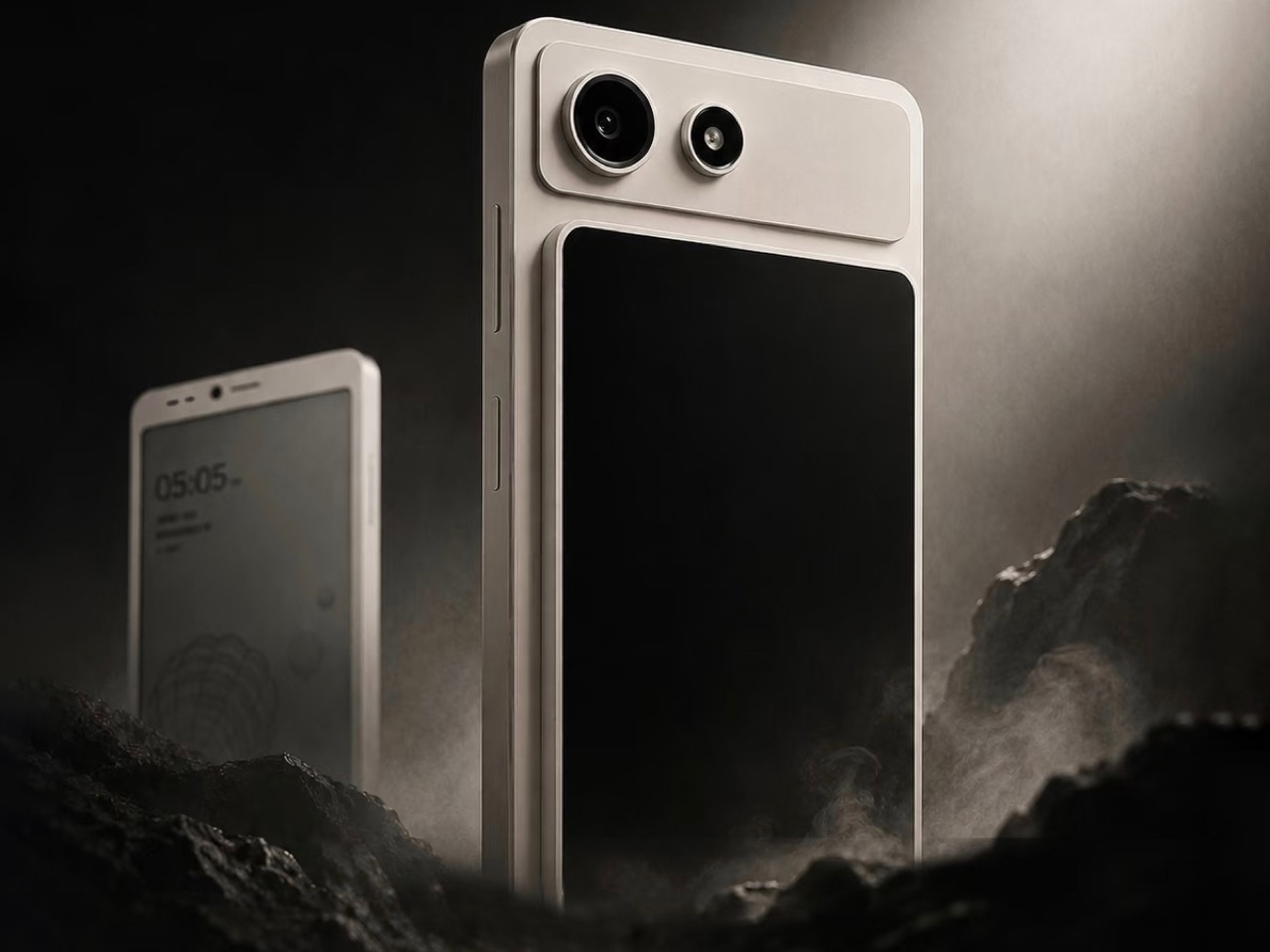
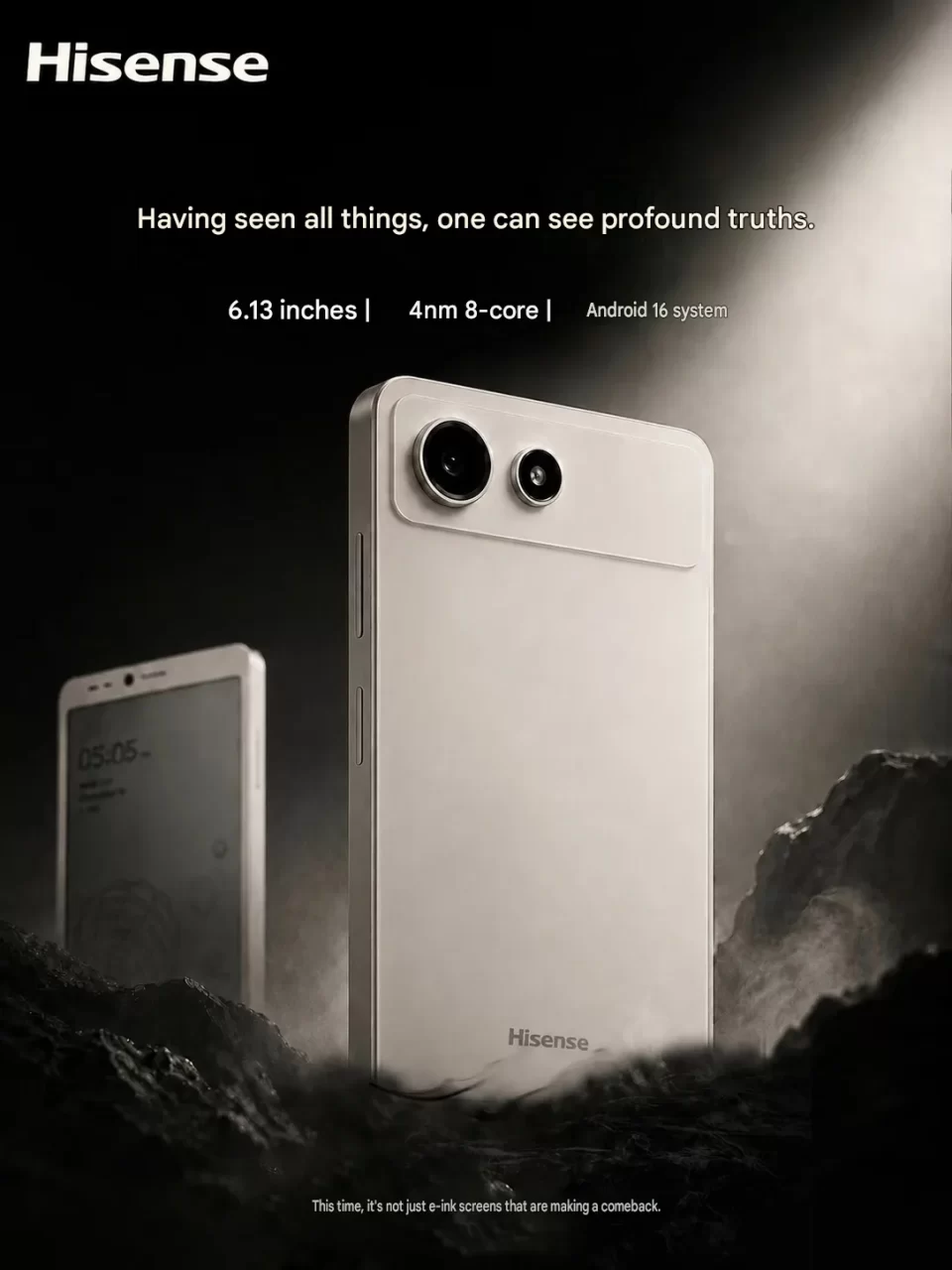
Hisense announced the A10, a phone built around a 6.13-inch monochrome E Ink display with a detachable magnetic color LCD for the back and a Snapdragon 6 Gen 3 processor. The removable rear panel lets you swap between a slim reading-focused device and a full-color smartphone without carrying two phones. It is also the first E Ink phone to ship with Android 15.
The secondary screen is a color LCD panel that attaches magnetically to the back of the phone. Hisense has not confirmed full specifications, but the approach sidesteps the compromises that have kept previous E Ink phones niche. The A10 is expected to cost around $590.
Two Screens: No Need to Carry Both All Day
Every E Ink phone asks for a compromise. YotaPhone paired a small, low-resolution rear panel with a conventional front screen. Hisense’s A5 and A9 use a single E Ink display that handles everything, which works for reading but makes maps, photos, and video a struggle. The A10 splits those jobs between two screens.
The front E Ink panel handles reading, messaging, and notifications. The detachable LCD adds color for navigation, photos, shopping, and video when you need it. You leave the color screen behind when you don’t. The E Ink phone stays slim and light for reading on the go, and the LCD clicks on magnetically when you need full smartphone capability.
Previous dual-screen phones such as the LG G8X, Microsoft Surface Duo, and YotaPhone made the second screen a permanent part of the device. Hisense made it optional. That is the difference that makes the A10 a more practical E Ink phone than anything before it, because you are not carrying the extra bulk and battery drain of a second display when you only want to read.
The Removable Screen: Less Bulk When You Want It
The secondary display is a color LCD panel that attaches magnetically to the back of the phone. Hisense has not confirmed full specifications, but the concept gives the A10 a practical edge over every previous dual-screen phone. A removable display keeps the extra bulk out of your pocket when you do not need it.
That setup suits people who use their phone differently at different times of day. Morning reading on E Ink. Afternoon navigation and messaging with the color display attached. Evening back to reading. You choose the screen that fits the task rather than compromising on one display that tries to do everything.
How the A10 Compares to Earlier E Ink Phones
E Ink phones have been around for more than a decade, and each major attempt exposed a different weakness.
- YotaPhone (2013-2016): The original dual-screen E Ink phone. The YotaPhone 1 and 2 had a color LCD on the front and a monochrome E Ink panel on the back. The rear screen was fixed in place and small at 4.7 inches on the YotaPhone 2.
- Hisense A5 (2019): An E Ink-only phone with no color display at all. It was slim and focused, but the lack of color made maps, photos, and apps frustrating.
- Hisense A7 and A7 CC (2021): Added color E Ink with Kaleido Plus, but lower contrast, a visible screen door effect, and dimmer brightness compared to standard E Ink.
- Hisense A9 (2022): A 6.1-inch Carta 1200 display at 300 PPI with a Snapdragon 662 in a familiar smartphone body. The best E Ink phone of its era, but still monochrome-only.
- Bigme Hibreak Dual 2 (2026): Launched earlier this year with a permanently attached color LCD on the back. The A10’s removable approach is a direct response.
- Boox Palma (2023-2026): A phone-sized E Ink reader that cannot make calls. It found an audience, but it highlights the gap in the market for a proper phone with a great E Ink screen.
Who Should Consider the A10?
The A10 is not a mass-market device. It is unlikely to ever be sold through US carriers or mainstream retailers. The design makes the most sense for specific groups of buyers.
Readers who spend hours on their phone daily. If you read books, articles, long-form newsletters, or RSS feeds on your phone, E Ink is easier on your eyes over extended sessions compared to OLED or LCD.
People who experience eye strain or migraines triggered by OLED screens. PWM dimming on modern OLED phones can trigger symptoms for sensitive users. E Ink uses no backlight in reflective mode, making it comfortable for long sessions.
Digital detox enthusiasts who still need a smartphone. The Light Phone and Punkt. offer minimalist devices with limited functionality. The A10 lets you keep full smartphone access on the detachable LCD while using the E Ink display as your default screen for distraction-free daily use.
Enthusiasts and early adopters. Hisense phones are regularly imported from China through AliExpress, eBay, and specialized importers. These buyers accept the import process for access to niche hardware that mainstream carriers do not carry.
Why Removable Screens Could Catch On
Phone makers have tried removable second screens before. LG sold case-based displays for the G8X and Velvet, while several Chinese accessory companies sell clip-on secondary screens. None of those efforts were built around the concept from the start. The A10 tests whether buyers want a second screen only when a task calls for one.
Hisense’s E Ink Phone Rivals: A Quick Comparison
Only a handful of companies compete in this category:
Bigme is Hisense’s closest competitor, with the Hibreak and Hibreak Dual lines offering similar specs at lower prices. Bigme focuses more on Western-friendly software, but its build quality and screen quality trail Hisense.
Onyx Boox has the Palma line, a phone-sized E Ink reader designed as a secondary device. But the Palma is not a phone, and Boox shows no interest in adding cellular connectivity.
TCL uses circularly polarized LCD technology in its NXTPAPER phones instead of E Ink. NXTPAPER phones offer eye comfort without the E Ink tradeoffs, but they do not offer the battery life or sunlight readability advantages of E Ink.
Dasung makes E Ink monitors, including the new Link 2 phone monitor, but has not entered the phone market. Mudita and Light sit at the extreme minimalist end with limited app support and basic hardware.
Who Should Buy It?
The Hisense A10’s removable rear display gives E Ink phone buyers a cleaner tradeoff. Keep the phone light and distraction-free for reading, or attach the color screen when you need maps, photos, and apps. The price around $590 makes it an enthusiast purchase. The E Ink phone market has long accepted that these devices are for people who prioritize reading comfort over mainstream convenience. The A10 does not change that equation. It makes it more practical.
Availability is the bigger problem. Hisense phones are difficult to buy outside China, and importing one can mean using AliExpress, working around Chinese ROM limitations, and accepting limited warranty support. The A10 will not change that pattern.
Where to Buy the Hisense A10
The Hisense A10 is expected to cost around $590 and will likely be available through AliExpress, eBay, and specialized importers when it launches. Hisense has not confirmed full regional availability or a firm release date.