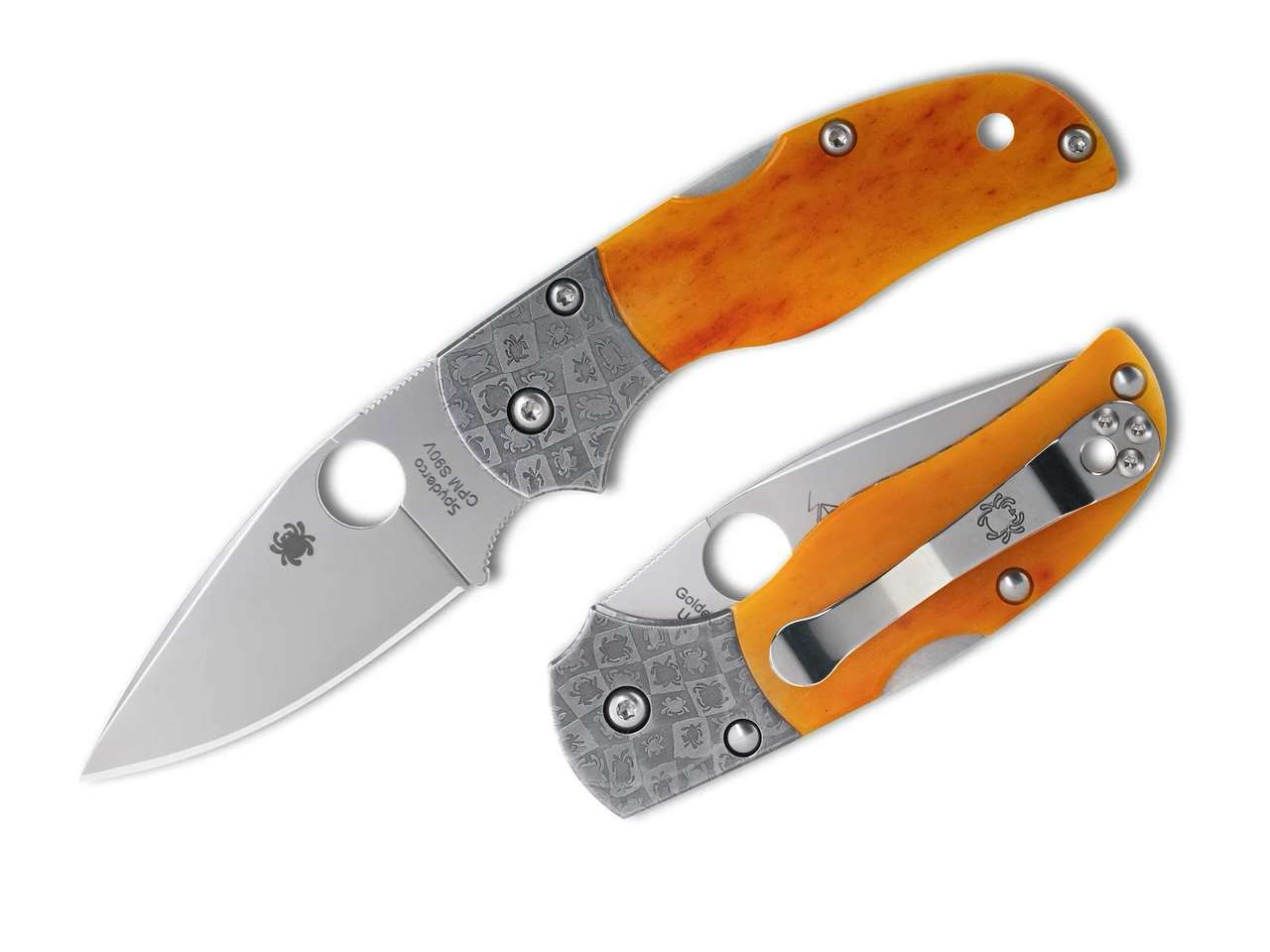
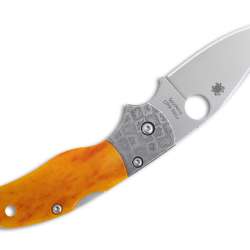
Most knife companies celebrate a milestone anniversary with a logo etch and a price bump. Spyderco, which has spent half a century quietly running one of the more interesting catalogs in production knives, decided to do something else. For its 50th, the Golden, Colorado outfit rebuilt what Spyderco itself calls its iconic Native® 5 as a small-batch heirloom: CPM® S90V® blade, amber-colored bone scales, hand-forged mosaic Damascus bolsters by Ed Schempp and his son Martin, and a solid African Padauk display box. The price is $1,200. The model is C41BA50TH.
This isn’t a knife you carry to break down boxes. It’s a knife you buy because the Native 5 has been around long enough to mean something, and the people who care are willing to pay custom-shop money for it.
Price: $1,200
Where to Buy: Spyderco | Amazon (Previous version)
At a glance
| Spec | Detail |
|---|---|
| Model | C41BA50TH |
| Price | $1,200 |
| Blade steel | CPM® S90V®, full-flat ground, brightly polished |
| Lock | Back lock |
| Handle scales | Dovetailed amber-colored bone, polished |
| Liners | Full stainless steel with decorative edge filework |
| Bolsters | Hand-forged mosaic Damascus (1084 + 15N20) |
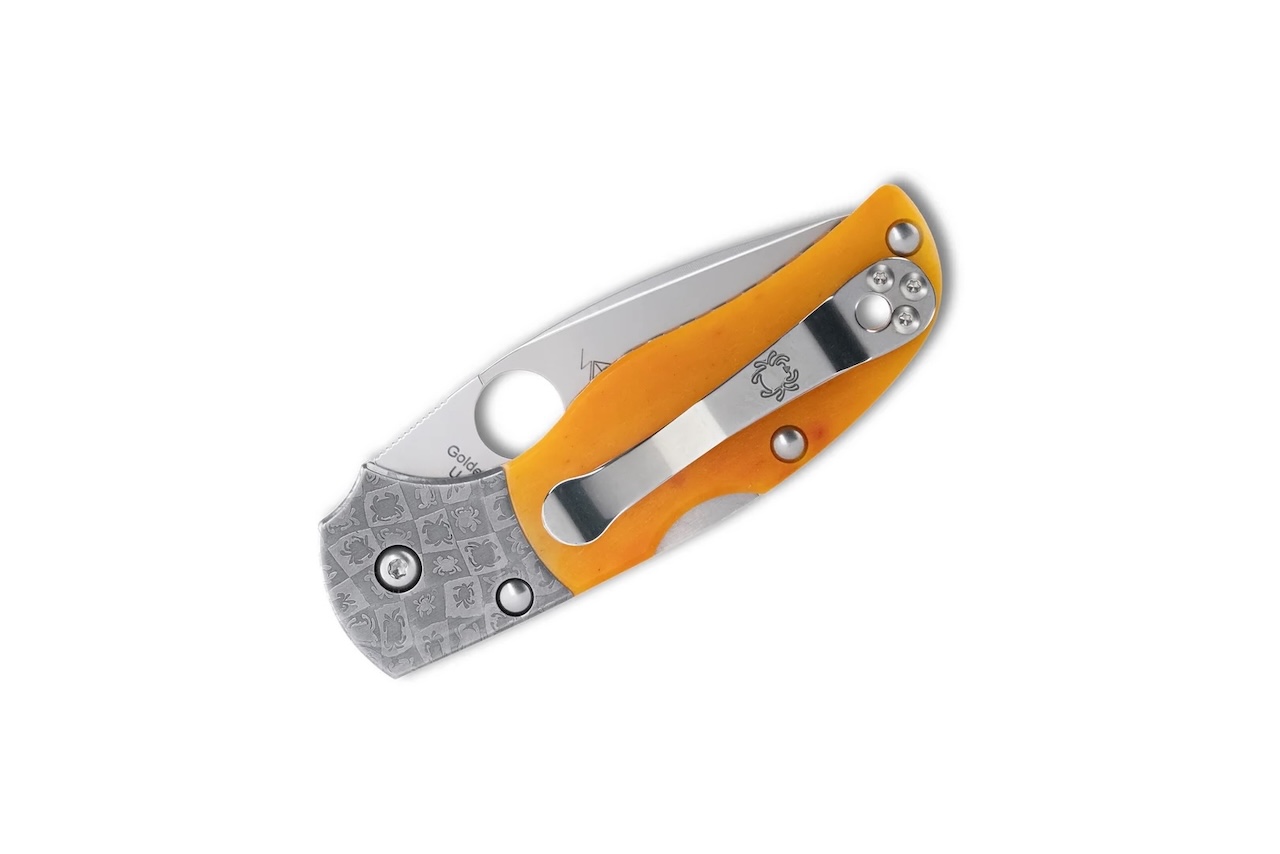
| Clip | Polished hourglass, right-side tip-up |
| Display box | Solid African Padauk, laser-engraved 50th anniversary logo |
| Edition | Sprint Run® (limited) |
Why a Native 5, of all things
The Native 5 is the current iteration of one of Spyderco’s longest-running designs: an American-made mid-size folder with a back lock, full-flat-ground leaf-shaped blade, and the brand’s signature round opening hole. Most ship with FRN or G-10 scales, S30V or S35VN steel, and a price that ranges from roughly $140 up to $300 depending on materials.
That unfussiness is exactly why it works as the chassis for an anniversary build. Anniversary editions usually pile premium materials onto an already premium platform. Spyderco went the other way. The result costs four to eight times the standard Native 5 and looks nothing like it.
The blade: CPM S90V, done properly
The blade is full-flat ground from CPM® S90V®, a powder-metallurgy stainless that sits near the top of Crucible’s catalog for edge retention. The recipe runs roughly 9 percent vanadium against 14 percent chromium, and the vanadium gets first claim on the carbon. It locks that carbon into microscopic vanadium carbides, hard enough to laugh at the aluminum-oxide abrasive in a standard whetstone, which is where the outlier edge life comes from. Because the vanadium is doing the wear-resistance work, the chromium stays in solution and is free to fight rust.
Spyderco brightly polished the blade rather than stonewashing or satin-finishing it. A bright polish telegraphs every micro-scratch, the trade-off any high-polish blade makes for the look, but it pairs with the amber bone and Damascus in a way a brushed finish wouldn’t. This is a display-grade build.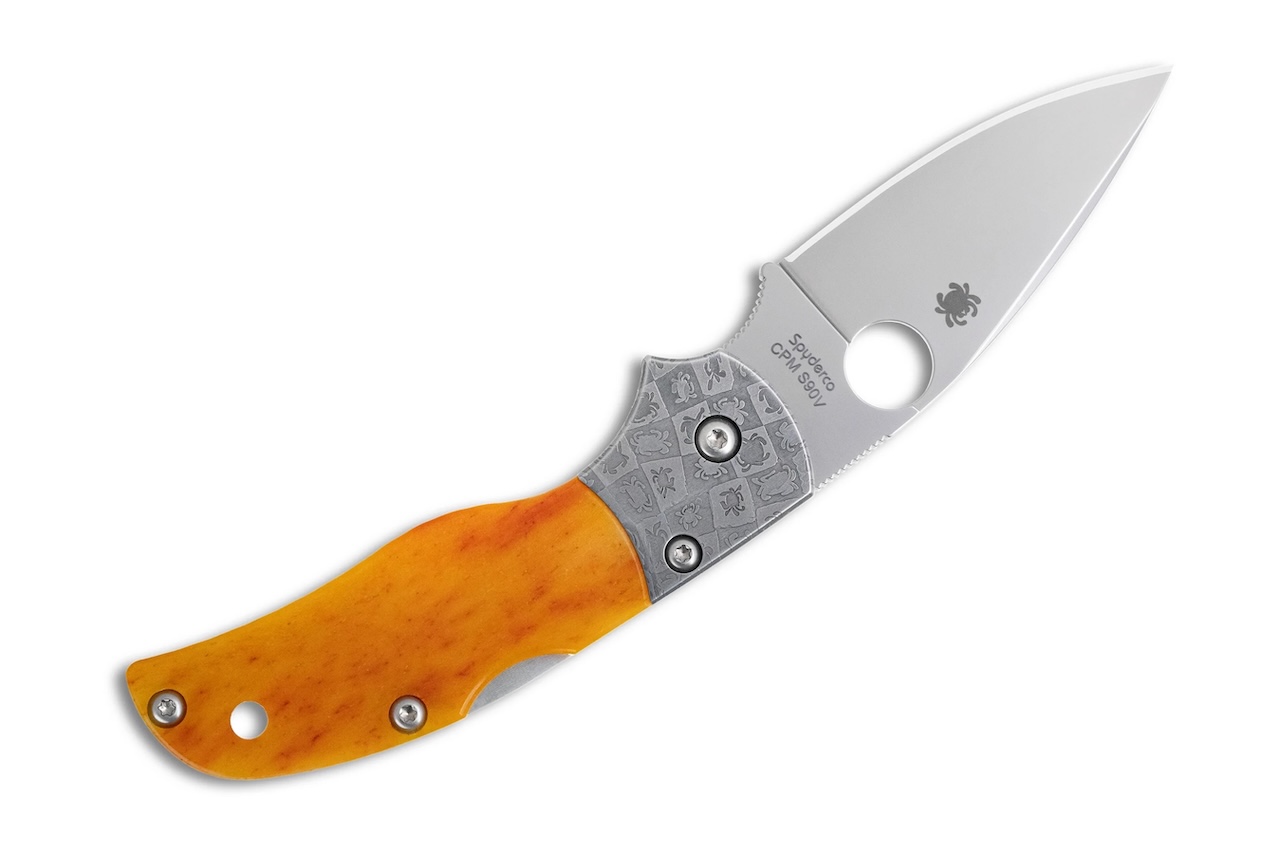
The bolsters: a year of forging, 1,200 hours, 36 squares
The headline feature, and the reason the price lands where it does, is the mosaic Damascus bolsters. Ed Schempp and his son Martin handled the forging. Schempp is a Washington-state bladesmith and wheat farmer with decades of mosaic Damascus work.
Starting from billets of 1084 (high-carbon) and 15N20 (nickel-bearing, stays bright after etching), the work is iterative: forge a billet, grind it flat, water-jet cut the pattern, stack and forge-weld the cells together, stress-relieve, then draw the welded billet down to bolster thickness. Those bars get sliced crosswise to expose the pattern: a 6-by-6 grid of cells, with the Spyderco bug forged in steel inside every one.
Spyderco puts the total time at more than 1,200 hours across roughly a year. The bolsters are acid etched for contrast, and dovetailed into the scales.
The handle: bone, filework, and old-school knifemaking
The scales are amber-colored bone, dovetailed into the Damascus bolsters and worked up to a deep, glossy finish. Bone scales are a traditional-slipjoint staple. Case, Boker, and other heritage brands use them constantly. But they’re rare on a modern lockback at this price tier. Bone isn’t as dimensionally stable as G-10 or micarta, and it ages, which is the entire point. Bone scales prefer being carried over being safe-stored.
Underneath, full stainless steel liners do the structural work, machined along their exposed edges with custom-shop-style filework. Internal liner filework is rare on production knives. It’s invisible once the scales go on, so most brands skip it. Spyderco did it anyway.
The box: African Padauk, with a tree-planting pledge
The presentation box is solid African Padauk, laser-engraved with the 50th anniversary logo. Spyderco says it will plant a tree for every box produced.
Who this is for
Not first-time Spyderco buyers. A standard Native 5 in S35VN runs around $160 and will keep pace with S90V on everyday cuts; the difference only shows up after an hour of cardboard.
This one is for the collector who already owns three or four Natives, has a Sebenza or a custom in the rotation, and wants a piece that anchors the case. For the long-time buyer who carried a Native through a first job and wants the upgraded version on the shelf. Recent precedent suggests this won’t sit on shelves: the 40th Anniversary Damasteel Native sold out at retail, and this build leans even harder on hand-forged components that can’t be scaled.
The catch
Four things before anyone clicks buy. The product page still reads “Coming Soon” even as Spyderco’s social channels tease pre-orders; if recent Sprint Runs are any guide, expect a short window. Polished CPM S90V is a maintenance commitment: anything beyond light upkeep calls for diamond or CBN abrasives, and the bright polish shows pocket wear fast. Bone scales are sensitive to heat and humidity, so storage belongs in the Padauk box in a climate-controlled space. Sprint Run resale runs hot or cold; some variants appreciate, plenty depreciate. Buy it because you want it on your desk, not because you plan to flip it.
Price: $1,200
Where to Buy: Spyderco | Amazon (Previous version)
Bottom line
The Native 5 50th Anniversary Sprint Run is the most distinctive production knife Spyderco has ever shipped, by the company’s own admission. The spec sheet backs the claim.
At $1,200, it’s not for the carry rotation. It’s the piece that goes on the shelf next to the company’s first 50 years and quietly argues for the next 50.