
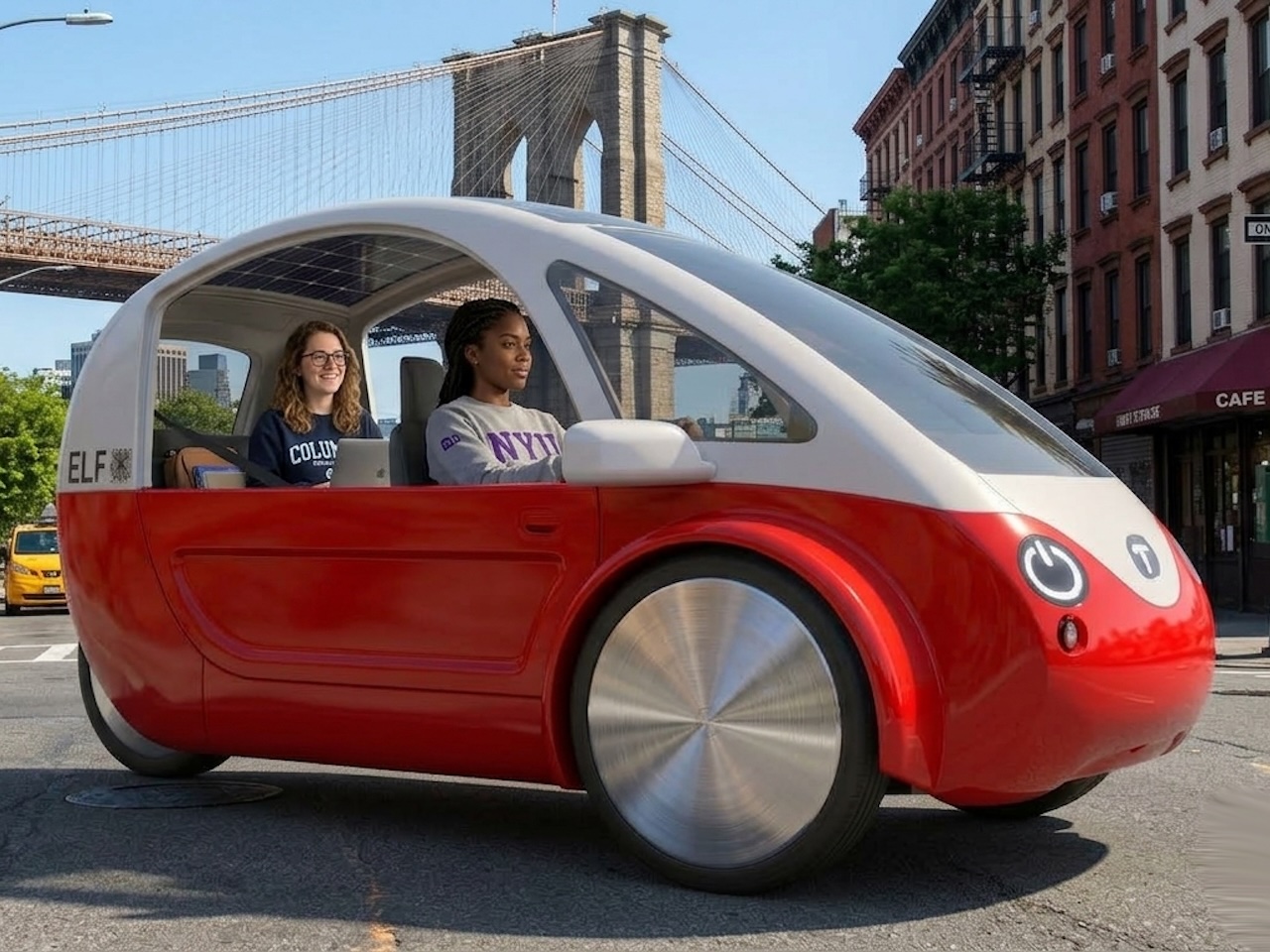
Organic Transit, the small Durham, North Carolina shop behind the original ELF solar electric trike, is bringing the vehicle back. The first ELF logged more than 10 million miles across 850 vehicles in the field, with a warranty rate the company puts under 3 percent, before a change in ownership paused production. Founder Rob Cotter has since reacquired the company and is bringing the platform back. The new version is called ELF 3.0, and it’s already taking reservations through Organic Transit’s site and a Wefunder campaign.
Price: From $7,500
Where to Buy: Organic Transit
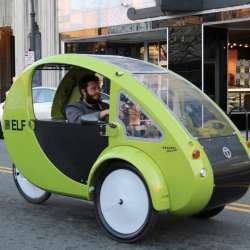
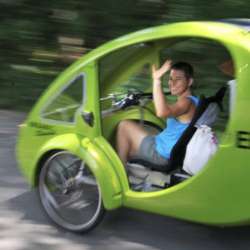
It’s still the same basic idea, a fully enclosed three-wheeler that runs on a mix of pedal power, an electric motor, and a roof full of solar panels, sized to fit in a bike lane. What’s different is almost everything else: a redesigned fuselage-style chassis, full suspension, a much larger battery that can feed power back into a home, and a single drivetrain that can be configured as a Class 1, 2, or 3 e-bike, a mobility device, or a low-speed neighborhood electric vehicle through an over-the-air setting.
Quick Specs
Solar: 200W standard, ~400W optional
Battery: ~2× original capacity, bidirectional (home backup)
Drivetrain: Programmable Class 1/2/3 e-bike, mobility, or NEV (OTA)
Price: TBD; reservations open
What’s Changed on the Outside and Underneath
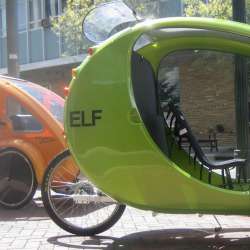
The shell still reads as an ELF, a teardrop pod with a clear front, rearward-opening doors, and a solar roof, but Cotter and CTO Ali Khalifa have rebuilt the structure as what the company calls a fuselage frame, borrowing from small aircraft construction. The panels carry their color through the material itself, so there’s no paint layer to chip, and owners can apply vinyl wraps over the top for custom looks.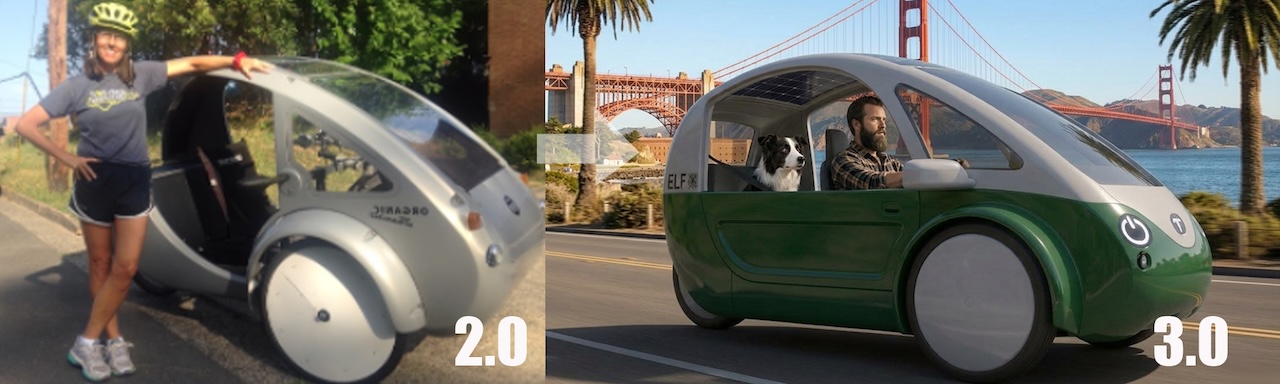
Underneath, ELF 3.0 gets full front and rear suspension, which the previous generation lacked, and a full floor that closes the cabin off from the road. Inside, there’s room for two passengers with seatbelts as a standard configuration, plus a reverse gear so riders don’t have to back the trike out of a parking spot by foot.
Solar and Battery Get a Real Upgrade
The original ELF solar vehicle shipped with a 100-watt roof panel. ELF 3.0 doubles that to 200 watts standard, with an optional roof setup the company says reaches roughly 400 watts for riders who want to lean harder on solar charging.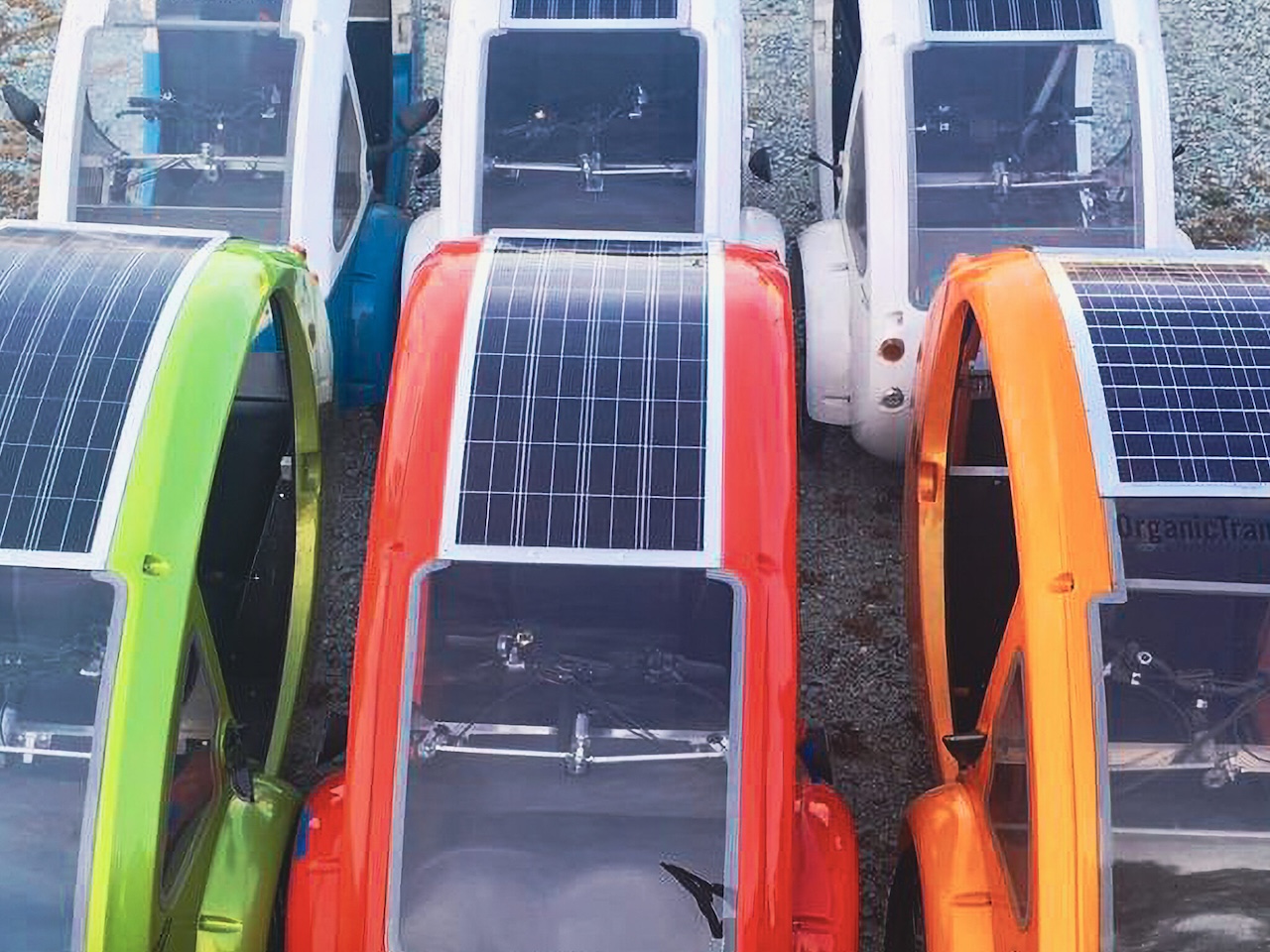
The battery roughly doubles in capacity compared to the first ELF and adds bidirectional charging, so the trike can be plugged into a home and used as backup power during an outage. Organic Transit is positioning that as a practical answer for owners in storm-prone regions, where the same vehicle that handles a daily commute can keep a fridge or a few lights running when the grid is down.
One Drivetrain, Multiple Vehicle Classes
One of the bigger changes is regulatory rather than mechanical. ELF 3.0 uses a single programmable drivetrain that can be set to Class 1, Class 2, or Class 3 e-bike specs, a mobility device profile, or a neighborhood electric vehicle profile, and the setting can be changed over the air. That means a rider in a state with strict bike-lane speed limits can run the trike as a Class 1 pedal-assist, while a rider who needs NEV registration for street use in a planned community can switch to that mode without swapping hardware.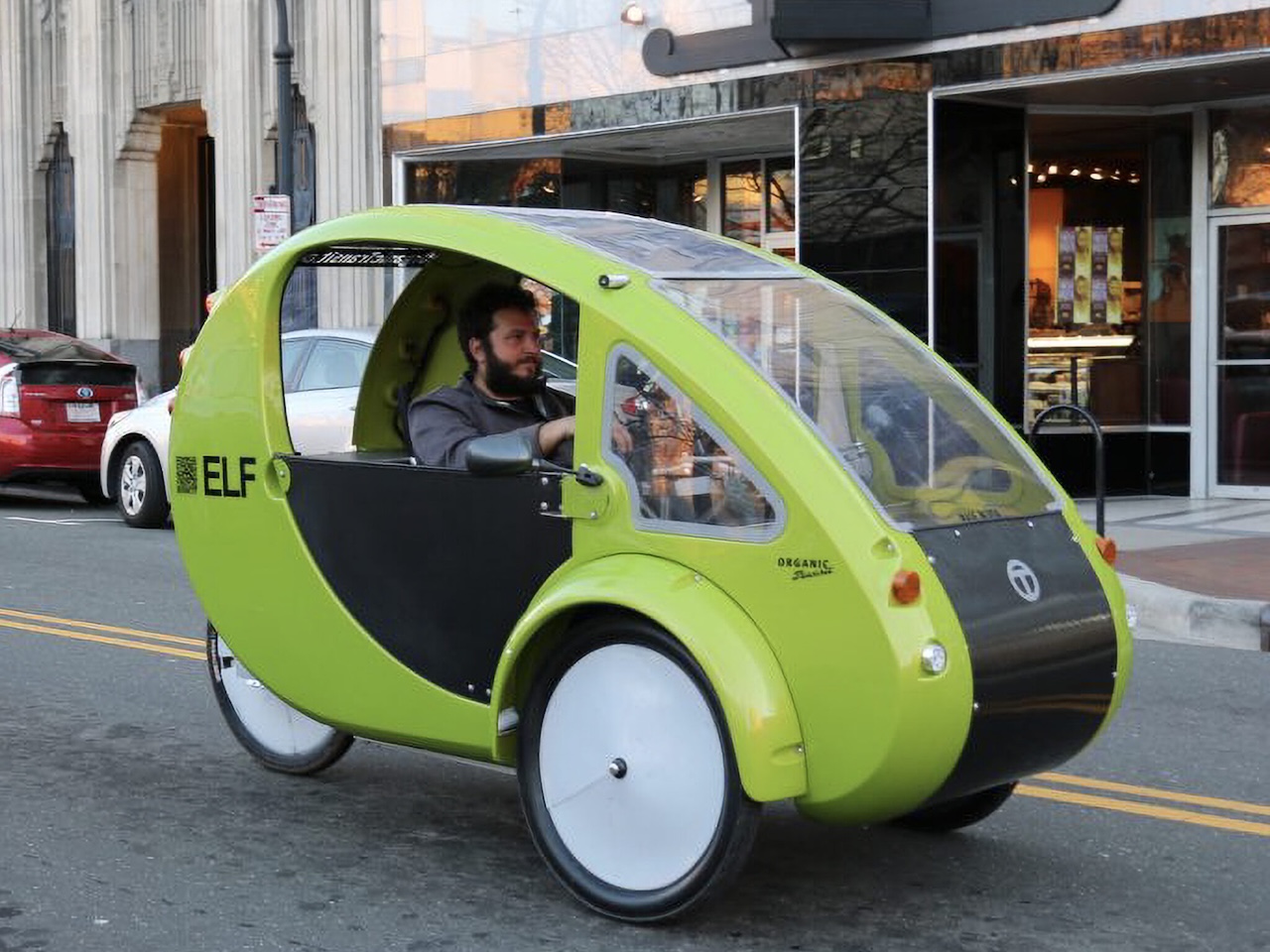
Pedaling is still an option, and the trike still charges from the roof or a wall outlet, but the legal envelope around it is now a software setting rather than a build option.
Built Like a Small Aircraft
The spec sheet leans into a more finished feel. The fuselage frame is meant to keep the structure light while raising stiffness, the rearward-opening doors are designed for easier entry and exit for both front and rear passengers, and there’s an electronic immobilizer plus an owner-only tracker built in for theft deterrence and recovery.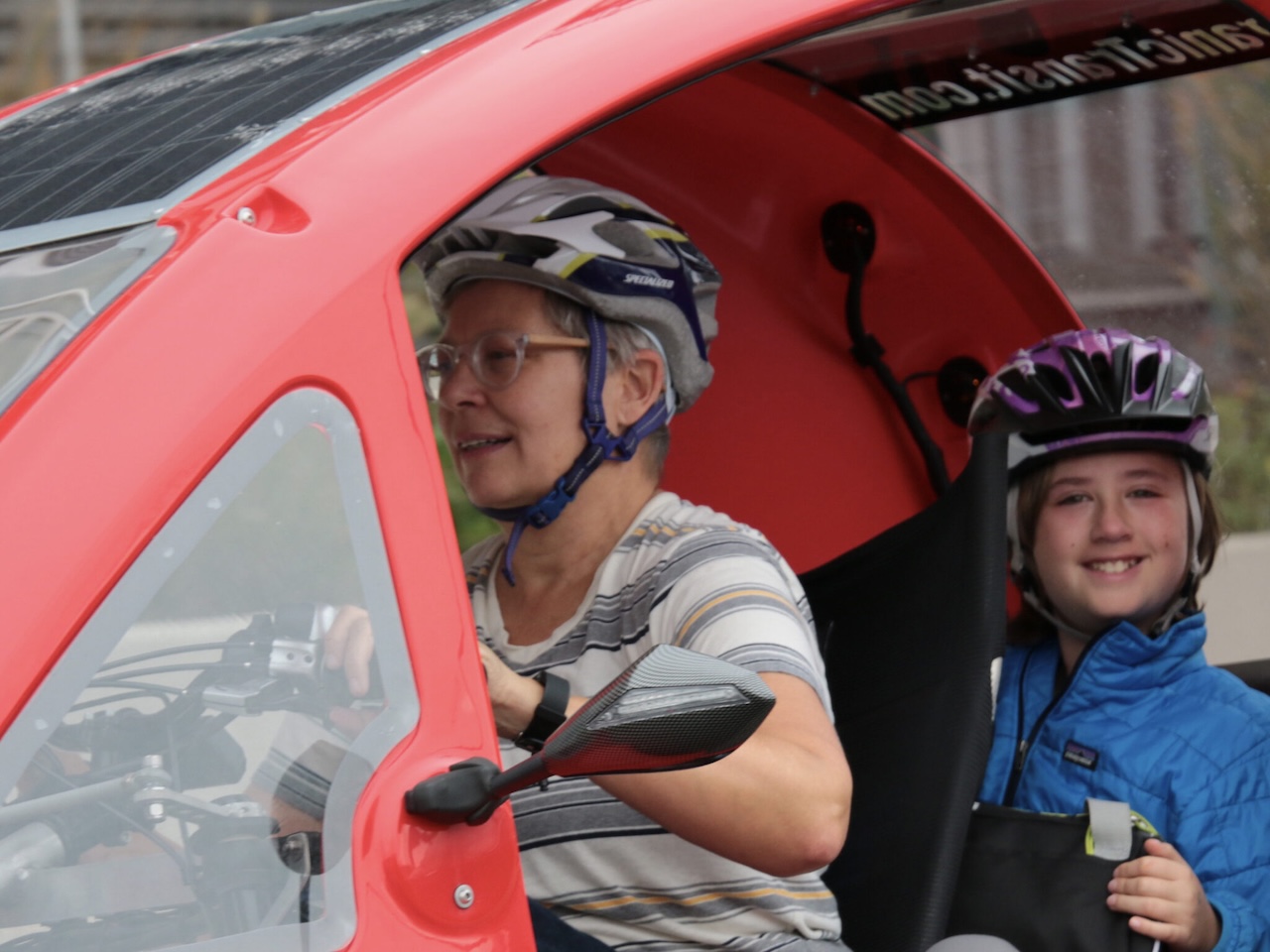
The color-molded panel approach is also a maintenance argument. With no paint layer, small parking-lot scuffs don’t expose bare material the way scratches on a painted body do.
Price: From $7,500
Where to Buy: Organic Transit
How to Reserve One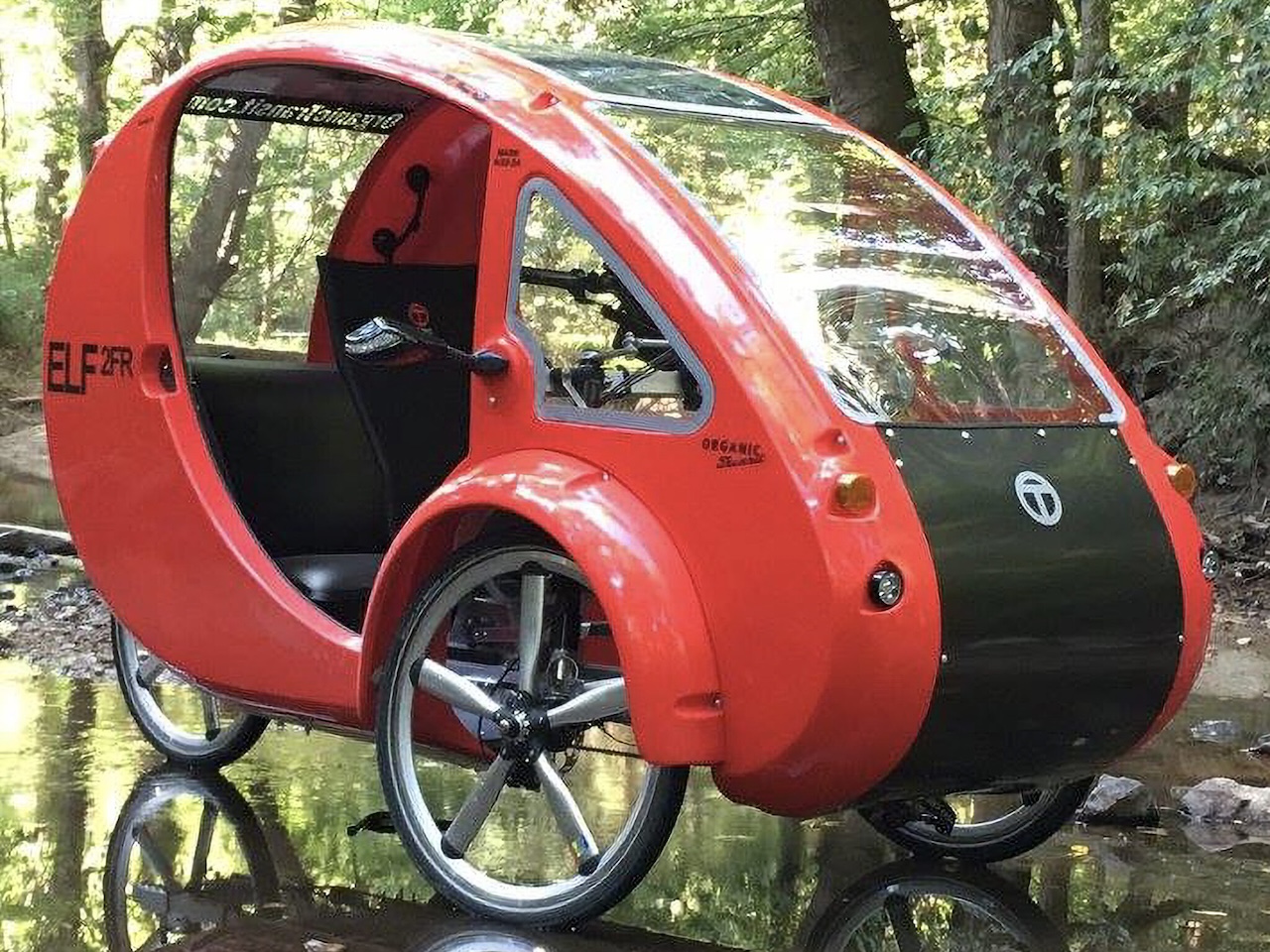
Organic Transit is taking reservations on the new solar electric trike now through its own website and through an active Wefunder equity campaign. The company hasn’t published a finalized retail price for ELF 3.0 yet, and delivery timing will depend on funding and production ramp. Anyone who owned an original ELF should recognize most of the silhouette, just with more solar, full suspension, and a battery that can help back up a home.


Gadgeteer Comment Policy - Please read before commenting
The new version looks a lot less reminiscent of the 1980s Sinclair C5 although all electric trikes share a heritage with that early commercial failure.
According to some reading the first Elf had about 500Wh of battery so this one should be in the 1kWh range. That’s not a serious amount to power your home – I’m guessing it will basically have an inverter and 120V output which could keep your fridge running for half a day, or if the Elf is still in the sun perhaps indefinitely.
I have to wonder how they plan to get 400W of solar (vs 200W standard) because that would require 2 m² or nearly 22 sf of surface area for 20% efficiency flex panels. Is it going to have an optional golf cart roof or fold out part for when it’s parked?
Either way I can see this as a fun vehicle for places where golf carts are accepted but I think in most places I would not ride it on the streets – it’s large enough that car drivers might wrongly expect it to have car like acceleration or safety and drive dangerously around it. In a crash i doubt it would perform any better than just a regular bike – it might even be worse if you’re trapped inside.
Our roads are designed for gas guzzlers. Anything slower bring out the American road rage spirit.
Just to fill in some of the blanks. Most original ELFs had LiFePO4 batteries at just over 750 Watt Hours. Many had two with a record range in optimum conditions of 132 miles.
ELF 3.0 will have a base battery of 1kW. Most will likely upgrade to the 2kW module.
Those opting for the ELF to Home “E2H” backup package will get: 400W solar package and 3 x 2kW battery modules. 4kW remain at the home and 2 kW remain on the ELF for transport or solar charging and swapped out with home units. When linked together, up to 6 kW available for emergency home backup.
Regarding safety, over 10 million miles 25 accidents were tracked with cars and trucks. Results: Zero serious injuries.
Hi,
I’m totally besotted with this concept and the possibility of perhaps owning one somewhere down the line. The new features that have been introduced make the ELF 3.0 an undeniable must-have! Everything about it just makes sense.
However, I haven’t seen anything about windscreen wiper/s for when it rains. Are these envisaged or something else mind-blowingly simple and brilliant? And will there be some kind of shields (perhaps roll-down plastic or similar) for the sides?
Regards,
Yvonne
I have a first generation 750kw ELF. If you have 1 to 3 people in your family even the first generation ELF can be your grocery getter or even your primary transportation if you live within 7 miles of work. You’d be surprised at the power of the first generation ELF going up hills even when fully loaded with groceries and a 200 pound driver. However, on frosty nights, the first generation ELFS’ windows can frost up pretty severely because there is no floor barrier in them; it’s completely open to the elements from underneath. Also, not surprisingly, I’ve observed that the first generation 750kw ELF’s range in snow or slush is severely diminished. The ELF 3.0 HAS a floor but I don’t know if that fixes the window frost/condensation problem. If you live in an area where frost/snow isn’t an issue and your grocery and other critical destinations are within 10 miles, replacing a car with an ELF will likely extend your life and save you a lot of money.
I can picture loading it up with some high quality camping gear and retiring to the road. It might be the most comfortable way to live on Social Security alone.