The NAVEE UT5 Ultra X became two different scooters during my review. Once moving, its 12-inch tires, hydraulic suspension, and 90.4-pound scooter made it feel calm and unusually stable. The moment the ride ended, that same weight became its biggest liability.
NAVEE UT5 Ultra X: $2,499.99 list price, $2,299.99 when this review was fact-checked. Check current price and availability at NAVEE.
NAVEE advertises 43 mph performance and up to 74.6 miles of range, but those headline numbers aren’t the most important part of owning it. Storage, charging, security, legal riding space, and whether you ever need to lift it will determine whether the Ultra X feels liberating or exhausting.
Although I had the scooter for some time, most of my riding happened this summer. I estimate that I covered roughly 30 to 40 miles, enough to evaluate its acceleration, handling, controls, and daily ownership demands, but not a controlled long-distance range test. My routes covered ordinary paved roads, sidewalks, and stretches of gravel. I didn’t treat it as an off-road machine; with this much speed and weight, keeping all my limbs and other body parts intact seemed like the better test plan.
For context, I’m 52 years old, about 6 feet 1 inch tall, and weigh approximately 195 pounds. I test cars for a living, but I’m not a performance-scooter enthusiast. I chose to use the Ultra X as a high-end transportation vehicle for getting from point A to point B, but that was my decision rather than the limit of the hardware. Its dual motors, large tires, hydraulic suspension, and substantial frame clearly invite more adventurous riding. A younger and braver version of me would have been tempted to explore that side of it. Given where I live and my current appetite for risk, I stayed with normal roads, sidewalks, and gravel and did not attempt to validate its off-road capability. At this price and performance level, the Ultra X deserves the same respect and planning you’d give other premium personal transportation.
What is the NAVEE UT5 Ultra X?
The UT5 Ultra X sits at the top of NAVEE’s U.S. scooter range. Its key specifications explain why it feels more like a compact personal vehicle than a last-mile scooter:
- Motors: Two 1,200W motors, each rated for 2,400W peak output
- Battery: 57.6V nominal, 22.3Ah, or 1,284Wh
- Claimed top speed: 43 mph
- Claimed grade capability: 46 percent
- Tires: 12-inch self-healing tubeless tires
- Ride hardware: Front and rear hydraulic suspension, hydraulic disc brakes with EABS, and traction control
- Maximum rider load: 330 pounds
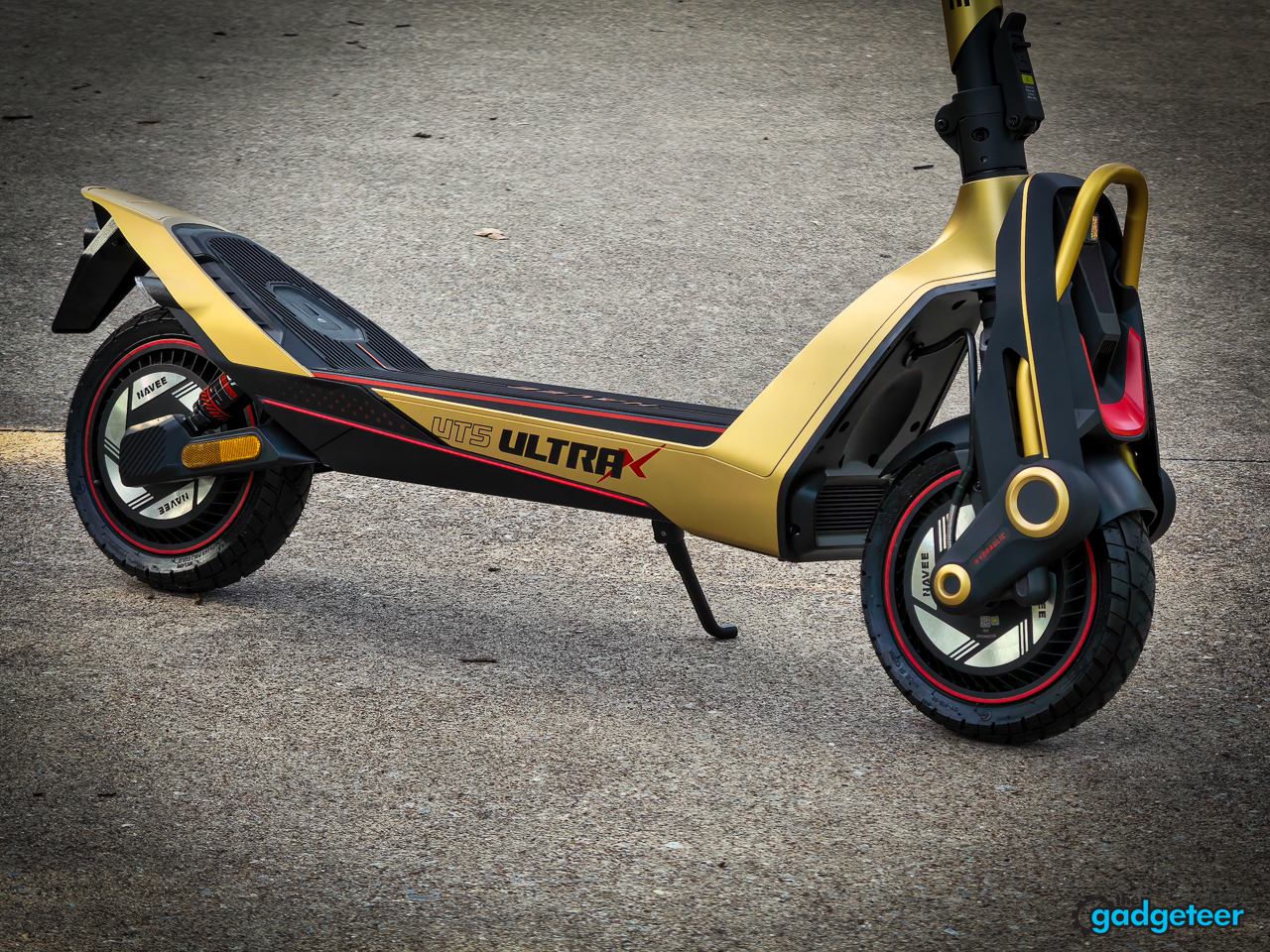
Folding helps with garage storage or fitting the scooter into a suitable vehicle. It doesn’t make 90.4 pounds easy to carry up stairs or lift into a trunk.
In the box, NAVEE includes the scooter, charging adapter, screws, hex key, and manual. Handlebar installation requires four screws tightened in the order shown in the quick guide, with a specified torque of 5 plus or minus 0.5 Nm.
Design and build quality
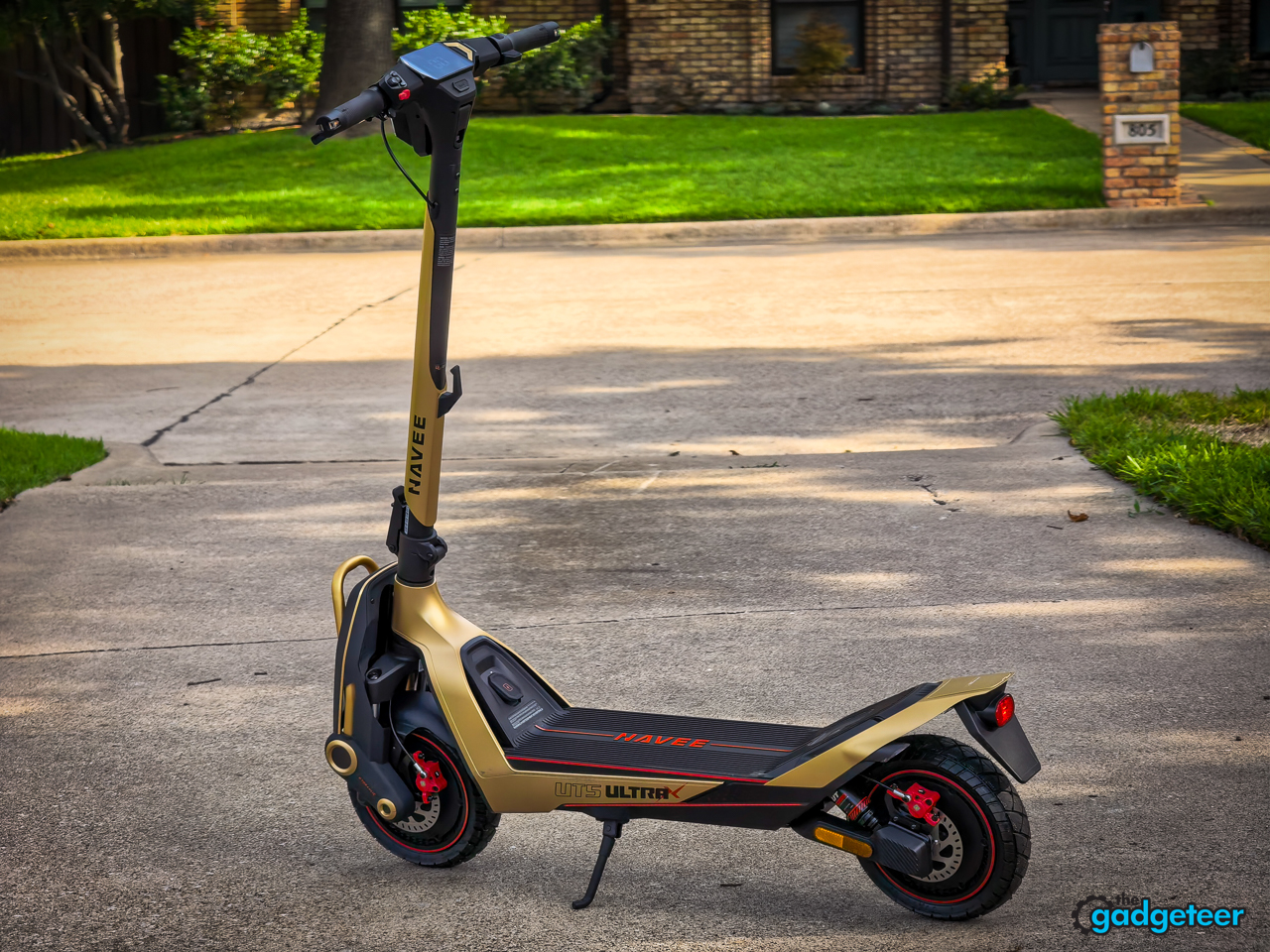
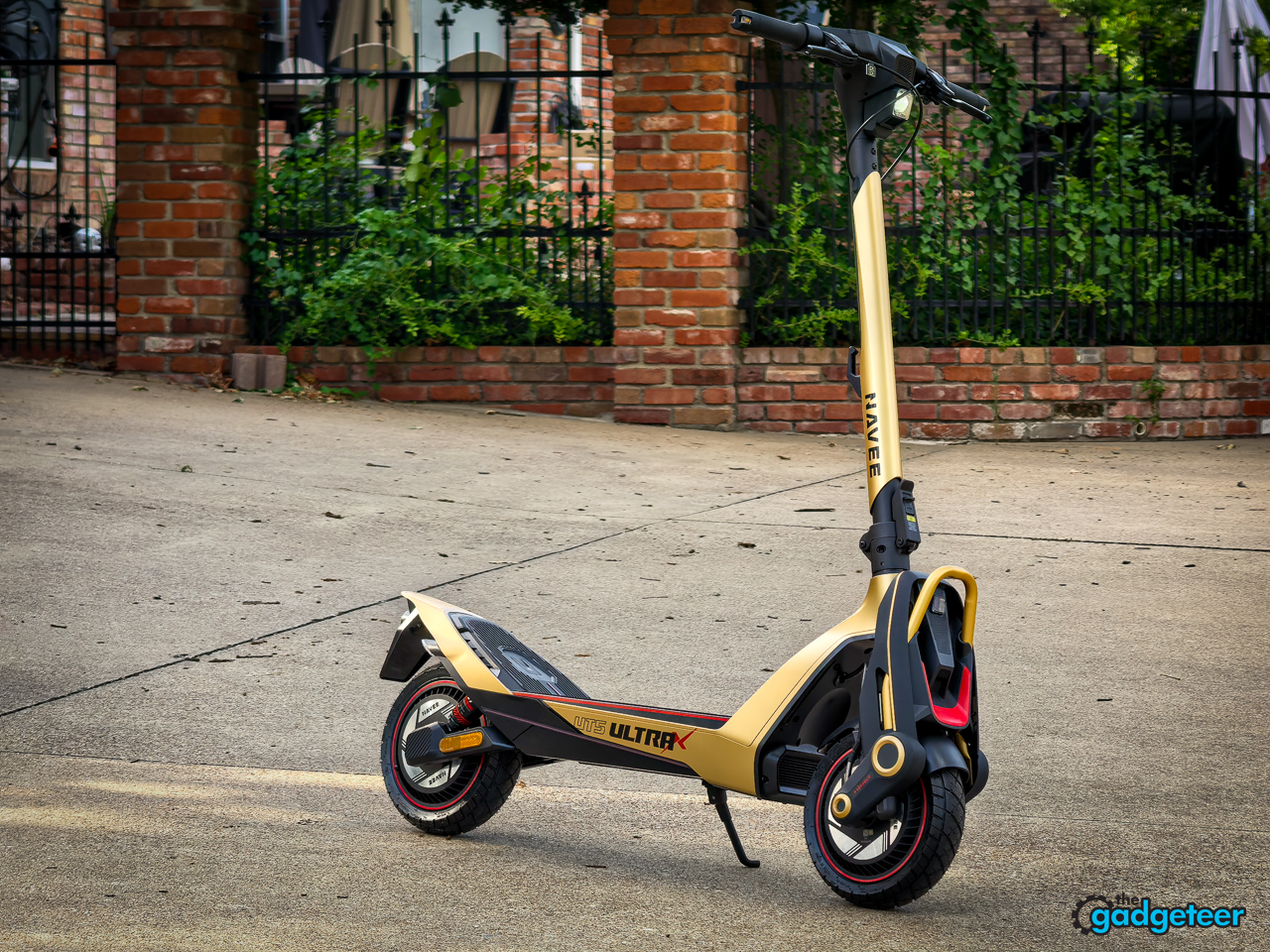
The Ultra X looks serious before you switch it on. Its wide deck, thick stem, large tires, exposed suspension, hydraulic brake hardware, and gold accents give it a planted stance that smaller commuter scooters can’t fake. The automotive-grade steel frame and large proportions make the scooter feel built around speed and stability rather than portability.
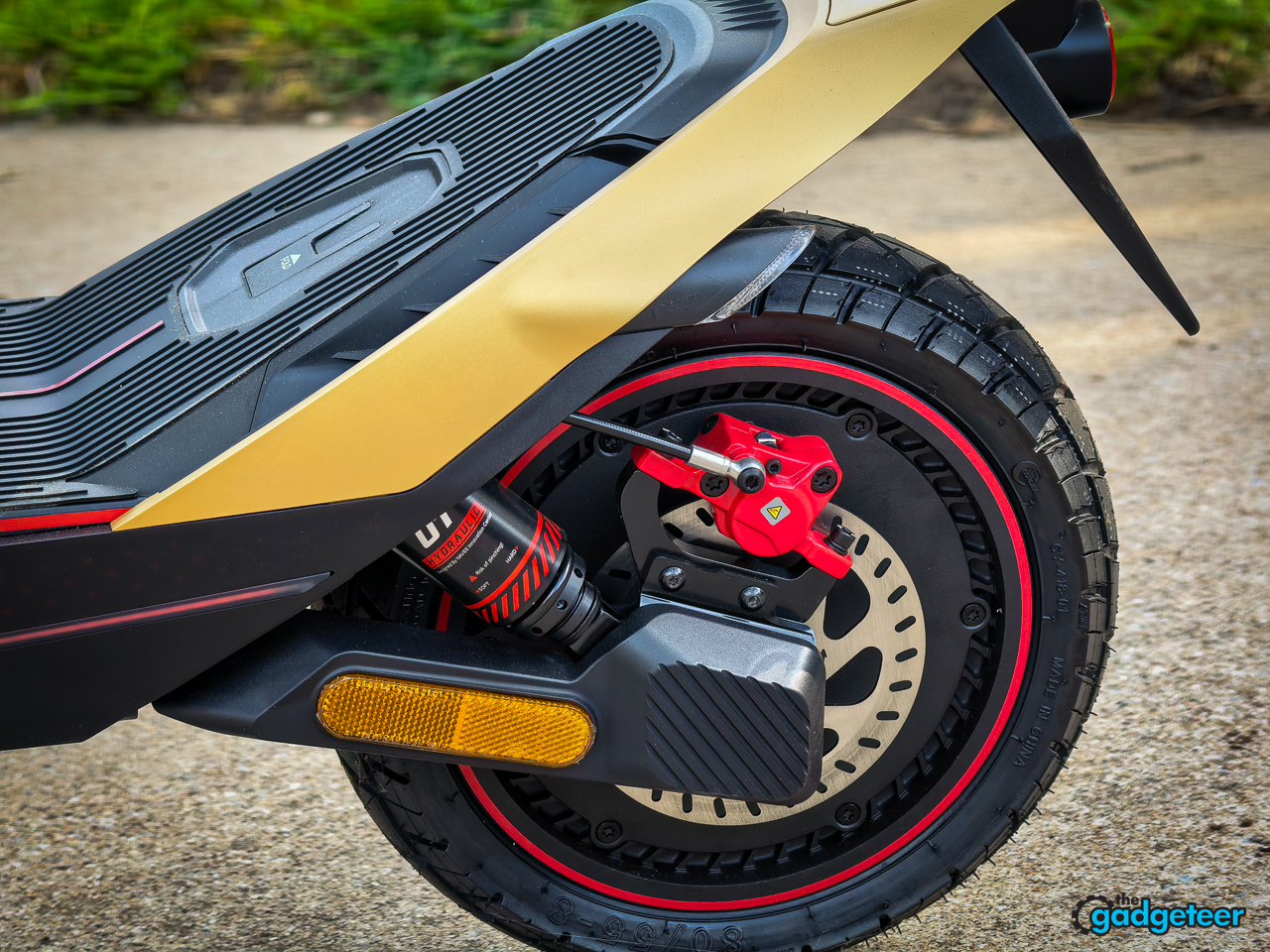
That approach worked for me while riding. The 12-inch tires and long chassis gave the scooter a calm, substantial feel, and the broad deck left room to shift my stance instead of locking my feet into one position. The physical size also demands more space for slow turns, parking, and storage than photos suggest.


NAVEE’s consumer product page lists the unfolded dimensions as 1,258 by 620 by 1,345 mm, a folded height of 650 mm, and a net weight of 90.4 pounds. Its current U.S. Important Information PDF differs slightly, listing dimensions of 1,252 by 620 by 1,358 mm, a folded height of 645 mm, and a net weight of 89.3 pounds. The product page also advertises 43 mph, while the PDF rounds the maximum speed to 44 mph. These small discrepancies do not change the ownership conclusion: this is roughly a 90-pound scooter that demands substantial storage and handling space.
Daily ownership is the deciding factor
The Ultra X works best when it can live on the ground floor near a secure charging location. Carrying it up stairs gets old immediately, and lifting 90.4 pounds into a vehicle isn’t a casual one-person task for many owners. The folding system shortens the package, but it doesn’t change the mass.
Parking requires a plan as well. Apple Find My, Bluetooth locking, and the frame locking point are useful layers, yet none of them make exposed street storage low risk. At this price, I’d want a substantial physical lock and a destination where the scooter doesn’t sit unattended for long periods.
Service support is better documented than I expected. NAVEE maintains a UT5 Ultra X support hub with manuals, repair assistance, parts routes, and videos for jobs such as front wheel replacement. The safety document also states that the battery and high-voltage components aren’t user-serviceable, which is the right boundary for fire and electric shock risk.
What surprised me
The Ultra X felt less intimidating once moving than it did while parked. Its large tires, suspension, and substantial chassis give it a planted character on the road, but maneuvering it through a confined space or preparing to load it into a vehicle exposes the cost of that stability. The folding mechanism changes its shape, not its portability.
Controls, display, and riding modes
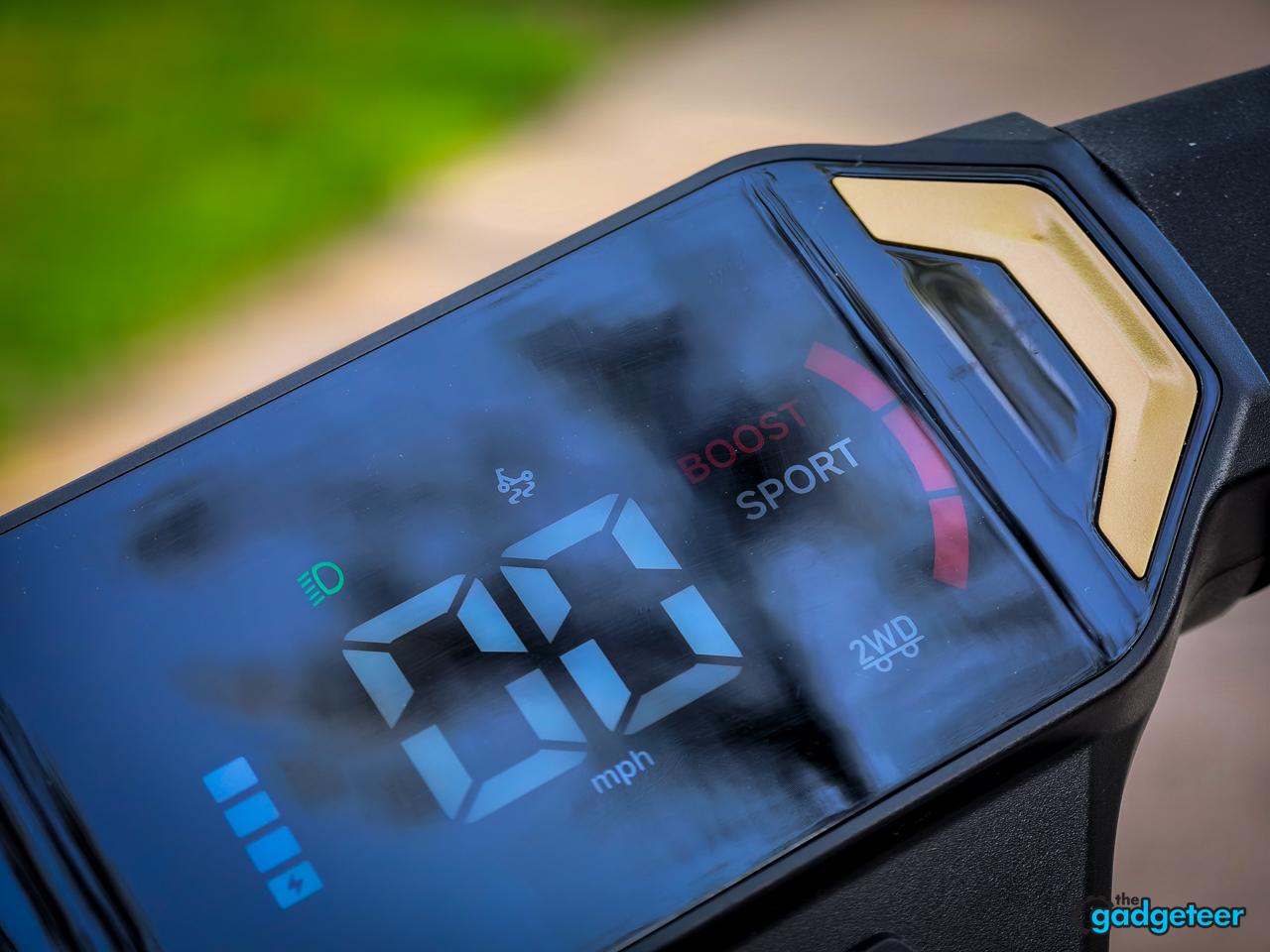
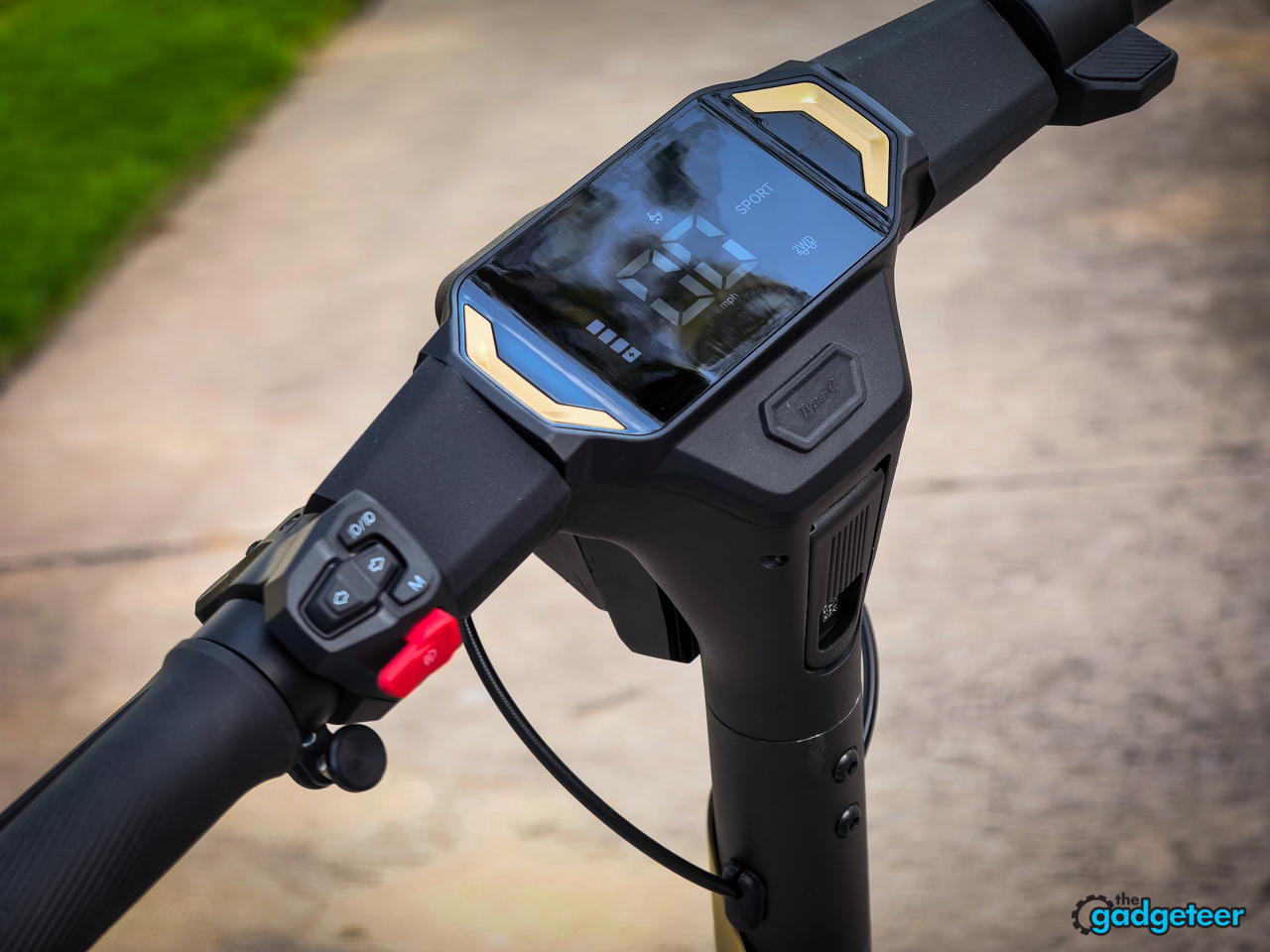
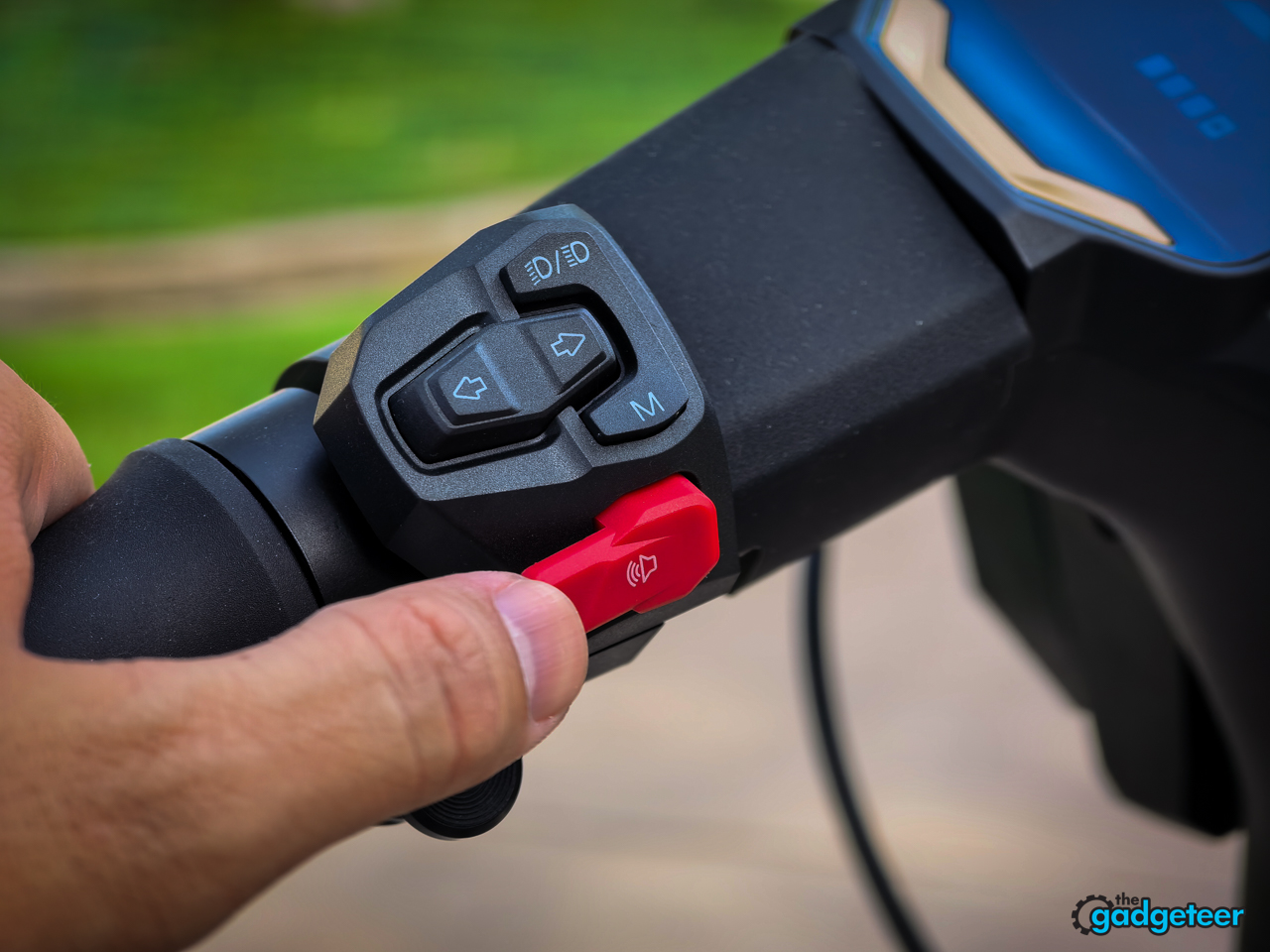
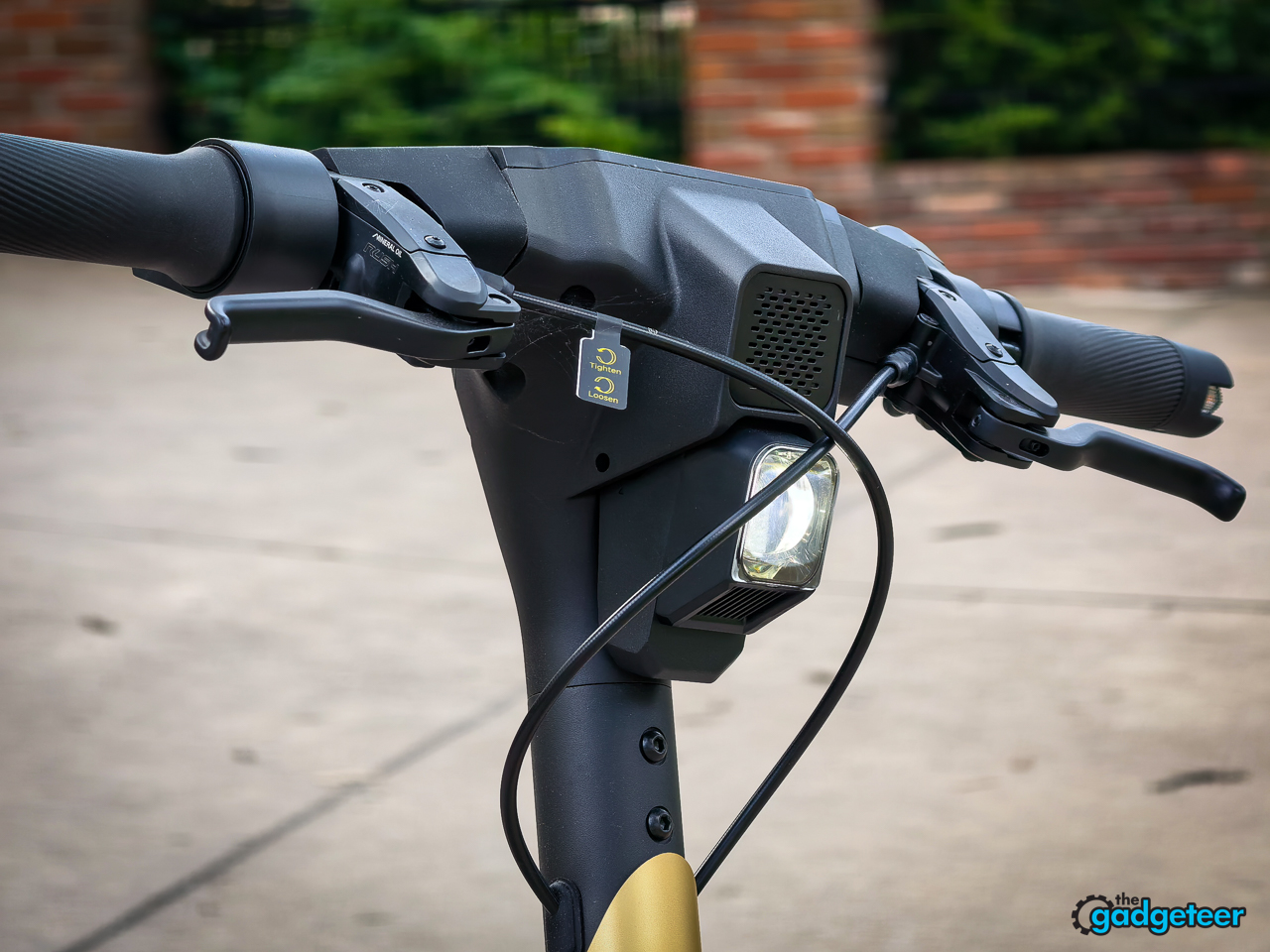
The 5-inch display is easy to read at a glance. It shows speed, battery level, riding mode, signals, lights, Bluetooth, traction control, two-wheel drive, lock state, temperature warnings, and system faults. Physical controls handle the horn, headlights, turn signals, riding modes, Boost, and two-wheel drive, so basic functions don’t require the app.
Four modes shape the experience:
- Walking: For moving the scooter at pedestrian speed
- Eco: Calmer acceleration and reduced performance
- Sport: Full-speed riding with more measured acceleration
- Boost: The same maximum speed as Sport with a harder initial response
The manual recommends Boost only after you’ve mastered the basic controls. I agree. The accelerator normally engages once the scooter reaches 1.9 mph, although the threshold is adjustable in the app. On the U.S. model, lowering that threshold activates Park mode at startup. Squeeze the brake lever or press the power button to exit Park.
App, locking, and tracking
The NAVEE app handles activation, locking, ride settings, traction control, hill assist, and other configuration options. Setup and pairing worked as expected for me, and I had no issues activating the scooter or using the app. Activation is required before normal use. Until the scooter is linked in the app, it remains limited and continues to beep, so setup isn’t optional if you want the full product.
Bluetooth proximity unlocking also worked as expected during my testing. NAVEE calls the system FlyLock: the scooter can unlock as you approach and lock as you walk away. That removes one small bit of friction, but it doesn’t replace a physical lock or secure storage. A software lock can discourage casual use; it can’t stop someone from lifting the scooter into a vehicle.
NAVEE lists Apple Find My support for iPhone owners. Treat it as a useful location feature, but not as a substitute for a physical lock or secure storage.
Power and acceleration
The Ultra X has more power than most riders need for routine trips. Two-wheel drive provides the shove that defines the experience, while the different modes let you calm the scooter down when full output would be wasteful or inappropriate. I preferred treating the upper modes as tools for specific situations rather than leaving the scooter at maximum aggression all the time.
Acceleration feels immediate, and the machine’s weight keeps that response from feeling like a toy. The tradeoff is that small control mistakes carry more consequence. The highest speed I saw during testing was approximately 37 to 38 mph, short of NAVEE’s 43 mph rating for the U.S. model. I didn’t verify the display against a separate GPS device, but the experience was equal parts thrilling and terrifying. Compared with reaching a similar speed on a bicycle, standing over the Ultra X’s smaller wheels made the speed feel more exposed, even though the substantial chassis remained composed. A scooter capable of this speed changes where you can safely ride, how far ahead you need to look, and what protective equipment makes sense.
NAVEE’s 46 percent grade figure is a manufacturer rating, not a promise for every rider, surface, or battery level. I rode the Ultra X up and down a couple of grassy hills that I estimated at roughly a 30-degree incline. I did not measure the grade, so this wasn’t a controlled climbing test, but the scooter handled those slopes without hesitation or any obvious struggle. The dual motors and traction technology felt solid throughout.
Ride quality and handling
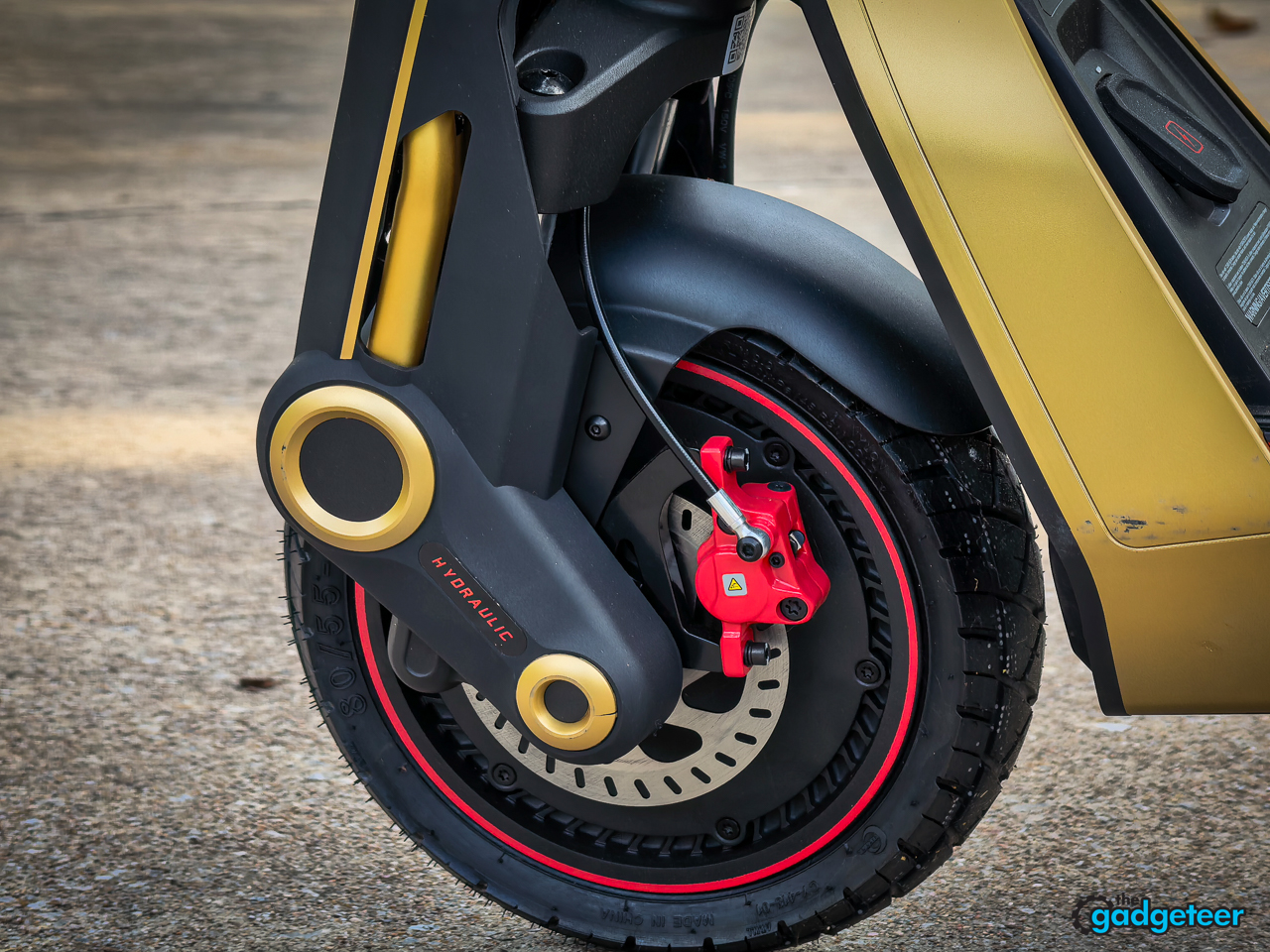
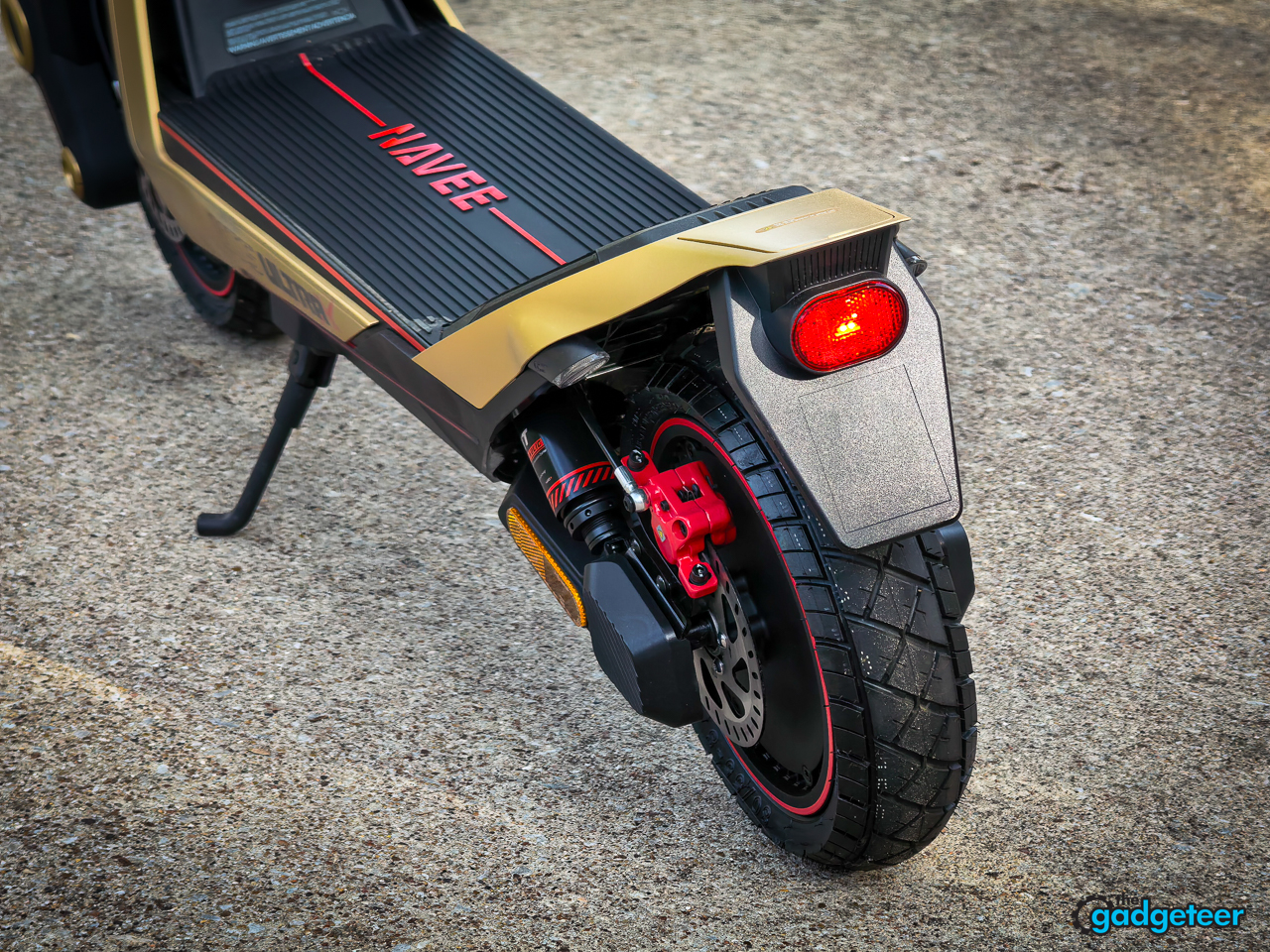
The chassis is the strongest part of the Ultra X’s argument. Large pneumatic tires roll over rough pavement with more confidence than the small wheels found on many commuter scooters, while the front and rear hydraulic suspension take the sharpness out of broken surfaces. The rear suspension also includes damping adjustment for different surfaces.
At speed, the scooter’s size and weight help it feel settled. At walking pace, those same traits make tight turns and repositioning more work. That split personality is easy to miss on a spec sheet: a machine can feel reassuring once moving and cumbersome when you need to thread it through a garage or turn it around in a narrow space.
Traction control helps limit excessive wheel slip during starts, acceleration, and turns. You can switch it through the app. I’d leave it active for normal riding unless you have a specific reason and a controlled place to change that setting.
Brakes, lights, and visibility
Hydraulic disc brakes at both wheels, backed by EABS, are the right class of hardware for a scooter with this speed and mass. I had no complaints about their performance. The brakes felt solid, controlled, and stable, even when I needed to slow hard from higher speeds.
I test cars for a living, including high-end performance vehicles. In terms of confidence, modulation, and the sense that the chassis remains composed under braking, the Ultra X delivered the kind of response I expect from premium machinery such as a Porsche or Lamborghini. That is a comparison of control feel, not stopping distance or automotive brake hardware.
A scooter rated for 43 mph needs serious braking power. Actual stopping distance will still change with speed, rider weight, tire condition, road surface, and weather, so leave more room than you would on a small commuter scooter.
Visibility hardware:
- 6W low beam and 12W high beam
- Front and rear turn signals
- Tail and stop lamp
- Side reflectors
- NAVEE’s 360-degree visibility system
A handlebar button switches between the low and high beams without opening the app, while separate buttons control the indicators.
The manual warns that wet conditions increase braking distance and advises riders to slow down in darkness. Those cautions carry extra weight here because 43 mph closes distance quickly. Visibility hardware helps, but it doesn’t make poor weather or an unsuitable route safe.
Range and charging
What NAVEE claims: 74.6 miles at 9.3 mph or 37.3 miles at 24.9 mph. Both figures come from controlled tests, and neither represents sustained riding at maximum speed. Speed, hills, wind, temperature, stops, tire pressure, and rider weight all affect range.
What I experienced: I never ran the battery to empty. My regular destinations were the park and tennis courts about two miles away and downtown roughly 1.5 miles away. Those trips were too short to make range a practical concern. The Ultra X proved itself as short-trip transportation, but my riding does not validate NAVEE’s published range figures.
For faster routes, the 37.3-mile figure is the more relevant of NAVEE’s two tests. Plan around your normal pace and leave reserve for detours, weather, and battery aging.
Charging: I used only the included charger and needed it just a few times. I did not time a complete charge from empty. NAVEE lists six hours for a standard charge and three hours for a “flash charge,” but its product page doesn’t identify the required fast-charging hardware or say whether it’s included.
The charger LED changes from red to green at completion. Charge indoors, keep the charger dry, and avoid temperatures below 32 degrees Fahrenheit or above 104 degrees Fahrenheit. A battery stored for about a month below 30 percent can enter sleep mode and may need a few seconds on the charger to wake.
Water resistance, maintenance, and warranty
The IPX6 rating reduces water risk, but it is not permission to ignore weather. NAVEE says to avoid bad weather, never charge a wet scooter, store it indoors, and stop using the battery if water intrusion is suspected.
Before every ride, check:
- Folding mechanism and steering
- Brake operation and hardware
- Wheels, tire condition, and pressure
- Axles and visible fasteners
At this speed, maintenance lapses have little room to hide.
Warranty at a glance:
- 24 months: Frame, motors, hub, controller, fork, suspension, folding assembly, and stem
- 12 months: Battery, lights, throttle, charger, and several electrical parts
- 3 months: Wear items including brake parts and tires
Misuse, unauthorized changes, poor storage, crashes, and several forms of water exposure are excluded.
Price and competition
The Ultra X has to be judged as a vehicle purchase rather than an impulse gadget, whether at its $2,499.99 regular price or the $2,299.99 sale price shown when this review was fact-checked. The hardware helps justify the price: dual motors, a large battery, hydraulic suspension, hydraulic brakes, 12-inch tires, traction control, app controls, and Apple Find My are all useful rather than decorative.
Value still depends on how much of that hardware you can use. I didn’t use the Ultra X for a regular commute, but its speed, stability, and short-trip range make it a formidable alternative to a bicycle for commuting to work or school, provided the route is legal and the destination offers secure parking. A rider limited to low-speed paths gains little from a 43 mph ceiling, and an upstairs apartment can turn the weight into a daily punishment. A smaller 20 to 25 mph commuter may provide a better ownership experience even if its specification sheet looks less exciting.
Our earlier CES 2026 coverage of the UT5 Ultra X focused on NAVEE’s claim that a scooter could replace short car trips. Living with the production model sharpened that idea: the Ultra X can support that role, but only if your route, storage, security, and local laws support it as well. You can find more of our electric scooter coverage here.
Who should buy the NAVEE UT5 Ultra X
The best buyer is an experienced adult rider with secure ground-floor storage, a legal and suitable route, protective gear, and a real reason to choose stability and power over portability. It also fits someone replacing specific short car trips where the destination offers secure parking.
Skip it if you live upstairs, combine a scooter with public transit, need to lift it into a small car, lack a secure charging area, or ride where local rules cap performance far below what you’re paying for. New riders should also start with something lighter and slower before considering this much machine.
The Gadgeteer’s take
The NAVEE UT5 Ultra X delivers the stability, hardware, and power that its size promises. It feels more convincing as a compact personal vehicle than as a commuter scooter, and that’s both its appeal and its limitation.
I’d buy it only with secure ground-floor storage, a route that lets me use it legally, and a clear plan for locking and charging at the destination. Meet those conditions and the Ultra X can replace short car trips. If I were spending this much on a high-end electric scooter, this is the model I would recommend. Miss those conditions and its 90.4-pound reality can overpower the thrill of its 43 mph potential.
NAVEE UT5 Ultra X: $2,499.99 list price, $2,299.99 when this review was fact-checked. Check current pricing and availability at NAVEE.
The sample for this review was provided by NAVEE. NAVEE didn’t have a final say on the review and didn’t preview the review before it was published.
FAQ
How fast is the NAVEE UT5 Ultra X?
NAVEE lists a 43 mph maximum speed for the U.S. model. Actual speed depends on rider weight, battery state, terrain, temperature, tire pressure, mode, and local restrictions.
How much does the NAVEE UT5 Ultra X weigh?
NAVEE’s product page lists the scooter at 90.4 pounds, while its current U.S. Important Information PDF lists 89.3 pounds. Either way, the folding mechanism helps with storage, but most owners won’t consider it portable.
Does it support Apple Find My?
NAVEE lists Apple Find My support for the UT5 Ultra X. Buyers should confirm the current setup and supported features with NAVEE before purchase.
Is the NAVEE UT5 Ultra X waterproof?
It has an IPX6 water-resistance rating. NAVEE still advises against bad-weather riding, wet charging, deep water, pressure washing connectors, and outdoor storage.