Meta Ray-Ban gets the magazine covers. Amazon’s smart-glasses category gets everyone else. And “everyone else” is doing more interesting work than the headlines suggest. AI assistants on open-ear frames, real Micro-OLED AR displays, 4K POV camera frames, and built-in prescription audio glasses are all sitting one search away, often for half what the big names charge.
These six smart glasses are all in stock on Amazon right now, all from brands you probably haven’t heard your friends mention, and each one earns its slot by doing something the headliners either skip or overcharge for. Prices are accurate at the time of writing and shift constantly on Amazon. Verify before you click “Buy.”
Why look past the big brands
For this roundup, “big-name” means Meta, Ray-Ban, Apple, Google, Samsung, Amazon, and Bose: the brands that dominate smart-glasses coverage in 2026. Everyone else is fair game.
The pitch for Meta Ray-Ban is built-in cameras, polished design, and the Meta AI brand. The pitch for Amazon’s Echo Frames is Alexa-in-your-ears. Both are fine. Neither is the only answer.
What you give up by going with a smaller brand: brand cachet, some design polish, and in a few cases, the smoothest companion-app experience. What you gain: lower prices (often dramatically), more focused feature sets (AI-only, AR-only, audio-only), prescription compatibility on more models, and frames that don’t immediately read as a tech product to everyone you walk past.
If you want a camera-first social wearable from a household name, Meta Ray-Ban still wins. If you want AI in your ears, an AR HUD, a hands-free POV camera, or built-in prescription audio frames, read on.
1. Lucyd Lyte (2025 Version): Best for ChatGPT on a budget

Price: $99
Where to Buy: Amazon
Lucyd has been the quiet workhorse of audio smart glasses for years, and the Lyte (2025 Version) is its most refined release to date. The frames look like ordinary acetate sunglasses or optical frames (there’s no obvious tech tell), and the open-ear speakers are tuned well enough that you can take a call on the sidewalk without anyone nearby hearing the other side of the conversation.
The real headline: Lucyd’s companion app routes voice commands through ChatGPT, so you can ask actual questions and get actual answers, rather than the canned voice-assistant responses you get from older audio glasses. Most styles in the line are prescription-ready through Lucyd’s online lens service, which puts them well ahead of most competitors on the optical side.
- Best for: prescription wearers who want AI assistance without earbuds
- Watch out for: battery is rated around 12 hours of music playback and call time, with the rating dropping under heavy continuous use
2. Solos AirGo 3: Best for AI features
Price: $249
Where to Buy: Amazon
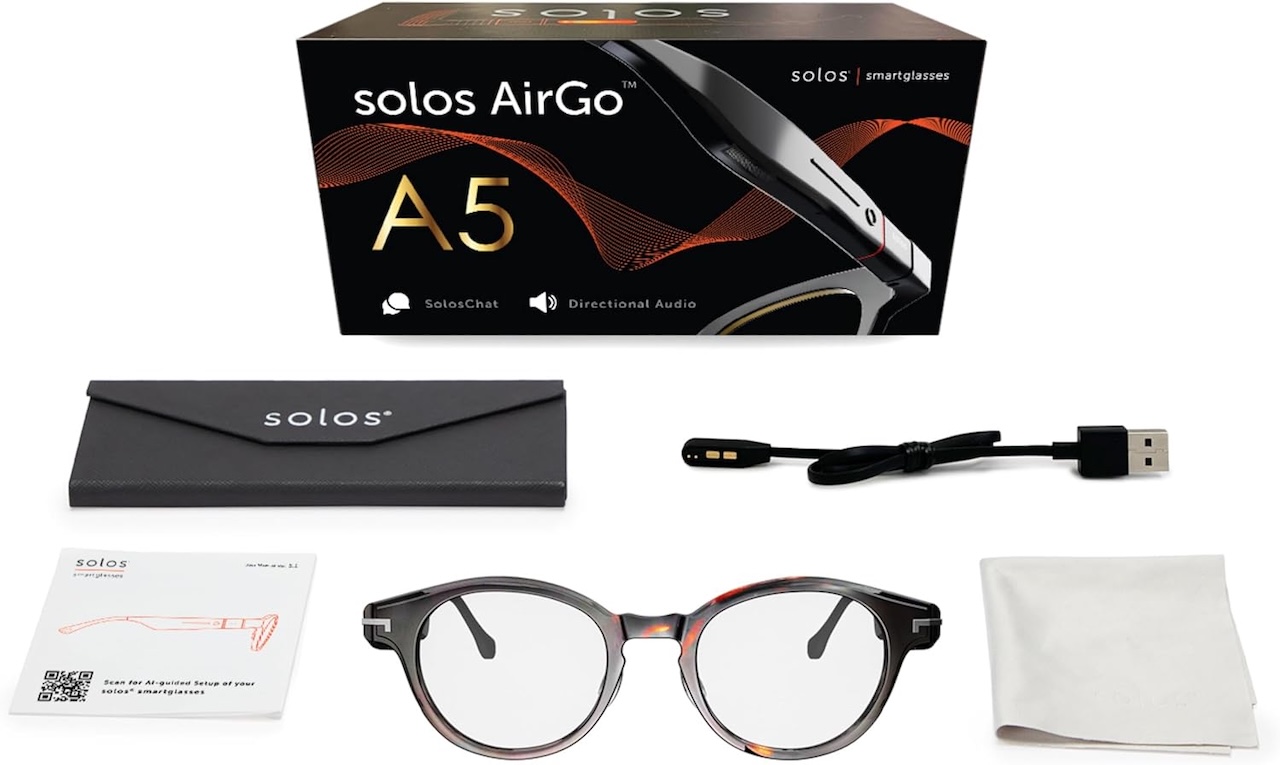
Solos’ AirGo 3 went hard on the AI angle before it was the obvious thing to do. The headline feature is SolosChat, which routes voice queries through ChatGPT and reads responses back to you through open-ear speakers, useful for translation, summaries, and quick “what is this thing in front of me” questions if you also use the phone-side image pipeline.
The SmartHinge system is the other reason to pay attention: the front frames detach from the temples, so you can swap looks (sport, optical, sun) without buying a second pair of electronics. Audio quality is competent rather than exceptional, but the AI integration and the modular hardware make these the most future-proof set on this list.
- Best for: early adopters who want LLM-powered voice features without waiting on Meta
- Watch out for: SolosChat ships with a 3-month premium Solos AirGo app subscription, then $9.99/month for extended ChatGPT history and watermark-free pasted AI content; basic voice assistant, messaging, and fitness tracking keep working without it
3. VITURE Luma Pro: Best for a private cinema on your face
Price: $499
Where to Buy: Amazon
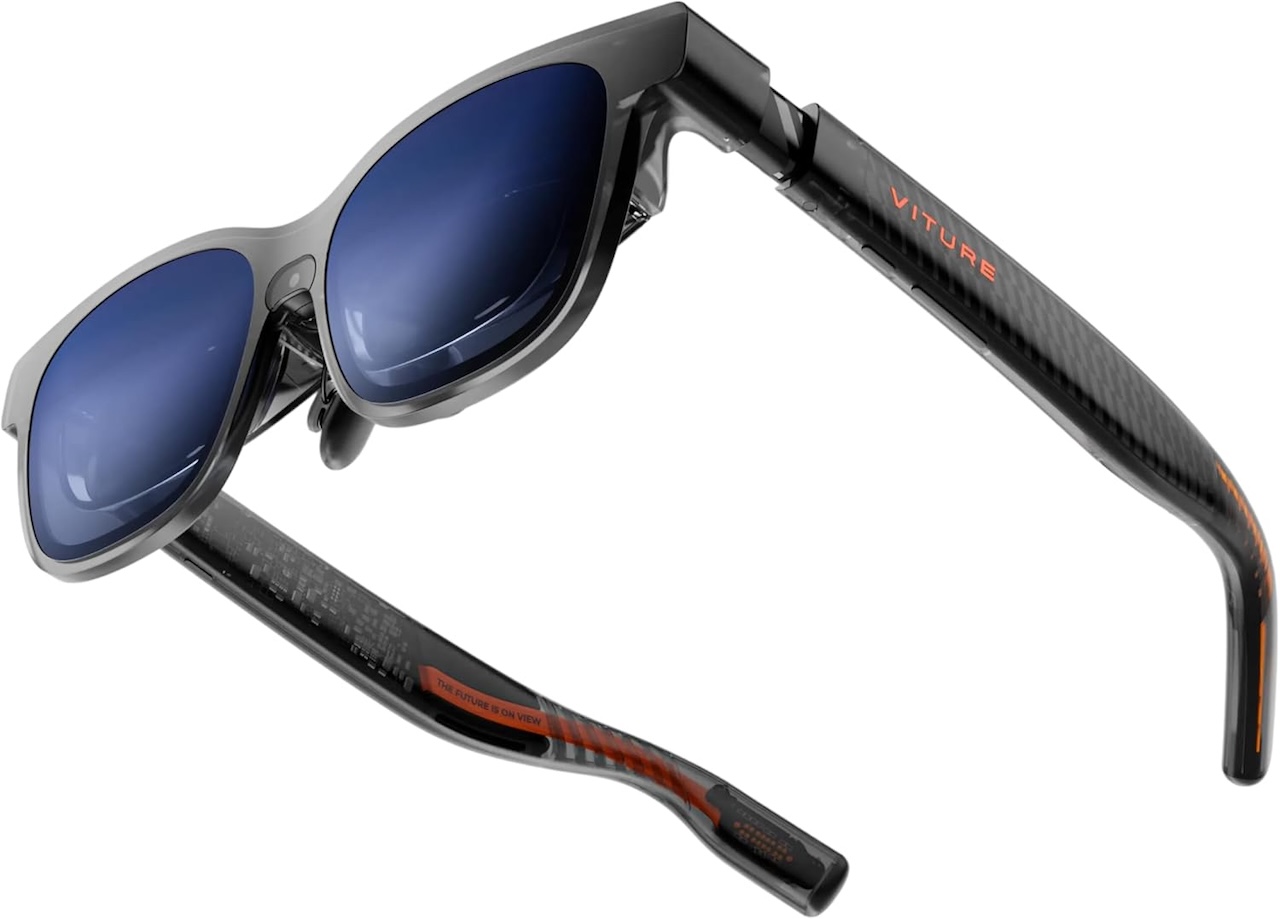
Most “smart glasses” don’t have a display. The VITURE Luma Pro does, and the display is the entire point. A pair of Micro-OLED panels projects a sharp 152-inch 1200p screen into your field of view at 1000 nits of brightness, running at a smooth 120Hz across a wide 52° field of view. There’s no battery and no operating system in the frames themselves: you plug into a USB-C source (iPhone with adapter, Android, Mac, PC, Steam Deck, Switch 2, or PS5 via HDMI adapter) and whatever’s on that screen shows up huge in front of you.
Two features set the Luma Pro apart from cheaper XR glasses. The first is an electrochromic dimming film that toggles between see-through and movie-theater dark with a button press, so the same frames work as a transparent productivity overlay on a flight and as a fully blacked-out movie session at home. The second is built-in myopia adjustment dials on each lens, so most nearsighted users can skip prescription inserts entirely. Audio is Harman-tuned open-ear, and the frames stay light enough for long sessions.
- Best for: travel cinema, big-screen gaming on a handheld or console, and second-monitor productivity without a desk
- Watch out for: these are a tethered display, not standalone glasses, so you need a compatible USB-C source device, and runtime depends on whatever you’ve plugged into
4. BooaBei AI Smart Glasses: Best for AI camera frames under $120
Price: $119.99
Where to Buy: Amazon
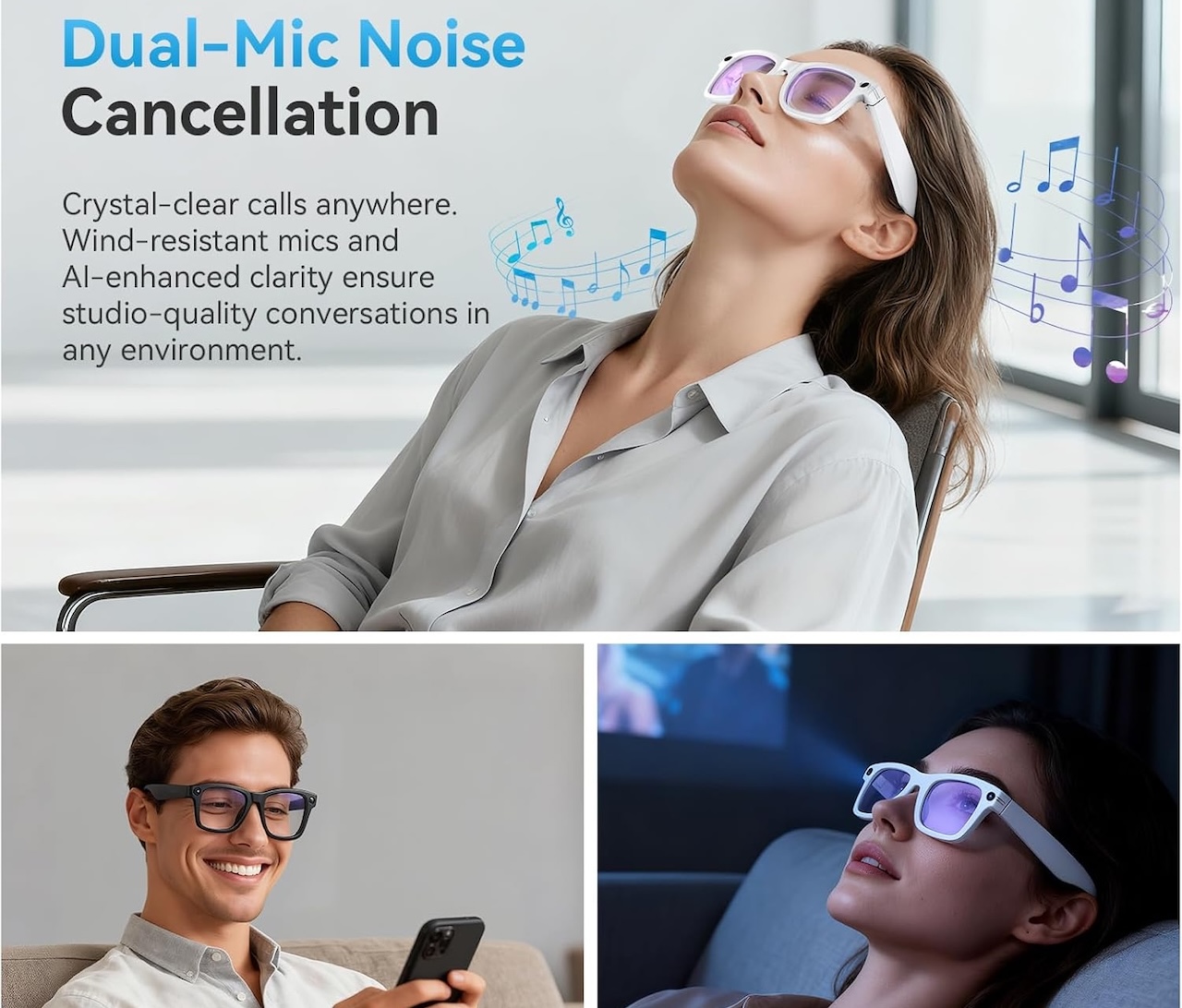
BooaBei is one of the small Amazon-only listings turning out feature-stacked AI smart glasses for a fraction of what the big names charge. The same hardware appears under several near-identical storefronts (the listing is sold by DEMAIB), so treat “BooaBei” as a SKU label more than a coherent brand. The headline spec is the 8MP 2K camera, paired with a GPT-4.0-powered voice assistant routed through the BooaBei companion app (iOS and Android). Say “Hello Xiaocheng,” ask a question, and the answer plays back through the open-ear speakers.
The supporting spec sheet runs unusually deep for the price: Bluetooth 5.3 with dual-mic beamforming, a 270mAh battery rated north of 12 hours of music playback, and IP67 waterproofing. The magnetic lenses swap tool-free between blue-light, transition, and clear, and the built-in translation flow runs “listen, translate, replay” for face-to-face conversations in seconds.
- Best for: Budget buyers who want a camera, GPT-style voice, and translation in one frame
- Watch out for: Amazon currently flags this listing as a “frequently returned item,” and Android users may need to install the companion app from outside Google Play; scan recent reviews and confirm sizing before committing
5. OhO sunshine Edge Pro: Best for hands-free 4K POV video
Price: $149.99
Where to Buy: Amazon
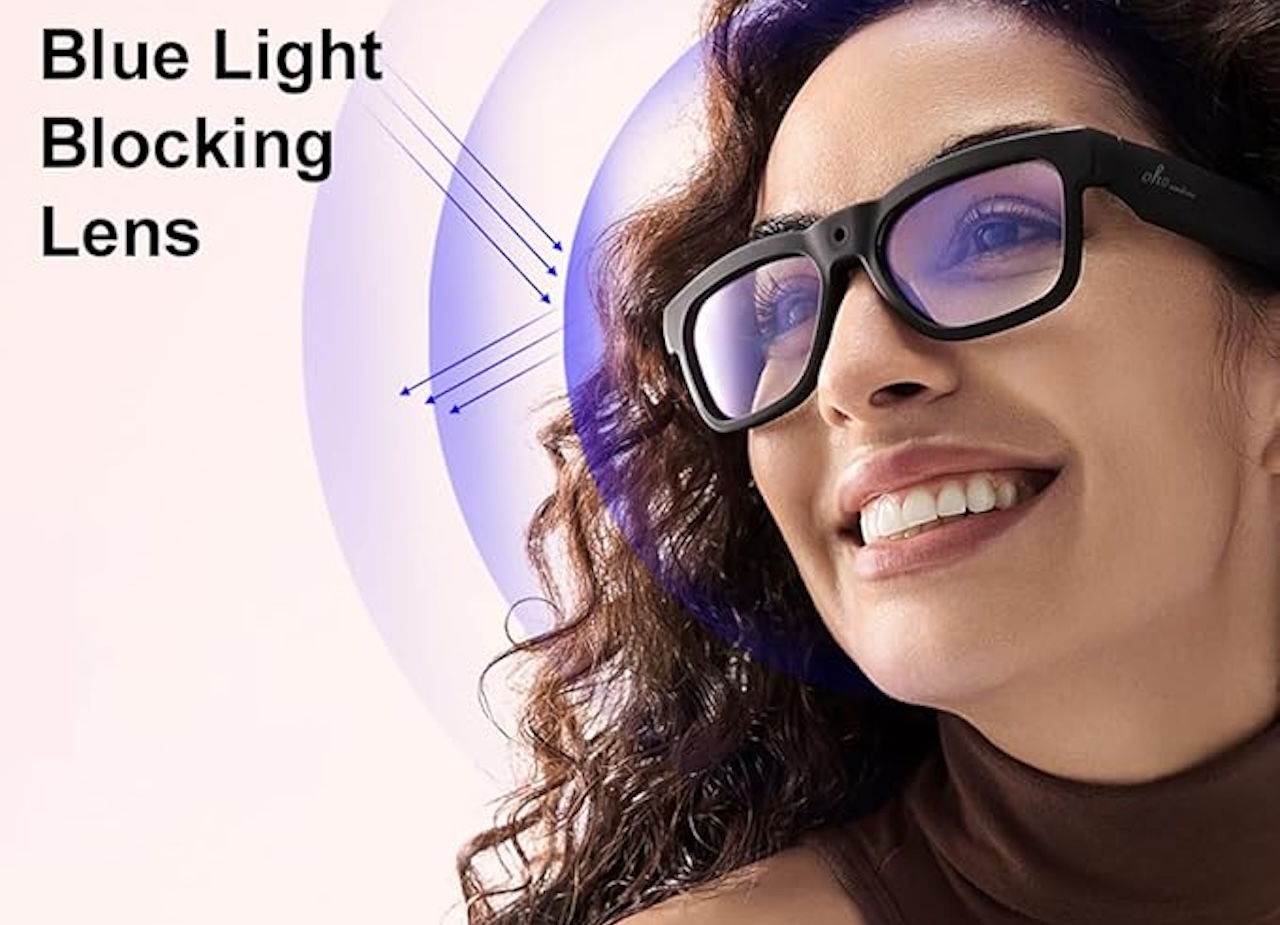
The OhO sunshine Edge Pro (model A31pro) is built around one specific job: capturing 4K video from your face without a phone in your hand. The camera writes to 64GB of built-in storage (roughly 5 hours of recording per OhO’s listing, less at sustained 4K bitrates), the USB-C port lets you record while charging from a power bank for marathon sessions, and the lightweight TR90 square frame keeps the whole package to about 41 grams.
Audio and Bluetooth 5.3 are along for the ride: open-ear speakers handle music and calls, voice-assistant support routes through Siri, Google Now, or Cortana, and OhO’s companion app covers two-way translation across 164 languages. The polarized lenses block blue light, hit 100% UV400 protection, and swap for tinted or clear alternates; per OhO’s product FAQ, clip-on prescription inserts are supported on most frames in the line.
- Best for: Vloggers, cyclists, and POV creators who want a sub-$200 4K capture device shaped like sunglasses
- Watch out for: Review count is still small at the time of writing
6. IOOIOO AI Smart Glasses: Best for built-in prescription AI audio
Price: $69.99
Where to Buy: Amazon
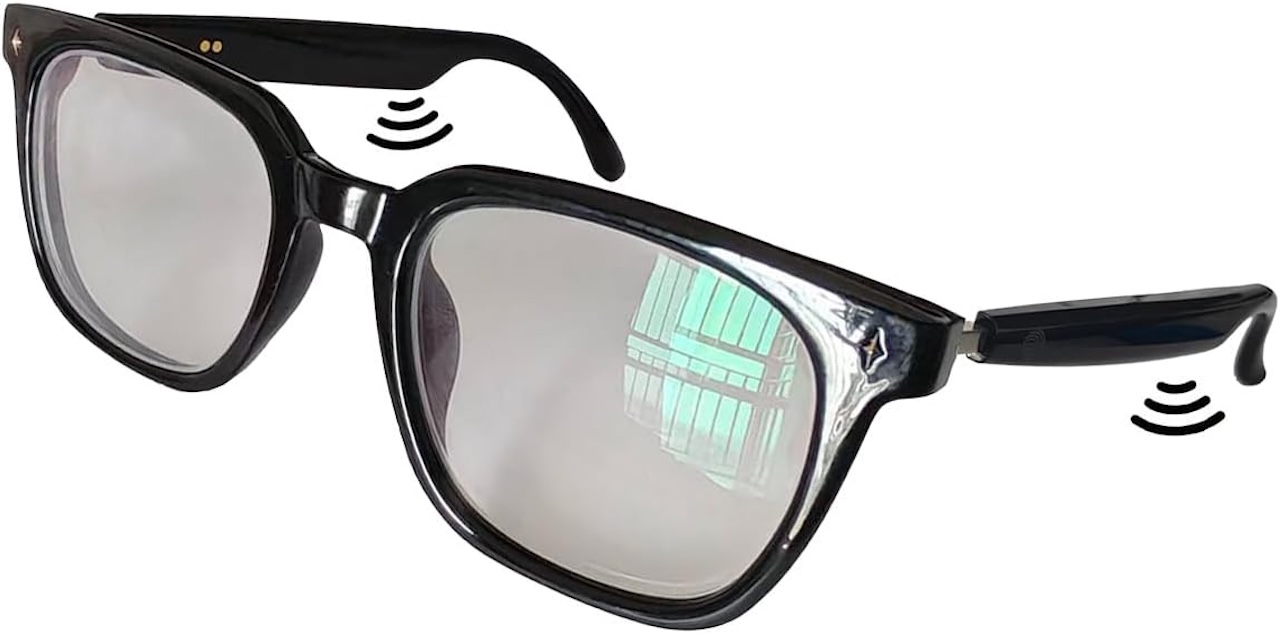
The IOOIOO AI Smart Glasses are the most narrowly targeted set on this list. The small Amazon brand sells frames with built-in nearsighted lenses in standard nearsighted powers (the listing also offers a SPH:0 bluelight-blocking-only variant), letting you select your prescription strength at checkout instead of routing through an optician. (Farsighted options are sold separately through the same storefront.)
The electronics side is deliberately minimal: open-ear Bluetooth speakers in the temples (rated for several hours of playback per the seller), direct voice access to ChatGPT and Google Gemini through a companion-app integration, and basic face-to-face multilingual translation supported via a companion app. There is no bulky camera, no complex AR display, and no hidden monthly subscription. If you’ve been holding out on smart glasses because every mainstream option requires an expensive prescription insert or a third-party lens swap, these get you to the finish line for under $70.
- Best for: Mild-to-moderate myopic buyers who want AI audio features without an optician detour
- Watch out for: Per-SPH stock at the listing level is often very limited, and IOOIOO doesn’t publish a hard maximum SPH on the smart-glasses listing, so anyone with a stronger script should confirm the available range with the seller before ordering. Similar-spec AI glasses frequently appear under rotating brand names across Amazon and Newegg; if this exact listing is unavailable, verify any alternate explicitly includes built-in nearsighted lenses, that unique feature is the actual reason this pick earns its slot.
Side-by-side: How the six picks compare
| Model | Best for | Display? | AI? | Audio type | Prescription-ready? | ~Price |
|---|---|---|---|---|---|---|
| Lucyd Lyte (2025 Version) | Budget AI audio | No | Yes (ChatGPT) | Open-ear speakers | Yes | $99+ |
| Solos AirGo 3 | AI features + modular frames | No | Yes (ChatGPT) | Open-ear speakers | Yes | $199–$249 |
| VITURE Luma Pro | Private cinema + XR display | Yes (Micro-OLED, 152″ 120Hz) | No (tethered display) | Harman open-ear | Built-in myopia dial | $499 |
| BooaBei AI Smart Glasses | Budget AI + 8MP camera | No | Yes (GPT-4.0) | Open-ear speakers | Swappable lenses (optician) | $119.99 |
| OhO sunshine Edge Pro | Hands-free 4K POV video | No | Voice assistant compatible | Open-ear speakers | Clip-on prescription inserts | $149.99 |
| IOOIOO AI Smart Glasses | Built-in prescription AI audio | No | Yes (ChatGPT + Gemini) | Open-ear speakers | Yes (built-in nearsighted lenses) | $69.99 |
How to choose
The cheat sheet, if you don’t want to read the full breakdowns again:
- If you wear prescription lenses and want AI in your ears, start with the Lucyd Lyte (2025 Version) starting at ~$99.
- If you want the most future-proof feature set, the Solos AirGo 3 with ChatGPT routing and SmartHinge frame swaps is the long-term play.
- If you actually want a giant display on your face, the VITURE Luma Pro projects a 152-inch 120Hz Micro-OLED screen from any USB-C device, with built-in myopia adjustment dials so nearsighted users can skip the prescription inserts.
- If you want a camera, GPT-style voice, and translation under $120, the BooaBei AI Smart Glasses stack the most features for the price.
- If you want a hands-free 4K camera shaped like sunglasses, the OhO sunshine Edge Pro writes to 64GB of onboard storage and supports record-while-charging.
- If you wear a mild myopic prescription and want AI audio without an optician visit, the IOOIOO AI Smart Glasses ship with built-in nearsighted lenses for under $70.
The bottom line
The big-brand smart glasses get the marketing budget. The brands on this list get the use cases the headliners haven’t gotten around to yet: AI on a $99 frame, a 152-inch private screen on a $399 frame, 4K POV video on a frame shaped like sunglasses, and built-in prescription AI audio for under $70. Amazon’s the easiest place to buy any of them, and most ship with the standard return window, so the cost of trying one is low.
Buy the Lucyd Lyte (2025 Version) first if you want a low-stakes entry into AI smart glasses. Step up to the Solos AirGo 3 if you want the broadest feature set. Go VITURE Luma Pro if you specifically want a giant private display on your face, BooaBei or OhO if you want a built-in camera, or IOOIOO if you wear a mild prescription.