
PROS:
- Wheels and pull handle make moving across job sites effortless.
- 1080P wide-angle camera captures clear footage in tight pipes.
- Modular build options let you pay only for needed features.
- Interface is clear enough to use without reading the manual.
CONS:
- Mystery cables ship in the box with zero documentation of purpose.
- Battery spec is buried in the manual instead of being advertised.
- Meter counter is only good for estimates, not precise billing work.
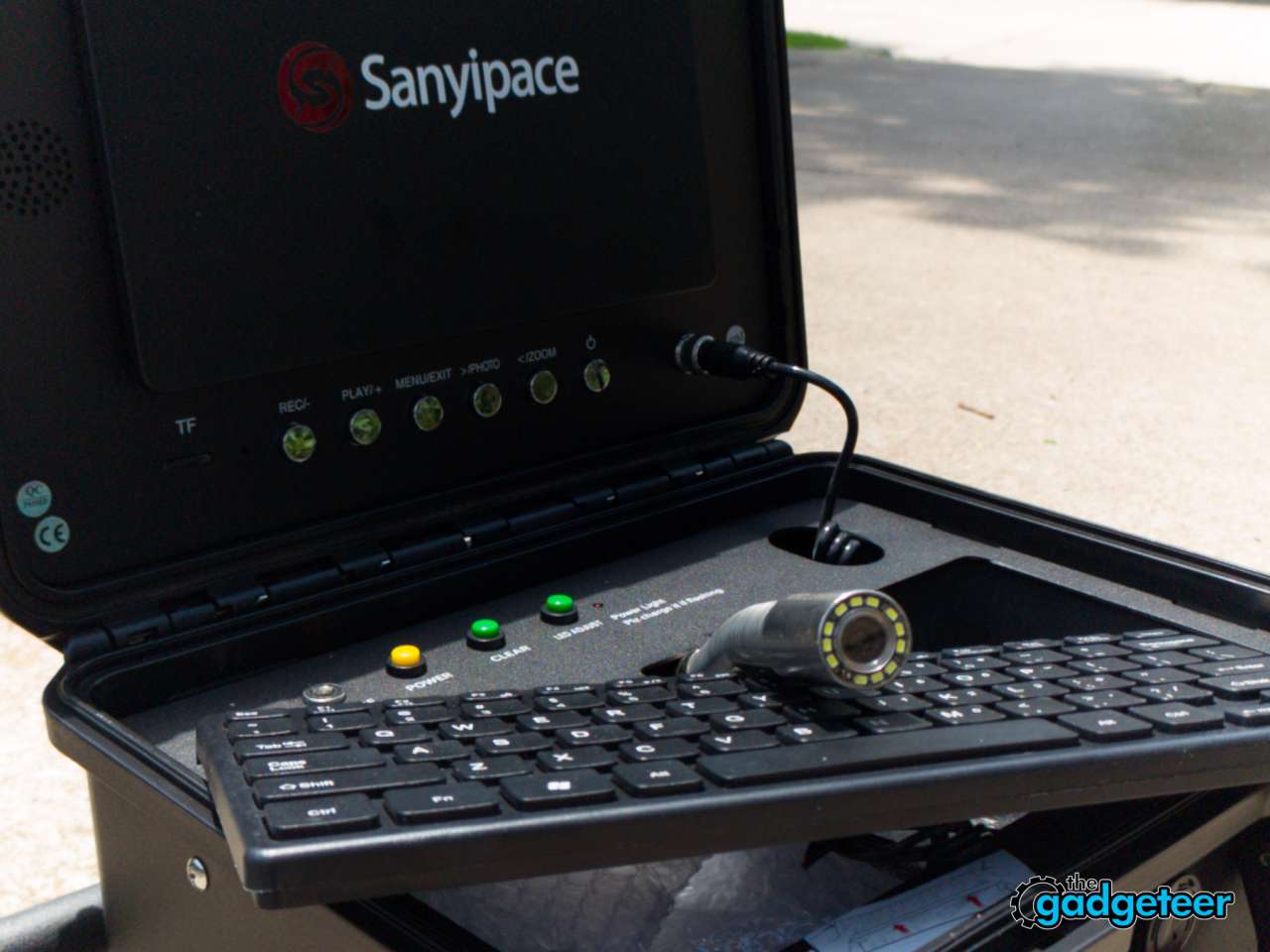
Most sewer cameras are a pain to move around. You lug a bulky case from the van to the crawl space, then wrestle the reel across gravel, mud, or concrete until you find the cleanout. The Sanyipace S860DSTKM Sewer Camera tries to solve that problem by adding a retractable pull handle and heavy-duty wheels to a fully featured pipe inspection system. At $849.88 for the base model (on sale from $1,099.99), it is not a budget impulse buy, but it sits in a sweet spot between bare-bones Chinese units and professional rigs that cost two or three times as much. My test unit came in closer to $1,250 because it has the bells and whistles: the 165 ft cable, self-leveling camera, and the wheeled frame.
Price: $849.88 (
Where to buy: Sanyipace | Amazon
If you are somebody who does drain inspections all day long, every day, you might want to spend $15,000 on a commercial-grade rig. But if you are like me and you might do it two or three times a year, maybe a little more, this is a good price range to get into. Here is what I found after running it through residential drains and a few PVC runs in my own house.
Specs at a Glance
- Screen: 10-inch integrated display
- Camera Resolution: AHD 1080P
- Waterproof Rating: IP68 camera head
- Camera Angle: 145 degrees
- Lighting: 12 adjustable LEDs
- Self-Leveling: Yes
- Meter Counter: Yes, with real-time distance tracking
- 512Hz Transmitter: Built-in
- Locator Options: None, S58R, or S68R (depending on configuration)
- Cable Length: 100ft/30M or 165ft/50M
- Coil Diameter: 0.20 inch (5mm) or 0.28 inch (7mm)
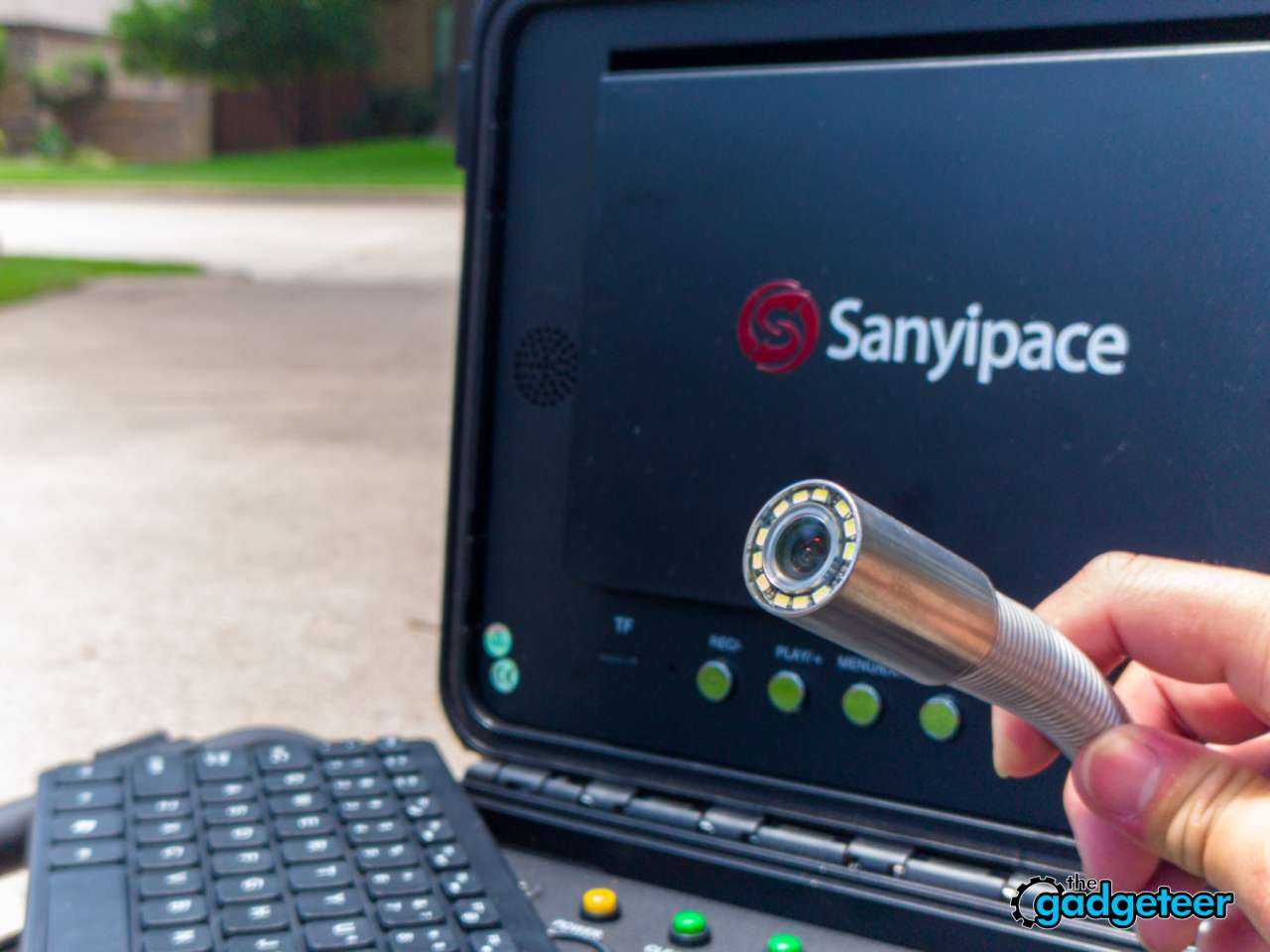
- Camera Head: 0.9 inch (23mm) diameter with spring assist
- Battery: 4500 mAh (not listed on the main product page, but confirmed in the spec sheet)
- Price: $849.99 to $1,349.99 depending on configuration (the fully loaded 165ft/7mm unit with locator runs closer to $1,250)
What’s In the Box
The S860DSTKM arrives in a reinforced carrying case with click-together latches that secure the lid. It houses the main control unit, the cable reel, the camera head, the charging accessories, a 32 GB SD card, spare O-rings for the camera head seal, three centering guides for different pipe sizes, a small plastic screwdriver, and a detachable USB keyboard that plugs into the side of the unit.
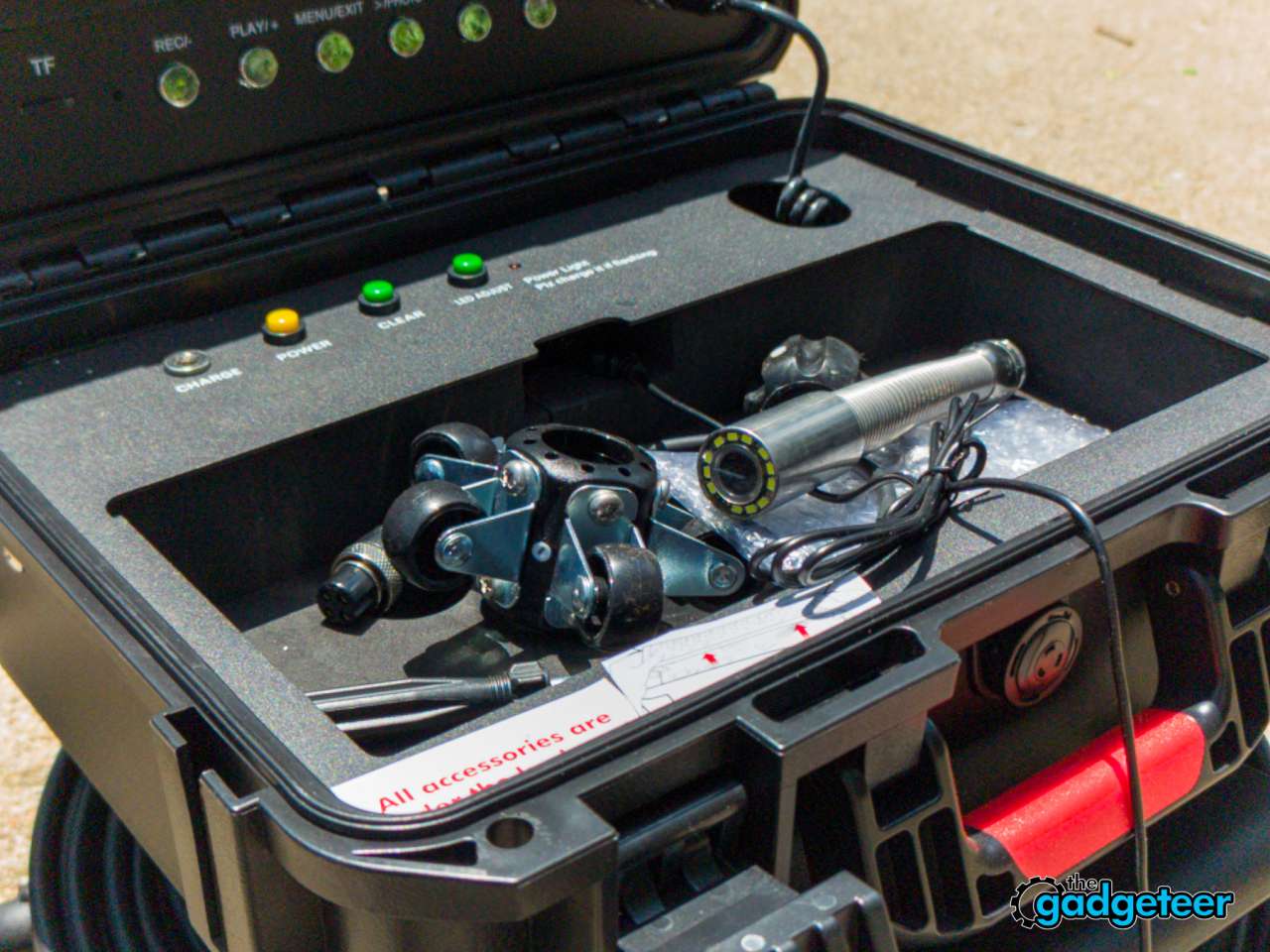
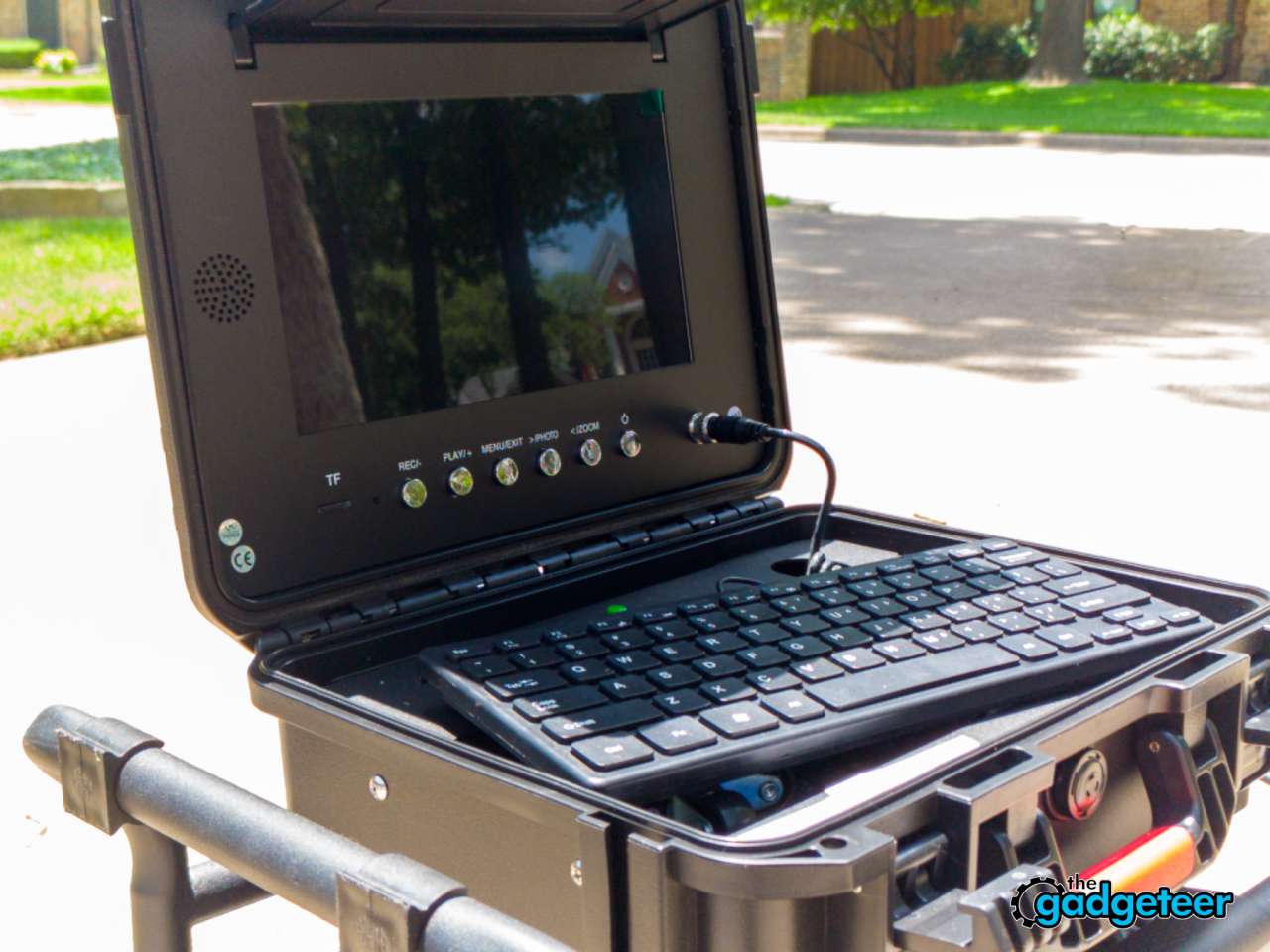
The first thing you notice is the integrated pull handle and the pair of wheels mounted to the reel frame. It is not a separate dolly or cart; the wheels are built into the reel assembly itself. That means you can tilt the unit back and roll it across a driveway or warehouse floor without breaking a sweat. The unit also has a flip-up shield that helps keep rain and sun glare off the screen. That is a nice touch that some cheaper models skip.
My base test unit came with the 165ft/50M cable, the 0.28 inch (7mm) coil diameter, and no external locator. The camera head is small enough to enter any pipe larger than 1.5 inches, and the spring-loaded tip makes it easier to navigate offsets and shallow bends without catching on the edge of a fitting.
There is a QR code on the unit that links to the English electronic manual, which is worth downloading before you buy. Sanyipace also includes two testing cables that I have not found a use for yet, and the manual does not explain what they do. That is a minor quibble, but the core accessories are what matter.
The Mobility Advantage
This is the headline feature, and it is the reason I wanted to test this unit. Most sewer cameras in the sub-$1,000 to $1,500 range are either handheld reels or rigid box units that you carry like a briefcase. After a full day of inspections, your shoulders and back notice the difference.
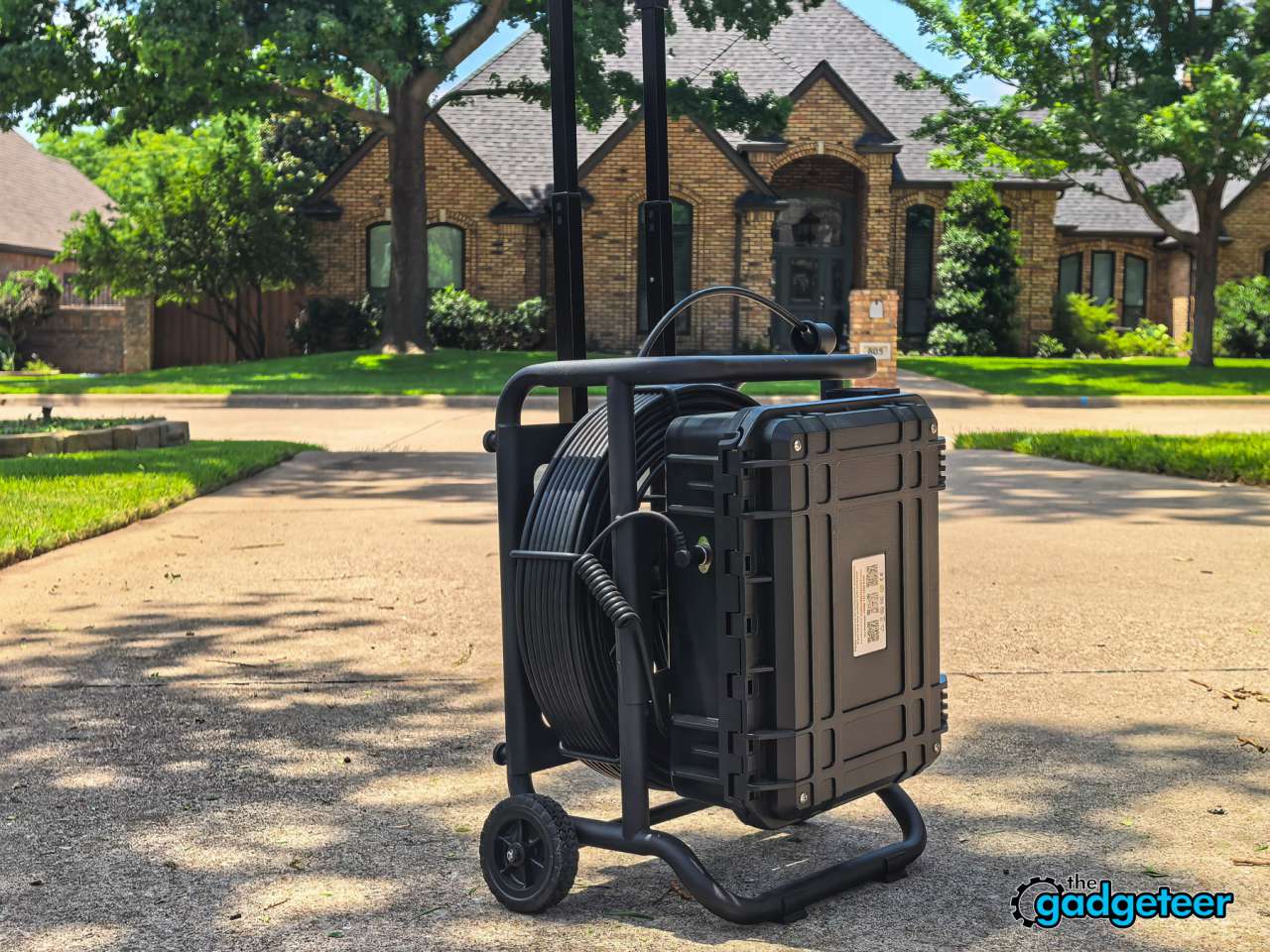
The S860DSTKM’s retractable pull handle locks at a comfortable height for walking, and the wheels are large enough to handle expansion joints, gravel, and uneven pavement. I rolled it across a cracked asphalt parking lot and up a concrete ramp with no issues. It is not all-terrain by any stretch, but it eliminates the short-distance carry that makes up 90 percent of a sewer camera’s daily movement. The handle telescopes out like a piece of luggage and folds flat against the frame when you are working, so it does not stick out and catch on door frames. That is a small detail, but it shows Sanyipace thought about the layout of the reel, not just the feature list.
You probably do not think you need wheels on a sewer camera, but once you have them, you will be glad they are there. It is genuinely useful when you are carrying tools, gloves, or a kneeling pad in one hand and need to get the reel to the cleanout without setting everything down.
Camera and Screen Performance
The 10-inch screen is bright enough to use in direct sunlight, and the flip-up shield cuts glare and helps in rain or bright conditions. I was working in afternoon sun and the shield made the screen readable without me having to squat in my own shadow. The 1080P resolution is a step up from the 720P cameras that still dominate the budget end of the market, and the 145-degree wide-angle lens lets you see the pipe walls without feeling like you are staring through a tunnel. In my opinion, this screen is noticeably clearer than the Vaver model I reviewed previously.
The camera head has 12 LEDs built in, and the brightness cycles through six distinct levels from off to full power. In a completely dark 4-inch sewer line, I ran the lights at about the third level to avoid blowing out the image with glare on the wet concrete. In a dry PVC drain, I bumped them up to the fifth level. The adjustment is stepped, not smooth, but six levels is enough granularity to dial in what you need.
The self-leveling feature works as advertised. No matter how I spin the camera head in a circle, the image stays upright and the water trail stays at the bottom of the frame. That sounds minor until you are trying to explain to a homeowner which side of the pipe has the root intrusion. Not having to mentally flip the image saves time and reduces miscommunication.
Cable and Navigation
My test unit has the 0.28 inch (7mm) fiberglass push rod, which is the thicker of the two options. It is stiff enough to push through 30 feet of horizontal run without buckling, but it still bends when it needs to. I would not try to force it through a 90-degree offset in a 2-inch line, but for standard 3-inch and 4-inch drains, it is the right balance of rigidity and flexibility.
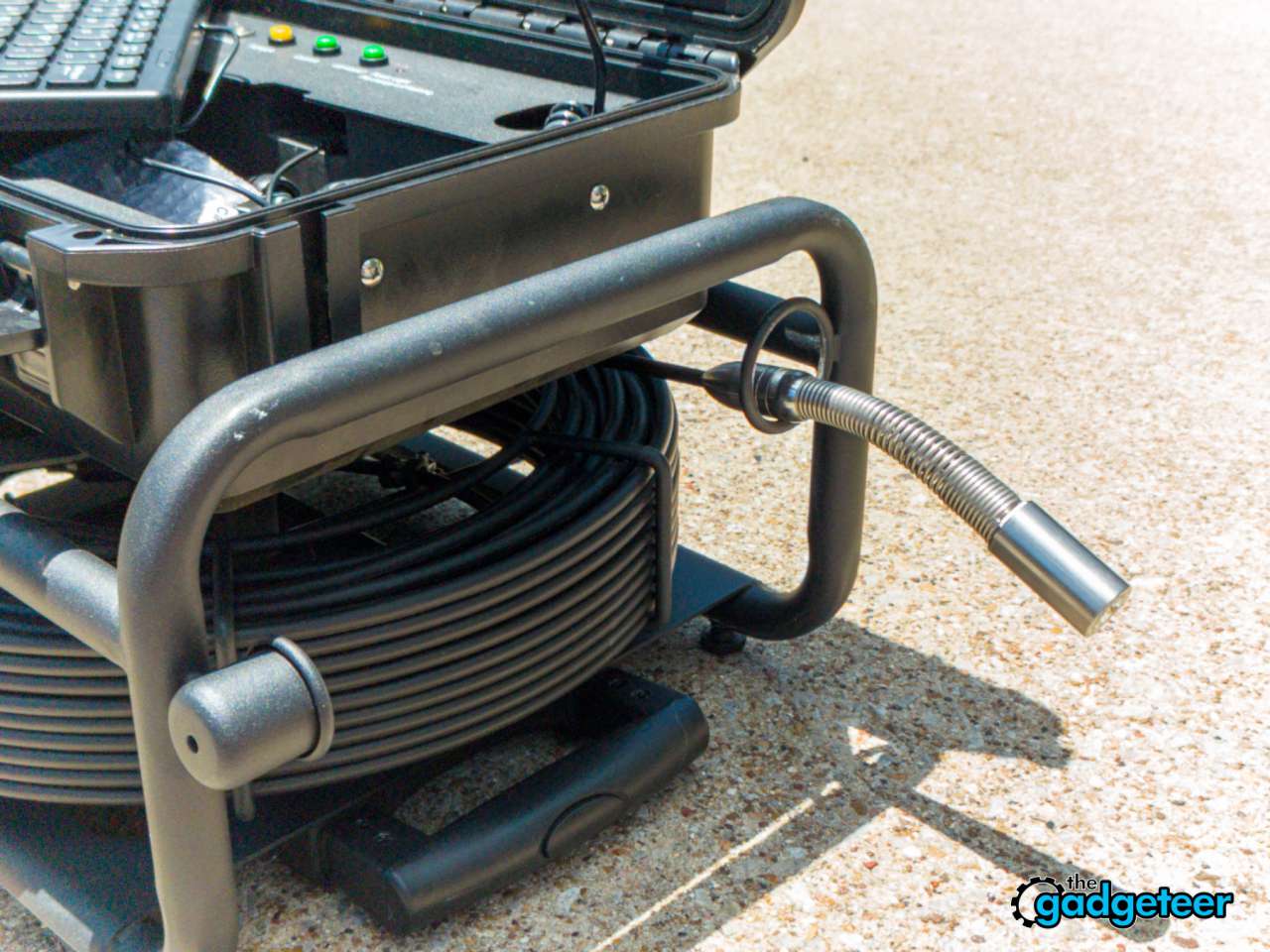
The 165ft length is overkill for most residential work, but it is nice to have when you are tracing a main line from a municipal cleanout to the house. If you do mostly residential kitchen and bathroom lines, the 100ft/30M version is probably the smarter buy, and it saves you $100 to $150 depending on the other options.
The 0.20 inch (5mm) cable option is available for those who need to snake through smaller lines or tighter bends. I did not test that variant, but the option is there if your work takes you into 2-inch or 1.5-inch pipes regularly.
The Meter Counter and 512Hz Transmitter
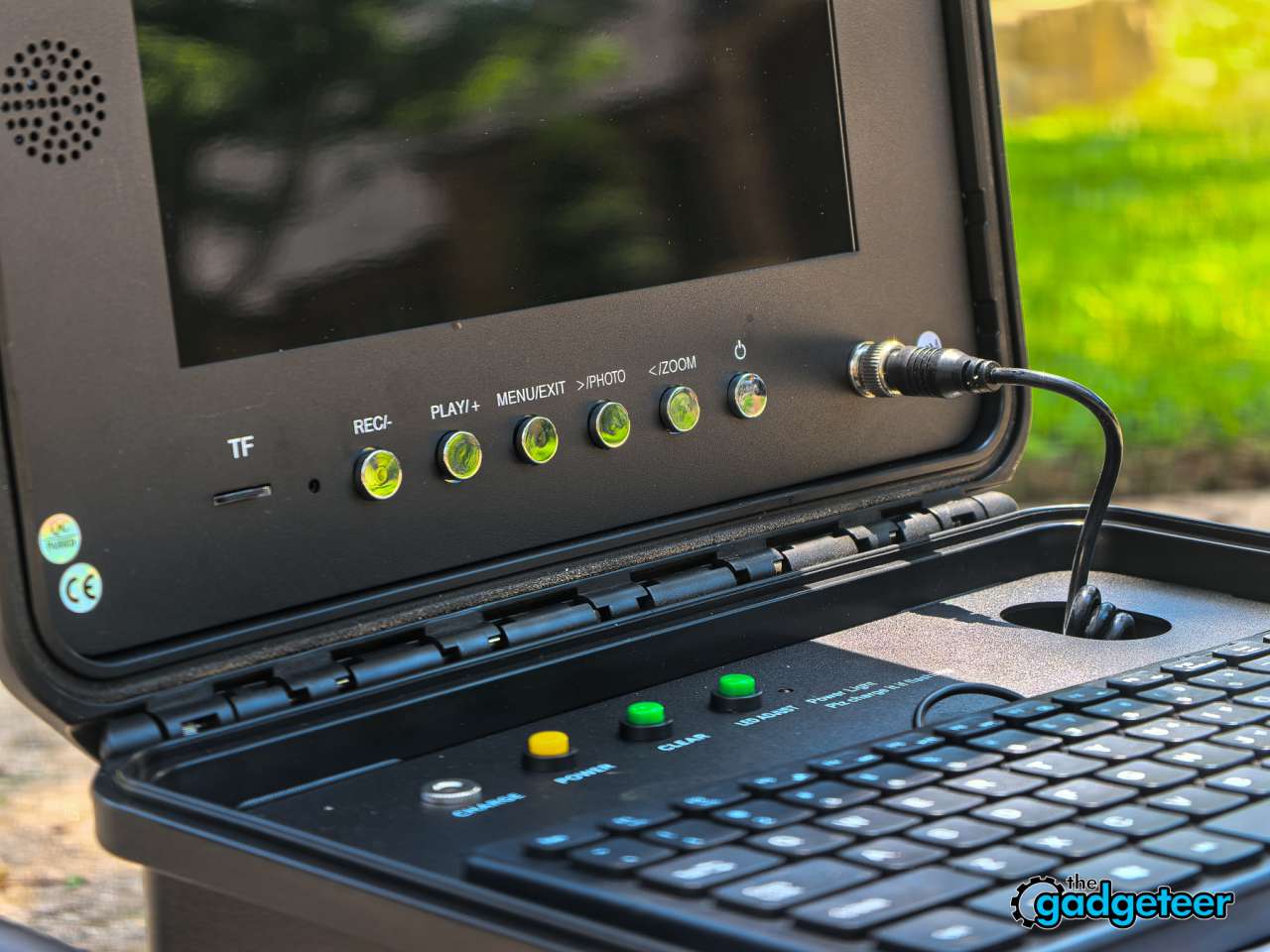
The built-in meter counter displays distance in real time on the screen. You can switch between feet and meters with the F4 key, and reset the counter to zero with F7. That is useful when you want to drop the camera into a cleanout, zero the counter, and then measure from that point forward.
I checked the counter against a known 24-foot run and it read 25 feet. I had some extra cable snaking in an S-curve before the straight section, so a one-foot discrepancy is reasonable. For estimating whether you need a longer drain machine or an extra cable extension, the counter is accurate enough. The 512Hz transmitter is built into the camera head, so you can pair it with an optional S58R or S68R locator if you need to mark exact dig points for a backhoe. My test unit did not include a locator, but the option is there if your work demands it.
Real-World Testing
I took the S860DSTKM to a two-story house on a septic system. The homeowner had been dealing with recurring drainage issues and wanted to know what was happening inside the pipes. I started at the cleanout outside and ran the camera up toward the house first, then reversed and ran it down toward the septic tank. The footage was clear enough to see every fitting, every Y-junction, and even the standing water in the belly of the pipe. I reached about 30 feet in when the camera passed the first toilet vent stack, then turned it around and fed it 44 feet in the opposite direction until I hit the septic tank. The self-leveling kept the water trail consistently at the bottom of the frame the entire time, even when I rotated the reel. That is exactly what you want when you are trying to show a homeowner where a problem is.
The six LED levels are more granular than most cameras in this class. I ran the lights from level one to level six inside a dark 4-inch line, and there was no blown-out glare on the wet concrete. In a dry PVC section, the higher levels gave me full visibility without any hot spots. The sun shield is a nice touch that the S860DSTKM has over some competitors. I was working in bright afternoon light and the shield cut the glare enough that I could see the screen without squatting in my own shadow.
The cable fed smoothly for the full 44-foot run. I cleaned it as I pulled it back, which is a habit I recommend with any fiberglass push rod. The meter counter read 25 feet when I had actually pulled out 24 feet by my tape measure, but I had some extra cable snaking in an S-curve before the straight run, so the discrepancy is understandable. For estimating whether you need a longer machine or a cable extension, the counter is accurate enough.
The 4500 mAh battery is not something Sanyipace advertises heavily on the product page, but it is listed in the spec sheet. After four hours of intermittent use, recording, and menu navigation, the battery indicator had only dropped one bar. That should cover a full day of service calls without anxiety.
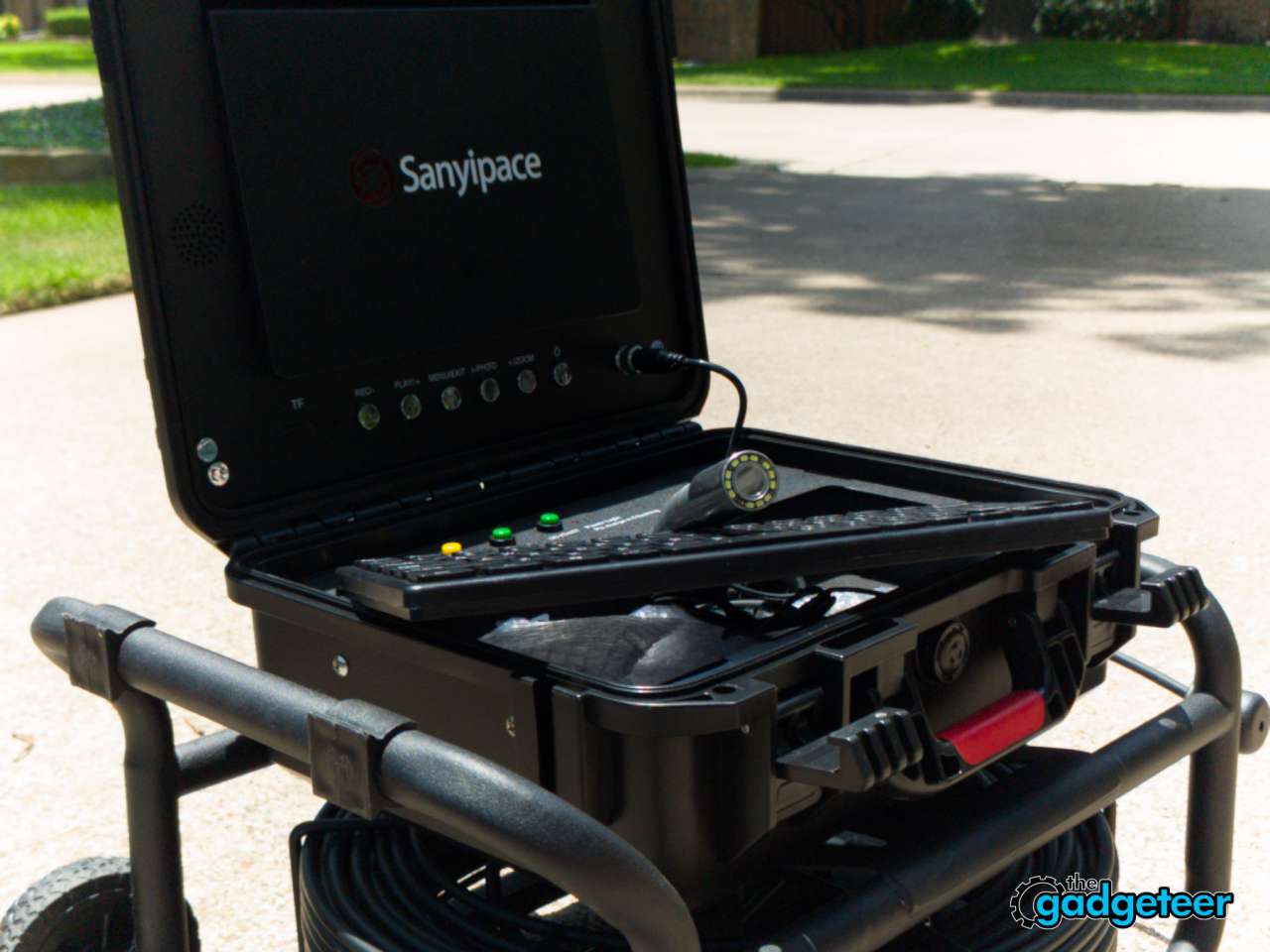
The interface is simple enough that I did not even read the instructions before I started using it. Every menu item says what it does, which is a nice change from some budget units where you have to guess what the icons mean. You can set the screen saver timer, flip the picture, adjust sound settings, and format the SD card without digging through nested menus. The video menu lets you set circular recording lengths so the camera automatically splits long inspections into smaller clips, and the playback function makes it easy to browse recordings or still images on site. You can also record audio through the built-in microphone, which is handy if you want to narrate your findings while you are still in the pipe. The detachable keyboard lets you type notes directly on the recordings, and you can remove it when you need the screen unobstructed.
I recorded the full inspection, popped the 32 GB SD card out, and reviewed the clips on a laptop later. The date and time stamp on each recording makes it easy to organize files for customer reports. The card that comes in the box is plenty for a few days of work, and the circular recording option means you do not have to manage one giant file per job.
The wheels and handle are genuinely useful in the field. I rolled the unit across a cracked asphalt driveway, up a concrete ramp, and over gravel without any handle wobble or wheel noise. It is not an all-terrain cart, but it eliminates the short-distance carry that eats up your energy between the truck and the cleanout. When I finished the inspection, I took the recordings inside and showed them to the homeowner so they could see exactly what was happening in their pipes. That kind of visual documentation builds trust and saves you from having to explain a belly or a root intrusion with hand gestures.
The Verdict
The Sanyipace S860DSTKM is a practical, well-equipped pipe inspection camera that solves a real problem: moving the reel around a job site. The wheels and handle are not gimmicks; they are genuine ergonomic improvements that make a difference over a full day of work. The 1080P image, six-step LED adjustment, and self-leveling camera head give you the tools you need to document problems clearly and communicate them to homeowners or contractors.
If you are a daily commercial inspector, you will eventually want a higher-end system with a stiffer push rod, software integration, and a formal service network. But for residential plumbers, maintenance techs, and home inspectors who need a capable camera a few times a month, the S860DSTKM hits the right balance of features, mobility, and price. Just buy the configuration that matches your actual work. There is no reason to pay for 165 feet of cable if you only inspect kitchen lines.
Price: $849.88 (
Where to buy: Sanyipace | Amazon
