
If you thought 5G was still settling in, Qualcomm, Google, and Samsung made it clear at Mobile World Congress 2026 that the wireless industry has already moved on. For Qualcomm, CEO Cristiano Amon took the stage in Barcelona and laid out a vision for the 6G network that goes way beyond faster download speeds. He called it “the wireless technology for the age of AI,” and he brought more than 60 companies along to prove he means it.
That coalition reads like a who’s who of the tech world. Amazon, Google, Meta, Microsoft, Samsung, Dell, Ericsson, Nokia, LG, Motorola, Snap, and dozens more have all signed on. T-Mobile is stepping up as the leading U.S. carrier for the initiative, and the timeline is aggressive: a working demonstration by 2028 and initial commercial rollout from 2029 onwards. For a technology that most people haven’t heard of yet, that’s remarkably close.
It’s not just faster 5G
The short version is that 6G is the next generation of wireless technology after 5G, but framing it as only “faster 5G” misses the point entirely. Qualcomm is building the 6G network around three big ideas: better connectivity, distributed computing, and something called nearly-universal sensing. That last one is the wild card.
Better connectivity is straightforward enough. Qualcomm says the new standard will deliver a 50 to 70 percent performance gain using existing spectrum, which means carriers won’t need to tear everything down and start over. The bigger shift is a major push on uplink speeds, because the next wave of AI-powered devices needs to send data back to the network constantly. Think smart glasses streaming what you see, wearables monitoring your health in real time, or AI assistants that need continuous access to cloud processing. All of that traffic flows upstream, and current 5G networks weren’t designed with that kind of demand in mind.
Distributed computing means the network itself becomes part of the processing chain. Instead of every AI request traveling all the way to a distant data center, 6G networks could handle some of that computing closer to where it’s needed. For everyday users, that translates to faster response times for things like real-time translation, AR navigation, and AI-powered search, the kind of tasks where even a small delay is noticeable.

Then there’s the sensing piece, which sounds like science fiction until you hear the details. Qualcomm envisions the 6G network providing what amounts to radar imaging at scale, using the wireless infrastructure that’s already blanketing cities and suburbs. That opens the door to applications like traffic monitoring, environmental sensing, and location services that work without GPS. It’s the kind of capability that doesn’t have obvious consumer products attached to it yet, but once the infrastructure exists, someone will build something clever on top of it.
Why 60 companies matter more than one
Qualcomm has always been central to wireless standards, but 6G isn’t something any single company can build alone. The coalition announced at MWC includes chipmakers, device manufacturers, carriers, cloud providers, and software companies. Amazon, Dell, Google, HP, HUMAIN, LG, Meta, Microsoft, Motorola, Nokia, NTT DOCOMO, Samsung Electronics, Snap, SK Telecom, Stellantis, and Viettel all made the list.
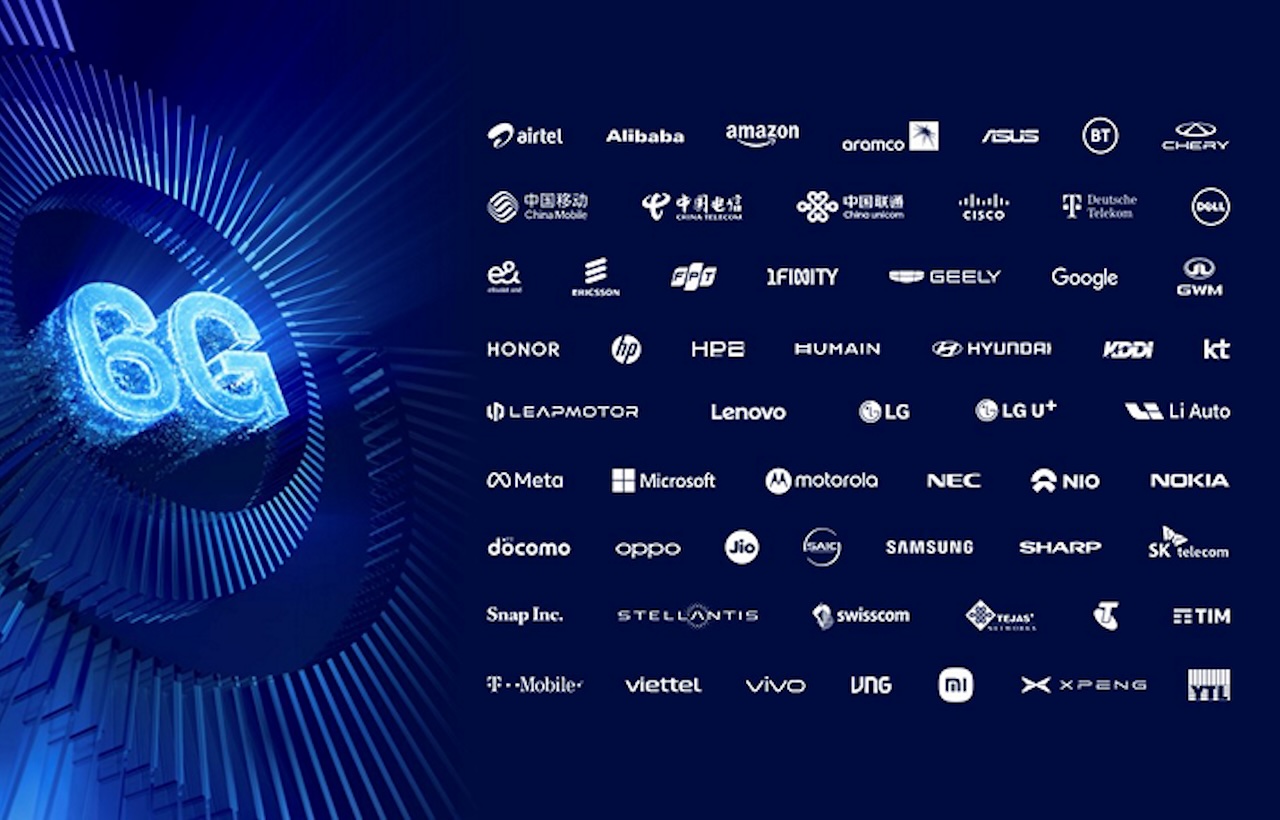
That breadth matters because 6G has to work across everything from smartphones to cars to industrial sensors. Having automakers like Stellantis and telecom operators from multiple continents at the table early means the standard is being designed with real-world deployment in mind, not lab conditions. Amon put it plainly during his keynote: “If you actually believe in the AI revolution, 6G will be required.”
The involvement of cloud giants like Amazon, Google, and Microsoft signals something else worth watching. These companies aren’t only building phones or towers. They run the data centers that AI models depend on. Their participation suggests 6G isn’t being conceived as a phone network that happens to support AI. It’s being designed as an AI network that happens to carry phone calls.
T-Mobile takes the lead in the US
For anyone wondering what this means stateside, T-Mobile is positioning itself as the first US carrier to go all-in on 6G development with Qualcomm. The two companies deepened their existing partnership at MWC, and T-Mobile will serve as the leading mobile operator for Qualcomm’s 6G initiative in the United States.
That’s a notable move considering T-Mobile’s aggressive 5G rollout over the past few years. The carrier already has one of the largest 5G networks in the country, and getting in early on 6G standards could give it a meaningful head start when the technology is ready for deployment. For T-Mobile customers, it’s premature to promise anything specific, but the direction is unmistakable.

When is 6G actually coming?
This is the question everyone asks, and for once, there’s a surprisingly specific answer. Qualcomm’s roadmap calls for a public demonstration of 6G technology in 2028, with infrastructure hardware, semiconductors, and consumer devices arriving toward the end of that same year. The 6G network release date, at least for initial commercial rollout, is targeted from 2029 onwards.
That timeline puts 6G roughly on the same development cycle as previous generations. 5G started rolling out commercially around 2019, about a decade after 4G LTE went mainstream. A 2029 launch would follow a similar rhythm. The difference this time is that the industry is organizing earlier and more deliberately, which could mean a smoother transition than the fragmented early days of 5G.
There’s a practical reason for the urgency. Global cellular traffic is expected to grow three to seven times by 2034, and Qualcomm estimates that AI alone will account for about 30 percent of all network traffic by then. The current infrastructure wasn’t built for that volume. That’s not marketing spin. It’s math.
What else Qualcomm brought to MWC
The 6G coalition grabbed the headlines, but Qualcomm used MWC to show off several technologies that bridge the gap between current networks and the 6G future. The company introduced new chips designed for personal AI wearables and Wi-Fi devices, along with a new modem that lays the technical groundwork for 6G connectivity.
On the show floor, Qualcomm gave the AI200 data center rack its first public appearance. Built using cards from HUMAIN, the AI200 is designed to handle the kind of heavy AI processing that 6G networks will eventually distribute more broadly. It’s a piece of infrastructure most consumers will never see, but it’s the hardware that makes the invisible parts of 6G work.
The bottom line
Qualcomm’s MWC announcement doesn’t change anything about your phone today. 5G isn’t going anywhere, and it’ll remain the standard for years to come. What it does is set the clock ticking on the next major shift in 6G wireless technology, and this time, the industry is getting organized early. A 60-company coalition with a concrete timeline and a clear focus on AI-native networking makes 6G feel less like a distant concept and more like an inevitability.
What’s worth noting is how global this coalition already looks. China Mobile, China Telecom, China Unicom, Xiaomi, and Oppo all appear on the partner list alongside SK Telecom, NTT DOCOMO, and carriers from Europe, the Middle East, and Southeast Asia. One notable absence: Huawei isn’t on it. Whether that matters long term remains to be seen, but the 2029 target is ambitious, and with this many companies across this many countries pulling in the same direction, it’s not unreasonable to start paying attention.

L39 Ultra Slim UV Protective Filter for Leica Q3 43 Q2 Camera with Moisture-Proof Case & Removal Tool 19 Layers Mulit-Coated UV Ultraviolet Filter 99.3% Light Transmission Water Oil Scratch Resistant
(as of March 3, 2026 13:53 GMT -06:00 - More infoProduct prices and availability are accurate as of the date/time indicated and are subject to change. Any price and availability information displayed on [relevant Amazon Site(s), as applicable] at the time of purchase will apply to the purchase of this product.)
