
Most people shop satellite messengers like phones, comparing screens and ounces, then forget the subscription will outspend the device by year two. That is the wrong frame for 2026.
Summer plans often mean going off grid, but staying reachable is the wise move. The satellite communicator market shifted in late 2025: Garmin moved to month-to-month plans with no annual lock-in, and the new inReach Messenger Plus arrived with a battery measured in weeks. Four picks cover the field: a compact app-driven messenger, a touchscreen standalone, a full GPS hybrid, and a budget phone pairing puck. All four run on Iridium, and the monthly fee matters as much as the hardware price.
The real question for 2026 is which of these you will still be happy carrying two summers from now.
At a Glance
The Messenger Plus wins on battery and simplicity. The Mini 3 Plus adds a touchscreen and standalone photo messaging. The GPSMAP 67i replaces a dedicated handheld GPS. ZOLEO undercuts everyone but keeps you tethered to your phone.
| Pick | Price | Weight | Battery | Best For |
|---|---|---|---|---|
| Garmin inReach Messenger Plus | $400 | 4.1 oz | 600 hrs | All-around use |
| Garmin inReach Mini 3 Plus | $500 | 4.4 oz | 350 hrs | Standalone messaging |
| Garmin GPSMAP 67i | $600 | 8.5 oz | 165 hrs | Navigation + SOS |
| ZOLEO Satellite Communicator | $149 | 5.3 oz | 200+ hrs | Budget phone pairing |
1. Garmin inReach Messenger Plus: Best Overall
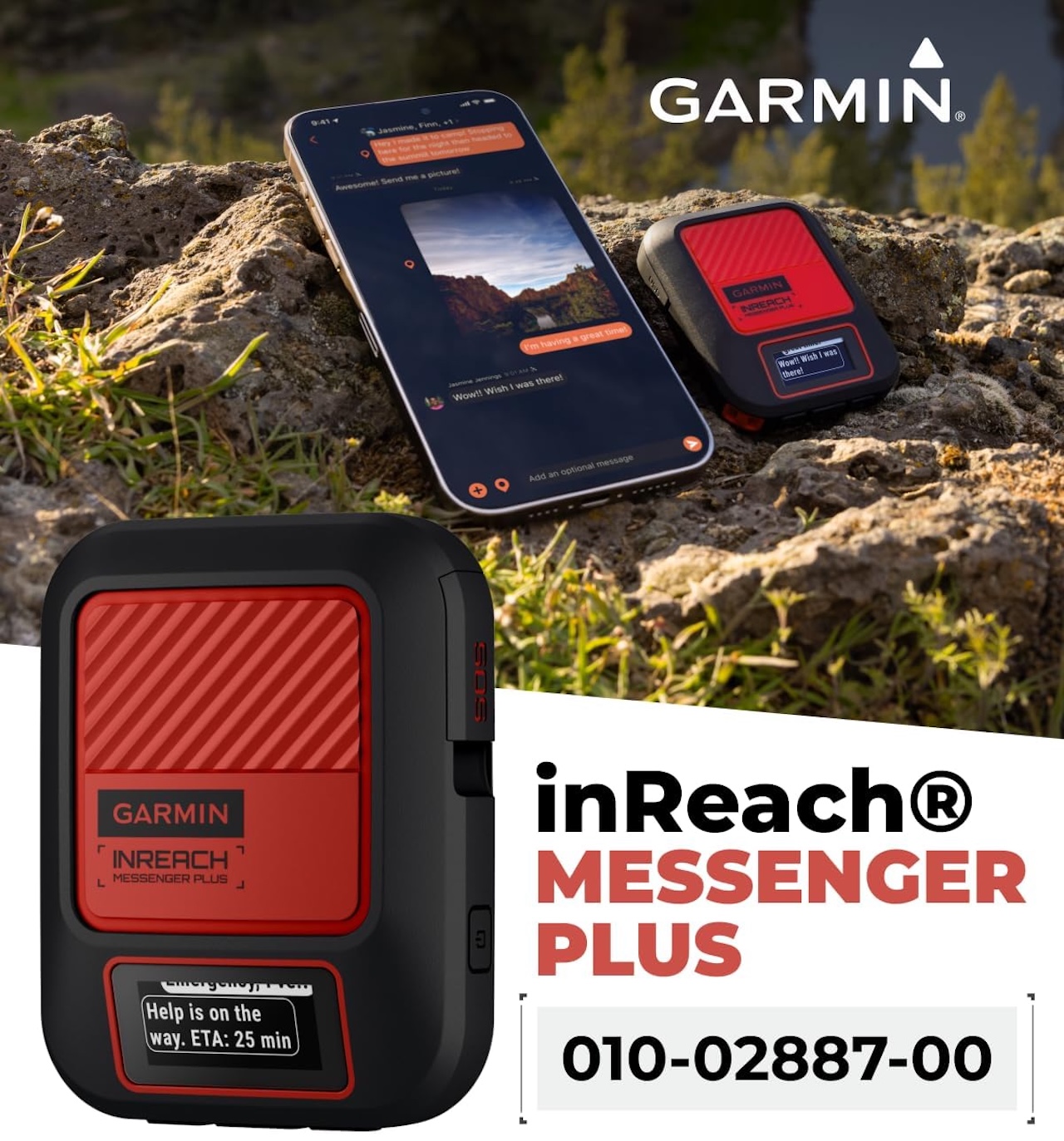
Price: $309.99 (On Sale from $409.99)
Where to Buy: Amazon
The Messenger Plus is the device Garmin’s lineup needed. It weighs 4.1 ounces and delivers up to 600 hours of battery in low-power mode with 10-minute tracking, roughly 25 days before you reach for a USB-C cable. Leave it in your pack for a two-week trek and still have juice for the ride home.
Messaging runs through the Garmin Messenger app via Bluetooth, or you can send preset messages directly. There is no touchscreen, which keeps the price at $400 and the battery drain minimal. Voice notes and photo sharing work when paired. These features used to require stepping up to the Mini 3 Plus. It is IPX7 rated.
Garmin simplified consumer plans in mid-2025: Enabled at $7.99/mo keeps the device emergency-ready with pay-as-you-go messaging; Essential is about $14.99, Standard ~$30, Premium tops the stack. All are month-to-month with a 30-day commitment, a one-time $40 activation, and as of June 2025, free suspension and reactivation.
2. Garmin inReach Mini 3 Plus: Best Standalone Touchscreen
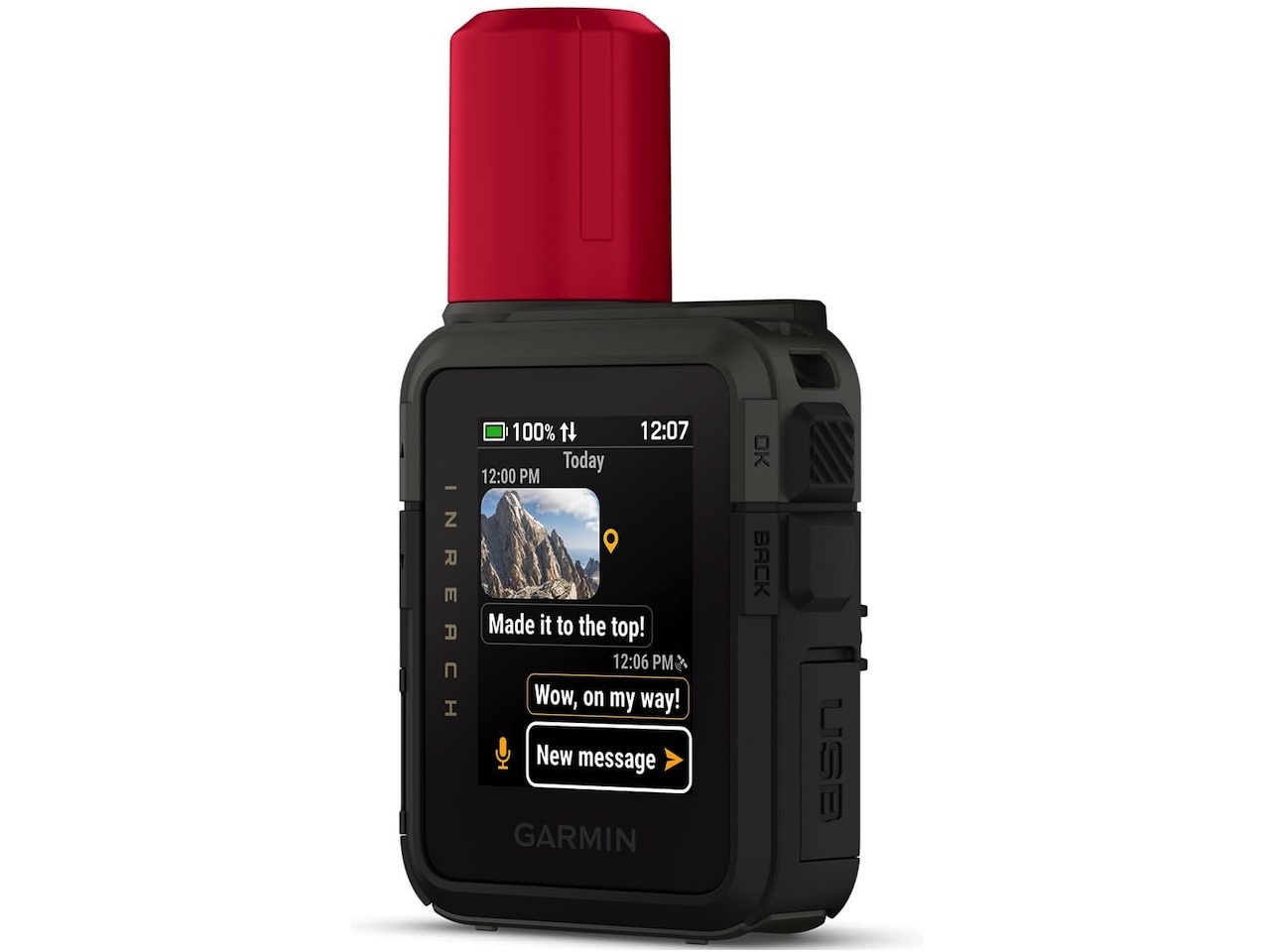
Price: $449.99 (On Sale from $499.99)
Where to Buy: Amazon
The Mini 3 Plus adds a small color touchscreen, on-device base maps (towns and cities only, no terrain or trails), a built-in speaker and microphone, and standalone photo and voice messaging. It weighs about 4.4 ounces and gets up to 350 hours of battery, a drop from the Messenger Plus but still enough for a week with tracking enabled.
The touchscreen changes the interaction model. You can type messages on the unit, view a simple base map, and check weather without a phone; for terrain detail you still need the paired Garmin Explore app. At $500, you are paying a $100 premium for standalone operation plus the speaker, microphone, and emergency siren. For thru-hikers who keep their phone packed, that premium pays off. For weekend warriors with a phone in a chest pocket, the Messenger Plus delivers nearly the same feature set for less money and far longer battery. (Garmin also sells a base Mini 3 at $449, but the $50 step up gets you the faster antenna, photo/voice messaging, and siren. Buy the Plus.)
Same subscription tiers and $40 activation as the Messenger Plus. If you own a Mini 2, the upgrade math is simple: bigger battery, better antenna, photo and voice messaging, touchscreen. Whether that justifies $400 to $500 depends on how much you value those additions.
3. Garmin GPSMAP 67i: Best Navigation Hybrid
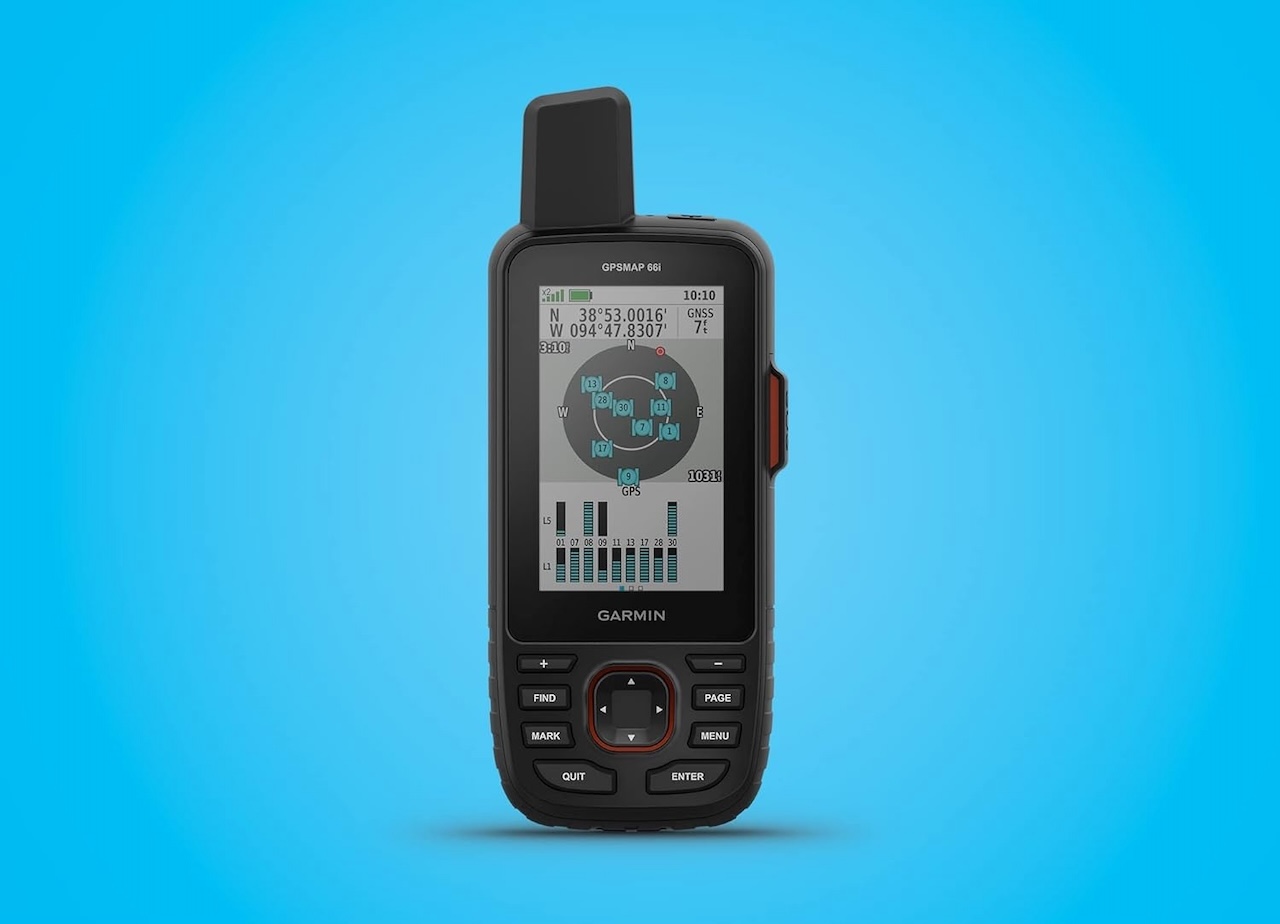
Price: $599.99
Where to Buy: Amazon
The GPSMAP 67i is not a messenger with GPS tacked on. It is a full handheld GPS with inReach satellite messaging built in. The multi-band GNSS receiver hits 6 to 9 foot accuracy, and preloaded topo maps cover the US in detail. At 8.5 ounces it is more than twice the weight of the Messenger Plus, and battery life is rated up to 165 hours with 10-minute tracking, or up to 425 hours in expedition mode.
Buy this when navigation is the primary goal and messaging is the safety net. The 67i supports two-way texting, interactive SOS, weather, and location sharing, alongside Garmin’s full handheld interface, including route planning, waypoint management, and BirdsEye satellite imagery. For hunters, SAR volunteers, or anyone who prefers a dedicated GPS over a phone app, the 67i replaces two devices with one. Same subscription rules, $40 activation, free off-season suspension. If you were already budgeting $400 for a GPS and $400 for a messenger, the 67i saves money and pack space.
4. ZOLEO: Best Budget Pick
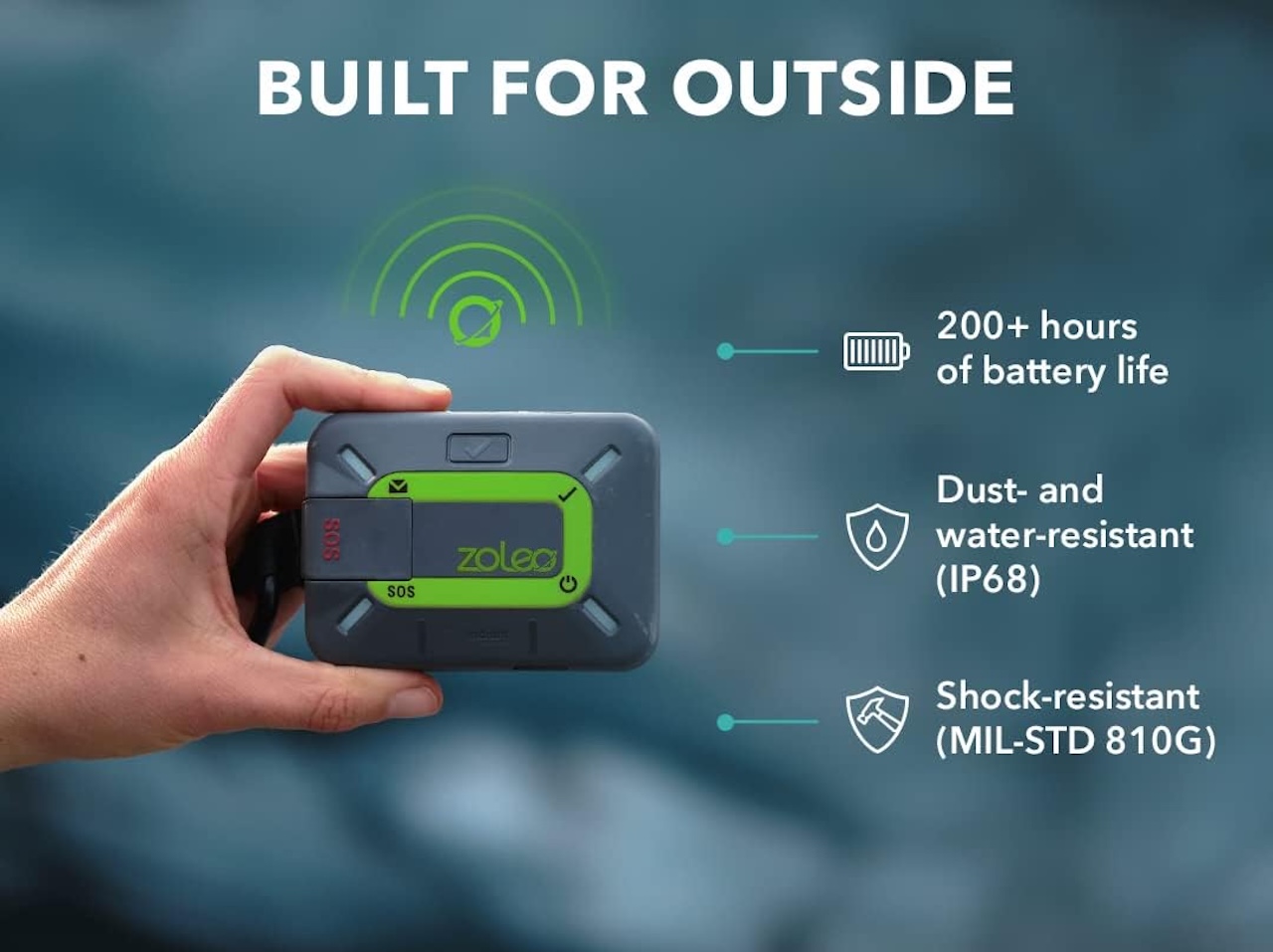
Price: $149
Where to Buy: Amazon
ZOLEO undercuts Garmin’s entry point by roughly $250 by shifting most of the interface to your phone. The device is a 5.3 ounce puck with an SOS button, a check-in button, and a small LED status array; everything else happens in the ZOLEO app over Bluetooth. Charging is still Micro-USB Type B in 2026, an annoyance if the rest of your kit has moved to USB-C. Battery life is rated at 200-plus hours: short next to the Mini 3 Plus and Messenger Plus, competitive with the GPSMAP 67i in default tracking, and enough for a long weekend with moderate use.
Messaging is smooth when paired. Your contacts see texts from a standard phone number, not a satellite address, so replies do not require a special app. ZOLEO’s three plans: Basic at $20 (75 satellite messages), In Touch at $35 (300 messages), and Unlimited at $50, plus a $6/mo Location Share+ add-on. Preset check-in and SOS messages are unlimited on every plan. Activation is $39.99, the commitment is month-to-month, and unlike Garmin, ZOLEO charges $4/mo to suspend.
ZOLEO runs on Iridium, carries an IP68 rating (meaningfully tougher on paper than the Messenger Plus’s IPX7), and is MIL-STD 810G shock-tested. Garmin’s larger buttons and dedicated controls remain better suited to cold-weather glove use. For casual hikers, paddlers, and weekend campers, ZOLEO is the logical choice. For alpine climbers or remote guides, the “Garmin tax” is worth paying.
What to Look For
Network matters more than brand. Iridium covers the entire planet pole to pole and is what all four picks use. Globalstar (SPOT Gen4) has gaps in extreme latitudes and ocean coverage. That is fine inside the continental US, not enough for Alaska, northern Canada, or open ocean.
Subscription math should be part of the purchase. A $400 Messenger Plus plus two years of Standard at $30/mo is about $1,120 before activation; the same hardware on Enabled at $7.99 drops to ~$592 over two years. A $149 ZOLEO on In Touch runs ~$989. Garmin’s free suspension saves another $48/yr versus ZOLEO’s paid pause.
Battery ratings are not universal. Garmin’s 600-hour Messenger Plus claim assumes 10-minute tracking and minimal screen use. Drop to 2-minute tracking and it falls. Cold weather cuts every lithium-ion battery by 30 to 50 percent. Treat ratings as best-case and carry a battery pack past a week in the field.
Who Should Skip Each Pick
Skip the Messenger Plus if you want an on-device map or need to type without your phone. It is built around app pairing.
Skip the Mini 3 Plus if your phone stays accessible on the trail. You are paying $100 extra for standalone operation you will not use.
Skip the GPSMAP 67i if navigation is not your primary use case. At 8.5 ounces and $600 it is too much device for casual messaging.
Skip ZOLEO if you hike above tree line in winter, depend on USB-C across your kit, or need a hardened device for alpine or expedition use.
The Bottom Line
If you want one satellite communicator that balances battery, messaging, and a sane subscription, the Garmin inReach Messenger Plus is the 2026 pick. The Mini 3 Plus justifies $500 only if you need a screen and standalone operation. The GPSMAP 67i is a navigation tool first, messenger second. Ideal if you were already shopping handheld GPS units. ZOLEO wins on upfront cost with reasonable monthly fees, though it asks you to trust your phone as the primary interface.
Frequently Asked Questions
Do all satellite messengers require a subscription?
Yes. Every device here needs an active monthly plan to send messages, share location, or trigger SOS. Two-way messaging and tracking always require paid service.
What is the difference between Iridium and Globalstar?
Iridium’s 66 satellites cover the entire planet, poles and open ocean included. Globalstar’s smaller constellation has gaps at extreme latitudes and mid-ocean. Inside the continental US the difference is invisible; outside it, it is a dealbreaker.
Can I use these devices without a smartphone?
The Mini 3 Plus and GPSMAP 67i work fully standalone. The Messenger Plus and ZOLEO are built around phone pairing for typing and maps, though both have SOS buttons that function independently.
How much does satellite messaging cost per year?
Garmin Standard runs about $360/yr plus a one-time $40 activation. Enabled drops to ~$96/yr. ZOLEO In Touch is ~$420/yr plus $39.99 activation, with another $48/yr to suspend in the off-season.
Is the SOS feature free to use?
Yes, on any active plan including the cheapest tier. Garmin routes alerts to Garmin Response; ZOLEO routes to Global Rescue. Neither charges per rescue coordination, though local rescue costs may apply.