
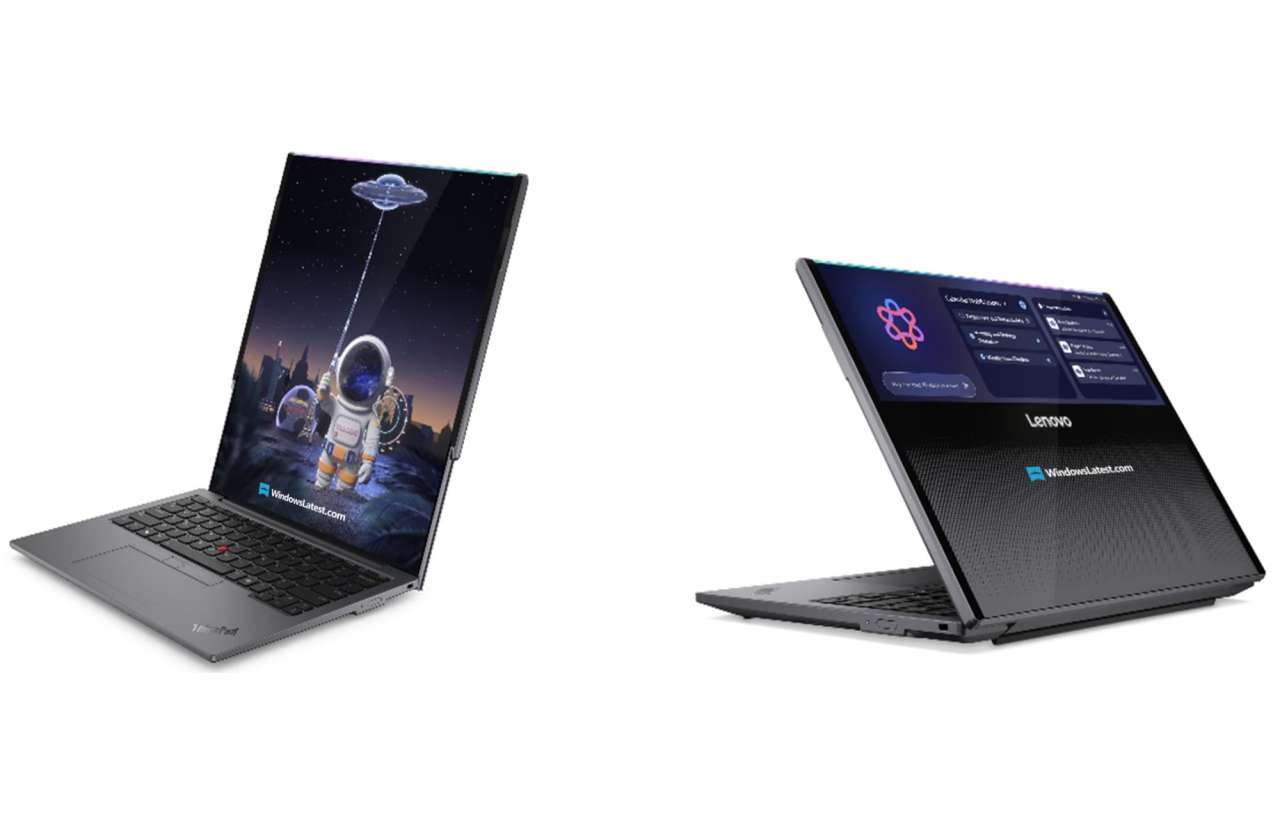
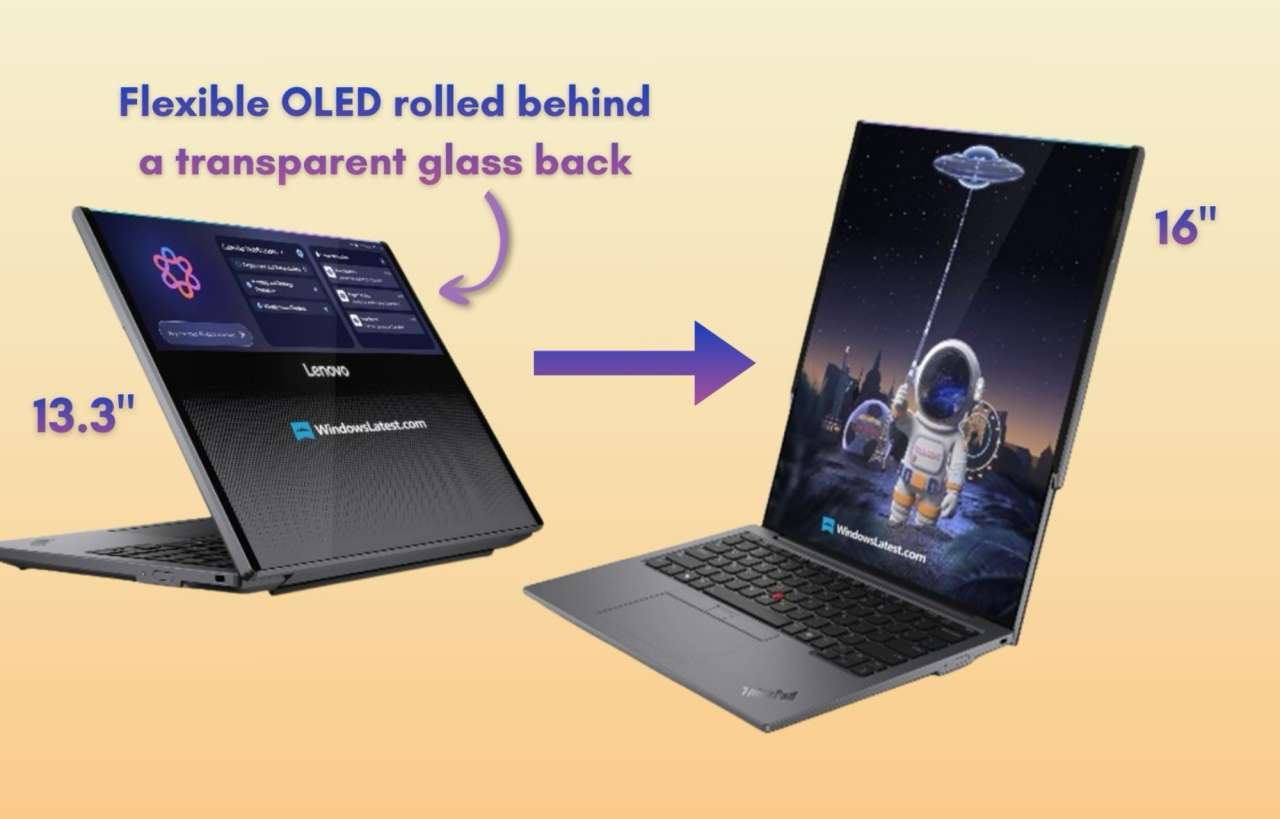
ARTICLE – Most laptop upgrades feel the same: a slightly faster chip, a slightly brighter panel, and a new sticker on the palm rest. Lenovo’s ThinkPad Rollable XD Concept is one of the rare designs that actually changes what a laptop is. Open, it starts as a compact 13.3-inch ThinkPad. Swipe, and the flexible OLED scrolls upward into a 16-inch vertical canvas, giving you more room for spreadsheets, documents, and dashboards without hauling a bigger machine.
Close the lid and it still refuses to act like a normal laptop. Instead of a dead slab of metal, you get a transparent Gorilla Glass Victus 2 cover with a strip of the 16-inch OLED still visible underneath. Lenovo calls it a world-facing display on the outside and an expanding user-facing screen on the inside: a concept aimed at people who want their work machine to be context-aware whether it’s open on a desk or closed in a meeting.
Lenovo is expected to show the ThinkPad Rollable XD Concept at CES 2026, building on earlier experiments like the ThinkBook Plus Gen 6 Rollable and the Legion Pro Rollable gaming laptop. According to Windows Latest, this time the focus is less on spectacle and more on the daily grind of remote work.
Add The Gadgeteer as a preferred source to see more of our coverage on Google.
Why Lenovo wants your laptop screen to grow instead of just getting faster
If you travel with a laptop, you already know the trade-off. A 13-inch machine is great on a plane tray table, but terrible when you’re trying to live in a spreadsheet, a slide deck, and a video call at the same time. A 16-inch machine feels like a portable desktop, but it’s miserable to carry and even worse to open in economy.
Most manufacturers have tried to solve this with higher resolutions, better scaling, and more virtual desktops. Lenovo’s rollable experiments go after the physical constraint instead: change the shape of the screen.
The ThinkBook Plus Gen 6 Rollable pushed this idea first with a 14-inch panel that could extend horizontally into a 16-inch ultrawide. The Legion Pro Rollable took the same trick to gaming, stretching from 16 to 24 inches. The ThinkPad Rollable XD turns that logic vertical for work: a compact 13.3-inch panel that can scroll up into a 16-inch workspace Lenovo says offers over 50 percent more screen real estate when fully extended.
With the screen fully raised, Lenovo is clearly targeting:
- Spreadsheet people who want more visible rows without shrinking text to ant size.
- Document people who want a full page and a reference window side by side.
- Dashboard people who live in tall charts and timelines that always feel chopped off.
On paper, that’s exactly what road warriors and hybrid workers have been asking for: a laptop that travels like a 13-inch machine but works like something closer to a 16-inch when you’re at a desk.
From 13.3 to 16 inches: vertical rollable screen, not a fold
The Rollable XD isn’t a foldable in the usual sense. There’s no crease down the middle and no dual-panel hinge. Instead, the 16-inch flexible OLED is rolled inside the chassis and can scroll upward behind the top bezel when you extend it.
In its default 13.3-inch mode, the display looks like a normal ThinkPad panel. When you trigger the roll mechanism, the screen rises vertically until you reach the full 16-inch height. That extra space is all about showing more of what you already work in, not changing the aspect ratio into something exotic.
According to Windows Latest, the fully extended Rollable XD is still about 0.7 inches shorter than the ThinkBook Plus Gen 6 Rollable’s maximum size, which makes sense given the different aspect ratios and internal layouts. The point here isn’t to win a “biggest screen” contest, but to give business users a meaningful second mode without turning the laptop into a monster.
We’ll need hands-on time to see how smooth the transition feels, how much wobble there is at full height, and what it does to thickness and weight. For now, this is very much a concept that shows what Lenovo’s display team is playing with.
The transparent Gorilla Glass lid turns the back of the laptop into a second screen
The rollable screen is only half of the story. The other half is what happens when you close the laptop.
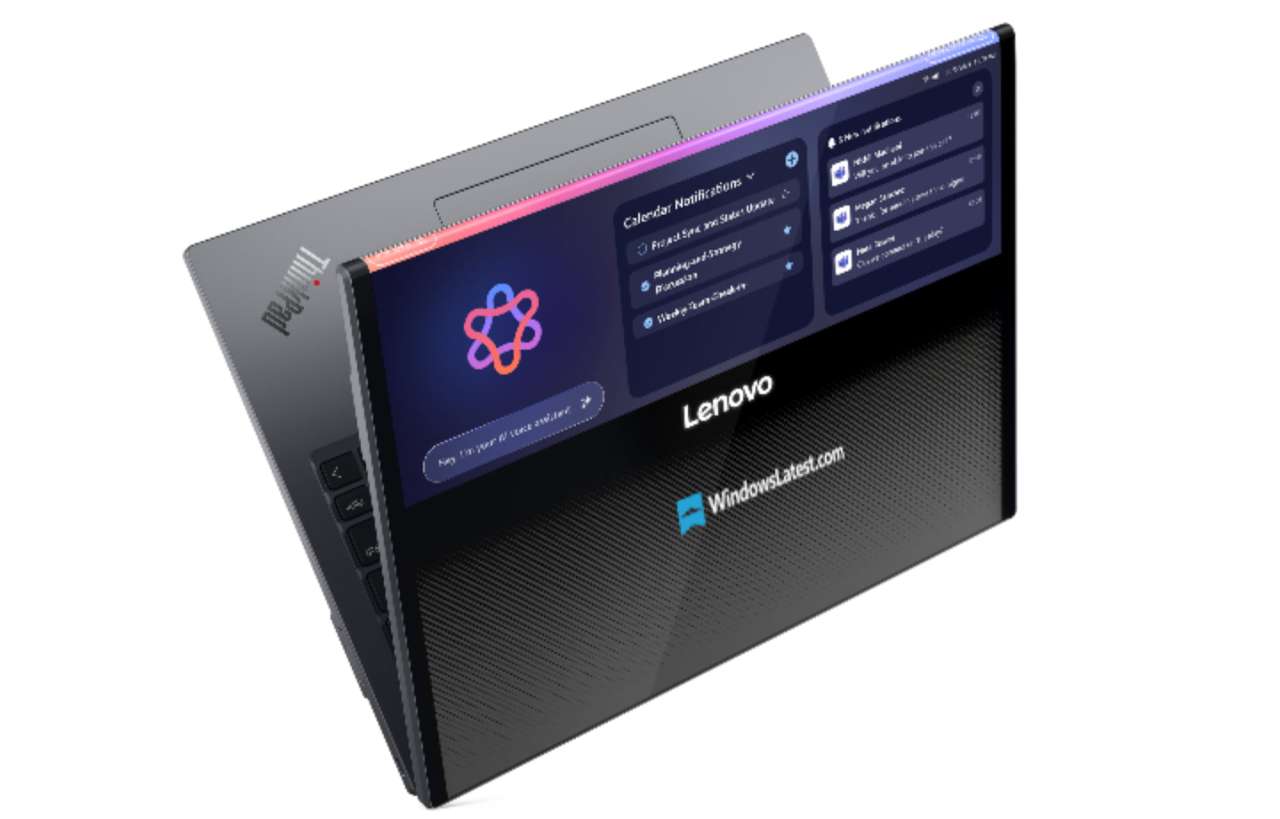
Instead of the usual aluminum or carbon-fiber lid, the ThinkPad Rollable XD Concept uses a 180-degree Corning Gorilla Glass Victus 2 cover. Under that glass, part of the 16-inch flexible OLED remains exposed, curving behind the lid so that a strip of the display is always visible from the outside.
Lenovo refers to this as a world-facing display. Based on marketing images Windows Latest obtained, that exposed strip can surface an AI chatbot, calendar events, and notifications, turning the back of the laptop into a glanceable status panel instead of dead metal. Because it’s literally part of the main panel, this outer display isn’t a separate screen bolted onto the lid; if the lid were opaque, you’d never know it was there.
The idea is to turn the back of the laptop into a contextual surface. In theory, you could check your next meeting without opening the lid, use the outer display as digital signage in a retail or event setting, or show prompts to a presenter while the main screen faces the audience. It’s a flex, literally and figuratively. How much of that will be possible in real software is still an open question, but the hardware is clearly designed to support more than just a pretty light show.
Swipe, voice, and AI: how Lenovo imagines you’ll talk to this thing
A shape-shifting screen and a world-facing display don’t mean much if the controls are clumsy. Lenovo’s concept stack for the Rollable XD layers swipe gestures to expand or collapse the screen, touch controls to switch modes, and voice commands to launch apps or join calls when your hands are busy.
On top of that, Lenovo is reusing some of the AI-powered features it’s building into the Legion Pro Rollable and other next-gen PCs: live translation, a voice assistant, and multimodal interactions that combine the outer display, microphones, and sensors even when the lid is closed.
The pitch is that you should be able to treat the Rollable XD as a context-aware device rather than a binary open-or-closed machine. Open on a desk, it’s a tall 16-inch ThinkPad. Closed in a meeting, it becomes a glanceable panel for notifications, prompts, or signage.
Until we see final software, all of this remains conceptual. The hardware, though, is clearly built to support more than just a single “wow” animation.
Who actually needs a laptop that grows and glows?
The ThinkPad Rollable XD Concept isn’t aimed at everyone, and that’s probably a good thing.
You’re the target if:
- You already live in documents, dashboards, and calls on the road.
- You routinely wish your 13-inch laptop had more vertical space without jumping to a heavier 16-inch machine.
- You can justify paying for experimental hardware if it genuinely improves your workflow.
You can safely skip it if:
- You’re mostly desk-bound and already dock into a big external monitor.
- You value thinness, simplicity, and price over new form factors.
- You don’t want to be the person explaining “why your laptop glows through the lid” in every meeting.
This is a concept for people who are willing to trade some normalcy for a shot at better workflows.
Durability, glare, and price: the questions this concept can’t answer yet
As exciting as the Rollable XD looks, it also raises a lot of practical questions.
Durability is the obvious one. A rollable OLED panel and a 180-degree glass lid will have to survive backpacks, airport security bins, and years of opening and closing. Gorilla Glass Victus 2 is tough, but we don’t know how the whole system behaves under real-world abuse.
Glare and fingerprints are another concern. A transparent glass lid with a display underneath sounds like a fingerprint magnet, and we don’t yet know how visible and readable the outer strip will be in bright light.
Then there’s weight and thickness. Rolling a 16-inch panel inside the lid and adding a glass cover isn’t free. Until Lenovo shares full specs, we can only assume this will be heavier and thicker than a standard 13-inch ThinkPad.
Finally, there’s price. Lenovo’s earlier ThinkBook Plus Gen 6 Rollable currently sells for around $3,299, and that’s a shipping product. As a concept with more complex glass and display work, the ThinkPad Rollable XD would almost certainly land at the very high end of the price spectrum if it ever reaches retail.
Those aren’t deal-breakers for a concept, but they’re the hurdles Lenovo will have to clear if this design is ever going to move beyond the CES show floor.
Future ThinkPad or just a very cool demo?
The ThinkPad Rollable XD Concept isn’t a laptop you can buy yet, and Lenovo hasn’t announced pricing, launch dates, or final specs. For now, it’s a directional signal: a glimpse at how Lenovo thinks business laptops should evolve once CPU and GPU upgrades stop feeling exciting.
If the idea works, your next ThinkPad might not just be a little faster than the last one. It might grow vertically when your work needs more room and keep part of its screen alive through a transparent lid when you close it. Your travel machine could double as a mini desktop and a glanceable info panel instead of turning into a brick the moment you snap it shut.
If it never ships in this exact form, the concepts behind it (rollable vertical space, world-facing displays, and context-aware workflows) are likely to show up in future Lenovo hardware. Either way, the cramped 13-inch laptop and the dead aluminum lid both look a little more obsolete than they did yesterday.
📡 CES 2026 Coverage
Want more from the show floor?
We’re covering the biggest announcements, wildest concepts, and gear that actually matters from CES 2026.

Gerber Gear Suspension 12-in-1 EDC Multi-Plier Multitool with Pocket Knife, Needle Nose Pliers, Wire Cutters and More, Gifts for Men, Camping and Survival, Grey
(as of March 28, 2026 18:29 GMT -05:00 - More infoProduct prices and availability are accurate as of the date/time indicated and are subject to change. Any price and availability information displayed on [relevant Amazon Site(s), as applicable] at the time of purchase will apply to the purchase of this product.)
