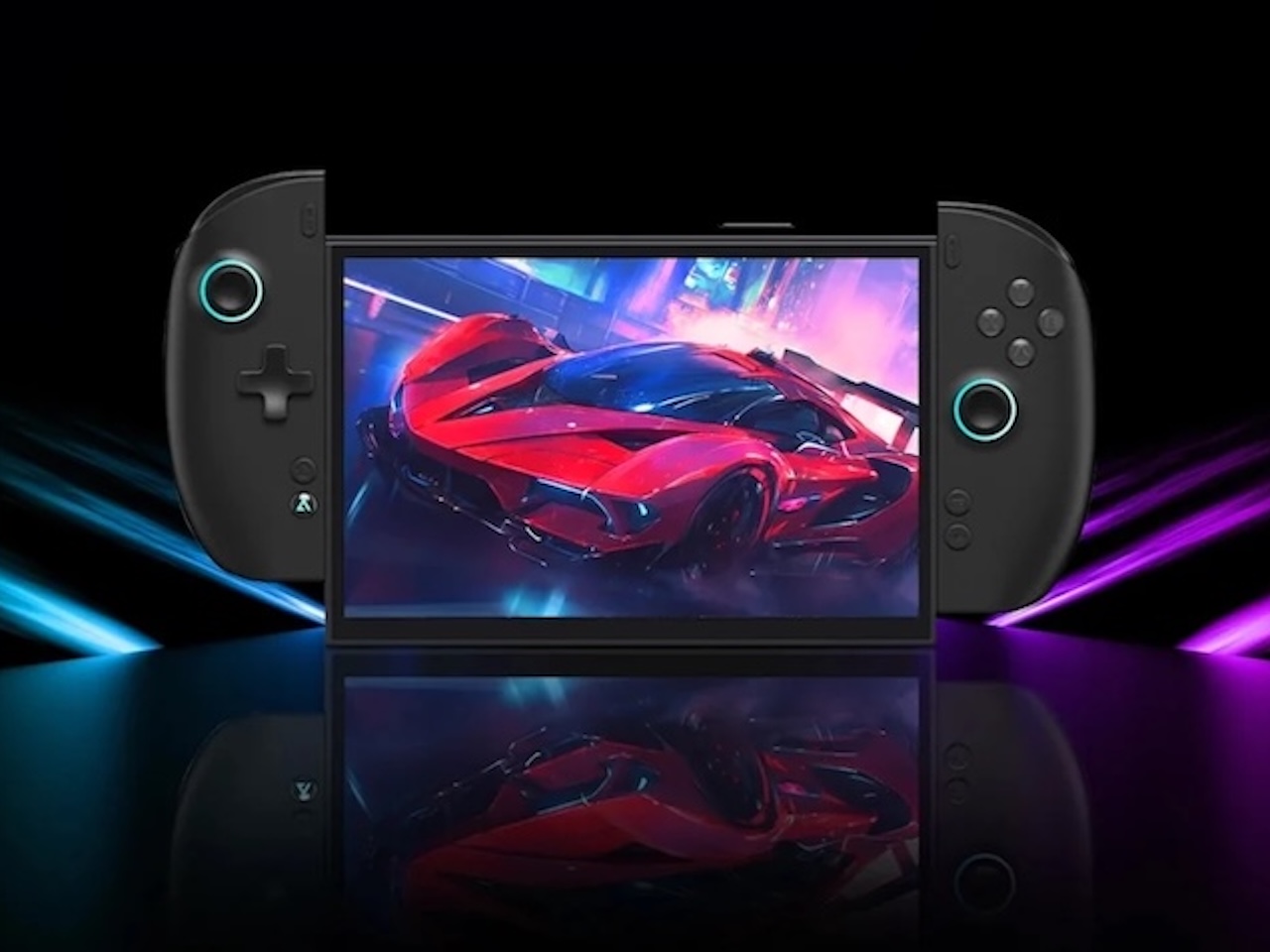
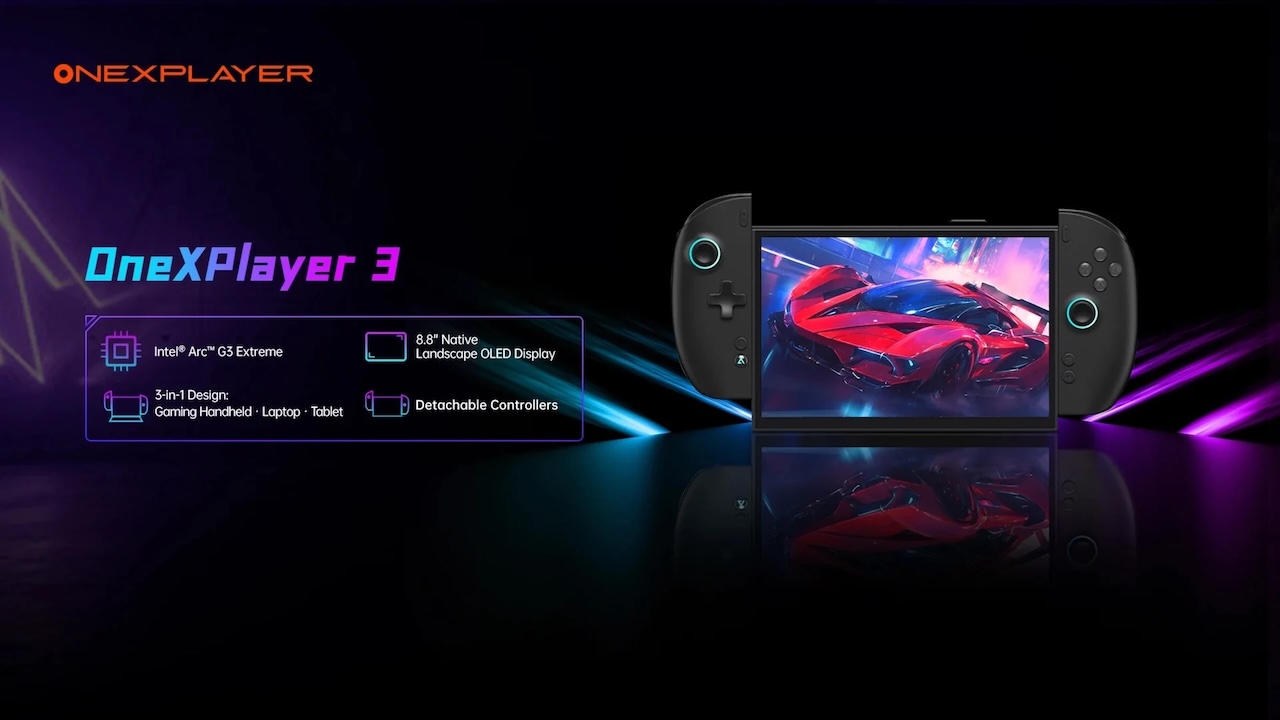
OneXPlayer just opened pre-orders for the OneXPlayer 3, and it’s the first 3-in-1 handheld to ship with Intel’s Arc G3 Extreme chip. Pricing starts at $1,399 on Indiegogo, with an 8.8-inch 144Hz OLED screen and an 85Wh battery leading the spec sheet. That combination puts it in direct range of the Legion Go 2 and the ROG Ally X, but with newer graphics silicon than either.
Price: From $1,399
Where to Buy: Indiegogo
The price is the aggressive part. At $1,399 to start, the OneXPlayer 3 undercuts the $1,799 MSI Claw 8 EX AI+ that runs the same Intel chip, which resets what a premium Arc G3 handheld is expected to cost.
What OneXPlayer put up for pre-order
The OneXPlayer 3 arrives as a 3-in-1 device that works as a handheld, a tablet, and a small laptop.
Pre-orders run through Indiegogo, and the base configuration pairs 24GB of RAM with 512GB of storage for $1,399. A 1TB version of that model runs $1,499, and the top-tier 32GB and 1TB configuration lands at $1,699. OneXPlayer lists estimated delivery around August 2026, though crowdfunding timelines can slip.
Why the Arc G3 Extreme chip matters
Intel’s Arc G3 Extreme is built on the company’s 18A process, and the OneXPlayer 3 is one of the first handhelds to use it. OneXPlayer positions it as a clear step up from the AMD Z2 Extreme, citing a pronounced lead in synthetic tests like 3DMark plus hardware ray tracing and XeSS 3 frame generation, though those are company and early hands-on figures rather than independent benchmarks. Thermal tuning usually decides how much of that headroom a handheld actually keeps.
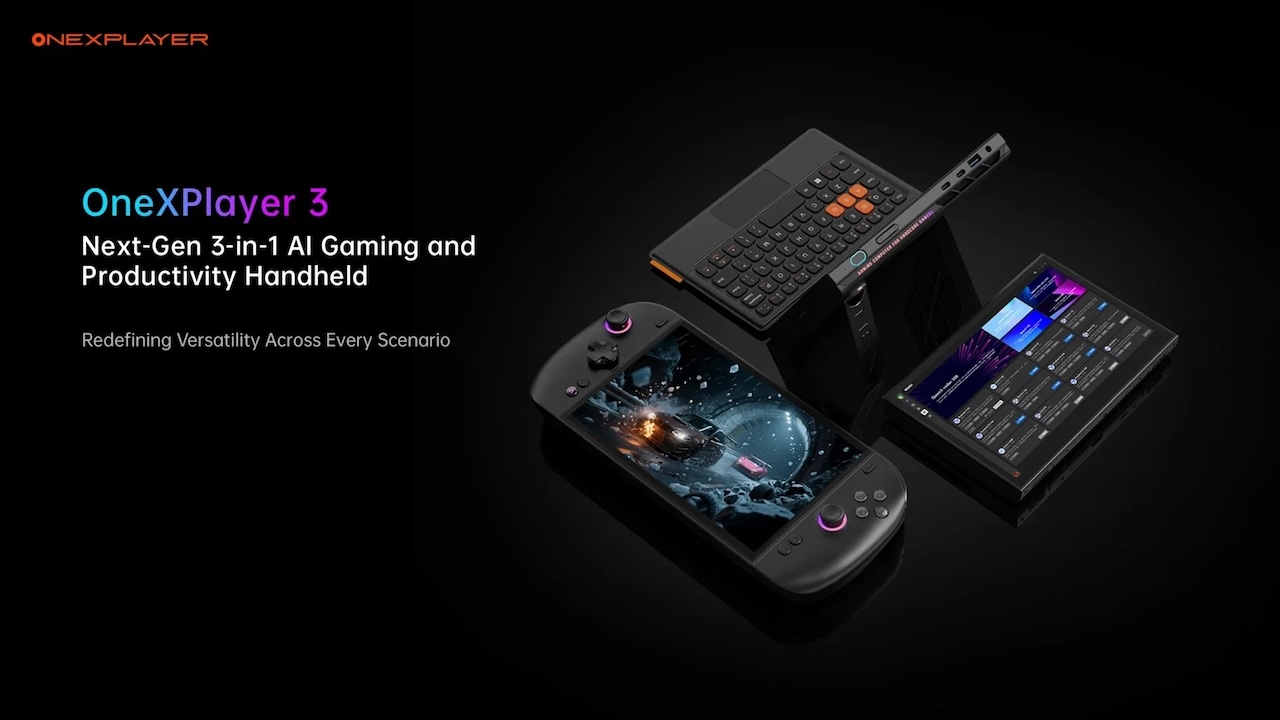
OneXPlayer also leans on the chip’s AI hardware, citing a dedicated NPU rated at 50 TOPS and total platform AI compute near 180 TOPS, plus figures like 119 frames per second in Cyberpunk 2077 in its top performance mode. Those numbers come straight from OneXPlayer, so treat them as launch marketing until reviewers run their own benchmarks.
The OLED and battery math
The 8.8-inch OLED panel runs at 1920×1200, 144Hz, with VRR and HDR brightness rated up to 1100 nits. That’s a brighter, higher-refresh screen than most handhelds ship today. The 85Wh battery is larger than the ROG Ally X at 80Wh and the Legion Go 2 at 74Wh. OneXPlayer’s own figures suggest around 10 hours for light indie games at 5W, but closer to two hours once you push the chip to its 35W ceiling.
A handheld that wants to be a laptop
Detachable controllers use Hall effect sticks and triggers, so stick drift shouldn’t creep in over time, and the center connector adds a built-in touchpad. A kickstand props the screen up, and the optional magnetic keyboard turns the whole thing into a compact Windows laptop. That laptop trick is the main thing separating it from the ROG Ally X, which doesn’t split apart at all.
Connectivity backs up the laptop ambitions, with a USB4 / Thunderbolt 4 port rated at 40Gbps, a USB Type-A port, a 3.5mm jack, a microSD slot, and a swappable internal SSD. That Thunderbolt port also drives an external GPU dock, so the handheld you carry on a trip can turn into a desktop-class rig at home.
The full spec sheet
At its core, the OneXPlayer 3 runs Intel’s Arc G3 Extreme on the 18A process, paired with either 24GB or 32GB of RAM and 512GB or 1TB of storage. The 8.8-inch OLED display handles 1920×1200 at 144Hz with VRR and HDR brightness up to 1100 nits. Power comes from an 85Wh battery feeding a chip that draws up to 35W, cooled by a vapor chamber and three heat pipes.
Controls run through detachable controllers with Hall effect sticks and triggers, while connectivity covers a USB4 / Thunderbolt 4 port at 40Gbps with eGPU support and microSD expansion.
Cooling and sustained play
A large battery and a 35W chip only matter if the OneXPlayer 3 can hold its clocks, and OneXPlayer built the cooling around that.
The system pairs a vapor chamber with pure aluminum fins, a fan, and three heat pipes to move heat off the chip. In OneXPlayer’s own FurMark stress runs, the front of the device measured 48.6°C while the grip stayed near 29.5°C. If those grip temperatures hold up in real games, long sessions shouldn’t get uncomfortable.
How it compares to the other Arc handhelds
The OneXPlayer 3 isn’t the only Arc G3 Extreme handheld, but it’s the one built around flexibility.
The MSI Claw 8 EX AI+ uses the same chip at a higher $1,799 start, yet it sticks to an LCD and a fixed one-piece body. The Legion Go 2 matches the detachable controllers and OLED but runs AMD silicon instead of Intel’s newest graphics. The ROG Ally X stays cheaper and lighter, though it remains a single fixed unit with no tablet or laptop mode.
Who should pre-order and who should wait
If you want the newest Intel handheld graphics, an OLED screen, and a device that folds into a laptop, the OneXPlayer 3 is the only option checking all three boxes right now. If you’d rather buy from a retailer with an easy return window, crowdfunding isn’t that. OneXPlayer has delivered Indiegogo campaigns before, so the risk here is timeline, not vaporware.


Price: From $1,399
Where to Buy: Indiegogo
Price and availability
Pre-orders are live now on Indiegogo, starting at $1,399 for the 24GB and 512GB configuration. OneXPlayer also revealed the X2 Mini Pro alongside it, which runs AMD’s Ryzen AI Max+ 395 instead of Intel silicon.