Smart glasses have a problem that has little to do with artificial intelligence. They need to be useful enough that you want to wear them, while also making people around you comfortable with a camera sitting on your face. HTC is tackling both issues with the HTC VIVE Eagle, its screen-free AI smart glasses. After launching in Taiwan in 2025, HTC announced broader availability on September 3, 2026, across North America, Europe, and Australia, with US prices starting at $499.
Price: $499
Where to Buy: Vive
Instead, it combines a camera, open-ear audio, translation, AI, HTC focuses on voice-controlled AI, photography, translation, note-taking, open-ear audio, and privacy controls. That makes the Eagle less like augmented-reality eyewear and more like an AI assistant you wear, which could be a better fit for people who want useful smart features without another screen demanding their attention.
No Display Might Be the Point
If you want navigation arrows or messages floating in your field of view, the VIVE Eagle is not designed for that because there is no display. Instead, you interact through voice commands and physical controls. The glasses have a 12MP ultra-wide camera that takes 3024 x 4032 photos and records video at up to 3K resolution, along with four microphones, including a directional microphone, and stereo open-ear speakers.
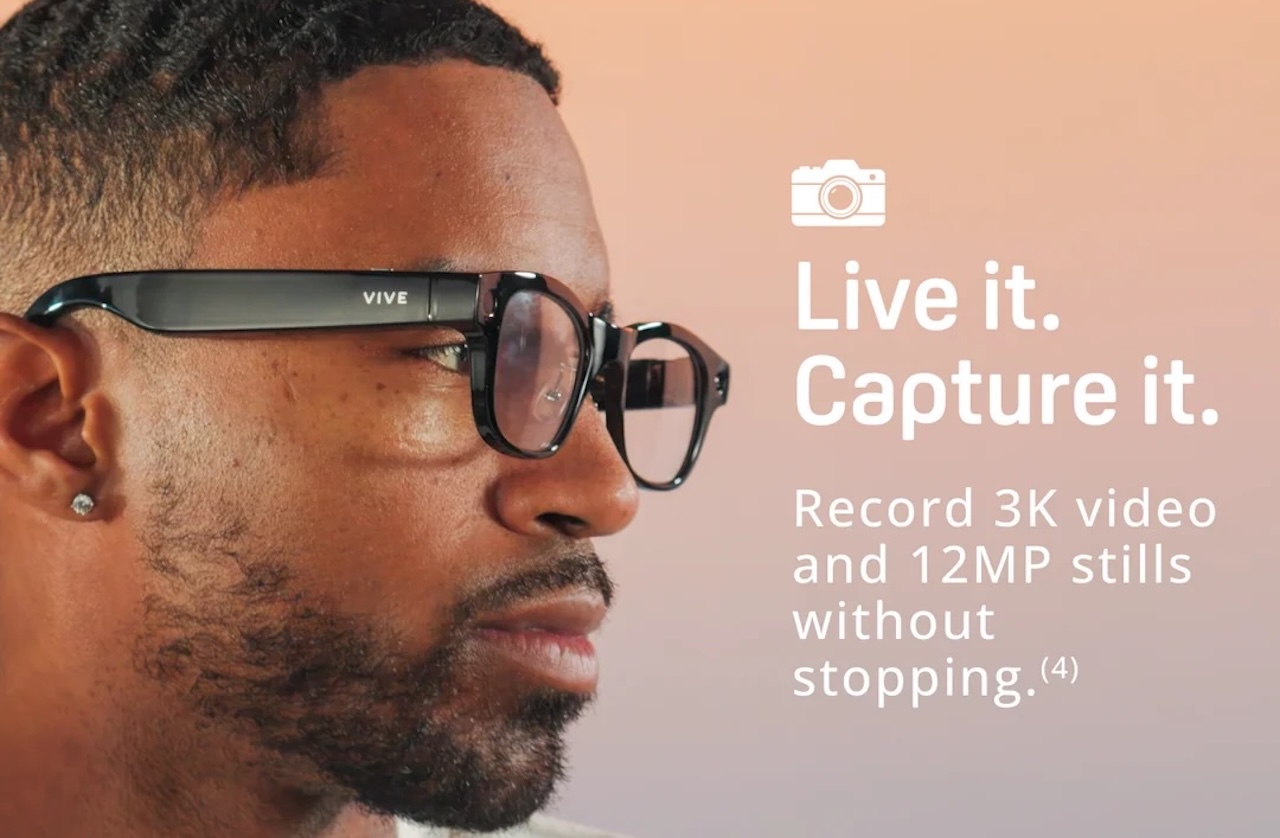 The missing display sounds like a limitation, but it gives the Eagle a focused job. You can capture photos and video, ask questions, listen to audio, translate speech or text, and create notes without constantly reaching for your phone. HTC’s documentation differs slightly on translation support: its September 3 announcement says live translation covers more than 96 languages, while its US FAQ says more than 90. Visual translation supports more than 70 languages.
VIVE AI Notes adds another practical layer by recording conversations, producing transcripts, distinguishing speakers, and generating summaries. HTC warns that these results can contain errors, so the feature is better treated as a convenient assistant than as the only record of an important meeting. For someone who regularly leaves meetings with scattered notes or forgotten action items, though, having the glasses handle the first pass could be genuinely useful.
Privacy Goes Beyond a Recording Light
Camera glasses inevitably raise the question of whether people nearby know when they are being recorded, and HTC has built several safeguards around that concern. The VIVE Eagle has a notification LED that illuminates or pulses during capture, and HTC says its brightness adjusts to remain visible. The glasses also refuse to record if the LED is obscured or compromised, while recording is disabled when they detect that they are not being worn.
 Users can enable another unusual feature that allows someone nearby to say “Stop filming” to stop a recording. That gives people around the wearer some control instead of leaving everything to the person behind the camera. These safeguards do not replace local recording and consent laws, something HTC specifically acknowledges, but they make the privacy approach more substantial than simply adding a tiny indicator light and calling the problem solved.
HTC says photos and videos are encrypted and stored locally until you import them, while queries sent to supported third-party AI services are de-identified. Not everything happens locally, however. VIVE AI Notes uses cloud processing for some transcription and summary functions, with relevant data potentially processed temporarily for up to seven days. HTC also says it does not sell customer data or use personal data to train VIVE AI, but those remain company claims rather than independently verified guarantees.

You Can Choose Your AI
Depending on region and device compatibility, the HTC VIVE Eagle supports AI services powered by Google Gemini and OpenAI GPT. HTC also describes integrations with smartphone assistants such as Siri and Gemini on supported devices. That flexibility matters because AI services are evolving quickly, and expensive smart glasses become less attractive if their usefulness depends entirely on one AI provider that may not always offer the features or answers you prefer.

Eligible purchases include two years of VIVE AI Plus at no additional charge, which gives buyers time to use the premium features before deciding whether they are worth paying for separately. Some AI functions require the premium service, however, so the $499 starting price does not necessarily represent the complete long-term cost of ownership. That is worth considering if AI features are the main reason you are buying the glasses.
Battery Life Still Requires Compromise
HTC claims up to 4.5 hours of continuous music playback and up to 36 hours of standby, while its US product page separately specifies up to 4.5 hours of continuous music playback. Those figures suggest the Eagle can cover stretches of a normal day, but real-world battery life under mixed use will need independent testing. Buyers who expect to use the glasses heavily from morning through evening should not assume the standby figure translates into all-day active use.
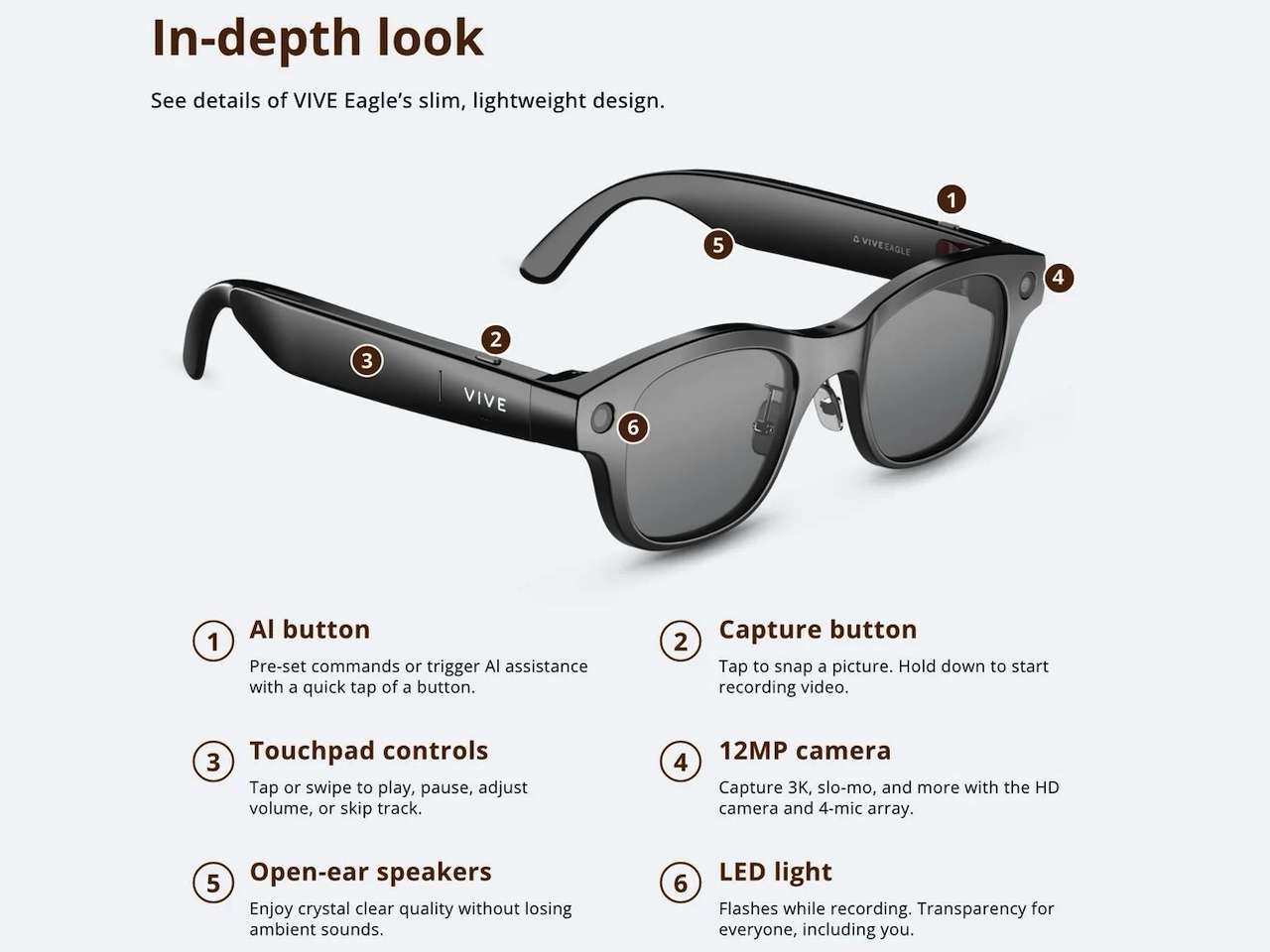
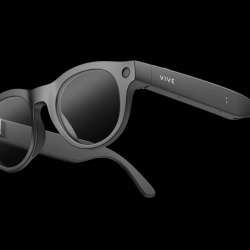
Charging may make that limitation easier to live with. HTC says the glasses reach 50% in 10 minutes and 80% in 23 minutes, and the magnetic pogo-pin connection means they can receive power without being placed inside a charging case. The optional $49 VIVE Power Boost weighs 8 grams and is claimed to extend battery life by up to 80%, which could be particularly useful for prescription-lens wearers who do not want to remove their glasses whenever the battery runs low. The frames are also IP54 rated, providing protection against limited dust ingress and splashing water, but they are water-resistant rather than waterproof.
Who Should Buy the HTC VIVE Eagle?
The HTC VIVE Eagle makes the most sense for travelers, commuters, meeting-heavy professionals, and people who want hands-free AI without another display in their field of vision. Translation, quick camera access, open-ear audio, and AI-generated notes all address situations where pulling out a phone can be inconvenient, while HTC’s recording safeguards give privacy-conscious buyers more to evaluate than a simple promise that their data will be handled responsibly.


Price: $499
Where to Buy: Vive
At $499 to start, these are premium smart glasses, particularly when some functionality depends on AI services and connectivity. Buyers expecting true augmented reality should look elsewhere because the Eagle is not trying to put your phone screen on your face. Instead, it combines a camera, open-ear audio, translation, AI, and smartphone assistance in relatively conventional-looking eyewear. The clearest buyer fit is someone who specifically wants screen-free smart glasses, values visible recording safeguards, and is willing to pay a premium for hands-free AI and camera features.