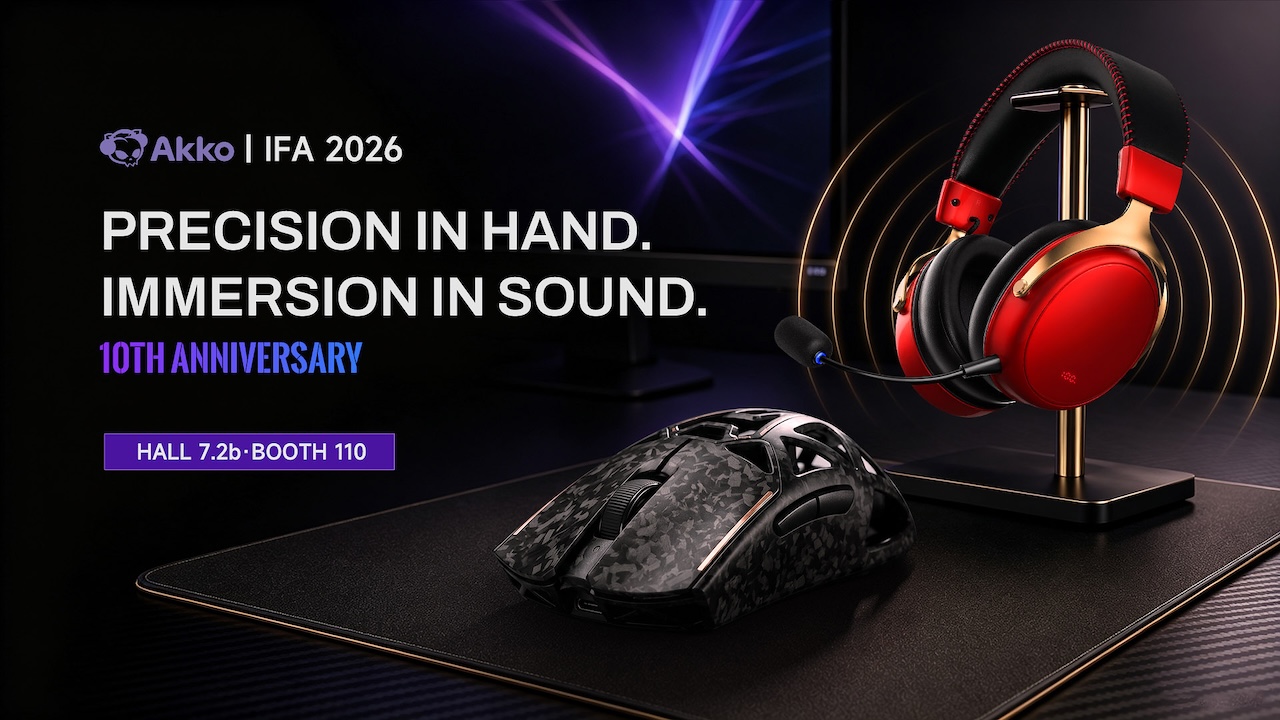
Building a gaming setup rarely means buying everything from one company. You might prefer one brand’s keyboard, another company’s mouse, a third headset, and something completely different if you play fighting games. That makes Akko’s IFA 2026 showing interesting for a reason that has little to do with another colorful mechanical keyboard.
Akko is entering its second decade by trying to become a broader gaming-peripheral company. Its Berlin lineup stretches from carbon-fiber gaming mice and wireless audio to a leverless fighting-game controller and the magnetic-switch keyboards that remain closest to the company’s roots. The expansion sounds ambitious, but a bigger catalog doesn’t automatically produce better products. Each category has established competitors, and impressive specifications still have to translate into something you can actually feel while playing. With that in mind, here are five parts of Akko’s IFA 2026 lineup worth watching.
1. Go Carbon Fiber takes Akko deeper into lightweight gaming mice
The Go Carbon Fiber Gaming Mouse shows how far Akko is moving from the mechanical keyboards that established the brand. Its basic idea is familiar: reduce weight while keeping the sensor performance and connectivity competitive PC players expect. Akko uses a carbon-fiber-composite construction, giving the Go a different approach to reducing weight than simply making a conventional plastic shell thinner.
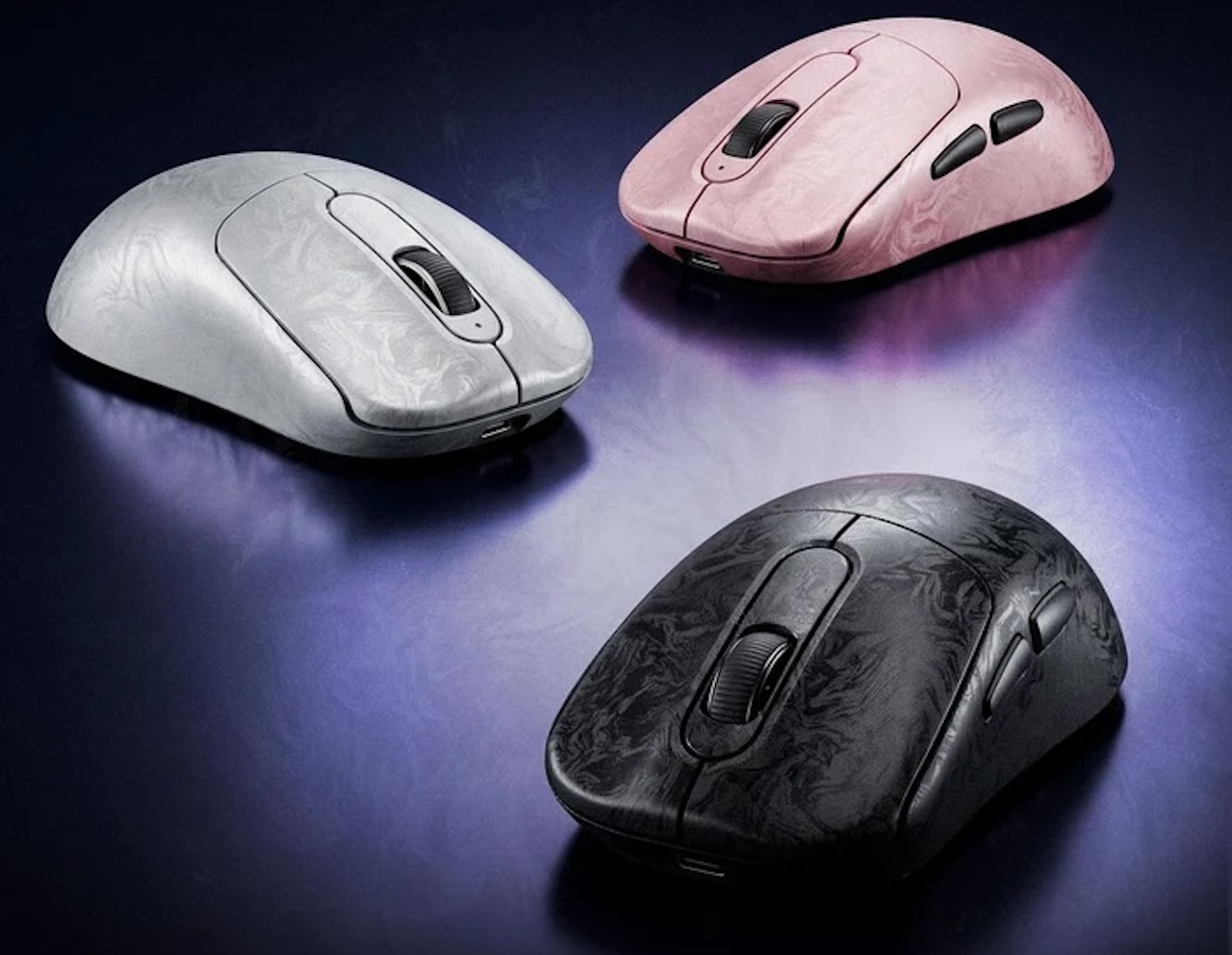
That matters because lightweight mice can become a balancing act. Reducing mass can make rapid movements easier, but a low number on a scale doesn’t tell you whether the shell feels rigid, the buttons feel consistent, or the shape works for your particular grip. Those characteristics become especially important during longer gaming sessions, when a mouse that looks ideal on a specification sheet can become uncomfortable in your hand.
Higher-end Go configurations also emphasize high polling rates and gaming-focused sensor hardware. Those are measurable specifications, but the practical benefit is harder to quantify because display refresh rate, PC performance, game behavior, and the player all influence whether faster reporting becomes noticeable. For most buyers, the Go’s shape, construction, button feel, and weight distribution may ultimately matter more than its biggest performance numbers.
2. Echo gives buyers another shape instead of pretending one mouse fits everyone
Akko is also showing the Echo Carbon Fiber Gaming Mouse, which could initially look redundant beside the Go because both pursue a similar lightweight, performance-oriented formula. The more useful distinction is that Akko is building multiple shapes around that concept rather than expecting one mouse body to work equally well for everyone.
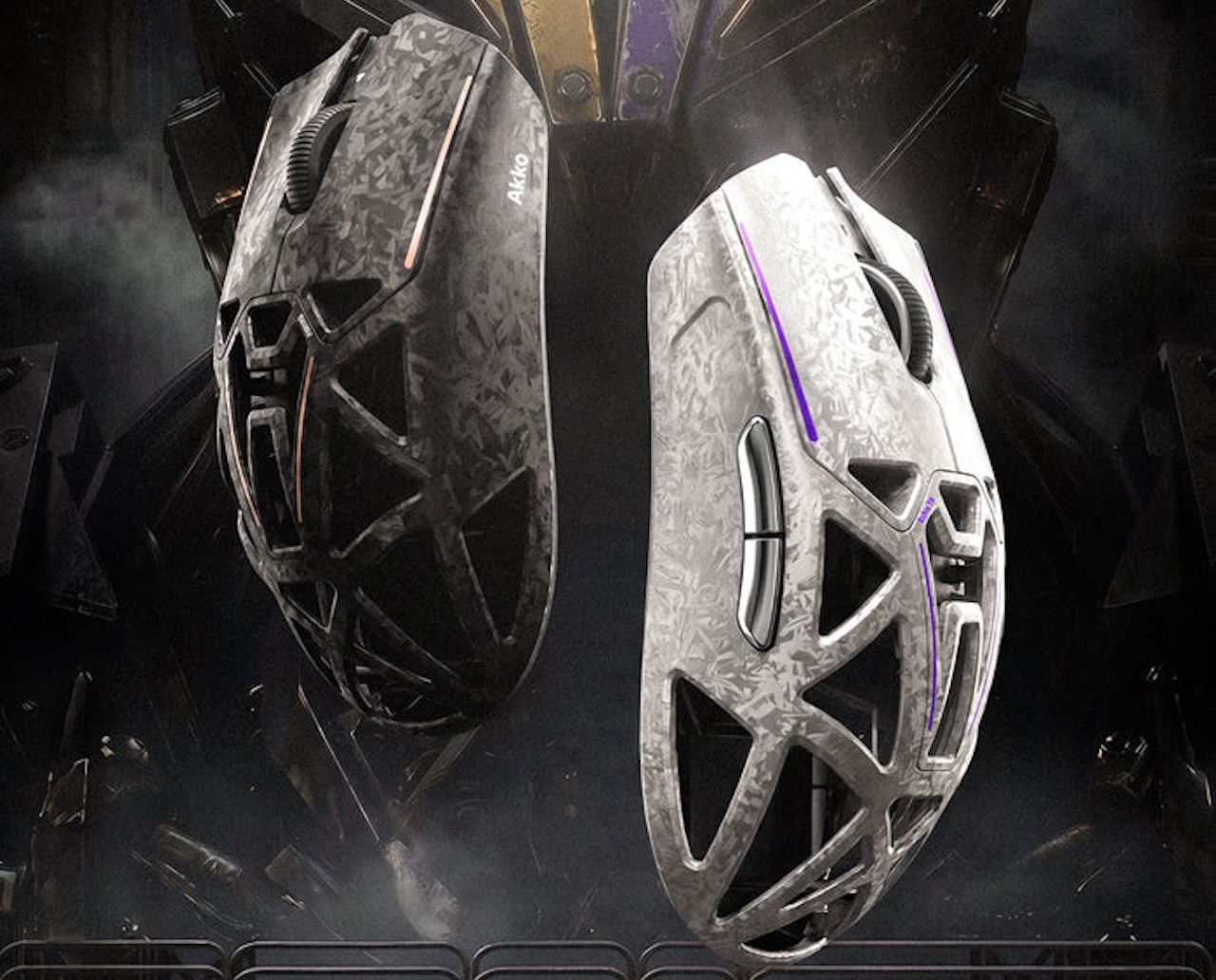 That’s a sensible approach because a gaming mouse is one of the most personal peripherals on a desk. Hand size, grip style, button placement, hump position, and weight distribution can matter more during a long session than maximum DPI. Someone using a palm grip may have a completely different experience from a fingertip-grip player even when the electronics inside two mice are similar.
Akko again emphasizes carbon-fiber-composite construction and higher-performance configurations aimed at competitive gaming. What the company cannot establish through specifications is whether the Echo’s shape is actually comfortable or preferable to the Go. That requires hands-on use, but offering different shapes at least acknowledges that the physical experience of using a mouse matters as much as the sensor underneath your hand.
3. Verge S9 Master tries to solve the multi-device headset problem
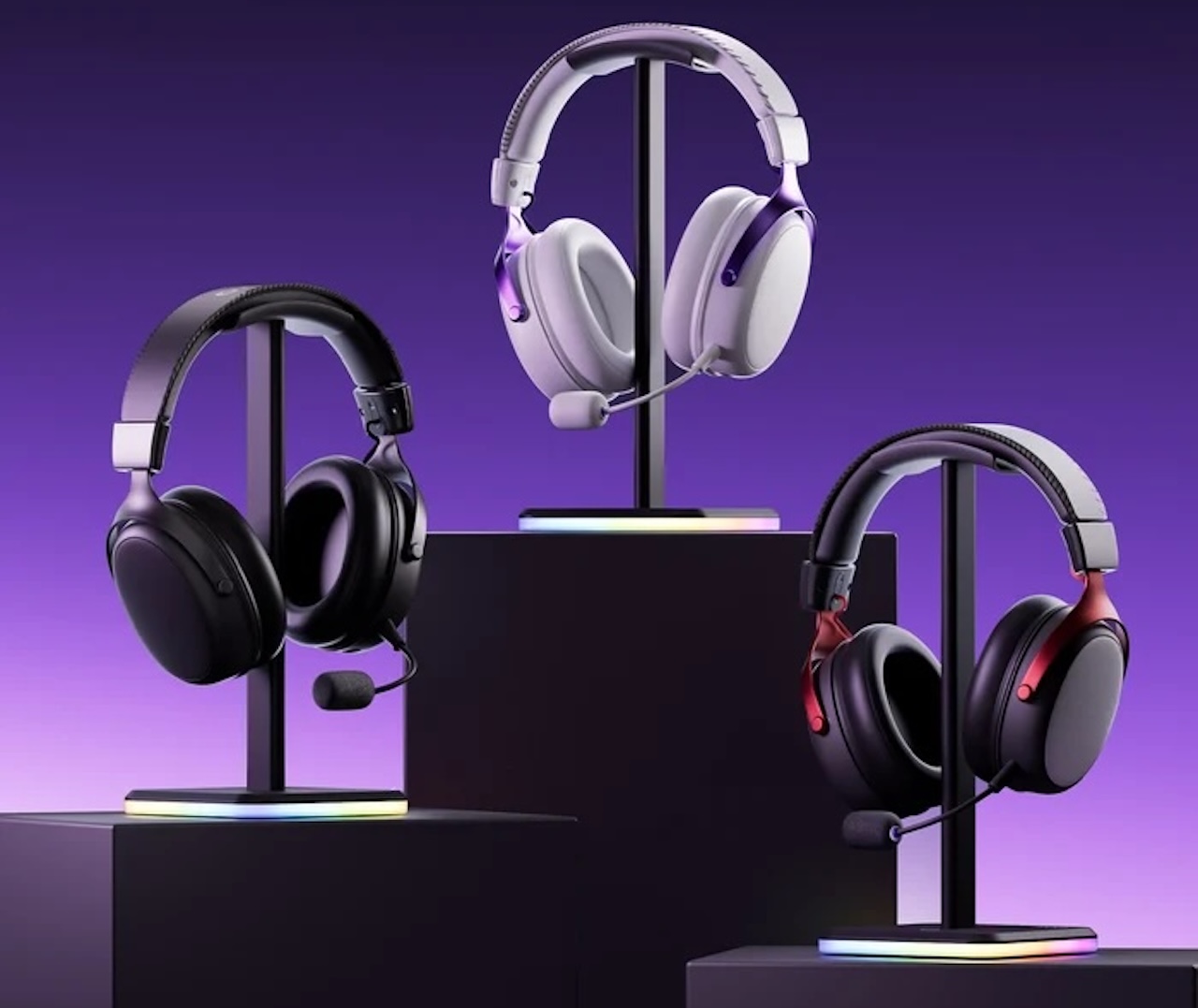
Gaming headsets become frustrating when moving between devices means moving dongles, changing cables, or discovering that one connection mode doesn’t work where you expected it to. The Verge S9 Master is Akko’s attempt to make one headset useful across a broader collection of devices by emphasizing multiple connection options alongside gaming-oriented audio features.
The practical appeal is straightforward. A headset becomes much easier to justify when it can move between PC gaming, mobile listening, consoles, and everyday use instead of living beside one computer. Akko also promotes large drivers, gaming-focused sound modes, and long claimed wireless battery life, giving the S9 Master a feature list designed to compete with established gaming-headset brands.
Those audio and endurance claims deserve more caution than the basic hardware specifications. Driver size doesn’t tell you whether a headset sounds good, surround-processing features don’t prove that footsteps become easier to locate, and a manufacturer battery estimate doesn’t establish how long the headset will run at your preferred volume and settings. Those questions require listening and battery tests.
If Akko gets the fundamentals right, connectivity could end up being the S9 Master’s strongest feature. For many buyers, having one comfortable headset that behaves predictably across several devices is more useful than another audio preset promising a competitive advantage.
4. FUNBOX gives Akko a product specifically for fighting-game players
The FUNBOX is the most specialized product in Akko’s IFA group. Instead of using a conventional arcade stick, it’s a leverless fighting-game controller that replaces the joystick with individual directional buttons. Akko combines that layout with magnetic switches and extensive input customization, putting it squarely into a category where players can be extremely particular about how their controls behave.
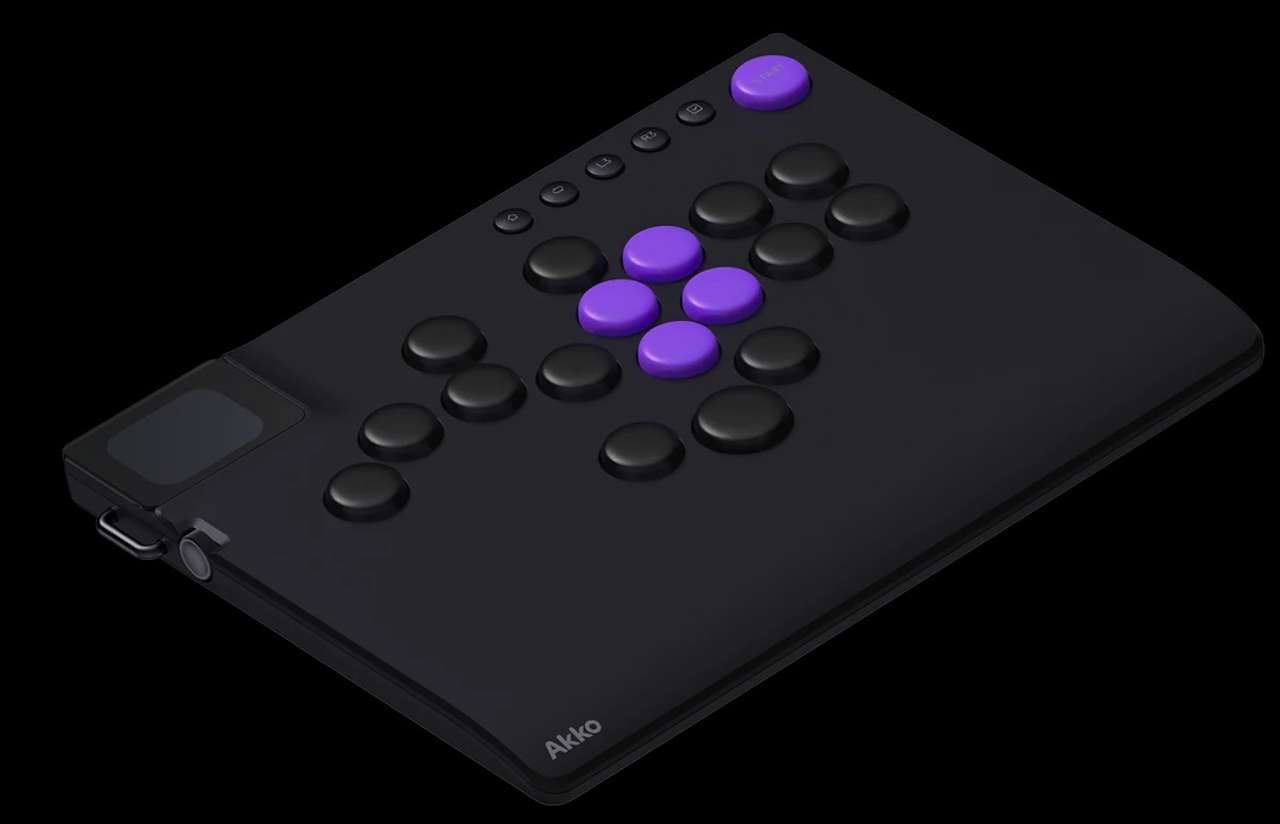
The practical reason for using magnetic switches is adjustability. Rather than being stuck with one fixed actuation behavior, players can tune when inputs activate and reset. That flexibility could matter in fighting games, where rapid and deliberate directional inputs are fundamental to movement, execution, and consistency.
Akko promotes very fine actuation and Rapid Trigger capabilities, but those specifications shouldn’t be confused with an automatic competitive advantage. Hardware can reduce travel and provide more control over how an input behaves, but it doesn’t execute a combo, read an opponent, or improve timing by itself. The real test will be whether the FUNBOX provides consistent inputs and useful customization without making setup unnecessarily complicated.
Platform support also deserves attention because fighting-game controllers can have complicated console-compatibility requirements. Buyers should check exactly which systems and adapters their intended FUNBOX configuration supports before purchasing. This isn’t a controller designed for every gamer, but that specialization is precisely what makes it an interesting expansion for Akko.
5. Magnetic keyboards keep Akko connected to what it already knows
For all the new product categories, keyboards remain Akko’s home territory, and its IFA lineup continues the company’s move into Hall-effect and TMR magnetic-switch keyboards. Akko is also expanding layouts for different regional markets, giving the familiar part of its business its own update while mice, audio, and controllers broaden the catalog around it.
Magnetic switches have become increasingly popular in gaming keyboards because they allow adjustable actuation and features such as Rapid Trigger. Instead of relying on one fixed physical actuation point, compatible keyboards can let players alter how far a key must move before registering an input and how quickly it resets. That flexibility has obvious appeal for competitive games built around fast, repeated movement inputs.
It isn’t automatically better for every user. Someone who spends the day writing and the evening playing slower-paced games may care much more about key feel, acoustics, layout, wireless reliability, software quality, and overall construction. A tiny actuation distance isn’t much of an advantage if you dislike typing on the keyboard.
Akko already has experience addressing those enthusiast-keyboard concerns, which makes this category different from its newer peripheral experiments. The more interesting question is whether it can combine magnetic-switch gaming features with the typing experience and customization options that made people pay attention to its keyboards in the first place.
Buyer fit: Akko’s ecosystem is getting bigger, but shop product by product
Akko’s IFA 2026 lineup makes the company’s direction clear. It wants to be considered for much more than the keyboard sitting in the center of your desk. The lightweight Go and Echo mice broaden its reach into competitive PC gaming, the Verge S9 Master tackles multi-device audio, and the FUNBOX reaches fighting-game players, while new magnetic-switch keyboards keep Akko connected to the category where it already has an established identity.
The expansion gives existing Akko customers more reasons to consider the brand, but matching logos aren’t a reason to replace peripherals you already like. The mice still need to prove their shapes and control quality, the headset needs listening and battery testing, and the FUNBOX needs to demonstrate that its customization works reliably in real matches. Akko’s magnetic keyboards also have to balance increasingly aggressive gaming specifications with the everyday typing experience buyers may care about just as much.
For someone building an entire gaming setup from scratch, Akko’s growing catalog is worth a look because there are now products aimed at several very different types of players. If you already have peripherals you like, however, there’s little reason to buy into the ecosystem simply for consistency. Akko’s most interesting message from IFA 2026 is that a company known primarily for keyboards now wants a chance to earn almost every other spot on your gaming desk. Whether it deserves those spots will depend on how each product performs once the specifications give way to actual use.