
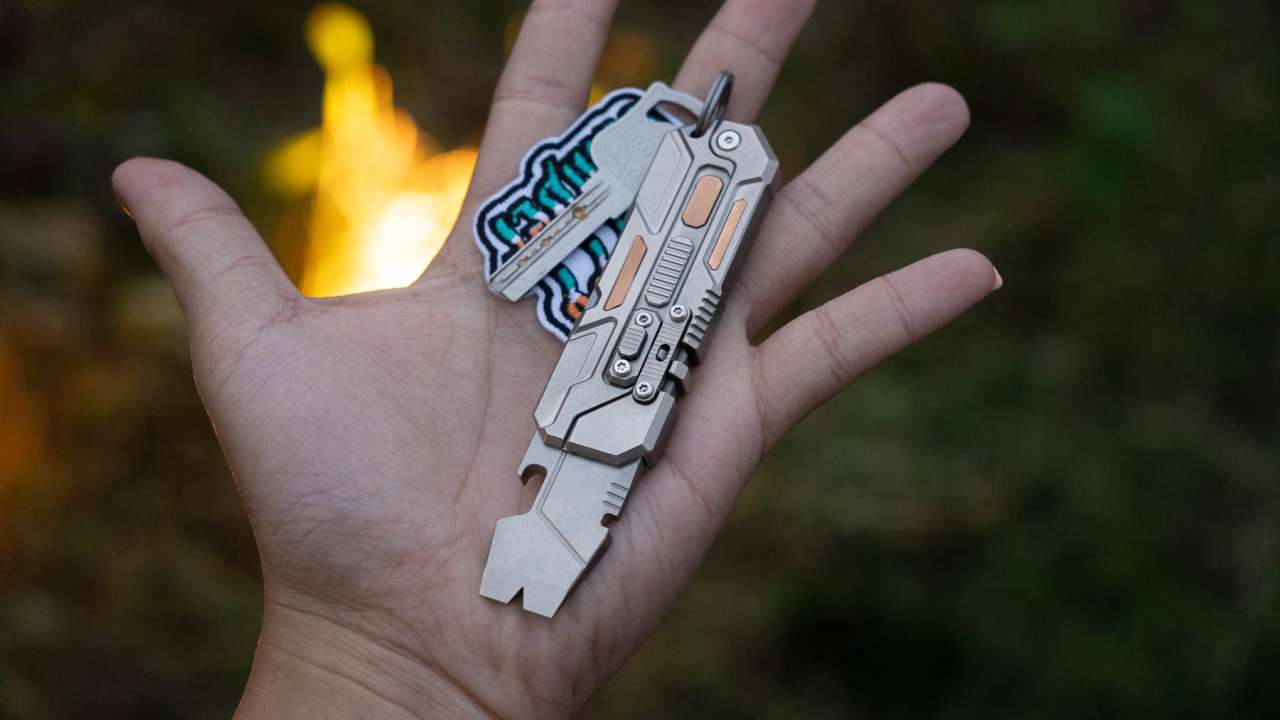
ARTICLE – Most pry bars exist purely to solve problems. You grab one when a lid won’t budge, a staple needs extraction, or a box refuses to cooperate. The TI PryBar Playmaker from Big Idea Design treats that assumption as optional, treating the tool itself as part of the appeal. Built from Grade 5 titanium with a quick-slide deployment mechanism, it’s an EDC piece that prioritizes how it feels in your hand as much as what it can actually do.
Live on Kickstarter
It’s the kind of choice that separates tools you actually carry from ones that migrate to a drawer. The EDC space has shifted away from maximum feature density toward objects that reward repeated interaction, and this pry bar sits squarely in that territory. It’s not trying to replace your multitool or compete with survival gear. There’s no saw blade, no hex bits, no corkscrew. Instead, it occupies the narrower space of a well-made object you’ll reach for because using it feels satisfying, not just because you need it.

Titanium, Brass, and the Weight Question
The Playmaker uses CNC-machined Grade 5 titanium as its primary material, the same alloy you’ll find in aerospace components and high-end watch cases. At 62.6 grams, it’s light enough for keychain carry without feeling insubstantial. The weight sits in that narrow band where you notice the tool in your pocket but don’t resent it after a few hours. Titanium’s corrosion resistance means humidity, salt spray, and general environmental abuse shouldn’t produce the oxidation you’d see on steel alternatives over the same timeframe.
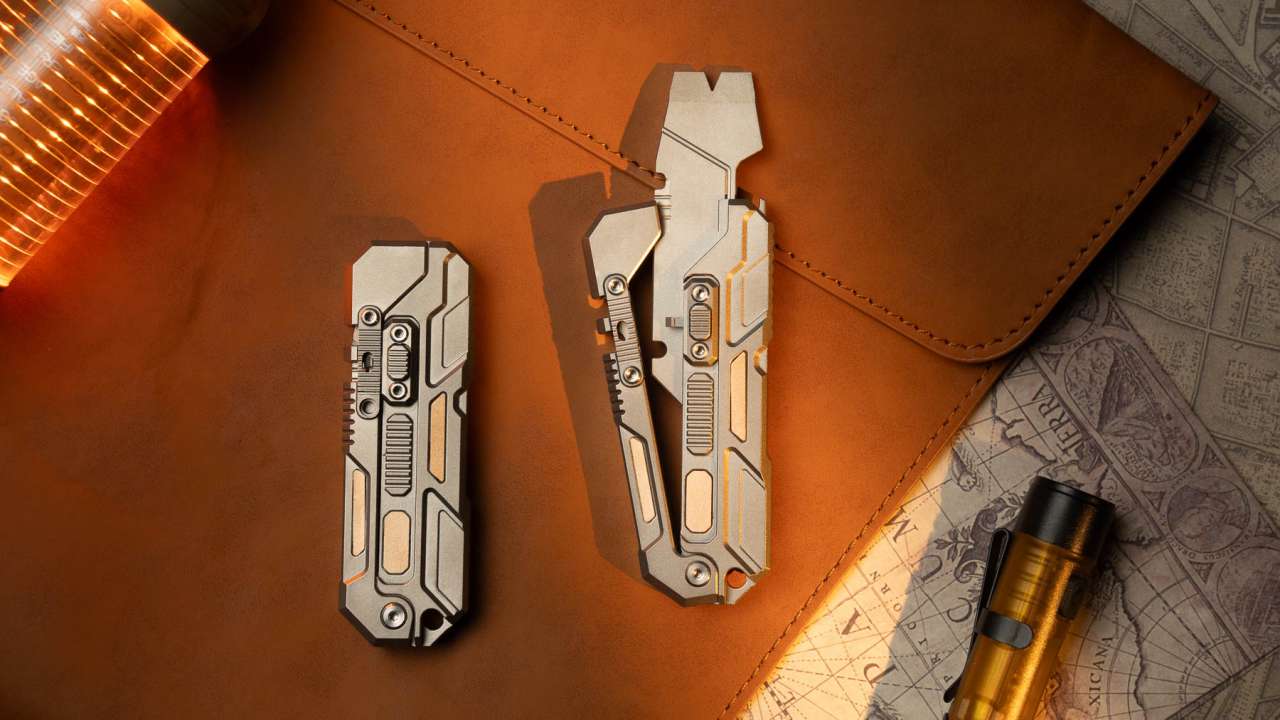
Sandblasting creates the matte finish, serving two purposes beyond aesthetics. It reduces fingerprint visibility, which matters more than you’d expect on a tool you’ll handle constantly. The micro-texture also improves grip without aggressive knurling that can feel abrasive during extended use. Brass inlays provide visual contrast against the gray titanium, but they also introduce tactile warmth that pure titanium lacks. The weight difference is minimal, yet the psychological effect of mixed materials shifts how the tool registers in your hand. You’re holding something assembled rather than extruded, which signals intention even before you deploy anything. The combination reads as industrial rather than decorative, leaning into angular lines and exposed mechanical details that suggest precision machining rather than mass production. These aren’t choices made for cost efficiency. They’re choices made for people who notice the difference.

Surface treatment choices like these tend to reveal themselves over months of use rather than initial handling. The sandblasting should develop a subtle patina without the dramatic discoloration you’d see on raw titanium, though long-term wear patterns will depend heavily on individual carry habits and environmental exposure. Big Idea Design claims stable mechanical properties across wide temperature ranges, which tracks with titanium’s known behavior but remains unverified until units ship.
The visual language here targets a specific audience: people who notice machining tolerances, appreciate material choices, and find satisfaction in objects built with visible intention. If you’ve ever examined the chamfering on a pocket knife or wondered why one flashlight body feels better than another despite similar specs, you’re probably the target demographic.

What It Actually Does
Four core functions integrate into a single body. The primary pry bar uses a progressive wedge shape designed for opening stuck lids, separating materials, light dismantling, and basic leverage tasks. The wedge profile also allows it to function as a flat-head screwdriver in some scenarios, though dedicated drivers will obviously outperform it for precision work. That’s an acceptable tradeoff for a tool this size.
A modular blade holder accepts standard utility blades, which is where the design shows restraint. Utility blades are cheap, universally available, and replaceable in seconds. When performance degrades, you swap the blade rather than sharpening or replacing the entire tool. You’re not babying a proprietary component or hunting for specialty replacements. The holder itself is removable, so you can configure the Playmaker for blade-free tasks when cutting isn’t needed. A bottle opener integrates into the pry bar structure, and the prying geometry doubles as a staple remover capable of extracting staples, small nails, rivets, and clips.

The deployment mechanism deserves attention because it’s central to the product’s identity. A quick-slide system allows one-handed operation through a press-and-slide motion. The internal spring assembly pairs with a locking system that uses a 45-degree angled catch, reportedly reducing friction and preventing the stuttering you sometimes feel when retracting spring-loaded tools. Big Idea Design emphasizes mechanical satisfaction as a design goal rather than pure speed, which suggests they’re targeting users who appreciate tactile feedback over raw deployment velocity. Whether the mechanism lives up to that promise requires hands-on testing, but the engineering approach at least indicates intentional design rather than checkbox feature inclusion.
Taken together, these functions don’t try to cover every scenario. The Playmaker is built around tasks that recur in daily carry rather than edge cases that might occur once a year. That focus is deliberate, and it means you’re not carrying extra weight for features you’ll never use.

Carry Options and the Travel Question
Grip design follows ergonomic principles you’d expect from a premium EDC tool: anti-slip textures, concave curves shaped around natural hand force patterns, and geometry intended to maintain control with wet hands or while wearing gloves. A precision-cut keychain hole transforms the Playmaker from pocket-only carry to constant-carry territory, which is where tools like this earn their keep.
Two tritium slots accept glow tubes for low-light visibility, available as paid add-ons in multiple colors. Luminous vials offer a lower-cost alternative that charges via light exposure rather than radioactive decay. Whether tritium counts as practical or purely enthusiast-grade is debatable, but it’s a nice touch for those who want options. The modularity here reflects broader EDC customization trends, letting you dial in the aesthetic without altering what the tool actually does.
Travel considerations introduce necessary caveats. The blade is removable, and Big Idea Design positions this as a TSA-friendly feature since you can discard the blade before flying and replace it cheaply on arrival. The campaign stops short of guaranteeing TSA compliance, which is the honest approach. Security screening remains unpredictable, and no manufacturer can promise a specific outcome at airport checkpoints. Traveling with the blade removed and the pry bar separated from other metal objects probably improves your odds, but “probably” isn’t a guarantee.

Campaign Reality and Who This Is For
Big Idea Design claims over a decade of experience designing smart and EDC products, with 18 previous Kickstarter campaigns fulfilled. That track record provides more confidence than a first-time creator would, though crowdfunding always carries inherent risk. If you’ve backed campaigns before, you know how variable delivery timelines can be. The campaign has already exceeded its roughly $3,848 goal by more than three times with approximately 24 days remaining, suggesting market validation for the concept. Super Early Bird pricing lands around $129, with estimated delivery in April 2026. Manufacturing occurs in Hong Kong using in-house CNC machining capability.
Live on Kickstarter
This targets a specific intersection of EDC enthusiast and material appreciator. It’s not for buyers who want maximum features per dollar or survival-oriented preparedness gear. It’s for people who find satisfaction in well-machined objects, appreciate the feel of quality materials, and want a pry bar that rewards handling rather than just accomplishing tasks. At this price point, you’re paying for titanium, precision manufacturing, and design intention rather than raw capability. A $15 steel pry bar will still open boxes. This one is for people who understand why that comparison misses the point.
Funding runs through Kickstarter with standard all-or-nothing rules. If the project fails to fully fund, backers aren’t charged. Given that it’s already well past goal, that scenario seems unlikely.
📡 CES 2026 Coverage
Want more from the show floor?
We’re covering the biggest announcements, wildest concepts, and gear that actually matters from CES 2026.

Gadgeteer Comment Policy - Please read before commenting
Quite the love story you wrote for this.