
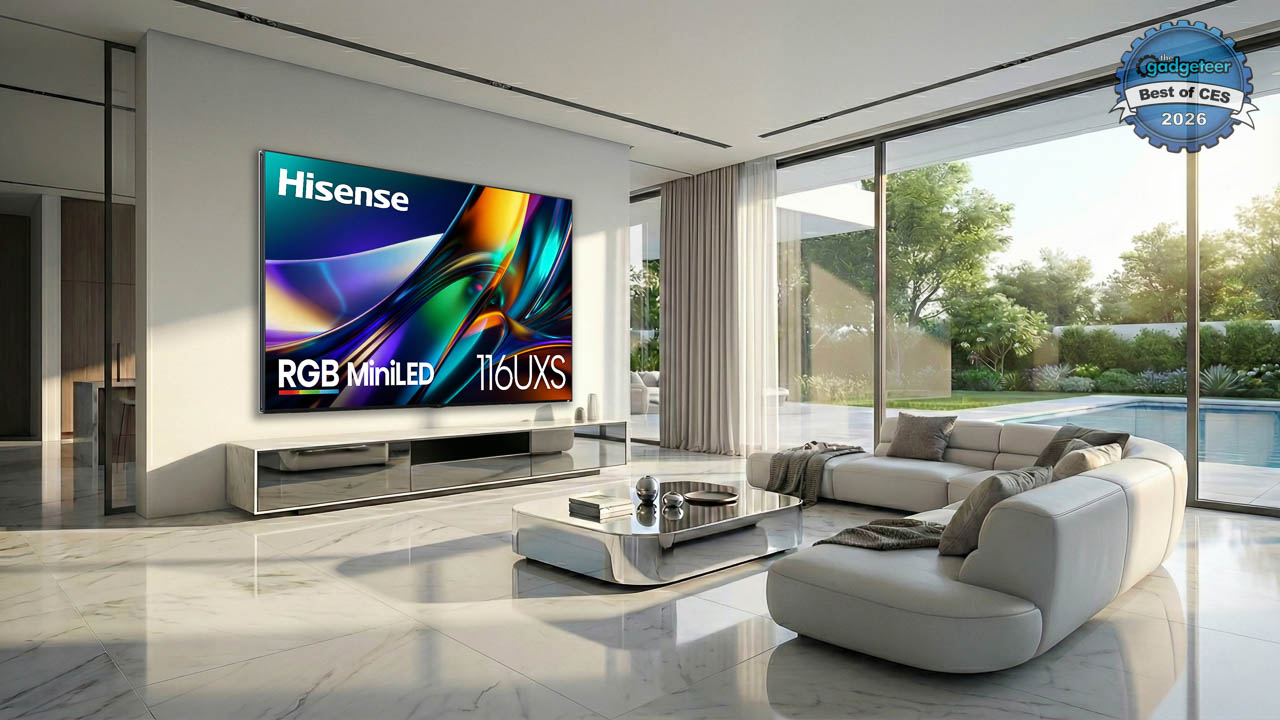
CES 2026 NEWS – There’s a color your TV can’t show you. It sits in the gap between green and blue, in the range where human eyes are most sensitive, and every display you’ve ever owned has been faking it.
You’ve seen it approximated. Never accurately.
So the real question is: what else has been missing from every screen you’ve trusted?
This isn’t a theoretical limitation buried in engineering documents. It’s a visible gap that affects ocean scenes, foliage, blue-hour skies, certain skin tone undertones. Every time your display tries to render cyan-green tones, it’s blending adjacent colors and hoping you won’t notice. Most of the time, you don’t. But your brain registers something slightly synthetic, slightly off, and you chalk it up to “that’s just how screens look.”
It’s not. That’s how compromised screens look.
At CES 2026, Hisense is showing the 116UXS: a 116-inch display with four LED primaries instead of three. Red, green, blue, and cyan. The fourth color fills the gap that RGB displays have been working around since the technology was invented.
We covered Hisense’s RGB mini LED launch earlier this year. That system used three independent LEDs per dimming zone, allowing separate control of color and light intensity. The 116UXS extends that architecture with a dedicated cyan LED, targeting the 490-520 nanometer range where your eyes are most perceptive and where three-primary systems are weakest.
Add The Gadgeteer as a preferred source to see more of our coverage on Google.
Why Cyan Changes More Than You’d Think
You came here expecting another CES TV announcement. This might actually be about biology.
Human vision doesn’t weight all colors equally. The cyan-green band sits in a perceptual sweet spot where your eyes have heightened sensitivity. Standard RGB displays struggle here because there’s a significant spectral gap between green and blue primaries. When content calls for cyan, your TV interpolates from nearby colors. The result looks close enough that you accept it. But it’s not what the colorist intended, and it’s not what the scene actually contains.
Think about watching footage of Caribbean water at midday. Or dense forest canopy with light filtering through. Or twilight sky transitioning from blue to green. On most displays, these scenes flatten slightly. The gradient loses dimensionality. The color feels compressed rather than expansive.
The 116UXS addresses this with hardware, not processing tricks. By adding cyan as a fourth primary LED, the display can hit those wavelengths directly instead of approximating them. According to Hisense, this enables up to 110% BT.2020 color coverage, exceeding the broadcast standard designed for next-generation content. Most premium TVs today cover 70-80% of BT.2020.
The number matters less than what it represents: colors you’ve been watching were constrained by a limitation you didn’t know existed. And you’ve been calling that limitation “accurate.”
How Four-Primary Systems Actually Work
Traditional mini LED backlights use white or blue LEDs filtered through color conversion layers. You start with one wavelength and subtract to create others. RGB mini LED improved this by generating red, green, and blue additively from separate LEDs under a precision optical lens.
The 116UXS takes that further. Hisense calls it RGB Mini LED Evo: four independent LEDs per dimming zone, each controllable for both intensity and color output. The 3D color dimming system that Hisense pioneered in 2025 now manages four primaries instead of three, increasing the variables available for hue, saturation, and brightness adjustments within each local dimming area.
One unexpected benefit: hardware-level blue light reduction. By redistributing color generation across four primaries, the system can produce equivalent brightness with less reliance on the blue LED. This happens at the source, not through software filtering that typically compromises color accuracy. Hisense emphasizes this matters more as screen sizes grow and viewing sessions extend.
The Advanced HiView AI Engine RGB handles frame-by-frame optimization across the four-primary system. Managing that complexity at 116 inches with thousands of dimming zones requires substantial processing overhead. Whether the system maintains precision during fast motion remains the open question until hands-on testing.
The Uncomfortable Part
Here’s what Hisense isn’t saying explicitly, but the technology implies: every high-end display you’ve invested in was working around a fundamental limitation. OLED, mini LED, QLED, whatever you bought, they all share the same three-primary architecture with the same spectral gap.
If four-primary systems prove perceptually superior, it reframes what “reference quality” has meant for the past two decades. You weren’t watching inaccurate colors because your display was cheap. You were watching inaccurate colors because the underlying technology had a hole in it, and no one told you.
That’s not a reason to throw out your current TV. It’s a reason to pay attention to what happens next.
Who This Isn’t For
If you’re looking for a TV you can actually buy at a normal price, this isn’t it. The 116UXS is a flagship product at flagship scale. 116 inches doesn’t fit most living rooms. It fits dedicated theater spaces and buyers who treat display technology as a long-term investment.
If your viewing environment has significant ambient light, much of the color precision advantage disappears. If you’re primarily watching compressed streaming content, the expanded gamut won’t have much source material to work with.
And if you’re happy with your current OLED or mini LED, there’s no urgent reason to upgrade. Those technologies are mature, available, and excellent at what they do. The question the 116UXS raises isn’t whether you should buy it. It’s whether you’ll be able to unsee what you’ve been missing.
Where This Leaves You
The 116UXS will be shown at CES 2026, with the press conference scheduled for January 6 at Mandalay Bay. Unlike most CES concepts, this builds directly on production technology Hisense shipped in 2025, suggesting availability could come faster than typical prototype timelines.
That matters because it moves four-primary systems from theoretical to tangible. If Hisense can ship this architecture at scale, it forces the rest of the industry to respond.
But the harder question isn’t about the industry. It’s about you. How much of what you’ve been watching was real, and how much was your display guessing at colors it couldn’t actually produce?
You probably won’t know until you see the difference. And then you won’t be able to stop noticing.
📡 CES 2026 Coverage
Want more from the show floor?
We’re covering the biggest announcements, wildest concepts, and gear that actually matters from CES 2026.
Hisense 65" E6 Cinema Series Hi-QLED 4K UHD Smart Fire TV (65E6QF, 2025 Model) -AI Light Sensor, Dolby Vision · Atmos, Voice Remote with Alexa, Motion Rate 120, HDR 10+ Adaptive, Game Mode Plus
(as of April 8, 2026 14:58 GMT -05:00 - More infoProduct prices and availability are accurate as of the date/time indicated and are subject to change. Any price and availability information displayed on [relevant Amazon Site(s), as applicable] at the time of purchase will apply to the purchase of this product.)

Gadgeteer Comment Policy - Please read before commenting
In another article (same author) we’re introduced to the Hisense 163MX, which uses four LEDs, Red, Green, Blue and YELLOW.
And then explains why the Yellow LED covers the gap.
Here the claim is that we need Cyan to cover the gap. So, which is it? Do we need both?
It seems like one of these article should have at least referred to this discrepancy.