
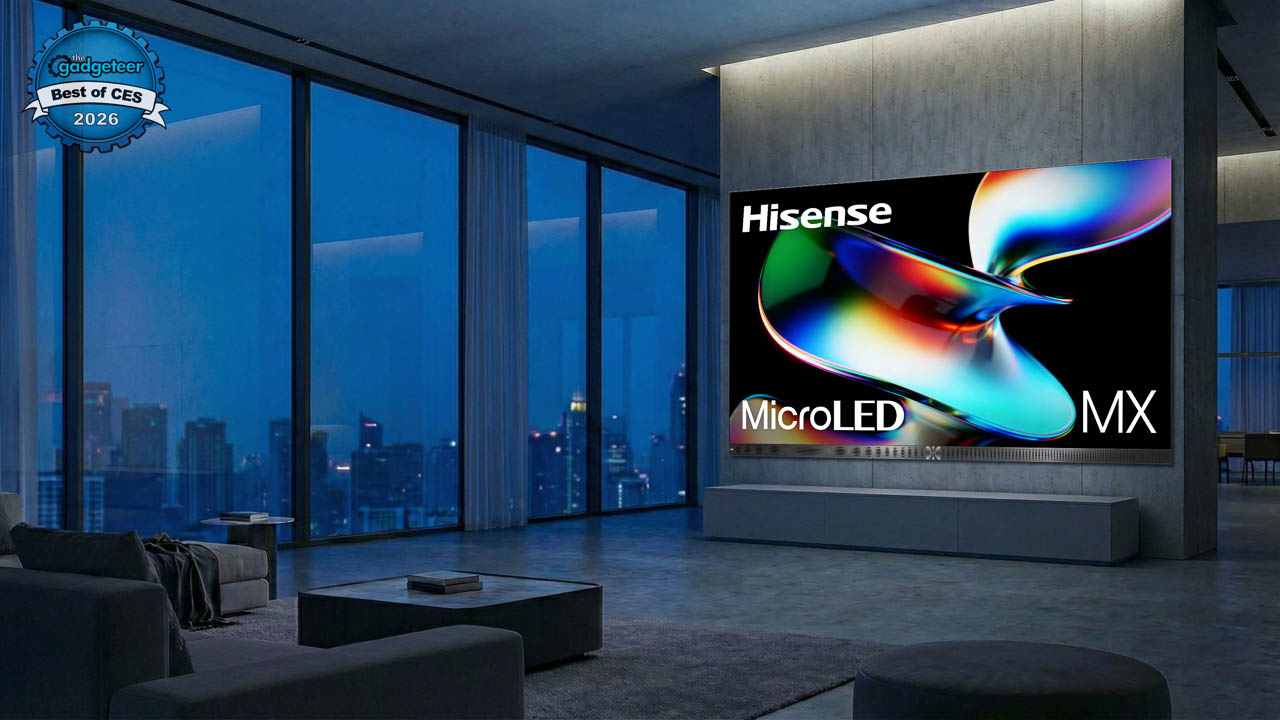
CES 2026 NEWS – Every sunset you’ve watched on a screen looked a little off. Every candlelit scene. Every warm skin tone under soft light. You probably thought that was just how screens worked.
It wasn’t. Your display was guessing at colors it couldn’t actually produce.
So the real question is: what else have you been settling for without knowing it?
This isn’t about resolution or refresh rate or any of the specs that usually dominate CES announcements. It’s about something more fundamental: whether the colors you’ve been watching for the past two decades were ever accurate in the first place.
The answer, according to Hisense, is no.
At CES 2026, the company is showing a 163-inch micro-LED display called the 163MX. The size is dramatic, but that’s not the point. The point is the fourth color.
Traditional displays use three primaries: red, green, and blue. The 163MX uses four: red, green, blue, and yellow. Hisense calls it RGBY architecture.
The reason matters more than the acronym. Human eyes are disproportionately sensitive in the 500 to 600 nanometer range, the warm band where golds, ambers, and flesh tones live. RGB displays have always struggled here because red and green don’t blend cleanly when asked to approximate yellow. The result: warm scenes that skew orange, or skin that looks synthetic under soft lighting.
You’ve noticed this. You just didn’t know why.
Add The Gadgeteer as a preferred source to see more of our coverage on Google.
Why This Changes What You Thought You Knew
Adding yellow as a fourth primary doesn’t make colors “better” in a vague marketing sense. It solves a specific biological problem that RGB has been working around since the beginning.
Think about watching a period drama lit entirely by candlelight. Or a nature documentary at golden hour. Or any scene where warmth is supposed to feel natural. RGB displays either push those tones toward orange or flatten them into something neutral. Neither is accurate. Both are compromises.
RGBY hits those tones directly instead of interpolating them. According to Hisense, this enables up to 100% BT.2020 color coverage at 163 inches. Most premium TVs today cover 70-80% of that standard. Reaching 100% at this scale hasn’t been demonstrated publicly before.
If that claim holds, it means the ceiling for color accuracy just moved. And everything below it, including whatever you’re watching this on right now, is working with a structural limitation baked into the panel.
But Here’s Where It Gets Complicated
The 163MX is also being positioned as “true micro-LED,” which opens a different can of worms.
Micro-LED has become one of those terms the industry uses loosely. Some displays labeled micro-LED still use backlights. Some still filter light through layers. Some are just smaller-than-usual LEDs arranged behind a panel, which is mini-LED with a marketing rebrand.
True micro-LED means self-emissive pixels, each producing its own light, no backlight required. That’s what separates it from everything else: higher brightness potential, better longevity, reduced burn-in risk. But most products wearing the label don’t meet that definition.
Hisense says the 163MX does. Self-emissive. Pixel-level control. No backlight. If that’s accurate, it’s one of the few displays that can actually claim the term.
We’ve seen Hisense push boundaries before with RGB mini-LED. Now they’re making a more aggressive claim.
But the micro-LED distinction might matter less than the RGBY breakthrough. One clarifies a definition. The other suggests everything you’ve been watching was built on a compromise.
The Constraints You Should Know About
At this scale, specs become tradeoffs.
Manufacturing reality: Micro-LED has been “almost ready” for a decade because yields don’t scale. Precision mass-transfer bonding of millions of individual LEDs keeps costs astronomical. The 163MX is a concept showcase, not a volume product. Hisense isn’t pretending otherwise.
Processing overhead: Managing four independent color primaries across a 163-inch panel with per-pixel control requires substantial compute. The Hi-View AI Engine RGB handles frame-by-frame optimization, but whether it maintains precision during fast motion is untested at this scale.
The obvious one: It’s 163 inches. That’s not a TV for a living room. It is the living room.
Who This Isn’t For
If you’re looking for a TV you can buy this year, this isn’t it.
If you’re happy with OLED or high-end mini-LED, there’s no urgent reason to change. Those technologies are mature, available, and excellent. Micro-LED’s advantages matter most at extreme scales and over very long ownership periods.
But here’s the uncomfortable part: if RGBY proves perceptually superior, it means every high-end display you’ve bought was working around a limitation you didn’t know existed. You were watching compromised warm tones and calling it “reference quality.”
That’s not a reason to buy anything. It’s a reason to pay attention.
Where This Leaves You
The 163MX will be on display at CES 2026 in Las Vegas. Most people will never buy it. Most people will never see it in person.
But the question it raises doesn’t require a purchase to matter: what if the colors you’ve been trusting were never quite right?
Hisense is betting you’ll start noticing. And once you do, you won’t be able to stop.
📡 CES 2026 Coverage
Want more from the show floor?
We’re covering the biggest announcements, wildest concepts, and gear that actually matters from CES 2026.
L39 Ultra Slim UV Protective Filter for Leica Q3 43 Q2 Camera with Moisture-Proof Case & Removal Tool 19 Layers Mulit-Coated UV Ultraviolet Filter 99.3% Light Transmission Water Oil Scratch Resistant
(as of April 8, 2026 12:17 GMT -05:00 - More infoProduct prices and availability are accurate as of the date/time indicated and are subject to change. Any price and availability information displayed on [relevant Amazon Site(s), as applicable] at the time of purchase will apply to the purchase of this product.)