

CES 2026 NEWS – The Fender booth at CES sat in the middle of a crowded ballroom, surrounded by competing demos and constant foot traffic. The result was a steady layer of ambient noise that made careful, isolated listening nearly impossible. I spent about 10-minutes with their first consumer headphones and portable speakers, guided by Fender staff through an informal demo. What I walked away thinking about wasn’t the sound signature or the feature list. It was the way the headphones came apart in my hands.
These impressions come from first contact only. I didn’t spend hours testing battery life or comparing frequency response to competitors. Fender’s team controlled the demo, chose the tracks, and narrated the experience. That matters because what they chose to show reveals what they think matters most about these products. The headphones are called the Mix, and the portable speakers are the ELIE 6 and ELIE 12. But the model names felt secondary to a bigger idea Fender kept circling back to: longevity.
This isn’t a review. It’s a hands-on from a loud trade show floor, and I’ll be upfront about where those limits are. What I can tell you is what stood out in the moment, what felt different from the dozens of other headphones I walked past that day, and why I left the booth wanting more time with the Mix in particular.
First Look: The Mix Headphones
The Mix headphones felt lighter than I expected when I first picked them up. Not flimsy, but noticeably unburdened compared to the chunky over-ears that dominate the noise-canceling category. The materials split between matte plastic on the outer shells and softer, textured padding on the ear cups and headband. Metal accents showed up at the hinges, adding a sense of sturdiness without making the whole thing feel industrial.

Fender’s branding stayed restrained. You’ll find their logo on the outer ear cups, but it doesn’t scream for attention the way some lifestyle audio brands do. The color options on display leaned toward neutral tones with a few bolder variants, though I didn’t get confirmation on which would ship at launch. The overall design language felt less like a guitar company trying to look cool and more like a guitar company that already knows what cool looks like and doesn’t need to prove it. That confidence came through in small details: the curve of the headband, the subtle texture on the ear pads, the way the hinges folded flat without feeling forced.
When I put them on, the clamp force registered as moderate. Not tight enough to cause immediate fatigue, but firm enough that they stayed put when I moved my head. The ear pads made full contact around my ears rather than pressing against them, which is a good sign for extended comfort, though I only wore them for a few minutes. I wouldn’t make any promises about all-day sessions based on a CES demo.
The build quality felt solid in a way that suggested durability without making weight claims. I could twist the headband slightly without hearing creaks, and the folding mechanism moved smoothly. But the real story wasn’t about how they felt as a finished product. It was about how they weren’t quite finished at all, by design.
The Modularity Demo
Midway through the demo, the Fender rep did something I didn’t expect. He gently detached part of the headphone’s ear cup assembly and showed me the connection point underneath. The Mix headphones are modular, and Fender positioned this as more than a gimmick. They framed it as the core idea.
Visible connection points separated the structural frame from the ear cups, padding, and other wear-prone components. The rep explained that users would be able to replace these parts without tools, swapping out worn cushions or damaged cables rather than replacing the entire headset. This wasn’t presented as customization for style. It was presented as a way to make the headphones last longer. Think worn ear pads after two years of daily use: instead of tossing the whole unit, you swap the pads and keep going. Fender talked about reducing waste, extending product lifespan, and designing for repair from the start rather than as an afterthought.
I actually got to mess with the Mix myself. I popped the modular parts apart and snapped them back together a few times, and it felt smooth, not scary. The pieces clicked in firmly, and the headphones still felt just as solid afterward. I can’t tell you how those connections will look after months of swapping, but in the booth they didn’t feel delicate. Fender didn’t confirm pricing or availability for replacement modules, and they didn’t claim third-party compatibility. But showing the build and the “this is meant to last” idea at CES, instead of leaning on ANC and codec talk, felt like a point they wanted to make.
The modularity angle caught me off guard because it reframes what Fender is actually selling. They’re not just entering consumer audio. They’re experimenting with how consumer audio products should age.
I should note: I didn’t verify full user repairability. This was a guided demo, not a teardown, and the long-term durability of those modular connections remains untested.
First Look: The Speakers
The ELIE 6 and ELIE 12 portable speakers looked compact but felt dense when I picked them up. That weight suggested solid internal components rather than hollow plastic, though I didn’t get to open them up to confirm. The exterior materials used a textured fabric wrap that felt closer to home speaker design than typical Bluetooth cylinder aesthetics.
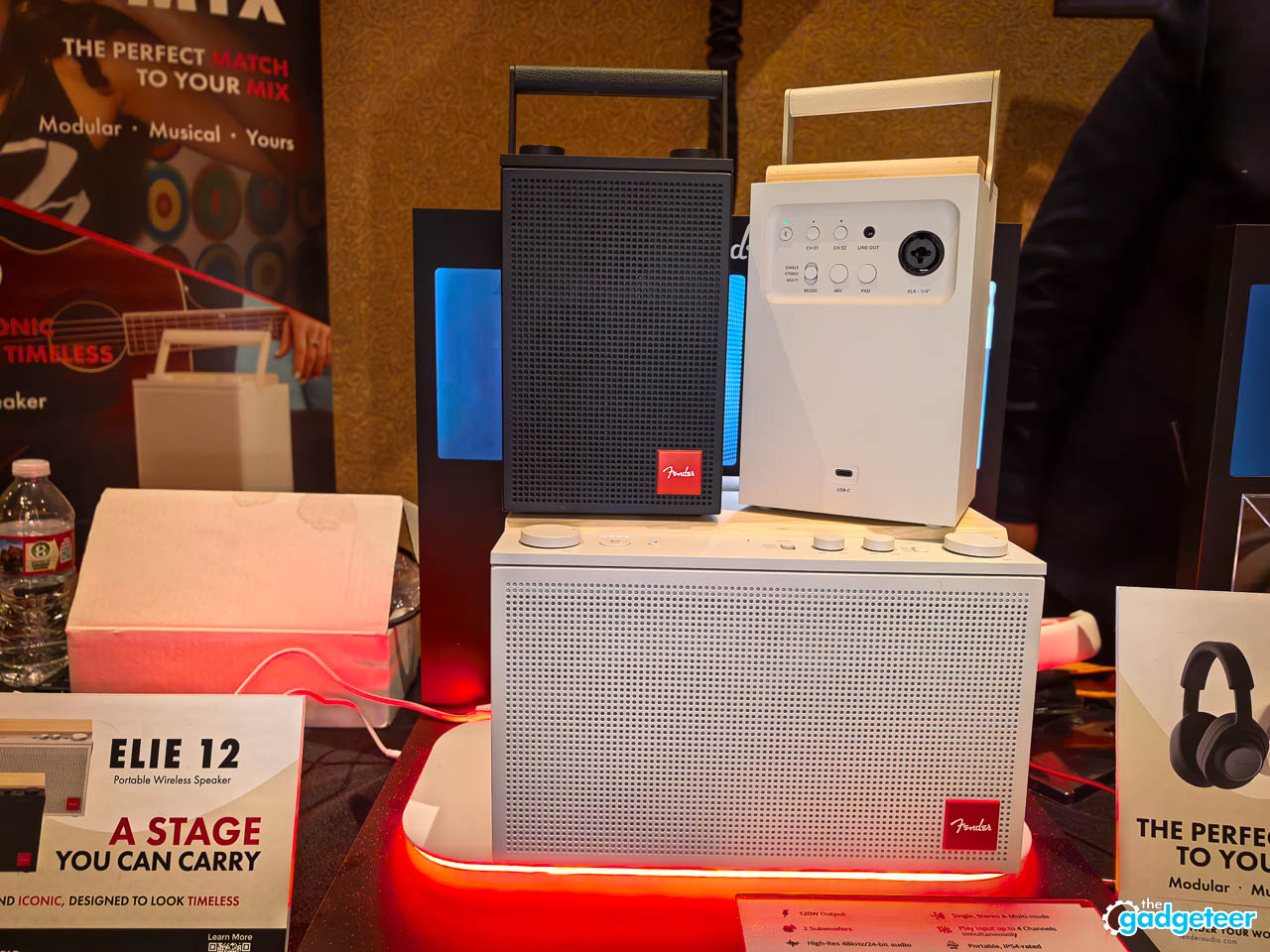
Button placement sat on the top surface, within easy thumb reach when carrying. The tactile feedback felt distinct enough that I could navigate without looking, which matters for a grab-and-go speaker you might use outdoors. Visually, these speakers didn’t blend into the sea of generic portable audio at CES. The grille design and color choices nodded toward vintage Fender amp aesthetics without going full retro pastiche. They looked like speakers made by a company that has opinions about how things should look, which isn’t always the case in this category.
Listening: The Headphones
The Mix headphones, in their default mode, delivered a sound signature that leaned toward warmth without feeling muddy. Bass presence registered quickly, but it didn’t overwhelm the mids or blur the highs. I’d call the tuning musical rather than clinical, which tracks with Fender’s heritage as an instrument company. They’re not chasing flat reference response here.
Switching modes shifted the balance noticeably. One profile pushed bass forward for more impact, while another pulled things back toward a flatter presentation. I didn’t have time to memorize every mode or map out the differences precisely, but the variation felt intentional rather than gimmicky. Each profile seemed designed for a specific listening context rather than just being a preset EQ tweak.
What surprised me was how well the audio cut through the ambient CES noise. The demo didn’t focus on active noise cancellation, but the passive isolation from the ear cup seal did more work than I expected. That physical seal made the demo more enjoyable than I anticipated given the environment. Whether the tuning holds up under closer scrutiny is a question for a full review.
Listening: The Speakers
The portable speakers got louder than I expected for their size. The Waves MaxxAudio processing seemed to focus on keeping the low end tight as volume increased, and I didn’t hear obvious distortion even when the rep pushed the ELIE 12 toward its ceiling. Bass presence felt solid relative to the speaker’s footprint, though physics still apply. These won’t replace a home system.
What stood out was the projection. In an open booth with no walls to help, the speakers filled the immediate area without sounding strained. The sound character stayed consistent as I moved around the demo space, which suggested decent dispersion. Fender clearly optimized for outdoor and social listening scenarios where you need volume and clarity over critical detail. I didn’t get to compare them side by side with competitors, but in isolation, they sounded like speakers that could actually deliver at a backyard gathering.
Controls and Interaction
The headphone controls responded quickly during the demo. Mode switching happened through physical buttons rather than app-only toggles, which meant I could change profiles without pulling out my phone. The button placement made sense after a few seconds of orientation, and I didn’t need the rep to guide every press.
The speakers used a similar physical control approach. Volume, playback, and power all lived on the top surface with distinct button shapes that helped with blind navigation. I appreciated that Fender didn’t bury basic functions in an app. Whether the companion app adds useful features remains unknown, but the products didn’t feel crippled without it.
Overall, the controls felt like they were designed for real use rather than demo scenarios. That’s harder to achieve than it sounds, and it’s one of those details that separates thoughtful products from rushed ones. During a fast CES walkthrough, I could operate both the headphones and speakers without fumbling, which says something about the interface design.
Does This Feel Like Fender?
This ended up being the part that mattered most to me. Fender makes instruments people hang onto for years, so I was curious whether any of that mindset carried over here. What I handled in the booth didn’t feel like a tech product borrowing a famous name.
The demo stayed pretty grounded. Nobody talked about charts or numbers. The focus was on how the headphones felt, how the sound came across, and why the modular design exists in the first place. The idea seemed straightforward: instead of replacing the whole thing when something wears out, you fix the part that does.
That doesn’t guarantee this will all work perfectly in the real world. But standing there at CES, it felt like Fender was thinking a little longer term than most headphone brands do, and that alone made the Mix more interesting than I expected.
Who This Seems For
The Mix headphones appear aimed at people who value build quality and longevity over chasing the latest feature specs. The modularity angle suggests buyers who keep products for years rather than upgrading annually. If you’ve ever thrown away headphones because the ear pads wore out or a cable frayed, Fender is betting you’ll appreciate a design that addresses those exact pain points.
The speakers seem targeted at social listeners who need portable volume without sacrificing sound quality. They’re not competing with audiophile desktop setups. They’re competing for backyard parties, beach trips, and outdoor gatherings where you need something that can fill space without distorting.
If you’re waiting for detailed reviews before buying, that’s the right call. CES demos don’t replace real-world testing, and these products deserve more time than a fifteen-minute booth visit. But as a first impression, Fender’s entry into consumer audio feels more considered than I expected. The modularity in particular signals something interesting about where they want to take this category. I’m curious to see how these hold up once they leave the show floor and land in people’s homes.
