Comfort is the spec nobody prints on a watch box, and it’s usually the reason a training watch ends up in a drawer by March. Casio’s GBA-950 goes after that problem from an unexpected direction, borrowing the mathematics of paper folding to change how the band sits against your wrist. The series arrived in 2025 and Casio has just added three colorways to it, which makes this a good moment to look at it again if you missed the first run.
Price: TBD
Where to Buy: Casio, Amazon (Regular Model)
The Fold That Does the Work
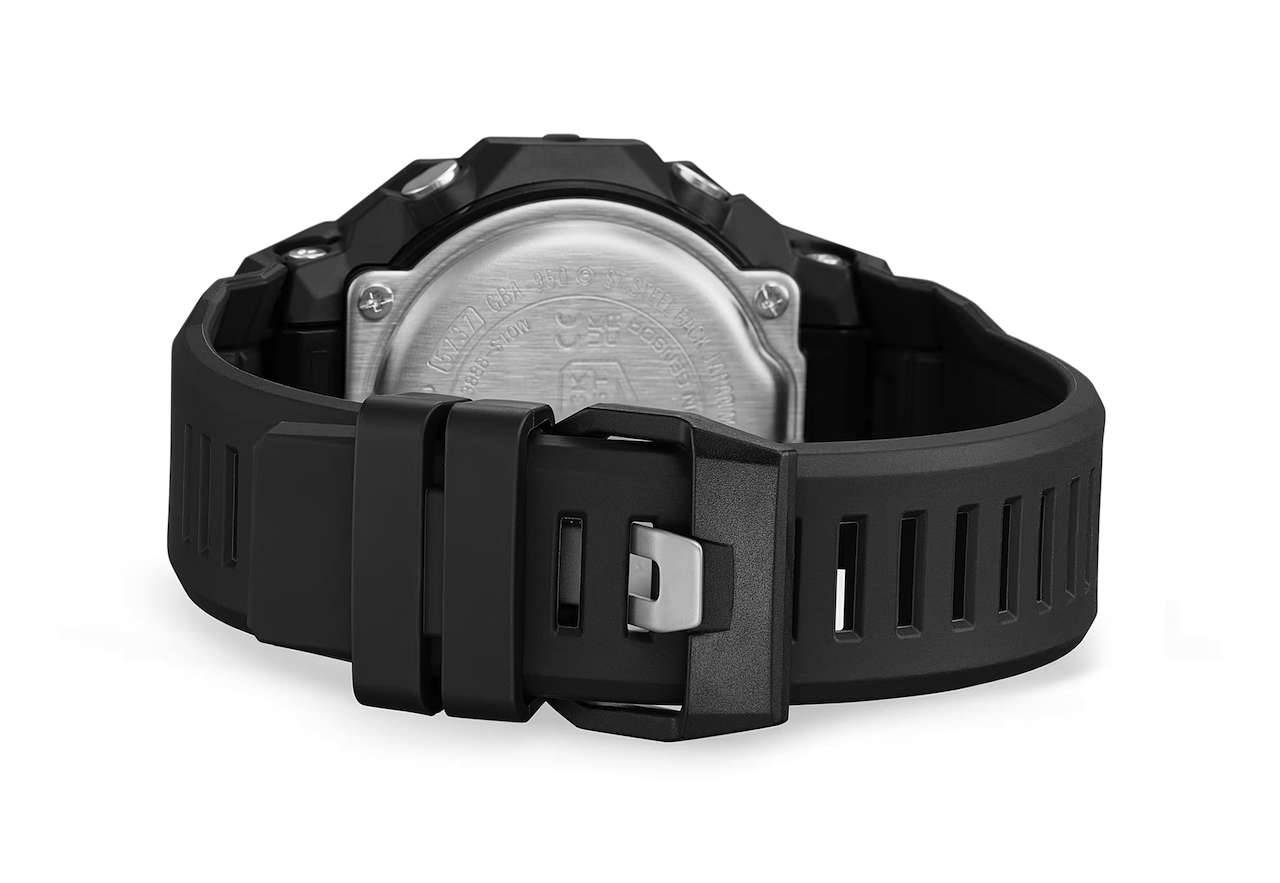
The band was developed with OUTSENSE Inc., a Tokyo firm that applies the geometry of paper folding to engineering problems rather than to paper itself. Casio calls this origami engineering, though OUTSENSE uses the term folding engineering. Casio says the base sections of the band carry precisely analyzed mountain and valley fold angles, that tightening the band makes those folds pull the sides outward to the left and right, and that the result seats the case snugly against the wrist on the underside of the band’s wave-shaped base.
That’s a structural answer to a fit problem rather than a padding one. A band that holds its own geometry under tension keeps the case from rocking when your arm swings, which is exactly the moment a loose watch starts to bother you.
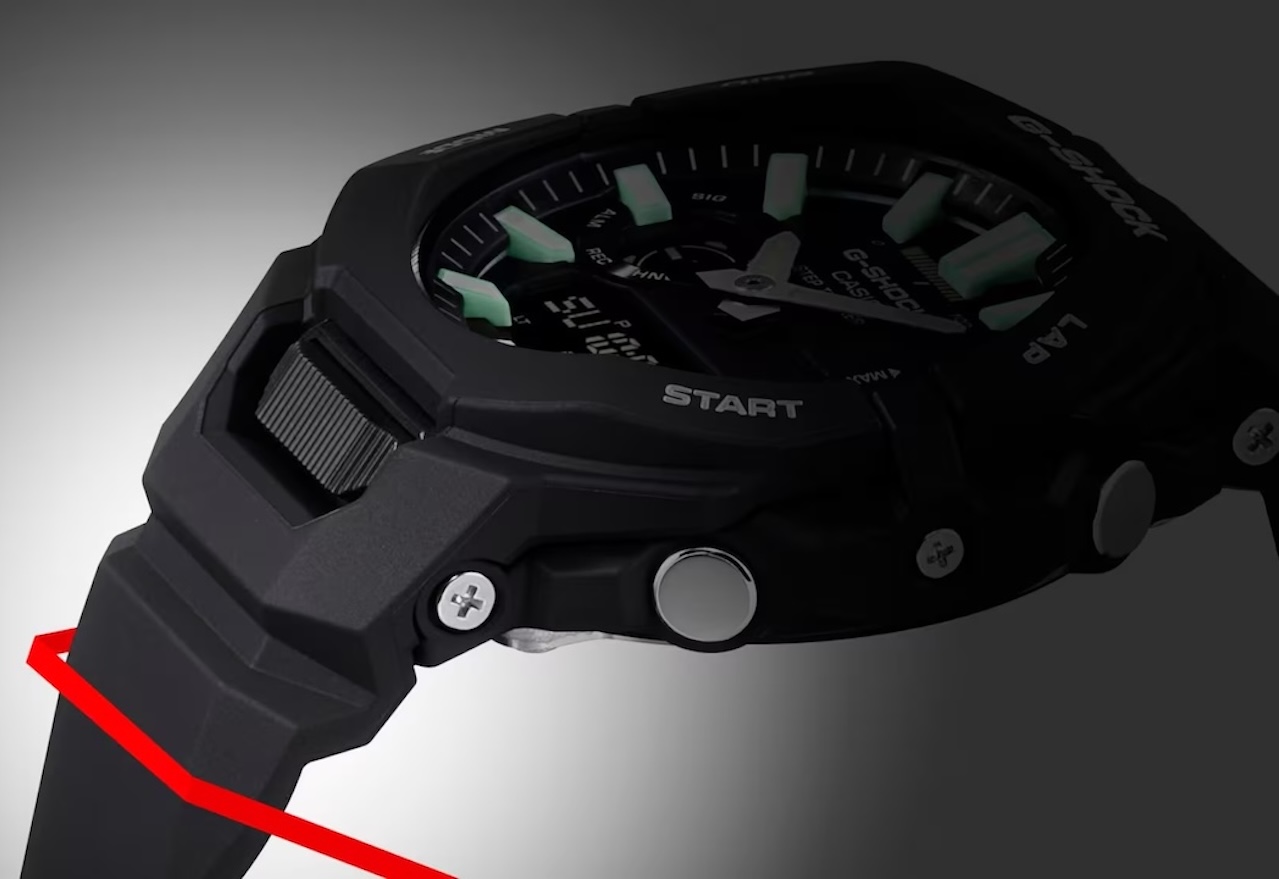
Casio molds the bezel and band into a single exterior piece that the company says protects the carbon fiber-reinforced resin case underneath, while the band itself is built for maximum flex to keep that comfort going. The adhesive glass attachment allows a more compact lug design, tightening the silhouette running from bezel to band. The result came in under the GBA-900 it followed on both counts, 53g against 61g, with a few millimeters trimmed in every direction.
What It Tracks While You Move
The watch measures time, distance, average pace, and calories burned, with an indicator at the 3 o’clock position showing exercise intensity across five stages. Auto Lap keeps track of times over a set distance without you touching a button. The stopwatch holds up to 45 records, and each one stores lap and split times, distance, average pace, and calories.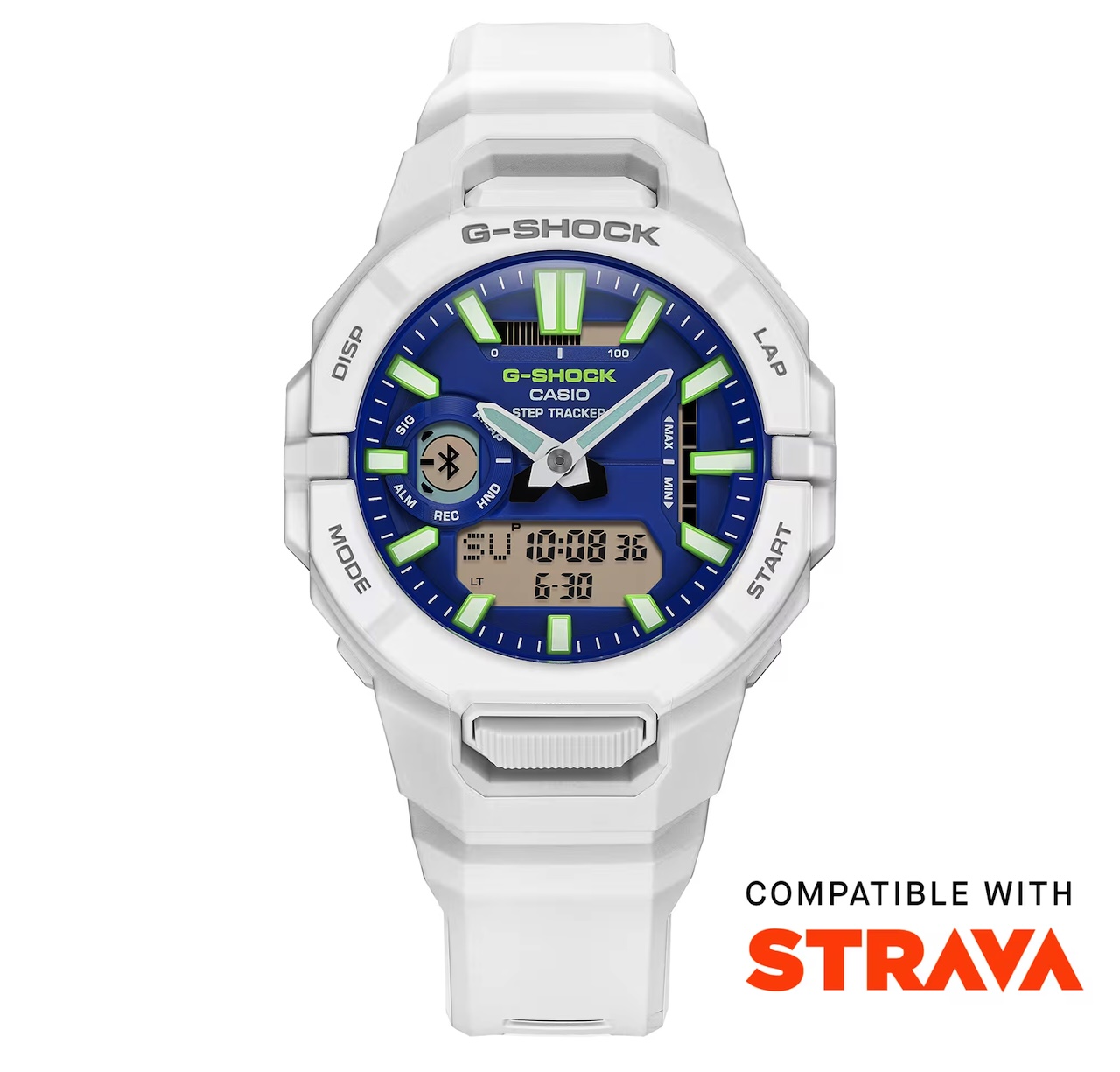
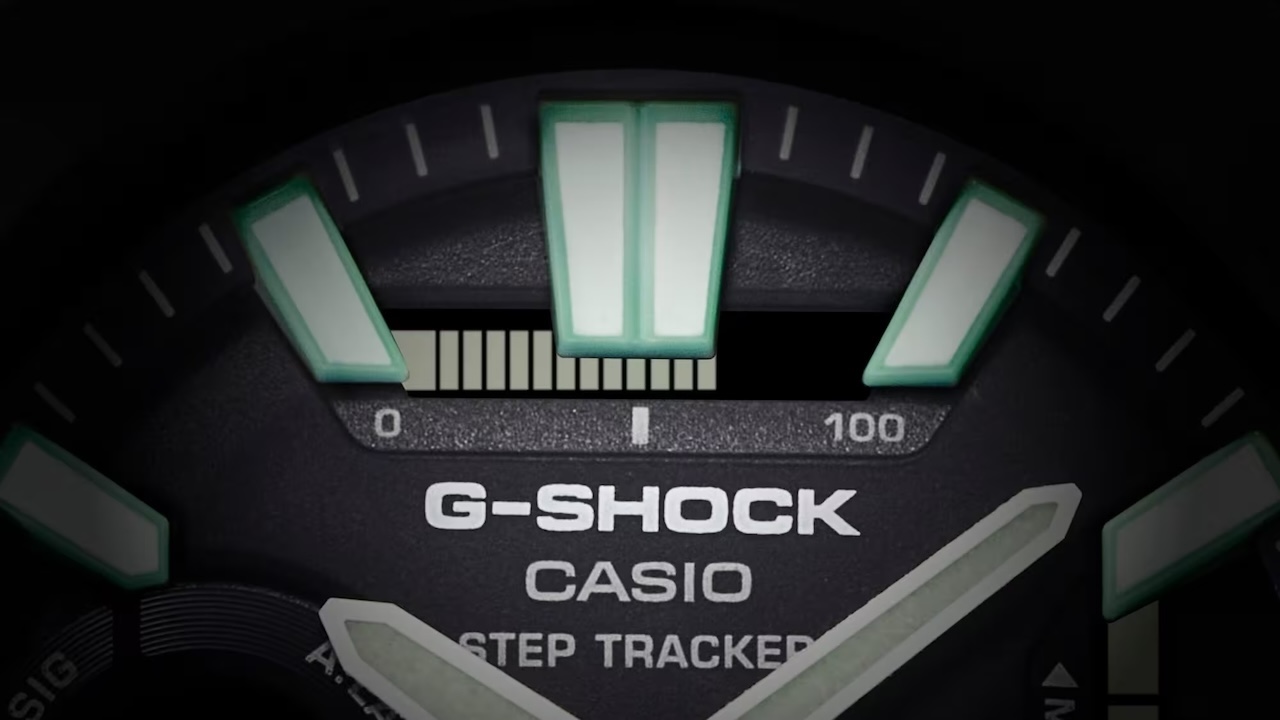
Step counting starts on its own when you begin walking, and the indicator at 12 o’clock shows progress toward your goal. Pairing with a phone lets the watch correct its distance measurement using the phone’s GPS, and Casio says that once those adjustments are made, the watch measures running distance more accurately even without the phone connected. The interval timer takes up to five time settings with auto-repeat, which covers most structured workouts.
Built to Read at Night
The indexes use resin imbued with phosphorescent material, with phosphorescent printing applied to the top surfaces. Casio says that gives the dimensional indexes a vivid glow in the dark.
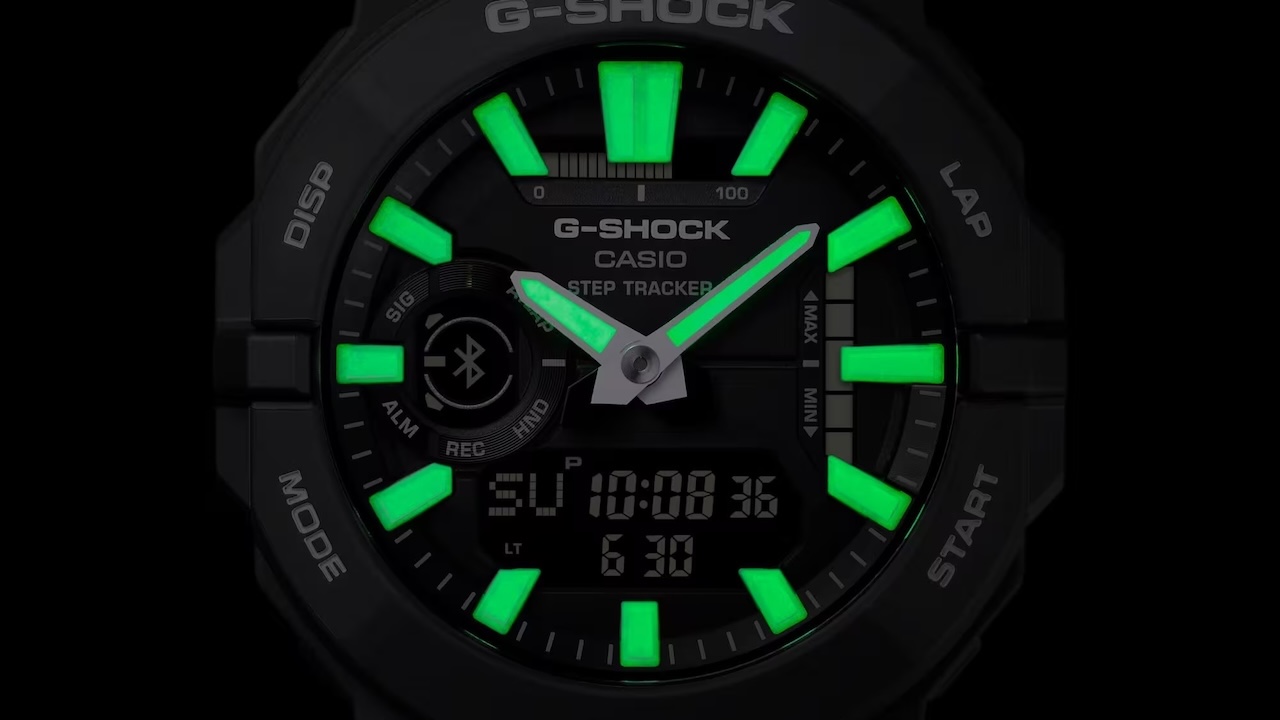
The hour and minute hands get phosphorescent accents too, so the analog side stays legible on an evening run. Neobrite is listed in the exterior spec.
A double LED setup covers both halves of the dial, one for the face and one behind the digital display, with Super illuminator, auto LED, afterglow, and a choice of 1.5 or 3 second illumination. There’s also a hand shift feature that moves the hands out of the way when you need an unobstructed look at the digital readout.
Three Colorways, One Spec Sheet
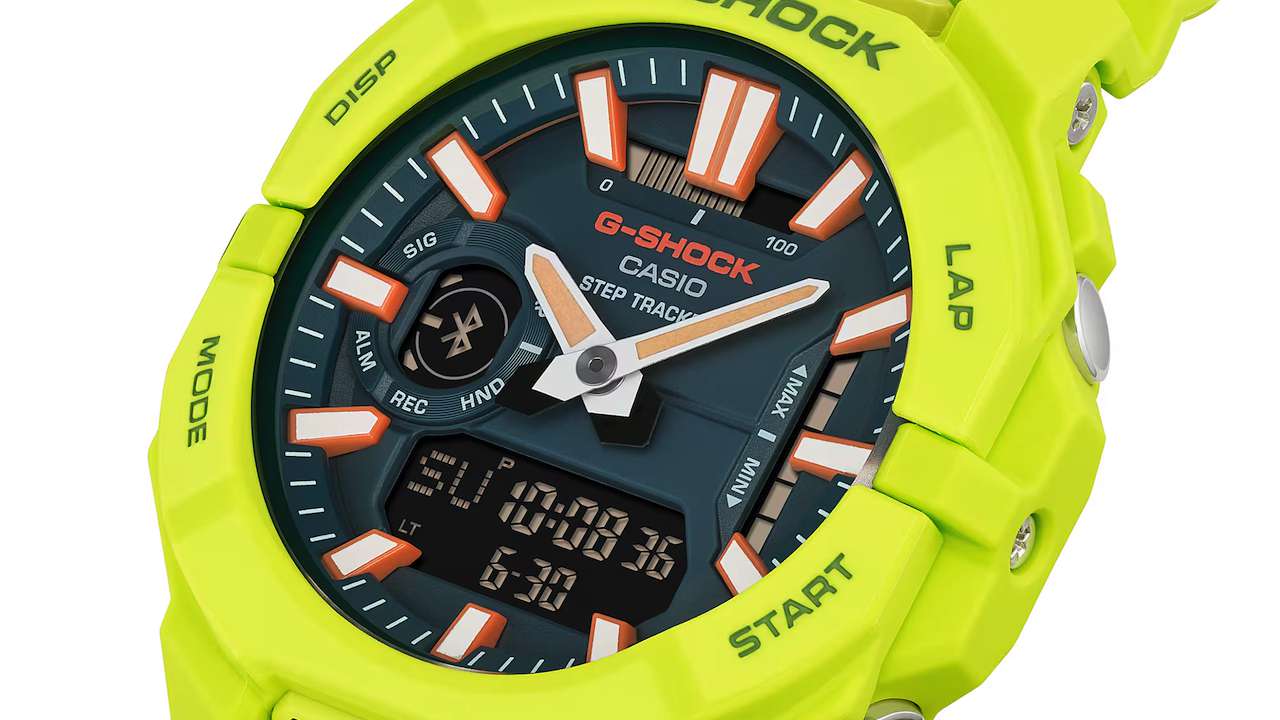
The GBA-950-1A4 pairs an orange dial with a black base, the GBA-950-7A2 puts a blue dial on a white body, and the GBA-950-9A3 sets a black dial against yellow green. They join the black 1A, purple 2A, and white 7A that opened the series in 2025, and beyond the color treatment the hardware is identical.
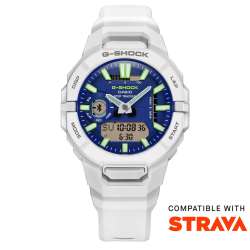
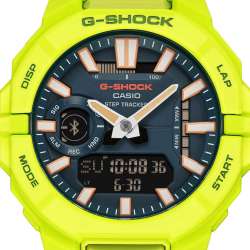
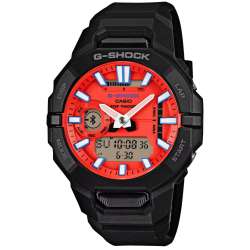
Every model measures 48.5 by 43.9 by 16 mm and weighs 53 g, with shock resistant construction, 200-meter water resistance, mineral glass, and a band that fits 145 to 215 mm. A CR2025 runs about two years, accuracy is rated at plus or minus 15 seconds per month without the mobile link, and the feature set includes dual time, five daily alarms, a full auto-calendar to 2099, and airplane mode. Key resin components in the bezel and band use bio-based resin, and Casio’s product pages link out to its G-SHOCK Strava compatible collection.
| Spec | GBA-950 series |
|---|---|
| Case size | 48.5 x 43.9 x 16 mm |
| Weight | 53 g |
| Water resistance | 200 meters |
| Glass | Mineral |
| Case and bezel | Resin and bio-based resin |
| Band | Bio-based resin, 145 to 215 mm |
| Battery | CR2025, approx. 2 years |
| Accuracy | Plus or minus 15 sec per month without mobile link |
| Connectivity | Bluetooth Smartphone Link, CASIO WATCHES app |
| Module | 5737 |
Where to Get It
Casio hasn’t printed a price on the three new product pages, but the series has a track record to work from. The launch models carry a $165 US list price and a watch trade title put the retail figure at $150, so that’s the range to expect unless Casio moves it. One thing worth knowing is that Casio’s international pages cover the Asia region, so US buyers should watch the G-SHOCK MOVE listings on Casio’s American site, where the line goes by MOVE rather than the G-SQUAD name used elsewhere.
If you’ve been tracking Casio’s 2026 cadence, this lands in the same run as the orange DW6900MO26-4 and the stealthier Luxe Black GA-2100. The GBA-950 is the training-focused entry in that group, closer in spirit to Casio’s step-tracking squares than to the fashion collaborations.
Price: TBD
Where to Buy: Casio, Amazon (Regular Model)
Where Things Stand
If your training watch keeps losing to your phone, the GBA-950 is aimed squarely at you. It handles pace, distance, laps, intervals, and steps on its own, borrows your phone’s GPS only to calibrate, and then keeps working when you leave the phone behind.
The band is the part worth watching. Casio put real engineering into how the strap holds the case still, and on a watch you’re meant to wear through a workout, that’s the difference between a daily habit and a drawer.