Fast scooters are easy to find. Fast scooters that stop the way they should, carry a battery worth trusting, and can tell you where they are when they’re not where you left them are a lot harder to find at $799. That’s the bar the Backfire M8 Rover sets for itself, and after riding mine, I think it clears it.
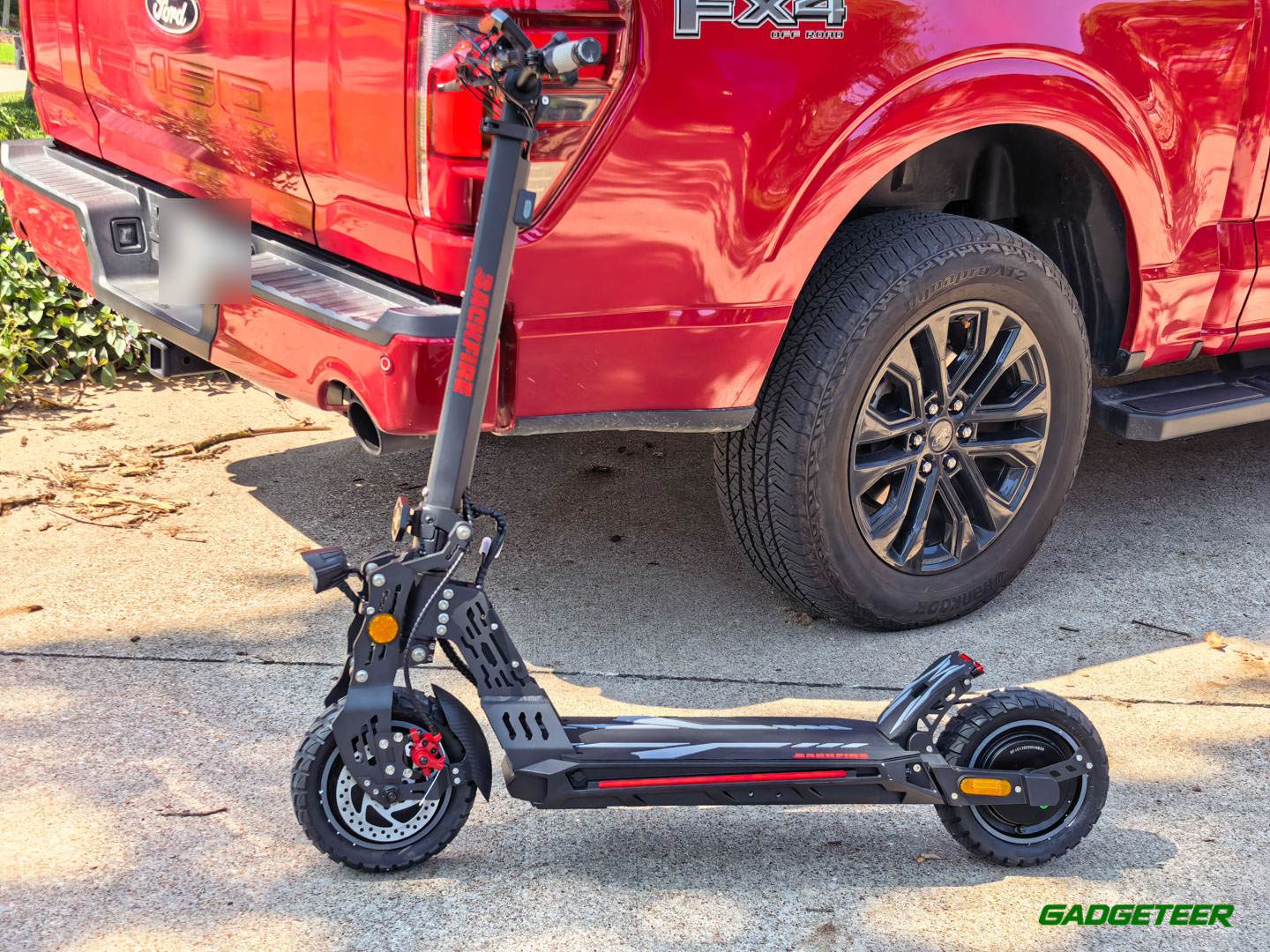
I live in a small town, and I reviewed the M8 the way it’s meant to be used: as my everyday ride to get places, not a lab project. The tennis courts are a mile away, Starbucks is a mile away, Walmart is a mile away, and the M8 became how I got to all of them. It performed amazingly. My experience has been on par with what I expected. The build quality is where I wanted it, everything has worked the way it should, and on a scooter Backfire rates for around 34 mph, braking is key. Backfire nailed it. Two 1,000W motors, a 960Wh Samsung-cell battery and built-in GPS for $799 is great value for the money. The catch is the one every scooter this capable carries: 68.3 pounds of it, every time you have to pick it up.
Price: $799 (list $999)
Where to buy: Backfire ($799), Amazon ($799.95)
Built like it plans to stay that way
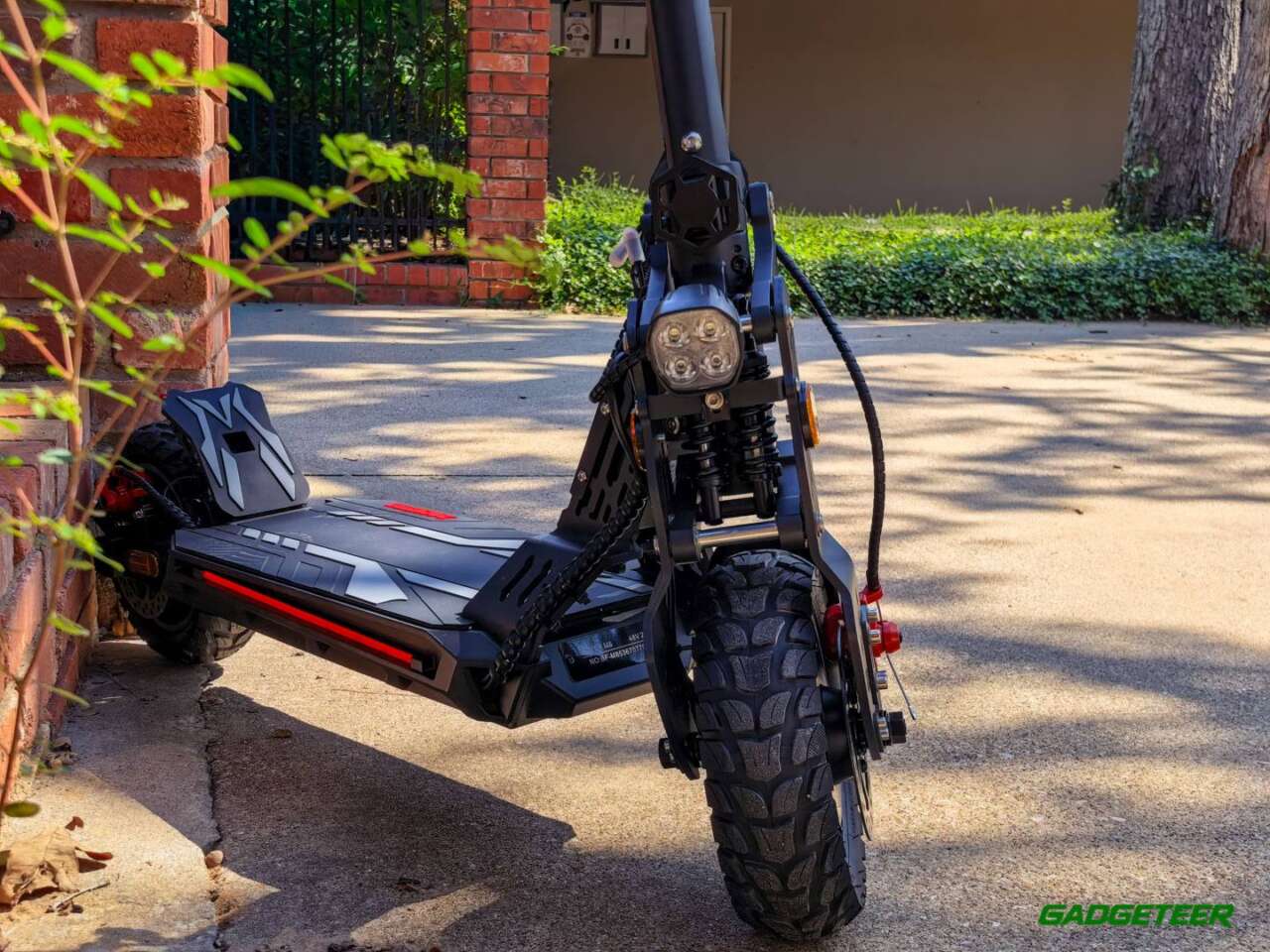
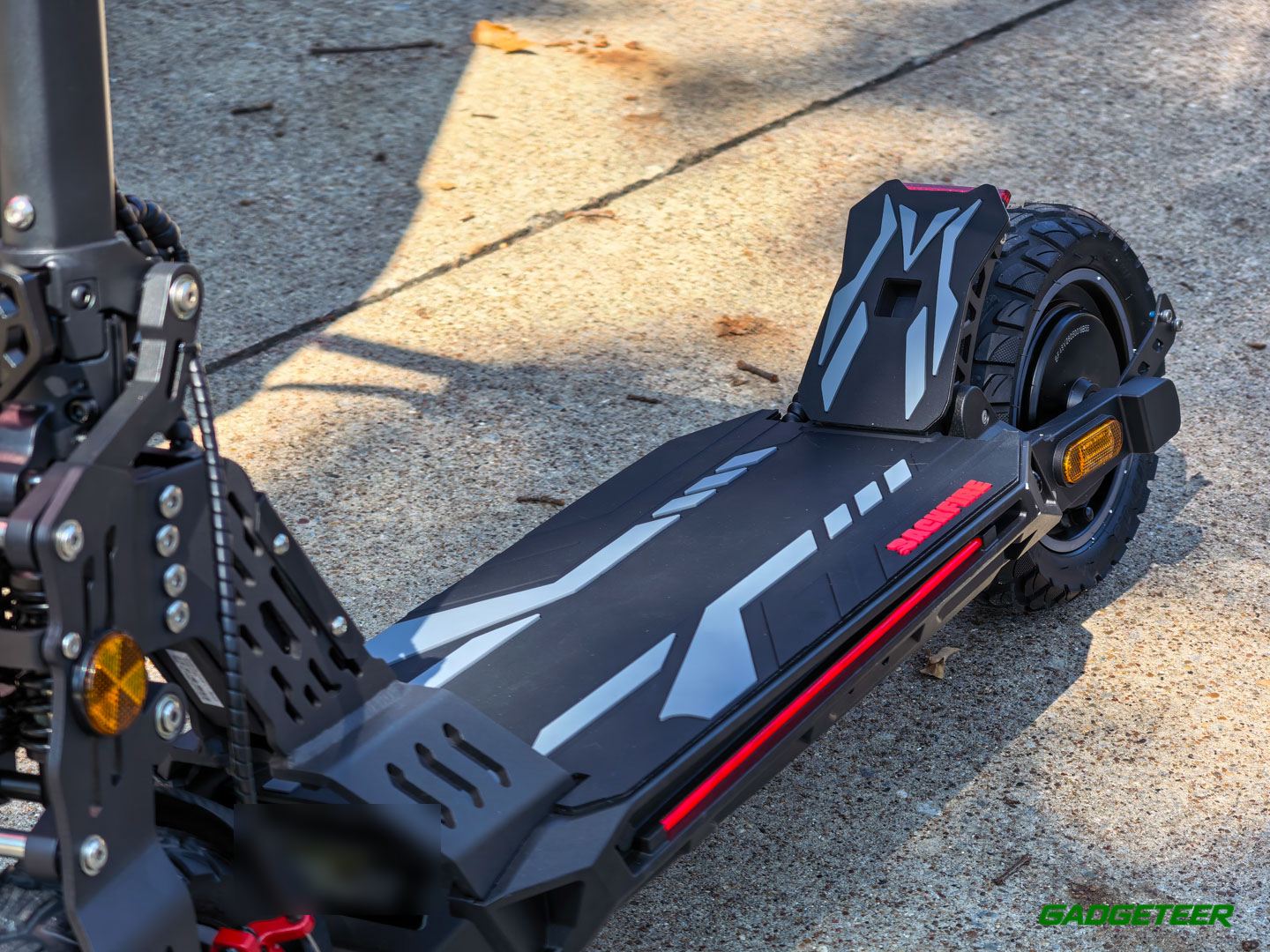
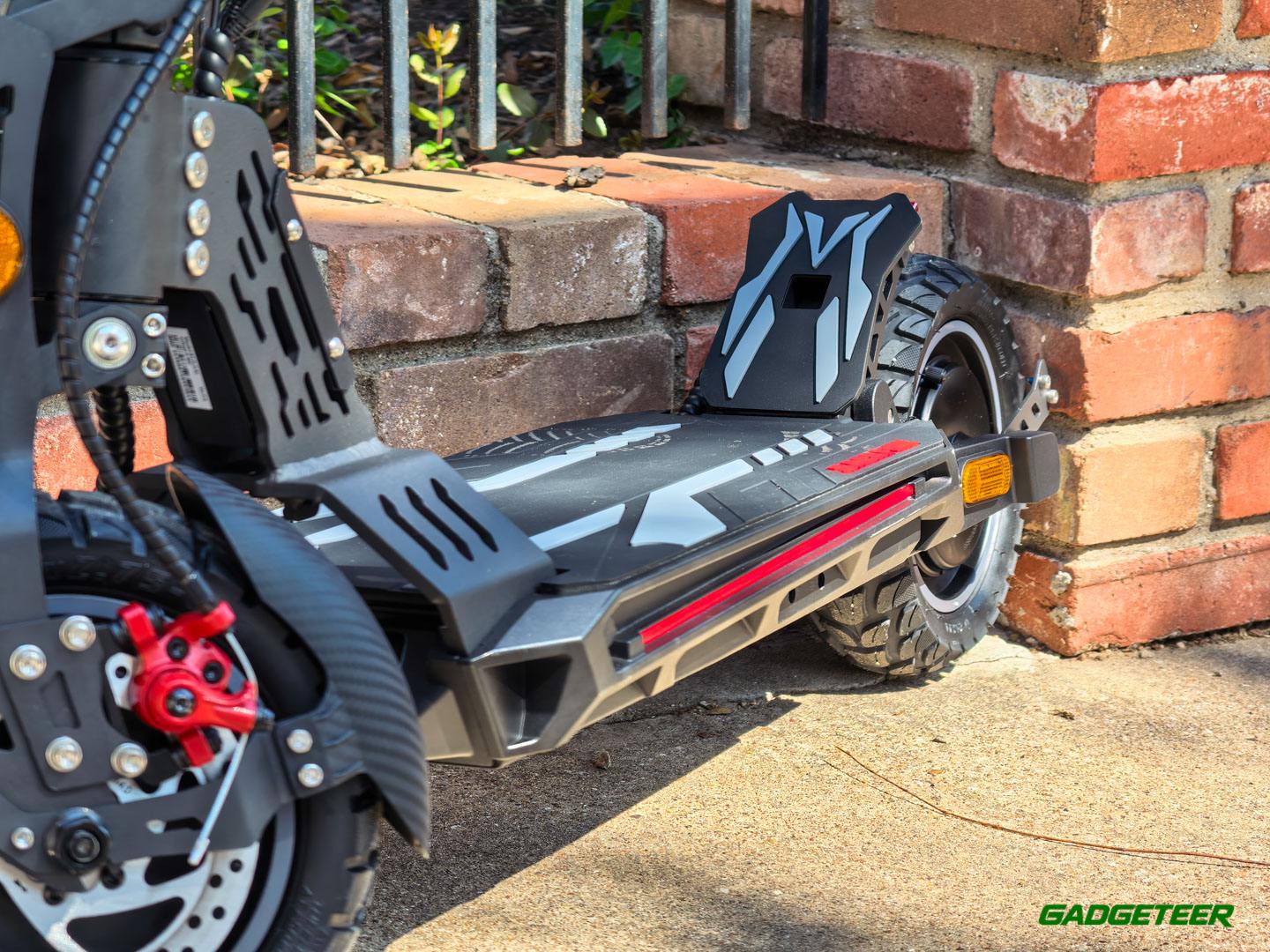
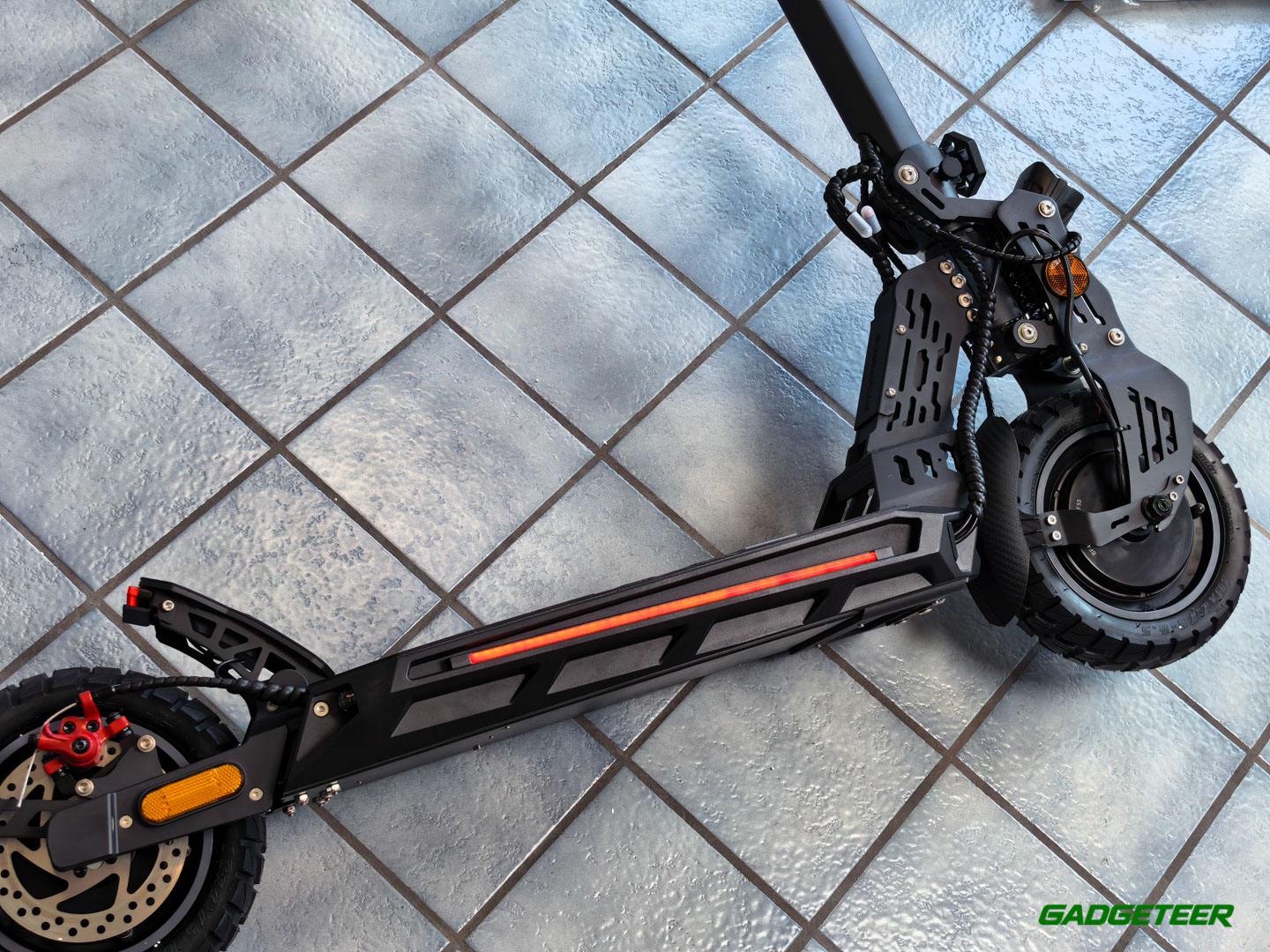
The M8 looks like it was designed by people who ride. The frame is forged aluminum, the handlebar is aluminum alloy, the deck is 9.5 inches wide with room to stand with your feet side by side, and twin coil springs sit at both ends of the scooter, the front pair tucked right under a four-lamp headlight. Red brake calipers and red trim along the deck are the only flash. Everything else is black, chunky and purposeful.
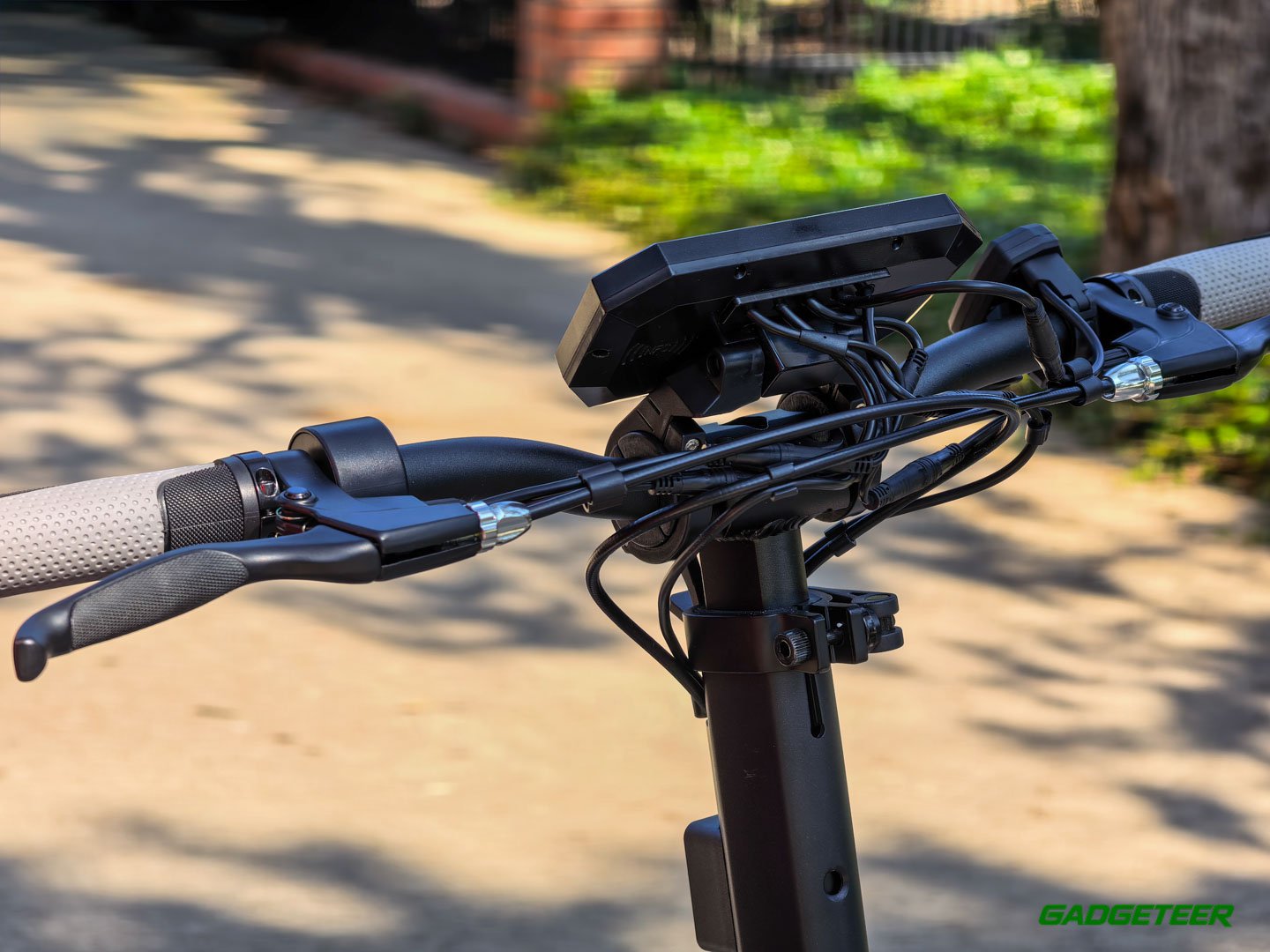
Setup is short. The handlebar goes on with the included hex wrench and four screws, the stem’s top cover goes back on, and then you set the display angle. Bar height adjusts across three positions on the telescoping stem, and the clamp is a lever under the central mounting block, so changing it doesn’t mean digging out tools again. Up close, it’s as solid as it looks, and that’s the first thing you want from a scooter that’s going to carry you at 30-plus mph.


The numbers, and what they mean on the road
Here’s what $799 buys, straight from Backfire’s spec sheet:
- Motors: two 1,000W brushless hub motors, one in each wheel
- Top speed: about 15, 25 and 34 mph across three modes
- Battery: 48V, 20Ah, 960Wh, built from Samsung 50GB 21700 cells
- Range: 31 to 45 miles, depending mostly on rider weight and speed
- Brakes: front and rear disc brakes plus a regenerative electronic brake
- Tires and suspension: 10 x 2.75-inch tubeless tires, twin springs front and rear
- Hill climbing: up to a 35 percent grade
- Size and weight: 1,170 x 630 x 1,220mm unfolded, 1,260 x 630 x 530mm folded, 68.3 pounds
- Max load: 330 pounds, with 220 pounds and under getting the best results
- Water resistance: IP55
Two of those numbers do most of the work. The 960Wh battery is what lets a $799 scooter run two motors without the range collapsing, and the 68.3-pound weight is what you pay for it. Everything else on the list sits somewhere between those two.


Two motors, three speeds, and a switch worth learning
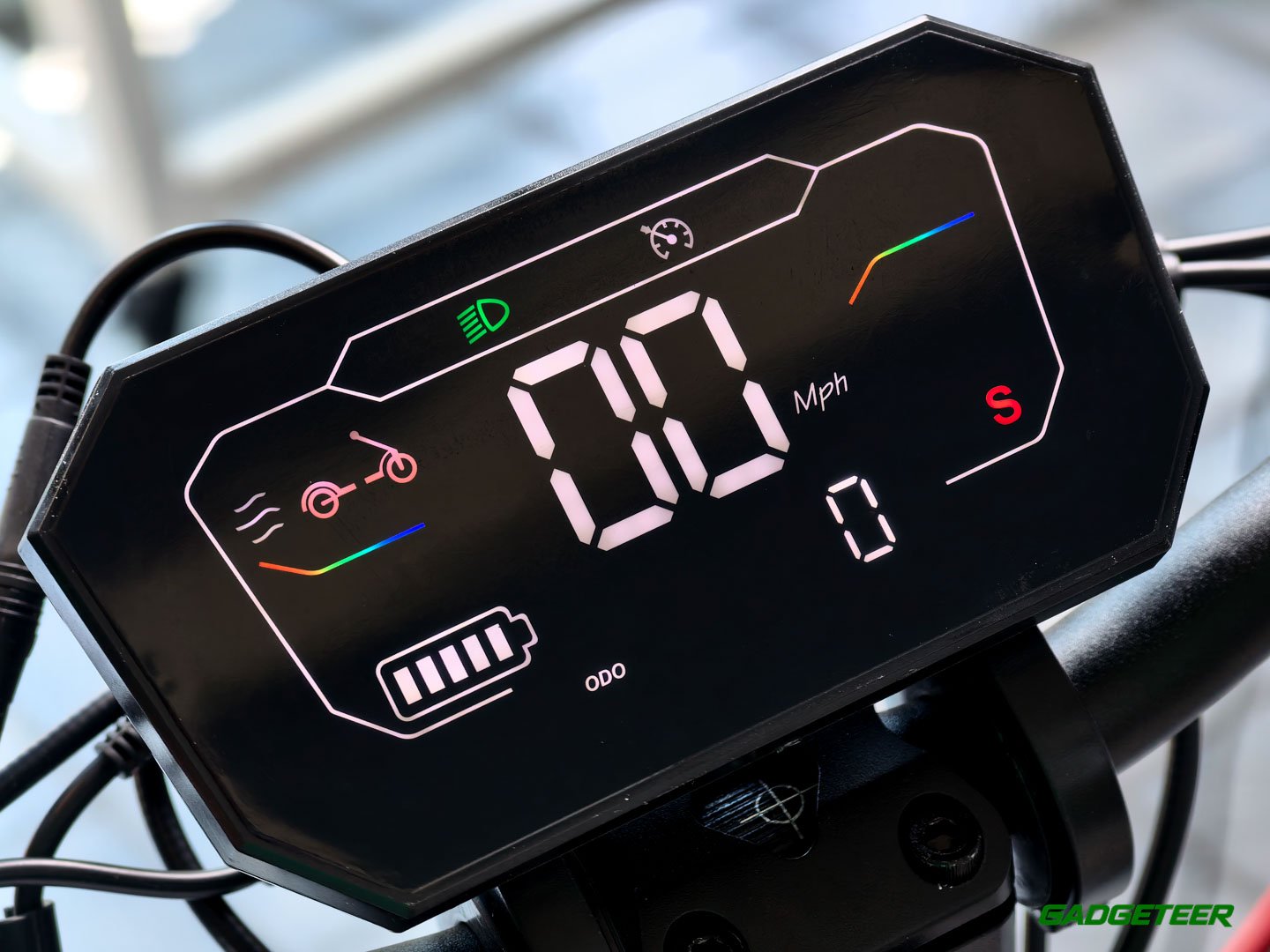
The three riding modes are Eco, D and S, and Backfire rates them at roughly 15, 25 and 34 mph. The throttle is a press-down thumb paddle on the right bar, and the color display shows speed, odometer and trip, battery level, Bluetooth, cruise, light and turn-signal status, plus error codes if something’s wrong.
Here’s the part most people will miss: motor choice is a separate control from the speed modes. Hold the plus button for five seconds and a double beep with the dual-drive icon puts both motors to work. Hold minus for five seconds and a single beep drops it back to one. Single drive is the range play for flat cruising. Dual drive is the full 2,000W, and it’s how the M8 wants to be ridden anywhere there’s a hill or a reason to hurry. Backfire says the M8 handles grades up to 35 percent, and that it’ll hold a climb steeper than 25 percent for about 12 miles with a 220-pound rider aboard.
Two more things shape how it feels from a standstill. The UNI SCOOTER app switches between Kick Start, where you push off before the throttle engages, and Zero Start, where the throttle works from a stop. And Backfire notes that top speed tapers as the battery drains, so the M8 at 20 percent isn’t quite the M8 at 100 percent. Everything I’ve asked of it on those everyday trips around town, it’s done.


Backfire nailed the brakes
On a scooter this fast, stopping is the whole game, and this is the part of the M8 I’d put first. It runs disc brakes front and rear in a symmetrical layout, with the front disc on the left side of its wheel and the rear disc on the right, and an electronic regenerative brake backs both of them up. Braking meets my expectations for a fast scooter, and on a $799 machine that’s the compliment that counts.
The taillight flashes brighter under braking, so the brake check happens behind you too. If you want more bite or less lever effort down the road, Backfire sells a hydraulic brake upgrade for the M8, which tells you the mechanical setup it ships with is the baseline, not the ceiling.


Comfort comes from the tires and the springs
Ride comfort on a scooter comes down to three things: how much air is in the tires, how much the suspension soaks up, and how much room your feet get. The M8 covers all three. The 10 x 2.75-inch tubeless tires carry real volume, there are twin springs at the front and twin springs at the rear, and that 9.5-inch deck lets you shift your stance on a longer ride. My rides were sidewalk and street, plus rough gravel just for fun, and the M8 took all of it in stride. The suspension does a great job damping bumps, and the more you ease off through a rough patch, the less of it you feel.
Tire pressure is the one thing you control. Backfire specs 31.9 to 34.8 psi, and it’s worth keeping a pump handy, because pressure feeds straight into both comfort and range. The M8 carries an IP55 rating for splashes, though Backfire’s own advice is to skip riding in the rain, and I’d follow it. Wet roads and a 34 mph scooter aren’t a combination worth trying.


Lights that do more than one job
The headlight and the ambient side lighting sit on separate controls, and that split is smarter than it sounds. The ambient strips mark the scooter’s silhouette for traffic, while the headlight does the job of lighting the road. Rear turn signals are built in, and the brake-flash taillight is the kind of detail you only appreciate once a car’s been tailgating you.


A real battery, and a charger that takes its time
The battery is the M8’s best argument. It’s a 48V, 20Ah pack, 960Wh in total, built from 52 Samsung 50GB 21700 cells in a 13S4P layout, and it charges to 54.6V when full. Backfire says it holds 80 percent of its original range after 500 charge cycles, which works out to roughly four years if you charge every third day. That’s the number that decides what this scooter is worth in year three.
Range is where most scooter marketing falls apart, so Backfire publishes its own table instead of one hero number. On flat road at 70°F, holding a steady 18.5 mph with minimal braking, a 130-pound rider gets 44 miles, 155 pounds gets 36.5 miles, 180 pounds gets 33, 200 pounds gets 30 and 220 pounds gets 28. Your weight picks your row, and speed, hills and cold weather take their cut from there. Across all my everyday riding, I never came close to running it flat.
Charging is the M8’s slow lane. Backfire rates the included 2A charger at 10 to 11 hours for a full charge, which means overnight, every night you ride it hard. Backfire says its optional 5A charger cuts that to about four hours, and it’s sold separately. If you’ll ride twice in one day, plan on the 5A from the start. There’s also a USB-C port on the scooter that puts out 5V at up to 20W, enough to keep a phone running navigation on the ride home.
GPS that earns its place, and an NFC card I’d use every day
Two apps split the work. UNI SCOOTER connects over Bluetooth and handles the riding settings: electronic lock and unlock, cruise control, Kick Start or Zero Start, max speed, push-to-start and mph or km/h, plus battery level, motor and controller temperatures and bus current. WhatsGPS handles the satellite side. You add the scooter with the IMEI number printed on the frame or packaging, and from there you get live tracking, route replay, geofence alerts when it leaves a zone, and notifications for low battery, unauthorized movement and speeding. Backfire says the location refreshes every 10 seconds.
GPS service is free for the first year, then $15 to $25 a year depending on your country. That’s cheap insurance on a $799 scooter. A tracker improves the odds of finding a stolen scooter, though it’s no substitute for a real lock, and the M8 deserves one.
The NFC card is the third way in, after the power button and the app, and it’s the one I’d reach for daily. Cards ship unbound. Power on, double-press the power button until the display shows “ad,” hold the card against the right side of the display and wait for the beep. Once a card is bound, one press of the power button drops the M8 into parking mode, and a tap of the card unlocks it. Triple-press the power button to unbind. No phone, no app, no menus.
Folding it is easy, lifting it isn’t
Folding takes three steps. Turn the fold-lock knob counterclockwise until the latch fully disengages, pull and hold the safety latch while you fold the stem back, then hook the stem latch into the slot on the angled deck. One tip from the manual: if you’ve changed the bar height, the hook won’t line up with the slot, so set the height first and then fold.
Folded, the M8 measures 1,260 x 630 x 530mm, and Backfire says it fits the trunk of a compact car. It still weighs 68.3 pounds, and folding changes its shape, not its mass. That’s a two-hand lift every time. The M8 is happiest living on a ground floor, in a garage or by the door, near an outlet for that overnight charge. If there’s a flight of stairs between you and where it sleeps, you’ll feel every one of those pounds.


$799 is the number that sells it
Backfire sells the M8 direct for $799, $200 under its $999 regular price, and it’s saying up front there won’t be Black Friday or Christmas discounts. If Backfire cuts the price later, you can get the difference back on your order through March 31, 2027. Amazon carries it too, from Backfire’s own storefront, and its clippable $100 coupon takes the $899.95 list price down to $799.95, all but matching Backfire’s direct price. Shipping is free in the continental US.
The merits go past the sticker. Samsung cells, two motors, GPS with a free first year, NFC, turn signals and a color display are all in the box, along with the charger and a tool kit. Backfire ships replacement parts from US warehouses and publishes repair tutorials, so a worn part doesn’t mean a dead scooter. Add the 5A charger and a good lock, and you’ve still got a well-equipped dual-motor scooter for well under a grand.
Who should buy the M8 Rover
Buy it if you want a fast, dual-motor scooter for commuting or errands, you’ve got ground-floor storage near an outlet, and you’ll ride it often enough to use the battery you’re paying for. Riders at 220 pounds and under get the most out of it.
Skip it if the scooter has to go up stairs every day, ride on and off a train, or squeeze into a tiny hatchback with no help. New riders should also be honest about 34 mph. Eco mode exists for a reason, and it’s where I’d start anyone on this scooter.
Final thoughts
The Backfire M8 Rover gets the fundamentals right. It’s built well, it stops the way a fast scooter should, the Samsung-cell battery is the real thing, and GPS plus NFC make it easier to own, not just faster to ride. The tradeoff is 68.3 pounds and a charge Backfire rates at 10 to 11 hours on the included charger, and both are easy to live with if the M8 lives on the ground floor.
At $799 direct from Backfire, or $799.95 with the coupon on Amazon, it’s great value for the money, and it’s the scooter I’d point anyone toward who wants dual motors and real range without paying for a name. Just leave room for a 5A charger and a lock.
Price: $799 (list $999)
Where to buy: Backfire ($799), Amazon ($799.95)
Fast, well-built, smartly equipped, and priced to make the weight easy to forgive.