Colorado State University’s TeCoBot has no joints anywhere along its body, and it still picks grapes, pours from a test tube and climbs inside pipes. That softness is deliberate.
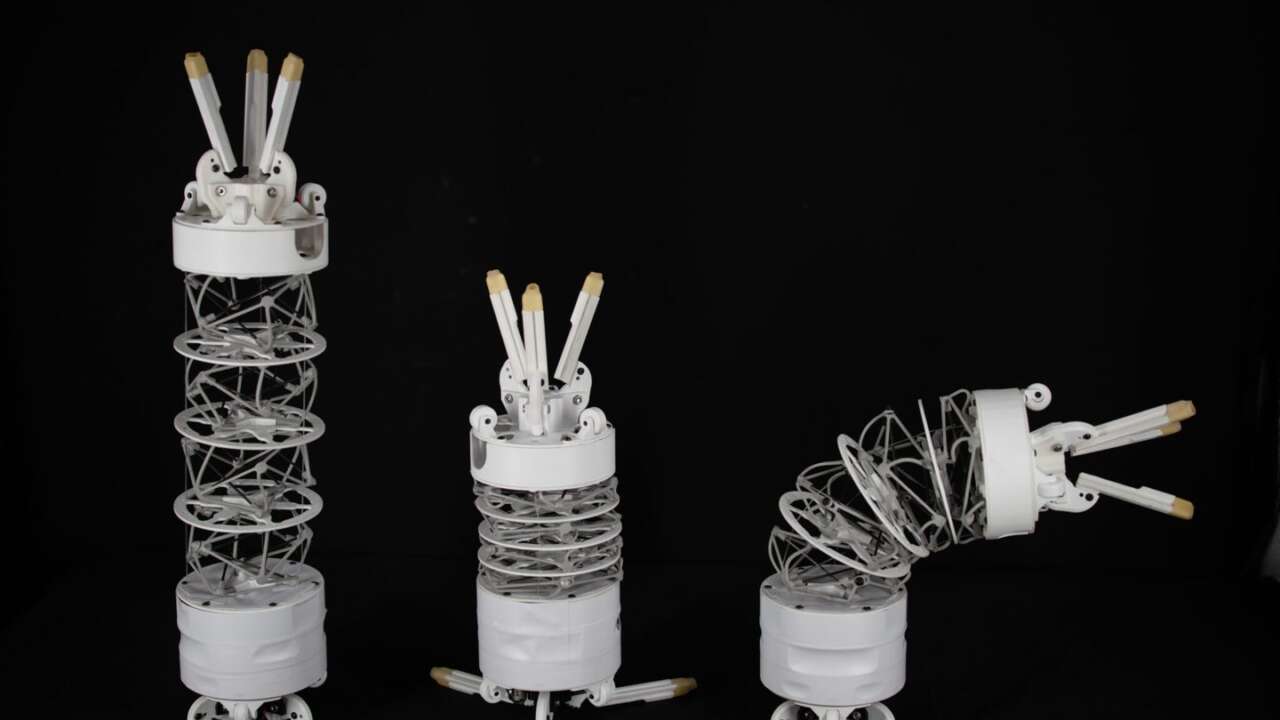
The robot bends because its skeleton is a tensegrity stack, a set of carbon fiber rods held apart by a stretchable printed lattice and pulled by three cables. The Adaptive Robotics Lab team built TeCoBot as a building block. A single unit handles objects and terrain on its own, then docks claw to claw with partners and becomes a chain, a loop or a branch.
In the paper’s demonstrations, that one design lifts a 200 millimeter ball with two partners, crosses a stream on a log and hands scrap paper down a chain to a bin.
A single unit weighs 600 grams, lighter than a full liter bottle of water.
Rods and cables instead of joints
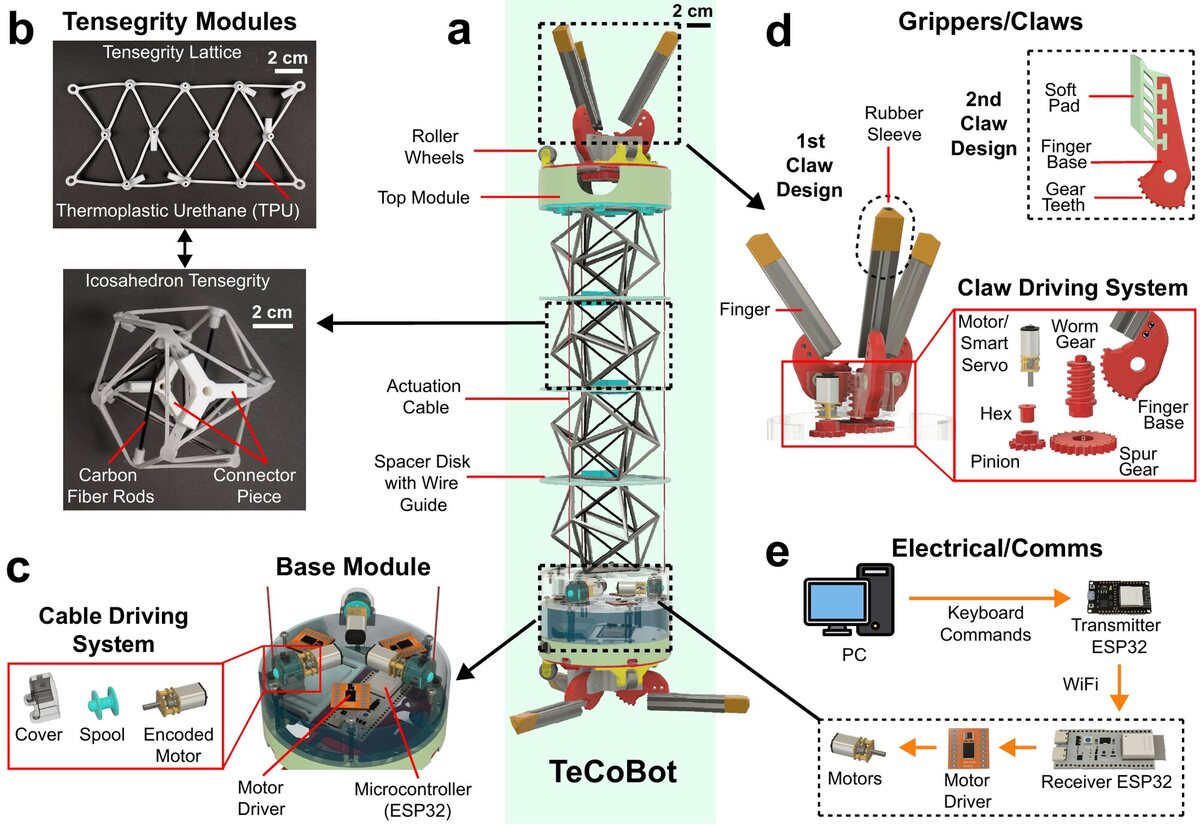
Each TeCoBot measures 587 millimeters long and 110 millimeters across, and its body stacks four icosahedral modules end to end. Each module carries six carbon fiber rods inside a continuous tendon lattice that the team prints in thermoplastic polyurethane, and spacer disks between modules guide the three drive cables.
Three cables run lengthwise through spacer disks at 120 degrees apart, and geared motors in the base module reel them in or pay them out for closed loop control. Pull one cable and the body bends toward it. Pull all three and the body collapses straight down, and the team’s kinematic model predicted the bent shape with tip errors between 1.9 and 6.4 millimeters.
Stacking modules buys reach without stronger motors, since the paper’s bench tests show peak collapsing force holding near 23 to 28 newtons from one module through four. Axial travel grows with the stack instead, from 60 millimeters of collapse on one module to 260 millimeters on four, and bending force stays near 16 to 18 newtons across the same range.
Nothing here pivots on a hinge.
What one robot does alone, and what three do together
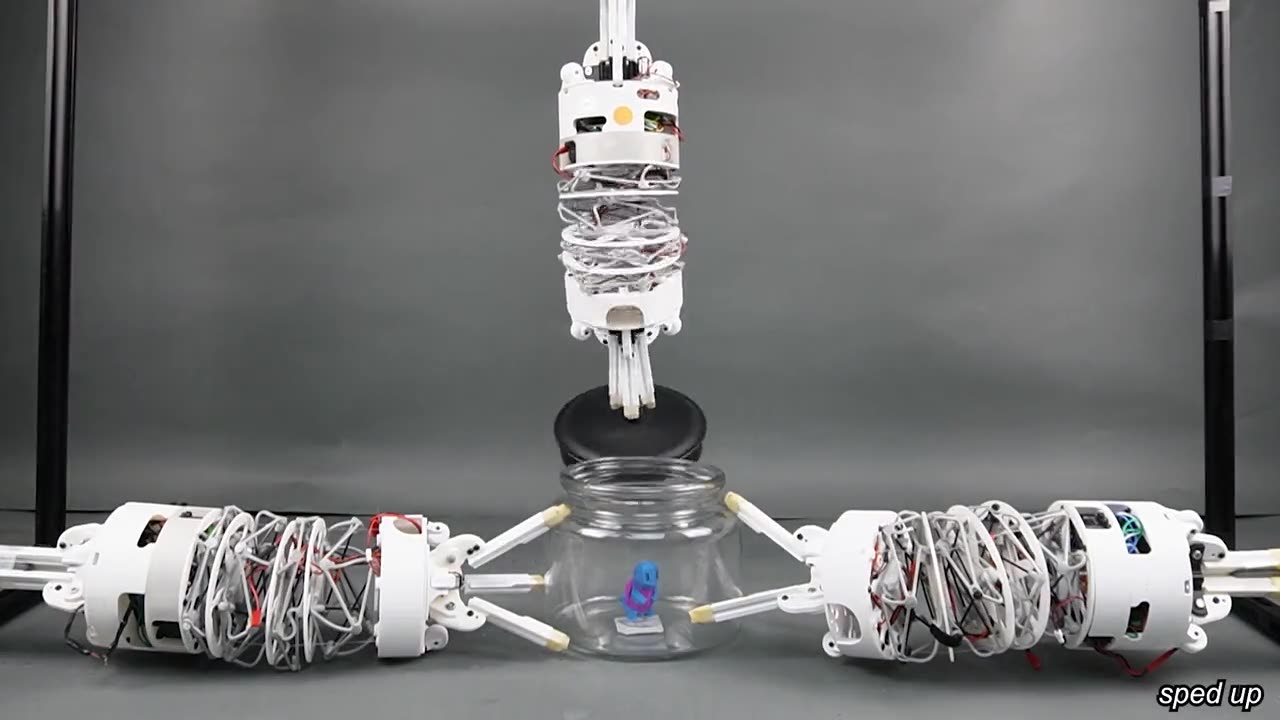
Working solo in the paper’s videos, a TeCoBot stretches up to pluck a grape and set it in a jar, then bends sideways to reach fruit on the other side. The same claws hold a full 2.5 liter water bottle while the robot hangs from its other claw, a load test the team ran to show the grip strength behind the tricks.
Locomotion comes in six modes in the team’s tests, axial extension and compression, inchworm, crawling, rolling, turning and climbing inside a pipe. Rolling runs fastest in those tests, topping out at 30 millimeters per second on smooth wood across eight terrains, while axial crawling manages 5 millimeters per second on the same surface and stalls on rocks and hay.
Three robots on a frame rearrange into four layouts in the paper, and each layout takes a different job, from lifting a 200 millimeter ball to opening a sealed container. In one layout two ground robots hold a tissue roll steady while the vertical partner unrolls and tears a sheet, and in another the chain of three reaches a bottle set beyond any single robot’s grasp.
The lab’s tabletop sequence strings the skills together, as two robots push a third up onto a table, where it takes scrap paper and hands it down to a partner on the floor. That chain then carries the paper across the room and drops it in a bin, a full tidy up run the team filmed indoors and repeated outdoors with a flower picked into a beaker.
Teamwork multiplies reach.
Chains roll over logs, and a person still drives
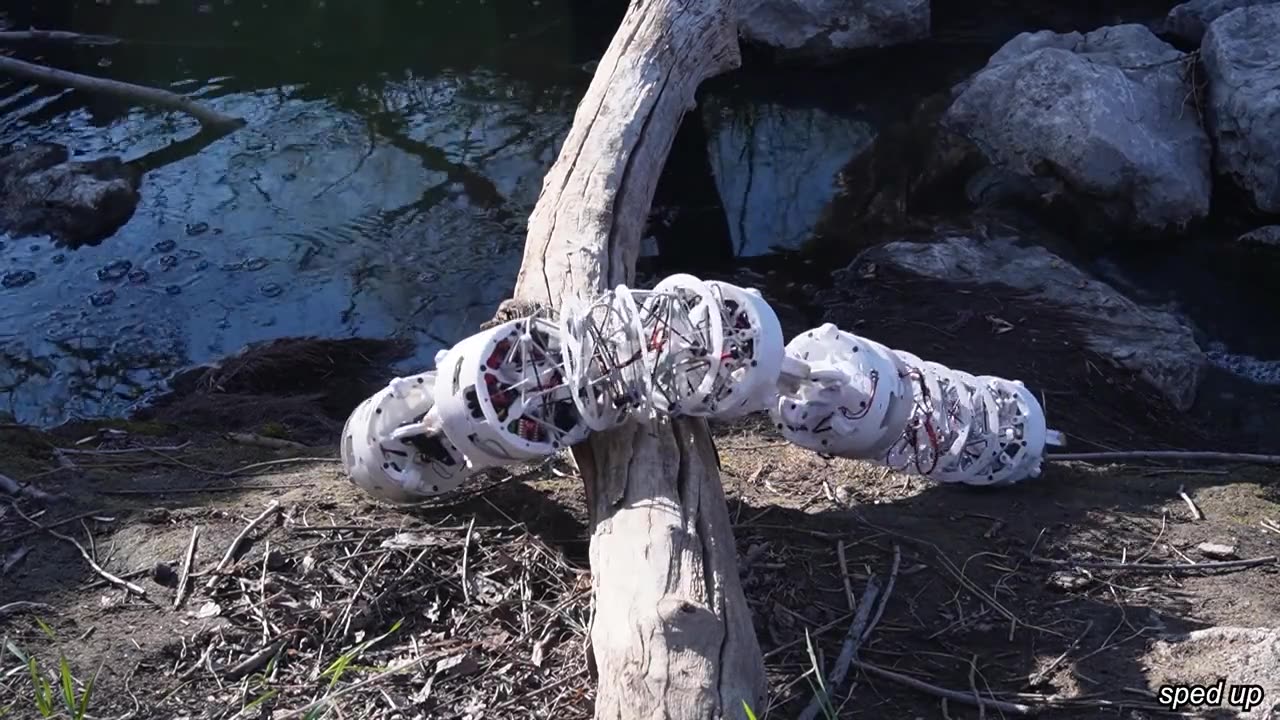
Linked into chains, loops and H shapes, the robots in the team’s outdoor runs rolled over a log at a stream, crossed gaps that stopped a single unit and carried litter to a bank. A loop of three can enclose a large object and inch it forward, an H pair can work through a rectangular duct, and four robots in a square translate forward as one body in the paper’s trials.
Docking strength sits behind those shapes, and the paper’s pull tests put symmetric claw to claw links at a mean peak of 42.9 newtons with latex sleeves fitted. Each claw runs on one motor through a self locking worm gear, so a grip holds without steady power, and the two claw styles swap between a rubber sleeved triangular claw and a padded claw for delicate objects.
Control stays human for now, since the paper’s demonstrations run teleoperated over a wireless link, with an onboard ESP32 receiver taking commands from a PC transmitter. Saikot reports one exception already working, two robots finding each other and docking on their own through the lab’s autonomous visual docking code.
Autonomy is the open gap.
The team names manufacturing, space exploration and search and rescue as the target fields, and Zhao’s stated next steps run toward faster motion and work alongside people with less supervision. Code and design files are public, so other labs can rebuild a TeCoBot and test the claims themselves.