A Caltech robot riding in low-Earth orbit has assembled a section of a reflector antenna truss entirely by machine, a first for construction in space. No astronaut touched a single strut.
The builder is ASTRA, short for Autonomous In-Space Tensioned Reflector Assembly, and it has spent the last six months in orbit working on a reflector antenna 1.4 meters across. Its building materials are composite fiber tubes, aluminum joints, and a Kapton reflective surface, joined one identical section at a time.
“This is the first time that a structure has been autonomously constructed in space,” says Sergio Pellegrino, the Caltech professor who leads the ASTRA team. DARPA funded the robot through NOM4D, its Novel Orbital and Moon Manufacturing, Materials, and Mass-efficient Design program. The agency calls the run the first ever demonstration of automated in-space assembly.
One bay at a time, built like a construction toy
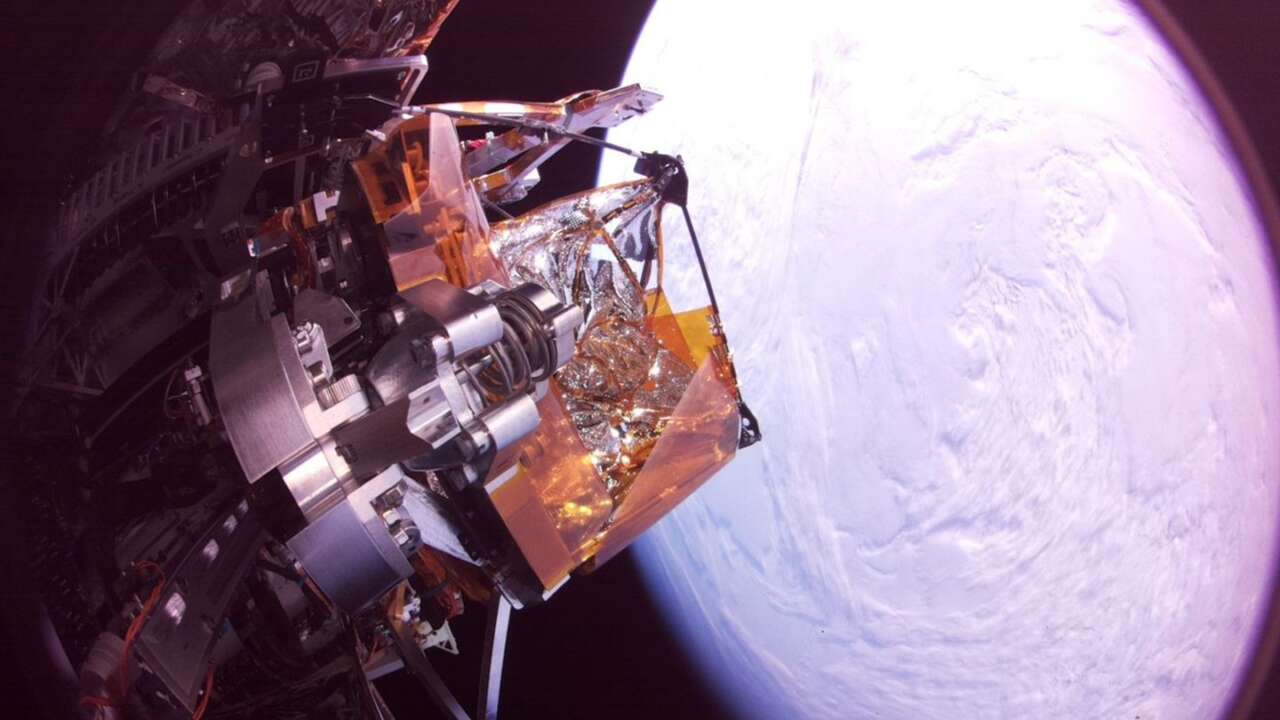
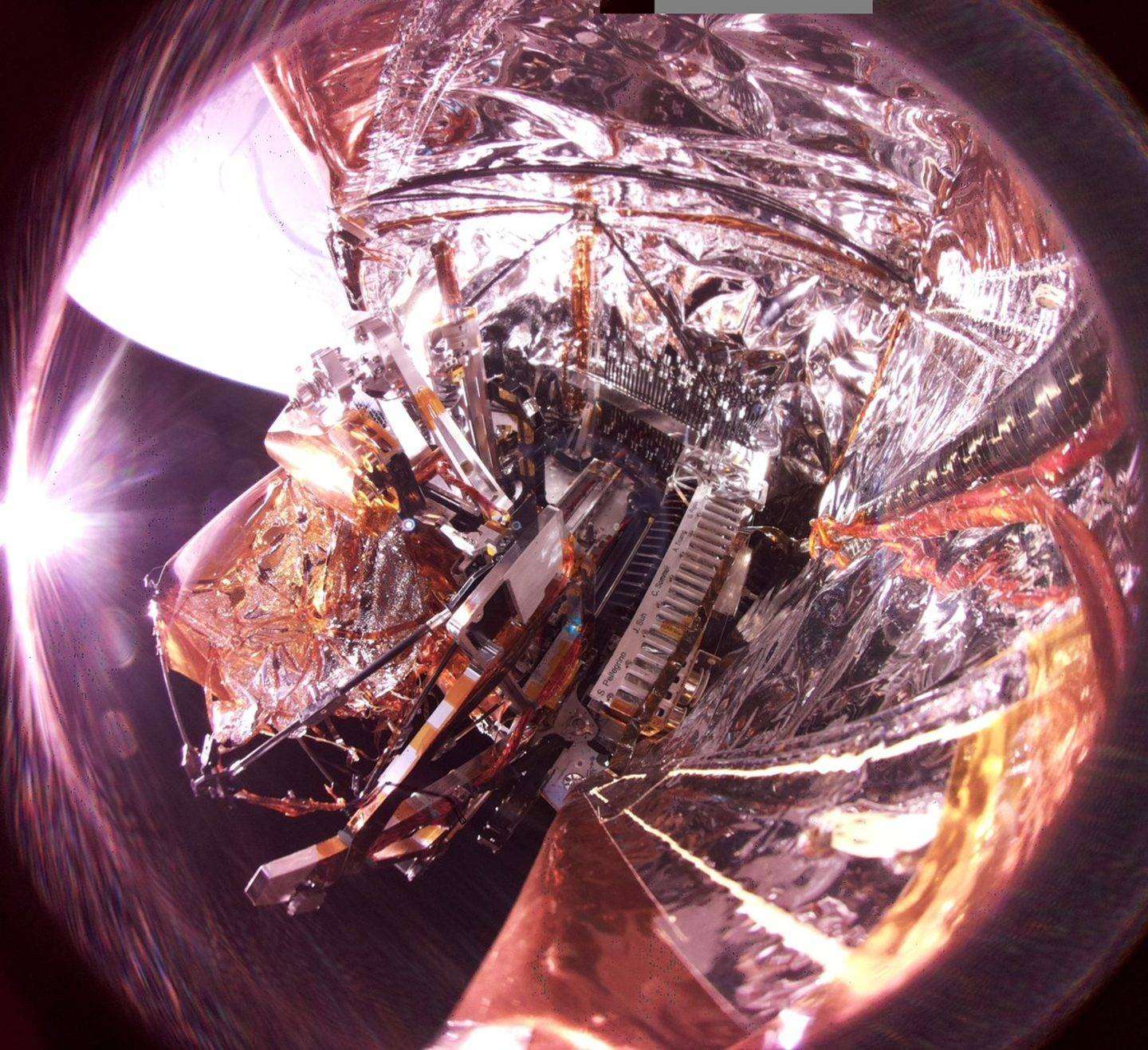
DARPA describes the machine as a relatively simple gantry robot that moves along three linear axes inside its assembly box, where a manipulator arm picks struts and joints out of motorized dispensers and carries them to an assembly plate. There it connects the composite members with custom-designed joints, deploying a thin reflective mesh at the same time.
Andrew Detor, DARPA’s program manager for NOM4D, compares the approach to Tinkertoys or K’nex: “individual truss members are joined at nodes, one section at a time, to create a larger structure.” Each finished section, called a bay, gets pushed out of the builder, and the sequence starts again on the next one.
Once a bay is built, the manipulator attaches a netlike perforated film that forms two reflective cable nets, prestressed against each other by springs. The Caltech team co-invented that film with collaborators at the University of Pennsylvania led by Professor Igor Bargatin. It needs far less prestress than the knitted metallic mesh normally used in furlable reflectors. Structures built this way can be much lighter. Eleven bays complete the full truss.
Launched in March, troubleshot from Pasadena
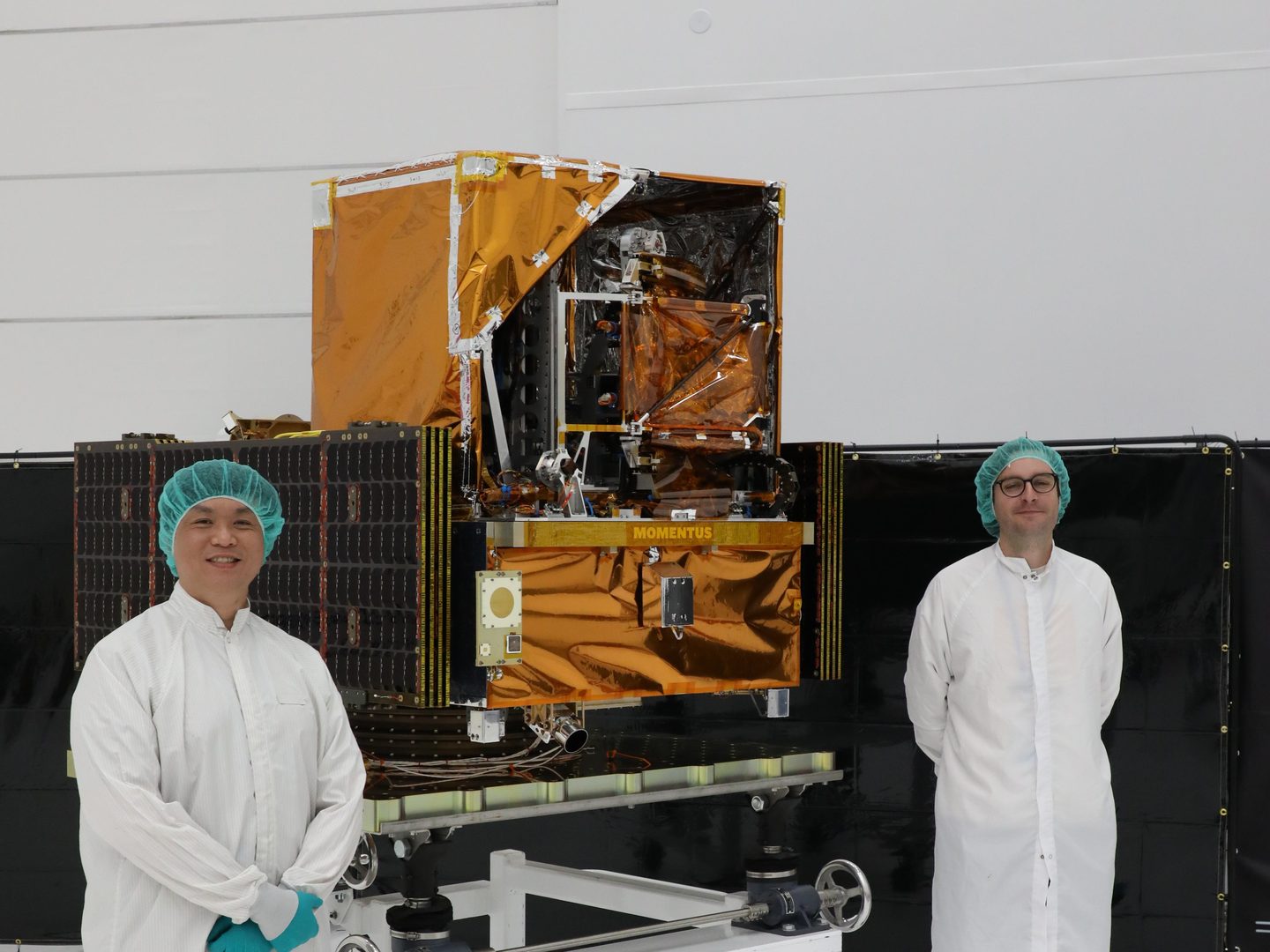
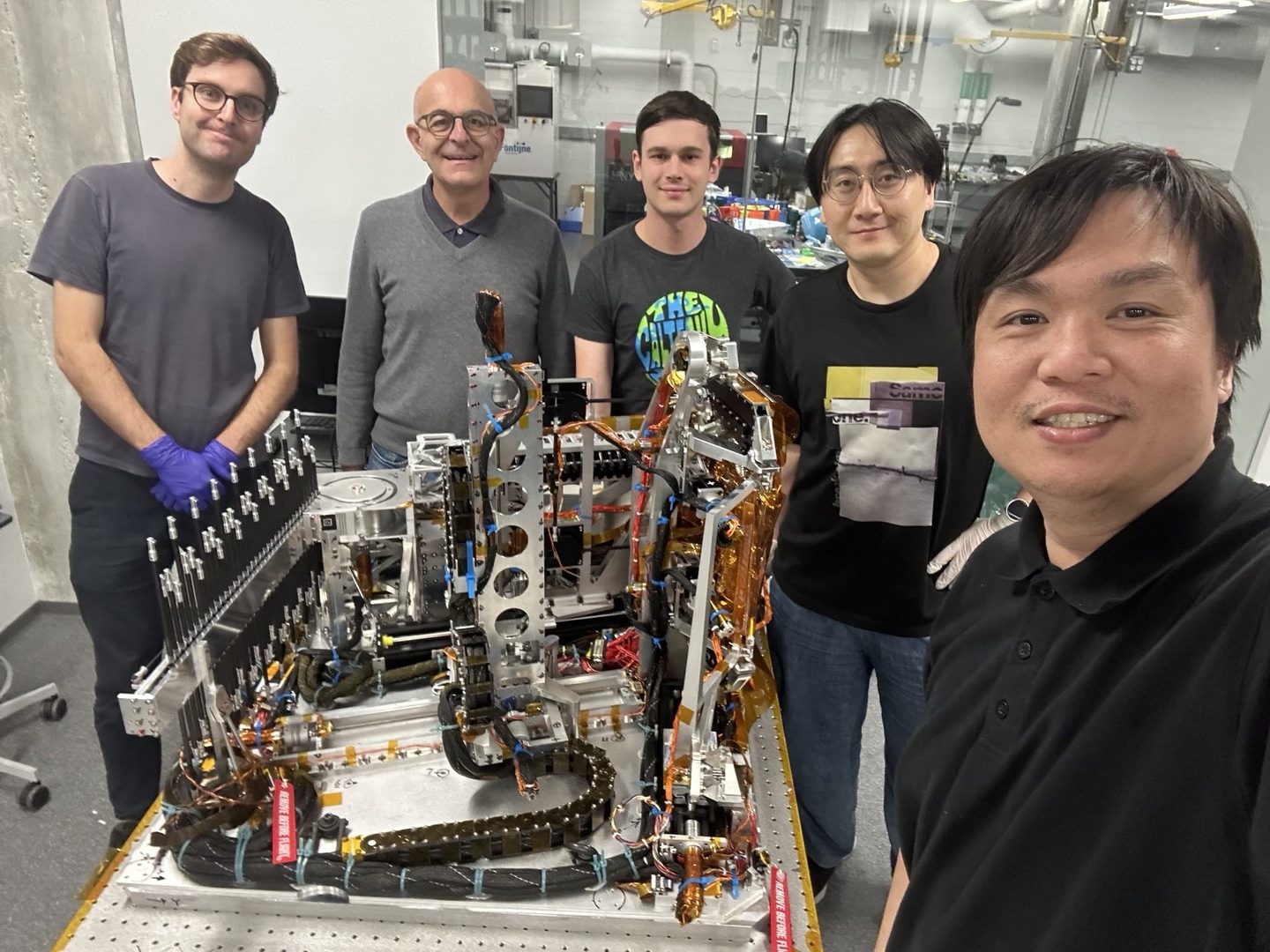
ASTRA reached orbit early in the morning on March 30, 2026, launched from Vandenberg Space Force Base as one of 10 payloads aboard Momentus Inc.’s Vigoride 7 orbital vehicle. That vehicle itself rode up on the SpaceX Transporter-16 mission. The payload measures roughly 1 cubic meter, and the small Caltech team completed, tested, and delivered it to Momentus in less than 12 months.
Inside that cubic meter sat two prebuilt bays of the truss, the manipulator arm, and every part needed to build the rest, packed into motorized dispensers. Once in orbit, the launch restraints came off, the two finished bays were pushed out of the builder, and the robot assembled the third bay from loose parts.
None of that ran on a live joystick. Team members Charles Sommer, Alan Truong, and Tara Venkatadri sent build commands through the Vigoride vehicle. They checked the results against photos downloaded from space and repeated runs to work around problems nobody had seen on the ground. Contact is scarce up there: the team gets about seven or eight windows a day, each roughly 15 minutes long.
For every surprise in orbit, the team kept an identical twin of the robot, a flight spare, in Pellegrino’s Caltech lab. Engineers reproduced each confirmed problem on the spare, tested fixes on the ground, and relayed the workaround to the machine in space.
Jaden Suh, a former Caltech postdoctoral scholar on the team, is now an assistant professor at the University of Texas at Austin. He watched the launch with tears in his eyes: “Sending your stuff to space is what I’ve been dreaming of my entire life.”
The rocket fairing is the ceiling this breaks
Every large structure in space today runs into the same wall: it has to fit inside a rocket fairing. Engineers have had exactly two ways around that wall, folding a finished structure up for launch and unfurling it in orbit, or sending pieces up across a series of launches for astronauts to assemble by hand. Both methods cap how big the finished structure can get.
Building in place is the third option. It’s the one NOM4D exists to prove. “NOM4D’s objective is to enable efficient, scalable construction of very large structures in space,” Detor says. “By ‘very large,’ I mean hundreds of meters or kilometers in scale. Nothing approaching that scale can be achieved today.”
Structures that size open up hardware that can’t be launched whole. The candidates start with enormous mirrors for space telescopes, giant radio antennas, and very large solar arrays for space solar power. Pellegrino works that last field from the other side, as co-director of Caltech’s Space Solar Power Project. Detor’s list runs further, to large space depots and habitats assembled where they will operate instead of adapted to the constraints of a launch from Earth.
DARPA started NOM4D in 2022 aiming to ferry raw materials from Earth for in-orbit manufacturing, and ASTRA is one of only two projects that made it through to the program’s third phase. The on-orbit demo wasn’t even in the original plan. Detor pivoted the final phase toward space after the lab results came in, and the program went from the idea of a flight demo to a working prototype in orbit in 15 months.
ASTRA’s own mission wraps up in December, and the team doesn’t expect to finish all 11 bays in the time left. The verdict they’re claiming is narrower and bigger at once: the approach works in the real environment, and the next version needs to be simpler.
One more NOM4D demonstration is still ahead. The University of Illinois Urbana-Champaign team will launch to the International Space Station later this year, to test a resin system that hardens carbon tubes into high-strength composite structures in space.