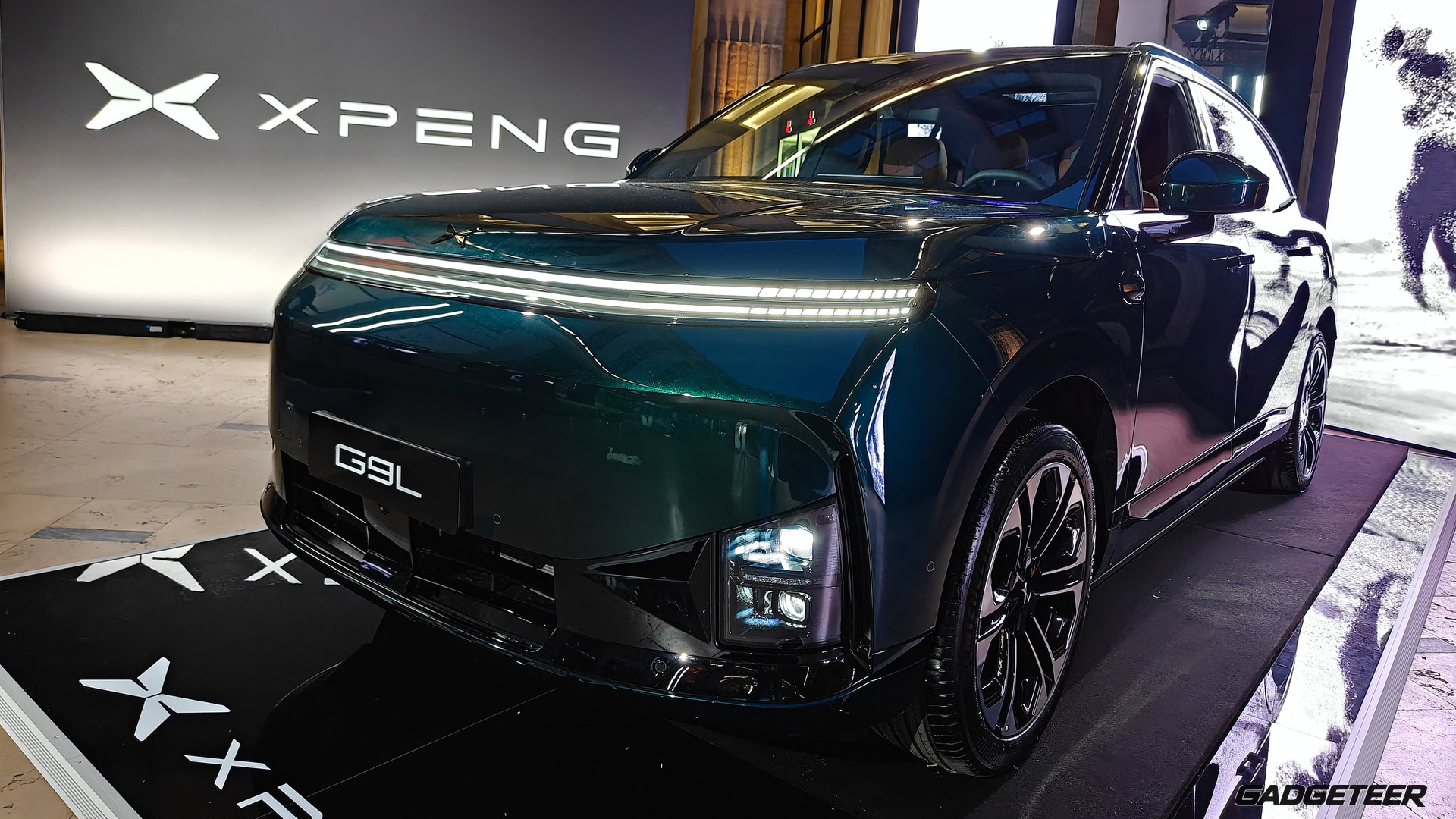
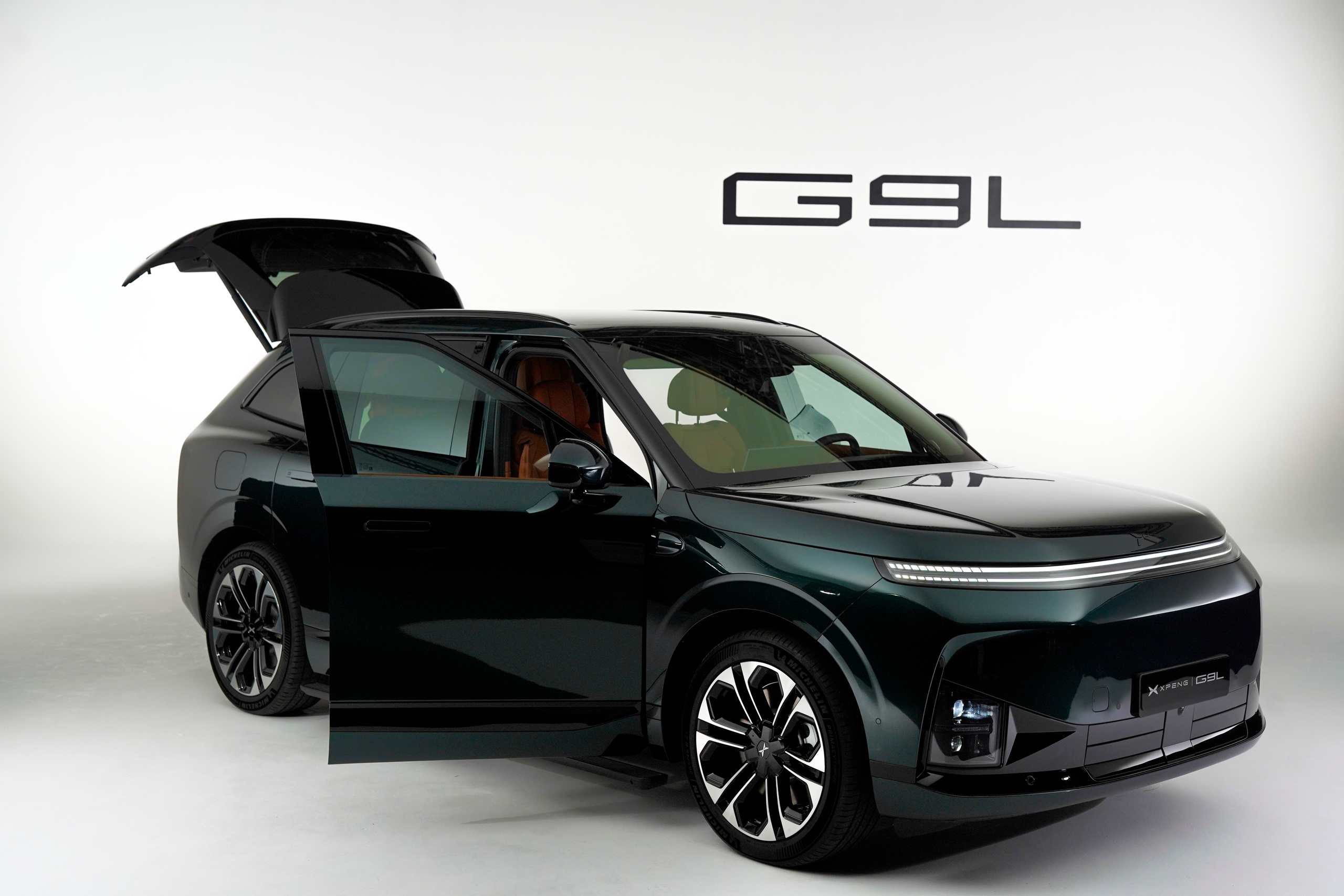
Green is my favorite color, so the XPENG G9L in Waving Green had a head start with me. Then I got around to the rear quarter panel. The way the body curved inward before dropping toward the back was so pretty that I stopped to admire it. It reminded me of the P7, which is a welcome connection to find in a big, three-row SUV.
The car I explored in Paris was the six-seat, all-electric, four-wheel-drive G9L, with a bright Tangerine interior. The powered doors, ceiling-mounted screen, and refrigerator give it the equipment of an ambitious luxury SUV. Rear-wheel steering and fast charging address the less glamorous business of maneuvering and replenishing a large EV, while an extensive safety program underpins its three-row layout.
Exterior
At 5.12 meters long, with a 3.10-meter wheelbase, the G9L is a substantial SUV. XPENG developed this six-individual-seat configuration specifically for Europe, alongside a seven-seat layout. The European model announcement puts those dimensions in context: this is a bigger family proposition than the existing G9.
The nose has a slim lighting signature running across its width, with the main lamp elements positioned separately below it. Flush handles keep the flanks clean, and another horizontal light signature stretches across the rear. There’s a broad, upright presence to it, but that sculpted rear quarter gives the body a sense of movement. That was the part of the design I liked most.


G9L exterior details: rear proportions, rear lighting, the grey car’s front lamps and wheel, and open-door access. Photos: Vincent Nguyen / GADGETEER.
There’s some playfulness in the lighting, too. The digital projection lamps can cast graphics onto the ground. A horse animation caught my attention immediately. It’s a small flourish alongside the more functional lighting, and it gives the car a little personality before anyone gets inside.
The powered doors open at a touch, with obstacle sensing intended to interrupt their movement when something is in the way. They still swing outward like conventional doors. Anyone regularly loading children or bags into a tight parking space will need to account for that arc, even when the car is doing the opening for them.
Interior
The Tangerine cabin is bright, carrying the color across the seats, door panels, and center console. The seats are upholstered in Nappa leather. From my seat, though, it was the dashboard’s height that stood out first. It felt unusually low; I found myself wondering whether I was sitting too high. That changes the visual relationship between the seat, dashboard, and screens before you’ve adjusted anything else.
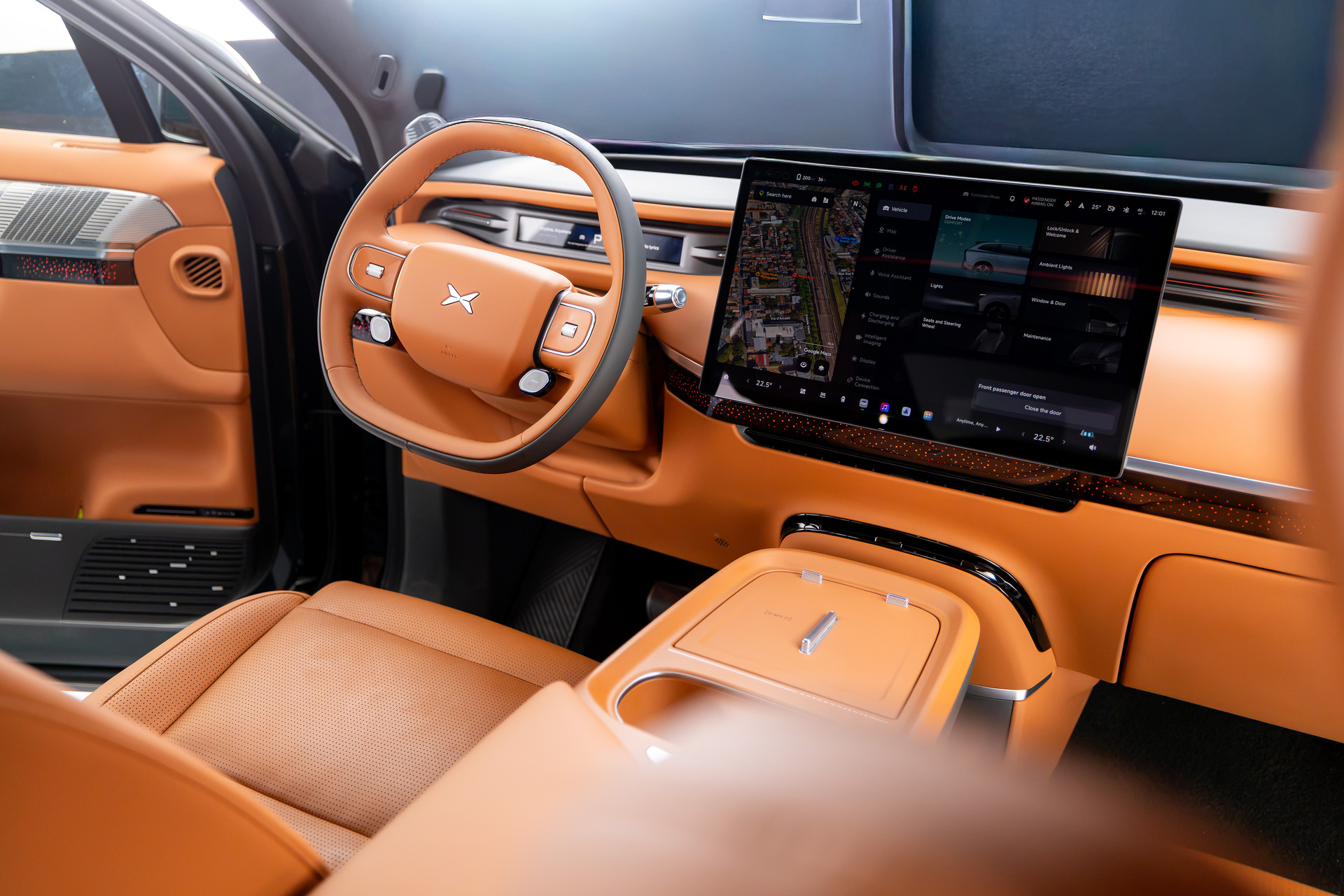
An 8.8-inch instrument display sits ahead of the driver, supplemented by an augmented-reality head-up display. The 17.3-inch central touchscreen combines integrated Google Maps with a substantial set of vehicle controls. Its menus cover the seats and steering wheel, door locks, windows and doors, lighting, and drive modes. Navigation and the car’s settings share the main interface.
XPENG puts a considerable amount of technology into the front seats themselves. Their adaptive air-supported system is designed to change the fit around the occupant, including the lower back and sides of the body. Instead of settling for a fixed bolster shape, the seat uses air zones to vary its support.
The more interesting part is how that support is intended to respond through a corner. As the car turns, the system adds support on the appropriate side to help hold the occupant’s torso. My immediate question was about spirited driving, followed by how the mechanism compared with the motorized systems I associate with German luxury cars. Here, the air-supported adjustment is doing more than offering another position to save in a seat memory.


The adaptive-seat menu, steering-wheel controls and front-seat design. Photos: Vincent Nguyen / GADGETEER.
That active support and the massage function have different jobs. One is intended to adapt the seat to your body and the car’s movement; the other is a comfort setting. I could feel the massage working, and I liked it. Heating and ventilation round out the first two rows’ comfort equipment.
The front passenger also gets a zero-gravity mode designed to recline almost flat. Its appeal is easy to understand during a stop on a longer trip: more room to stretch out than a conventional upright seat provides. That gives the front passenger a different kind of comfort from the driver’s adaptive support.
The middle row has two individual captain’s chairs, each with an armrest and nearby physical seat controls. You don’t have to begin every adjustment by reaching for a screen. The chairs also leave a center passage through to the third row, which is a useful distinction from the three-person middle bench in the seven-seater.
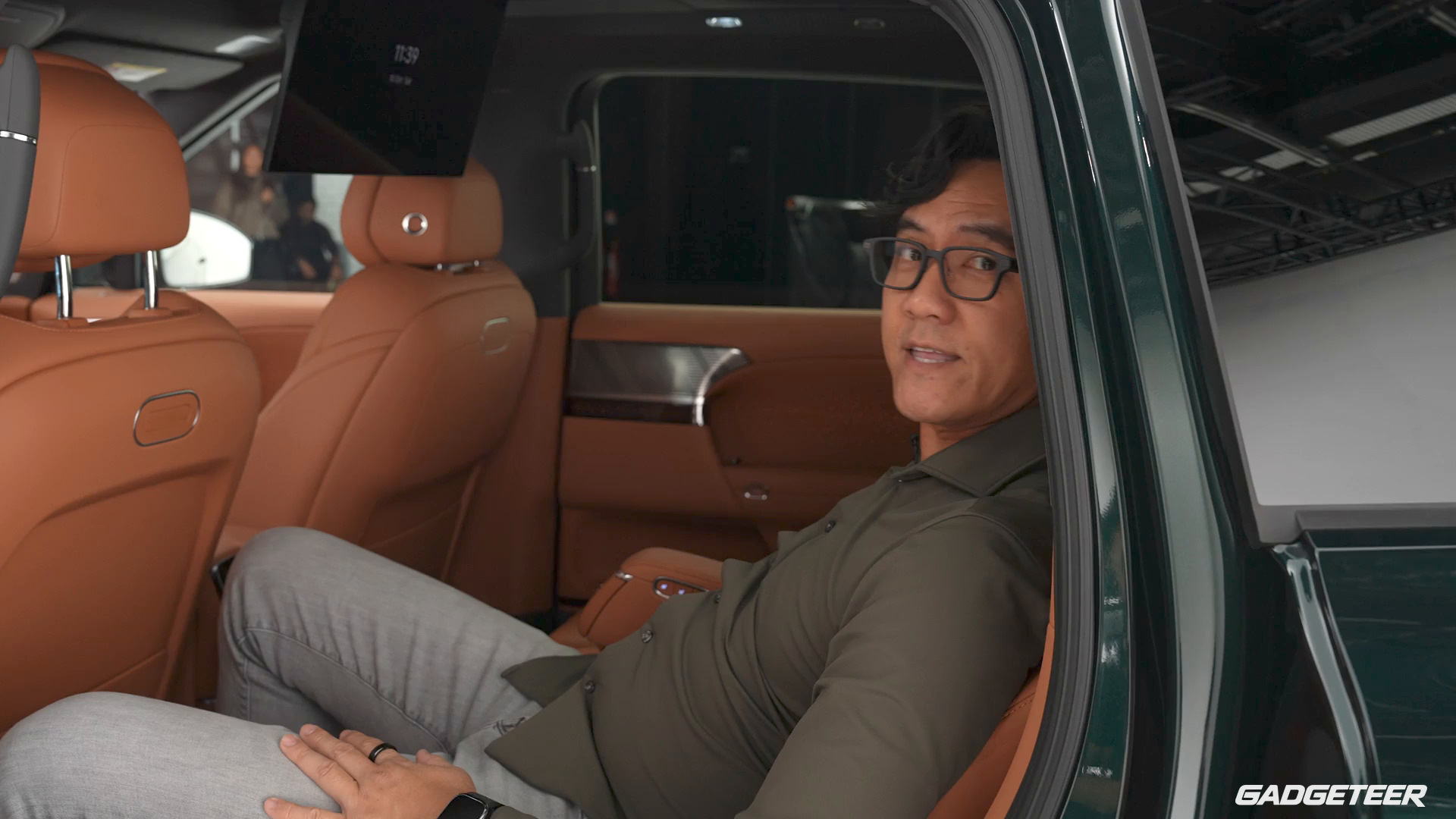
Those individual chairs still share the available cabin length. With the second-row seat in the position I’d chosen, I wasn’t leaving much room for the person behind me. Moving the middle seat changes the third-row experience, so the useful way to judge this layout is with both rows set for the people who’ll actually occupy them. A generous position for one passenger doesn’t tell you how six people will fit together. The third row gets heating and power adjustment, while ventilation and massage are reserved for the first two rows.
The ceiling-mounted display gives the rear passengers a shared screen that folds against the roof when it isn’t needed. At 21.4 inches, it’s large enough to be a defining part of the rear cabin, accompanied by a 23-speaker audio system. I’d love to be able to stream content directly to it.
It also serves as a cabin control surface. Its touchscreen interface includes a seat diagram, massage-program choices, and a seat-position page, so rear passengers can move between entertainment and comfort controls on the same display. Those functions coexist with the chairs’ physical switches rather than replacing them.


Rear-cabin controls and comfort: armrest switches, the roof-mounted display and the refrigerator drawer. Studio photos: Paul DUFAU / XPENG. Display photo: Vincent Nguyen / GADGETEER.
An 8-inch touchscreen on the back of the front center console controls the 12.5-liter refrigerator drawer below it. Open the illuminated drawer, and the drinks are within reach of the middle row. The fridge’s position and separate control make it part of the passenger space, rather than something that requires a stop at the tailgate.
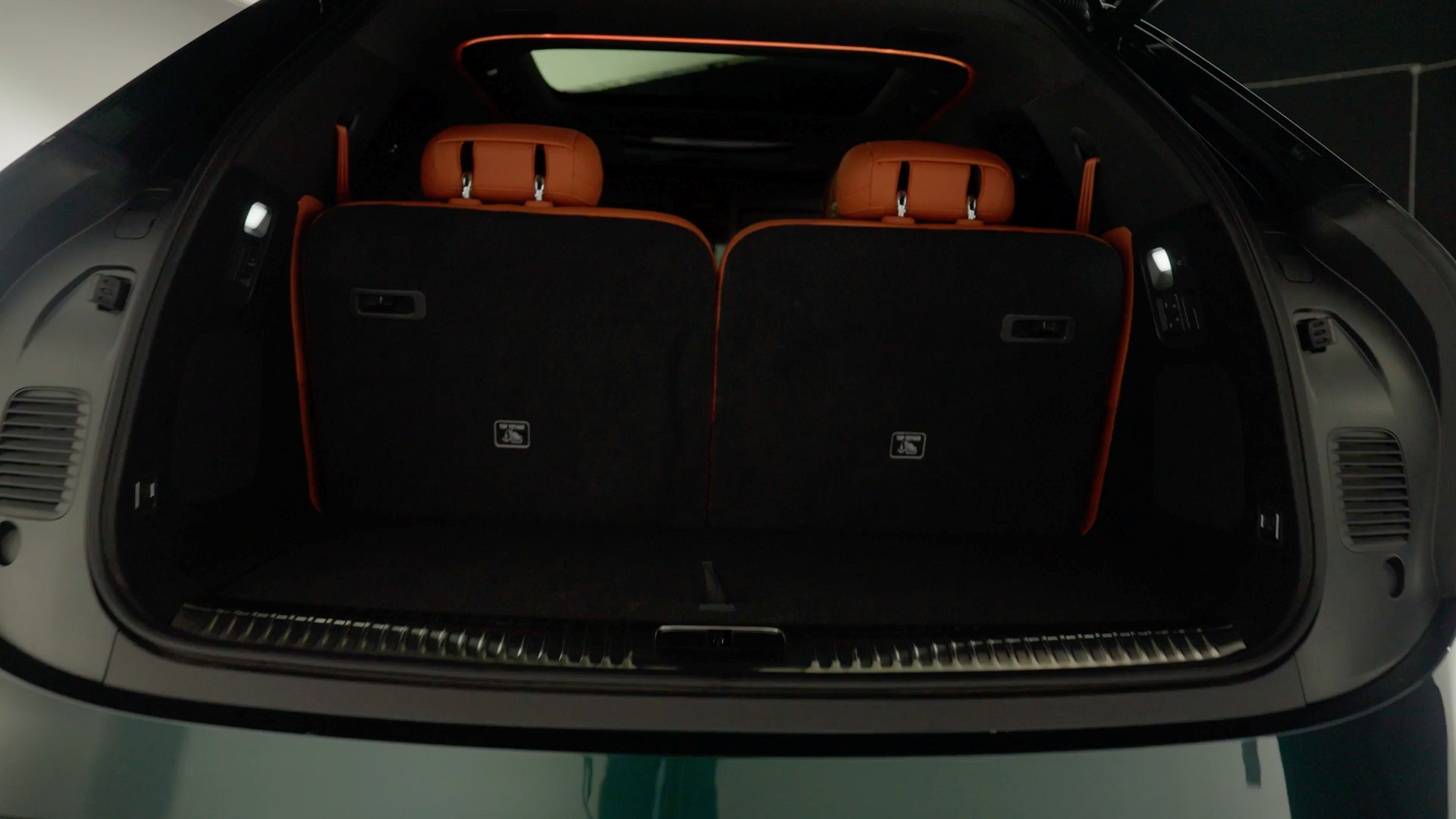
That tailgate opens onto a luggage area whose usefulness depends on how many seats you need. Lowering one third-row backrest extends the load space while keeping the other rear seat available. Carry all six occupants, and the space behind the upright seats has to accommodate their bags. A front compartment and 108 liters of underfloor rear storage provide additional places to put smaller items. Across the six-seat cabin, XPENG counts 34 storage compartments, which should help distribute the smaller things that accumulate on a family trip.
Powertrain and chassis
The G9L I saw was battery-electric, with four-wheel drive. XPENG specifies a 106.7-kWh NCM battery, with a WLTP range of 553 kilometers for the AWD version and 591 kilometers for the two-wheel-drive model. The company claims 0–100 km/h in 4.9 seconds for the AWD EV, versus 7.0 seconds for the rear-wheel-drive version.
XPENG also has a range-extended G9L in its wider plans, using an engine to generate electricity. Its European availability remains unconfirmed. The quoted 1,154-kilometer combined range belongs to that fuel-and-battery version, rather than the electric SUV I explored.
The headline charging claim is approximately 12 minutes from 10% to 80%, using an 800-volt architecture and 5C charging. That is XPENG’s figure, dependent on suitable charging conditions. The appeal is a shorter interruption on a longer trip, though the location and capability of the charger still determine how useful the hardware will be on your route.
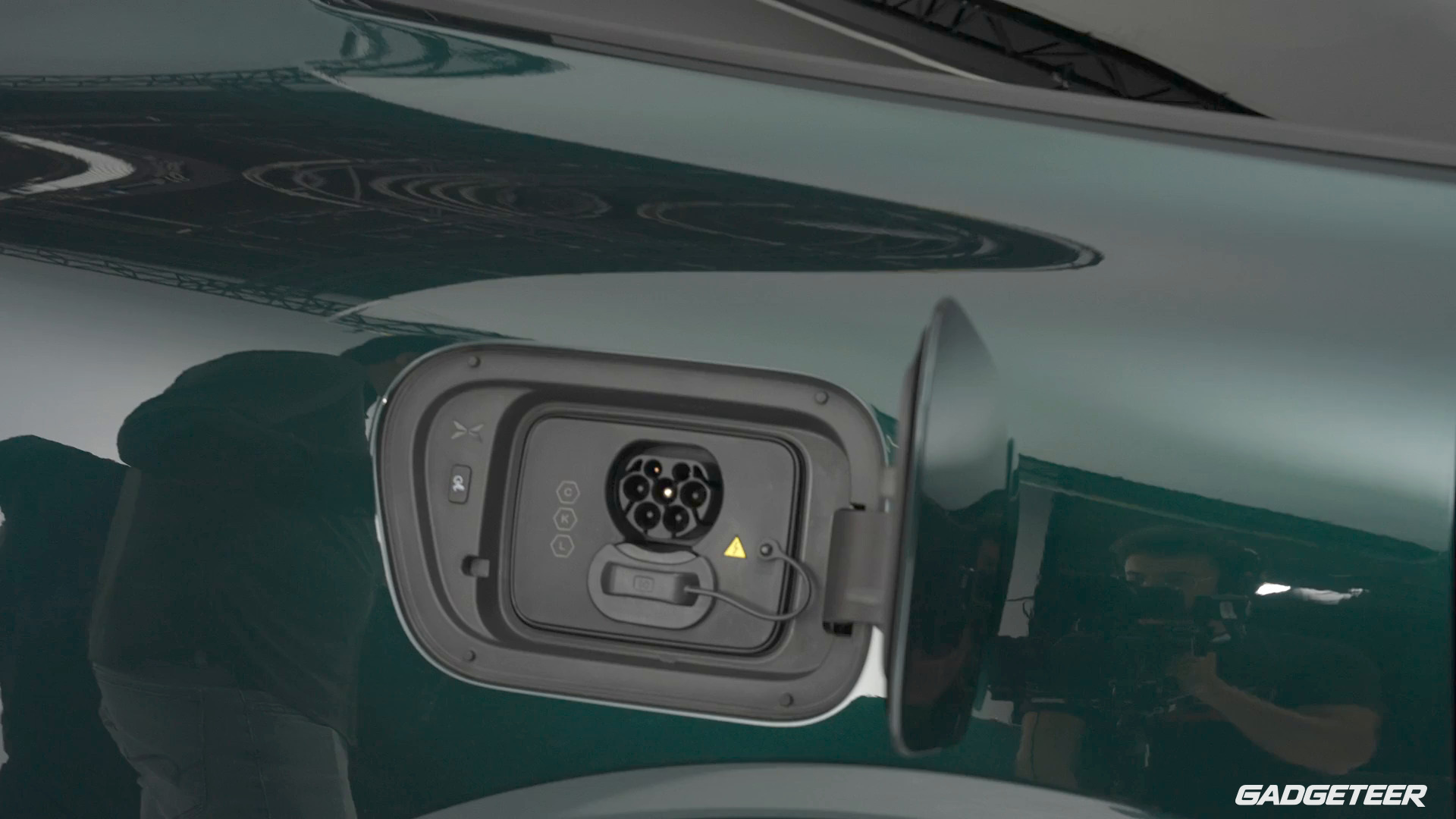
The charging port is on the right side of the car. That’s worth considering in the context of where you park at home and how the cable will reach, something I was already thinking about as I looked around the G9L. Vehicle-to-load capability also lets the battery supply external equipment. XPENG lists a towing capacity of up to 2,000 kilograms, giving the SUV another potential role on trips beyond carrying people and luggage.
Underneath, dual-chamber air suspension and variable damping are standard. Rear-wheel steering is designed to help maneuverability at low speeds and stability at higher speeds, with a claimed turning radius of less than 5.5 meters. The chassis hardware is also set out in XPENG’s European production announcement.
I wanted to know how much the rear wheels could turn, and how that changed between city and highway speeds. The idea of making a large SUV feel more compact is appealing, but those two situations ask different things of the same system: a tighter turn when parking and a composed response at speed. The hardware gives XPENG several ways to address both, without expecting one suspension setting to do every job.
Technology
NGP is XPENG’s driver-assistance system based on VLA 2.0. Adapting it for Europe involves local road conditions, signs, and driving conventions, including the priority rules at unmarked junctions. Those are practical requirements for assistance that will be used across countries with different roads and habits.
The company’s international rollout plan targets 2027, subject to regulatory approval, with deployment planned through over-the-air updates. It remains supervised driver assistance, with the driver responsible for the vehicle. Buyers will need to distinguish between hardware in the G9L and the functions approved and available in their market.
Standard XPILOT Assist Parking provides a separate set of parking-assistance functions. Inside the car, six-zone voice interaction is designed to identify where a request comes from. It adds another way to use the cabin’s functions alongside the dashboard, rear screens, and physical controls.
Safety
XPENG reports 192 crash tests and more than 110 testing protocols in the G9L’s global validation program, including both left- and right-hand-drive configurations. The broader development work spans three years, 26 countries and regions, and approximately 6.74 million kilometers of road testing. The European production announcement details the program.
The European G9L has nine airbags as standard. Its high-strength body is engineered to preserve the passenger compartment, with testing covering rollovers and impacts from multiple angles. Water immersion, battery-underbody impacts, and battery fire also form part of the seven-stage land, water, and air safety challenge. This extends the protection work beyond the shape of the cabin to what happens around and underneath it.
For the battery, XPENG specifies a 2,000-joule underbody impact test. The company also says its cells are engineered to resist fire or explosion for at least 24 hours following thermal runaway, with protection designed to prevent heat propagating through the battery. Battery-management risk alerts and continuous Battery Doctor monitoring support that hardware.
Tire failure gets a dedicated response, too. XPENG says blowout stability control can detect a blowout within 300 milliseconds and coordinate the brakes, steering, and powertrain to help maintain stability. That coordinated response is more specific than simply adding another warning to the dashboard: the system is intended to manage the vehicle’s motion after the tire fails.
Automatic emergency braking and driver-incapacity assistance address other emergencies. AEB is intended to avoid an impact or reduce its severity, while incapacity assistance responds to the separate risk of the driver becoming unable to continue. Neither function removes the need for an attentive driver.
Redundancy addresses a failure inside the car’s own systems. The architecture is designed to maintain critical functions after a single-point failure so the vehicle can reach a safe state. XPENG calls it an aviation-style approach, using backup provision to preserve the car’s ability to respond. Alongside the body’s occupant protection and the emergency interventions, it addresses a third question: what happens if essential equipment itself stops working?
Independent crash testing remains an important next piece of evidence. XPENG’s European announcement states a five-star ambition, while explicitly noting that an official Euro NCAP assessment was still outstanding. The development-test figures are substantial, but they aren’t an awarded Euro NCAP rating.
First impressions
The G9L’s styling made an immediate impression on me, particularly that rear quarter and the green finish. Inside, the low dashboard, the massage I could feel, and the individually controlled middle-row chairs gave me more to think about than the screen count alone. The driver’s adaptive support is another idea I want to understand in the context of the chassis around it.
My earlier visit to XPENG in China explored the company’s wider technology ambitions. The G9L brings them into a European family SUV, with a different set of practical demands. European pricing and order opening are planned for the October 12 launch in Paris. That will put the equipment into a buying context. The styling and cabin equipment give it a strong starting point; how its chassis, adaptive support, and assistance work together on the road will determine how far the experience extends beyond the interior.