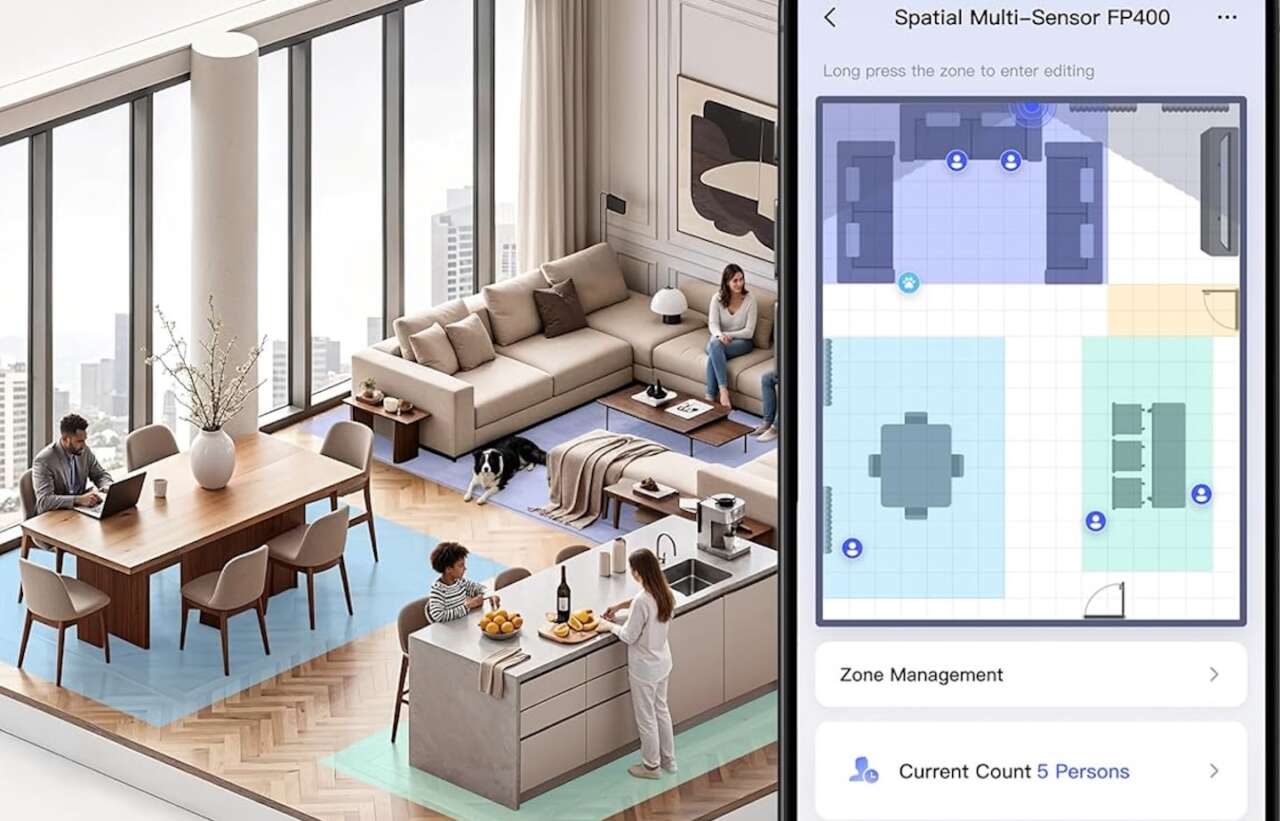
Traditional motion sensors have an annoying weakness: stop moving, and your smart home can start behaving as though you’ve left.
Price: $79.99
Where to Buy: Amazon
That can mean lights switching off while you’re reading on the sofa or working quietly at a desk. The Aqara Spatial Multi-Sensor FP400 tackles that problem with 60GHz millimeter-wave radar, which can detect presence without relying solely on obvious movement. More importantly, it’s designed to tell where people are within a room rather than simply reporting whether the room is occupied.
For anyone building more sophisticated automations, that spatial awareness is the real reason to consider the FP400.
One sensor can create eight automation zones
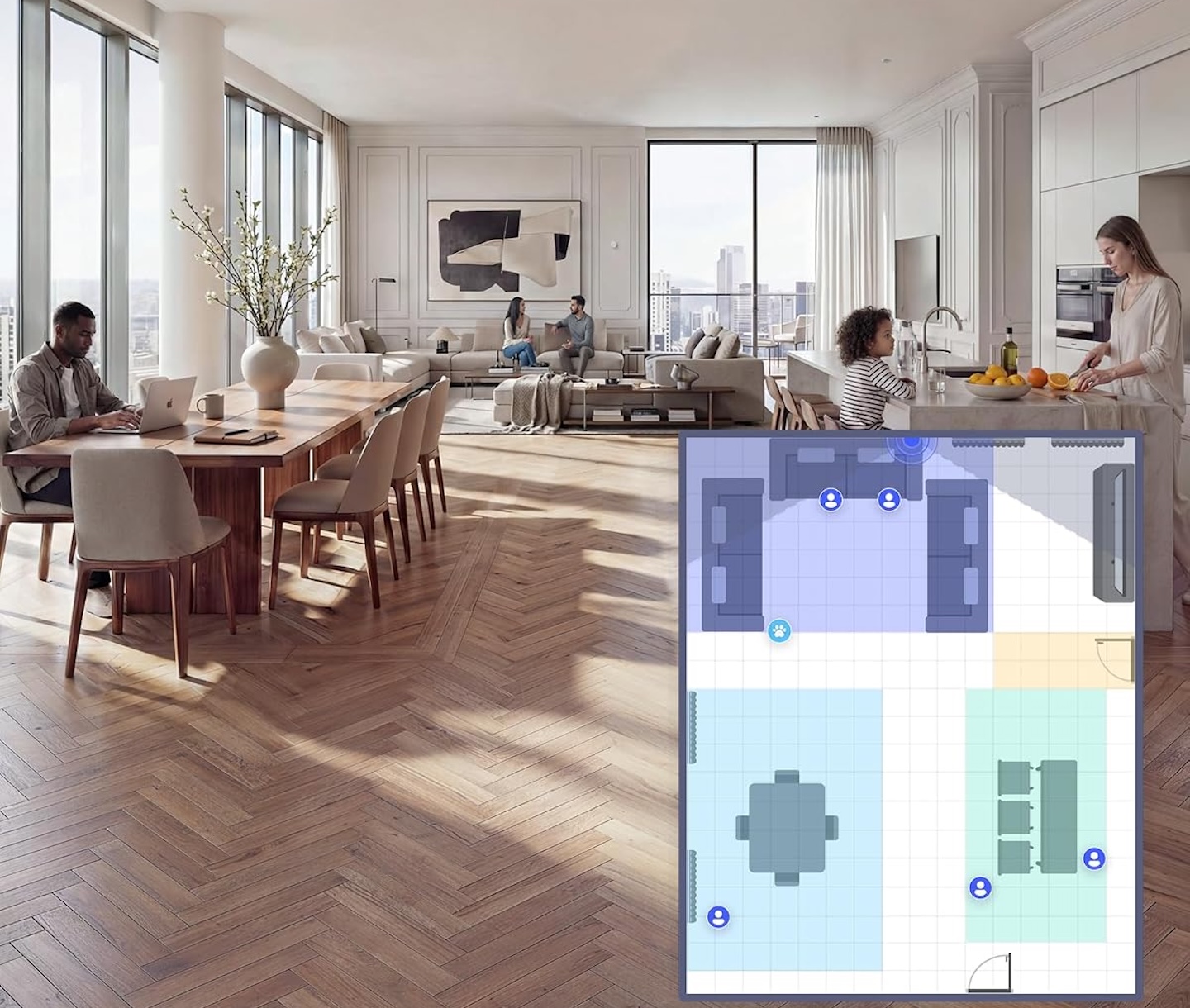
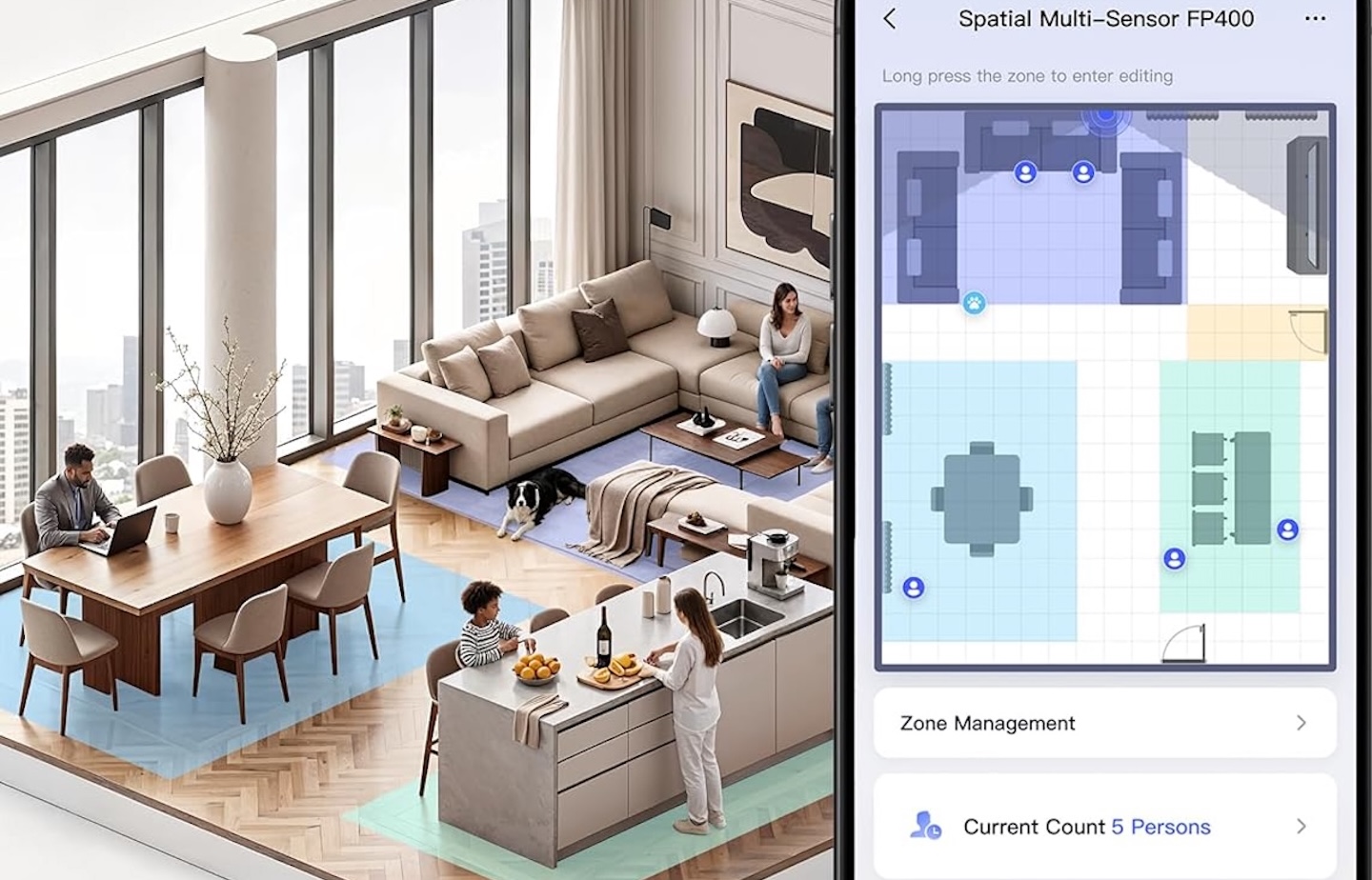
The FP400 maps its detection area using a 0.5 × 0.5-meter grid and supports up to eight customizable monitoring zones. Aqara also says it can track the real-time position and movement direction of up to 10 targets at once. That means one sensor could potentially handle jobs that might otherwise require several devices.
A sofa could become one zone, a desk another, and a dining table a third. Moving to the desk could trigger task lighting, while sitting on the sofa could activate softer lights. Aqara demonstrates a similar automation in which remaining in a sofa zone for 20 seconds during specified evening hours triggers ambient lighting and changes an air-conditioner setting.
This doesn’t make the FP400 a precision people-counting system. Aqara warns that its count can be off by one to three people when several people are present, so treat the headcount as an estimate rather than an exact tally.
The stronger use case is spatial automation: detecting whether someone is in a particular part of the room and responding accordingly.
It detects presence without a camera
Detailed room sensing can raise privacy concerns. Cameras provide plenty of information, but many people understandably don’t want one watching a bedroom, living room, or home office.
The FP400 uses radar instead of capturing images.
Aqara says its 4T4R MIMO antenna array produces more than five times denser point-cloud data than its previous generation. The company also says its AI Enhanced Person Detection can help distinguish people from interference caused by pets, robot vacuums, and other moving objects.
Early beta reports illustrate why that distinction matters. One tester completed a 30-minute stationary test after initially experiencing a presence dropout. Another found stationary detection inconsistent on a sofa despite experimenting with mounting positions and settings. Other early users have reported better results after carefully configuring their rooms.
Those reports offer useful firsthand impressions, but they’re too few to establish how every retail FP400 will perform. They do suggest that placement and calibration matter.
Your room can make detection harder
Aqara warns that glass, mirrors, metal surfaces, fans, moving plants, pets, and other sources of motion or radar reflection can interfere with detection.
Reflections can even create “ghost” targets that appear where nobody is standing. The Aqara app provides boundary and interference-source zones, along with AI Spatial Learning, to help reduce those problems.
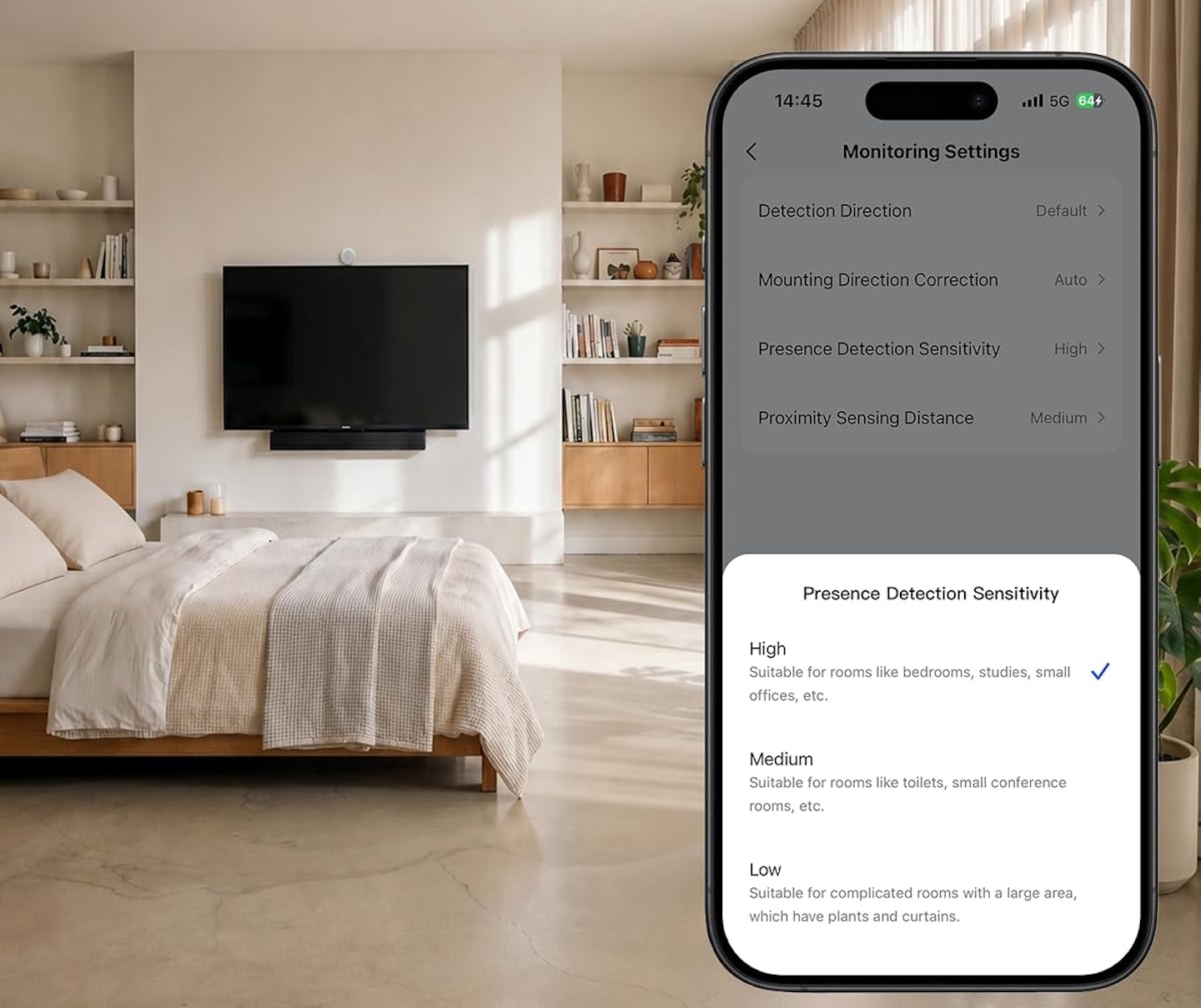
Installation therefore deserves more thought than sticking a conventional motion sensor to a wall.
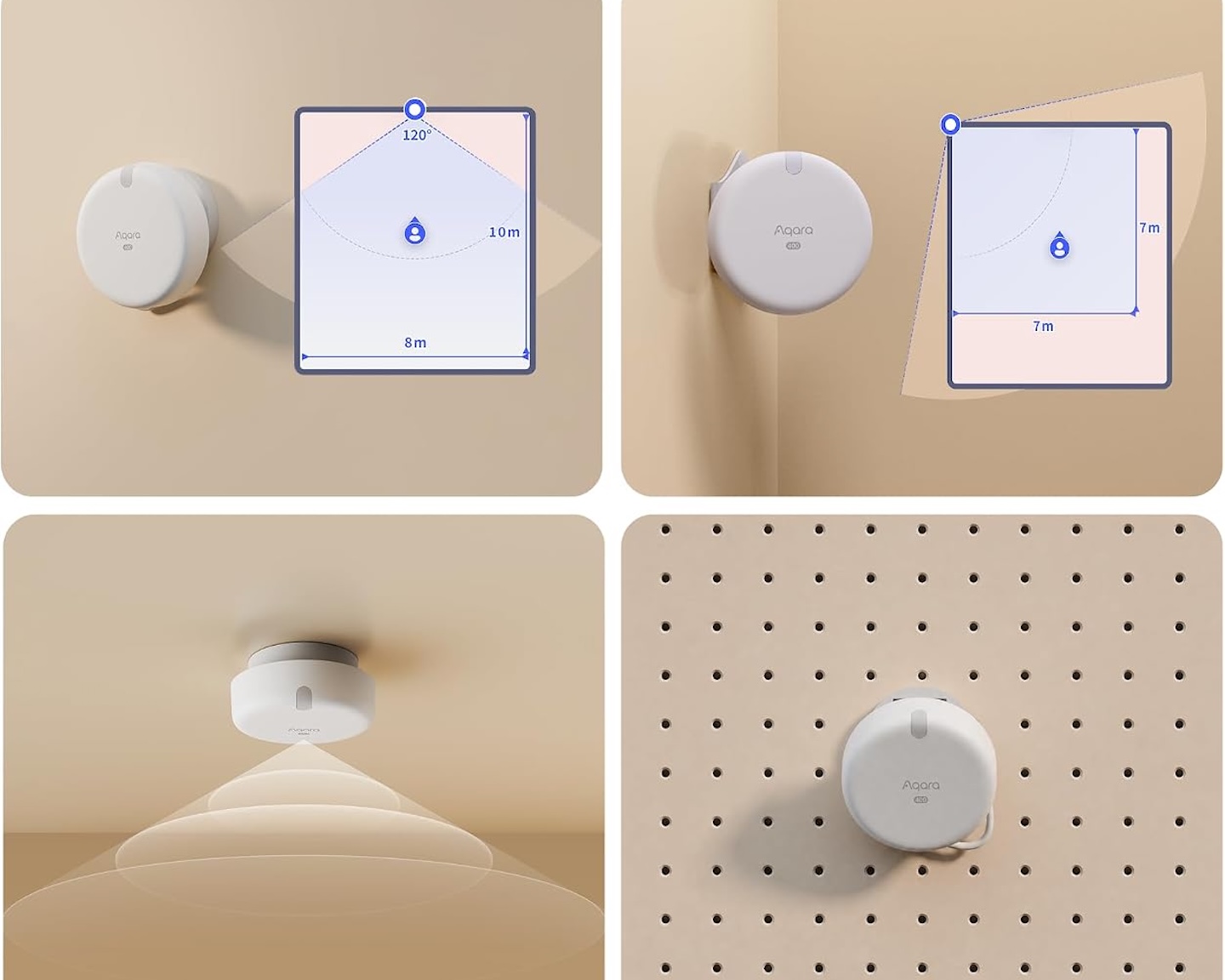
The FP400 has a 120-degree field of view and supports side, corner, and ceiling placement. Aqara says side mounting can provide detection up to 10 meters deep and 8 meters wide under its test conditions. Actual coverage will depend on your room and installation.
The sensor also requires continuous 5V/1A USB-C power. There’s no battery to recharge, but you’ll need a suitable power source nearby. The enclosure measures 64 × 64 × 29.5mm and has an IPX5 protection rating.
Thread and Zigbee offer setup options
The FP400 supports Zigbee and Matter over Thread, giving you more setup options than a sensor tied to one wireless protocol.
A compatible Aqara hub provides the full Aqara Home experience, including the positioning map, custom zones, real-time headcount, AI features, and local Aqara automations. An Aqara hub isn’t mandatory for useful multi-zone operation, though.
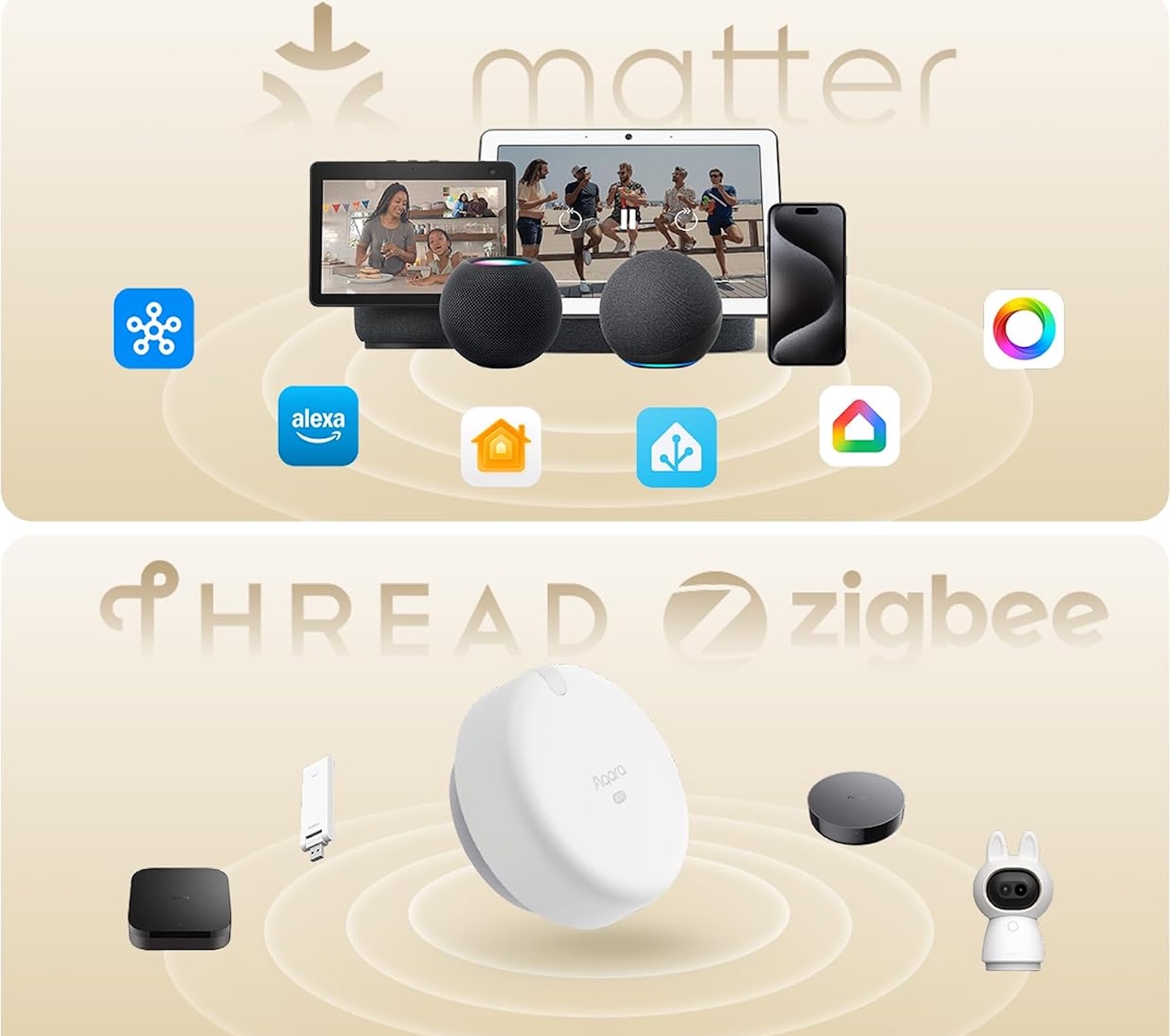
If you have a compatible third-party Thread Border Router, Aqara says you can first configure the FP400 through Aqara Home, including its zones, sensitivity, and absence-confirmation period. You can then expose one whole-area occupancy sensor and up to eight zone occupancy sensors to a compatible Matter ecosystem.
Adding the FP400 directly to a third-party Matter platform without configuring it through Aqara Home first is more limiting. Aqara says that approach exposes only general whole-area occupancy and illuminance, but not the custom zone sensors that make the FP400 interesting.
The practical lesson: even if Matter is your final destination, configure the FP400 through Aqara Home first.
Amazon buyers don’t get the separate bracket
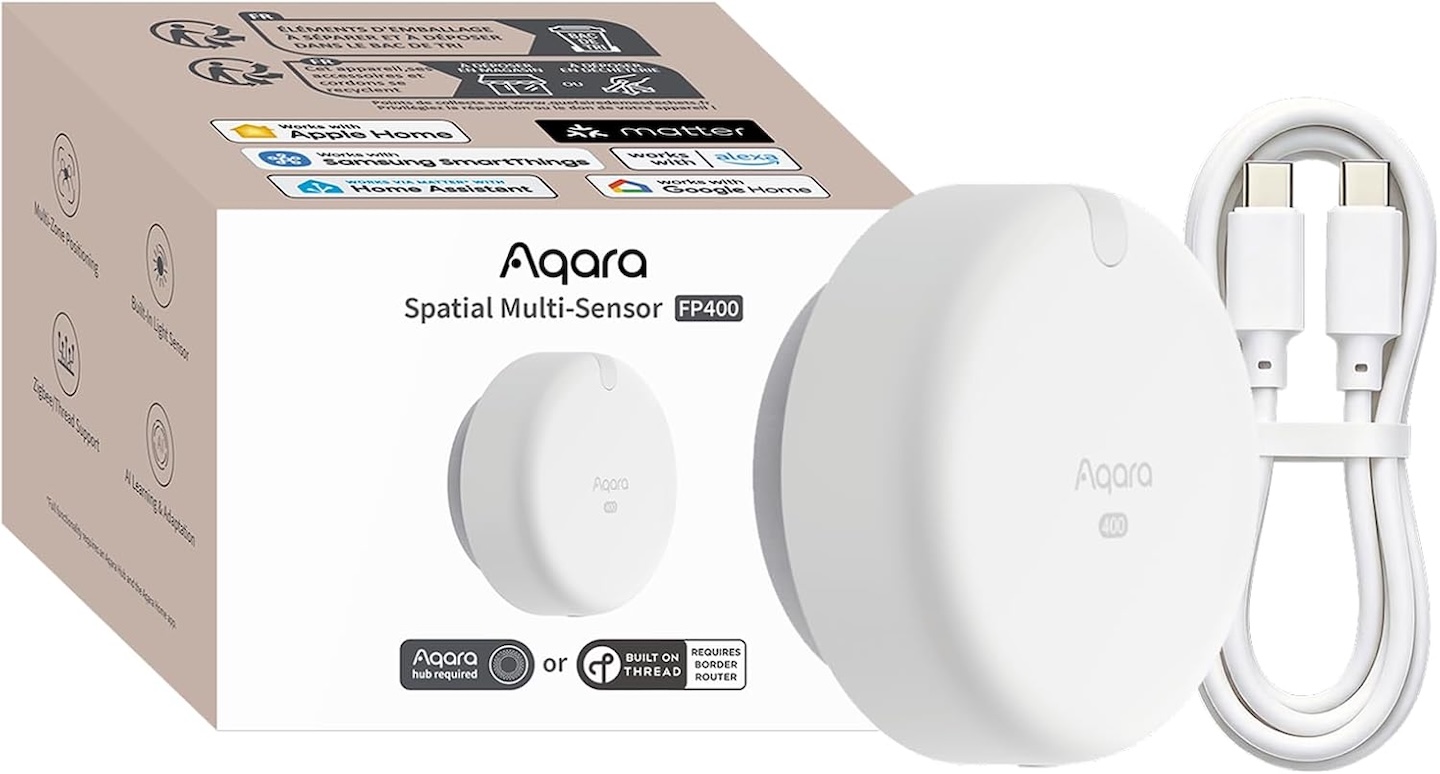
There’s a packaging difference worth checking before you buy. Aqara lists the Amazon package as containing the FP400, a USB-C-to-USB-C cable, metal plate, adhesive sticker, screw kit, and manual. The separate mounting bracket included with Aqara’s brand-retail version isn’t included in the Amazon package.
That doesn’t prevent installation, but it makes planning your mounting position more important before ordering.
Who should buy the Aqara FP400?
The FP400 makes the strongest case in rooms where ordinary motion detection isn’t smart enough.
A living room, bedroom, office, or open-plan space can contain several activity areas. Knowing where someone is gives you more automation options than simply knowing that something moved.
There are tradeoffs. The FP400 requires continuous power, calibration takes more effort than installing a basic motion sensor, reflective surfaces can create false targets, and early user reports suggest performance can vary with placement.
For a closet, hallway, or utility room where you only need lights to react when someone walks in, it’s probably overkill.
Price: $79.99
Where to Buy: Amazon
It’s a better fit for someone who wants the sofa and desk to trigger different automations, wants a sensor designed to detect people who sit still, or wants room-level spatial awareness without installing a camera.