There’s no Intel chip inside the Huawei Qingyun HM650. No AMD, no Qualcomm, and no copy of Windows on the drive. Huawei built this desktop around its own Kirin X90 processor and its own operating system, HarmonyOS, aimed at exactly one buyer: the Chinese state, and the companies that work for it. It’s the first desktop Huawei has ever sold running HarmonyOS, and the first anywhere certified as built entirely from Chinese-made parts.
You can’t buy one, and Huawei won’t sell you one.
Huawei Qingyun HM650
Kirin X90, 10 cores, 20 threads · 16GB LPDDR5 memory · 512GB SSD
Price: about $1,080 in China
Where to buy: More details at Huawei
Kirin X90, out of the laptop and onto the desk
The Kirin X90 started life in Huawei’s laptops last year, the MateBook Pro first among them, and it arrives here in two forms. The full chip carries 10 cores and 20 threads, built on Huawei’s own Taishan core designs. A cut-down 8-core version powers the cheaper HM650g government line.
Huawei rates the chip at 40 watts, a fraction of what a mainstream Intel desktop processor pulls, and Huawei cools it with a dual-layer heatsink built for long, steady office loads rather than short bursts. Integrated Maleoon graphics handle the display work, and a separate neural processor runs the AI features on the machine itself, no cloud round trip needed for the basics.
What’s missing is any proof of speed. No benchmark of the HM650 exists yet, and Huawei quotes no clock speed for the desktop chip in its own materials.
Teardowns of the same chip in Huawei’s laptops found it built on SMIC’s 7-nanometer-class N+2 process, a couple of generations behind the leading edge. For the offices this machine targets, that gap is beside the point. Nobody procuring these by the thousand is buying frames per second.
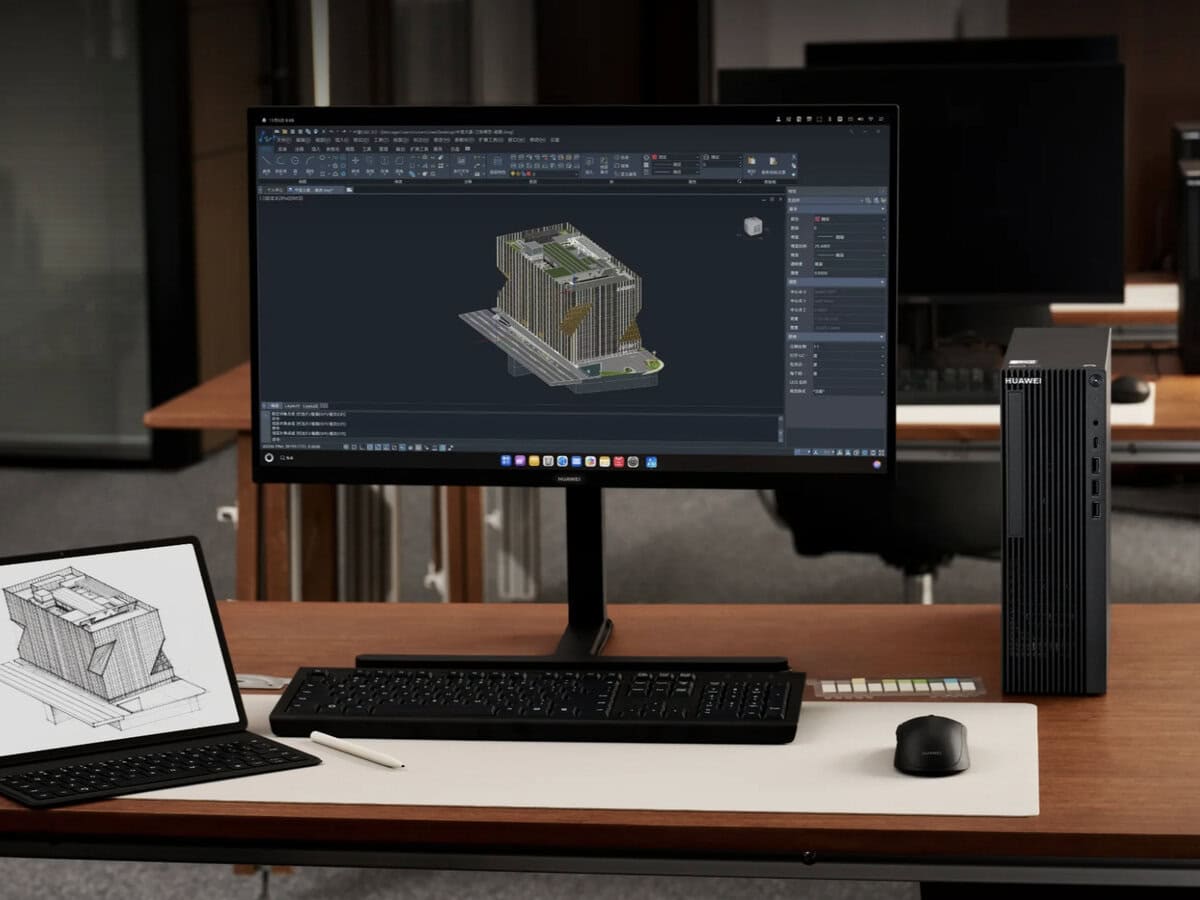
Configurations and China pricing
Nearly every configuration ships with 16GB of LPDDR5 memory and a 512GB SSD. The government line adds hard-drive options, and the range tops out at 24GB of memory. China list prices run like this, converted to dollars.
| Configuration | Chip, memory and storage | China list price |
|---|---|---|
| HM650g | Kirin X90, 8 cores · 16GB · 512GB SSD | about $1,035 |
| HM650g | Kirin X90, 8 cores · 16GB · 256GB SSD + 1TB hard drive | about $1,065 |
| HM650g | Kirin X90, 8 cores · 16GB · 512GB SSD + 1TB hard drive | about $1,155 |
| HM650 | Kirin X90, 10 cores · 16GB · 512GB SSD | about $1,080 |
| HM650 | Kirin X90, 10 cores · 24GB · 512GB SSD + 2TB hard drive | about $1,575 |
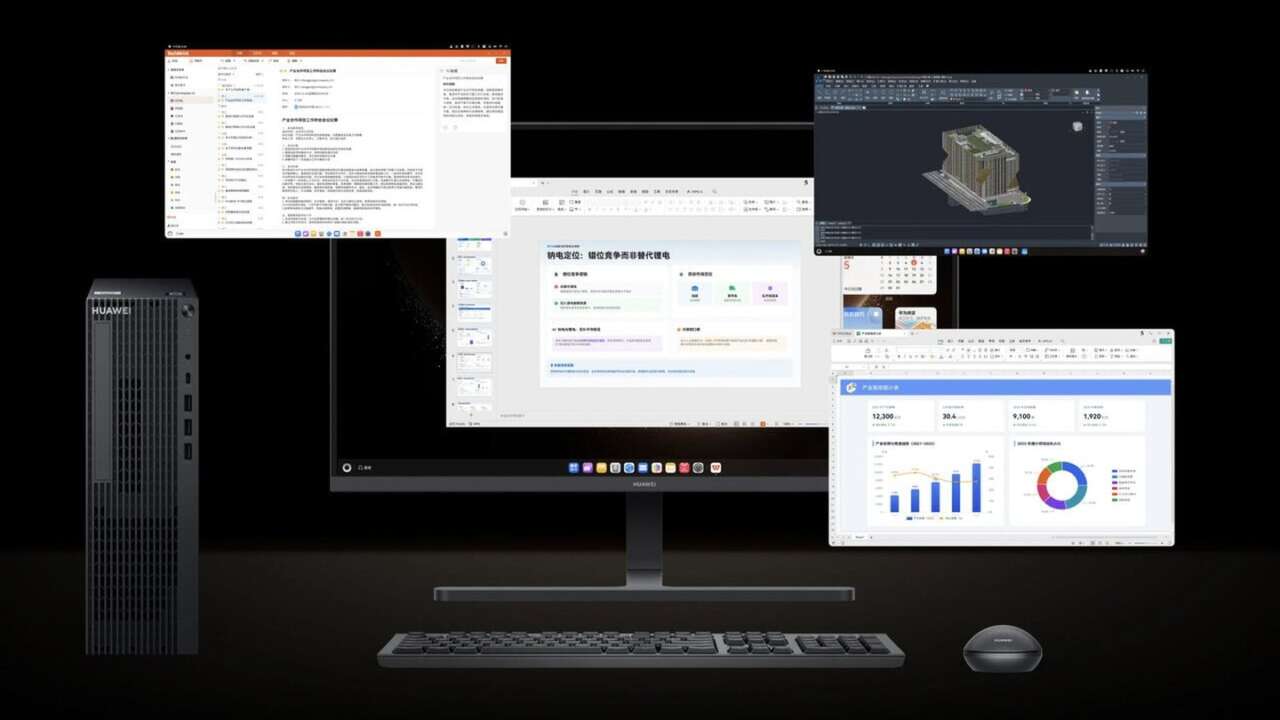
Physically it’s a slim black tower, 293 millimeters tall and 93 wide, about 3.6 kilograms in SSD-only trim. The front carries USB-C and three USB-A ports. The back adds four more USB-A, HDMI, DisplayPort and Gigabit Ethernet, and a wired keyboard and mouse come in the box, with a 180-watt power supply inside. It looks like office equipment because it is.
What “100 percent Chinese” actually certifies
The headline claim needs a careful read, because Huawei’s own footnote narrows it. On Huawei’s product page, “domestic” means components produced in China, and Zhejiang Kezheng Electronic Information Product Inspection tested the parts and certified a 100 percent localization rate for both models.
What’s covered is where the parts are made: the processor, the memory, the SSD, the power supply, the board. The inspectors signed off on the full list, and the X90 itself comes out of SMIC’s fabs.
What the certificate doesn’t cover is design. The X90’s cores run on Arm’s instruction-set architecture, licensed from a British company, and the equipment that prints advanced chips still leans on foreign suppliers. Huawei designed the processor, the board and the operating system. The certificate says where everything was made, and that is all it says. None of that makes the machine less real. It makes the certificate a narrower document than the headline built on it.
Read as a manufacturing claim, it holds up. Read as total independence, it doesn’t.
HarmonyOS grows up into a desktop
The HM650 is the first desktop to ship with HarmonyOS, in its V1.0 enterprise build, certified to the same Level II security-and-reliability standard as the chip. It’s built for fleet life: central device management, permission control, and two isolated workspaces on one machine, one for internal networks and one for everything else.
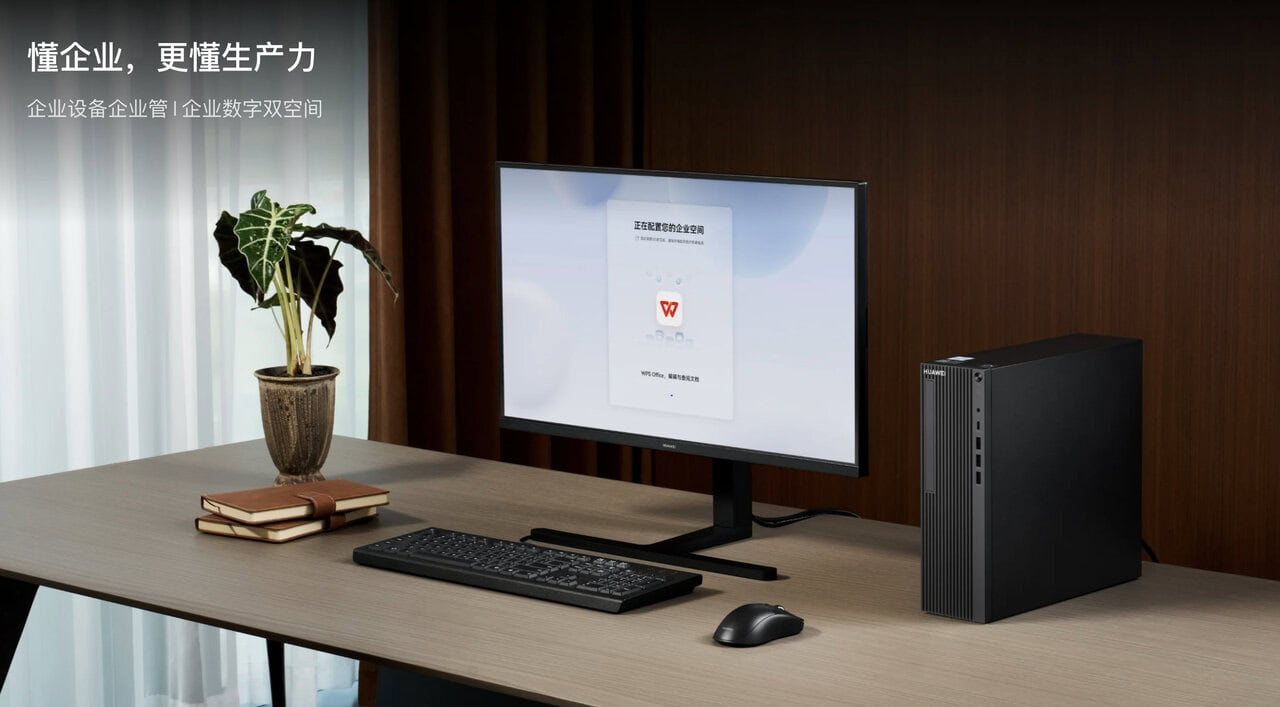
Huawei’s Xiaoyi assistant is baked in, drafting documents, summarizing research and transcribing meetings, with a dedicated key for it on the keyboard. The SSD is encrypted at the chip level, and the Star Shield 2.0 framework watches for AI-swapped faces and altered voices on calls. Some of the assistant’s features need a network connection and a paid subscription.
Huawei also claims its tuning lifts overall performance 15 percent over the previous generation, and that its memory compression keeps 40 percent more large files open at once. Both are Huawei lab numbers. Nothing outside Huawei has tested them.
The desktop is the third leg of a fast build-out. HarmonyOS laptops arrived last year, Huawei says shipments of HarmonyOS computers have passed a million, and the MateBook Fold S we covered last night folds the same software into a PC that fits in a coat pocket. The HM650 is the office-bound end of the same push.
Sold to the state, not to you
Huawei sells the series through government and enterprise channels in China, and its online store lists general sales starting December 1. There’s no retail shelf stock and no sale planned outside China.
Huawei Qingyun HM650
Kirin X90, 10 cores, 20 threads · 16GB LPDDR5 memory · 512GB SSD
Price: about $1,080 in China
Where to buy: More details at Huawei
As a product, the HM650 is easy to file away: a plain black office tower with an unbenchmarked chip.
As a signal, it’s harder to ignore. A complete desktop stack with no Intel, no AMD and no Microsoft in it is now a shipping, certified product, bought by the largest office customer on the planet. The Wintel PC spent forty years as the default. In China’s government offices, it just stopped being one.