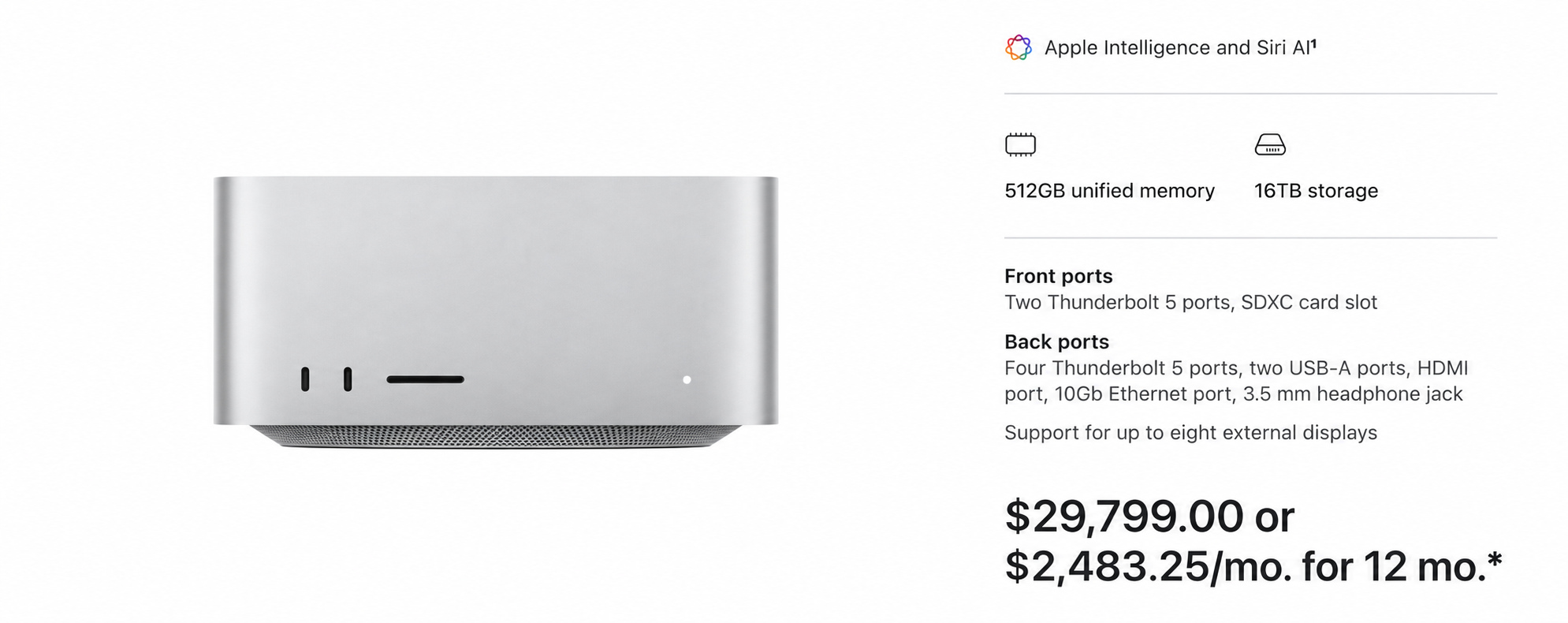
Apple apparently thinks money grows on trees. Apples do, so perhaps somebody in Cupertino decided the same harvesting schedule should apply to your bank account. Configure an M5 Ultra Mac Studio with 512GB of unified memory and a 16TB SSD, and Apple’s U.S. store asks for $29,799. That buys the computer, not an orchard.
The number that bothers me more is $4,000. That’s the jump from 96GB to 256GB of unified memory on the M5 Ultra. For my workload, 128GB is the sweet spot. Apple’s Ultra configuration menu skips it entirely, leaving anyone who needs more than 96GB to buy a much bigger memory upgrade.
Price: Mac Studio with M5 Ultra from $5,499; 512GB/16TB configuration $29,799, U.S. pricing before tax.
Where to buy: Apple
The missing middle is the expensive part
The entry M5 Ultra configuration has a 30-core CPU, 64-core GPU, 96GB of unified memory and a 1TB SSD for $5,499. Keep that chip and storage, select 256GB, and the price becomes $9,499. Same computer configuration apart from memory. Four thousand dollars more.
My screenshots show the same $4,000 jump with a 2TB SSD selected: $5,999 with 96GB, then $9,999 with 256GB. The extra storage changes both totals, not the memory premium.
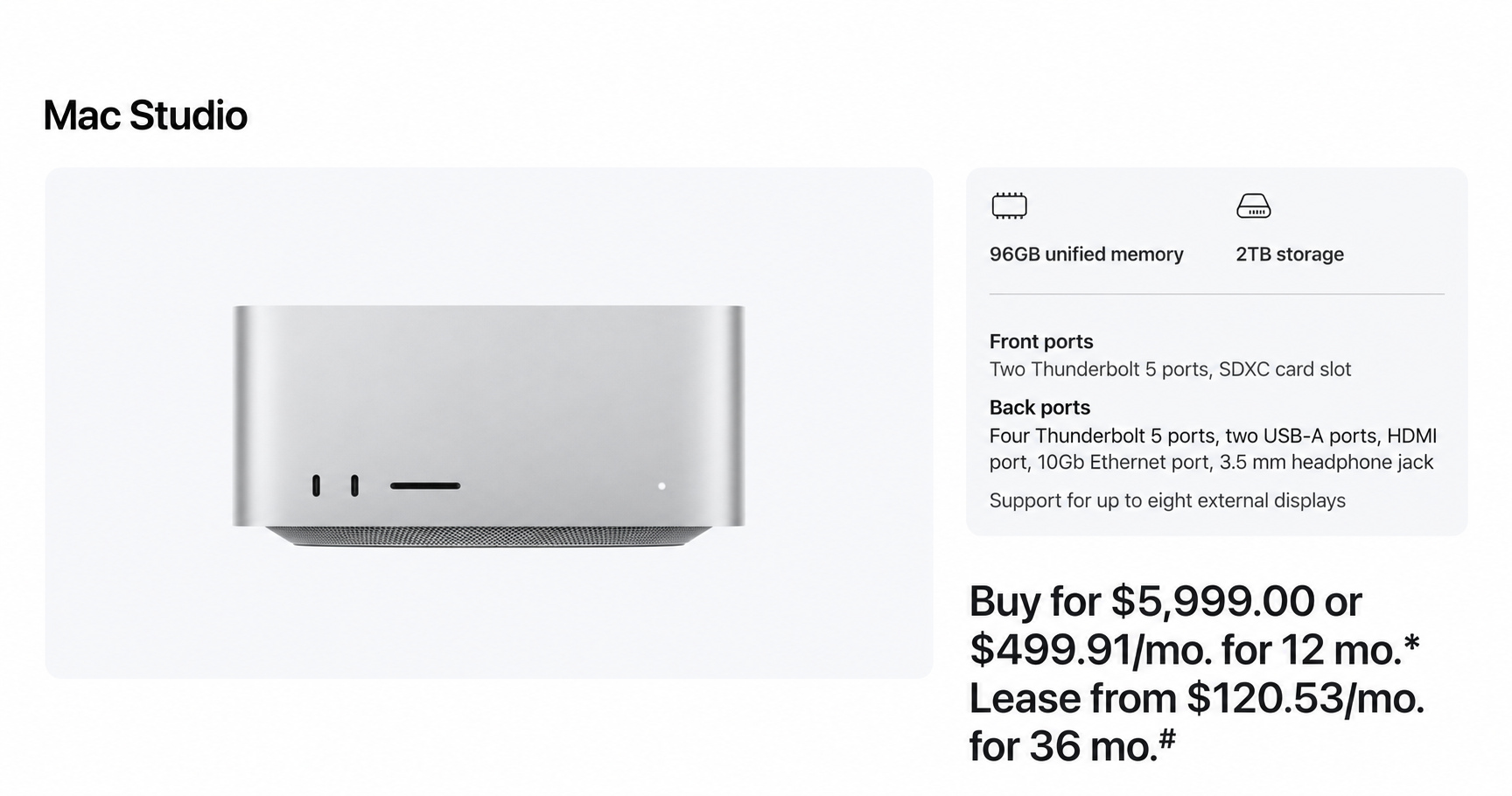
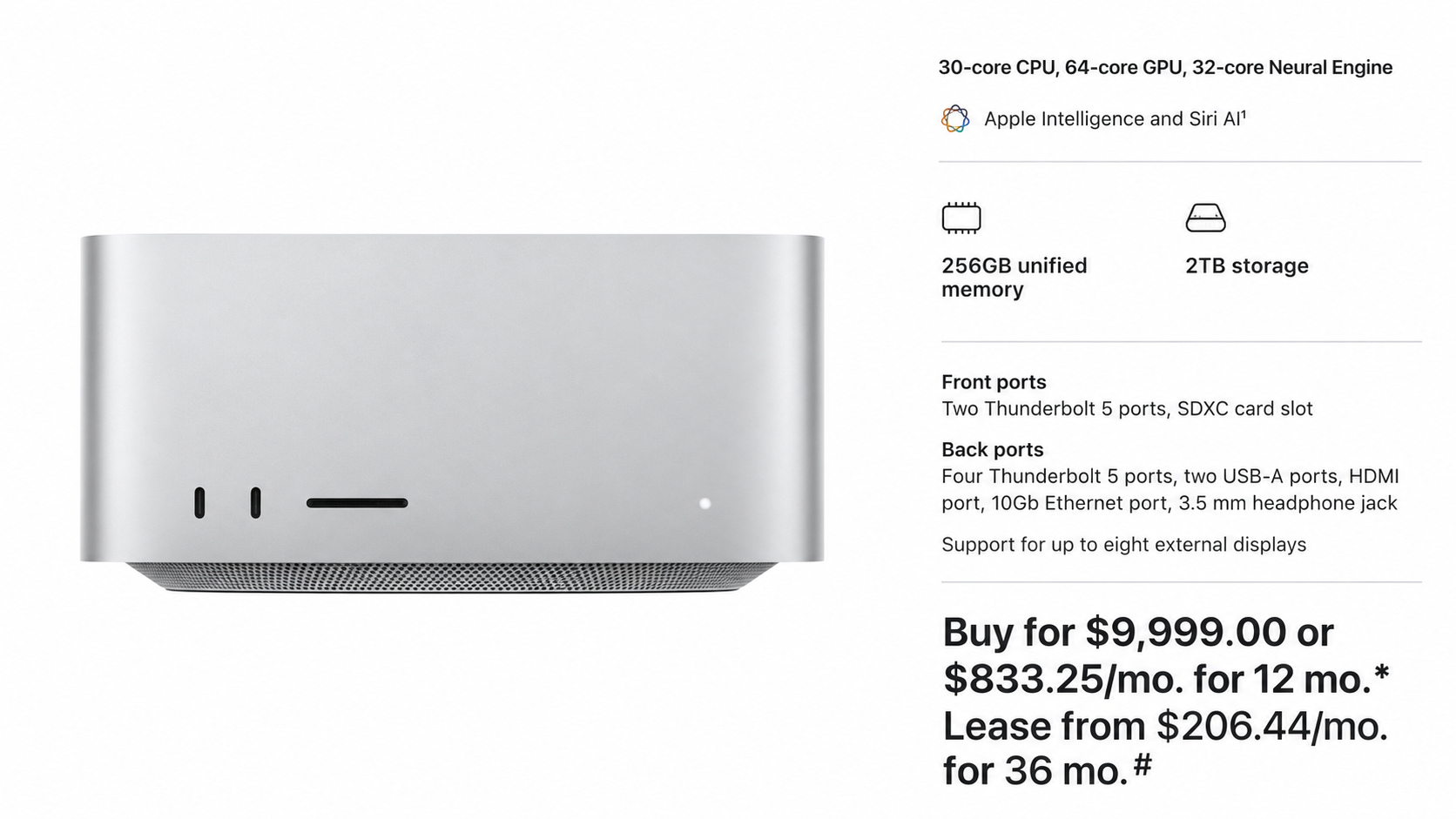
There’s no 128GB option on the M5 Ultra menu. No 192GB step, either. Your choices are 96GB, 256GB and, with the higher-tier chip, 512GB. If 96GB falls short of the job you want to run, the next available capacity is 160GB higher. Apple has made the staircase admirably simple by removing the middle steps and putting a cash register at the top.
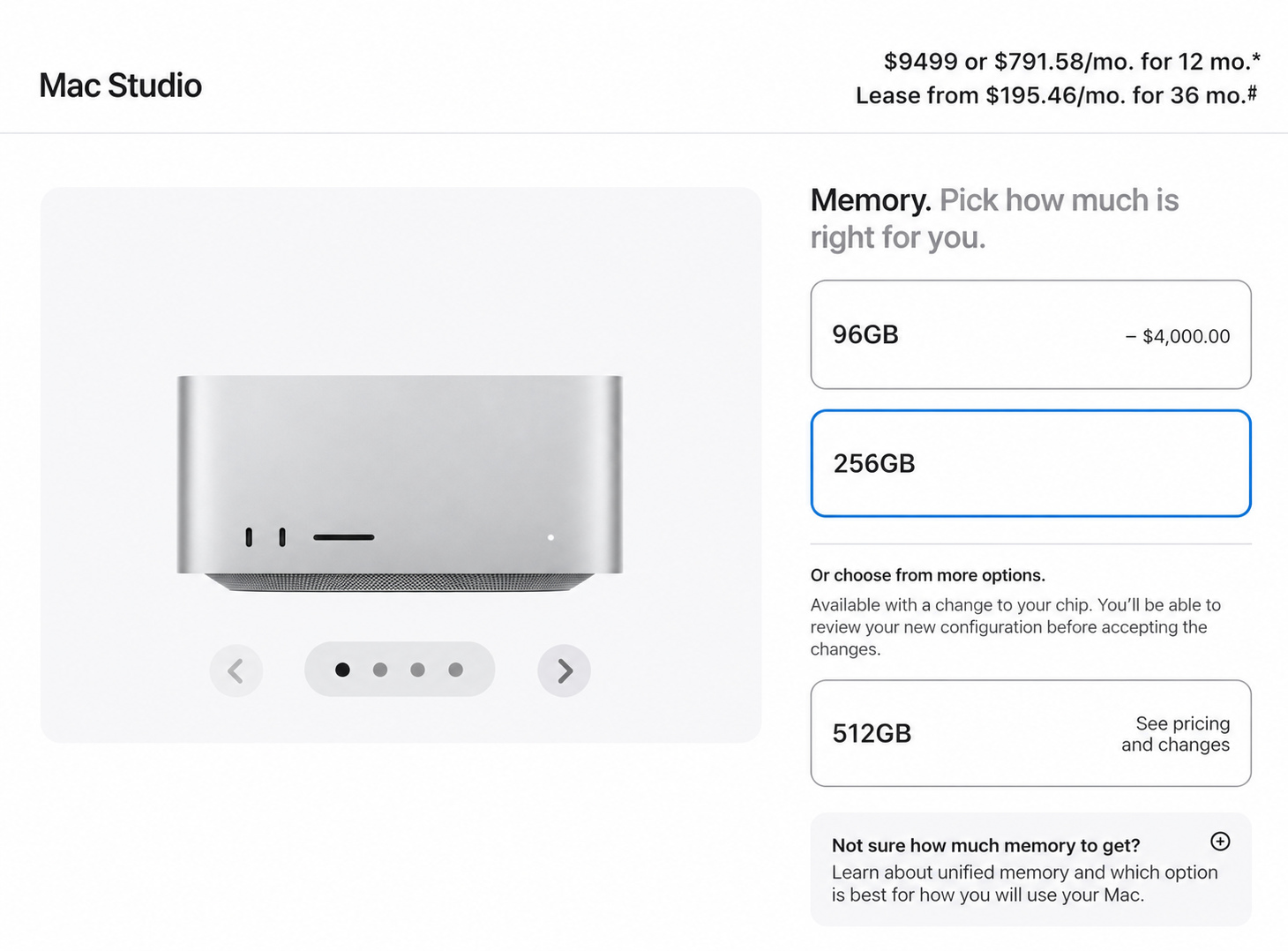
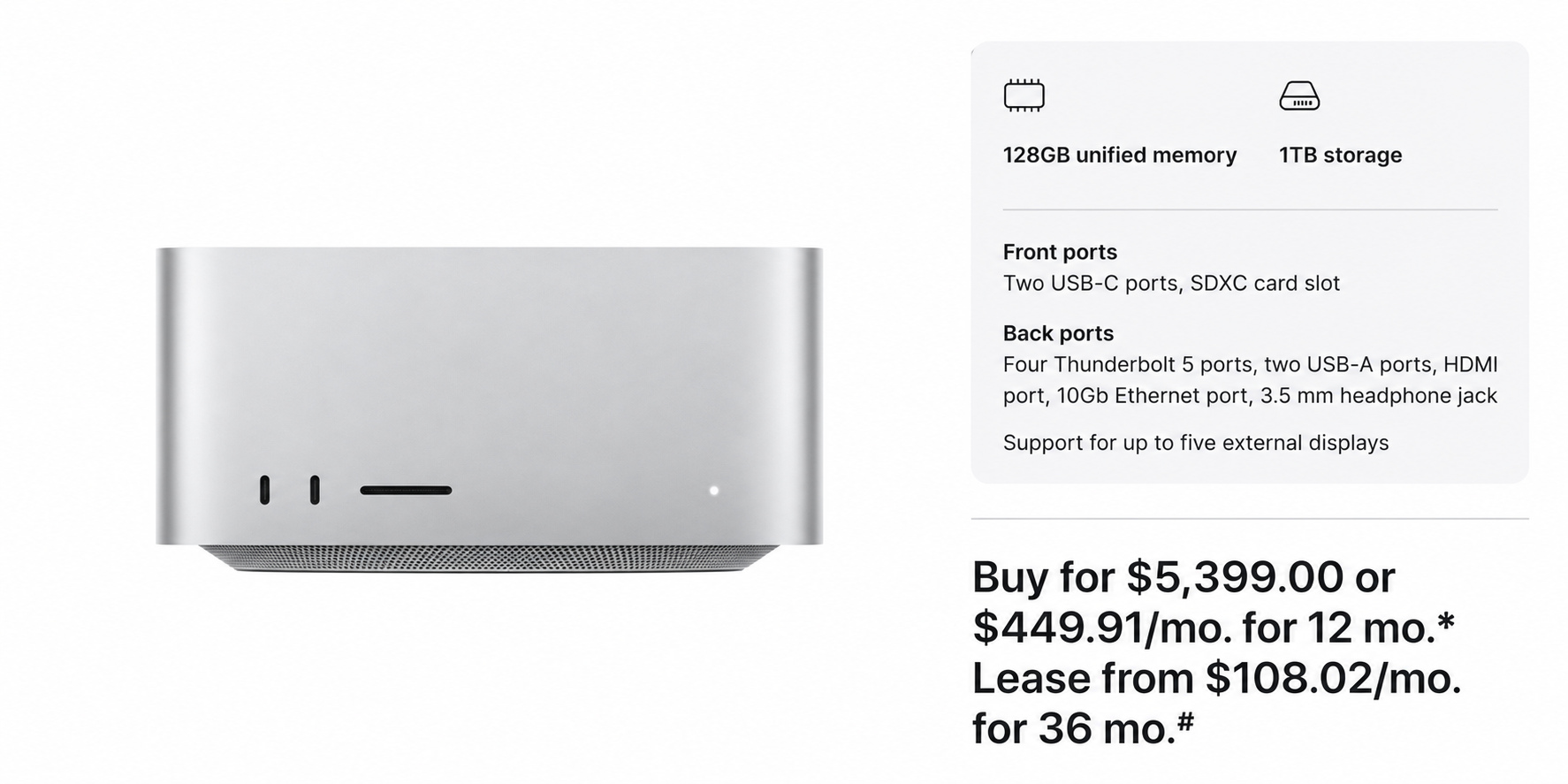
I want the Ultra, but not at 256GB pricing. That’s why the 128GB omission gets under my skin. I’m not asking Apple to sell me the maximum amount of memory it can fit into this box. I want the chip I’ve chosen with the memory capacity that fits my work. I’d pay the premium for the Ultra chip and, given the choice, another $2,000 for 128GB rather than $4,000 for 256GB. That’s the configuration I wish Apple sold, not an option on its order page.
Apple does offer 128GB in a Mac Studio, but on the M5 Max with the 18-core CPU and 40-core GPU. That is a different chip configuration, not the missing 128GB M5 Ultra. If you specifically want the Ultra’s capabilities and more than 96GB, choosing the Max isn’t simply checking a cheaper memory box.
Then the memory upgrade costs more than the computer
The 512GB option requires the M5 Ultra with a 36-core CPU and 80-core GPU. That chip configuration costs $6,799 with 96GB of memory and a 1TB SSD. Moving from 96GB to 512GB adds $15,500.
That is the memory upgrade alone. The resulting computer costs $22,299 with its 1TB SSD still in place. The upgrade costs more than twice the $6,799 computer it goes into. Somewhere, a perfectly innocent dropdown menu has become a financial event.
There is a lot of memory here, and these figures describe unified memory shared across the system, not a pile of ordinary desktop RAM sticks you can substitute from another retailer. The capacity is real. So is the requirement to pay Apple’s configured price if this is the combination you need.
Storage would like a word with your wallet
The SSD menu adds another $7,500 to move from 1TB to 16TB. Add that to the $22,299 configuration and the total becomes $29,799.
Here’s how the bill builds:
| M5 Ultra configuration | Unified memory | SSD | U.S. price |
|---|---|---|---|
| 30-core CPU / 64-core GPU | 96GB | 1TB | $5,499 |
| Same chip, memory upgrade | 256GB | 1TB | $9,499 |
| 36-core CPU / 80-core GPU | 96GB | 1TB | $6,799 |
| Same higher-tier chip | 512GB | 1TB | $22,299 |
| Same higher-tier chip, maximum SSD | 512GB | 16TB | $29,799 |
These are hardware configuration prices, before tax and without adding a display or accessories. The maximum configuration is not the starting price of a Mac Studio. It is what happens when you keep selecting the largest number until the store gives your accountant something to do.
Powerful hardware, remarkably confident pricing
The M5 Ultra combines 1.2TB/s of memory bandwidth with up to 512GB of unified memory. That capacity can accommodate large AI models locally.
The Ultra is a beast on paper, and Apple’s own tests make an impressive pitch. Its performance charts claim up to 8.2 times the text-to-image performance of M1 Ultra, using a 12-billion-parameter model and the MLX framework. Apple also claims up to 1.8 times the performance of M3 Ultra in Cyberpunk 2077: Ultimate Edition, with the ultra preset, ray tracing on and MetalFX set to balanced at 2560 by 1400.
Those July 2026 tests used a preproduction 36-core/80-core M5 Ultra with 512GB of memory and an 8TB SSD. The M3 Ultra comparison system had 32 CPU cores, 80 GPU cores and 512GB; the M1 Ultra had 20 CPU cores, 64 GPU cores and 128GB. All used 8TB SSDs and an attached 5K display. These are Apple’s workload-specific results, not a promise that every application gets the same multiplier.
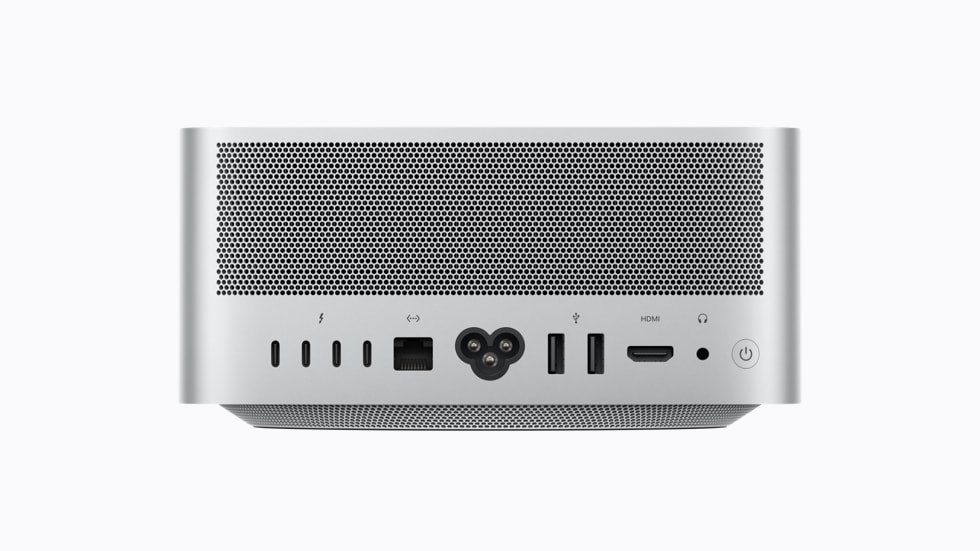
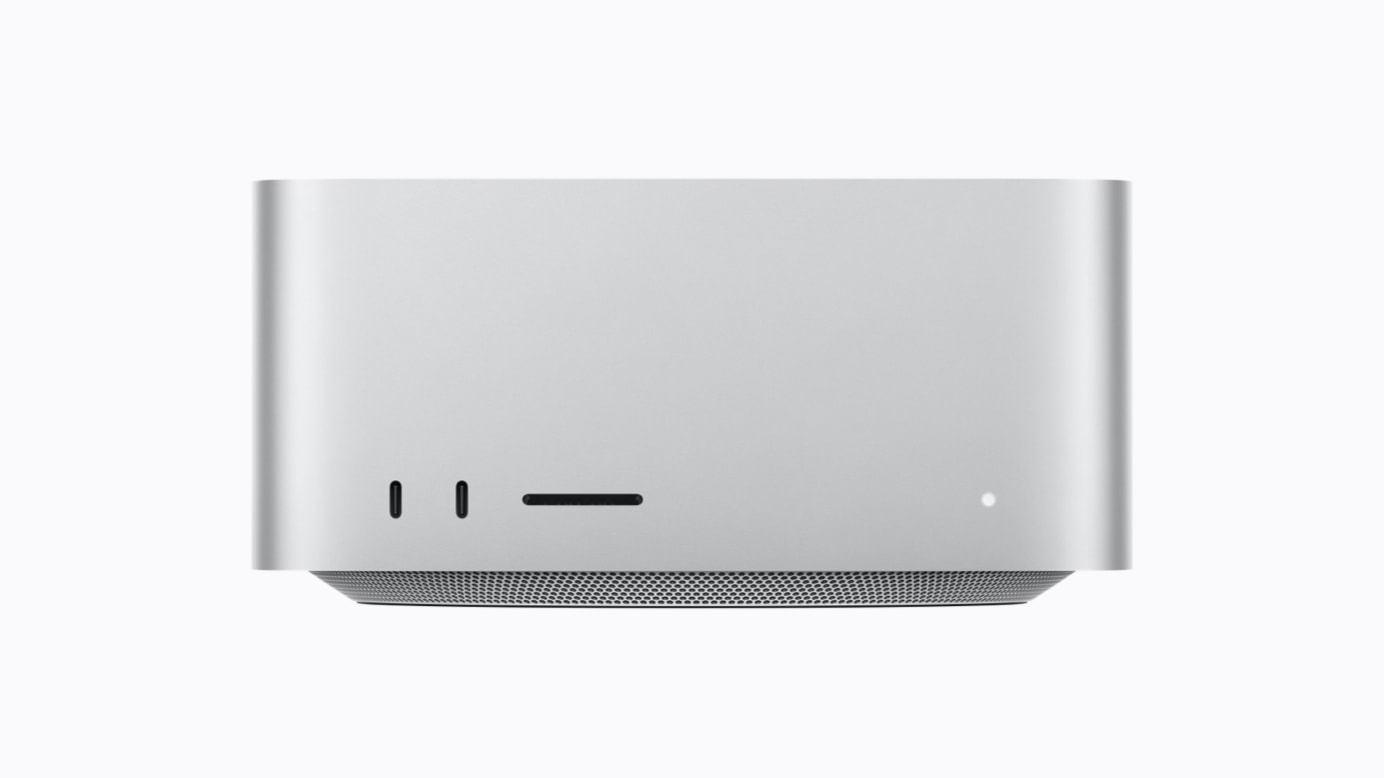
There’s substantial connectivity, too: four Thunderbolt 5 ports at the rear, plus two more at the front on M5 Ultra. The M5 Max has two front USB-C ports rated up to 10Gb/s instead. Both put an SDXC card slot up front.
We covered the broader Mac Studio and Mac mini announcement when Apple introduced these machines.
Price: Mac Studio with M5 Ultra from $5,499; 256GB/1TB from $9,499; 512GB/16TB $29,799, U.S. pricing before tax.
Where to buy: Apple
Apple can build an extraordinarily capable little computer. It can also make a missing 128GB option feel like the most expensive thing in the box. If money really does grow on trees, Cupertino clearly expects you to bring your own orchard.