Running large AI models locally creates a problem ordinary mini PCs were never designed to solve: memory. Even a powerful graphics card can run out of VRAM, forcing developers to use smaller models, heavier quantization, cloud services, or a larger workstation.
Price: 6.399,00 € (About $7,442)
Where to Buy: ACEMAGIC
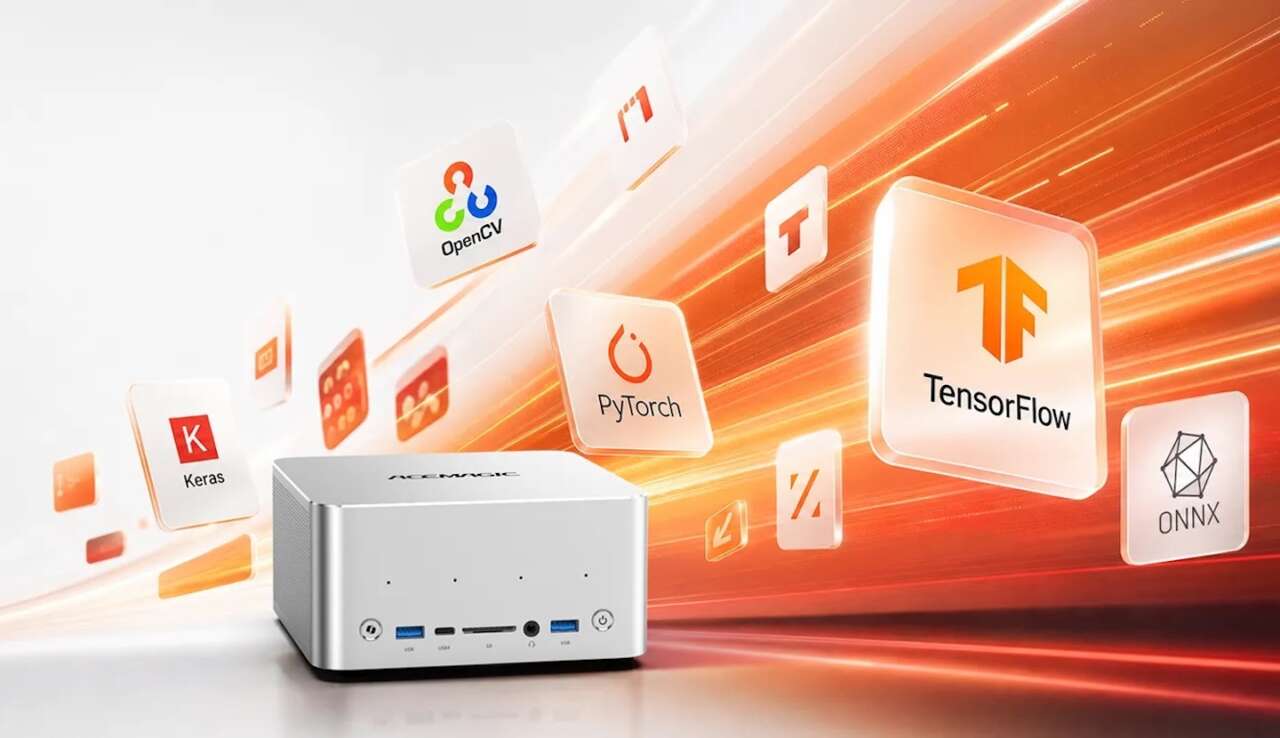
The Acemagic F9A Pro 495 is built around that bottleneck. This roughly 2-liter PC pairs AMD’s Ryzen AI Max+ PRO 495 with 192GB of LPDDR5X-8533 unified memory. Acemagic lists the 192GB/2TB configuration for €6,399 on its European store; its US listing estimates shipping in late October.
That is serious workstation money. The reason to pay it isn’t simply that the F9A is compact. It’s that its shared memory pool gives the CPU and integrated graphics access to far more memory than most mini PCs can offer.
The 192GB memory pool is the real upgrade
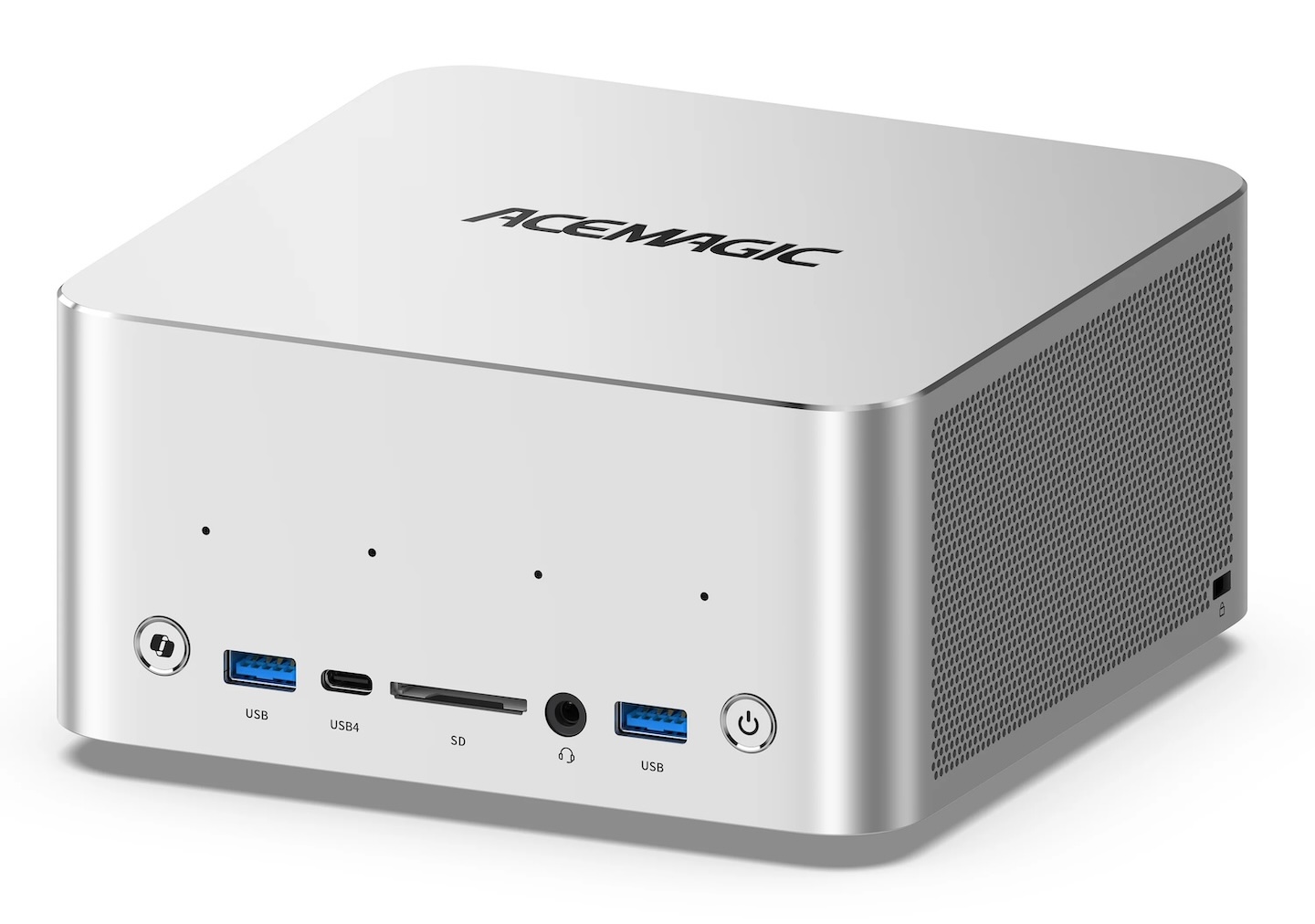
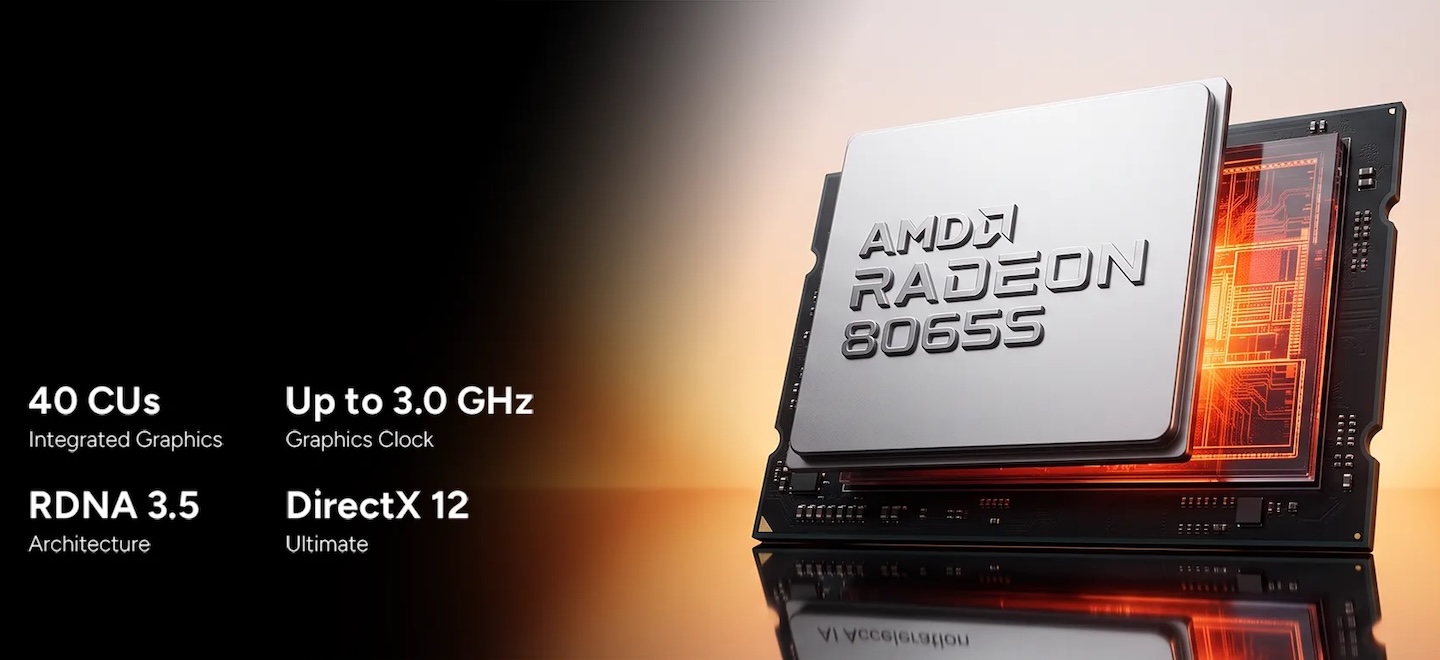
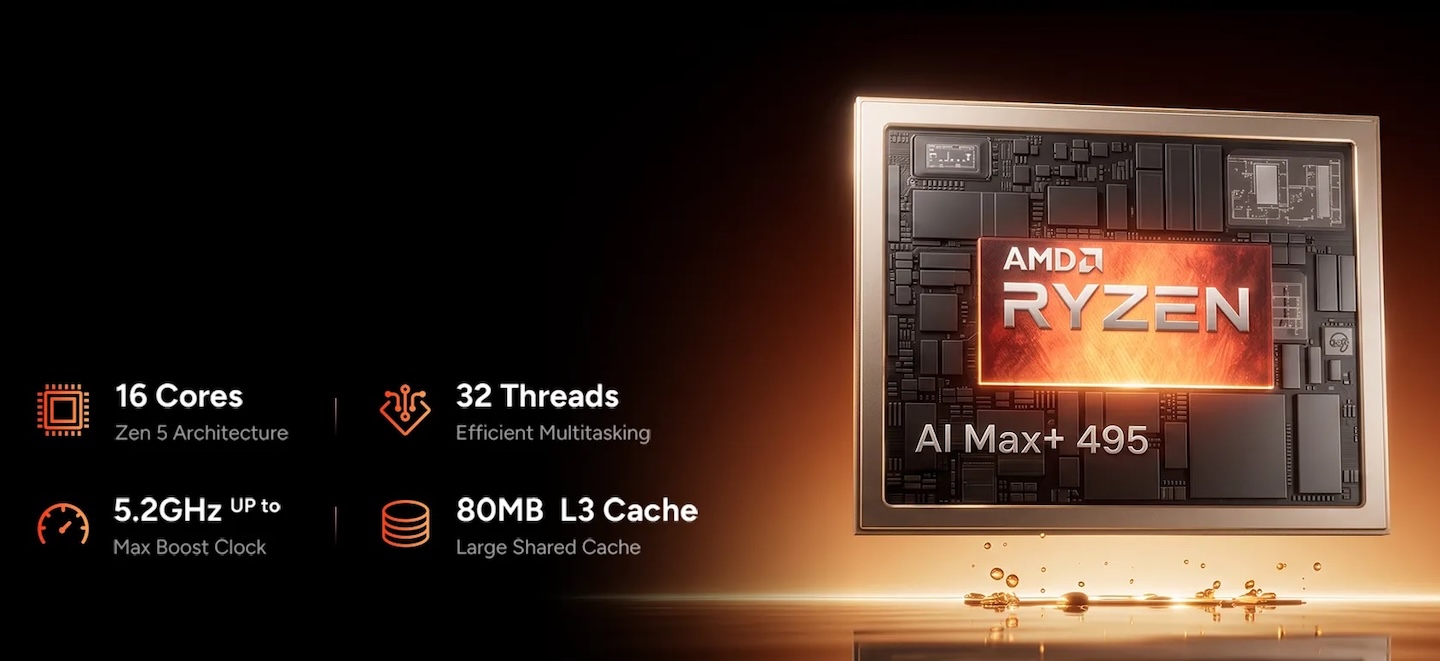
The Ryzen AI Max+ PRO 495 has 16 Zen 5 cores and 32 threads, with boost speeds up to 5.2GHz. Its integrated Radeon 8065S graphics have 40 compute units and run at up to 3.0GHz. AMD also specifies an XDNA 2 NPU capable of up to 55 TOPS, with total platform AI performance of up to 131 TOPS.
Those figures are impressive, but memory capacity is what makes the F9A unusual. AMD supports up to 192GB of LPDDR5X-8533 on the PRO 495, and Acemagic says up to 160GB can be allocated to graphics workloads.
That matters for local AI because a model has to fit somewhere. A discrete GPU may run some workloads much faster, but if a model exceeds its VRAM, using that speed can require offloading part of the workload or splitting it across devices. The F9A doesn’t eliminate the trade-off between capacity and speed. It shifts it.
Acemagic claims support for huge models
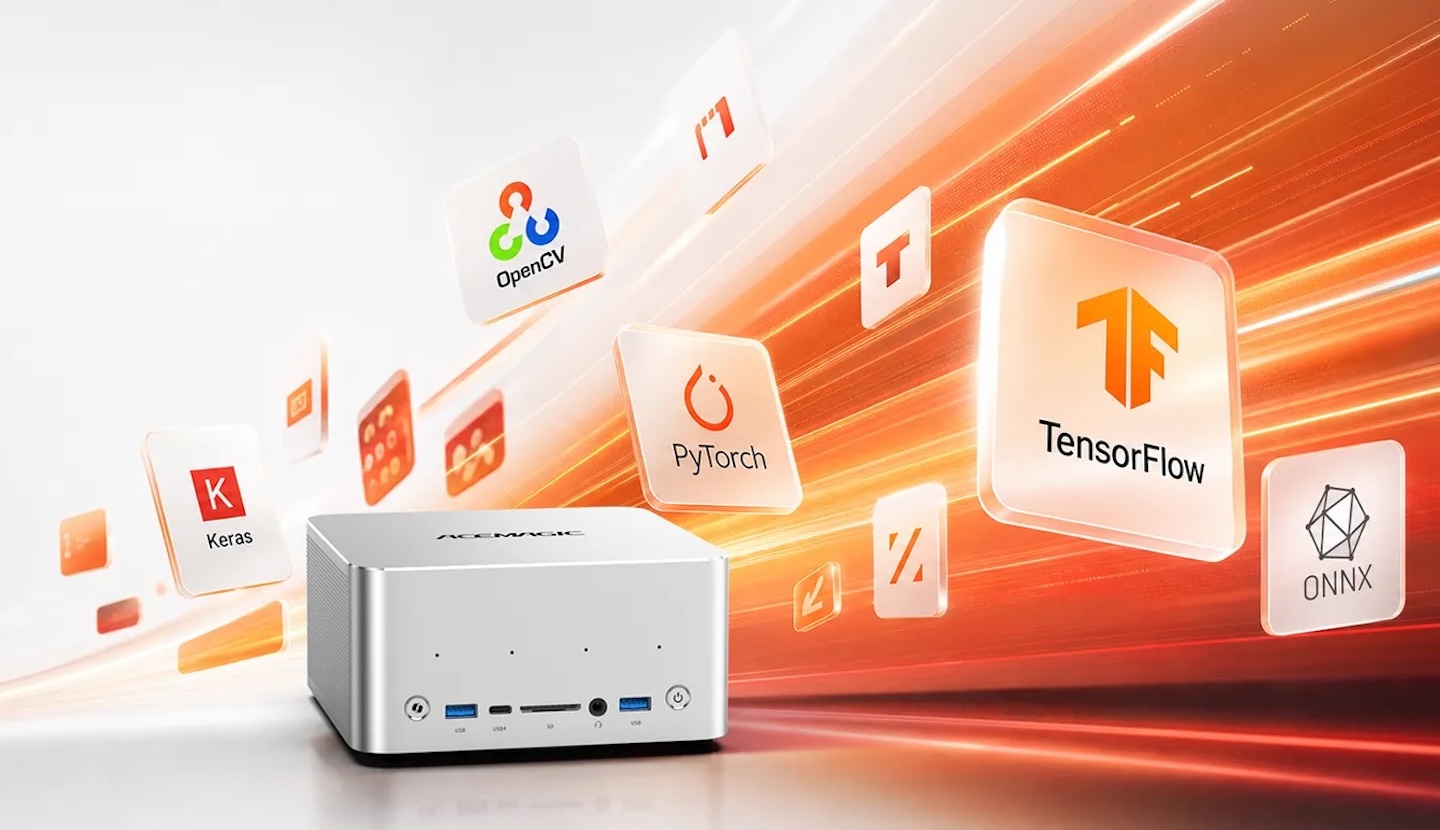
Acemagic positions the F9A Pro 495 for local large language model inference and says it can support models in the 70B-to-200B-parameter range. The company also cites a demonstration running DeepSeek V4 Flash, a 284-billion-parameter model.

Those claims need context. Loading a model into memory isn’t the same as running it at a useful speed. Results depend on quantization, software, context length, memory bandwidth, model architecture, and how work is divided between the CPU and GPU.
AMD says allocating up to 160GB to graphics can provide enough capacity for models above 300 billion parameters at 4-bit quantization. That describes what may fit in memory; it isn’t a tokens-per-second benchmark.
We have not seen independent, model-specific performance results for the retail F9A Pro 495, so its practical speed with very large models remains an open question.
A workstation in roughly two liters
The F9A measures 158.5 × 158.5 × 81.5mm, giving it a volume of approximately 2.05 liters. It weighs about 1.4kg. Acemagic specifies an aluminum, ABS, and polycarbonate housing with five heat pipes and a 3D airflow cooling system designed to sustain a 120W TDP.
Sustained-load testing will matter here. Long AI, rendering, or compilation jobs can put a compact cooling system under pressure, so we don’t yet know how well the F9A maintains performance, or how loud it gets, during extended use.

Its space-saving advantage is less uncertain. The F9A can sit beside a monitor or fit into a crowded development setup without demanding room for a tower PC.
Ports and expansion
The F9A includes two USB4 Type-C ports rated at up to 40Gbps, HDMI 2.1, DisplayPort 2.1, three USB 3.2 Gen 2 Type-A ports, a USB 2.0 port, an SD card reader, separate audio connections, dual 2.5Gb Ethernet, Wi-Fi 7, and Bluetooth 5.4.
OCuLink provides a PCIe 4.0 x4 connection for compatible external hardware, including graphics enclosures. That offers a potential expansion path if the integrated Radeon 8065S becomes the performance bottleneck.
For storage, Acemagic specifies two M.2 2280 PCIe 4.0 x4 slots supporting up to 8TB in total. The LPDDR5X memory, however, is soldered onboard and cannot be upgraded later.
The PRO 495 is about capacity
The PRO 495 doesn’t make the F9A dramatically faster on paper than a Ryzen AI Max+ 395 version. Both processors have 16 Zen 5 CPU cores and 40 graphics compute units. The PRO 495 raises the maximum CPU boost clock from 5.1GHz to 5.2GHz, the GPU clock from 2.9GHz to 3.0GHz, and NPU performance from 50 to 55 TOPS.
The consequential difference is memory: the 395 supports up to 128GB, while the PRO 495 supports up to 192GB, with as much as 160GB available for graphics allocation. That extra capacity changes which workloads can fit locally. For office work, browsing, gaming, and most creative projects, it will be excessive.
Who is the F9A Pro 495 for?
The F9A Pro 495 makes the most sense for someone who already knows why 128GB isn’t enough. That could include developers running large local models, professionals managing multiple virtual machines or containers, researchers working with memory-heavy datasets, and creators handling unusually large projects.
For those buyers, 192GB of shared memory in such a compact PC is a distinctive proposition. For everyone else, the €6,399 European price is difficult to justify.
Price: 6.399,00 € (About $7,442)
Where to Buy: ACEMAGIC
The F9A Pro 495 is a specialized answer to a memory problem, not a shortcut to the fastest possible AI workstation. If 128GB is already constraining your local models or other workloads, its 192GB shared pool could be valuable. If it isn’t, the price is hard to justify, especially until independent testing shows how well the compact system performs under sustained loads.