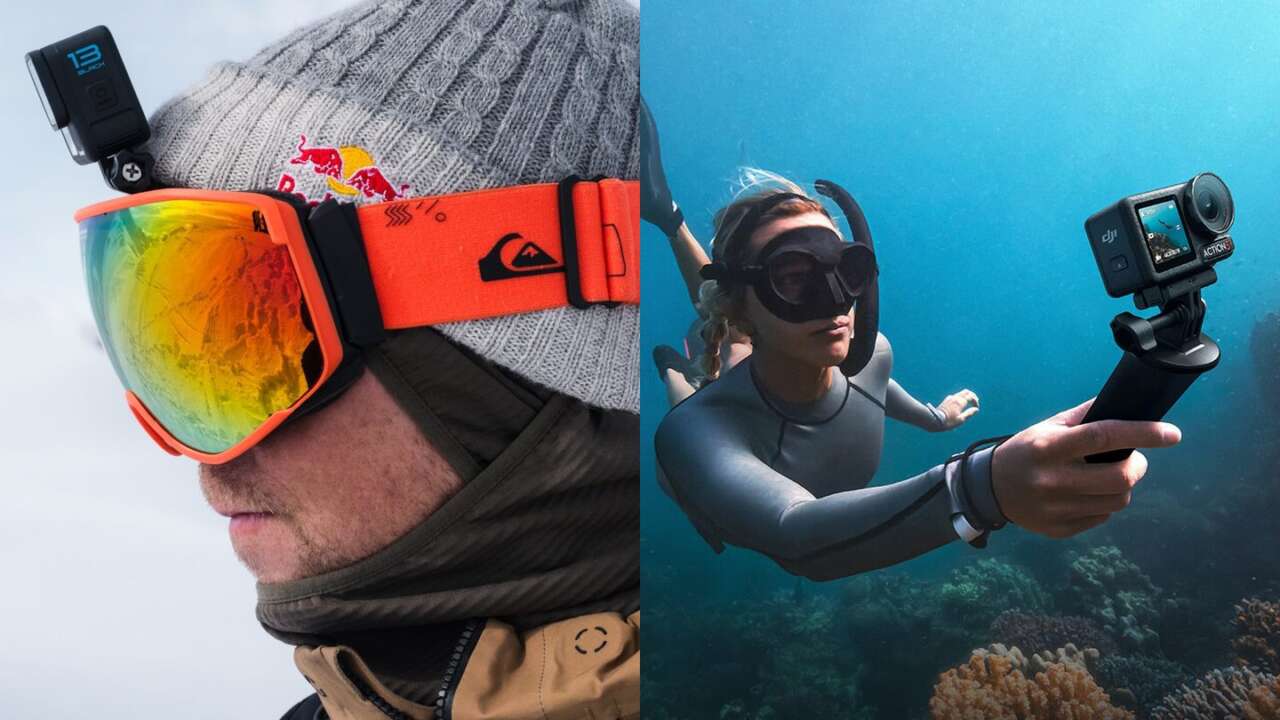
GoPro’s HERO13 Black and DJI’s Osmo Action 5 Pro chase the same buyer with opposite priorities. GoPro spends on resolution and swappable lenses, while DJI spends on battery life, depth and a lower price.
The gap between them is $110 today, and the spec sheets split just as cleanly. DJI records for longer, dives deeper and weighs less, though its video tops out at 4K while the GoPro reaches 5.3K. Neither camera pairs its headline feature with a weak sensor.
Black Friday season makes the pairing timely, since action cameras are gift purchases as often as personal ones.
GoPro HERO13 Black makes the resolution and lens case
GoPro records 5.3K video at 60 frames per second, 4K at 120 and 1080p at 240, from a 1/1.9-inch sensor that also shoots 27MP stills. HyperSmooth 6.0 handles stabilization, and Burst Slo-Mo reaches 400 frames per second at 720p for 15 seconds at a time.
The tall sensor shoots an 8:7 frame with a 156° field of view, so one recording can leave as a wide clip, a vertical clip or a full-frame edit.
GoPro HERO13 Black
5.3K60 video and 27MP stills · 1900mAh Enduro battery · GPS and Wi-Fi 6 · Waterproof to 33 feet without a housing
Price: $429
Where to buy: Buy on Amazon
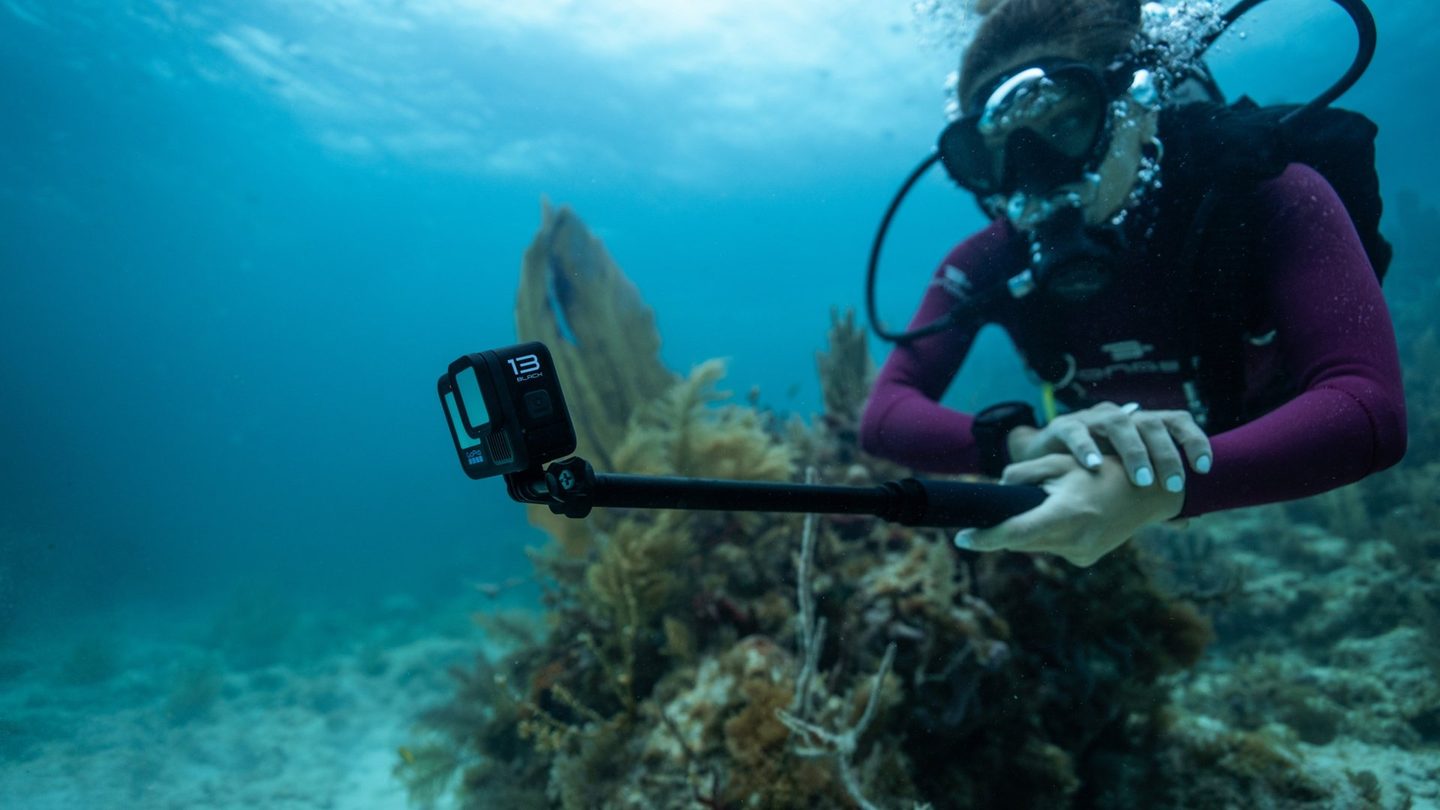
The HB-Series is the GoPro’s clearest separation from DJI. Macro, Ultra Wide and Anamorphic lens mods plus a Smart Motion Blur ND Filter 4-Pack all attach up front, and the camera detects each one and adjusts its settings on its own. Every mod sells separately.
GPS sits inside the spec sheet again, and the Quik app turns that data into speed and altitude overlays on a finished clip. Timecode sync links several HERO13 Black cameras inside the app for multi-camera edits, while Bluetooth audio support pairs AirPods and other wireless mics for interviews and narration.
Color runs deep here, since HLG HDR, 10-bit color and GP-Log encoding give editors a wider file.
Waterproofing stops at 33 feet without a housing, half the DJI’s bare-camera depth.
DJI Osmo Action 5 Pro makes the runtime and depth case
DJI builds the Osmo Action 5 Pro around a larger 1/1.3-inch sensor with 40MP stills, dual OLED touchscreens and a 155° lens at f/2.8. Video tops out at 4K and 120 frames per second, with 240 available at 1080p, and RockSteady 3.0 plus HorizonSteady hold the frame level. Subject tracking keeps a moving subject centered.
DJI Osmo Action 5 Pro Standard Combo
1/1.3-inch sensor and 40MP stills · 1950mAh battery · Dual OLED touchscreens · Waterproof to 20 meters without a case
Price: $319 $349 (save $30, 9% off)
Where to buy: Buy on Amazon
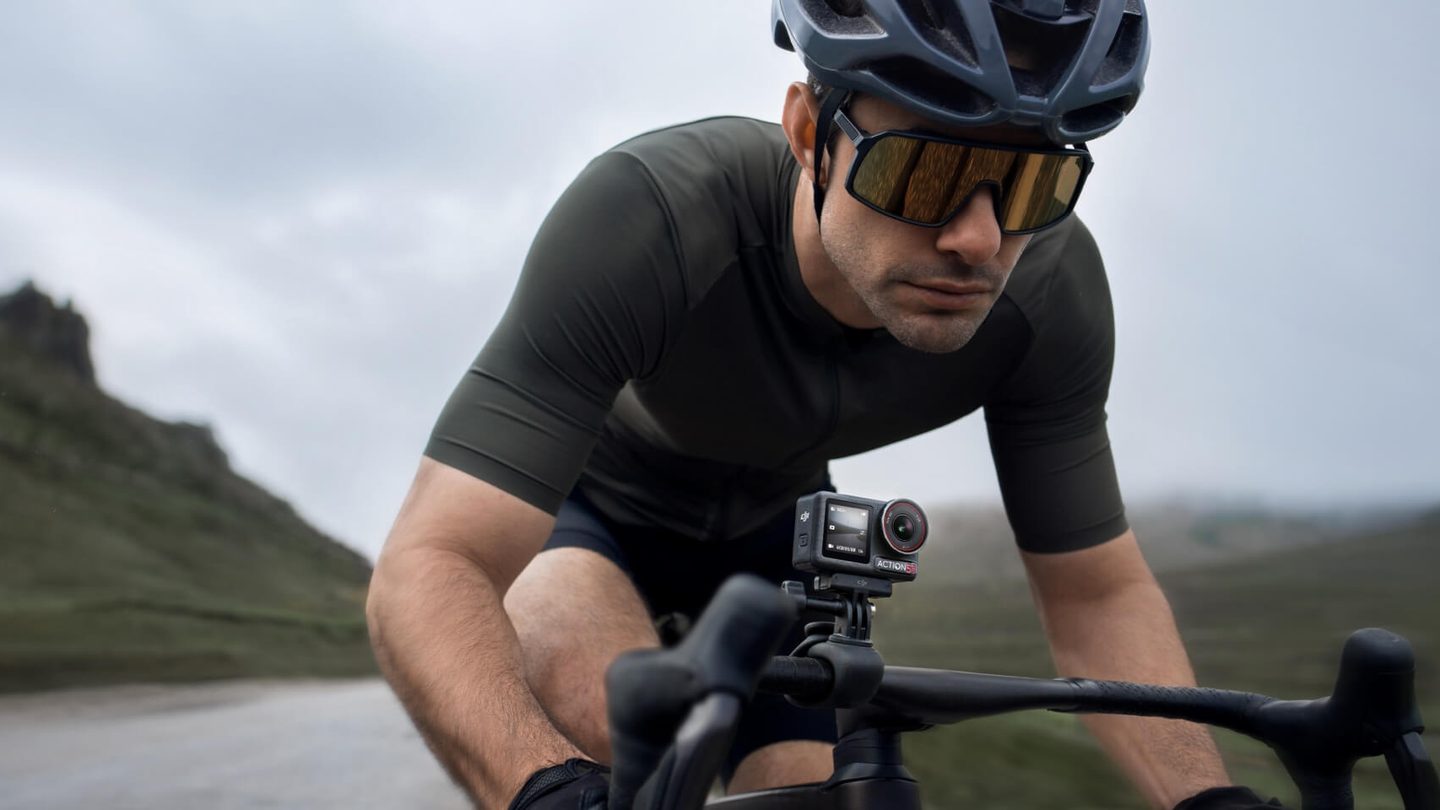
Battery is where DJI pulls away from the pairing. DJI rates the 1950mAh battery at 240 minutes of recording, measured at 1080p/24 with RockSteady on and the screens and Wi-Fi off, against GoPro’s quoted 2.5 hours of continuous recording from a 1900mAh cell. The DJI also carries 47GB of usable built-in storage before a card ever goes in, and the Standard Combo ships one battery in the box.
Underwater, the gap widens further, since the DJI reaches 20 meters without a case and 60 meters with one. Both the camera and the case carry an IP68 rating, and DJI warns against hot springs, extreme underwater environments and corrosive or unknown liquids, so reef and pool work sits well inside its limits.
Three microphones record the audio, and the camera connects directly to DJI microphones for cleaner voice tracks without a receiver riding on the rig. The 1.46-inch front OLED stays readable while you frame yourself, which counts on solo trips where nobody stands behind the camera to check the framing.
Slow motion reaches 240 frames per second at 1080p and 120 at 4K.
Side by side
Side by side, the trade is resolution against endurance. GoPro gives you the sharper file, the lens shelf and GPS data overlays in the Quik app, while DJI gives you the longer day, the deeper dive and $110 back. Our earlier look at five outdoor cameras matched to five jobs splits the wider field by use case, and these two sit at its top end.
| GoPro HERO13 Black | DJI Osmo Action 5 Pro | |
| Max video | 5.3K60 | 4K120 |
| Sensor and stills | 1/1.9-inch, 27MP | 1/1.3-inch, 40MP |
| Battery | 1900mAh Enduro | 1950mAh |
| Rated recording | 2.5 hours continuous | 240 minutes at 1080p/24 |
| Waterproof, no case | 33 feet | 20 meters |
| Weight | 159 g | 146 g |
| Amazon price | $429 | $319 |
The lenses see almost the same scene, at 156° for the GoPro in its 8:7 frame and 155° for the DJI, so framing rarely decides this pairing. Low light might decide it instead, since the DJI’s larger sensor gathers more light per pixel and its SuperNight mode records 4K at 60 frames per second.
Mounts soften a switch for GoPro owners, since the HERO13 Black keeps its folding fingers, adds a 1/4-20 thread and still fits the HERO12 Black protective case and Media Mod. DJI answers with a quick-release adapter mount inside the Standard Combo box, plus a horizontal-vertical protective frame and a curved adhesive base. A magnetic latch mount and a magnetic power cable join the GoPro mounting system this generation as well.
Weight and size land close enough to ignore, at 159 grams for the GoPro and 146 grams for the DJI in bodies within two millimeters of each other on every side. Storage splits them instead, because the DJI records to built-in memory on a cardless day and the GoPro needs a microSD card from the first clip.
The call
Buy the GoPro HERO13 Black at $429 if you crop, reframe and grade your footage, because 5.3K, 10-bit color with GP-Log and the HB-Series lens shelf give an editor more to work with on every clip. Buy the DJI Osmo Action 5 Pro at $319 if your days run long and wet, and keep the $110 difference for the card and mount budget.
Skip both if your phone already covers the family trip and the trailhead, since neither camera fixes shaky storytelling on its own. Between the two, the DJI is the better buy for most weekends. The GoPro is the better tool for anyone cutting footage for an audience.