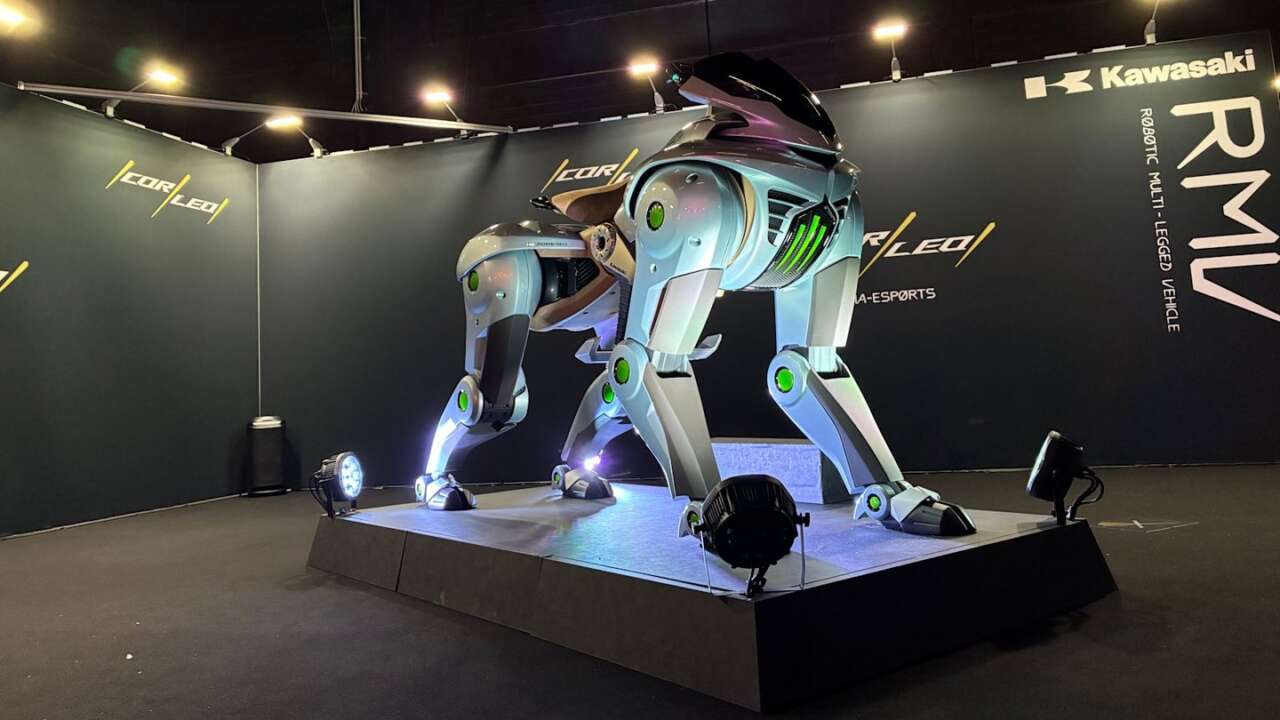
The strangest machine Kawasaki has ever shown is no longer a showpiece. CORLEO, the four-legged hydrogen robot a rider sits like a horse, now runs as an official development program, with a dedicated team reporting straight to Kawasaki’s president and a commercialization target of 2035.
The hardware the public can touch is still a full-scale mock-up, shown most recently at EICMA in Milan. That part hasn’t changed. Everything around it has.
A new category with a president-level team
Kawasaki calls CORLEO an RMV, short for Robotic Multi-legged Vehicle, and pitches it as a new category of personal mobility rather than a motorcycle with extra legs. The logic is corporate as much as mechanical. Kawasaki Heavy Industries builds industrial robots and motorcycles under one roof, and this is the machine that needs both halves at once.
In December 2025 the company stood up a dedicated team, the SAFE ADVENTURE Business Development Team, reporting directly to the president, with commercialization as its whole brief and a 2035 deadline. Concept vehicles don’t usually get that. This one does.
The machine debuted at Expo 2025 in Osaka, where Kawasaki counts roughly 1.2 billion social media impressions for the concept. At gamescom in Cologne in August, around 6,100 visitors sat astride the mock-up in five days. In November it stood at EICMA in Milan, still a mock-up, still not walking anywhere.
No handlebars, no throttle, just weight shifts
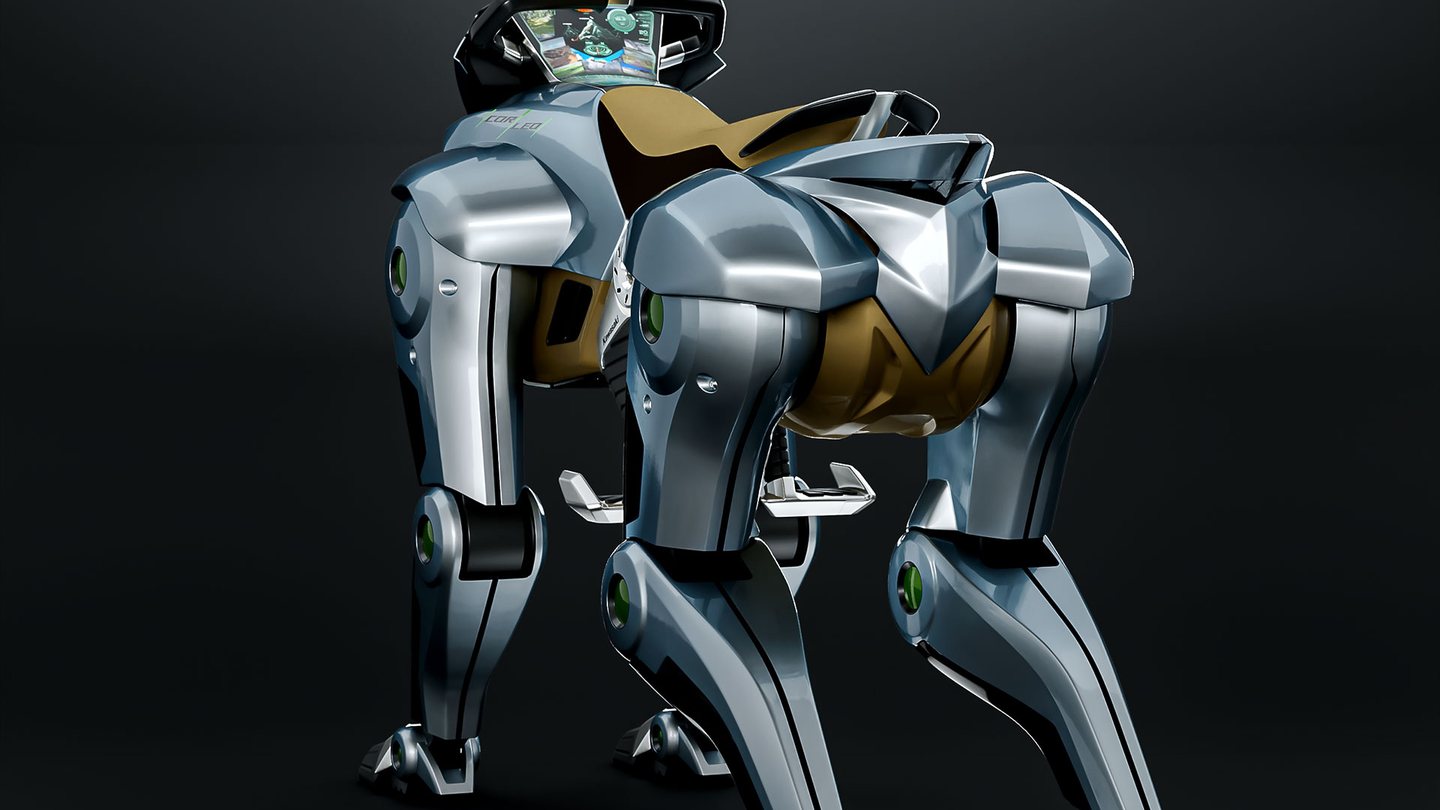
There’s no handlebar, no throttle, and no conventional steering. The rider sits in a saddle and steers by shifting body weight, the way a rider asks a horse to change direction. Stirrups and handholds carry the sensors that read those shifts, and the stirrups adjust their own length to keep the rider’s posture where the machine wants it.
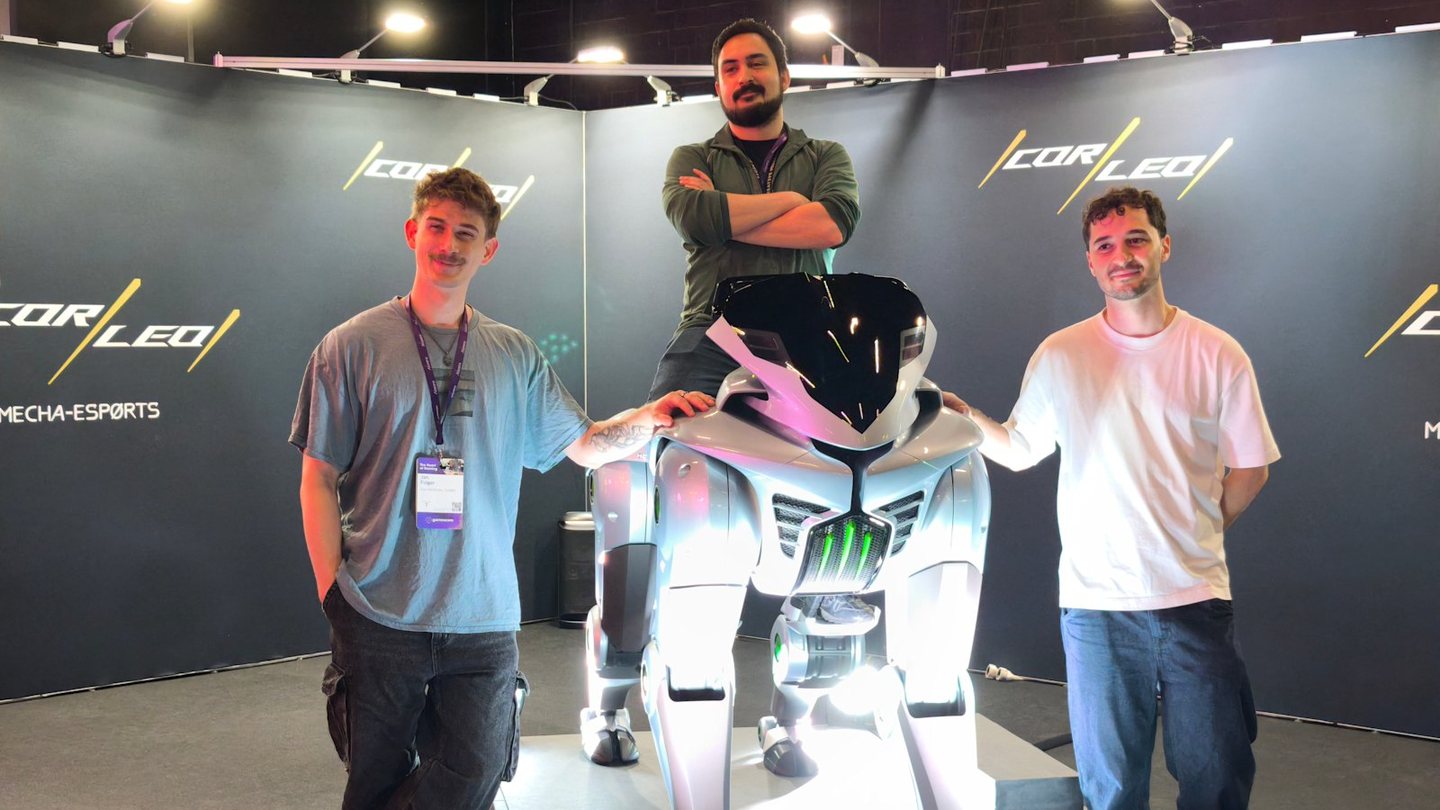
Kawasaki checked the ergonomics with Kobe University’s equestrian club, whose riders sat the clay mock-up and reported back. A horse club, consulted by a motorcycle company, about a robot.
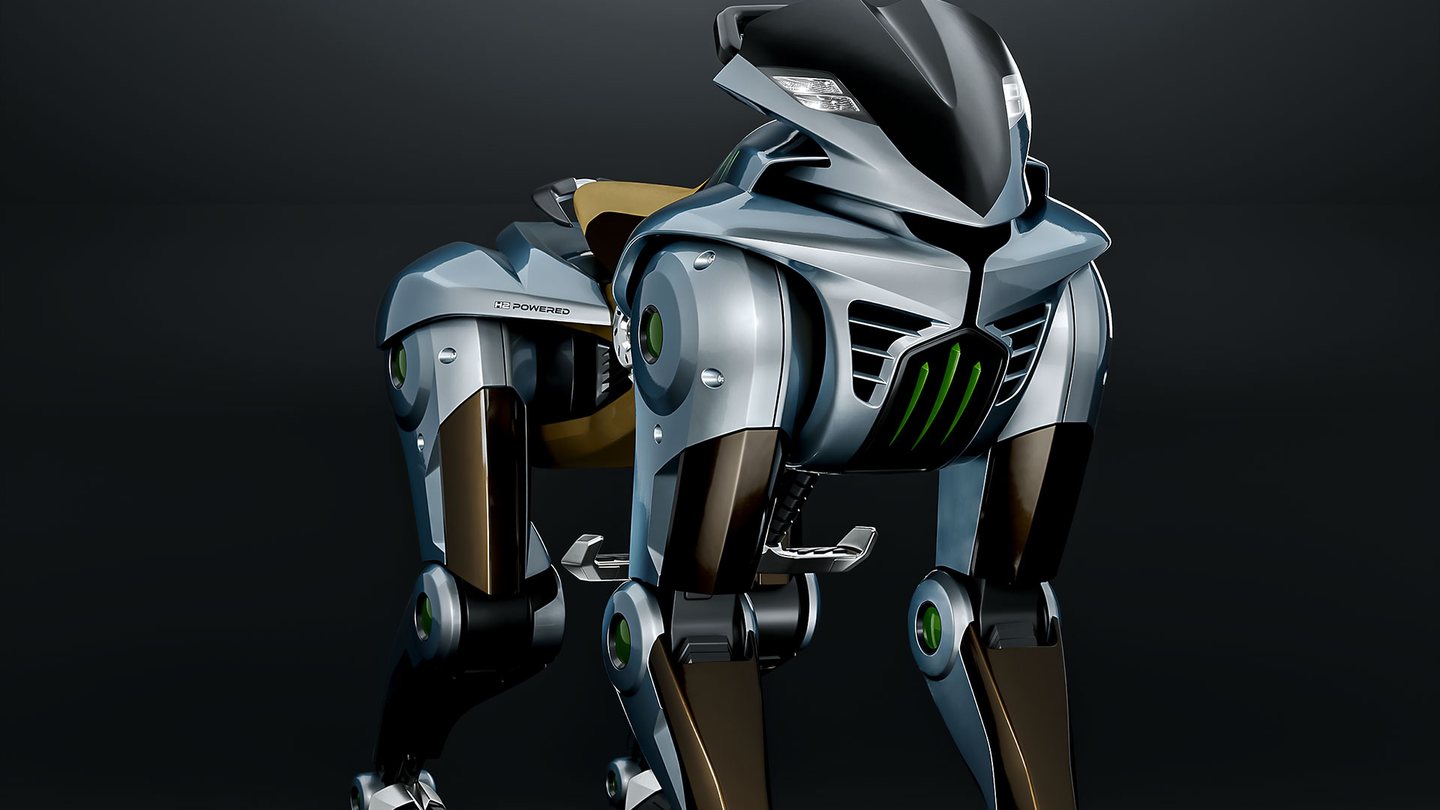
The legs do the work. Each of the four articulates on its own for broken ground, and the rear pair hangs from a swing-arm mechanism borrowed from Kawasaki’s motorcycles. A shaft across the middle of the chassis lets the rear legs swing up and down against the front, absorbing impacts and holding the saddle level on a climb, so the rider keeps eyes on the trail ahead instead of the sky.
The feet are rubber hooves, split left and right like a cloven hoof, shaped to grip grass, rock, and loose gravel. An inertial sensor tracks attitude, a switch flips between riding modes such as walking and running, and the control system can override a weight shift that would put the machine somewhere dangerous.
Kawasaki calls that adaptive shared control.
A 150 cc hydrogen engine that never touches the legs
The engine doesn’t drive the legs. A 150 cc hydrogen-burning unit sits in the body and works as a generator, making the electricity that runs the actuators in all four legs. Kawasaki built it as a series hybrid: engine, generator, inverter, and a battery tucked under the seat.
The engine is a turbocharged two-stroke with direct injection, burning lean to keep nitrogen oxide emissions down. Kawasaki’s technical review sets the power unit’s design spec at a rated output of at least 15 kW. That’s a paper target for the generator, not a production rating, and the company has published nothing beyond it.
Hydrogen rides at the rear in six storage-alloy canisters of two sizes. They swap by hand, like dry-cell batteries, which is also the refueling plan for backcountry with no hydrogen station: carry spares.
A navigation panel ahead of the saddle shows the route and can project the path onto the ground when the light goes.
Simulator first, riders in 2030, sales in 2035
The roadmap is patient. A riding simulator comes first, targeted for completion in 2027, built as the platform for developing the machine’s handling.
The simulator data has a second life: its motion data and 3D models go to gaming and esports, which is how a robot horse ends up at a game show in Cologne.
People ride the real thing in 2030, if the plan holds. Kawasaki wants a rideable CORLEO working as on-site mobility at Expo 2030 in Riyadh, and its roadmap sketches the machine carrying security officers around the site. The first paying work after that is tourism and recreation: riding parks and mountain routes, under a SAFE ADVENTURE brief to cut mountain accidents and open rough country to people who’d never reach it on foot.
Commercial sales stay targeted for 2035. By then Kawasaki wants a machine that walks, runs, and jumps across ground a wheeled vehicle would have to go around. Today it does none of those in public. The ambition is printed in the engineering review. The demonstration isn’t.
The numbers Kawasaki hasn’t published
There’s no production spec sheet. Kawasaki hasn’t released horsepower or torque for a finished machine, no hydrogen capacity figure, no range, no top speed, no weight. The price is open too: Kawasaki’s own FAQ says it hasn’t been determined. Anyone quoting those numbers today is guessing.
What exists is a mock-up thousands of people have sat on, a concept film of the machine moving the way the finished one is meant to, and a development organization with the president’s name on the door and a decade of work ahead of it.
Kawasaki even named it for a lion. In the company’s words, the rider should feel like they’re riding one.
Ten years is a long wait for a first ride. It’s also the first time Kawasaki has talked about this machine like a product instead of a poster.