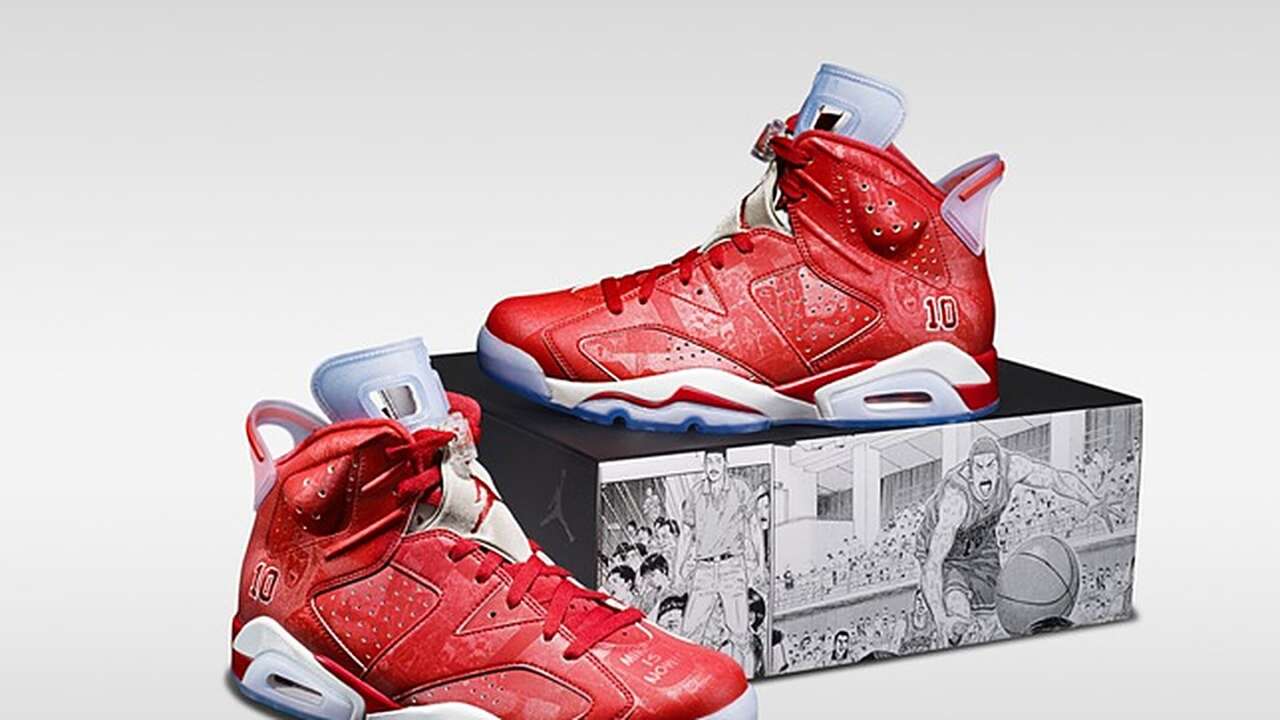
Hanamichi Sakuragi never existed. He’s a red-haired high school delinquent from a basketball manga, drawn by Takehiko Inoue in 1990, and he has a signature shoe. Jordan Brand built it in 2014: the Air Jordan 6 Retro “Slam Dunk,” an all-red colorway of the 1991 silhouette Sakuragi wore in the series, with his Shohoku number 10 sitting where Michael Jordan’s 23 belongs.
Plenty of sneakers borrow a story. This one borrowed a fictional player’s entire identity, down to the number on the heel, and it has traded like a grail ever since.
Air Jordan 6 Retro “Slam Dunk” (717302-600)
Nov 1, 2014 global release at $250 · Sakuragi’s No. 10 replaces the 23 at the heel · reflective manga graphics across the red upper
Price: $599 last sale at StockX, pairs listed from $480
Where to buy: Buy on StockX
Sakuragi wore the shoe before the shoe wore Sakuragi
Inoue started Slam Dunk in 1990, and it ran for 31 volumes. Sakuragi starts as an outcast with a temper and a gift for getting rejected, talks his way onto the Shohoku High team, and turns out to be a natural: spring, strength, and a rebounder’s instinct he didn’t know he had. The manga made him a star across Asia while the anime carried him further.
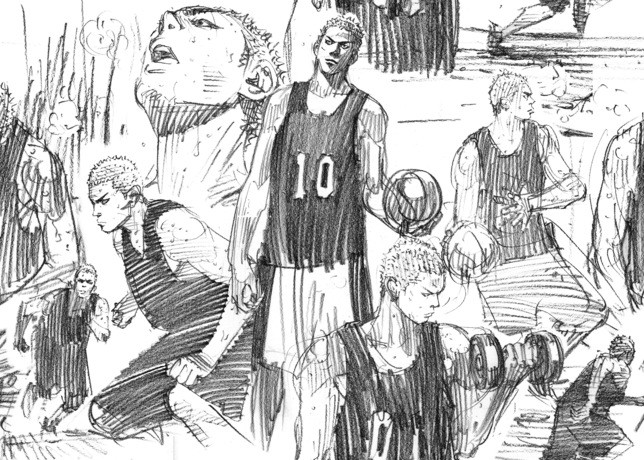
Jordan’s game fed the whole thing. “I have been hugely inspired by Michael Jordan’s game, as well as his attitude,” Inoue said at the launch, and in the manga Sakuragi plays in Jordans, the VI among them.
The scale of the series is the backdrop. Slam Dunk moved more than 100 million copies across its run, and it pulled a generation of kids toward basketball courts all over Asia. The story ended in 1996 with Sakuragi sidelined by injury, the arc unfinished. Inoue has said he spent the years after imagining him still out there, still calling himself the genius. That open ending is part of why a shoe could land like a reunion eighteen years later.
The 10 sits where the 23 belongs
The upper runs red from toe to collar, and the manga is printed across it in a tonal layer: Sakuragi’s face, game scenes, panels you catch when the light moves. The graphics carry a reflective finish, so a flash or a streetlight pulls the artwork up out of the red. From across the room it’s a red Jordan 6. Up close it’s a comic book.
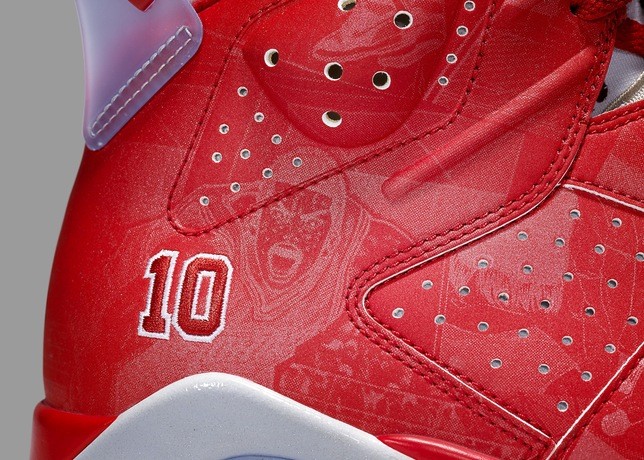
The heel carries the tell.
An embroidered 10 replaces the 23, stitched in white and red against the red upper. The rest of the shoe keeps the 1991 hardware: the toggle and the clear lace locks, the perforated panels, the translucent heel tab, the icy outsole under it all. Even the box got the treatment, wrapped end to end in Inoue’s black-and-white manga panels, Sakuragi mid-game on the side. Nothing here is shy about its subject.
The canvas earned its place on its own. The VI is Tinker Hatfield’s 1991 design, the shoe Jordan wore through his first title run. It was already an icon before the manga art touched it.
A player line for a player who never existed
Jordan Brand didn’t stop at one shoe. The 2014 Slam Dunk collection paired the VI with the Super.Fly 3, the brand’s current performance model at the time, carrying an Inoue illustration that has never been published anywhere else. Two tees and a hat rounded it out, the red shirt wearing Sakuragi’s 10 in elephant-print numerals.
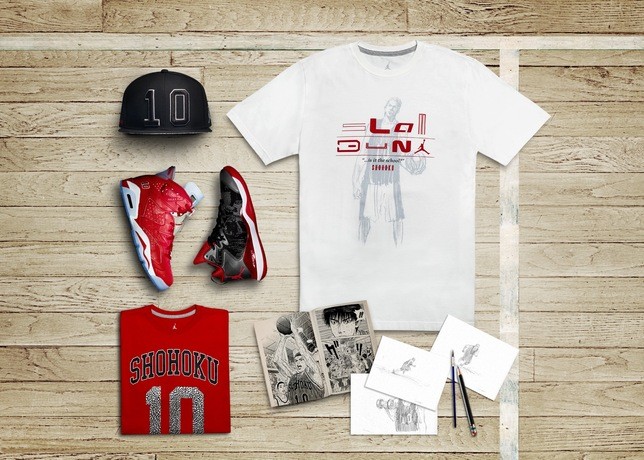
The pairing was the argument: a legacy shoe for the manga’s era and a current performance model for the present tense. Jordan Brand’s energy director at the time, Gemo Wong, called the two shoes “the perfect vehicle to highlight the past and present,” in the product and in the storyline alike.
Resale is the only store it has left
Asia got it first. The collection reached select Asian markets on October 18, 2014, and went global on November 1, at $250 for the VI and $185 for the Super.Fly 3. There was no restock worth the name and no retro after it. Twelve years on, the shoe has never returned, which leaves exactly one way to buy a pair.
StockX is that way in. Its sales record for the Slam Dunk 6 shows a last sale at $599 and a trading range of $299 to $1,050 across the past year, with a $453 average over its most recent quarter. For a shoe that retailed at $250, the chart is the review.
The flow is thin: nine sales in three months, pairs surfacing slowly while two audiences bid against each other. The VI has come back in a long line of colorways since 2014, and this one never has.
Air Jordan 6 Retro Black and White (White/Black)
The same 1991 AJ6 silhouette in a current colorway · men’s sizing
Price: $209.01
Where to buy: Buy on Amazon
So the shoe asks you to price two different objects. As footwear, it’s a red Jordan 6 with printed artwork, and the current colorway of the same silhouette sells on Amazon at $209.01. As an artifact, it’s the signature model of the most famous fictional basketball player ever drawn, made by the brand he chased, in a run that ended in 2014.
Air Jordan 6 Retro “Slam Dunk” (717302-600)
Clear lace locks included · manga-illustrated box · never re-released since 2014
Price: $599 last sale at StockX, pairs listed from $480
Where to buy: Buy on StockX
Buy the artifact and the $599 last sale makes its own sense. Buy the footwear and the Amazon pair wins by $390. The manga’s fans settled this argument years ago; the resale chart is just where they wrote it down.