Google DeepMind introduced Gemini Robotics 2.5 today, its most capable vision-language-action model so far, and the headline is a set of test scores that used to read zero. Across more than 200 distinct tasks, DeepMind reports success rates running 30% to 100% higher than its previous baselines, with the same jobs finishing 20% to 30% faster.
Some of those tasks weren’t low scorers. They were complete failures the last time around, and a few of them now sit at 100%.
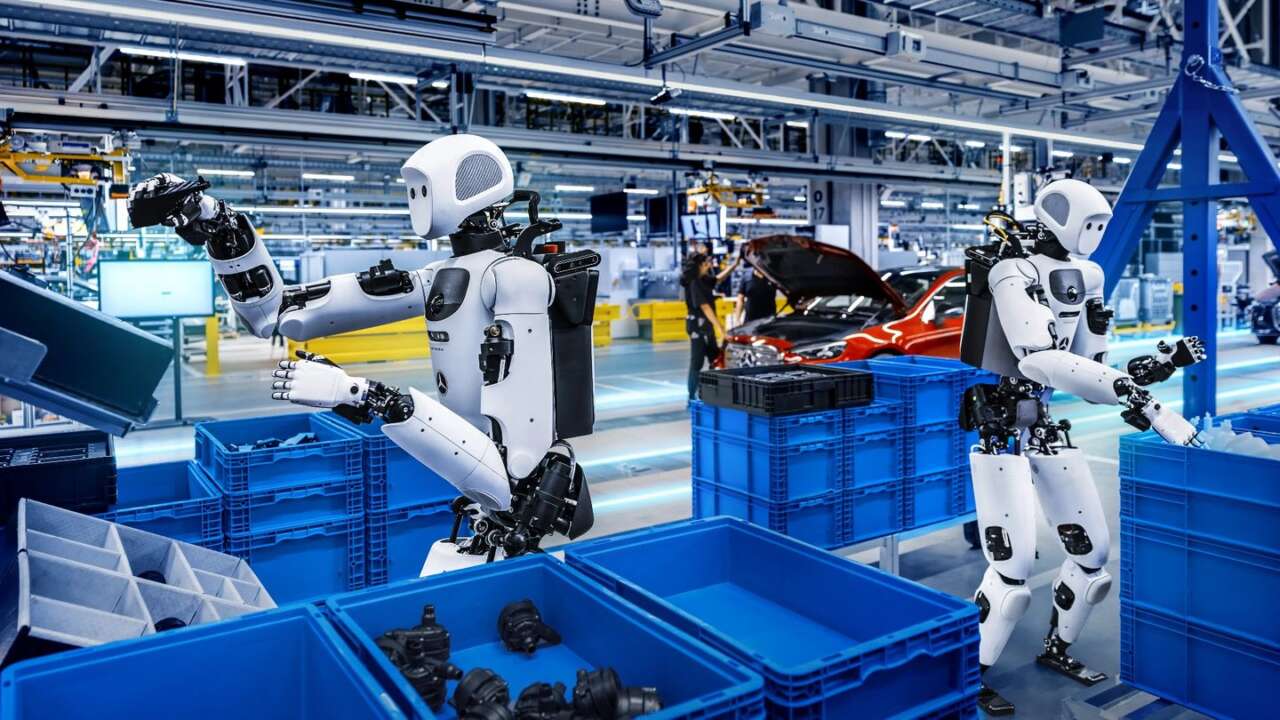
The model builds on Gemini 4 Argon, paired with the Gemini Robotics ER embodied reasoning model, and it isn’t staying in the lab. Apollo 2 humanoids are already running it on live Mercedes-Benz production lines in Hungary and Germany.
Zero was a common score
Pulling a disk drive out of its bay. Setting a lime on a top shelf. Packing pastries with tongs. DeepMind’s earlier models scored 0% on the first two and 5% on the pastries, and version 2.5 scored 100% on all three. All three mix tool use with flexible, unforgiving parts.
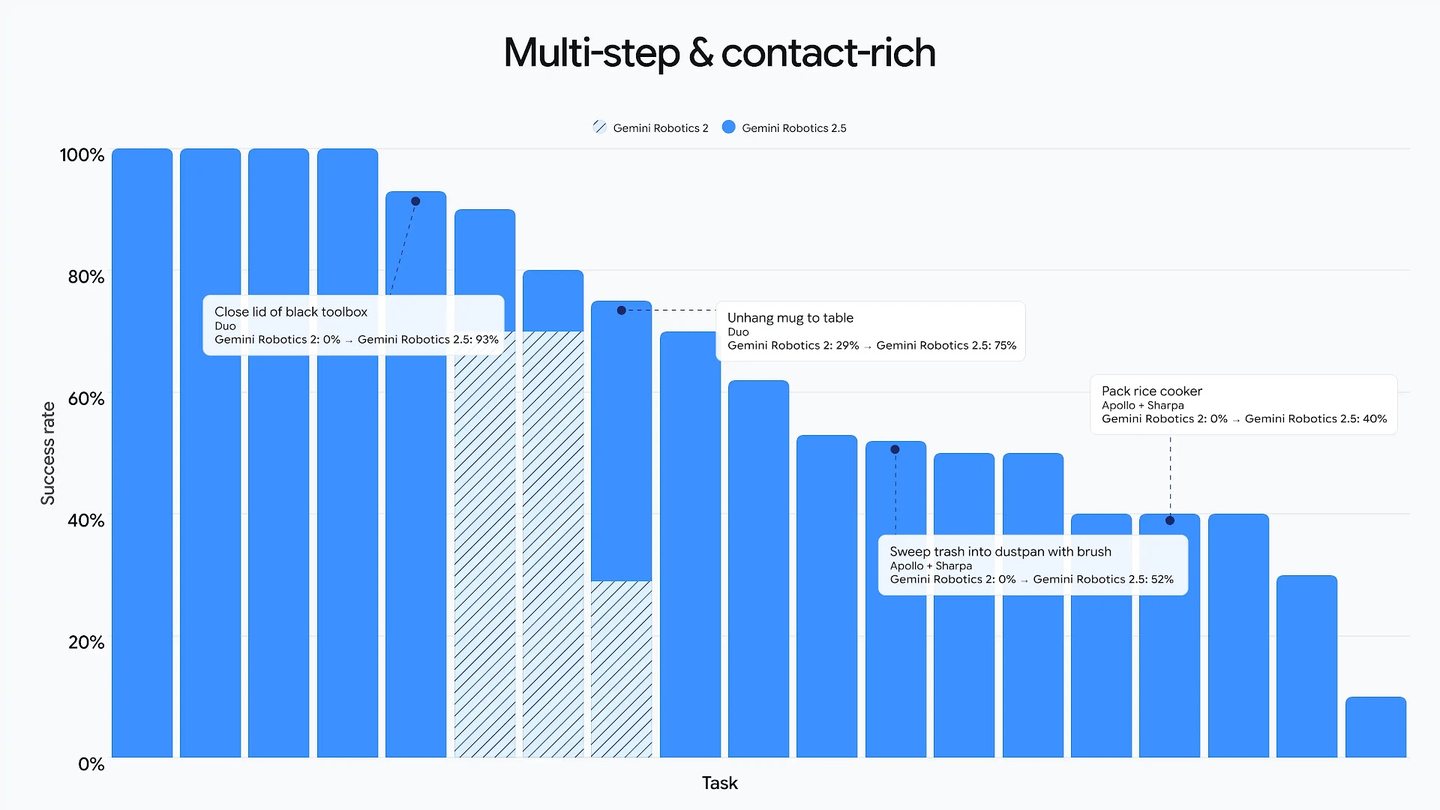
The near misses are almost as striking. Taking a Polaroid photo went from 0% to 92%, closing a toolbox lid from 0% to 93%, and untying a ribbon bow from 0% to 70%.
Not everything flipped. Plenty of the harder multi-step jobs still land in the 40% to 75% range, and DeepMind’s own charts show the spread plainly.
Then it went to work at Mercedes-Benz
Benchmarks are one thing. A production line that can’t pause is another, and that’s where DeepMind took this next.
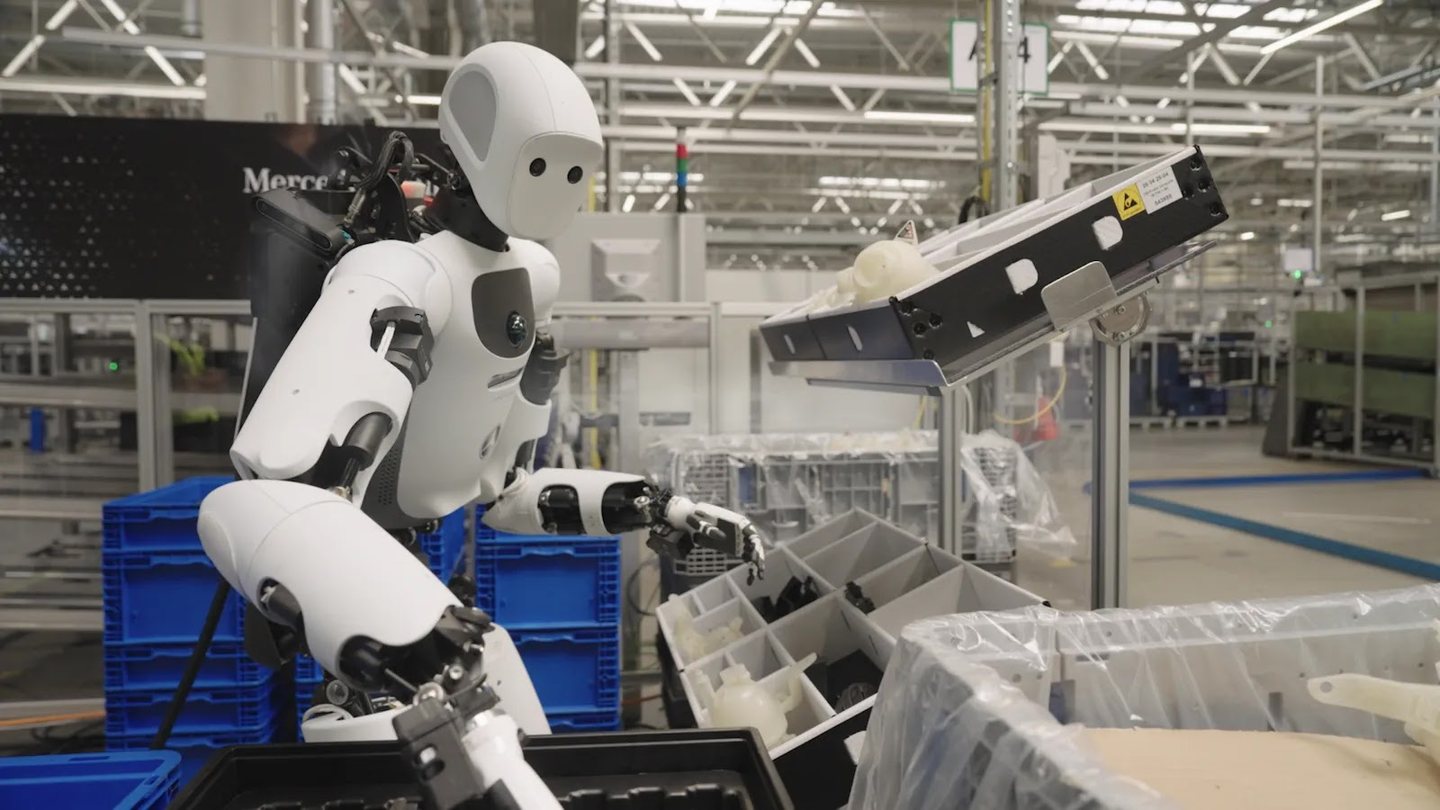
At plants in Kecskemét, Hungary, and Sindelfingen, Germany, Apollo 2 humanoids from Apptronik are doing automotive kitting on active lines. The job is sorting metal brackets out of bulk bins and into sequencing trays, in the exact order each car on the line needs them. It’s repetitive, physical work, and the robots are completing it at a 96% success rate. Offloading that prep work keeps the line moving and frees technicians for the complex build tasks.
Two models split the work. The ER reasoning model tracks the workflow and what’s left to do, while 2.5 itself runs the arms and hands, correcting when a bin runs short or a part sits wrong. Apollo’s five-finger SharpaWave hand carries 22 degrees of freedom, and the same model also drives Franka’s Duo platform with plain two-finger grippers.
The home list runs longer than the factory list
Most of those 200-plus tasks aren’t industrial at all. They’re the jobs that fill a house, one small chore at a time, and they’re the ones a household robot would actually be hired for.
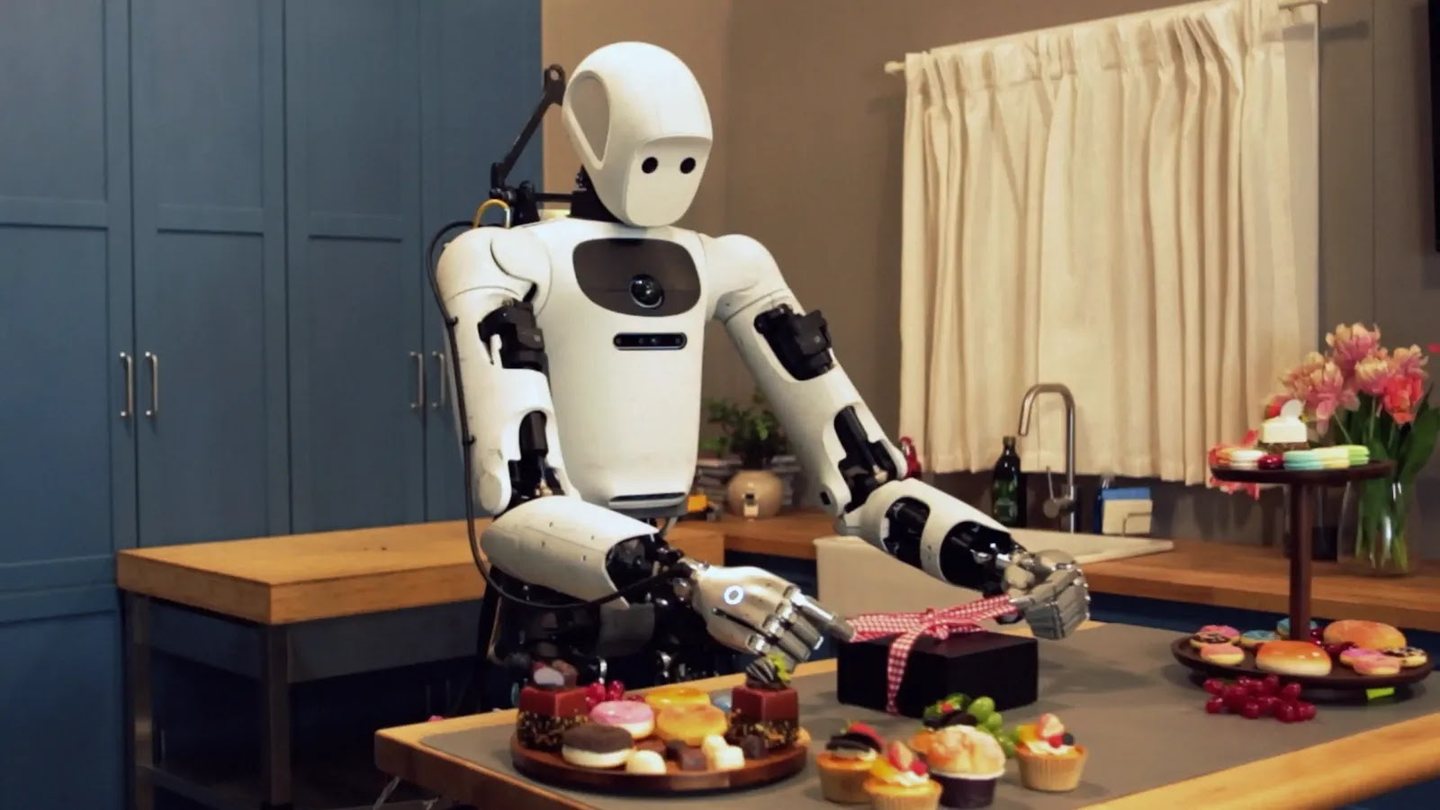
Folding laundry. Putting groceries onto the correct fridge shelf. Loading a dishwasher, wrapping presents, hanging clothes. Each chains a dozen decisions, and a robot that drops the thread halfway through hasn’t finished anything.
That’s the shift running through this release. Dexterity used to mean one careful grip. Here it means finishing the whole sequence, tools and flexible objects included. Serving food with tongs and pipetting a liquid sit on the same test list as the toolbox lid.
Argon did the homework
The speed of the jump has a cause DeepMind names directly. Gemini 4 Argon didn’t just reason inside the robot. It built the practice field.
Working from a real camera scene, Argon generated thousands of simulated practice runs and built a realistic digital twin the model could train against. Mixed with real demonstrations, that synthetic volume is how a skill goes from never to routine without a robot repeating it in a physical room for weeks.
Argon also works the other direction. Given video of a failure, it can hypothesize why the attempt broke down and test the fix in simulation before anyone tries it on hardware. That loop, failure to explanation to retest, runs in hours instead of the weeks a hardware cycle takes.
Safety got its own benchmark
Robots leaving the lab need more than steady hands. They need to not hit anyone.
DeepMind says 2.5 steers around hazards as it works, using inference-time reasoning to keep its distance. In the team’s evaluations, safe task completion improved 33% around obstacles and 43% around people nearby.
For the adversarial side, the team open-sourced ASIMOV-Jailbreak, a benchmark of hundreds of prompts that dress unsafe requests up as ordinary ones across dozens of scenes. Argon resisted 99.5% of them. The previous reasoning baseline, Gemini Robotics ER 2, managed 82%, and the paper behind the benchmark is up on arXiv.
Gemini Robotics started in March 2025, picked up whole-body control earlier this year, and 2.5 is rolling out to DeepMind’s robotics partners now. There’s no product to buy and no price to quote. What bears watching is whether the factory number holds at scale, because 96% on a pilot line is a promise the next deployment out in the field has to keep.
It’s also the second time a Gemini-powered humanoid has turned up on a car line. Figure’s 03 is doing related work at BMW, and the pattern is getting hard to miss. The lab scores get the headlines. The factory floor decides.