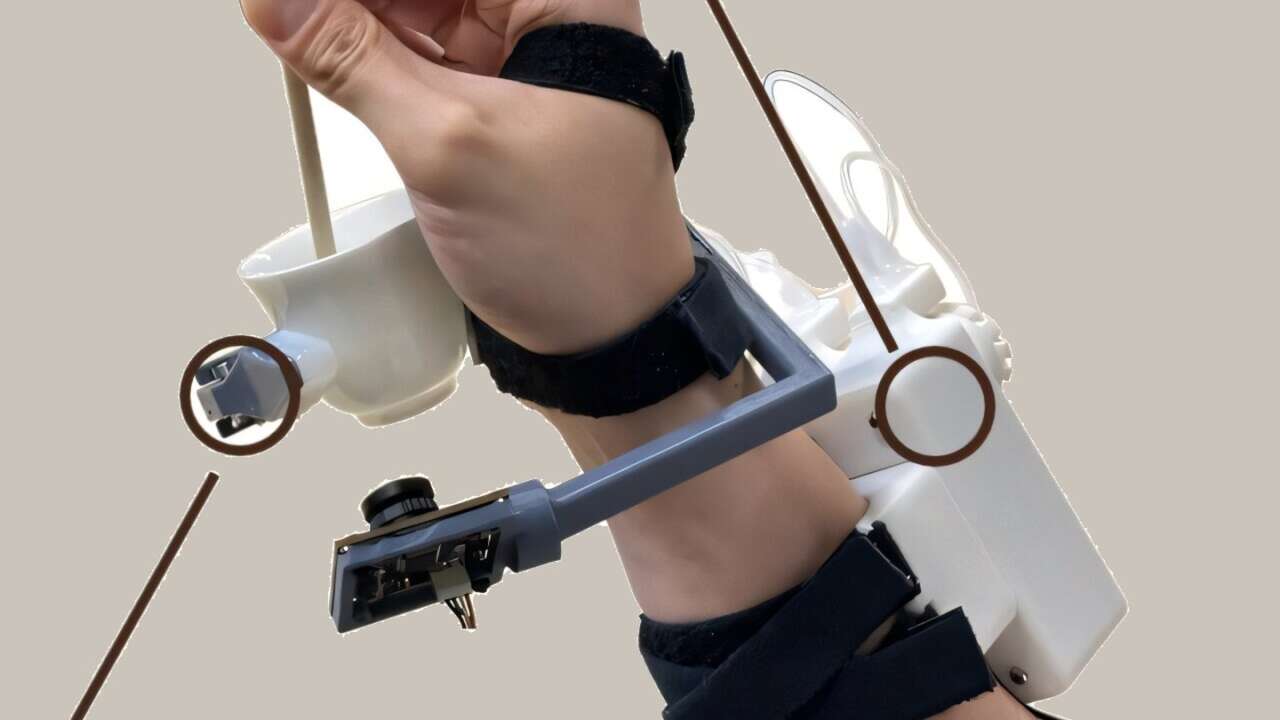
Stirring tea takes two hands. One holds the cup still, the other works the spoon. EgoThumb gives that holding job to a robot, a second thumb strapped to the inside of your wrist, and it leaves your own fingers free for the part that needs feel.
It isn’t remote-controlled. There’s no button to press and no gesture to memorize.
A fisheye camera sits in the palm and watches your hand and whatever you’re reaching for. The thumb closes on its own when the picture says grab.
No switch, no trigger, nothing to learn first.
EgoThumb comes out of UC San Diego’s computer science and engineering department, built with Sudo AI in Zurich. The team has published the full design as open source, and the work has been accepted to IROS 2026.
Six names sit on the paper: Jianyu Hou and Jiawei Fu as co-first authors, with Weikang Wan, Minghui Jiang, Jiajun Li, and Hao Su.
Where it sits
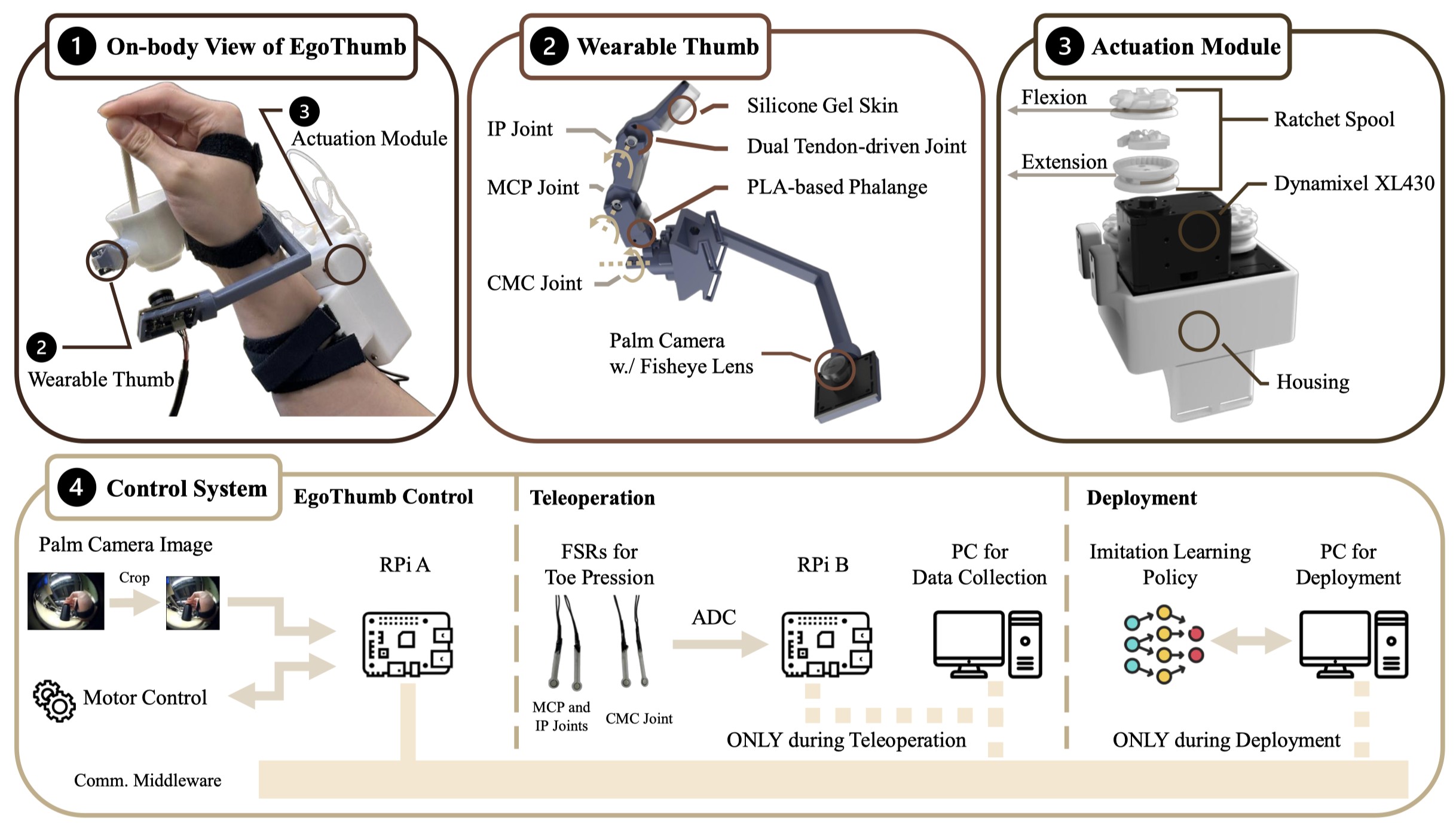
The thumb itself rides low, mounted at the inner wrist with its two joints curling up toward your palm.
Hook-and-loop straps hold the rig on and adjust across different hands, and the fingertip segments are PLA coated in silicone so the grip bites instead of skating off smooth plastic.
Each of the two joints is tendon-driven. One hinge can only pinch in a straight line. Two active joints let the thumb curl around objects at different scales, from a small cube to the side of a cup, and hold each one the way a thumb is supposed to.
It watches your palm, not a trigger
Older robotic fingers mostly waited for an explicit command, a muscle twitch, a tilt, a tap.
Those triggers carry no context. They can’t tell a mug from a bottle, and they fire the same way. This one skips triggers entirely.
Its control is a visual imitation learning policy. During training, the system recorded what the camera saw while the setup performed each task, and it learned to map those egocentric images straight to joint positions. The policy never sees a command signal at all.
At run time, the live view goes in and joint positions come out, frame by frame.
Intent is read off the scene. Reach for a cup and the view matches the training views that ended in a grip.
The muscle lives on the forearm
Motors are heavy, and weight at the fingertip is weight your hand drags through every motion it makes. So the actuation sits up the arm, on the forearm.
A module strapped to the forearm houses three ratchet spools, each one driven by a Dynamixel XL430 motor, a servo common in research robots, and the tendons run from those spools down to the thumb’s two joints.
Keeping the mass proximal keeps the worn end of the system light. The part at your wrist is mostly structure, straps, and the camera, which is a big reason the rig can stay on through a full task instead of feeling like a tool you’re carrying on your hand all day.
Four tasks, counted
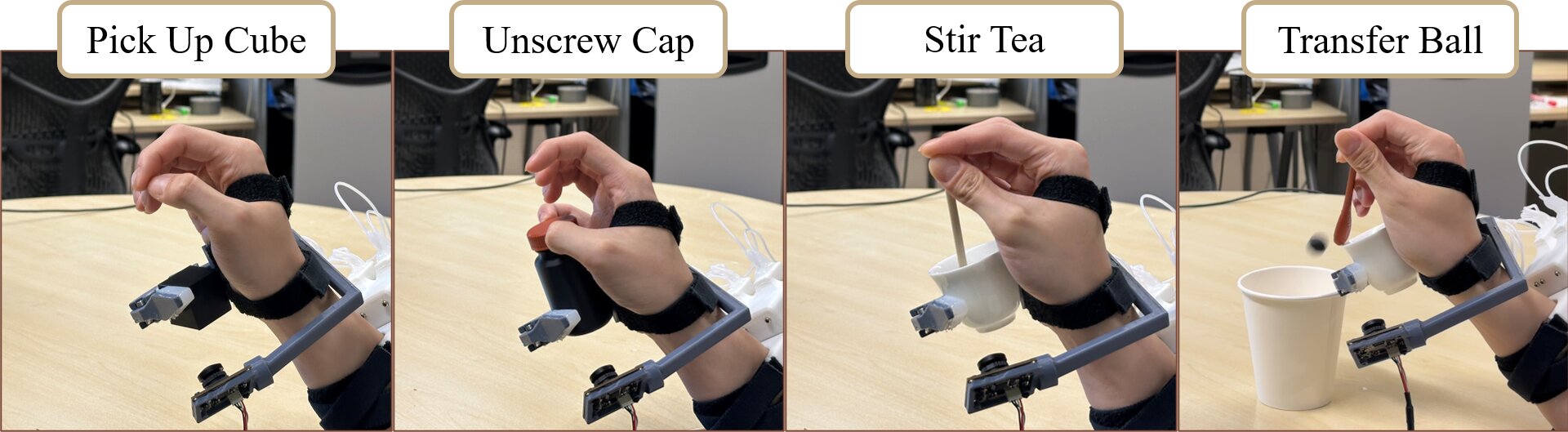
The team tested it on four jobs in the lab, each one a hold-and-manipulate task that normally takes both hands. On the demonstrator’s hand, the hand the system trained with, the results came out like this.
| Task | Completed |
|---|---|
| Pick Up Cube | 100% |
| Unscrew Cap | 70% |
| Stir Tea | 90% |
| Transfer Ball | 100% |
That’s a 90 percent average, with cap unscrewing the clear weak spot. Turning a cap asks for sustained grip force while the fingers rotate against it, and three times in ten the hold gave out.
New hands barely dented it. Two first-time users averaged 92.5 percent and 87.5 percent across the same four tasks, right in line with the demonstrator’s 90. Both were new to the rig. The straps and the camera don’t care whose hand it is, and the policy reads the scene rather than the wearer.
Push the setup and the numbers move. With objects spread across wider starting and target areas, picking up the cube and unscrewing the cap held up well, tea stirring stayed moderate, and ball transfer dropped off. In rooms the system had never seen, stirring tea landed between 67 and 73 percent. More training data helped everywhere: scaling the demonstrations from 25 to 105 improved performance in seen and unseen environments alike.
Research, and open
There’s nothing to buy here. EgoThumb is a research prototype, not a product with a price tag, and the team’s move is the opposite of a storefront.
The designs and the software are open source, posted through the project site, so any lab with a printer and a parts order can build one and test it.
Novelty, until you count two-handed tasks. Jar lids. Bottles. A cup and a spoon.
EgoThumb’s answer is a thumb that holds its side of the job and reads your intent from a camera instead of a switch, and the test numbers say the reading is already good. What happens when a hundred other labs start printing it is the interesting part.