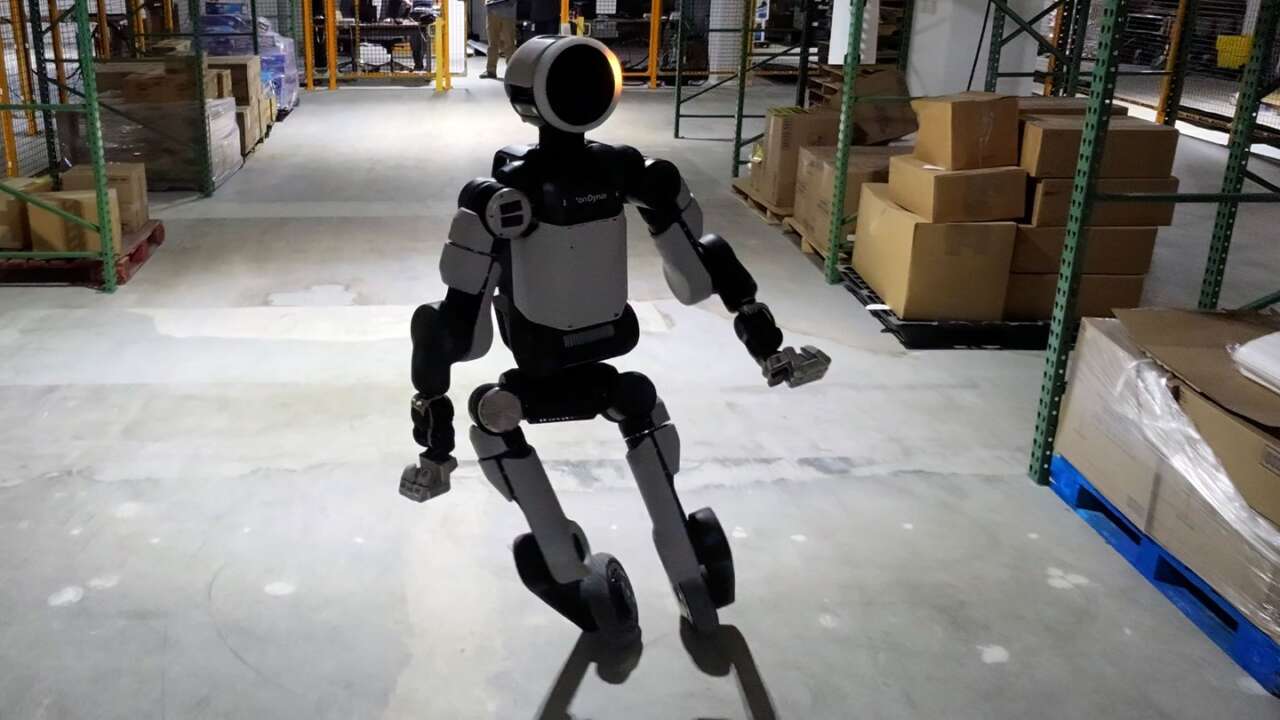
Atlas rolls down a warehouse aisle on two scooter wheels, leaning into the run like a skater cutting across a rink. Boston Dynamics swapped the humanoid’s feet for wheels, but the rolling isn’t the part worth watching. Nobody programmed the rolling. Atlas taught itself.
This isn’t a product move, and it isn’t a speed stunt. Call the wheeled build what Boston Dynamics calls it: a research testbed, built to hold Atlas’s motors at the edge of their performance and show where the team’s model of a motor stops matching the motor itself.
Wheels come off. Lessons stay.
One adapter is the whole conversion
The hardware change is almost disappointingly small. One custom adapter bolts an off-the-shelf scooter rim onto the ankle actuator Atlas already has, and that adapter is the only new part in the build. Controls engineer Xiaoyu Wu, who wrote up the project, calls the swap about as involved as changing a wheel on a bicycle. Atlas was designed to be built in volume and serviced easily, and the conversion rides on that work.
Wheels hold the motors at full stretch
In the software model, each wheel is just an ankle that never stops rotating. Wu took the baseline Atlas model, swapped feet for wheels, and the stack above it never noticed the difference. No new robot. No new control stack. Just a new answer to what an ankle is allowed to do.
Years of field data from Spot and Stretch working in customer buildings taught Boston Dynamics one recurring lesson: real floors find problems a lab floor can’t. Running Atlas at the edge of its envelope on purpose, inside its own test cell, is how the company learns where the design runs thin before a deployment does.
The controller had to invent rolling
Two layers share the driving. Classical motor controls watch the hardware in real time: the currents, the limits, the heat of each actuator.
Above them sits a learned whole-body policy, trained by reinforcement learning, that takes high-level commands and decides how the machine carries them out. Nobody wrote it a steering routine. Give it the commands and the hardware, and rolling is what it settled on.
Between the layers sits the catch. Train a policy in a simulation whose motors are too perfect, and it learns tricks the real actuators can’t perform.
So the team spent real effort on unglamorous work: measuring how the actual motors behave, tuning the simulated motors to match, checking that control parameters lined up across every setup. A policy has to train against the same machine it will meet on the floor, or the transfer falls apart the first time the hardware pushes back.
Before Atlas rolled across a real floor, it rolled across millions of simulated ones in MuJoCo, Google DeepMind’s physics engine. A few changes to the training rewards, the range of commands, and how the policy holds its posture were enough for smooth rolling to emerge on its own, the robot stable and, by Wu’s account, fun to drive.
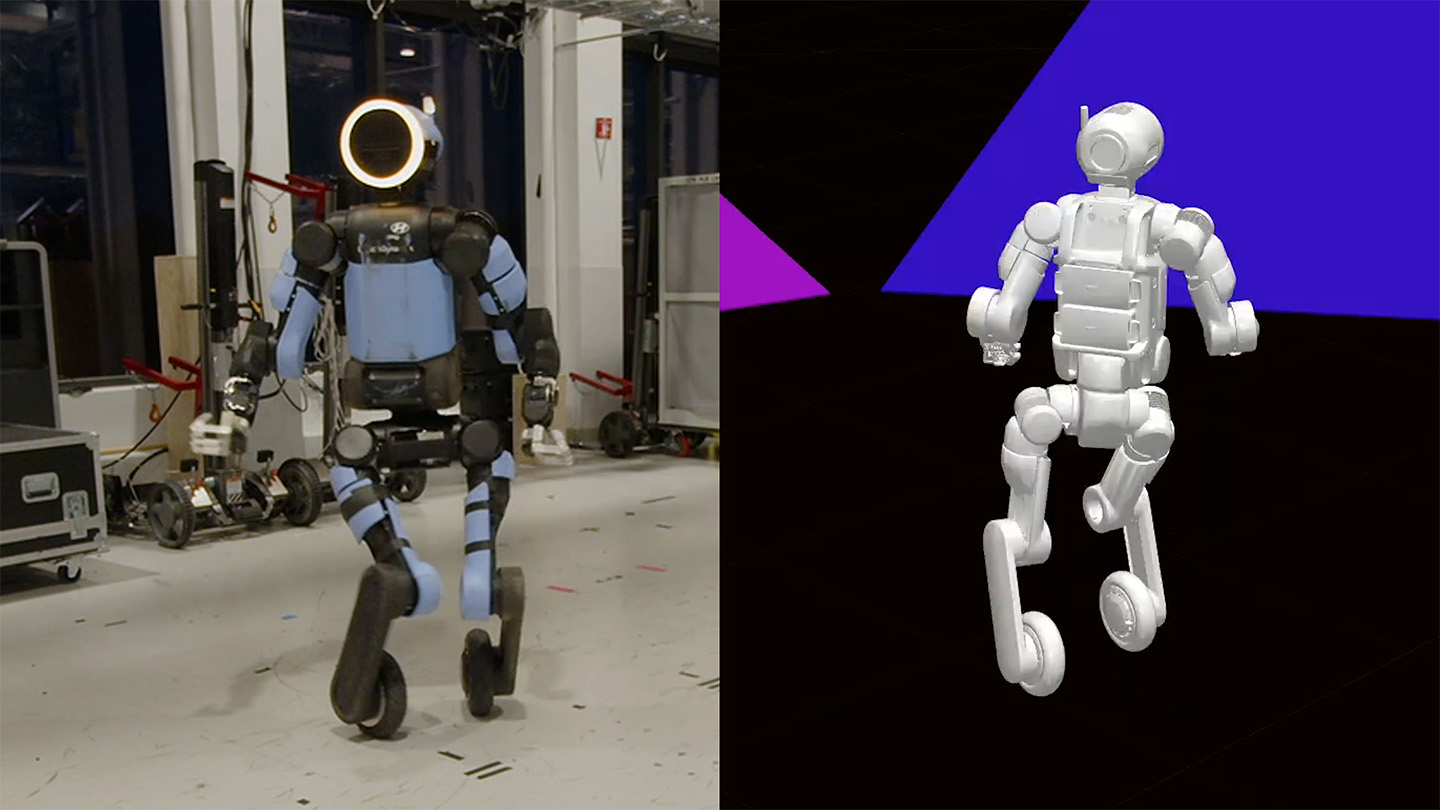
Wu’s summary is the whole story in one line: “Give the policy wheels, and it figures out how to use them.”
Side dashes, spins, and a jump it landed first try
Some of the movement started as human motion capture, and Wu went hunting for clips with heavy foot sliding, on the theory that sliding is where wheels get interesting. He was right. In the side dash, where a person would slide both feet across the floor, the policy steers the wheels and rolls through the move sideways. No shuffle. No stutter. That’s the motion-capture trick paying off.
A 360-degree jump looks like the risky one, and it wasn’t. A trajectory-tracking policy follows a recording of a person making the jump, and it worked on the first attempt. Watch the windup and you’ll see the lower body roll itself into position before the push, using traction in a way feet never could. Between the tricks, the film puts the robot to actual work: rolling the aisles, stopping and starting, crouching, reaching overhead, fetching boxes.
What rolls back into the working Atlas
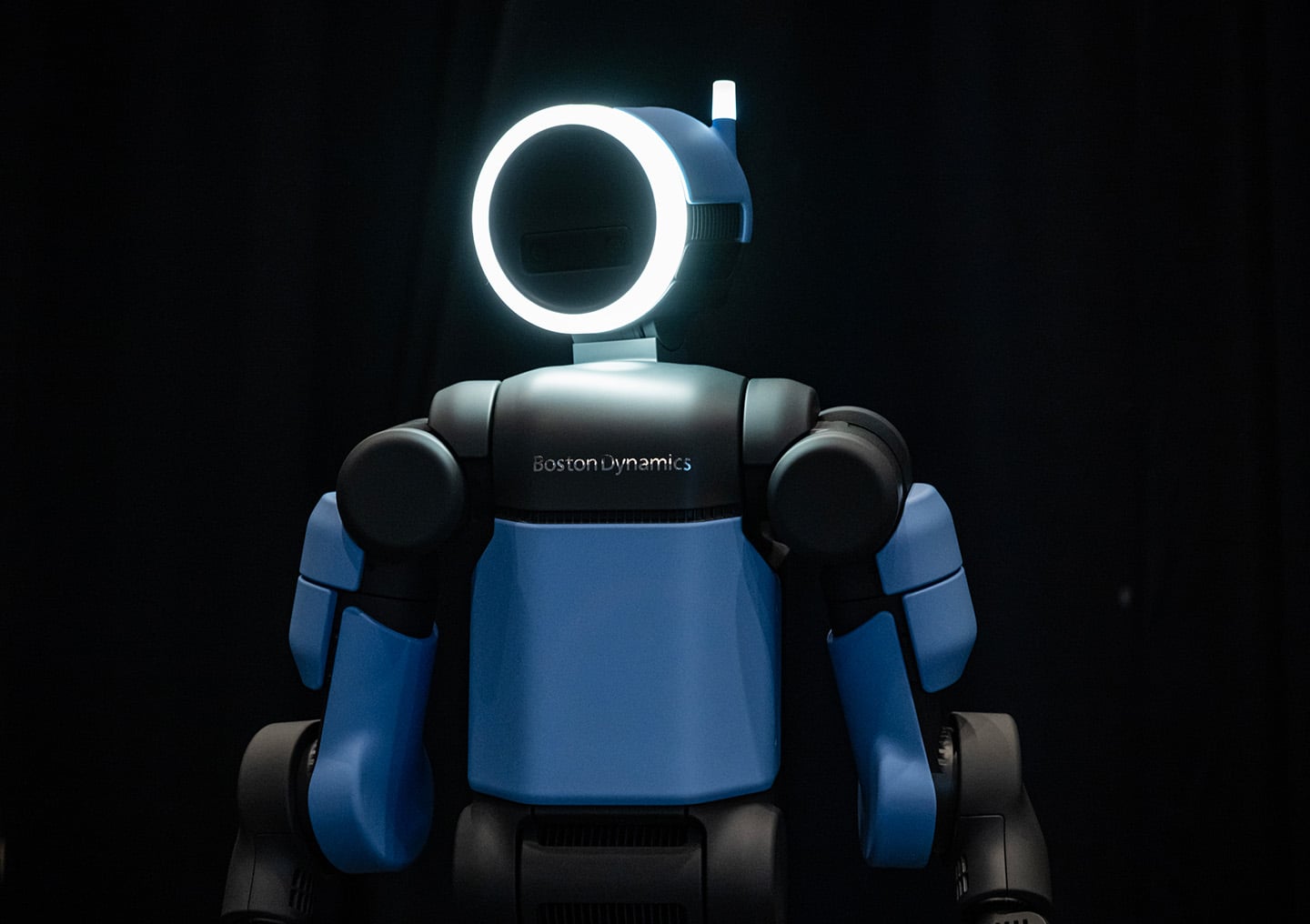
None of this turns a wheeled humanoid into a warehouse plan. Meanwhile the production Atlas keeps its feet: the blue machine Boston Dynamics unveiled in April 2024 is now testing in Hyundai facilities, and Agility’s Digit shows what a humanoid with an actual job looks like.
The wheeled build had a narrower assignment: find the weak spots in the lab, under controlled abuse, so the standard robot doesn’t find them in the field. That’s a production program with a schedule and a customer waiting on the answers.
Those findings are already feeding back into the standard configuration, tightening how the actuator models and the whole-body controller get developed together. What stays is the proof. Hand the policy a machine it wasn’t shaped for and it comes back with the technique by itself. That’s the capability the production robot cashes in, long after the wheels go back on a shelf.