
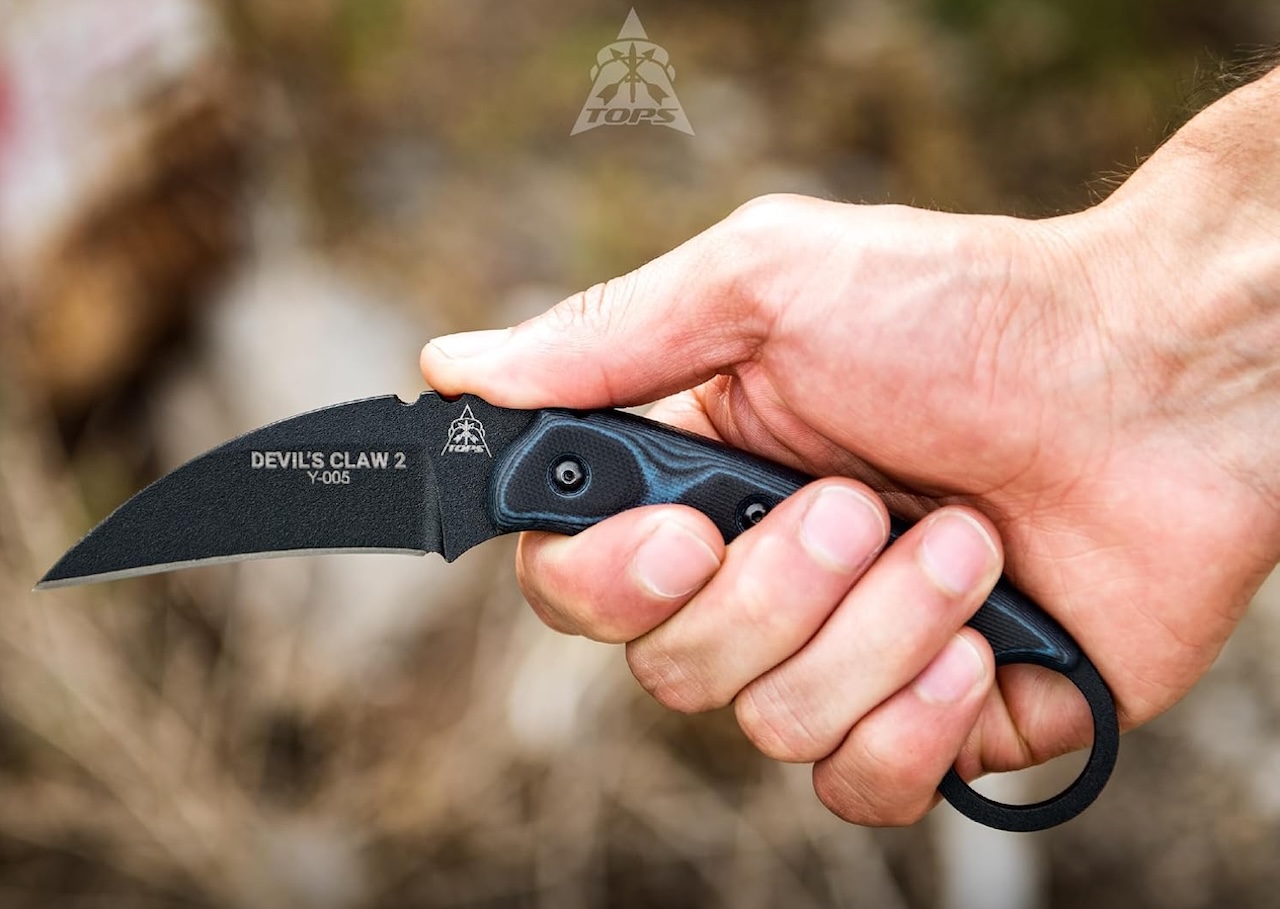
A fixed blade eliminates the opening mechanism and lock of a folder, but carry convenience is usually the tradeoff. Add a sheath to even a relatively short knife, and the complete package can end up bulkier and heavier than its blade length suggests.
Price: $138.95
Where to Buy: Amazon
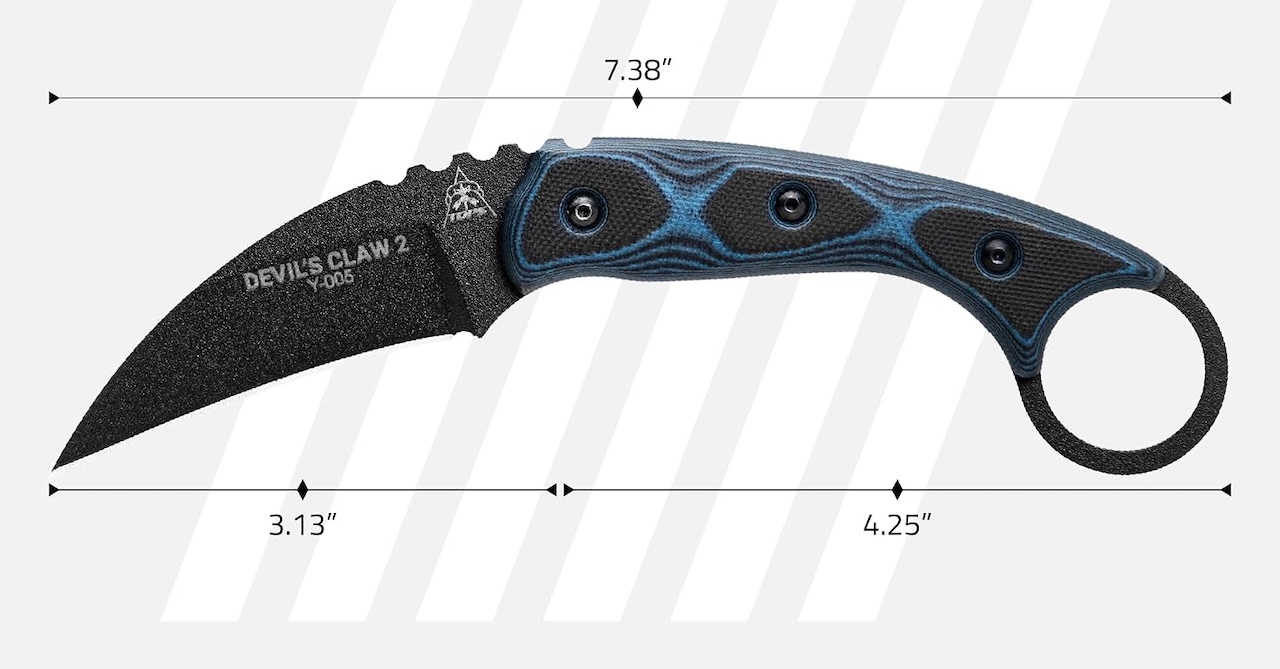
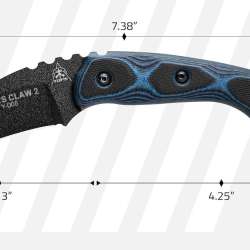
The TOPS Devil’s Claw 2 keeps its dimensions relatively compact, measuring 7.38 inches overall with a 3.13-inch blade. TOPS lists the knife at 5.6 ounces by itself and 7.2 ounces with its included Kydex sheath, so this is compact mainly in length, not weight.
There is also an important distinction in the blade specifications. TOPS lists a 3.13-inch blade length but a 2.75-inch cutting edge. Those are separate measurements for the same knife, not conflicting specifications or evidence of different Devil’s Claw 2 versions.
Combined with a hawkbill profile, full-size G10 handle, and finger ring, those dimensions make the Devil’s Claw 2 a specialized compact fixed blade rather than a universal replacement for an everyday folding knife.
The hawkbill blade favors pull cuts
The defining feature of the Devil’s Claw 2 is its strongly curved hawkbill blade. TOPS describes this geometry as effective for pull cuts. That makes sense in principle: the inward curve can help keep material engaged with the cutting edge as the knife is drawn through it. For utility work, that can make the shape particularly relevant to jobs involving cord, plastic strapping, packaging, and similar materials.
That description should still be separated from independent evidence. TOPS is explaining how it intends the knife to be used; we have not performed comparative cutting tests showing that the Devil’s Claw 2 outperforms conventional blade shapes.
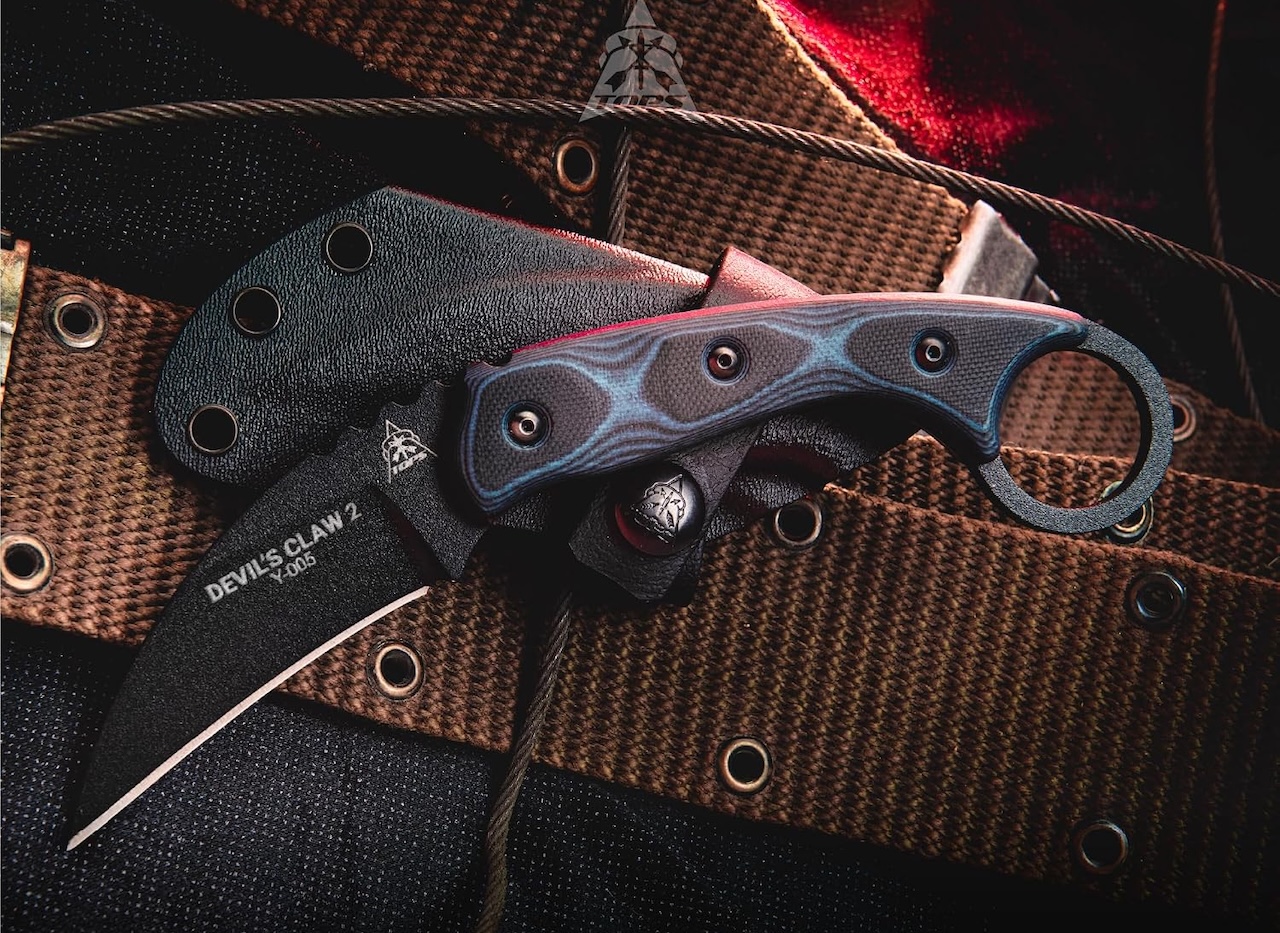 The measurements are worth considering here as well. Although the blade is officially 3.13 inches long, TOPS specifies 2.75 inches of cutting edge. Buyers comparing knives solely by advertised blade length could therefore overestimate how much sharpened edge they are getting.
The tradeoff for the hawkbill geometry is versatility. Flatter edges and conventional drop-point profiles can be easier to use for jobs involving long cuts against flat surfaces or other tasks where a strongly inward-curving edge provides little benefit.
The Devil’s Claw 2 therefore makes the most sense when the blade shape matches the material you regularly cut.
The second generation gives your hand more room
The Devil’s Claw 2 is not simply the original knife with a ring added. According to TOPS, the original Devil’s Claw deliberately used a shorter handle. For the second version, the company extended the handle to accommodate a full hand and added the prominent ring at the pommel. TOPS says the blade shape, materials, and thickness remain the same between the two generations.
Published specifications from other retail and media sources align with those core construction details: 7.38 inches overall, a 3.13-inch hawkbill blade, blue-and-black G10 scales, full-tang construction, and a 5.6-ounce knife weight.
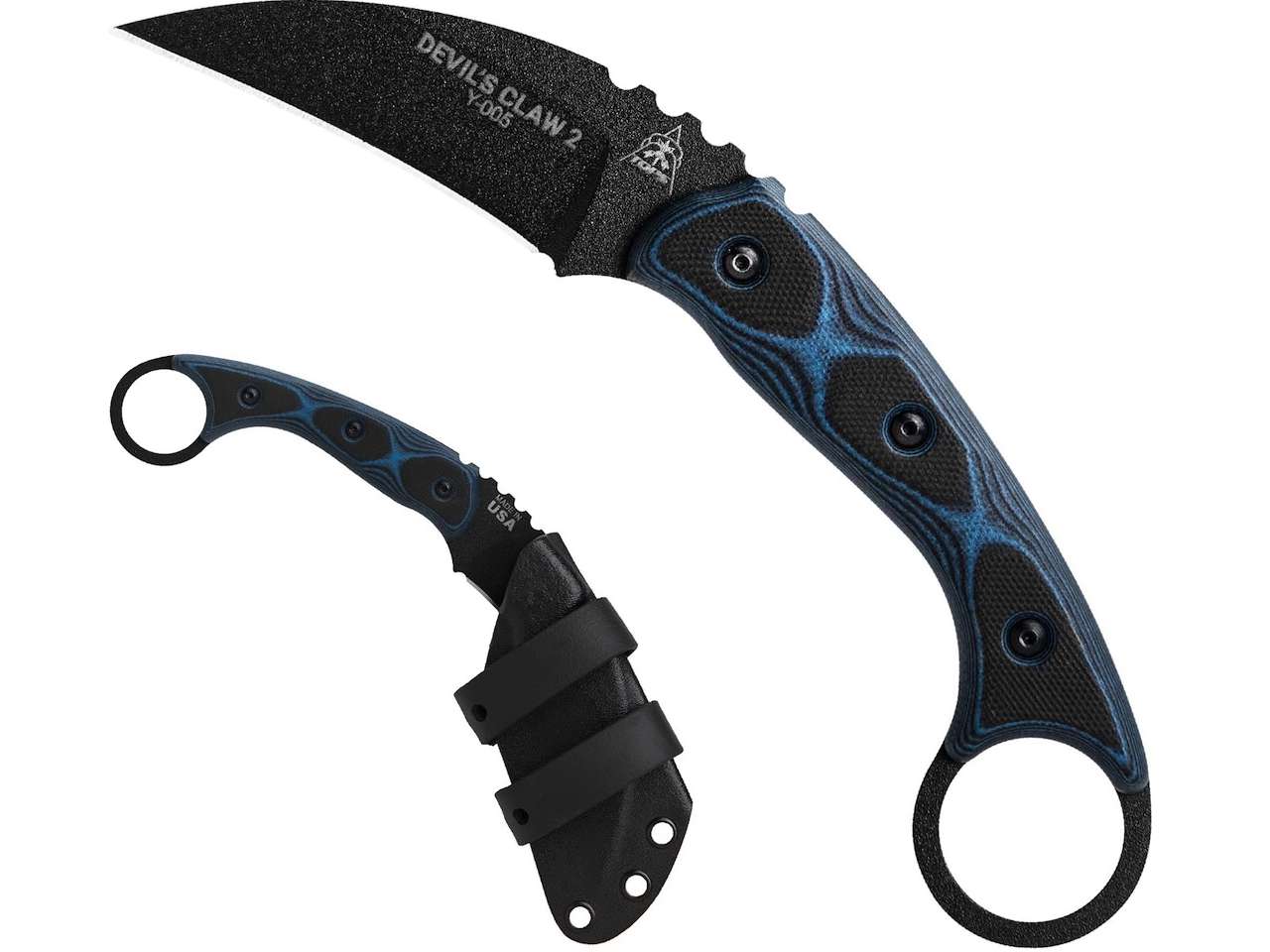 The practical change is straightforward. More handle length gives the user more physical space for a complete grip, addressing an intentional compromise of the original design.
The finger ring makes the design more distinctive, but its presence does not automatically establish better ergonomics. Hand size, grip preference, and the shape of the handle all affect comfort. Without hands-on testing, it would be premature to say how comfortable the Devil’s Claw 2 will be for a particular user.
The 1095 blade needs realistic expectations
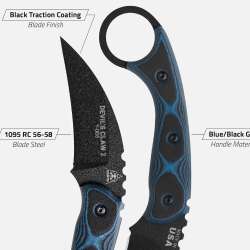
TOPS specifies 1095 carbon steel hardened to 56–58 HRC, with a blade thickness of 0.190 inches and its Black Traction Coating.
Those specifications tell us what TOPS built, but steel type alone does not establish real-world edge retention or overall cutting performance. Heat treatment, edge geometry, sharpening, and individual use all contribute to how a finished knife behaves.
 The more practical ownership consideration is that 1095 is a carbon steel rather than a stainless steel. TOPS’ coating covers much of the blade, while the sharpened edge necessarily remains exposed. Keeping exposed steel clean and dry is therefore sensible, particularly if the knife encounters moisture.
For someone who wants a knife requiring minimal attention around water and humidity, a stainless-steel alternative may be a better fit.
The sheath determines whether the compact size pays off
Fixed-blade dimensions tell only half the carry story because you carry the sheath too.
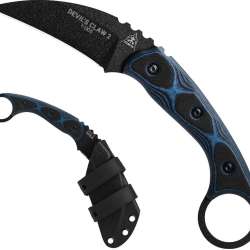
TOPS includes a black Kydex sheath fitted with its Beta Loop attachment. The company lists the complete knife-and-sheath package at 7.2 ounces, compared with 5.6 ounces for the knife alone.
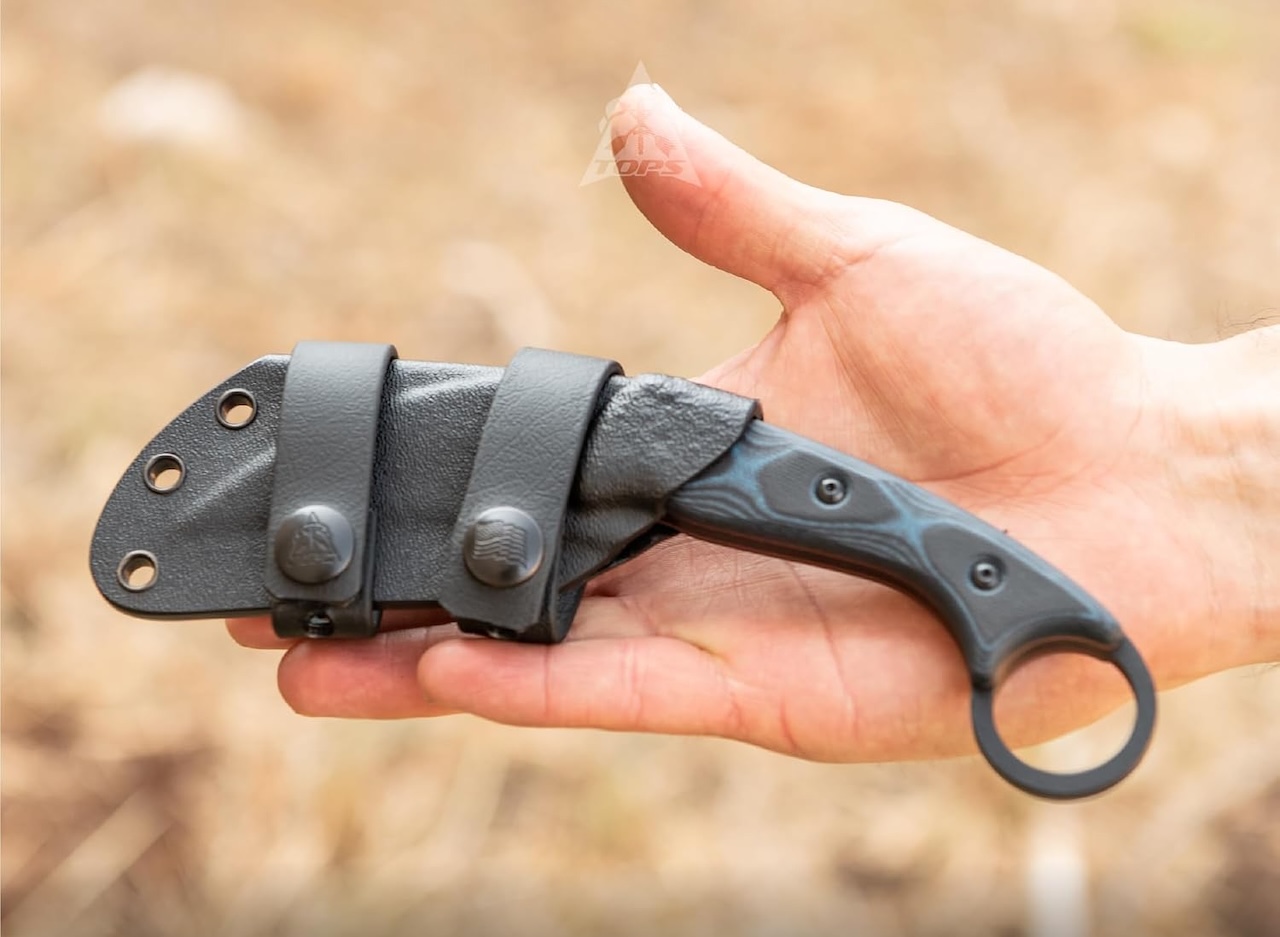 That 1.6-ounce difference reinforces the real carry tradeoff. A 3.13-inch blade sounds compact, but the Devil’s Claw 2 should not be confused with an ultralight EDC knife.
Its advantage is instead fitting fixed-blade construction, a full-size handle, and a specialized hawkbill edge into a package measuring less than 7.5 inches overall. Whether that works better than a folder depends heavily on how and where you normally carry your gear.
Who should buy the TOPS Devil’s Claw 2?
The Devil’s Claw 2 has a more specific buyer than a conventional EDC knife.
It makes the most sense if you want a relatively compact fixed blade and regularly cut cord, packaging, strapping, or other materials where a hawkbill’s pull-cut geometry is useful. The longer second-generation handle also addresses the intentionally abbreviated grip of the original Devil’s Claw.
Just keep the numbers in perspective. The knife has a 3.13-inch blade but 2.75 inches of cutting edge, and its 7.2-ounce sheathed weight means compact does not equal lightweight.
If you prioritize minimum carry weight, stainless steel, or a blade shape suited to a wider variety of everyday jobs, a conventional folder or small drop-point fixed blade is likely the better choice.
Price: $138.95
Where to Buy: Amazon
The Devil’s Claw 2 works best when you want its specific mix of compact overall length, full-size handle, fixed-blade construction, and hawkbill edge. Those traits can be real advantages for the right tasks, but they also make this a specialist rather than an all-purpose EDC knife.
Auto Amazon Links: No products found.
