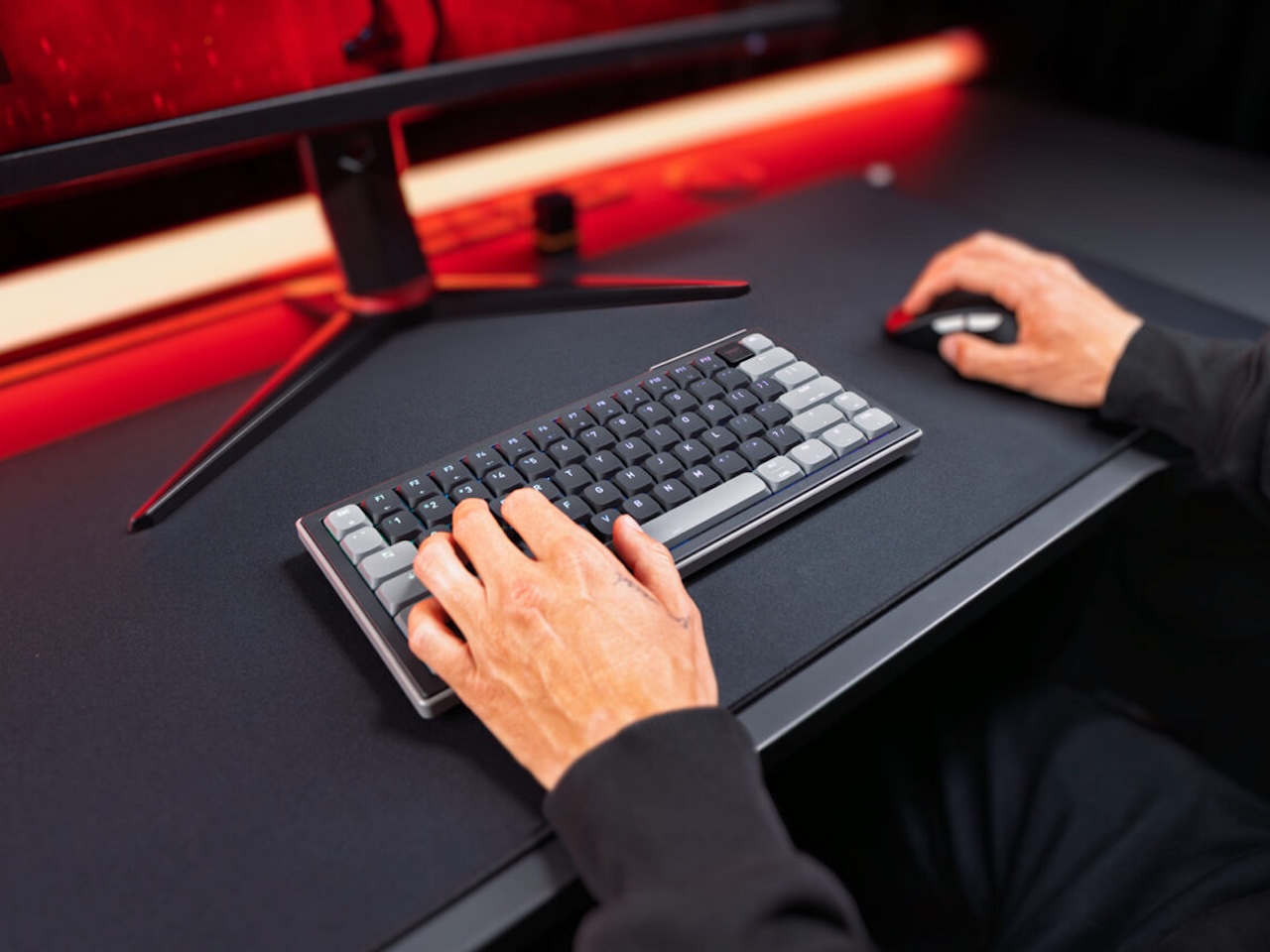
Wireless gaming keyboards have been making the same trade for years: pick compact and live in a crowded radio neighborhood, or keep the cable and stop thinking about it. Ultra-Wideband changes the math. It runs on short pulses across a wide frequency range, separate from the Bluetooth headsets and Wi-Fi routers that chip away at standard wireless reliability.
Price: €179.99
Where to Buy: Cherry
CHERRY XTRFY’s K63W Pro Compact Ultra-Wideband is built around that premise, combining UWB connectivity with a 70% form factor, 8,000 Hz polling in both wired and wireless modes, and a low-profile gasket mount. The company unveiled it at COMPUTEX 2026 and lists it at €179.99 RRP.
What the K63W Pro Ships With
The K63W Pro uses CHERRY MX Low Profile 2.0 switches under a gasket-mounted plate, with per-key RGB lighting, full N-key rollover, and ABS keycaps. CHERRY rates the switches for 100 million keystrokes, a durability claim that says nothing about how the keycap finish will hold up over that same lifespan. Its 6,000 mAh battery carries a manufacturer rating of up to 1,100 hours, which is the best-case number at minimum polling with RGB off.
CHERRY XTRFY says the keyboard is now available at €179.99 in the markets covered by the launch announcement. The official product page lists $169.99 USD, with purchase routing to the European shop at shop.cherry.de. No US retailer, US ship date, or separate US distribution channel has been confirmed as of this writing. Function row access stays intact in the 70% layout, and Mod Tap settings let the lower-right keys swap between arrow and function duty without a separate hardware toggle.
Ultra-Wideband Isn’t Another Polling Upgrade
8,000 Hz polling has been available long enough that it no longer moves the needle as a standalone claim. The K63W Pro’s real argument sits underneath: UWB sends data across a wide frequency band instead of competing for space in the 2.4 GHz range shared by most wireless peripherals, Bluetooth devices, and home routers. A desk running multiple wireless devices in the same band will produce different behavior than a desk with a single wireless peripheral, and CHERRY XTRFY is betting UWB sidesteps that interference pattern entirely.
That claim lands differently depending on your setup. If your environment is already clean, the difference won’t feel obvious. For readers who’ve spent time on mechanical keyboard customization and have felt a wireless connection degrade mid-session, the infrastructure-level change is the more interesting story than another RGB or switch announcement. CHERRY XTRFY hasn’t published a controlled comparison between UWB and standard 2.4 GHz in a congested RF environment, so that proof remains open.
Matching wired polling rates wirelessly is technically demanding, and earlier high-frequency wireless implementations have required specific dongle placement and range constraints. CHERRY XTRFY’s announcement doesn’t specify dongle geometry, recommended operating distance, or what happens to polling consistency at the edge of its rated range, which means those variables stay unresolved until unit access is possible.
The 70% Layout Has One Job
Seventy percent boards exist to return real estate to the mouse, and CHERRY XTRFY’s version makes the call that most buyers actually care about: the function row stays. Readers who’ve worked through a DIY keyboard build know that layout choice usually matters more in daily use than switch feel. The K63W Pro sits closer to that practical compromise than heavier 80% or full-size boards, keeping core shortcut access while clearing the navigation cluster and numpad.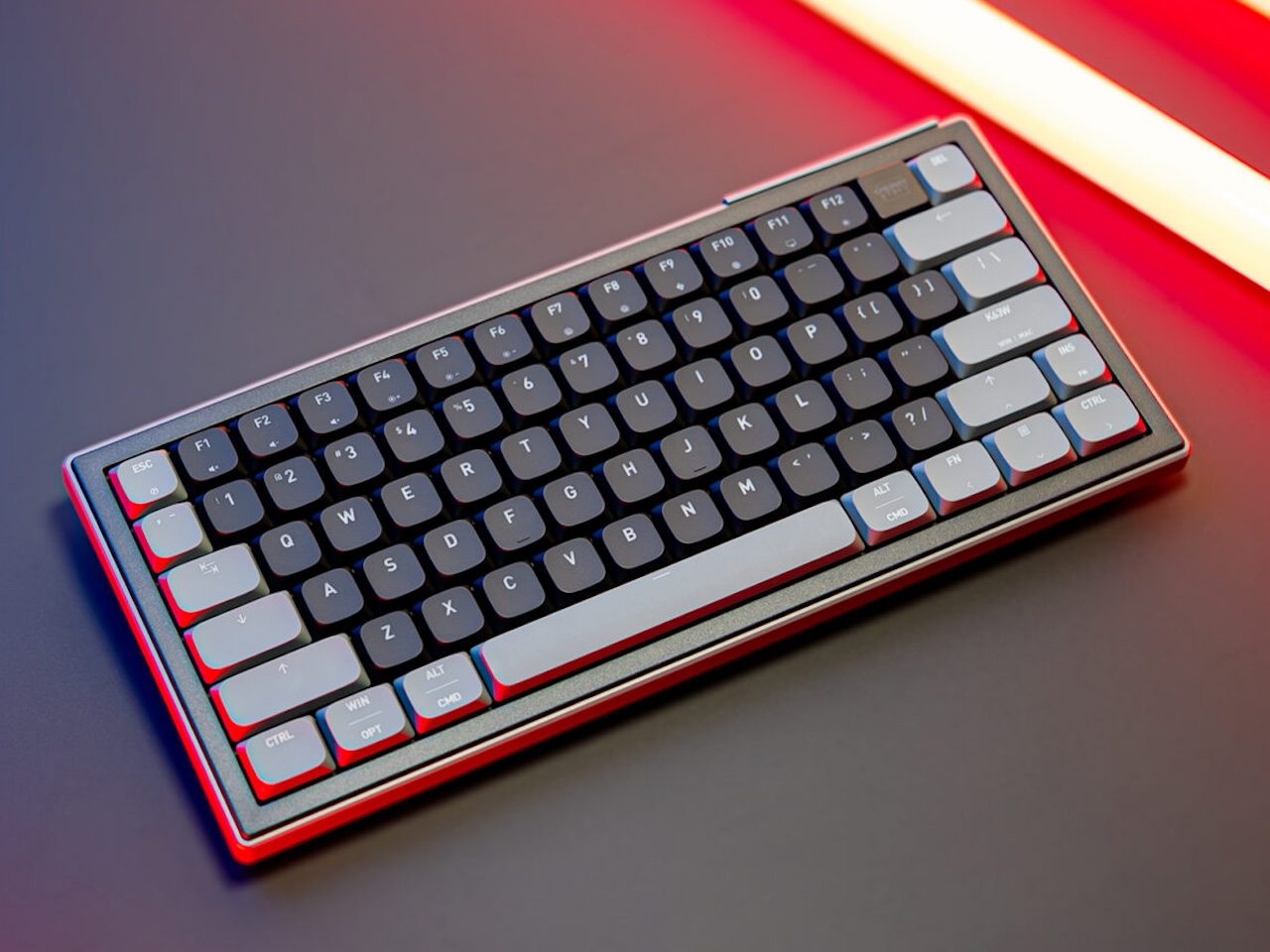
MX Low Profile 2.0 switches shorten travel compared to standard-height keyswitches, which reduces the keyboard’s overall profile and changes wrist angle across a long session. Gasket mounting absorbs vibration that a rigid plate concentrates at the fingertips, though how much that matters in practice depends on your switch preference, typing force, and how long you run at a stretch. At 820 g and 307 x 135 x 30 mm, the board carries more heft than most compact wireless boards its size, and the detachable 1.8-meter braided USB-C to USB-A cable means wired mode doesn’t depend on a delicate connector. That’s the part of the feel story a spec sheet can’t fully resolve.
What the Launch Doesn’t Tell US Buyers
€179.99 is the confirmed launch price, and nothing beyond that is settled for buyers outside the covered markets. Regional pricing, import costs, and local stock availability can move the value case enough to change the recommendation entirely.
Battery figures from any manufacturer warrant the same skepticism: the 1,100-hour ceiling describes the lowest-power configuration, meaning minimum polling, RGB off, and stable temperature. Sustained 8,000 Hz wireless with per-key lighting active will return a considerably smaller number, and CHERRY XTRFY hasn’t published a use-scenario breakdown that shows where real daily-use hours land. Runtime claims are worth checking against your own setup once real units are in hands, not against the announcement’s best-case framing.
Nothing in the COMPUTEX 2026 announcement includes independent testing of any kind. Every performance figure in the sections above comes from CHERRY XTRFY’s own release materials.
The Bottom Line
The K63W Pro has a cleaner product argument than most keyboard launches, because it leads with infrastructure rather than a spec checklist. Putting UWB connectivity into a 70% gasket-mounted board with matching wired and wireless polling is a specific bet on what actually limits wireless performance in a real desk environment. That bet only pays off if the UWB advantage holds up in the environments where wireless keyboards usually struggle: crowded conference rooms, LAN events, apartments stacked with routers and headsets. If you play in a radio-dense setup, travel with your keyboard, or want wireless polling parity without giving up the function row, this is worth tracking once a US retail channel and ship date land.
Price: €179.99
Where to Buy: Cherry
Skip it if you want a full-size layout, a numpad, or a confirmed US retailer and ship date before deciding. Skip it also if previous high-polling wireless boards haven’t changed your experience: the UWB case depends on your environment being the limiting factor, not your reaction time.