You’re shopping for a MacBook Air in 2026 and facing a rare choice: Apple’s still selling the M4 alongside the newer M5. At first glance the M5 costs $100 more, but it ships with double the base storage and Wi-Fi 7. With retailers already discounting the M5 below its launch price, the decision’s trickier than it looks. Here’s how the specs, street pricing, and real-world use cases break down so you can pick the right one without overpaying.
Price: From $1,099
Where to Buy: Apple MacBook Air M5 15-inch, 16GB / 512GB Starlight | Amazon
Why Apple Still Sells the M4 Alongside the M5
The M4 MacBook Air arrived in March 2025. The M5 followed exactly one year later on March 11, 2026. Apple set the new model at $1,099 for the 13-inch base configuration, $100 above the M4’s original $999 launch price.
Despite the refresh, Apple didn’t retire the M4. The 13-inch M4 is still listed on apple.com, with configurations spotted in the $859 to $999 range depending on storage and memory. The pattern is familiar: keeping the previous generation in the lineup gives education buyers and budget-conscious shoppers a lower entry point without forcing Apple to officially discount its newer hardware. Apple also runs its standard education discount on the M5 itself, bringing the 13-inch to $999 and the 15-inch to $1,199 for qualifying students and staff. That program tightens the price gap further if you can claim it.
That overlap is precisely why this comparison matters right now. For roughly two months after launch, the M5 sat at a clean $100 premium. May 2026 changed that.
Four Concrete M5 Upgrades Over the M4
The M5 isn’t a redesign. It’s a focused internal refresh that touches four areas.
1. The chip. The M5 keeps the same 10-core CPU layout as the M4 but rebrands the four performance cores as “super cores,” reflecting architectural changes. GPU options remain 8-core or 10-core, and Apple now puts a Neural Accelerator inside each GPU core alongside a third-generation ray-tracing engine. The bigger story is memory bandwidth: 153 GB/s on the M5 versus 120 GB/s on the M4, which Apple pegs as a 28 percent improvement in its own newsroom announcement. The 16-core Neural Engine carries over, but the GPU-side Neural Accelerators are a chip-level addition that the M4 spec sheet doesn’t list.
2. Storage. The base M5 ships with a 512GB SSD, configurable up to 4TB. The M4 starts at 256GB and tops out at 2TB. Apple doubled both the entry point and the ceiling, and claims the M5’s SSD is up to 2x faster on reads and writes versus the M4. For anyone who has watched a base MacBook Air fill up in eighteen months, that change matters as much as the chip.
3. Wireless. The M5 introduces Wi-Fi 7 (802.11be), Bluetooth 6, and Thread networking, all routed through Apple’s new N1 wireless chip. The M4 sticks with Wi-Fi 6E and Bluetooth 5.3. Wi-Fi 7 doubles theoretical peak throughput compared to Wi-Fi 6E and adds multi-link operation, which keeps a connection stable across congested bands.
4. External display support. This one slips past most launch coverage. The MacBook Air M5 can drive a single external display at up to 8K at 60Hz, 5K at 120Hz, or 4K at 240Hz through one Thunderbolt port, or two displays at up to 6K at 60Hz or 4K at 144Hz. The M4 tops out at two displays at 6K at 60Hz. For anyone running a high-refresh external monitor, the M5 is the only Air that can keep up.
The camera is the one place where Apple’s marketing implies a change but the spec sheets don’t. Both models carry the same 12MP Center Stage camera with Desk View and 1080p video. Apple lists the image signal processor with computational video on both pages in identical language.
Small win: the charger. The M5 ships with a 40W Dynamic Power Adapter rated to 60W max. The M4 ships with either a 30W USB-C adapter (8-core GPU base) or a 35W Dual USB-C Compact adapter (10-core GPU configuration). Not a headline reason to upgrade, but one more spec that quietly moves up.
What Stayed Identical
If you put the two machines side by side, you can’t tell them apart. The chassis dimensions match to the hundredth of an inch. Weight differs by a single hundredth of a kilogram (1.23 kg for the M5, 1.24 kg for the M4). The colors, ports, display, battery, and speaker layout carry over without changes.
| Spec | M5 (2026) | M4 (2025) |
|---|---|---|
| Display | 13.6-inch Liquid Retina, 2560×1664, 500 nits, P3, True Tone | 13.6-inch Liquid Retina, 2560×1664, 500 nits, P3, True Tone |
| Ports | MagSafe 3, 2x Thunderbolt 4, 3.5mm | MagSafe 3, 2x Thunderbolt 4, 3.5mm |
| Battery | 53.8Wh, up to 18hr video / 15hr web | 53.8Wh, up to 18hr video / 15hr web |
| Base RAM | 16GB unified (max 32GB) | 16GB unified (max 32GB) |
| Weight (13-inch) | 2.7 lbs (1.23 kg) | 2.7 lbs (1.24 kg) |
| Colors | Sky Blue, Midnight, Starlight, Silver | Sky Blue, Midnight, Starlight, Silver |
| Camera | 12MP Center Stage, 1080p | 12MP Center Stage, 1080p |
| Audio | Four-speaker, Spatial Audio, 3-mic | Four-speaker, Spatial Audio, 3-mic |
| Authentication | Touch ID | Touch ID |
If you’re upgrading from anything older than an M2 Air, neither generation will feel different in the hand. The decision lives entirely inside the chassis.
MSRP vs Street Price: How Discounts Flipped the Value Equation
This is the part most launch-day comparisons missed.
| Model | MSRP | Street Price (May 2026) |
|---|---|---|
| 13-inch M5 (512GB/16GB) | $1,099 | $949 (Amazon, Walmart) |
| 15-inch M5 (512GB/16GB) | $1,299 | $1,149 (Amazon) |
| 13-inch M4 (256GB/16GB) | $999 | $859 to $999 (clearance) |
Independent reporting in May 2026 pegged the M5 at record-low pricing at Amazon and Walmart unusually soon after launch. At roughly $949 for the 13-inch M5 versus roughly $999 for an M4 still being stocked by Apple, the newer machine is now cheaper than the older one while shipping with twice the storage and a generation-newer wireless stack.
That’s the inversion that makes this comparison interesting. On launch day, the M4 was the value pick. Two months later, the M5 is.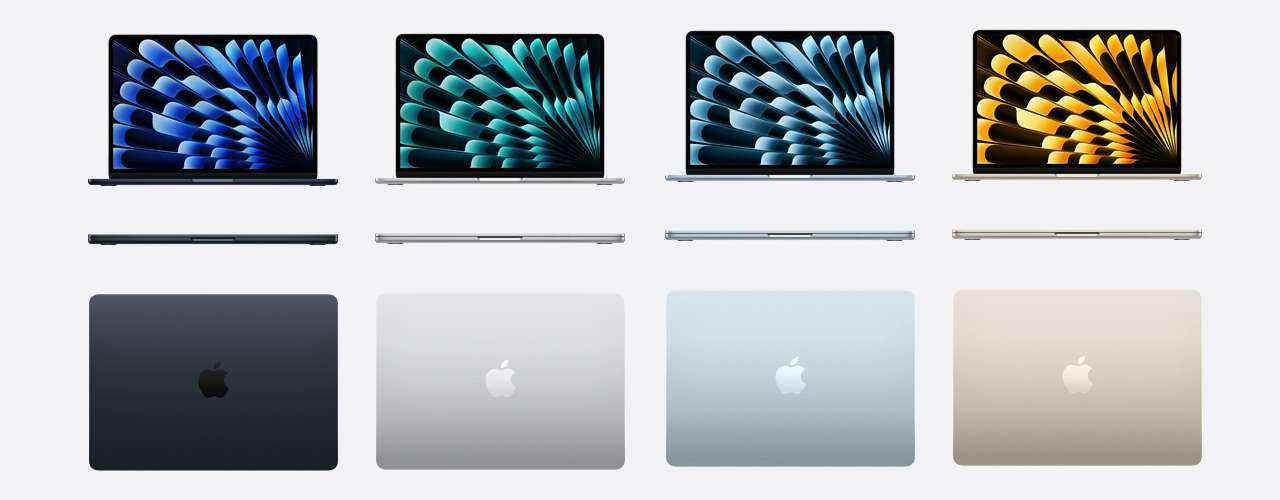
Which Everyday Tasks Actually Benefit From the M5 Chip
The 28 percent memory bandwidth jump and the new GPU-side Neural Accelerators show up clearly in Apple’s own testing numbers. Per Apple’s M5 newsroom announcement, the M5 is up to 4x faster on AI tasks versus the M4, up to 9.5x faster versus the M1, up to 1.9x faster in Topaz Video Enhance, and up to 1.5x faster in both Blender 3D ray-tracing and Affinity image processing, all measured against the M4. Those are Apple-tested figures, not independent benchmarks, but they line up with where the spec gains land in practice.
- On-device AI: Apple Intelligence features like Writing Tools, image generation, and notification summaries run faster on the M5’s Neural Accelerators, which the M4 doesn’t list separately.
- Video editing: Higher bandwidth helps Final Cut Pro scrubbing, color grading, and ProRes encode and decode throughput. The 153 GB/s figure is the spec that matters here.
- Multi-monitor setups: If you’re driving an 8K, 5K at 120Hz, or 4K at 240Hz external display, the M5 is the only Air that supports it.
- Large creative files: The 512GB base storage gives photographers and video editors room to breathe without an immediate external drive purchase.
For light everyday tasks like web, email, document work, and video calls, both chips are overpowered. You won’t feel a practical difference. The M5 advantages are real, but they are concentrated in workloads that already push the Air.
When the M4 Still Makes Sense and What Discount to Target
The M4 isn’t obsolete. It’s just no longer the default value pick.
The M4 still earns its slot if you find it at $799 or below on clearance and you don’t need Apple Intelligence acceleration or a high-refresh external monitor. Students and budget buyers who live in browsers, document editors, and video calls won’t notice the chip difference. Anyone who already owns 512GB or more of external storage and uses Wi-Fi 6E happily can ignore the wireless upgrade.
The math gets specific. At $949 for a 512GB M5, the M4 needs to land at roughly $749 or less for its 256GB base configuration to match the M5’s price per gigabyte of storage. If you find an M4 16GB/256GB at the $859 price seen in some Apple community listings, you’re paying more per gigabyte than the discounted M5 and getting older wireless. Above $799, the M5 wins the value argument almost every time.
13-inch vs 15-inch and Whether RAM Upgrades Change the Math
The 15-inch M5 starts at $1,299 MSRP and has been seen at $1,149 street. That’s a $200 MSRP premium over the 13-inch for the larger 15.3-inch diagonal. Apple’s newsroom strongly implies the 15-inch base model ships with a 10-core GPU versus the 8-core GPU on the 13-inch base (confirm against the 15-inch spec page before publish). If that holds, the extra GPU cores plus the bigger canvas make the 15-inch the more capable machine at the entry tier, not just a larger one.
RAM is the one config choice you can’t walk back. Both M4 and M5 Airs ship with 16GB unified memory at the base tier and max out at 32GB. There’s no aftermarket upgrade path. If you keep your laptop for four or five years and run anything resembling pro workloads, the bump to 24GB is the sweet spot. 32GB is reserved for heavy video work or virtualization. 16GB is fine for most people, and Apple has tuned macOS aggressively for unified memory, but plan for the workload you’ll have in year four, not year one.
Final Verdict
| Buyer profile | Recommendation |
|---|---|
| Most buyers | 13-inch M5 at $949 street: more storage, Wi-Fi 7, and longer software runway for $50 less than an MSRP M4 |
| Tight budget | M4 only at $749 or below clearance, otherwise the M5 wins on value |
| Power and creative users | M5 with a 24GB RAM upgrade. 512GB base is workable but 1TB is worth considering for video |
| Dual-monitor or high-refresh external setups | M5 required for 8K at 60Hz, 5K at 120Hz, 4K at 240Hz single-display, or 4K at 144Hz dual-display |
| 15-inch buyers | 15-inch M5 at $1,149 street, which adds a 10-core GPU at base for $200 more than the 13-inch |
Price: From $1,099
Where to Buy: Apple MacBook Air M4 15-inch, 16GB / 256GB Midnight | Amazon
The headline-grade simplification: if you’re choosing today and you can find the M5 at street price, buy the M5. The $100 MSRP gap that defined this comparison on launch day has been erased by retailer discounting, and the M5 ships with macOS Tahoe out of the box, which buys you the longest software support runway in the Air lineup. Apple’s older model is now harder to justify unless you find it on deep clearance. The M4’s still a good MacBook. It’s just no longer the smart MacBook to buy.