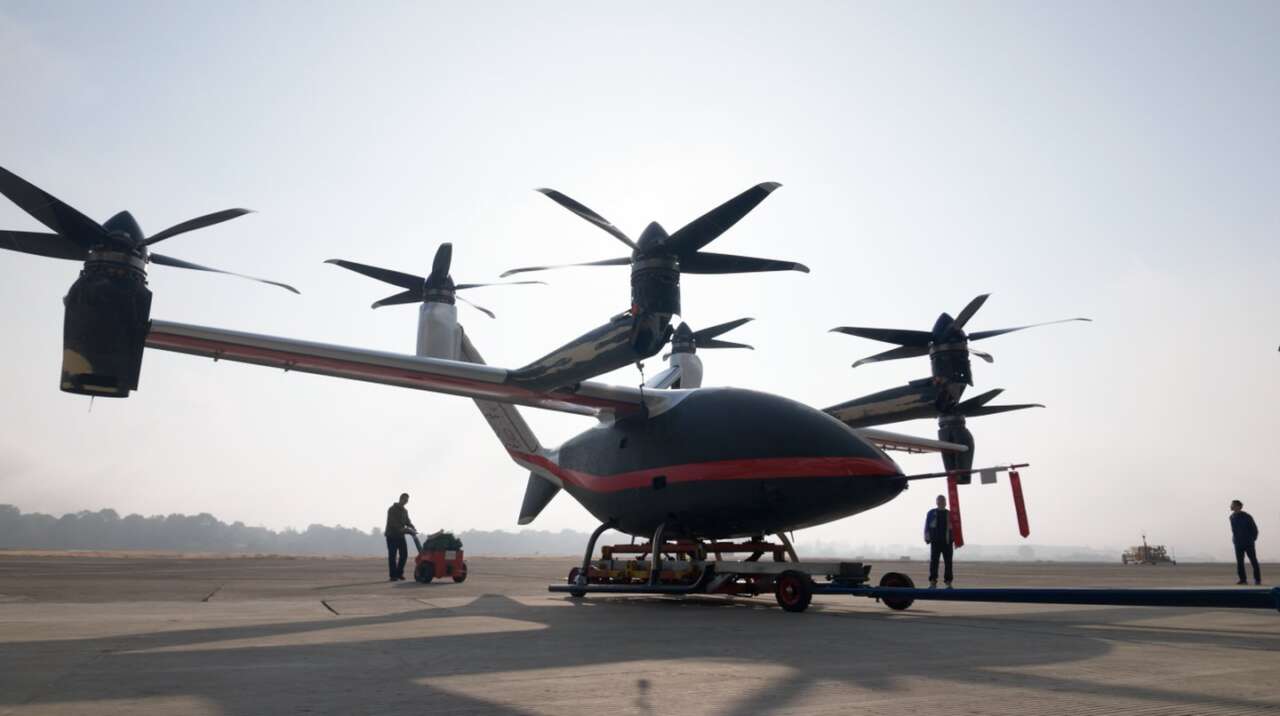
ARIDGE’s A868 has done the thing that separates a real tiltrotor from a hover toy with a rendering attached. The full-scale prototype tilted all six rotors from vertical lift into forward thrust, settled onto the wing for cruise, then tilted back and landed the same way it left.
I watched the sequence twice. The second time was slower, looking for a wobble in the middle where lift hands off to the wing, and that handoff is exactly where these aircraft tend to show you plainly whether the control laws actually work.
This one held together. That does not make it a product yet, and ARIDGE is not pretending otherwise.
Hover tests finished a year ago proved the A868 could leave the ground and come back under control, which is necessary and not especially interesting on its own. They never tested the wing, and the wing is the whole bet here, because a battery heavy aircraft that cruises badly will never reach a 500 km target however clean its hover looks.
ARIDGE posted the full sortie, not a highlight cut: crew tow the prototype out, six rotors spin up, it lifts into a hover, rolls the nacelles forward over open country, cruises in fixed-wing configuration, then reverses the move and settles back onto the runway. Watch it in order and you get the complete argument in one run, takeoff to landing, with no edit hiding the transition itself.
Price: TBD (flight-test prototype; ARIDGE has announced no price and no order book)
Where to buy: More details at ARIDGE
Why every rotor tilts
Most eVTOL designs that tilt anything tilt only part of the propulsion. The rest stays fixed in the lift position for the entire flight, cruise included, which is easier to control and leaves those fixed rotors riding through cruise as drag.
The A868 tilts all six. Nothing on this aircraft exists only for takeoff, so nothing rides along as dead weight once the wing takes over, and that is the efficiency case for doing it the hard way. The cost is real too, because every degree of nacelle movement feeds straight into the flight control solution, which is why people keep calling full tiltrotors electric Ospreys and why so few builders have committed to the layout.
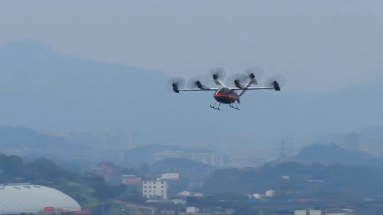
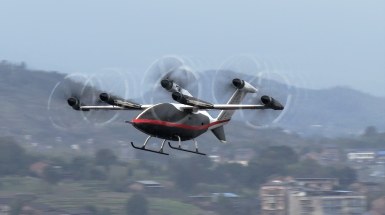
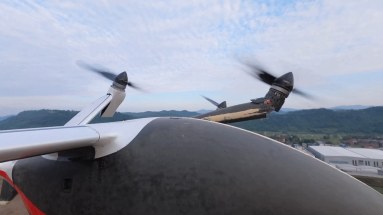
Few builders have committed to this route at all, and now ARIDGE is in that small group on video evidence rather than on a claim in a deck. I would still want repeats before I called the maneuver routine, because one clean transition proves the aircraft can do it and repeated transitions at different weights and speeds prove a program can trust it.
Built for range, not hops
The powertrain is hybrid-electric, built around a range extender that generates electricity in flight, and ARIDGE designs the A868 for roughly 500 km (311 miles) of range at a cruise speed around 360 km/h (224 mph). No battery-only aircraft in this class is flying figures like those today, which is the point of carrying the extender.
Is 500 km believable? On paper, yes, more believable than the same number from a pure battery design, because the wing does the efficient work in cruise and the extender keeps feeding the motors instead of asking a pack to carry the whole trip. In practice it is still a design target, not a demonstrated range, and this flight did not prove it.
Six seats fill the cabin, and ARIDGE aims the A868 at business travel between city clusters rather than short hops across a single city. It is the long-range half of a two-product plan, while the company’s Land Aircraft Carrier covers personal recreational flight with a smaller aircraft docked in a road vehicle.
That positioning is where it stacks up differently from the rest of the eVTOL field as this piece has described it. Most of the category is built around short urban hops, semi-tilt layouts and battery limits, while the A868 is arguing for intercity distance, full tilt and hybrid power, a harder aircraft to certify and a more useful one if the numbers hold.
The safety case runs on redundancy. The electric drive carries two independent windings, so a single winding fault still leaves enough power to land safely, and flight control is fully redundant on the same logic, designed to keep the aircraft flyable if one system fails outright rather than sharing a single point of failure.
A year from first hover to full transition
The aircraft broke cover at XPENG AI Day in Guangzhou in November 2025, shown as a six-seat hybrid-electric tiltrotor. It went from unveiling to first flight in the same month, then spent twelve months on hover and landing verification, repeating the basics until the team trusted the aircraft in the air before stepping into the full tiltrotor regime.
ARIDGE sits inside the XPENG Group. It ran this program under its XPENG AEROHT name until the rebrand, and the company calls itself the largest flying car company in Asia, with the A868 as its flagship bet that the category’s future is intercity, not intracity.
What has not been published is just as specific. There is no location or duration for the transition flight, no certification timeline and no price, and there is no order book to quote or a date for passenger service either, so every number attached to the A868 today is a target rather than a specification sheet you can hold the company to.
Would I ride in it? Not yet, and I suspect ARIDGE would not ask me to. I would ride in it after the envelope work is done, after the transition has been repeated at different weights, speeds and altitudes and after the redundant drive and flight control systems have been proven against simulated failures, because that unglamorous program is what turns a striking flight video into an aircraft a regulator can talk about certifying.
The A868 is no longer a hover demonstrator with a cruise claim attached. It has flown the cruise configuration and come back through the maneuver in reverse, and the open questions from here are the ones that decide every eVTOL program in the end: certification, price and a timeline anyone outside the company can verify.
Price: TBD (flight-test prototype; ARIDGE has announced no price and no order book)
Where to buy: More details at ARIDGE