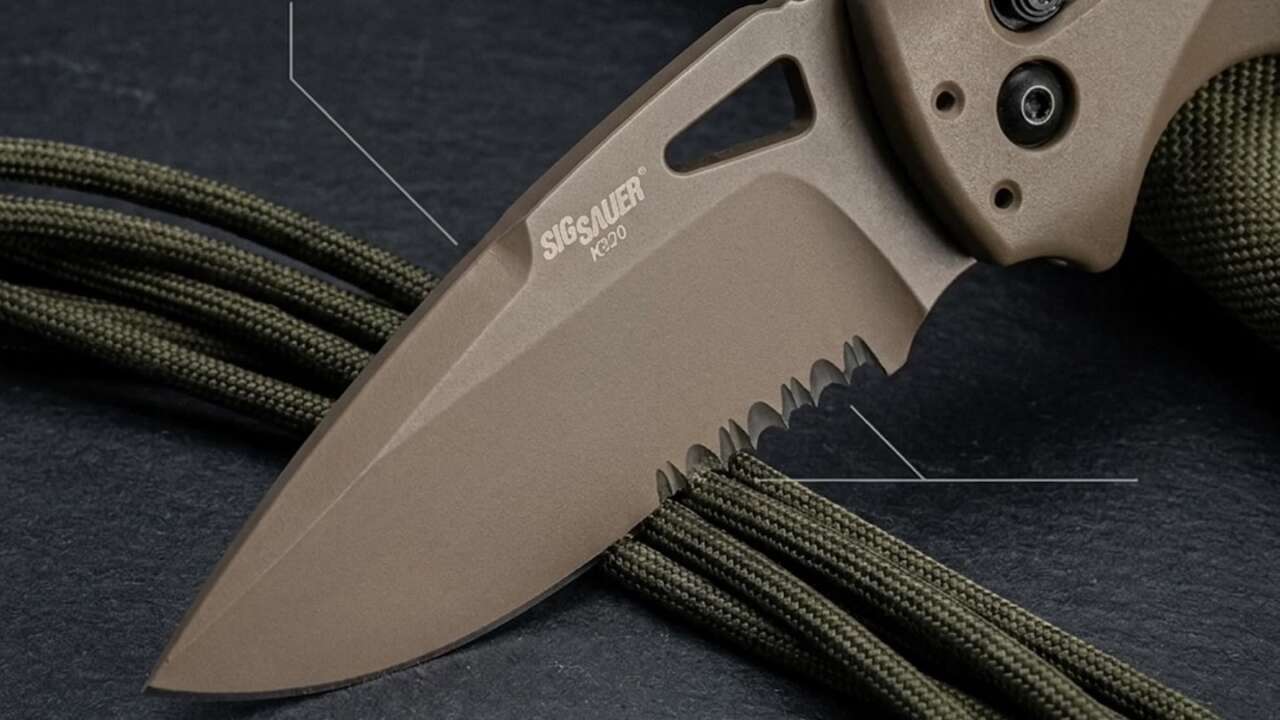
Hogue’s SIG SAUER K320 AXG Scorpion costs $238.46, and its aluminum frame, G10 inserts, and partially serrated drop-point blade give you a different build from the $188.96 K320 M17/M18. You’re paying $49.50 more for that build.
Price: $238.46
Where to Buy: Amazon
The M17/M18 pairs a lighter glass-fiber-reinforced polymer handle with a partially serrated tanto blade, while both knives share CPM S30V steel, an ambidextrous ABLE Lock, and a four-position pocket clip. For everyday carry, the lighter M17/M18 wins on value.
Drop Point Versus Tanto: Which Blade Makes More Sense?
Opening packages, slicing cardboard, and cutting cord are common jobs for a folding knife. Blade geometry affects how the cutting edge contacts those materials, and these two models take different approaches.
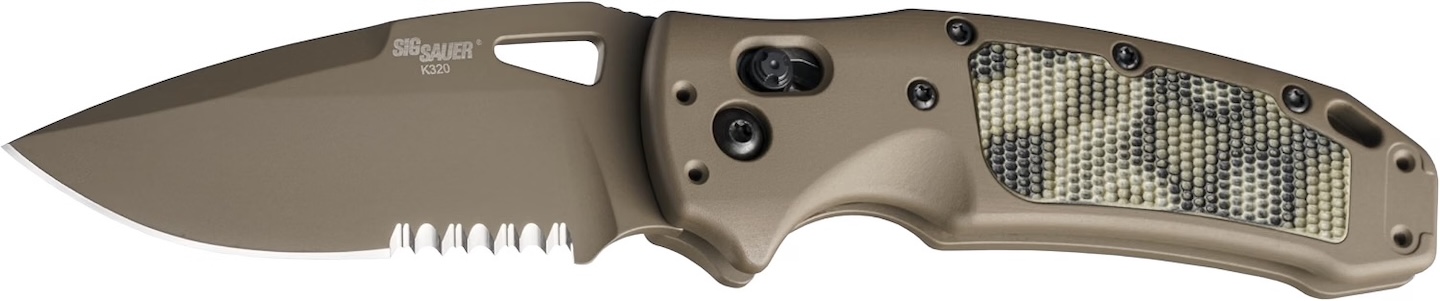
Hogue equips the Scorpion with a 3.5-inch CPM S30V drop-point blade. Its curved belly provides a sweeping cutting edge for general slicing, while partial serrations near the handle are designed for fibrous materials such as rope and webbing.
A 3.5-inch tanto blade gives the M17/M18 a straighter primary cutting edge and an angular tip with a defined secondary point. It uses the same CPM S30V steel and includes partial serrations, so the difference is in the blade profile, not the steel.
Both blades receive cryogenic heat treatment. Neither has a documented advantage in steel grade or heat treatment based on the supplied specifications.
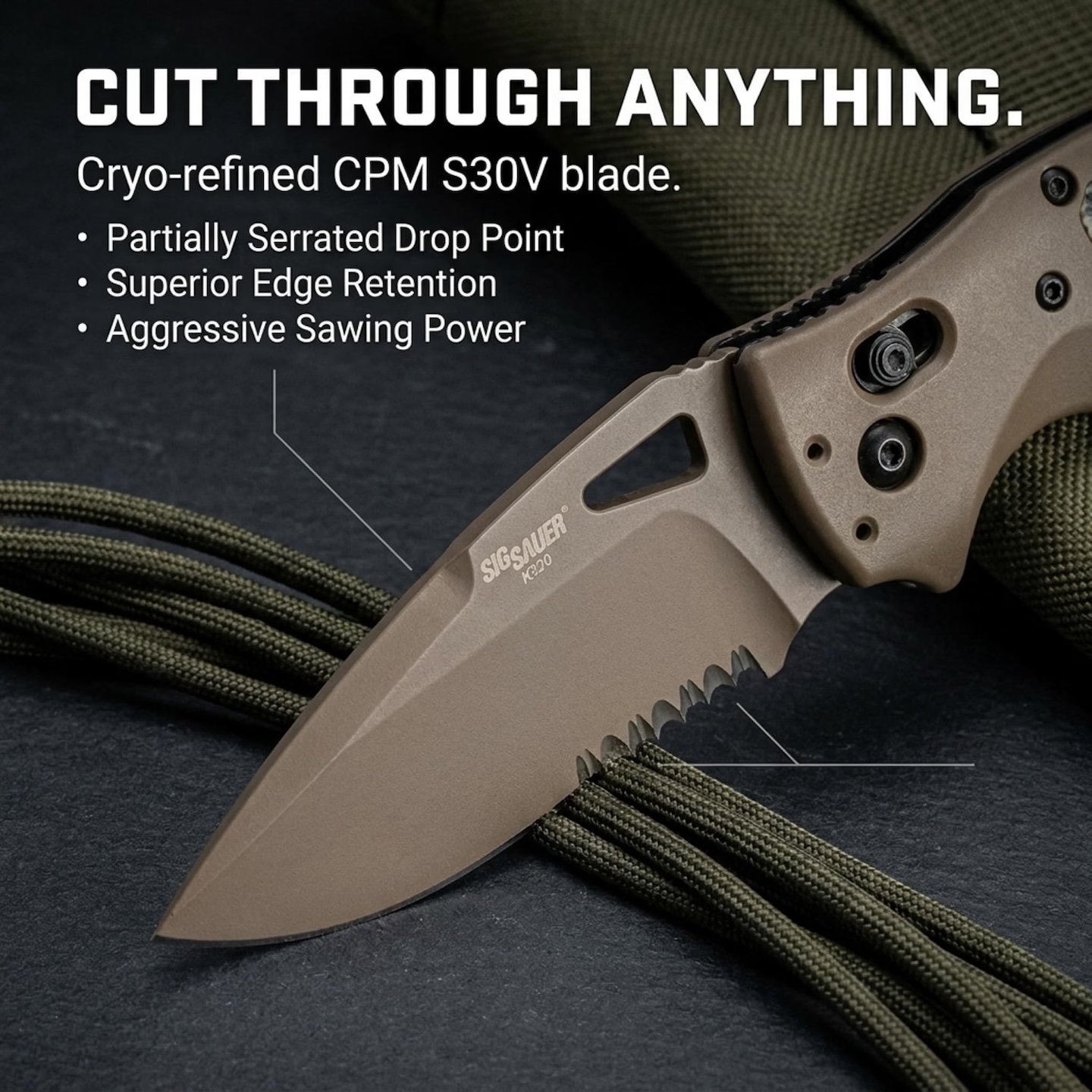
For general-purpose slicing, the Scorpion’s drop point is the more practical choice. The M17/M18 makes sense for buyers who prefer a tanto profile and its pronounced tip.
Aluminum and G10 Versus Reinforced Polymer
Handle construction is the clearest reason to choose one model over the other. You get a metal frame with separate grip inserts on the Scorpion, while the M17/M18 uses a lighter polymer design.
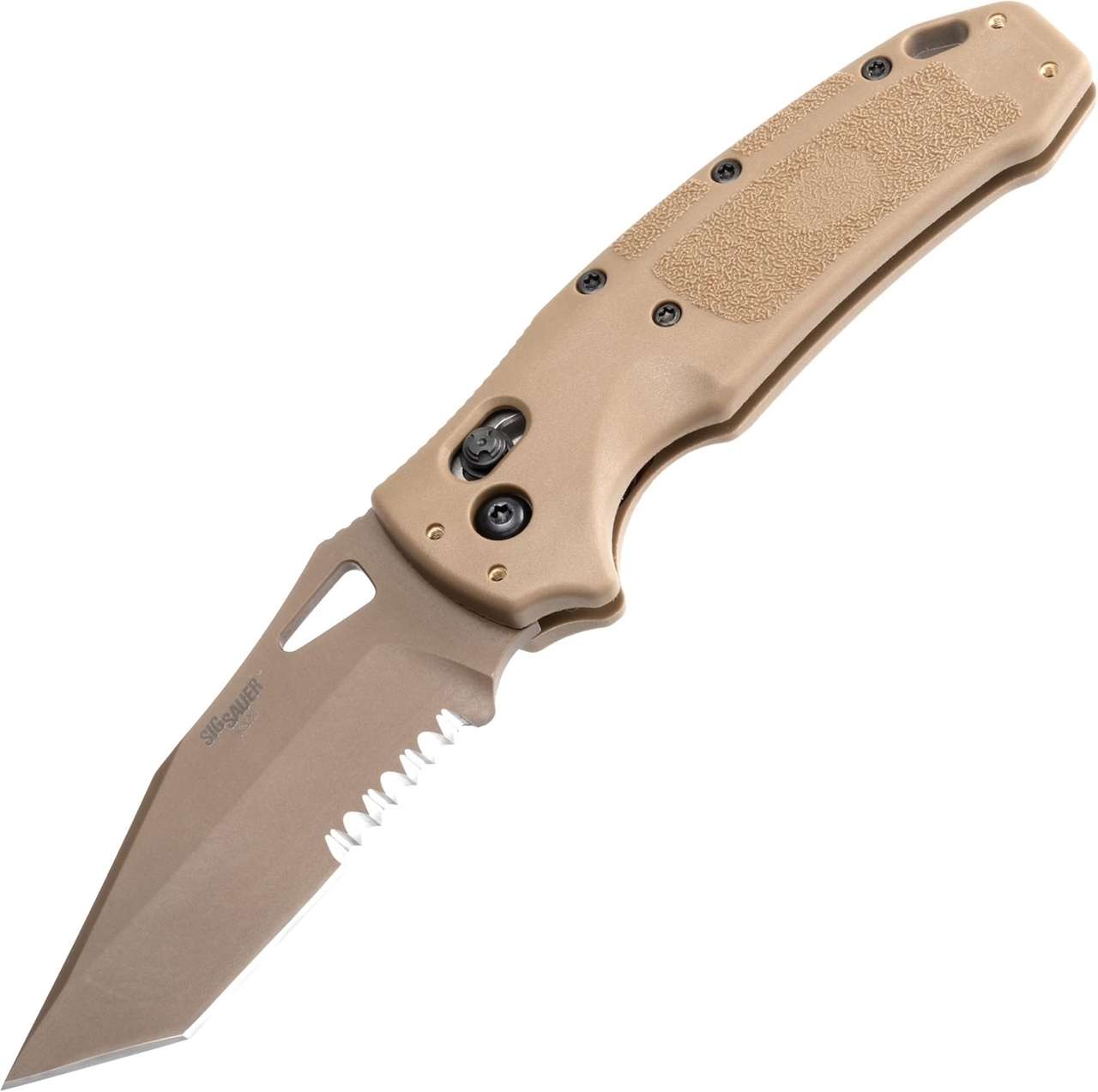
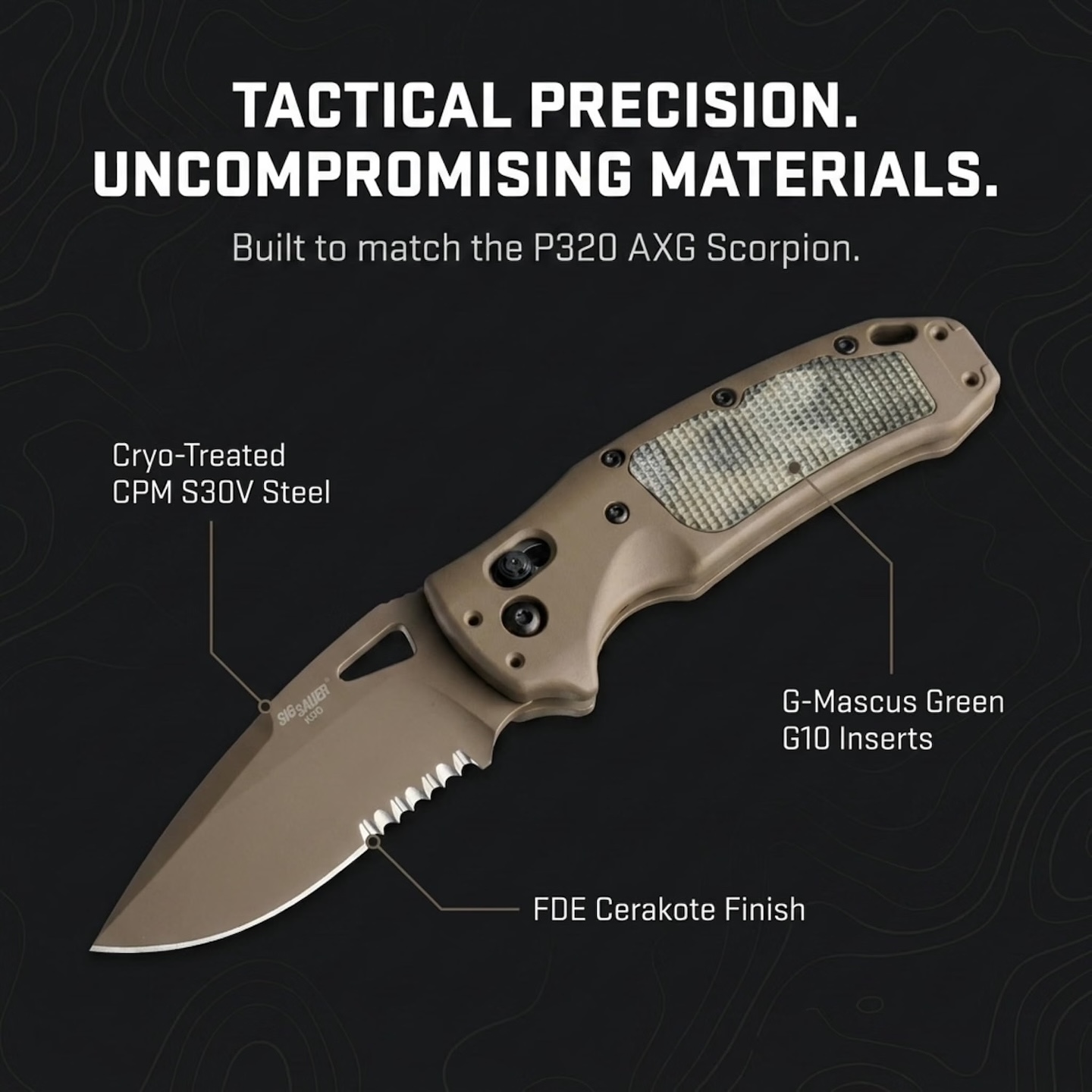
Hogue uses a 6061-T6 hard-anodized aluminum frame with green G-Mascus G10 inserts for the Scorpion. Its textured panels provide gripping surfaces, and the FDE finish gives the handle its distinctive appearance.
Glass-fiber-reinforced polymer forms the M17/M18 handle. A stippled texture provides a patterned gripping surface, while the Coyote Tan color follows the SIG SAUER M17 and M18 styling.
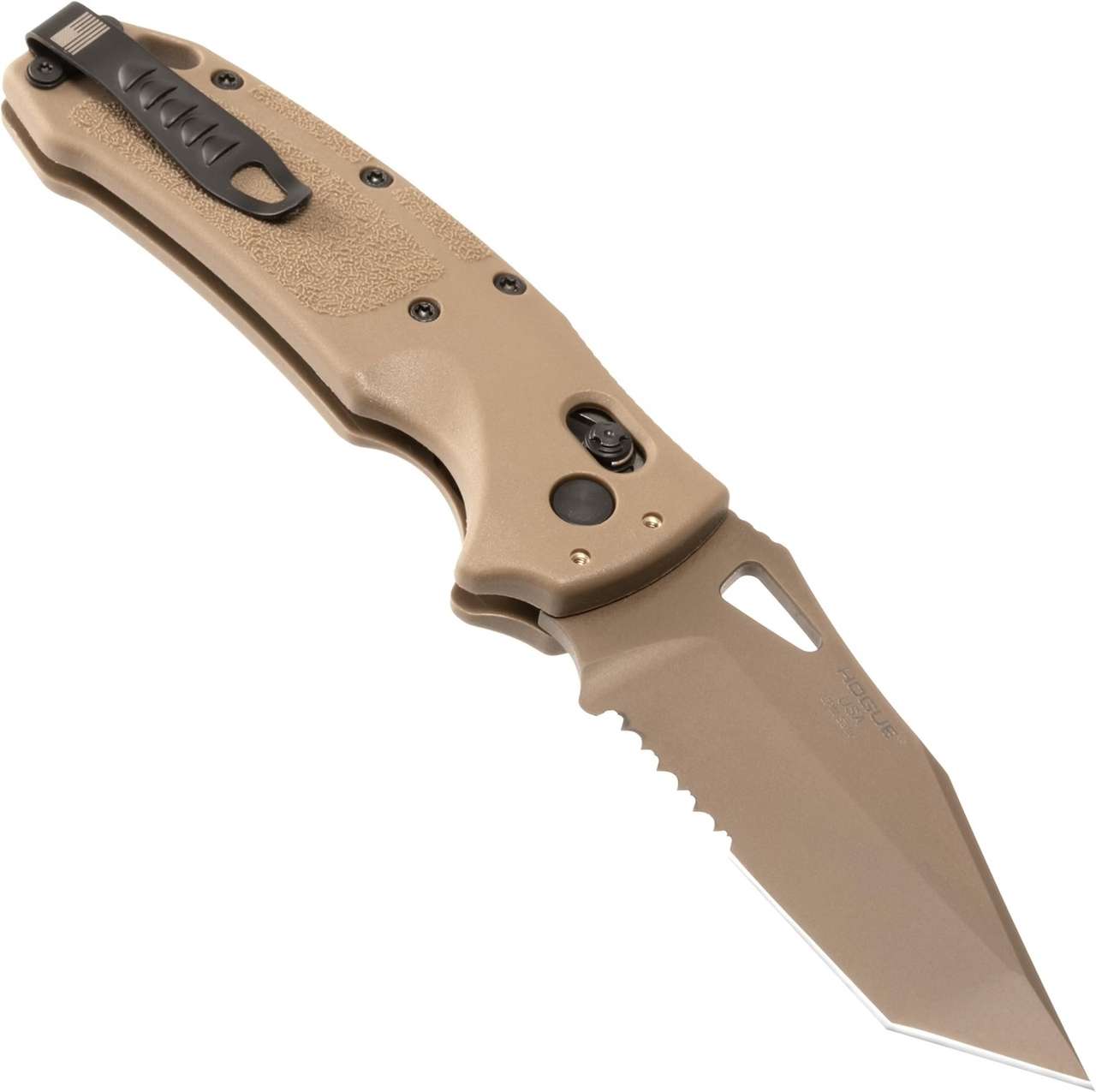
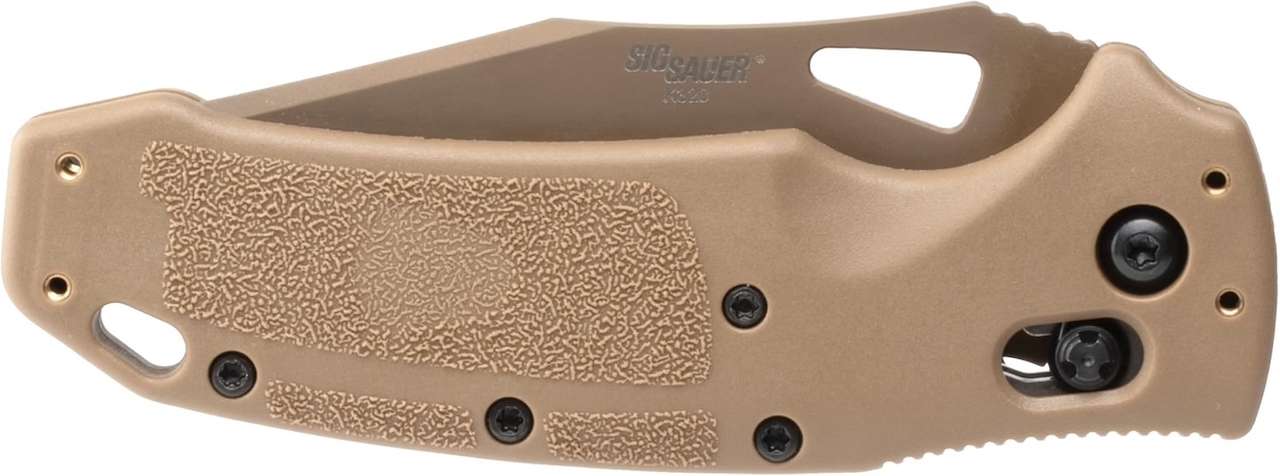
Hogue lists the K320 AXG line at 5.1 ounces and the M17/M18 at 4.18 ounces, making the latter 0.92 ounce lighter. Both measure 8 inches overall and 4.5 inches closed.
Choose the Scorpion for its aluminum-and-G10 construction. If you want to reduce pocket weight, the M17/M18 has the advantage.
ABLE Lock and Pocket Carry
Both knives use Hogue’s Manual ABLE Lock, an ambidextrous bar-lock mechanism that can be operated from either side. Right- and left-handed users get the same locking arrangement.
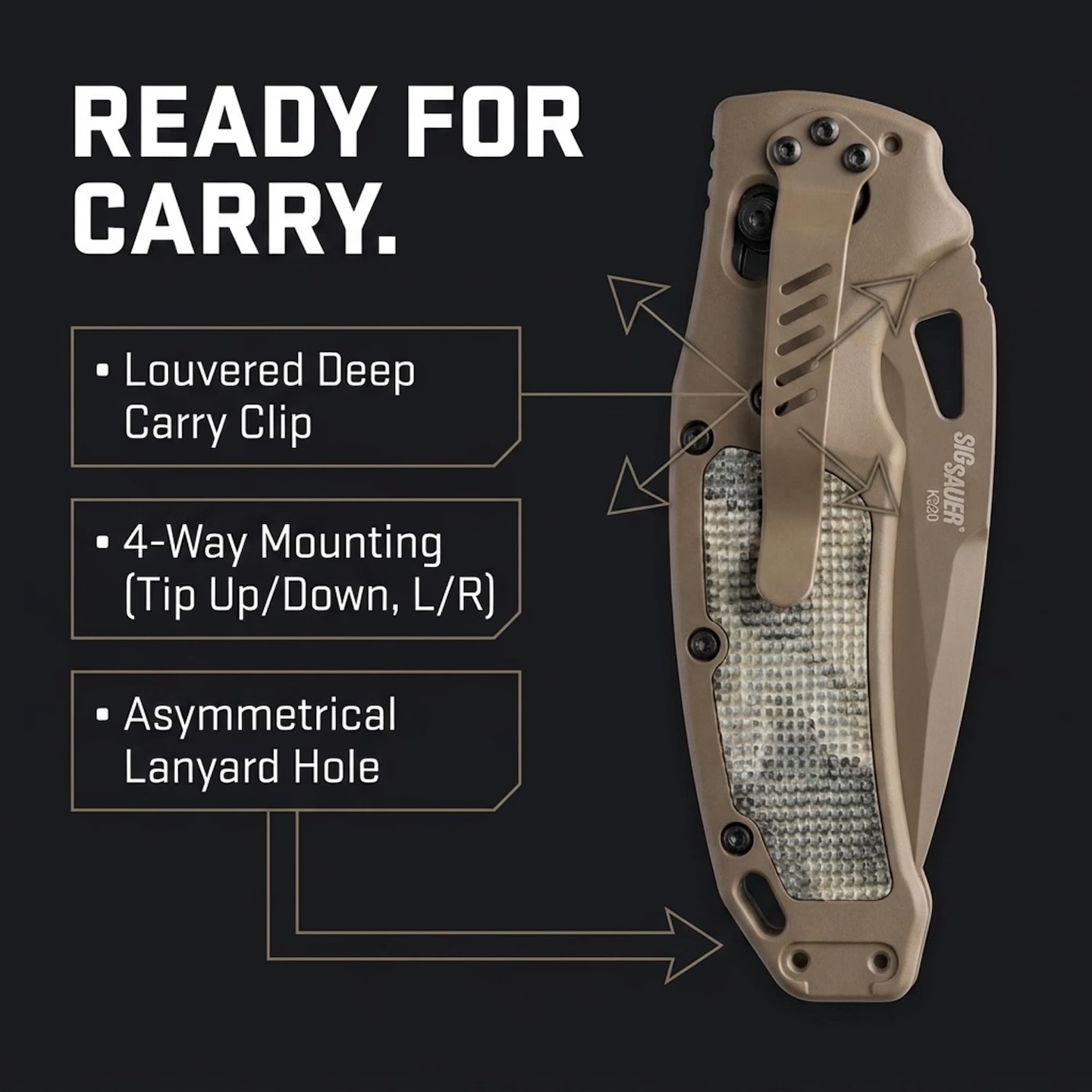
A louvered deep-carry pocket clip supports four mounting positions, allowing right- or left-side placement with tip-up or tip-down orientation. Both models also include a lanyard hole.
Neither knife offers additional locking or pocket-clip configurations in the listed specifications. The shared mechanism and carry options give the M17/M18 a clear value advantage for buyers focused on these features.
Cerakote Versus PVD Blade Finishes
Hogue uses different protective coatings on the two blades. The Scorpion receives an FDE Cerakote finish, while the M17/M18 uses Coyote Tan PVD.
Cerakote is a ceramic-based coating intended to provide corrosion protection. Its flat dark earth color complements the Scorpion’s aluminum frame and green G10 inserts.
PVD, or physical vapor deposition, creates a protective surface layer on the M17/M18 blade. Hogue describes the finish as scratch-resistant, and its Coyote Tan color coordinates with the polymer handle.
Both coatings provide surface protection, but the supplied specifications don’t establish which performs better under identical conditions. Choose the finish based on your preferred appearance, not an assumed durability advantage.
Hogue K320 AXG Scorpion vs. M17/M18: Specifications Compared
| Specification | AXG Scorpion | M17/M18 |
|---|---|---|
| Model number | 36378 | 36363 |
| Blade shape | Drop point | Tanto |
| Blade length | 3.5 inches | 3.5 inches |
| Blade steel | CPM S30V | CPM S30V |
| Blade edge | Partially serrated | Partially serrated |
| Handle | Aluminum with G10 inserts | Glass-fiber-reinforced polymer |
| Blade finish | FDE Cerakote | Coyote Tan PVD |
| Lock | Manual ABLE | Manual ABLE |
| Overall length | 8 inches | 8 inches |
| Closed length | 4.5 inches | 4.5 inches |
| Weight | 5.1 ounces (Hogue AXG line); 5.2 ounces (Blade HQ, model 36378) | 4.18 ounces (Hogue) |
| Pocket clip | Four-position | Four-position |
| Price | $238.46 | $188.96 |
Which Hogue K320 Is the Better Buy?
The M17/M18 is the better value at $188.96. You get CPM S30V steel, an ambidextrous ABLE Lock, and four-position pocket-clip mounting in a lighter package. Its polymer handle and tanto blade keep the price below the Scorpion while retaining the same core features.
Spending $238.46 on the Scorpion gets you a 6061-T6 aluminum frame, G10 inserts, and a drop-point blade. Those differences justify the higher price for buyers who prefer metal construction and a curved cutting edge for general slicing.
Neither model has a documented advantage in blade steel or locking mechanism. You’re paying for a different handle and blade profile, not an upgrade to the shared components.
Price: $188.96
Where to Buy: Amazon
On specifications and the prices listed here, I’d point buyers who prioritize lower weight and cost to the M17/M18. The Scorpion is the more appealing option for those who specifically want an aluminum-and-G10 handle and a drop-point blade.