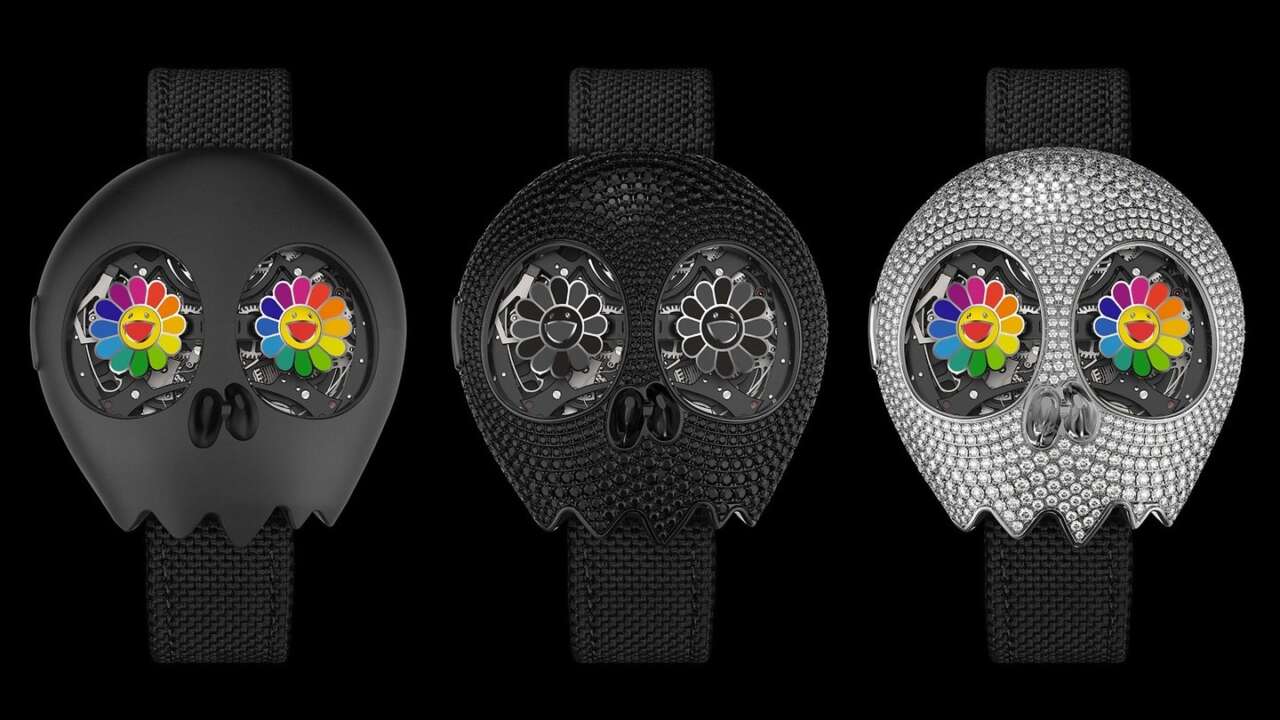
Takashi Murakami has spent five years putting his smiling flowers on other brands’ watches. Now the watch is his own. Time Objects, a new brand under his Kaikai Kiki company, opens with the Skull Flowers Cylindrical Jumping Hours Tourbillon, a sculpted titanium skull that keeps the time in its jaw.
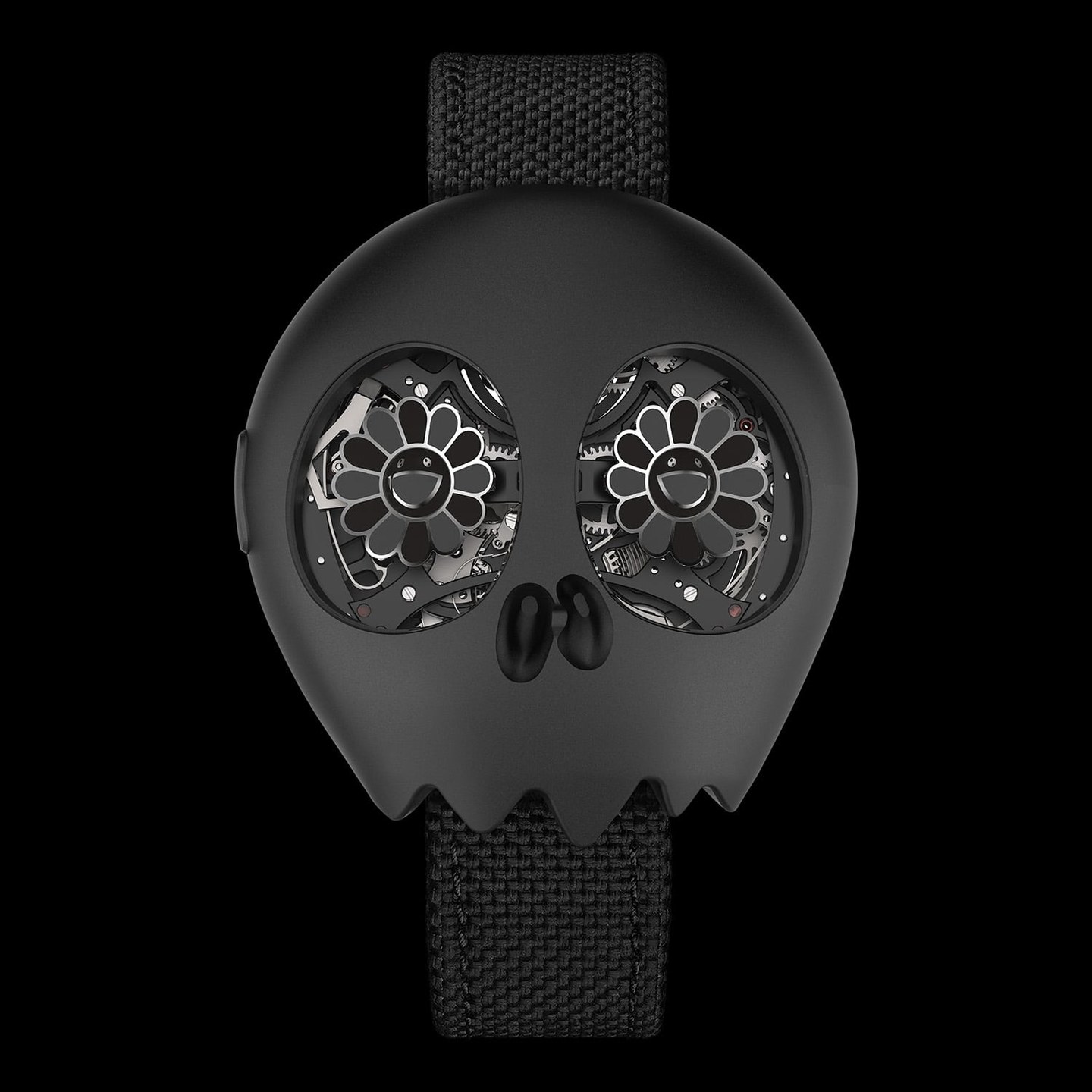
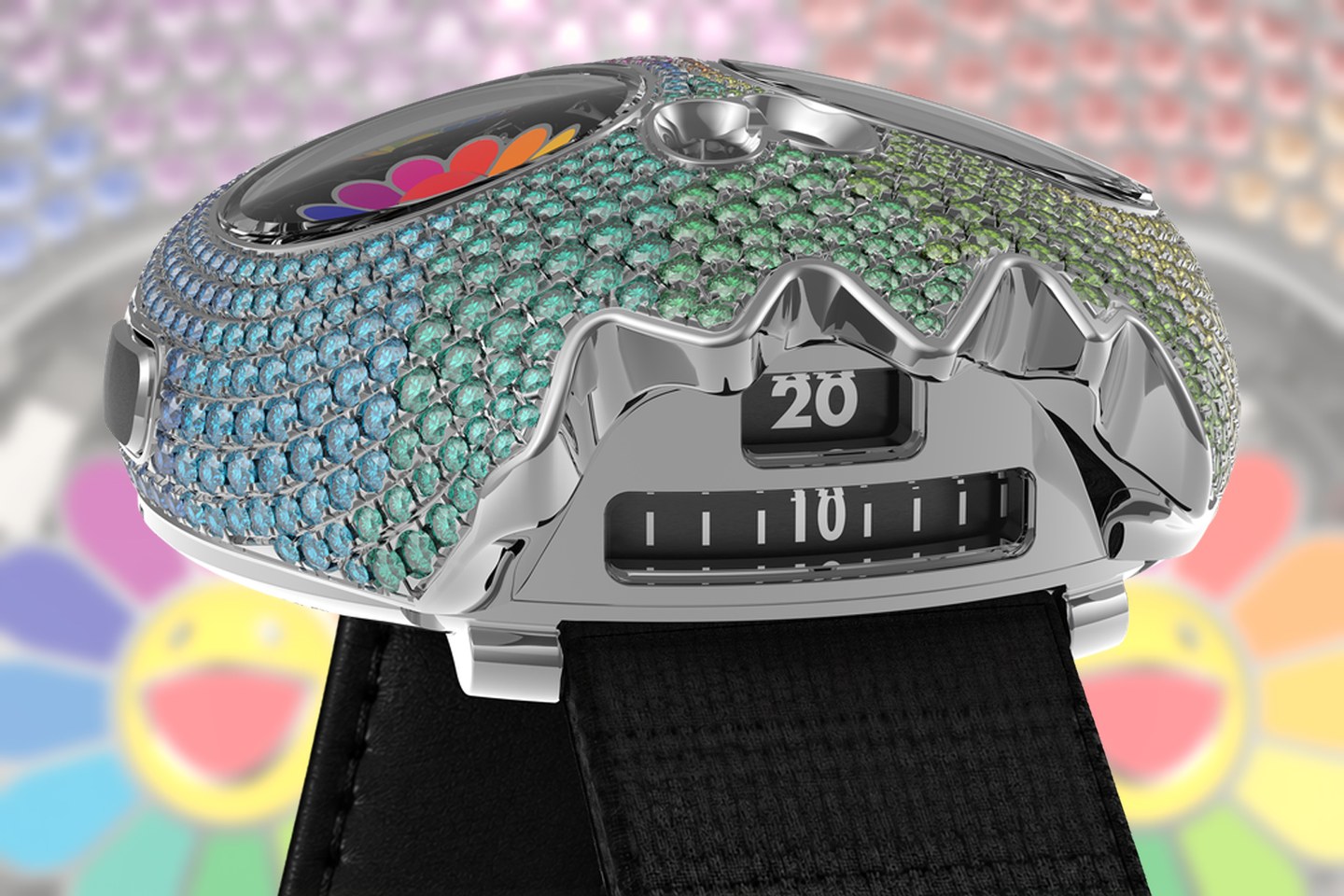
There’s no dial to read. The skull’s face is solid titanium, its eye sockets hold two of Murakami’s flowers, and the hours and minutes sit in a slot cut into the case band at six o’clock, right where the jaw meets the strap. The face you look at tells you nothing.
Murakami founded the Tokyo studio that became Kaikai Kiki in 1996 and built it into the company that produces his art, runs his galleries and develops younger artists. Skulls and smiling flowers have been paired in that work for decades, in paintings and in sculpture at gallery scale. Time Objects takes the pairing off the wall: the skull stops being a picture and becomes the case itself, with the flowers riding inside it.
Five versions exist. The two plain ones stop at 12 pieces.
The time sits in the jaw
Reading it takes a tilt of the wrist. The hours ride on a rotating cylinder behind the upper window and jump the instant the hour changes, while the minutes trail across a long disc underneath, sliding past printed marks the way a ruler moves through a slot.
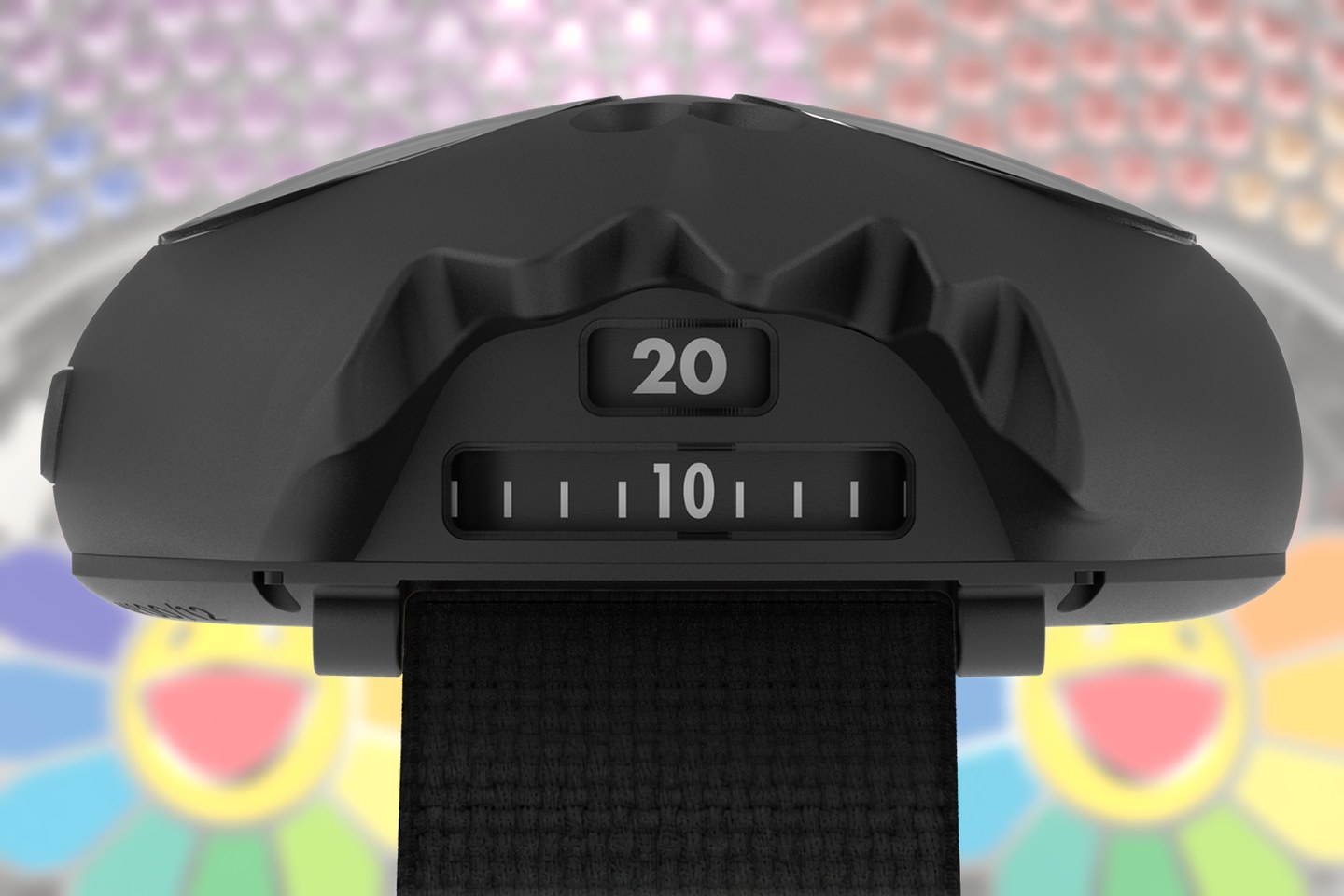
The cylinder carries the full 24 hours, so three in the afternoon gets its own numeral instead of borrowing one from the morning, and the brand bills the layout as the first cylindrical jumping-hours display built this way. The discs are black ruthenium with white decals under sapphire, and the engineering is heavier than it looks, because a cylinder wrapped in 24 hour numerals carries far more mass into each jump than a flat disc ever would.
The minutes print in tens on the disc, with single tick marks for the minutes in between, so the reading stays approximate by design, the hour exact and the minute close enough.
It’s a driver’s-watch idea pushed into sculpture. You read the time off the side of the case, or you don’t read it at all.
Flowers where the eyes go
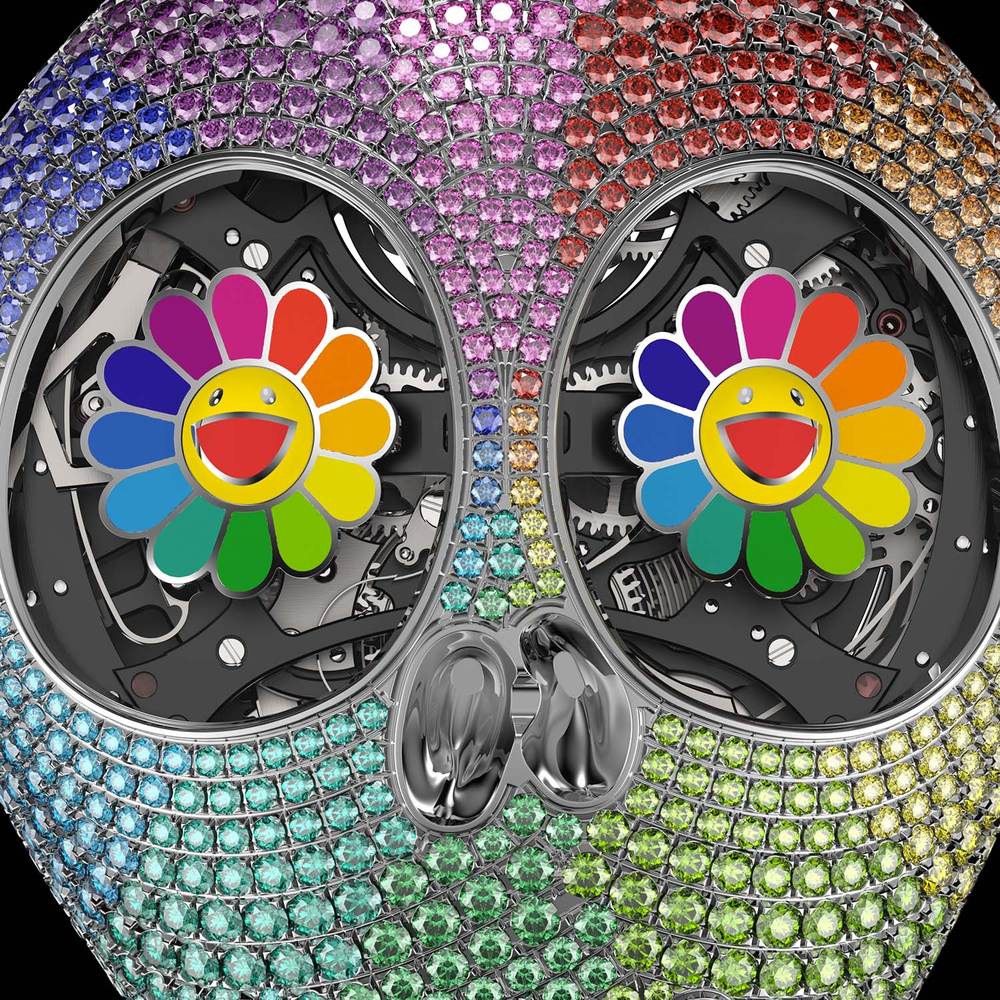
The flowers do no work at all, and they’re the first thing anyone sees. Each one sits in an eye socket under the sapphire, its petals mounted on ball bearings, free to spin as the wrist moves through the day.
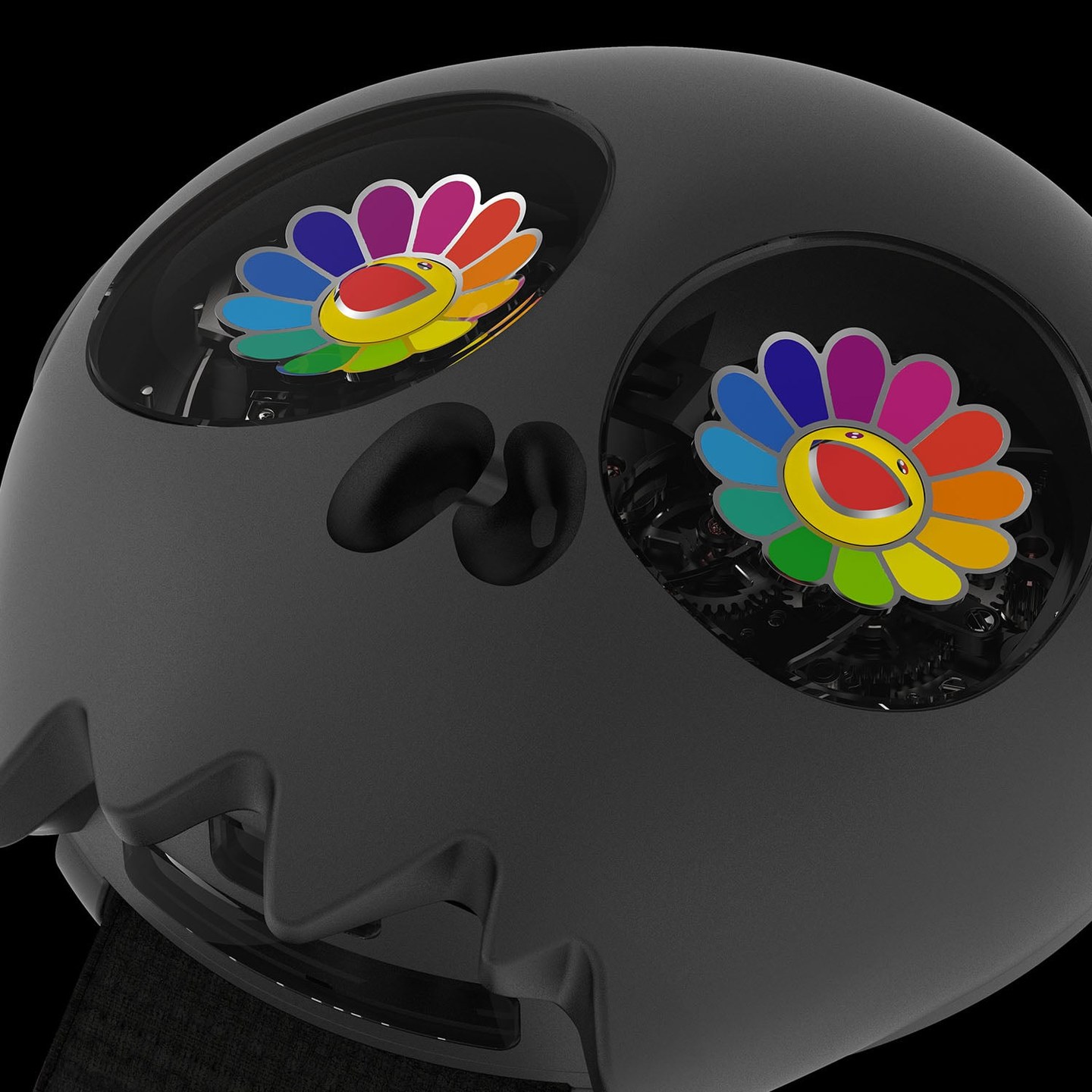
Murakami pairs skulls and flowers all through his art, life on one side and death on the other, and the brand names the philosophy behind the watch The Chronos Paradox: life and death, beauty and transience, an instant held against eternity. The case went through more than 600 skull shapes before the team settled on the final form, a 44 mm by 18.4 mm sculpture built from 33 titanium components.
Teeth are cast into the jaw line.
The tourbillon lives on the back
Flip the watch over and the movement fills the caseback. Calibre KM 7012 TM is hand-wound, built for this watch by Marco Tedeschi, whose years at Hublot included work on the Unico chronograph and who now runs Kross Studio. It packs 409 components and 81 jewels into a calibre that beats at 21,600 vibrations per hour and runs for 125 hours on a wind.
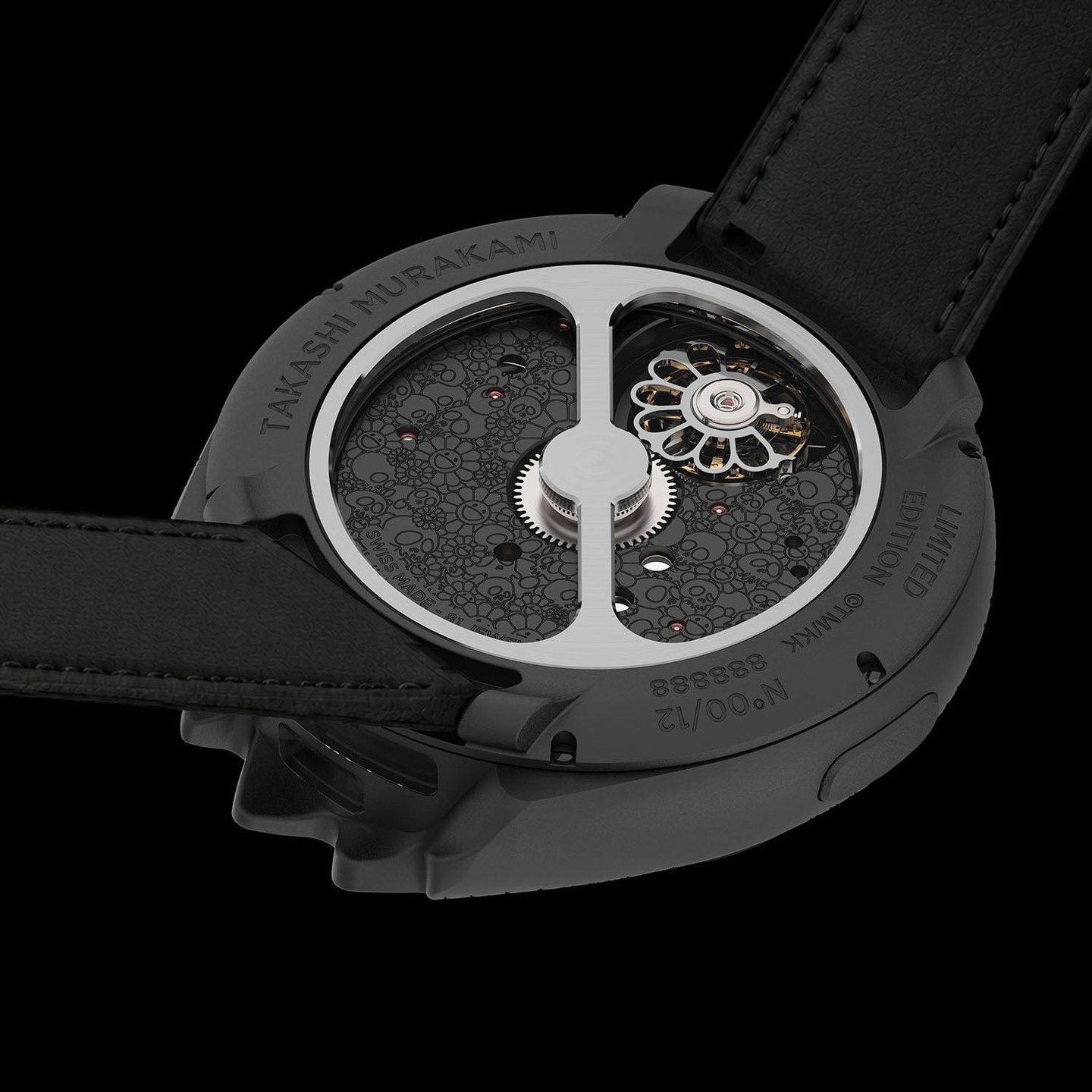
The tourbillon sits at twelve on the reverse, its cage shaped like a flower, above a darkened plate engraved with skulls and flowers repeating across the surface, the pattern running under the bridges and around the jewels until the whole back of the movement is covered in the motif.
The caseback rim carries his name and the edition number, and the winding ring’s gear sits exposed at the center of the view.
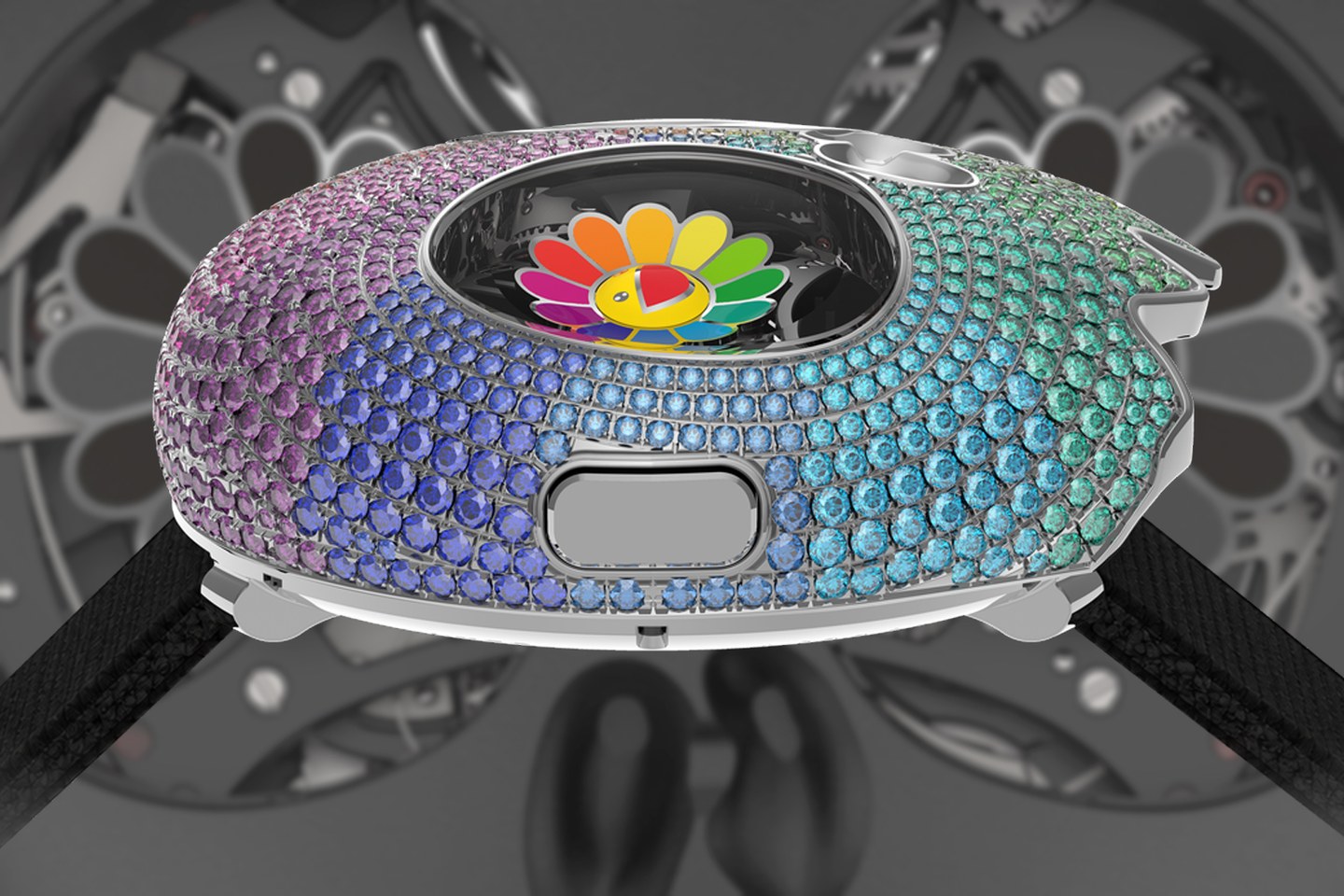
There’s no crown. Winding runs through a ring built into the caseback, and a small pusher on the left flank handles setting, so the skull’s silhouette stays unbroken.
Five versions, and the plain ones stop at 12
Black Rainbow and All Black lead the range. Both wear microblasted titanium under a black DLC coating, the rainbow flowers glowing out of the first and the flowers turned black on the second, and each edition stops at 12 numbered pieces priced at $102,400 before taxes, sold by enquiry only.
Above them sit three gem-set versions on polished titanium, every surface the black editions leave bare covered in stones. Full Pavé Rainbow runs $168,700, Full Pavé Black Diamonds $171,100 and Full Pavé Diamonds $178,300, each one carrying 744 stones totaling 9.3 carats before taxes, in a small series the brand hasn’t sized publicly.
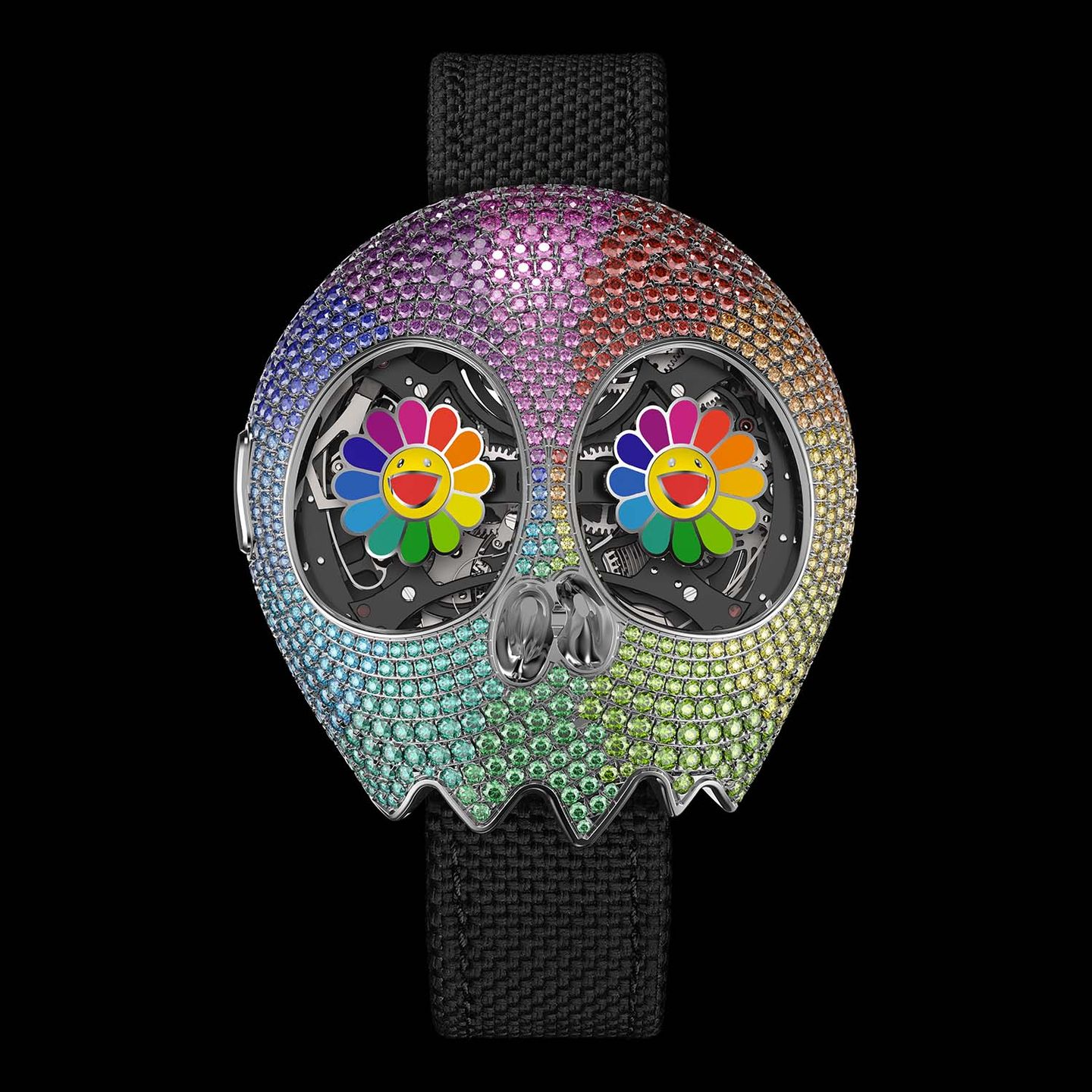
The strap is black rubber, closed by a Grade 5 titanium folding clasp shaped as a small skull, and water resistance stops at 30 meters. There’s no shop and no checkout; enquiries go to Kaikai Kiki’s watch desk at [email protected].
| Specification | Skull Flowers |
|---|---|
| References | TMSKL26-TN-RAIN (Black Rainbow) · TMSKL26-TN-ALLB (All Black) |
| Case | Sculpted skull, Grade 5 titanium, 33 components |
| Dimensions | 44 mm × 18.4 mm |
| Finishes | Microblasted black DLC (Black Rainbow, All Black) · polished, gem-set (Full Pavé) |
| Crystal | Sapphire, front and open caseback |
| Display | Cylindrical jumping hours, trailing minutes, lateral aperture at 6 o’clock |
| Movement | Calibre KM 7012 TM by Marco Tedeschi, hand-wound |
| Movement parts | 409 components, 81 jewels |
| Frequency | 21,600 vph (3 Hz) |
| Power reserve | 125 hours, about five days |
| Water resistance | 30 m |
| Strap | Black rubber, Grade 5 titanium folding clasp shaped as a skull |
| Limited editions | Black Rainbow and All Black, 12 pieces each |
| Price | $102,400 before taxes · Full Pavé $168,700 to $178,300 |
The Hublot years built the audience for this. Murakami’s flowers first spun inside a Classic Fusion in 2021, and the run peaked with the MP-15 and its central tourbillon, but those were his art on Hublot’s cases. Time Objects flips the ownership: his name on the brand, his skull as the case, a movement built around his display idea.
None of this makes telling time easier, and that trade is the offer. The 24 numbered pieces will sell to the collectors who followed the flowers through the Hublot years, buying the sculpture first. The watch comes with it.