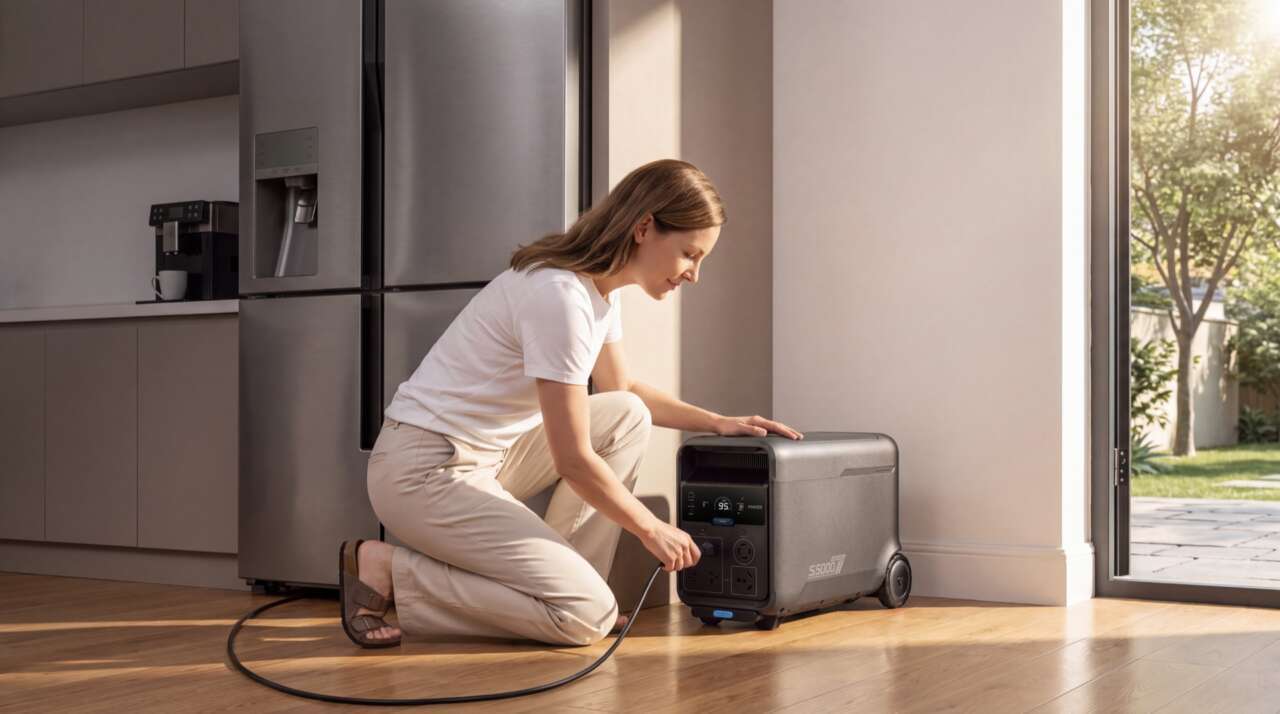
Anker’s SOLIX S5000 puts a 5,024Wh battery, 4,500W of rated output and both 120V and 240V connections into a rolling home-backup station. It’s due Oct 27, 2026 at a $2,499.99 launch price. The useful detail for a mixed-voltage setup is that its 240V output stays available while the station is charging from a 120V source.
Anker is also trying to stretch the energy already in the battery. Its OptiSave 2.0 system reduces idle consumption and improves efficiency at lighter loads, where a power station may spend much of an outage running a refrigerator, networking gear and a few lights. There’s room to build a larger system, too, with additional batteries taking capacity up to 30kWh.
Anker SOLIX S5000: Launch planned for October 27, 2026
Get S5000 launch updates
What the 120V and 240V connections can run

Anker-supplied front view showing the AC outlets, USB ports and controls.
The S5000 is rated for 4,500W continuously and up to 8,000W at peak. That combination is intended to cover ordinary household essentials and compatible higher-demand equipment such as a furnace or well pump. Compatibility still comes down to the particular appliance’s voltage, running power and startup surge; an 8,000W peak rating doesn’t establish how long that peak can be sustained.
The supplied US specifications list four NEMA 5-20 outlets, a TT-30 outlet and a 240V L14-30 connection. The TT-30 is listed at 3,600W and the L14-30 at 4,500W. The station’s overall output limit remains 4,500W, so those individual ratings shouldn’t be added together. The sheet also puts a 2,400W figure beside the four standard outlets without clearly explaining how that allowance is shared.
Small electronics get their own connections: one USB-C port is listed at up to 100W, a second at 15W, and USB-A at 12W. The different USB-C ratings are worth noticing if you’re choosing where to plug in a laptop rather than a phone.
There’s a rated 10ms UPS switchover for compatible equipment when grid power fails. Whether that transfer is suitable for a particular computer, network device or other sensitive load depends on the device’s tolerance; we haven’t tested the transition yet.
Why idle consumption changes the runtime story

Anker-supplied cutaway illustration of the S5000’s battery, electronics and cooling layout.
Battery capacity and output power answer different questions. The 5,024Wh figure describes stored energy; 4,500W describes how much power the station can supply at once. A battery running a cycling refrigerator and occasional coffee maker will last very differently from one carrying a heavy continuous load.
Anker specifies idle draw of 8.8W in 120V mode and 13.7W in 240V mode. Using those figures, a full day at the stated no-load draw would consume about 0.21kWh or 0.33kWh respectively, before powering an appliance. That overhead consumes energy when the equipment you’re backing up switches on and off.
Efficiency changes with the load as well. The release quotes up to 96% at 1,000W, while the specification sheet lists 90.5% at the full 4,500W load. The higher percentage shouldn’t be applied to every operating condition. Anker also claims 20% more runtime from OptiSave 2.0, but doesn’t identify the comparison baseline in the release.
In Anker’s testing, the S5000 ran a combination of a refrigerator, Wi-Fi router, coffee maker, lights and a phone for 48 hours. Its separate appliance tests produced up to 86 hours for a refrigerator alone and up to 25 hours for a window air conditioner.
The company also lists up to 21 days of standby in 120V mode and 14 days in 240V mode. Those standby figures don’t describe two or three weeks of running household appliances.
Anker reports a TÜV SÜD A+ Runtime rating covering usable output energy, conversion efficiency, energy retention and energy density by volume. It also describes the S5000 as the first 5kWh portable power station to earn that rating. The company separately calls it the longest-lasting in its class.
Those runtime examples, efficiency figures and rankings come from Anker’s launch materials. The appliance models, duty cycles, full comparison field and underlying A+ test report aren’t supplied, so the results shouldn’t be treated as measured endurance for your particular home.
Charging from the wall, solar or a generator
Anker lists AC, solar, vehicle, generator and mixed-source charging options. The 99-minute recharge claim has a specific requirement: a 4,500W, 240V charging source. Under that configuration, Anker lists 64 minutes to 80% and 99 minutes to full. Its ordinary 120V AC charging input is rated at 1,800W, so a standard 120V supply won’t deliver the advertised ultra-fast charging rate.
The same distinction applies while using the station. The 240V output can remain active during 120V charging, but a sufficiently heavy connected load can still draw down the battery faster than the lower-powered source replenishes it.

Anker-supplied image showing the S5000 connected to wall power.
Solar input is rated at 3,000W total, split between 2,000W and 1,000W inputs in the specification sheet. Reaching that maximum depends on a compatible panel setup and available sunlight; it isn’t a promise that the panels shown in a promotional image will provide 3,000W.

Anker-supplied image of the S5000 with solar panels.
There’s also a dedicated input for an Anker SOLIX Smart Generator, plus support for third-party generator bypass. The published bypass limits are 1,800W with a 120V generator input and 4,500W with a 240V input. As with wall charging, the source voltage and mode affect what the setup can deliver.
Portable enough to roll, substantial enough to plan around
At 97 pounds, the S5000 is a heavy piece of equipment. Wheels and a telescoping handle should help on level floors, but stairs and vehicle loading remain a different proposition. The body is roughly 22 inches long, 11 inches wide and 15 inches tall, with a stated volume of 58 liters. Anker’s documents differ slightly on the exact dimensions, which is worth resolving if you’re fitting it into a tight space.
The company describes it as 28% lighter and 45% smaller by volume than selected competing 5kWh-class models. The comparison applies to Anker’s selected models and doesn’t establish a universal smallest-or-lightest ranking.
Expansion to 30kWh gives the system a way to carry more stored energy for longer outages. Anker hasn’t supplied expansion-battery pricing in this announcement, so the cost of a full-size setup is still an open question. The larger capacity figure shouldn’t be read as a higher output-power rating.

Anker-supplied image of the S5000 with additional battery packs. Expansion pricing is not included in the announcement.
For a home where a smaller battery is enough for phones, networking and a short outage, the S5000’s weight and capacity may be more than the job needs. Its more distinctive use is backing up a broader set of essentials, including a compatible 240V load, while keeping the option to add storage.
Battery life, safety claims and the warranty
The S5000 uses 314Ah lithium iron phosphate cells. Anker rates them for up to 10,000 cycles and describes an estimated service life of up to 15 years under specified conditions. The release doesn’t state the retained-capacity threshold or cycling conditions behind those figures, so they need more context before making a like-for-like longevity comparison. Standard warranty coverage is five years.
Anker says the system is UL 9540 certified and has been tested in accordance with UL 9540A. Those are distinct claims: UL describes UL 9540 as the basis for energy-storage-system product certification, while UL 9540A evaluates behavior during thermal runaway and fire propagation. The S5000-specific certification and test report haven’t been independently checked here; neither statement establishes an absolute fireproof guarantee.
A noise figure below 30dB is also quoted under specified conditions, without the operating load or measurement distance. Noise with the loads you’re actually running remains a hands-on question.
Launch price and the signup offer
Anker says the SOLIX S5000 will be available Oct 27, 2026 through its website and Amazon at a $2,499.99 launch price, with a $3,599.99 MSRP.
The bonus offer has two separate steps: sign up through Anker’s website from Oct 9, 2026 through Oct 26, 2026, then purchase the S5000 from Oct 27, 2026 through Nov 9, 2026. Anker says qualifying buyers receive a two-year warranty extension, an Anker Prime Charging Station and an Anker SOLIX Smart Generator DC Charging Cable. The company values that bundle at $699; terms and availability apply.
Anker SOLIX S5000: Launch planned for October 27, 2026
Get S5000 launch updates
An available alternative: Anker SOLIX F3800
If you need a comparable home-backup station before the S5000 launches, the Anker SOLIX F3800 is available on Amazon. This separate model has 3,840Wh of capacity and 6,000W of output with 120V and 240V connections. It holds less energy than the S5000 but has a higher rated output. Unlike the S5000, its 240V output cannot be used while it charges from 120V AC.
Related alternative: Anker SOLIX F3800, standalone power station
Price: $1,979.99 at the October 9 check
Where to buy: Check F3800 price on Amazon