QIDI’s MakeBuddy Smart5 is a fully enclosed 3D printer built for family rooms instead of workbenches, with an AI camera, automatic bed leveling and an app that turns phone photos into printable models. It sells for $349.
MakeBuddy Smart5 AI 3D Printer
Fully enclosed CoreXY · 180 by 180 by 180 mm build volume · AI photo-to-3D, auto leveling and a 1080P camera
Price: $349
Where to buy: Buy on Amazon
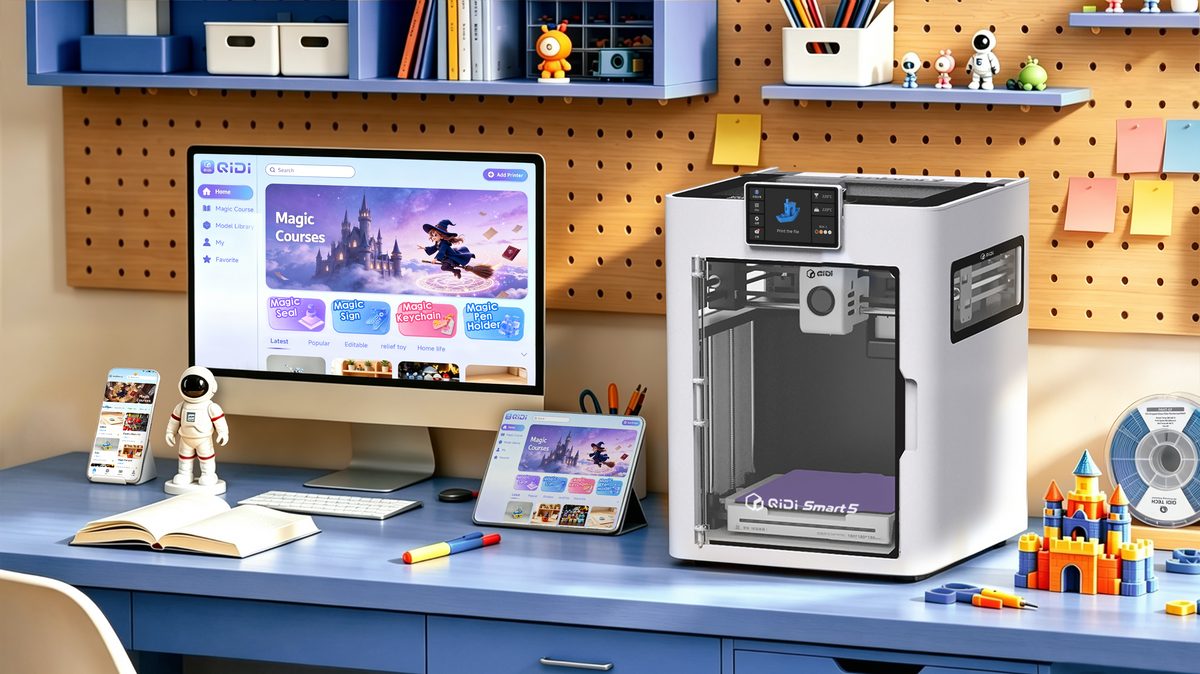
QIDI built the Smart5 on its Joy platform, which pairs a library of ready-to-print models with instructor-led STEAM courses and beginner tutorials inside one app.
A child picks a model, taps print, and the machine handles leveling, calibration and the print itself while the camera feed runs in the app. Parents get the supervision tools, and kids get a first print on day one without a parent learning slicer software first.
QIDI launched the Smart5 on November 10, and it arrived inside the company’s Black Friday sale window, which runs in the US from November 2 through December 6 on the company’s own sale calendar. The $349 price holds at both the QIDI store and Amazon while that window stays open, so the gift-season timing is deliberate rather than accidental.
A photo goes in and a figure comes out
The AI Image-to-3D tool takes a photo or a drawing and builds a personalized 3D model from it, so a kid’s sketch of the family dog becomes a figure the printer can actually make. There’s no modeling software to learn first, and no parent translating a child’s idea into CAD at the kitchen table.
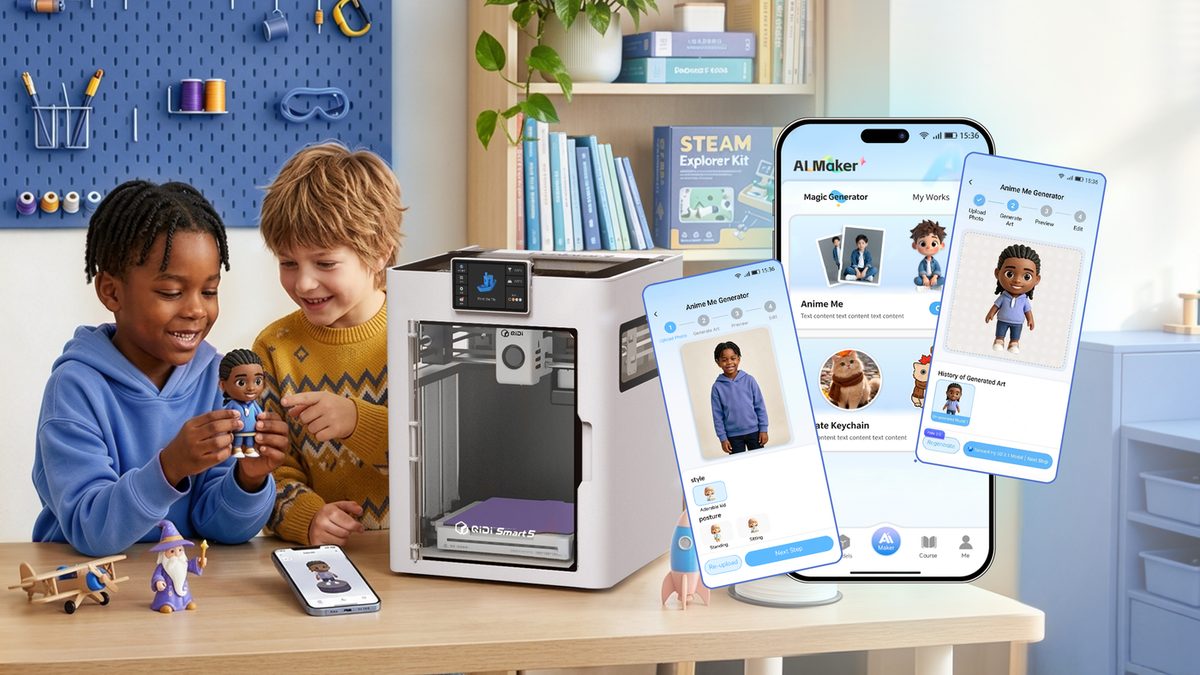
The library fills the gaps between original ideas. Ready models cover toys, decorations, school projects and gifts, and the STEAM courses turn a Saturday print into a small engineering lesson with video guidance.
Control runs three ways, through the 4-inch touchscreen that tilts to 90 degrees, through the QIDI Joy app on a phone or tablet, and through a PC. The built-in camera records a timelapse of every print, so a finished model arrives with its own short film.
The enclosure is the parent feature
Smart5 prints inside a closed chamber with flame-retardant structure, and that single design choice keeps hot parts and moving gantries away from small hands and curious pets. QIDI’s own product photo puts a cat at the glass with a paw raised, and the door is exactly why that photo works as a joke instead of a warning. Parents read that spec first.
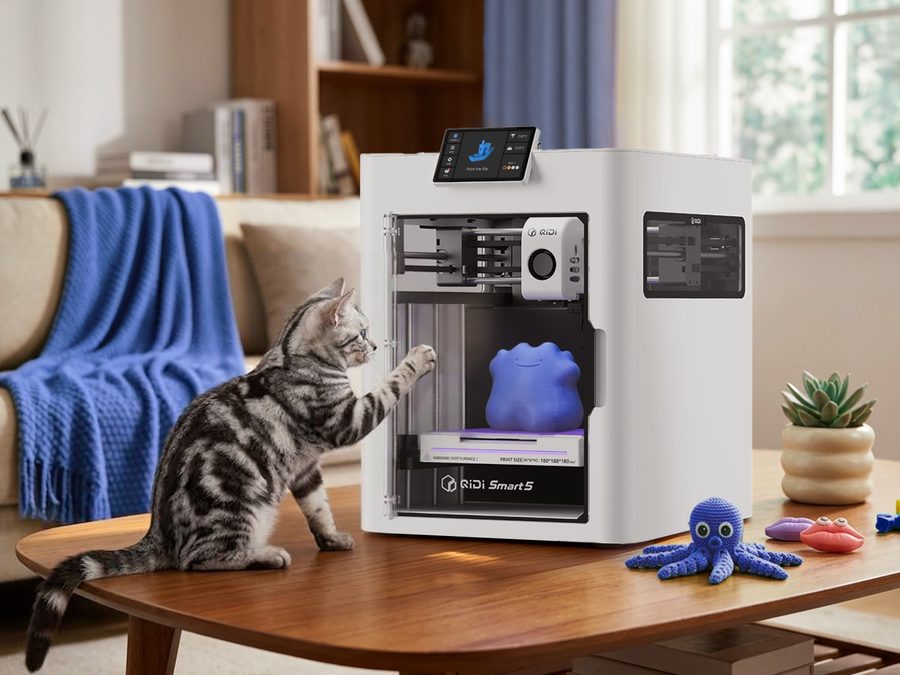
Air moves through a three-stage filter stack, G3 pre-filter first, then an H12 HEPA layer and activated carbon, and QIDI rates the system at capturing 99.5% of dust and particles inside the chamber before the air reaches the room. Odors drop with the particles, which is the difference between a printer that lives in a study and one that gets banished to the garage.
The enclosure also keeps noise contained, and QIDI built the machine at 10 kg with a 322 by 344 by 410 mm footprint, so it sits on a desk without claiming the surface. A status light strip on the bed shows print state from across the room. Garage banishment is a real risk.
Filtration sells this machine to parents.
Real printer hardware under the friendly shell
A CoreXY system sits under the shell, rated at 600 mm/s with a 180 by 180 by 180 mm build volume. That’s full-size printer architecture, scaled down. The hotend reaches 300°C, the bed 80°C, acceleration peaks at 20,000 mm/s², and leveling runs off a loadcell sensor with no knobs.
QIDI’s own benchmark prints the test boat in 13 minutes, and QIDI states plainly on the maker page that actual print time varies with filament, model shape and settings. Speed still helps at family scale, since a small toy finishes inside one homework session instead of running overnight while everyone sleeps.
| Spec | Detail |
|---|---|
| Build volume | 180 x 180 x 180 mm |
| Max toolhead speed | 600 mm/s |
| Acceleration | 20,000 mm/s² |
| Nozzle | 0.4 mm |
| Hotend max | 300°C |
| Bed max | 80°C |
| Display | 4 inch, 800 x 480 touch |
| Storage | 32 GB |
| Weight | 10 kg |
| Footprint | 322 x 344 x 410 mm |
| Filament | PLA, PETG |
| Connectivity | Wi-Fi 2.4/5 GHz, USB |
The trade runs like this: the enclosure, filtration and automation cost some freedom, since Smart5 prints PLA and PETG in a single color out of the box, and multi-color work needs the optional QIDI Box add-on. Families gain a machine a child can run safely at the table, and hobbyists lose the open frame, exotic filaments and endless tuning they actually enjoy.
Four spools and two maker kits ride in the box
The standard box carries the printer, a build plate, four 250 g spools of PLA filament and a combined LED light and clock maker kit, plus the tools and a quick start guide. QIDI sells three bundle steps above the standard machine: an accessories bundle at $369, an Advanced PLA bundle at $379 and the Advanced PLA Bundle Pro at $399.
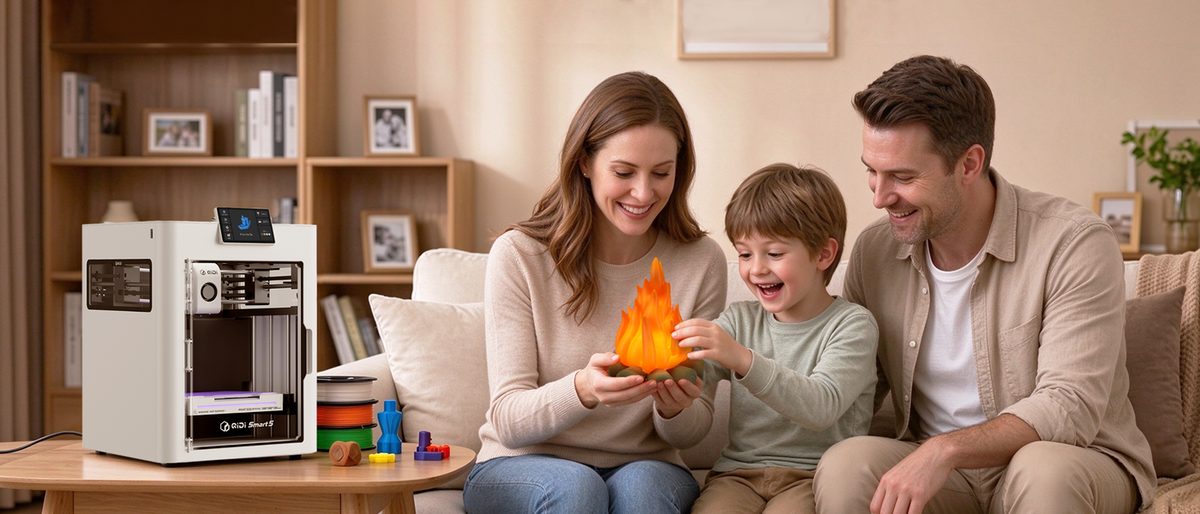
The first STEAM projects are a campfire lamp and a desk clock, both built around printed parts, so the learning starts with objects a kid can put on a shelf. Both kits ride inside the standard box, with course videos walking each build. Assembly becomes the activity.
MakeBuddy Smart5 AI 3D Printer
Fully enclosed CoreXY · 180 by 180 by 180 mm build volume · AI photo-to-3D, auto leveling and a 1080P camera
Price: $349
Where to buy: Buy on Amazon
Buy the Smart5 at $349 if your household wants a first printer a child can run today, with courses, filament and safety hardware already in the box. Skip it if the goal is big parts, engineering filaments or multi-color prints from day one, since a larger open machine serves that work better at this money.
For a holiday gift that gets built with, this is the one to wrap.